Brand Audit Report: Analysis of House of Fraser's Brand Management
VerifiedAdded on 2020/06/06
|11
|3537
|94
Report
AI Summary
This report presents a comprehensive brand audit of House of Fraser, a departmental store operating in the UK and Ireland. It analyzes the brand's performance using the Customer-Based Brand Equity (CBBE) model, examining brand identity, meaning, response, and resonance. The report explores the importance of branding, its value to consumers and society, and the factors contributing to House of Fraser's decline, including economic downturns and competition from rivals. The audit includes market, company, competitor, and customer insights. The report also highlights the impact of e-commerce, integrated brand communication, and financial performance on the brand's position. It concludes by discussing the challenges and opportunities for House of Fraser to improve its brand equity and resonate with its target audience.
STRATEGIC
BRAND
MANAGEMENT
BRAND
MANAGEMENT

Paraphrase This Document
Need a fresh take? Get an instant paraphrase of this document with our AI Paraphraser
Table of Contents
INTRODUCTION...........................................................................................................................1
Importance of brand and its value to consumers and society.................................................1
Brand Audit of House of Fraser.............................................................................................2
Level 1- Brand Identity....................................................................................................................3
Level 2- Brand Meaning..................................................................................................................4
Level 3- Brand Response.................................................................................................................4
Level 4- Brand Resonance...............................................................................................................5
CONCLUSION................................................................................................................................6
RECOMMENDATIONS.................................................................................................................6
REFERENCES................................................................................................................................8
INTRODUCTION...........................................................................................................................1
Importance of brand and its value to consumers and society.................................................1
Brand Audit of House of Fraser.............................................................................................2
Level 1- Brand Identity....................................................................................................................3
Level 2- Brand Meaning..................................................................................................................4
Level 3- Brand Response.................................................................................................................4
Level 4- Brand Resonance...............................................................................................................5
CONCLUSION................................................................................................................................6
RECOMMENDATIONS.................................................................................................................6
REFERENCES................................................................................................................................8

⊘ This is a preview!⊘
Do you want full access?
Subscribe today to unlock all pages.

Trusted by 1+ million students worldwide
INTRODUCTION
Strategic brand management refers to the process by which a company aims to manage its
brand image through preparation of innovative policies. This procedure includes several factors
like planning, implementing and controlling marketing programmes to manage brand equity. It is
important for an enterprise to follow certain essential steps like determining and evaluating brand
position, devising appropriate policies and then applying them in marketing activities (Williams
Jr and Omar, 2014). For this, an organisation conducts brand audit which is a process carried out
to gain an insight into the current state of a brand and offer possible recommendations to enhance
this position in future context. The present report is based on brand audit of House of Fraser that
is a departmental store having outlets spread across Ireland and UK. Also, it includes a
comprehensive research around the brand to capture the relevant aspects related to the company.
Importance of brand and its value to consumers and society
A brand is the wholesome experience driven by customers or society that differentiates
the products or services rendered by an organisation from its rivals in the eyes of people. Brand
is a popular term in business, advertising and marketing which seeks to represent the image of
any product or company within the marketplace. In modern world, people are surrounded by a
number of brands which they utilise or experience in a routine manner in their daily lives (Keller
and Brexendorf, 2017). In this regard, House of Fraser wanted the customers to have an
exceptional time coming to the brand stores due to the enjoyable experience they derive within
the store. They possessed the belief that this form of customer service would lure a large number
of people to visit the stores on a daily basis just to have the quality experience. Also, company
regarded this as the stepping stone to building a strong brand image and position in market such
that they could instil a sense of loyalty and trust among customers. Further, this company kept on
increasing the range of beauty products to captivate consumers of all age groups and retain them
for a longer time. House of Fraser also provided big size advertising posters for newly
refurbished outlets so as to have a massive impact upon people.
Yet, contrary to all the efforts of company, the brand name and position of HOF declined
severely which caused significant fall in revenues as well as profits. This initiated with economic
collapse of financial markets from 2008. With continuous recession, families within global
markets began tightening their budget and looked for cheaper alternatives from competitors such
1
Strategic brand management refers to the process by which a company aims to manage its
brand image through preparation of innovative policies. This procedure includes several factors
like planning, implementing and controlling marketing programmes to manage brand equity. It is
important for an enterprise to follow certain essential steps like determining and evaluating brand
position, devising appropriate policies and then applying them in marketing activities (Williams
Jr and Omar, 2014). For this, an organisation conducts brand audit which is a process carried out
to gain an insight into the current state of a brand and offer possible recommendations to enhance
this position in future context. The present report is based on brand audit of House of Fraser that
is a departmental store having outlets spread across Ireland and UK. Also, it includes a
comprehensive research around the brand to capture the relevant aspects related to the company.
Importance of brand and its value to consumers and society
A brand is the wholesome experience driven by customers or society that differentiates
the products or services rendered by an organisation from its rivals in the eyes of people. Brand
is a popular term in business, advertising and marketing which seeks to represent the image of
any product or company within the marketplace. In modern world, people are surrounded by a
number of brands which they utilise or experience in a routine manner in their daily lives (Keller
and Brexendorf, 2017). In this regard, House of Fraser wanted the customers to have an
exceptional time coming to the brand stores due to the enjoyable experience they derive within
the store. They possessed the belief that this form of customer service would lure a large number
of people to visit the stores on a daily basis just to have the quality experience. Also, company
regarded this as the stepping stone to building a strong brand image and position in market such
that they could instil a sense of loyalty and trust among customers. Further, this company kept on
increasing the range of beauty products to captivate consumers of all age groups and retain them
for a longer time. House of Fraser also provided big size advertising posters for newly
refurbished outlets so as to have a massive impact upon people.
Yet, contrary to all the efforts of company, the brand name and position of HOF declined
severely which caused significant fall in revenues as well as profits. This initiated with economic
collapse of financial markets from 2008. With continuous recession, families within global
markets began tightening their budget and looked for cheaper alternatives from competitors such
1
Paraphrase This Document
Need a fresh take? Get an instant paraphrase of this document with our AI Paraphraser
as ASDA and Sainsbury's which operated at lower market end. The condition of organisation
worsened with the upcoming years. Consequently, the enterprise signed a Complete Voluntary
Agreement (CVA) with creditors in 2018 to assure that HOF would pay off their debts over a
fixed time period (House of Fraser: What went wrong?, 2019).
Brand Audit of House of Fraser
Brand Audit is a tool that helps to identify the strength and opportunities associated with
brand that can be enhanced to increase customer satisfaction as well as take into account the
shortcomings that have to be worked upon in order to build a strong brand name and position in
marketplace. This gains an insight into the complete product-line of company and also ascertains
the ways in which business makes its offerings accessible to customers. Further, it includes a
deep study of company’s rivals to provide suggestions upon ways in which brand image and
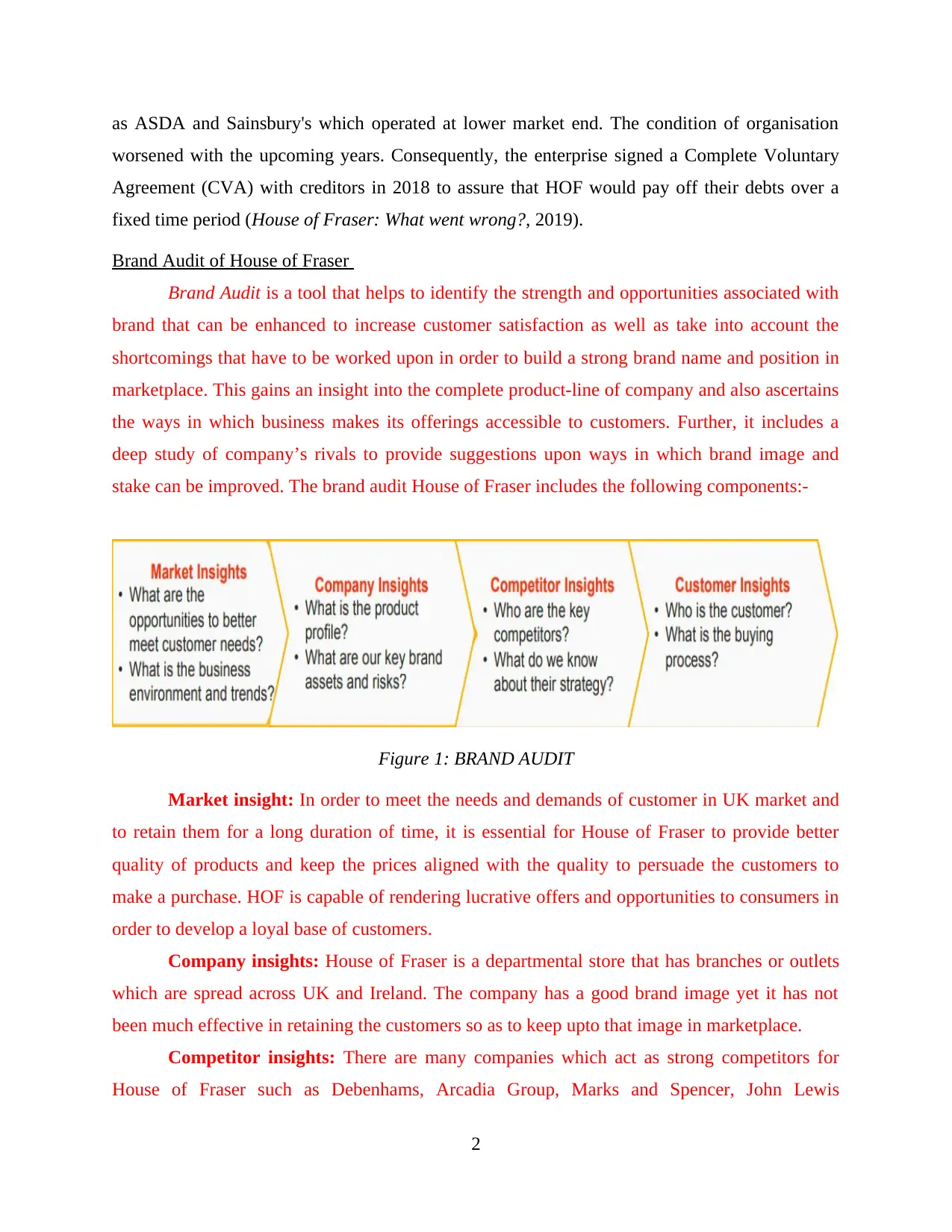
stake can be improved. The brand audit House of Fraser includes the following components:-
Figure 1: BRAND AUDIT
Market insight: In order to meet the needs and demands of customer in UK market and
to retain them for a long duration of time, it is essential for House of Fraser to provide better
quality of products and keep the prices aligned with the quality to persuade the customers to
make a purchase. HOF is capable of rendering lucrative offers and opportunities to consumers in
order to develop a loyal base of customers.
Company insights: House of Fraser is a departmental store that has branches or outlets
which are spread across UK and Ireland. The company has a good brand image yet it has not
been much effective in retaining the customers so as to keep upto that image in marketplace.
Competitor insights: There are many companies which act as strong competitors for
House of Fraser such as Debenhams, Arcadia Group, Marks and Spencer, John Lewis
2
worsened with the upcoming years. Consequently, the enterprise signed a Complete Voluntary
Agreement (CVA) with creditors in 2018 to assure that HOF would pay off their debts over a
fixed time period (House of Fraser: What went wrong?, 2019).
Brand Audit of House of Fraser
Brand Audit is a tool that helps to identify the strength and opportunities associated with
brand that can be enhanced to increase customer satisfaction as well as take into account the
shortcomings that have to be worked upon in order to build a strong brand name and position in
marketplace. This gains an insight into the complete product-line of company and also ascertains
the ways in which business makes its offerings accessible to customers. Further, it includes a
deep study of company’s rivals to provide suggestions upon ways in which brand image and
stake can be improved. The brand audit House of Fraser includes the following components:-
Figure 1: BRAND AUDIT
Market insight: In order to meet the needs and demands of customer in UK market and
to retain them for a long duration of time, it is essential for House of Fraser to provide better
quality of products and keep the prices aligned with the quality to persuade the customers to
make a purchase. HOF is capable of rendering lucrative offers and opportunities to consumers in
order to develop a loyal base of customers.
Company insights: House of Fraser is a departmental store that has branches or outlets
which are spread across UK and Ireland. The company has a good brand image yet it has not
been much effective in retaining the customers so as to keep upto that image in marketplace.
Competitor insights: There are many companies which act as strong competitors for
House of Fraser such as Debenhams, Arcadia Group, Marks and Spencer, John Lewis
2
Partnership, Burberry Group, Laura Ashley Holdings. Consumers prefer buying goods from
these brands due to high quality products and optimal pricing strategy of these entities.
Customer insights: The target customer group of House of Fraser is millennial. They
mainly target A/B class of people and a certain proportion of upper middle class. Yet the loyal
customer base of this brand contains a very small portion of UK population.
The brand audit of House of Fraser is further carried out through implementation of
Customer Brand Based Equity Model which is abbreviated as CBBE. It is a model which is
helpful in building brand equity by analysing people of UK so that more and more investment
could be made to develop effective strategies (Dev and Keller, 2014). Such strategies tend to
build a reliable brand image of House of Fraser among customers to retain them for a long
duration of time in future. CBBE model is explained in context of HOF below:-
Level 1- Brand Identity
This level of CBBE model attempts to identify perception of people towards House of
Fraser. The brand identity of any product takes place when the audience is totally aware about
the organisation as a destination for shopping. It can be considered as the foundation upon which
the brand is built. It can be said that House of Fraser has always been willing to offer an
enjoyable in-store experience for customers. Yet many public posts displaying the willingness of
company to shut its maximum stores and relocate the others have shaken the confidence of
customers. Yet, the old customers of the brand are still attached to the enterprise and willing to
purchase products from them.
But this quantum of people is diminishing day-by-day. This has led to massive decline of
this brand in market thereby affecting the purchase behaviour of consumers. People have now
begun to shift to substitute brands like ASDA, ALDI, LIDL, Sainsbury's. House of Fraser now
enjoy a much lower proportion of adults buying from their departmental stores. This implies the
worsening position of the brand in market against rivals like Debenhams and John Lewis which
have half the number of outlets as House of Fraser (Liu, Liu and Lin, 2015). Customers who give
priority to quality and price or are brand conscious are not willing to turn into HOF outlets. The
people who are still purchasing their products are from A/B class. The organisation also
possesses fair proportion of lower class customers. Yet the shift of customers towards other
brands as well as lack of initiative from company to invest in refurbishment of stores have led to
3
these brands due to high quality products and optimal pricing strategy of these entities.
Customer insights: The target customer group of House of Fraser is millennial. They
mainly target A/B class of people and a certain proportion of upper middle class. Yet the loyal
customer base of this brand contains a very small portion of UK population.
The brand audit of House of Fraser is further carried out through implementation of
Customer Brand Based Equity Model which is abbreviated as CBBE. It is a model which is
helpful in building brand equity by analysing people of UK so that more and more investment
could be made to develop effective strategies (Dev and Keller, 2014). Such strategies tend to
build a reliable brand image of House of Fraser among customers to retain them for a long
duration of time in future. CBBE model is explained in context of HOF below:-
Level 1- Brand Identity
This level of CBBE model attempts to identify perception of people towards House of
Fraser. The brand identity of any product takes place when the audience is totally aware about
the organisation as a destination for shopping. It can be considered as the foundation upon which
the brand is built. It can be said that House of Fraser has always been willing to offer an
enjoyable in-store experience for customers. Yet many public posts displaying the willingness of
company to shut its maximum stores and relocate the others have shaken the confidence of
customers. Yet, the old customers of the brand are still attached to the enterprise and willing to
purchase products from them.
But this quantum of people is diminishing day-by-day. This has led to massive decline of
this brand in market thereby affecting the purchase behaviour of consumers. People have now
begun to shift to substitute brands like ASDA, ALDI, LIDL, Sainsbury's. House of Fraser now
enjoy a much lower proportion of adults buying from their departmental stores. This implies the
worsening position of the brand in market against rivals like Debenhams and John Lewis which
have half the number of outlets as House of Fraser (Liu, Liu and Lin, 2015). Customers who give
priority to quality and price or are brand conscious are not willing to turn into HOF outlets. The
people who are still purchasing their products are from A/B class. The organisation also
possesses fair proportion of lower class customers. Yet the shift of customers towards other
brands as well as lack of initiative from company to invest in refurbishment of stores have led to
3
⊘ This is a preview!⊘
Do you want full access?
Subscribe today to unlock all pages.
Trusted by 1+ million students worldwide
shrink in market share as well as fall in profits (Williams Jr and Omar, 2014). This has
compelled the company to continuously keep on closing HOF stores across UK.
Level 2- Brand Meaning
This level focuses upon the act of getting to know more about the brand so that a
familiarity with House of Fraser is established in marketplace. This level reflects that once the
customer is acquainted with the product, they are willing to gather more details about the same.
The factor of reliability is established with House of Fraser only by way of collecting additional
information which is valid and relevant. This includes elements such as exchange rate, market
size, market potential, regulation and subsidies which are to be provided to investors for getting
assistance in establishing a connect with customers (Baumgarth, Kaluza and Lohrisch, 2016).
The performance of this company in UK market is evaluated overtime so that features of trust
and reliability could be established. The experiences of existing investors could be taken into
account so that brand personality could be developed. For a business to become successful in
market, it is necessary that the brand is valued among customers in market and its share in
marketplace keeps on expanding over years.
In this regard, House of Fraser failed to embrace the rise of e-commerce within retail
industry. It is acknowledged that convenience of online deliveries at a rapid pace and the ease
with which customers can incur money online was ignored by House of Fraser for a long
duration of time. At present, one-fifth of UK retail business is carried out online and this
proportion is expected to grow more in upcoming years. The brick-and-mortar stores of House of
Fraser have not been successful in building connect with clients. Further, the whole process of
integrated brand communication was ignored by enterprise. This process refers to the planning
process related to the consistency as well as relevance of brand strategy of company inclusive of
all points of contact to get connected with potential customers (Gerakos and Syverson, 2015).
The brand audit of House of Fraser thus revealed that there was highly ineffective
communication of the enterprise with target audience which led to the fall of company within
UK marketplace.
Level 3- Brand Response
This level of CBBE model is concerned with the response of existing investors which can
be categorised on the basis of their judgement and feelings. The positive response for House of
4
compelled the company to continuously keep on closing HOF stores across UK.
Level 2- Brand Meaning
This level focuses upon the act of getting to know more about the brand so that a
familiarity with House of Fraser is established in marketplace. This level reflects that once the
customer is acquainted with the product, they are willing to gather more details about the same.
The factor of reliability is established with House of Fraser only by way of collecting additional
information which is valid and relevant. This includes elements such as exchange rate, market
size, market potential, regulation and subsidies which are to be provided to investors for getting
assistance in establishing a connect with customers (Baumgarth, Kaluza and Lohrisch, 2016).
The performance of this company in UK market is evaluated overtime so that features of trust
and reliability could be established. The experiences of existing investors could be taken into
account so that brand personality could be developed. For a business to become successful in
market, it is necessary that the brand is valued among customers in market and its share in
marketplace keeps on expanding over years.
In this regard, House of Fraser failed to embrace the rise of e-commerce within retail
industry. It is acknowledged that convenience of online deliveries at a rapid pace and the ease
with which customers can incur money online was ignored by House of Fraser for a long
duration of time. At present, one-fifth of UK retail business is carried out online and this
proportion is expected to grow more in upcoming years. The brick-and-mortar stores of House of
Fraser have not been successful in building connect with clients. Further, the whole process of
integrated brand communication was ignored by enterprise. This process refers to the planning
process related to the consistency as well as relevance of brand strategy of company inclusive of
all points of contact to get connected with potential customers (Gerakos and Syverson, 2015).
The brand audit of House of Fraser thus revealed that there was highly ineffective
communication of the enterprise with target audience which led to the fall of company within
UK marketplace.
Level 3- Brand Response
This level of CBBE model is concerned with the response of existing investors which can
be categorised on the basis of their judgement and feelings. The positive response for House of
4
Paraphrase This Document
Need a fresh take? Get an instant paraphrase of this document with our AI Paraphraser
Fraser is being achieved through availing a quantum of return on their investment. It has been
ascertained that higher amount of feeling associated with judgement is helpful in formulation of
positive outlook of the brand (Seddon, J., 2015). In context of UK, there should be minimum
number of judgements so that positive brand equity can be formed. The people who have
invested in the market of UK have been satisfied with the amount of returns which is being
availed by them.
The retailer has been continuously suffering from issues associated with cash flows. As
per 'Management Today', company's cash and cash equivalents significantly reduced from
£125.4m in January 2016 to £72.9m in January 2017 and then to even lower C&CE
approximating to £7.4m in January 2018. Further, the company went through a loss of £44m loss
in 2017 which largely indicates the lack of healthy and effective relationship with customers
(House of Fraser: What went wrong?, 2019). It appeared as if House of Fraser was about to get a
much needed cash injection from C. Banner, Chinese owner of Hamley’s. C. Banner showed the
willingness to buy a controlling stake in House of Fraser Group for a sum total of £70 million.
However, when their share prices themselves declined by 70%, C. Banner took their hands out of
the plan and stated that it was “impractical and inadvisable” to further continue with the deal.
This reflected that the brand response was ineffective and this was yet another reason that
fostered the organisation to close maximum of its stores, refurbish some and relocate the
remaining ones (Han, Nguyen and Lee, 2015).
Level 4- Brand Resonance
It is very crucial for House of Fraser to reach this level in terms of brand equity as very
few are able to achieve this level in the CBBE pyramid. By keeping a review of this, HOF will
be able to ensure that the investors who have been part of this brand over so many years connect
on the social and psychological grounds with the enterprise. The resonance can be broken down
on the basis of numerous segments, the most crucial of these which is loyalty (Boone, Khurana
and Raman, 2014). This element reflects that customers who have a liking towards the brand will
show repetition in their purchase behaviour and will continuously keep on investing in House of
Fraser repeatedly. This level of CBBE model emphasizes upon the necessity of building a sense
of attachment with customers. There is a dire requirement from House of Fraser not just to invest
in enhancing the customer service but also encourage people around to be a part of the overall
culture and experience of House of Fraser.
5
ascertained that higher amount of feeling associated with judgement is helpful in formulation of
positive outlook of the brand (Seddon, J., 2015). In context of UK, there should be minimum
number of judgements so that positive brand equity can be formed. The people who have
invested in the market of UK have been satisfied with the amount of returns which is being
availed by them.
The retailer has been continuously suffering from issues associated with cash flows. As
per 'Management Today', company's cash and cash equivalents significantly reduced from
£125.4m in January 2016 to £72.9m in January 2017 and then to even lower C&CE
approximating to £7.4m in January 2018. Further, the company went through a loss of £44m loss
in 2017 which largely indicates the lack of healthy and effective relationship with customers
(House of Fraser: What went wrong?, 2019). It appeared as if House of Fraser was about to get a
much needed cash injection from C. Banner, Chinese owner of Hamley’s. C. Banner showed the
willingness to buy a controlling stake in House of Fraser Group for a sum total of £70 million.
However, when their share prices themselves declined by 70%, C. Banner took their hands out of
the plan and stated that it was “impractical and inadvisable” to further continue with the deal.
This reflected that the brand response was ineffective and this was yet another reason that
fostered the organisation to close maximum of its stores, refurbish some and relocate the
remaining ones (Han, Nguyen and Lee, 2015).
Level 4- Brand Resonance
It is very crucial for House of Fraser to reach this level in terms of brand equity as very
few are able to achieve this level in the CBBE pyramid. By keeping a review of this, HOF will
be able to ensure that the investors who have been part of this brand over so many years connect
on the social and psychological grounds with the enterprise. The resonance can be broken down
on the basis of numerous segments, the most crucial of these which is loyalty (Boone, Khurana
and Raman, 2014). This element reflects that customers who have a liking towards the brand will
show repetition in their purchase behaviour and will continuously keep on investing in House of
Fraser repeatedly. This level of CBBE model emphasizes upon the necessity of building a sense
of attachment with customers. There is a dire requirement from House of Fraser not just to invest
in enhancing the customer service but also encourage people around to be a part of the overall
culture and experience of House of Fraser.
5
In this regard, the audit of House of Fraser revealed that the relationship that a consumer
possessed with this brand was not effective enough to be able to retain them for a long duration
of time in future. Although the old customers were able to relate to the products to some extent,
yet most of the people could not associate House of Fraser with being a quality and price worthy
brand. The resonance of a brand is also related to the randomness of people to recall a brand in
various consumption situations (Gong and et. al., 2015). In this context, there was nothing really
unique about House of Fraser that could appeal to consumers and make them remain connected
with the brand for a long time.
CONCLUSION
As per the above mentioned report, it has been concluded that Brand Audit is a
systematic process to know the fundamental positioning of a particular brand of a company in a
marketplace. With help of this process company remarkably increase their return on investment
and gain other financial benefits. In this present report, Formative theory of Customer Brand
Based Equity Model is included which throws light on the importance of building strong
powerful brand and evaluating the strength of a particular brand within the marketplace. With the
help of this model, it has been evaluated that it is essential for an enterprise to effectively convert
their struggling brand image into a successful one so as to ensure their sustainability in market
and long term customer loyalty.
RECOMMENDATIONS
On the basis of the above brand audit, it can be said that House of Frasers has been
continuously going through a financial crisis. Majority of brick and mortar stores of company are
shutting down on a frequent basis within UK. Thus, the revelations of the brand audit reach out
to certain recommendations for the enterprise which would assist them in getting out of the
financial losses and regaining the older name and stake in market. Further these
recommendations have been devised emphasizing upon the importance of building the brand
again in a manner that customers can relate as well as associate with the brand and stay loyal
towards it for a long period of time. Besides this, these recommendations will assist House of
Fraser to establish an exceptional image among customers by creating an integrated brand
communication with them and offering as well as delivering products and services of premium
6
possessed with this brand was not effective enough to be able to retain them for a long duration
of time in future. Although the old customers were able to relate to the products to some extent,
yet most of the people could not associate House of Fraser with being a quality and price worthy
brand. The resonance of a brand is also related to the randomness of people to recall a brand in
various consumption situations (Gong and et. al., 2015). In this context, there was nothing really
unique about House of Fraser that could appeal to consumers and make them remain connected
with the brand for a long time.
CONCLUSION
As per the above mentioned report, it has been concluded that Brand Audit is a
systematic process to know the fundamental positioning of a particular brand of a company in a
marketplace. With help of this process company remarkably increase their return on investment
and gain other financial benefits. In this present report, Formative theory of Customer Brand
Based Equity Model is included which throws light on the importance of building strong
powerful brand and evaluating the strength of a particular brand within the marketplace. With the
help of this model, it has been evaluated that it is essential for an enterprise to effectively convert
their struggling brand image into a successful one so as to ensure their sustainability in market
and long term customer loyalty.
RECOMMENDATIONS
On the basis of the above brand audit, it can be said that House of Frasers has been
continuously going through a financial crisis. Majority of brick and mortar stores of company are
shutting down on a frequent basis within UK. Thus, the revelations of the brand audit reach out
to certain recommendations for the enterprise which would assist them in getting out of the
financial losses and regaining the older name and stake in market. Further these
recommendations have been devised emphasizing upon the importance of building the brand
again in a manner that customers can relate as well as associate with the brand and stay loyal
towards it for a long period of time. Besides this, these recommendations will assist House of
Fraser to establish an exceptional image among customers by creating an integrated brand
communication with them and offering as well as delivering products and services of premium
6
⊘ This is a preview!⊘
Do you want full access?
Subscribe today to unlock all pages.
Trusted by 1+ million students worldwide
quality that can lead to enhancing the lifestyle of people within UK. Such recommendations are
given as follows:-
House of Fraser offer excellent reward systems. The brand is capable of increasing the
offer of purchase bonus to lure new customers as well as to retain old ones. Also, House
of Fraser can offer purchase reward schemes to keep the customers enticed for a long
time.
At present, there is a market segment which is not fully taken advantage of by House of
Fraser, namely, the middle class market. This segment comprises of adults and teenagers
who like to buy those articles that offer them quality as well as price within their budget
but are usually captivated by the quality of products sold by the House of Fraser brand. T
implement this, House of Fraser should continue focussing upon the strategy of opening
more retail outlet stores. This could lead to substantial increase in their profits and assist
them in competing with other strong and lower priced brands like Asda, Sainsbury’s etc.
House of Fraser has been strongly advertising and marketing to keep a strong presence
and position in marketplace yet they lack behind John Lewis. The company is suggested
to come up with a strategy so as to increase the advertising initiatives which are way
more unique than John Lewis which would assist the enterprise in gaining more
customers who are usually more attracted as well as devoted towards John Lewis. This
may comprise of initiatives like Green or sustainable products and extensive advertising
which reflects that HOF is working towards reduction of carbon emissions and giving
their contribution for saving the environment. This would lead to attraction of customers
which prefer purchasing such brand products which do not harm the environment.
Further, the company can increase as well as improve its product range to become
capable of attracting all the generations and all the customer segments.
It is also recommended that managers of House of Fraser realise the link between a brand
and integrated brand communication so as to be able to establish a healthy and effective
connect with customers to ensure that they stay loyal towards House of Fraser.
7
given as follows:-
House of Fraser offer excellent reward systems. The brand is capable of increasing the
offer of purchase bonus to lure new customers as well as to retain old ones. Also, House
of Fraser can offer purchase reward schemes to keep the customers enticed for a long
time.
At present, there is a market segment which is not fully taken advantage of by House of
Fraser, namely, the middle class market. This segment comprises of adults and teenagers
who like to buy those articles that offer them quality as well as price within their budget
but are usually captivated by the quality of products sold by the House of Fraser brand. T
implement this, House of Fraser should continue focussing upon the strategy of opening
more retail outlet stores. This could lead to substantial increase in their profits and assist
them in competing with other strong and lower priced brands like Asda, Sainsbury’s etc.
House of Fraser has been strongly advertising and marketing to keep a strong presence
and position in marketplace yet they lack behind John Lewis. The company is suggested
to come up with a strategy so as to increase the advertising initiatives which are way
more unique than John Lewis which would assist the enterprise in gaining more
customers who are usually more attracted as well as devoted towards John Lewis. This
may comprise of initiatives like Green or sustainable products and extensive advertising
which reflects that HOF is working towards reduction of carbon emissions and giving
their contribution for saving the environment. This would lead to attraction of customers
which prefer purchasing such brand products which do not harm the environment.
Further, the company can increase as well as improve its product range to become
capable of attracting all the generations and all the customer segments.
It is also recommended that managers of House of Fraser realise the link between a brand
and integrated brand communication so as to be able to establish a healthy and effective
connect with customers to ensure that they stay loyal towards House of Fraser.
7
Paraphrase This Document
Need a fresh take? Get an instant paraphrase of this document with our AI Paraphraser
REFERENCES
Books and Journals
Williams Jr, R. L. and Omar, M., 2014. How branding process activities impact brand equity
within Higher Education Institutions.
Keller, K. L. and Brexendorf, T. O., 2017. Measuring brand equity. Handbuch Markenführung,
pp.1-32.
Dev, C. S. and Keller, K. L., 2014. Brand revitalization. Cornell Hospitality Quarterly. 55(4).
pp.333-341.
Williams Jr, R. L. and Omar, M., 2014. Applying brand management to higher education through
the use of the Brand Flux Model™–the case of Arcadia University. Journal of
Marketing for Higher Education. 24(2). pp.222-242.
Baumgarth, C., Kaluza, M. and Lohrisch, N., 2016. Brand Audit for Cultural Institutions (BAC):
A Validated and Holistic Brand Controlling Tool. International Journal of Arts
Management. 19(1). p.54.
Gerakos, J. and Syverson, C., 2015. Competition in the audit market: Policy
implications. Journal of Accounting Research. 53(4). pp.725-775.
Boone, J. P., Khurana, I. K. and Raman, K. K., 2014. Did the 2007 PCAOB disciplinary order
against Deloitte impose actual costs on the firm or improve its audit quality?. The
Accounting Review. 90(2). pp.405-441.
Gong, Q. and et. al., 2015. On the benefits of audit market consolidation: Evidence from merged
audit firms. The Accounting Review. 91(2). pp.463-488.
Seddon, J., 2015. The Brand in the Boardroom: How Ogilvy & Mather Reinvented The
Marketing Principles of Brand Valuation. Journal of Advertising Research. 55(2).
pp.146-161.
Liu, C. R., Liu, H. K. and Lin, W. R., 2015. Constructing customer‐based museums brand equity
model: The mediating role of brand value. International Journal of Tourism
Research. 17(3). pp.229-238.
Han, S. H., Nguyen, B. and Lee, T. J., 2015. Consumer-based chain restaurant brand equity,
brand reputation, and brand trust. International Journal of Hospitality Management. 50.
pp.84-93.
Online
House of Fraser: What went wrong? 2019. [Online]. Available Through:
<https://www.globalbankingandfinance.com/house-of-fraser-what-went-wrong/>.
8
Books and Journals
Williams Jr, R. L. and Omar, M., 2014. How branding process activities impact brand equity
within Higher Education Institutions.
Keller, K. L. and Brexendorf, T. O., 2017. Measuring brand equity. Handbuch Markenführung,
pp.1-32.
Dev, C. S. and Keller, K. L., 2014. Brand revitalization. Cornell Hospitality Quarterly. 55(4).
pp.333-341.
Williams Jr, R. L. and Omar, M., 2014. Applying brand management to higher education through
the use of the Brand Flux Model™–the case of Arcadia University. Journal of
Marketing for Higher Education. 24(2). pp.222-242.
Baumgarth, C., Kaluza, M. and Lohrisch, N., 2016. Brand Audit for Cultural Institutions (BAC):
A Validated and Holistic Brand Controlling Tool. International Journal of Arts
Management. 19(1). p.54.
Gerakos, J. and Syverson, C., 2015. Competition in the audit market: Policy
implications. Journal of Accounting Research. 53(4). pp.725-775.
Boone, J. P., Khurana, I. K. and Raman, K. K., 2014. Did the 2007 PCAOB disciplinary order
against Deloitte impose actual costs on the firm or improve its audit quality?. The
Accounting Review. 90(2). pp.405-441.
Gong, Q. and et. al., 2015. On the benefits of audit market consolidation: Evidence from merged
audit firms. The Accounting Review. 91(2). pp.463-488.
Seddon, J., 2015. The Brand in the Boardroom: How Ogilvy & Mather Reinvented The
Marketing Principles of Brand Valuation. Journal of Advertising Research. 55(2).
pp.146-161.
Liu, C. R., Liu, H. K. and Lin, W. R., 2015. Constructing customer‐based museums brand equity
model: The mediating role of brand value. International Journal of Tourism
Research. 17(3). pp.229-238.
Han, S. H., Nguyen, B. and Lee, T. J., 2015. Consumer-based chain restaurant brand equity,
brand reputation, and brand trust. International Journal of Hospitality Management. 50.
pp.84-93.
Online
House of Fraser: What went wrong? 2019. [Online]. Available Through:
<https://www.globalbankingandfinance.com/house-of-fraser-what-went-wrong/>.
8

1 out of 11


Related Documents


Your All-in-One AI-Powered Toolkit for Academic Success.
+13062052269
info@desklib.com
Available 24*7 on WhatsApp / Email
![[object Object]](/_next/static/media/star-bottom.7253800d.svg)
Unlock your academic potential
Copyright © 2020–2026 A2Z Services. All Rights Reserved. Developed and managed by ZUCOL.