University Rooms Division Operations Management Assessment CX660015A
VerifiedAdded on 2022/11/15
|12
|3185
|2
Homework Assignment
AI Summary
This assignment comprehensively addresses rooms division operations management, focusing on housekeeping functions within a hotel setting. It begins with a detailed staffing guide, calculating staffing needs and associated costs across different occupancy levels (60%, 80%, and 100%). The guide covers roles such as Room Attendants and House Persons, detailing their time per room and shift requirements. The assignment then delves into inventory management, calculating par values for various housekeeping items (bed sheets, pillows, etc.) and analyzing shrinkage to determine reorder quantities. A perpetual inventory card for shampoo is presented, illustrating stock management. Furthermore, the document examines expense control, including a variance analysis of budgeted versus actual expenses for cleaning supplies, guest supplies, and laundry supplies. The assignment concludes with a discussion of expense control methods, such as cross-training staff, intelligent power usage, supplier partnerships, and menu adjustments. An operating budget is also presented as a key tool for managing expenses. This analysis provides a practical guide to efficient housekeeping operations and cost management within a hotel environment.
Running Head; HOUSEKEPING MANAGMENT.
ROOMS MANAGEMENT
NAME OF STUDENT
NAME OF UNIVERSITY
ROOMS MANAGEMENT
NAME OF STUDENT
NAME OF UNIVERSITY

Paraphrase This Document
Need a fresh take? Get an instant paraphrase of this document with our AI Paraphraser
ROOMS MANAGEMENT 2
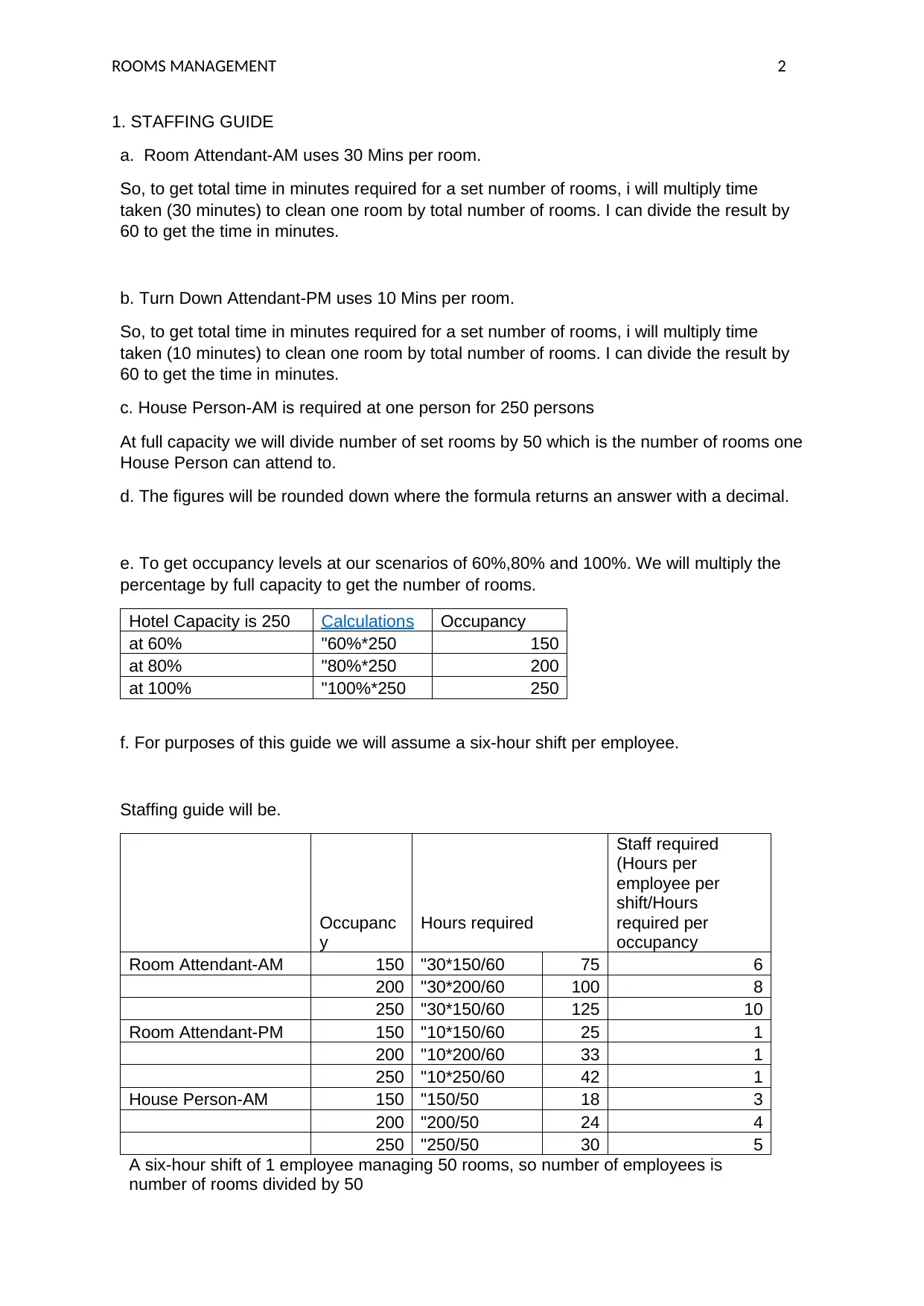
1. STAFFING GUIDE
a. Room Attendant-AM uses 30 Mins per room.
So, to get total time in minutes required for a set number of rooms, i will multiply time
taken (30 minutes) to clean one room by total number of rooms. I can divide the result by
60 to get the time in minutes.
b. Turn Down Attendant-PM uses 10 Mins per room.
So, to get total time in minutes required for a set number of rooms, i will multiply time
taken (10 minutes) to clean one room by total number of rooms. I can divide the result by
60 to get the time in minutes.
c. House Person-AM is required at one person for 250 persons
At full capacity we will divide number of set rooms by 50 which is the number of rooms one
House Person can attend to.
d. The figures will be rounded down where the formula returns an answer with a decimal.
e. To get occupancy levels at our scenarios of 60%,80% and 100%. We will multiply the
percentage by full capacity to get the number of rooms.
Hotel Capacity is 250 Calculations Occupancy
at 60% "60%*250 150
at 80% "80%*250 200
at 100% "100%*250 250
f. For purposes of this guide we will assume a six-hour shift per employee.
Staffing guide will be.
Occupanc
y
Hours required
Staff required
(Hours per
employee per
shift/Hours
required per
occupancy
Room Attendant-AM 150 "30*150/60 75 6
200 "30*200/60 100 8
250 "30*150/60 125 10
Room Attendant-PM 150 "10*150/60 25 1
200 "10*200/60 33 1
250 "10*250/60 42 1
House Person-AM 150 "150/50 18 3
200 "200/50 24 4
250 "250/50 30 5
A six-hour shift of 1 employee managing 50 rooms, so number of employees is
number of rooms divided by 50
1. STAFFING GUIDE
a. Room Attendant-AM uses 30 Mins per room.
So, to get total time in minutes required for a set number of rooms, i will multiply time
taken (30 minutes) to clean one room by total number of rooms. I can divide the result by
60 to get the time in minutes.
b. Turn Down Attendant-PM uses 10 Mins per room.
So, to get total time in minutes required for a set number of rooms, i will multiply time
taken (10 minutes) to clean one room by total number of rooms. I can divide the result by
60 to get the time in minutes.
c. House Person-AM is required at one person for 250 persons
At full capacity we will divide number of set rooms by 50 which is the number of rooms one
House Person can attend to.
d. The figures will be rounded down where the formula returns an answer with a decimal.
e. To get occupancy levels at our scenarios of 60%,80% and 100%. We will multiply the
percentage by full capacity to get the number of rooms.
Hotel Capacity is 250 Calculations Occupancy
at 60% "60%*250 150
at 80% "80%*250 200
at 100% "100%*250 250
f. For purposes of this guide we will assume a six-hour shift per employee.
Staffing guide will be.
Occupanc
y
Hours required
Staff required
(Hours per
employee per
shift/Hours
required per
occupancy
Room Attendant-AM 150 "30*150/60 75 6
200 "30*200/60 100 8
250 "30*150/60 125 10
Room Attendant-PM 150 "10*150/60 25 1
200 "10*200/60 33 1
250 "10*250/60 42 1
House Person-AM 150 "150/50 18 3
200 "200/50 24 4
250 "250/50 30 5
A six-hour shift of 1 employee managing 50 rooms, so number of employees is
number of rooms divided by 50
ROOMS MANAGEMENT 3
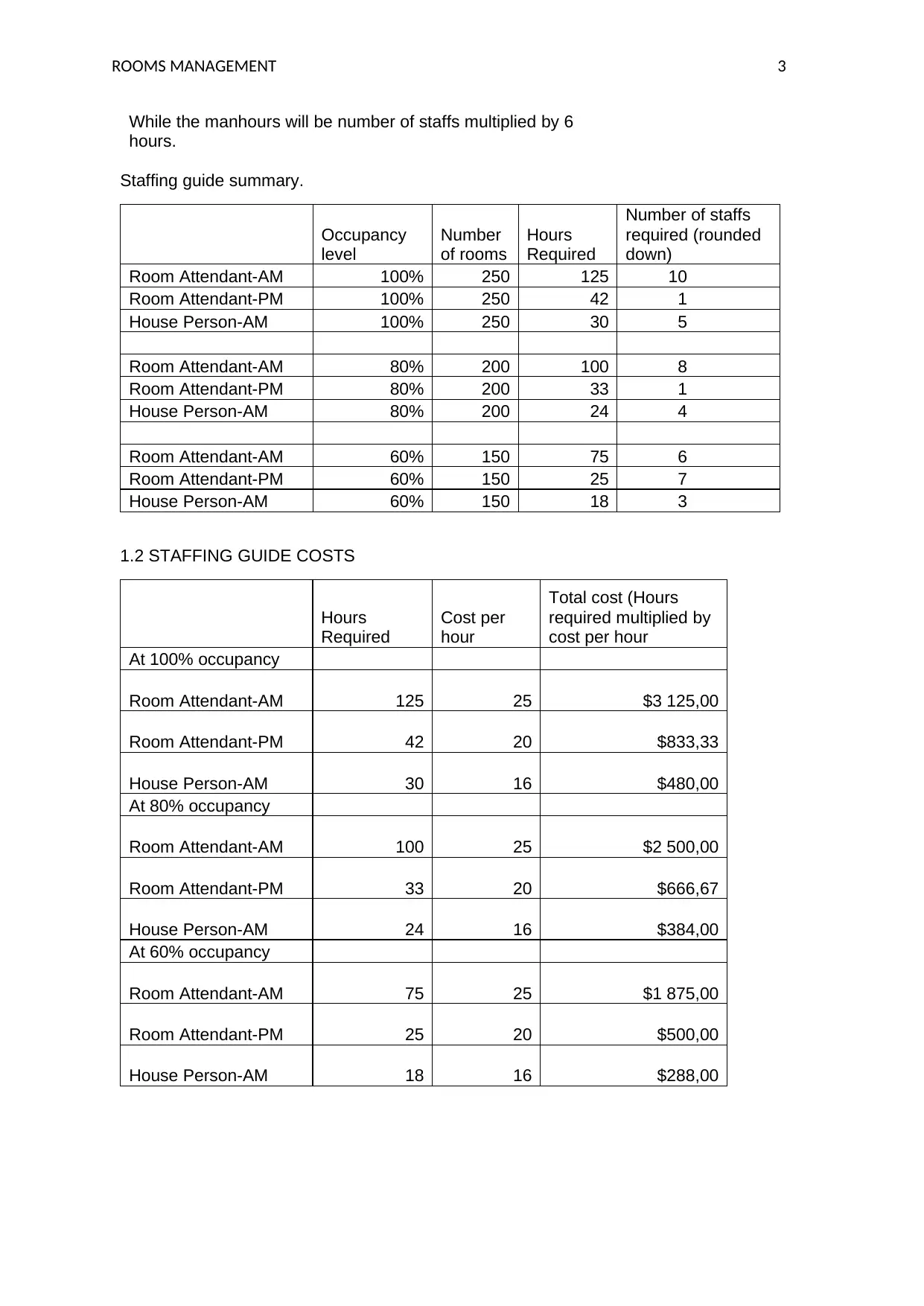
While the manhours will be number of staffs multiplied by 6
hours.
Staffing guide summary.
Occupancy
level
Number
of rooms
Hours
Required
Number of staffs
required (rounded
down)
Room Attendant-AM 100% 250 125 10
Room Attendant-PM 100% 250 42 1
House Person-AM 100% 250 30 5
Room Attendant-AM 80% 200 100 8
Room Attendant-PM 80% 200 33 1
House Person-AM 80% 200 24 4
Room Attendant-AM 60% 150 75 6
Room Attendant-PM 60% 150 25 7
House Person-AM 60% 150 18 3
1.2 STAFFING GUIDE COSTS
Hours
Required
Cost per
hour
Total cost (Hours
required multiplied by
cost per hour
At 100% occupancy
Room Attendant-AM 125 25 $3 125,00
Room Attendant-PM 42 20 $833,33
House Person-AM 30 16 $480,00
At 80% occupancy
Room Attendant-AM 100 25 $2 500,00
Room Attendant-PM 33 20 $666,67
House Person-AM 24 16 $384,00
At 60% occupancy
Room Attendant-AM 75 25 $1 875,00
Room Attendant-PM 25 20 $500,00
House Person-AM 18 16 $288,00
While the manhours will be number of staffs multiplied by 6
hours.
Staffing guide summary.
Occupancy
level
Number
of rooms
Hours
Required
Number of staffs
required (rounded
down)
Room Attendant-AM 100% 250 125 10
Room Attendant-PM 100% 250 42 1
House Person-AM 100% 250 30 5
Room Attendant-AM 80% 200 100 8
Room Attendant-PM 80% 200 33 1
House Person-AM 80% 200 24 4
Room Attendant-AM 60% 150 75 6
Room Attendant-PM 60% 150 25 7
House Person-AM 60% 150 18 3
1.2 STAFFING GUIDE COSTS
Hours
Required
Cost per
hour
Total cost (Hours
required multiplied by
cost per hour
At 100% occupancy
Room Attendant-AM 125 25 $3 125,00
Room Attendant-PM 42 20 $833,33
House Person-AM 30 16 $480,00
At 80% occupancy
Room Attendant-AM 100 25 $2 500,00
Room Attendant-PM 33 20 $666,67
House Person-AM 24 16 $384,00
At 60% occupancy
Room Attendant-AM 75 25 $1 875,00
Room Attendant-PM 25 20 $500,00
House Person-AM 18 16 $288,00
⊘ This is a preview!⊘
Do you want full access?
Subscribe today to unlock all pages.

Trusted by 1+ million students worldwide
ROOMS MANAGEMENT 4
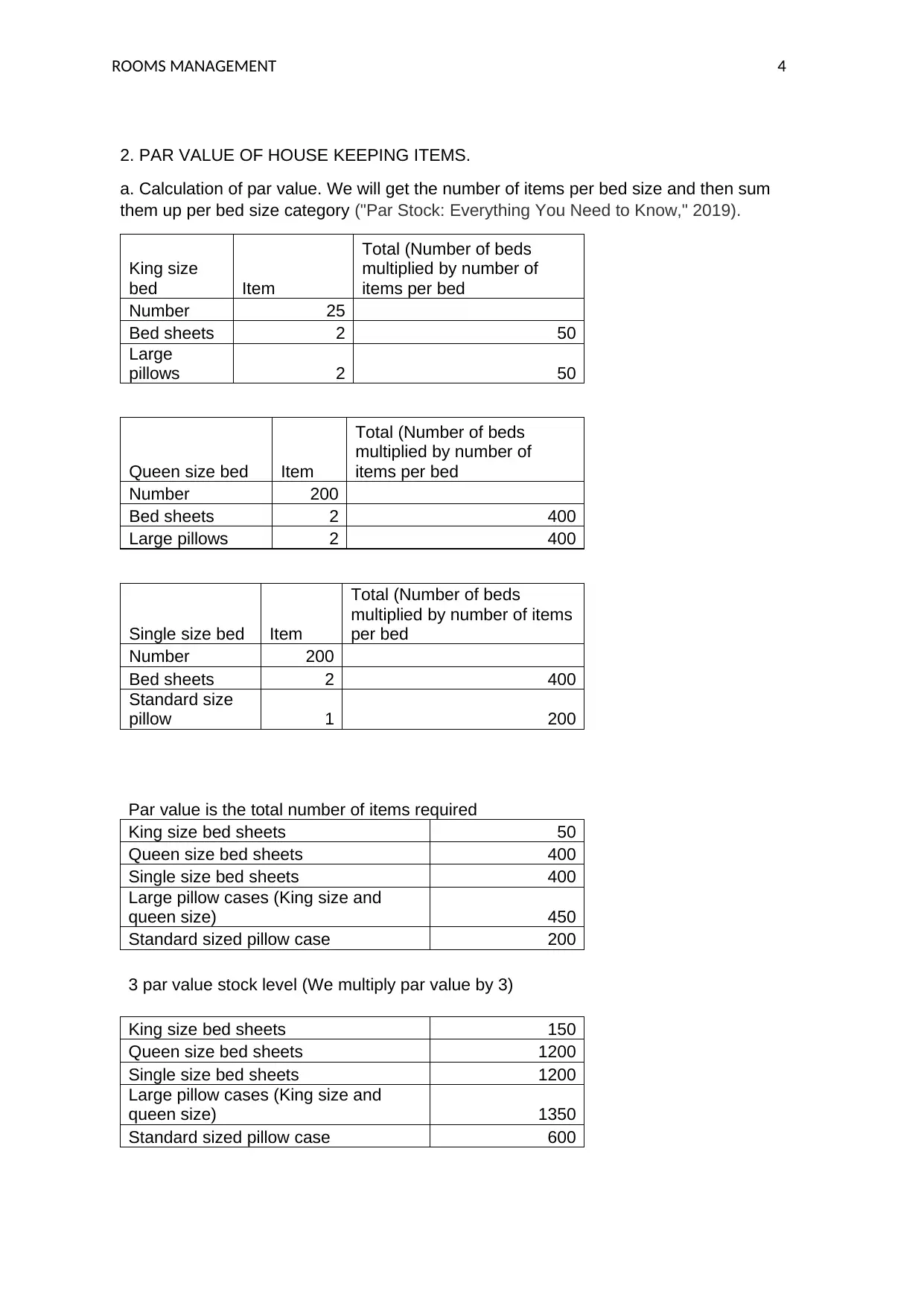
2. PAR VALUE OF HOUSE KEEPING ITEMS.
a. Calculation of par value. We will get the number of items per bed size and then sum
them up per bed size category ("Par Stock: Everything You Need to Know," 2019).
King size
bed Item
Total (Number of beds
multiplied by number of
items per bed
Number 25
Bed sheets 2 50
Large
pillows 2 50
Queen size bed Item
Total (Number of beds
multiplied by number of
items per bed
Number 200
Bed sheets 2 400
Large pillows 2 400
Single size bed Item
Total (Number of beds
multiplied by number of items
per bed
Number 200
Bed sheets 2 400
Standard size
pillow 1 200
Par value is the total number of items required
King size bed sheets 50
Queen size bed sheets 400
Single size bed sheets 400
Large pillow cases (King size and
queen size) 450
Standard sized pillow case 200
3 par value stock level (We multiply par value by 3)
King size bed sheets 150
Queen size bed sheets 1200
Single size bed sheets 1200
Large pillow cases (King size and
queen size) 1350
Standard sized pillow case 600
2. PAR VALUE OF HOUSE KEEPING ITEMS.
a. Calculation of par value. We will get the number of items per bed size and then sum
them up per bed size category ("Par Stock: Everything You Need to Know," 2019).
King size
bed Item
Total (Number of beds
multiplied by number of
items per bed
Number 25
Bed sheets 2 50
Large
pillows 2 50
Queen size bed Item
Total (Number of beds
multiplied by number of
items per bed
Number 200
Bed sheets 2 400
Large pillows 2 400
Single size bed Item
Total (Number of beds
multiplied by number of items
per bed
Number 200
Bed sheets 2 400
Standard size
pillow 1 200
Par value is the total number of items required
King size bed sheets 50
Queen size bed sheets 400
Single size bed sheets 400
Large pillow cases (King size and
queen size) 450
Standard sized pillow case 200
3 par value stock level (We multiply par value by 3)
King size bed sheets 150
Queen size bed sheets 1200
Single size bed sheets 1200
Large pillow cases (King size and
queen size) 1350
Standard sized pillow case 600
Paraphrase This Document
Need a fresh take? Get an instant paraphrase of this document with our AI Paraphraser
ROOMS MANAGEMENT 5
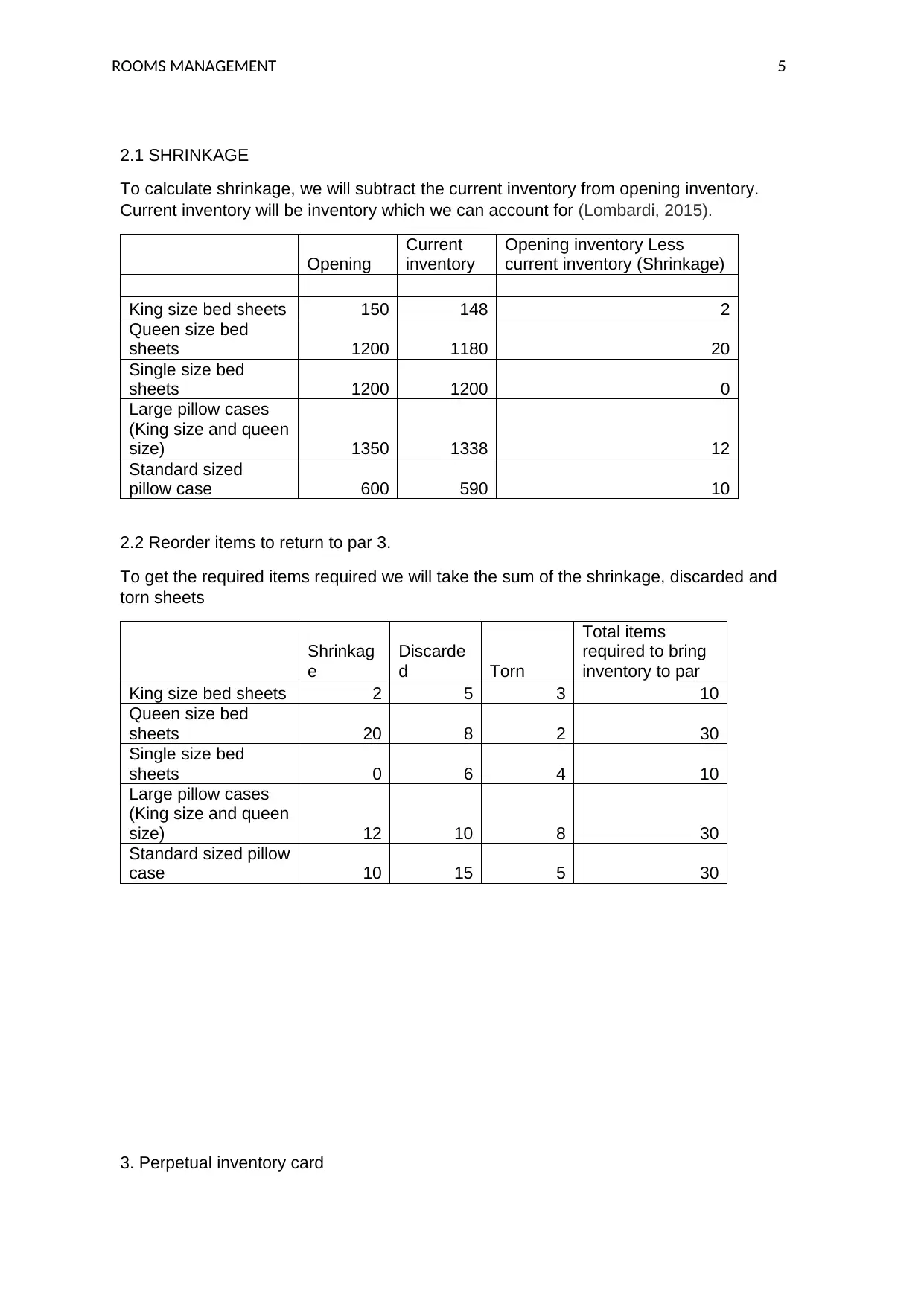
2.1 SHRINKAGE
To calculate shrinkage, we will subtract the current inventory from opening inventory.
Current inventory will be inventory which we can account for (Lombardi, 2015).
Opening
Current
inventory
Opening inventory Less
current inventory (Shrinkage)
King size bed sheets 150 148 2
Queen size bed
sheets 1200 1180 20
Single size bed
sheets 1200 1200 0
Large pillow cases
(King size and queen
size) 1350 1338 12
Standard sized
pillow case 600 590 10
2.2 Reorder items to return to par 3.
To get the required items required we will take the sum of the shrinkage, discarded and
torn sheets
Shrinkag
e
Discarde
d Torn
Total items
required to bring
inventory to par
King size bed sheets 2 5 3 10
Queen size bed
sheets 20 8 2 30
Single size bed
sheets 0 6 4 10
Large pillow cases
(King size and queen
size) 12 10 8 30
Standard sized pillow
case 10 15 5 30
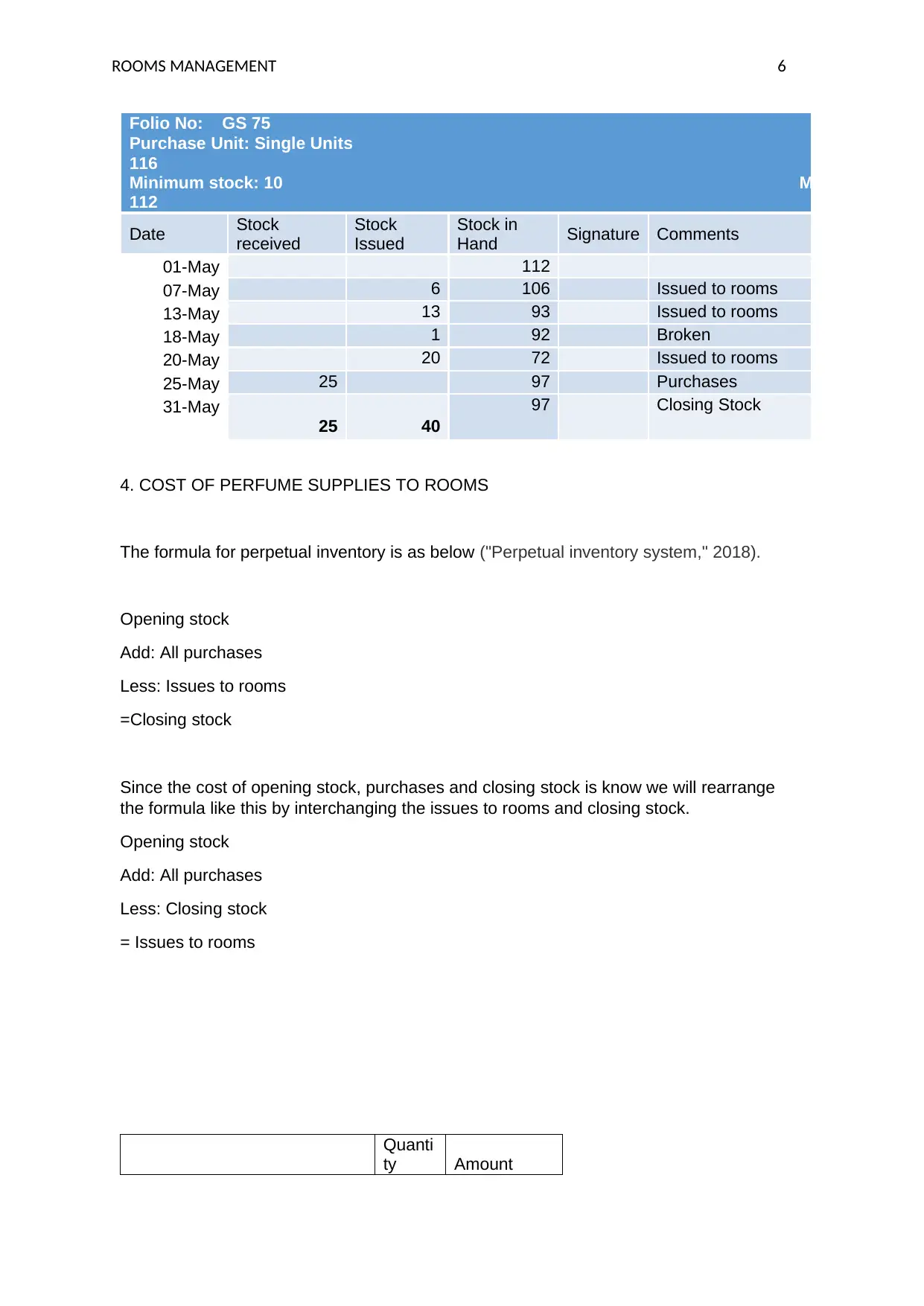
3. Perpetual inventory card
2.1 SHRINKAGE
To calculate shrinkage, we will subtract the current inventory from opening inventory.
Current inventory will be inventory which we can account for (Lombardi, 2015).
Opening
Current
inventory
Opening inventory Less
current inventory (Shrinkage)
King size bed sheets 150 148 2
Queen size bed
sheets 1200 1180 20
Single size bed
sheets 1200 1200 0
Large pillow cases
(King size and queen
size) 1350 1338 12
Standard sized
pillow case 600 590 10
2.2 Reorder items to return to par 3.
To get the required items required we will take the sum of the shrinkage, discarded and
torn sheets
Shrinkag
e
Discarde
d Torn
Total items
required to bring
inventory to par
King size bed sheets 2 5 3 10
Queen size bed
sheets 20 8 2 30
Single size bed
sheets 0 6 4 10
Large pillow cases
(King size and queen
size) 12 10 8 30
Standard sized pillow
case 10 15 5 30
3. Perpetual inventory card
ROOMS MANAGEMENT 6
Folio No: GS 75 Shampoo
Purchase Unit: Single Units Unit Price:
116
Minimum stock: 10 Maximum Stock
112
Date Stock
received
Stock
Issued
Stock in
Hand Signature Comments
01-May 112
07-May 6 106 Issued to rooms
13-May 13 93 Issued to rooms
18-May 1 92 Broken
20-May 20 72 Issued to rooms
25-May 25 97 Purchases
31-May 97 Closing Stock
25 40
4. COST OF PERFUME SUPPLIES TO ROOMS
The formula for perpetual inventory is as below ("Perpetual inventory system," 2018).
Opening stock
Add: All purchases
Less: Issues to rooms
=Closing stock
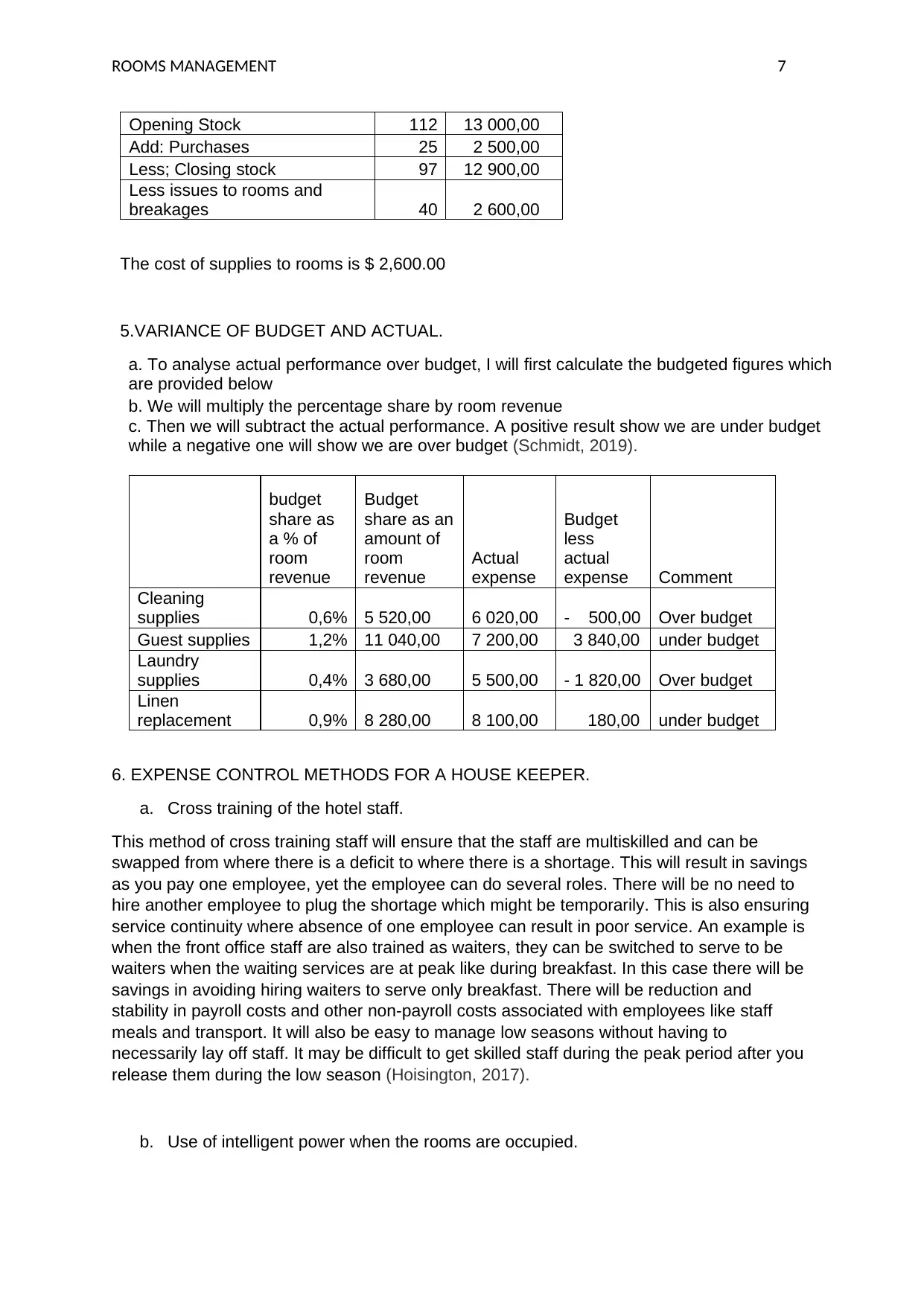
Since the cost of opening stock, purchases and closing stock is know we will rearrange
the formula like this by interchanging the issues to rooms and closing stock.
Opening stock
Add: All purchases
Less: Closing stock
= Issues to rooms
Quanti
ty Amount
Folio No: GS 75 Shampoo
Purchase Unit: Single Units Unit Price:
116
Minimum stock: 10 Maximum Stock
112
Date Stock
received
Stock
Issued
Stock in
Hand Signature Comments
01-May 112
07-May 6 106 Issued to rooms
13-May 13 93 Issued to rooms
18-May 1 92 Broken
20-May 20 72 Issued to rooms
25-May 25 97 Purchases
31-May 97 Closing Stock
25 40
4. COST OF PERFUME SUPPLIES TO ROOMS
The formula for perpetual inventory is as below ("Perpetual inventory system," 2018).
Opening stock
Add: All purchases
Less: Issues to rooms
=Closing stock
Since the cost of opening stock, purchases and closing stock is know we will rearrange
the formula like this by interchanging the issues to rooms and closing stock.
Opening stock
Add: All purchases
Less: Closing stock
= Issues to rooms
Quanti
ty Amount
⊘ This is a preview!⊘
Do you want full access?
Subscribe today to unlock all pages.
Trusted by 1+ million students worldwide
ROOMS MANAGEMENT 7
Opening Stock 112 13 000,00
Add: Purchases 25 2 500,00
Less; Closing stock 97 12 900,00
Less issues to rooms and
breakages 40 2 600,00
The cost of supplies to rooms is $ 2,600.00
5.VARIANCE OF BUDGET AND ACTUAL.
a. To analyse actual performance over budget, I will first calculate the budgeted figures which
are provided below
b. We will multiply the percentage share by room revenue
c. Then we will subtract the actual performance. A positive result show we are under budget
while a negative one will show we are over budget (Schmidt, 2019).
budget
share as
a % of
room
revenue
Budget
share as an
amount of
room
revenue
Actual
expense
Budget
less
actual
expense Comment
Cleaning
supplies 0,6% 5 520,00 6 020,00 - 500,00 Over budget
Guest supplies 1,2% 11 040,00 7 200,00 3 840,00 under budget
Laundry
supplies 0,4% 3 680,00 5 500,00 - 1 820,00 Over budget
Linen
replacement 0,9% 8 280,00 8 100,00 180,00 under budget
6. EXPENSE CONTROL METHODS FOR A HOUSE KEEPER.
a. Cross training of the hotel staff.
This method of cross training staff will ensure that the staff are multiskilled and can be
swapped from where there is a deficit to where there is a shortage. This will result in savings
as you pay one employee, yet the employee can do several roles. There will be no need to
hire another employee to plug the shortage which might be temporarily. This is also ensuring
service continuity where absence of one employee can result in poor service. An example is
when the front office staff are also trained as waiters, they can be switched to serve to be
waiters when the waiting services are at peak like during breakfast. In this case there will be
savings in avoiding hiring waiters to serve only breakfast. There will be reduction and
stability in payroll costs and other non-payroll costs associated with employees like staff
meals and transport. It will also be easy to manage low seasons without having to
necessarily lay off staff. It may be difficult to get skilled staff during the peak period after you
release them during the low season (Hoisington, 2017).
b. Use of intelligent power when the rooms are occupied.
Opening Stock 112 13 000,00
Add: Purchases 25 2 500,00
Less; Closing stock 97 12 900,00
Less issues to rooms and
breakages 40 2 600,00
The cost of supplies to rooms is $ 2,600.00
5.VARIANCE OF BUDGET AND ACTUAL.
a. To analyse actual performance over budget, I will first calculate the budgeted figures which
are provided below
b. We will multiply the percentage share by room revenue
c. Then we will subtract the actual performance. A positive result show we are under budget
while a negative one will show we are over budget (Schmidt, 2019).
budget
share as
a % of
room
revenue
Budget
share as an
amount of
room
revenue
Actual
expense
Budget
less
actual
expense Comment
Cleaning
supplies 0,6% 5 520,00 6 020,00 - 500,00 Over budget
Guest supplies 1,2% 11 040,00 7 200,00 3 840,00 under budget
Laundry
supplies 0,4% 3 680,00 5 500,00 - 1 820,00 Over budget
Linen
replacement 0,9% 8 280,00 8 100,00 180,00 under budget
6. EXPENSE CONTROL METHODS FOR A HOUSE KEEPER.
a. Cross training of the hotel staff.
This method of cross training staff will ensure that the staff are multiskilled and can be
swapped from where there is a deficit to where there is a shortage. This will result in savings
as you pay one employee, yet the employee can do several roles. There will be no need to
hire another employee to plug the shortage which might be temporarily. This is also ensuring
service continuity where absence of one employee can result in poor service. An example is
when the front office staff are also trained as waiters, they can be switched to serve to be
waiters when the waiting services are at peak like during breakfast. In this case there will be
savings in avoiding hiring waiters to serve only breakfast. There will be reduction and
stability in payroll costs and other non-payroll costs associated with employees like staff
meals and transport. It will also be easy to manage low seasons without having to
necessarily lay off staff. It may be difficult to get skilled staff during the peak period after you
release them during the low season (Hoisington, 2017).
b. Use of intelligent power when the rooms are occupied.
Paraphrase This Document
Need a fresh take? Get an instant paraphrase of this document with our AI Paraphraser
ROOMS MANAGEMENT 8
Use of power intelligently cannot be said enough times in the hospitality industry. There are
many appliances that must run irrespective of occupancy levels in hotel. A review of power
consumption should be conducted. Appliances that are not used should have their power
switch off. Rooms that are not in use should have all their power switched off. Areas not in
use should also have only minimal power being utilised as opposed for example to lighting
conference rooms when they are not in use. To achieve this, the hotel can invest in motion
sensors for areas like washrooms and walkways and escalators. Another method is to buy
appliances that can switch off automatically or switch to low power when not in use. Buying
these appliances comes at a premium ("21 tips: no-cost ways to save electricity," 2019).
These costs can be recouped within three years.
c. Shopping around for better prices and partnering with suppliers with a long-term view
Since the hotel will be doing bulk purchases, it is possible to get into a partnership with a
supplier who can supply to the hotel at a discount from the market. The discount can be
extended if the supplier is guaranteed sales for a specified period. Such arrangements can
also have the supplier customise the supplies to the hotel to meet its unique needs such as
branding and sizes that the market is not providing. The arrangements can also lock the
prices and insulate the hotel against price hikes. The arrangement can also have the hotel
reduce on the space required for inventory since the supplier can be supplying in a timely
manner. A significant burden of inventory management can be transferred to the supplier at
no extra cost. The sum of these savings in costs and transfer of responsibility can go along
way in managing costs for the line items (Dixon, 2013).
d. Leveraging on observation of the eating habits of people and adjusting the menus
accordingly.
One of the major costs in a hotel is in the kitchen. A lot of work is done before a meal is
served in kitchen. Through observation, the hotel can learn about their clients’ meals
preferences. If many client’s plates are returned with a specific food item, the hotel can
reduce the portions of that food item. This will result in cost savings. Some food items can be
made optional and made available on request. Another method will be to check the amount
of left-over food to ascertain if the portions of food are optimal. If the leftovers portions are
considered high, the hotel can reduce the portions up to the size that they have observed to
be optimal. Another method can be to use locally available and seasonal food. Such food is
usually cheap to source. However, the adjustments as proposed should be done gradually to
minimise customer impact. Every adjustment should also be subject to reviews so that the
impact can be evaluated (Morningadvertiser.co.uk, 2011).
7. OPERATING BUDGET AS A TOOL TO CONTROL EXPENSES
An operating budget is a useful tool that is used to project, monitor and track business
financial performance on the income and expenditure lines ("What is a Budgeting Process?"
2019). As such it is a short-term view. Long-term capital outlays are excluded. An operating
budget is made of segments which build up to the master budget. The budget being short
term view also must be split into smaller periods according to the activity cycles. The smaller
periods can be daily, weekly, monthly or quarterly. The projections can be derived from
historical data and then adjusted for inflation and any prevailing circumstance.
Use of power intelligently cannot be said enough times in the hospitality industry. There are
many appliances that must run irrespective of occupancy levels in hotel. A review of power
consumption should be conducted. Appliances that are not used should have their power
switch off. Rooms that are not in use should have all their power switched off. Areas not in
use should also have only minimal power being utilised as opposed for example to lighting
conference rooms when they are not in use. To achieve this, the hotel can invest in motion
sensors for areas like washrooms and walkways and escalators. Another method is to buy
appliances that can switch off automatically or switch to low power when not in use. Buying
these appliances comes at a premium ("21 tips: no-cost ways to save electricity," 2019).
These costs can be recouped within three years.
c. Shopping around for better prices and partnering with suppliers with a long-term view
Since the hotel will be doing bulk purchases, it is possible to get into a partnership with a
supplier who can supply to the hotel at a discount from the market. The discount can be
extended if the supplier is guaranteed sales for a specified period. Such arrangements can
also have the supplier customise the supplies to the hotel to meet its unique needs such as
branding and sizes that the market is not providing. The arrangements can also lock the
prices and insulate the hotel against price hikes. The arrangement can also have the hotel
reduce on the space required for inventory since the supplier can be supplying in a timely
manner. A significant burden of inventory management can be transferred to the supplier at
no extra cost. The sum of these savings in costs and transfer of responsibility can go along
way in managing costs for the line items (Dixon, 2013).
d. Leveraging on observation of the eating habits of people and adjusting the menus
accordingly.
One of the major costs in a hotel is in the kitchen. A lot of work is done before a meal is
served in kitchen. Through observation, the hotel can learn about their clients’ meals
preferences. If many client’s plates are returned with a specific food item, the hotel can
reduce the portions of that food item. This will result in cost savings. Some food items can be
made optional and made available on request. Another method will be to check the amount
of left-over food to ascertain if the portions of food are optimal. If the leftovers portions are
considered high, the hotel can reduce the portions up to the size that they have observed to
be optimal. Another method can be to use locally available and seasonal food. Such food is
usually cheap to source. However, the adjustments as proposed should be done gradually to
minimise customer impact. Every adjustment should also be subject to reviews so that the
impact can be evaluated (Morningadvertiser.co.uk, 2011).
7. OPERATING BUDGET AS A TOOL TO CONTROL EXPENSES
An operating budget is a useful tool that is used to project, monitor and track business
financial performance on the income and expenditure lines ("What is a Budgeting Process?"
2019). As such it is a short-term view. Long-term capital outlays are excluded. An operating
budget is made of segments which build up to the master budget. The budget being short
term view also must be split into smaller periods according to the activity cycles. The smaller
periods can be daily, weekly, monthly or quarterly. The projections can be derived from
historical data and then adjusted for inflation and any prevailing circumstance.
ROOMS MANAGEMENT 9
An operating budget is useful in that it can project the performance of a business at periodic
intervals and to the to the the specific line of income or expense. This makes easy to have a
single view of business. This can enable one to simulate the various income and expenditure
lines to achieve a desired result (Hardman, 2019). One example of a desired result is to
increase profits to a certain level. For one to reach the desired level one can either increase
sales to generate more revenue. However, increasing sales also comes with increased
expenses. These scenarios can be performed on an operating budget for one to achieve a
desired state. The ability to have a single view. However, the most important purpose of the
budget is when it used as control to compare actual performance against budget figures.
The variations are noted, and important conclusions can be made on how the hotel is
performing. The variance indicates an anomaly that should be investigated. After
investigations, actions to rectify the situation can be made. However, the budget can still be
modified later to reflect the prevailing situation. Used as a comparison tool, the budget is a
powerful tool that gives a status of the hotel performance against the targeted result. An
increase expense line without a corresponding increase in a related income line should be
investigated.
An operating budget can give a trend of revenue and expenses. Comparison of the
expenses and revenue in successive periods can give an indication of the viability of the
business in future. It can also give an indication of when the business will not be viable as a
going concern. If the projections indicate that profitability will be decreasing in future. Then a
decision needs to be made on whether to continue with the business or to re-evaluate the
business model. This is very critical as knowing when to exit a business is important to avoid
entering into costly contracts like long term leases ("What is a Budgeting Process?," 2019)
An operating budget will also guide the house keeper on the capital and cash flow required
to run such an enterprise. The expenses projected which are a result of the commitments
required to run the business. An example is that the sum of your expenses means that the
business owner needs to have the cash equivalent of the same to settle the bills. The cash
or cash equivalent must be available as and when needed.
The budget also acts as a tool to check on if the projected figures are realistic. This is so as
the various the budget lines should be aligned. The sales figures must be supported by a
minimum set of investments. Such investments must be realistic such that they can achieve
as set target of sales.
8. MASTER KEYS AND THEIR LEVEL OF ACCCES.
We have various types of keys ("Types of keys used in hotels for effective security," 2018)
four of those are.
a. Emergency keys which can open all doors in the hotel. These doors are gym, guest
room doors and attendant store rooms. The keys are kept very securely and only
used during emergencies. These are even kept in an off-premise location. They are
secured and only few people can access them in the hotel
b. Master keys which can open more than one door. There are various levels of mater
keys depending on the hotel rooms configuration. We have the grand master which
can open all guest rooms and storage rooms. There is another level of section
master that open sections of the hotel. The keys are mainly with the supervisors. The
An operating budget is useful in that it can project the performance of a business at periodic
intervals and to the to the the specific line of income or expense. This makes easy to have a
single view of business. This can enable one to simulate the various income and expenditure
lines to achieve a desired result (Hardman, 2019). One example of a desired result is to
increase profits to a certain level. For one to reach the desired level one can either increase
sales to generate more revenue. However, increasing sales also comes with increased
expenses. These scenarios can be performed on an operating budget for one to achieve a
desired state. The ability to have a single view. However, the most important purpose of the
budget is when it used as control to compare actual performance against budget figures.
The variations are noted, and important conclusions can be made on how the hotel is
performing. The variance indicates an anomaly that should be investigated. After
investigations, actions to rectify the situation can be made. However, the budget can still be
modified later to reflect the prevailing situation. Used as a comparison tool, the budget is a
powerful tool that gives a status of the hotel performance against the targeted result. An
increase expense line without a corresponding increase in a related income line should be
investigated.
An operating budget can give a trend of revenue and expenses. Comparison of the
expenses and revenue in successive periods can give an indication of the viability of the
business in future. It can also give an indication of when the business will not be viable as a
going concern. If the projections indicate that profitability will be decreasing in future. Then a
decision needs to be made on whether to continue with the business or to re-evaluate the
business model. This is very critical as knowing when to exit a business is important to avoid
entering into costly contracts like long term leases ("What is a Budgeting Process?," 2019)
An operating budget will also guide the house keeper on the capital and cash flow required
to run such an enterprise. The expenses projected which are a result of the commitments
required to run the business. An example is that the sum of your expenses means that the
business owner needs to have the cash equivalent of the same to settle the bills. The cash
or cash equivalent must be available as and when needed.
The budget also acts as a tool to check on if the projected figures are realistic. This is so as
the various the budget lines should be aligned. The sales figures must be supported by a
minimum set of investments. Such investments must be realistic such that they can achieve
as set target of sales.
8. MASTER KEYS AND THEIR LEVEL OF ACCCES.
We have various types of keys ("Types of keys used in hotels for effective security," 2018)
four of those are.
a. Emergency keys which can open all doors in the hotel. These doors are gym, guest
room doors and attendant store rooms. The keys are kept very securely and only
used during emergencies. These are even kept in an off-premise location. They are
secured and only few people can access them in the hotel
b. Master keys which can open more than one door. There are various levels of mater
keys depending on the hotel rooms configuration. We have the grand master which
can open all guest rooms and storage rooms. There is another level of section
master that open sections of the hotel. The keys are mainly with the supervisors. The
⊘ This is a preview!⊘
Do you want full access?
Subscribe today to unlock all pages.
Trusted by 1+ million students worldwide
ROOMS MANAGEMENT 10
lowest level is the floor key which is entrusted to room attendant and can only open
rooms in one floor.
c. Guest room keys can only open one guest room. The room can also open the
swimming area door and gym door. These keys are usually located in the front desk
d. Storage rooms are keys that can open the storage room doors. The keys are
entrusted to room attendants and supervisors. Their level of access is dependent on
what the store room holds and who has been entrusted.
lowest level is the floor key which is entrusted to room attendant and can only open
rooms in one floor.
c. Guest room keys can only open one guest room. The room can also open the
swimming area door and gym door. These keys are usually located in the front desk
d. Storage rooms are keys that can open the storage room doors. The keys are
entrusted to room attendants and supervisors. Their level of access is dependent on
what the store room holds and who has been entrusted.
Paraphrase This Document
Need a fresh take? Get an instant paraphrase of this document with our AI Paraphraser
ROOMS MANAGEMENT 11
References
21 tips: no-cost ways to save electricity. (2019). Retrieved from
https://www.bchydro.com/powersmart/residential/savings-and-rebates/everyday-
electricity-saving-tips.html?WT.mc_id=rd_21tips
7.1 Introduction to Budgeting and Budgeting Processes | Managerial Accounting. (2019).
Retrieved from
https://courses.lumenlearning.com/sac-managacct/chapter/introduction-to-
budgeting-and-budgeting-processes/
Dixon, G. (2013, December 18). Why You Need a Long Term Supply Agreement. Retrieved
from https://www.contractstore.com/blog/running-an-sme/why-you-need-a-long-
term-supply-agreement/
Hardman, J. (2019). What Are Budget Assumptions? Retrieved from
https://www.sapling.com/8187389/budget-assumptions
Hoisington, A. (2017, April 18). Focus on these areas to control costs at your hotel.
Retrieved from https://www.hotelmanagement.net/operate/how-to-control-costs-at-
your-hotel
Lombardi, A. (2015). What Is Retail Shrinkage and How Is It Affecting Your Retail
Business? Retrieved from https://www.cashtechcurrency.com/blog/what-is-
shrinkage-and-how-is-it-affecting-your-retail-business
Morningadvertiser.co.uk. (2011, May 3). Cost effective menu planning. Retrieved from
https://www.morningadvertiser.co.uk/Article/2001/05/03/Cost-effective-menu-
planning
Par Stock: Everything You Need to Know. (2019). Retrieved from
https://www.upcounsel.com/par-stock
References
21 tips: no-cost ways to save electricity. (2019). Retrieved from
https://www.bchydro.com/powersmart/residential/savings-and-rebates/everyday-
electricity-saving-tips.html?WT.mc_id=rd_21tips
7.1 Introduction to Budgeting and Budgeting Processes | Managerial Accounting. (2019).
Retrieved from
https://courses.lumenlearning.com/sac-managacct/chapter/introduction-to-
budgeting-and-budgeting-processes/
Dixon, G. (2013, December 18). Why You Need a Long Term Supply Agreement. Retrieved
from https://www.contractstore.com/blog/running-an-sme/why-you-need-a-long-
term-supply-agreement/
Hardman, J. (2019). What Are Budget Assumptions? Retrieved from
https://www.sapling.com/8187389/budget-assumptions
Hoisington, A. (2017, April 18). Focus on these areas to control costs at your hotel.
Retrieved from https://www.hotelmanagement.net/operate/how-to-control-costs-at-
your-hotel
Lombardi, A. (2015). What Is Retail Shrinkage and How Is It Affecting Your Retail
Business? Retrieved from https://www.cashtechcurrency.com/blog/what-is-
shrinkage-and-how-is-it-affecting-your-retail-business
Morningadvertiser.co.uk. (2011, May 3). Cost effective menu planning. Retrieved from
https://www.morningadvertiser.co.uk/Article/2001/05/03/Cost-effective-menu-
planning
Par Stock: Everything You Need to Know. (2019). Retrieved from
https://www.upcounsel.com/par-stock
ROOMS MANAGEMENT 12
Perpetual inventory system. (2018, November 28). Retrieved from
https://www.accountingtools.com/articles/2017/5/13/perpetual-inventory-system
Schmidt, M. (2019, June 21). How to Plan, Create, Use Budgets. Budget Variance Analysis
Steps. Retrieved from https://www.business-case-analysis.com/budget.html
Types of keys used in hotels for effective security. (2018). Retrieved from
https://setupmyhotel.com/train-my-hotel-staff/securityandloss/294-key-control-
hotel.html
What is a Budgeting Process? (2019). Retrieved from
https://www.myaccountingcourse.com/accounting-dictionary/budgeting
Perpetual inventory system. (2018, November 28). Retrieved from
https://www.accountingtools.com/articles/2017/5/13/perpetual-inventory-system
Schmidt, M. (2019, June 21). How to Plan, Create, Use Budgets. Budget Variance Analysis
Steps. Retrieved from https://www.business-case-analysis.com/budget.html
Types of keys used in hotels for effective security. (2018). Retrieved from
https://setupmyhotel.com/train-my-hotel-staff/securityandloss/294-key-control-
hotel.html
What is a Budgeting Process? (2019). Retrieved from
https://www.myaccountingcourse.com/accounting-dictionary/budgeting
⊘ This is a preview!⊘
Do you want full access?
Subscribe today to unlock all pages.
Trusted by 1+ million students worldwide

1 out of 12


Related Documents


Your All-in-One AI-Powered Toolkit for Academic Success.
+13062052269
info@desklib.com
Available 24*7 on WhatsApp / Email
![[object Object]](/_next/static/media/star-bottom.7253800d.svg)
Unlock your academic potential
Copyright © 2020–2026 A2Z Services. All Rights Reserved. Developed and managed by ZUCOL.