ECON 101: The Canadian Housing Market and Economic Sectors

Verified

Added on  2021/12/09

|8
|1523
|68
Essay
AI Summary
This essay analyzes the Canadian housing market, focusing on how housing prices influence various sectors of the Canadian economy. It examines the impact of rising wage rates, government interventions such as price ceilings, and market structures, including oligopolistic characteristics. The paper explores the effects of unemployment rates, fiscal policies, and the business cycle on housing demand and prices. It also considers the negative externalities associated with increased housing production, such as pollution. The essay discusses the housing market's relationship with the labour market and proposes solutions like providing common properties to stabilize prices. The conclusion emphasizes the challenges posed by rising housing prices for the Canadian government and suggests strategies to mitigate these challenges.
Document Page
ECON 101 WRITING ASSIGNMENT
tabler-icon-diamond-filled.svg

Paraphrase This Document

Need a fresh take? Get an instant paraphrase of this document with our AI Paraphraser
Document Page
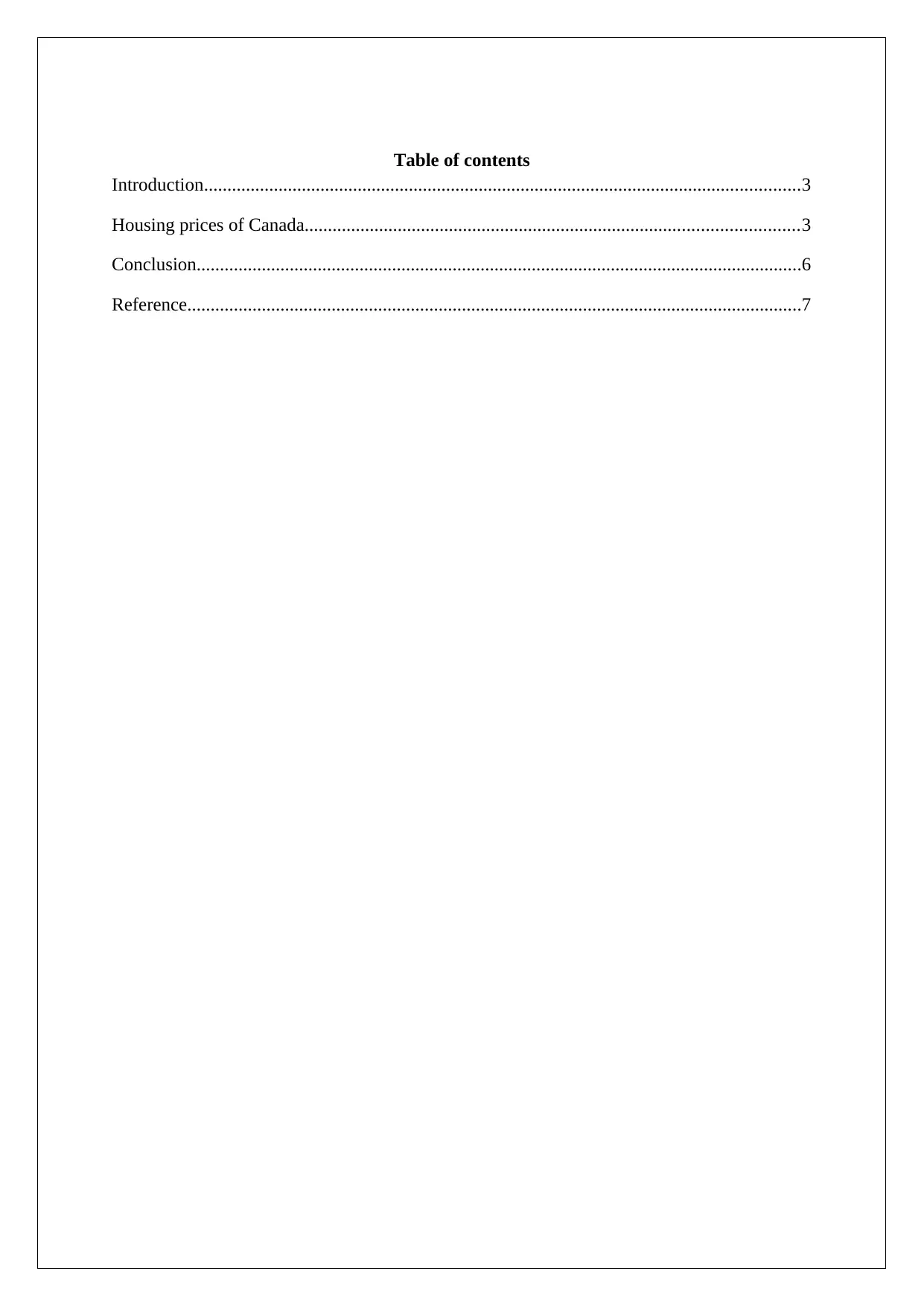
Table of contents
Introduction................................................................................................................................3
Housing prices of Canada..........................................................................................................3
Conclusion..................................................................................................................................6
Reference....................................................................................................................................7
Document Page
Introduction
Housing is one of the most influencing good or commodity of the market. Historical evidence
such as the financial crisis of 2007 has shown the power of the price change in the housing
industry. This paper is going to talk about how the recent estimation regarding the change of
housing price may affect different sectors of the Canadian economy.
Housing prices of Canada
Housing prices in Canada like most part of the world is very instrumental in stabilizing the
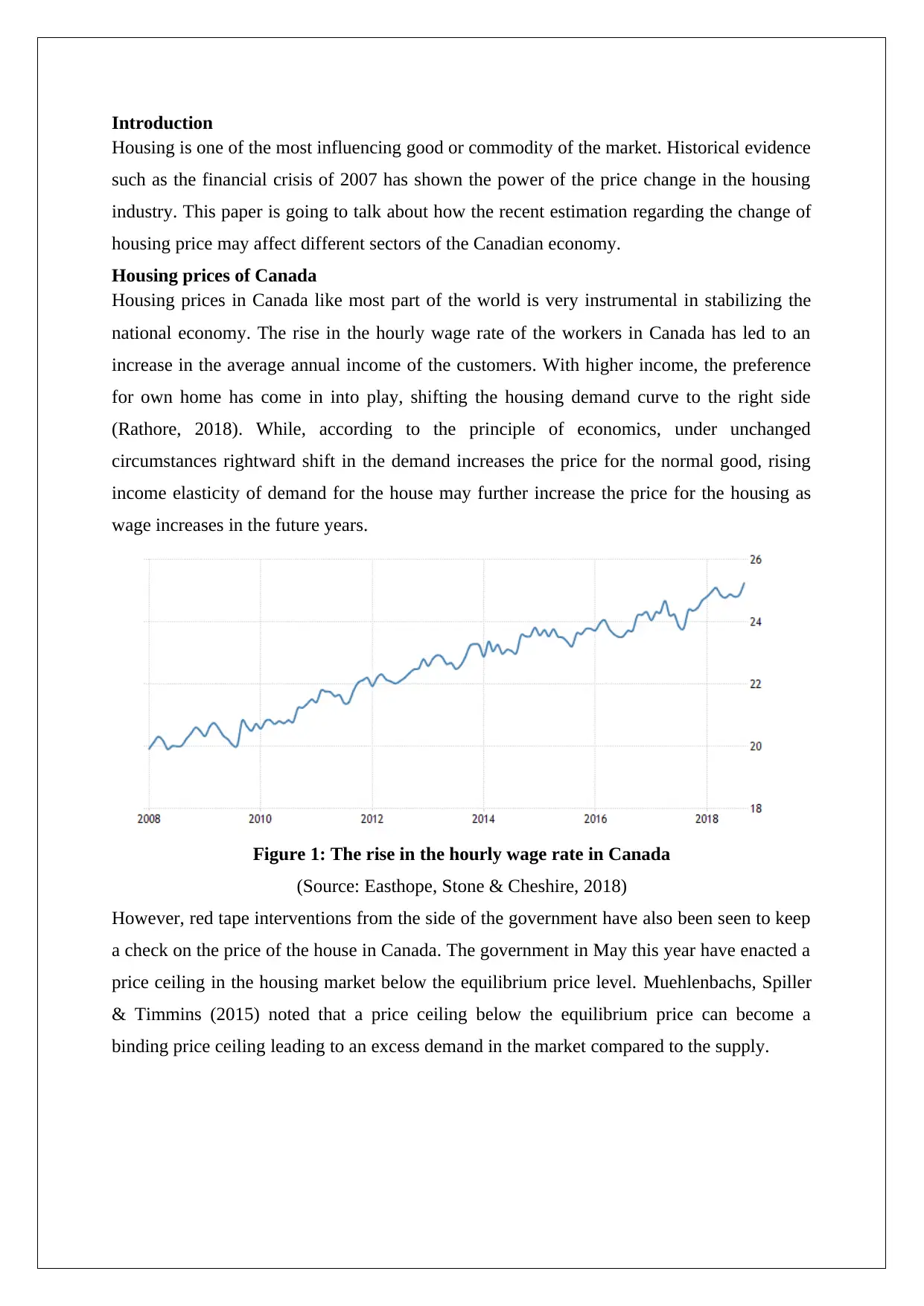
national economy. The rise in the hourly wage rate of the workers in Canada has led to an
increase in the average annual income of the customers. With higher income, the preference
for own home has come in into play, shifting the housing demand curve to the right side
(Rathore, 2018). While, according to the principle of economics, under unchanged
circumstances rightward shift in the demand increases the price for the normal good, rising
income elasticity of demand for the house may further increase the price for the housing as
wage increases in the future years.
Figure 1: The rise in the hourly wage rate in Canada
(Source: Easthope, Stone & Cheshire, 2018)
However, red tape interventions from the side of the government have also been seen to keep
a check on the price of the house in Canada. The government in May this year have enacted a
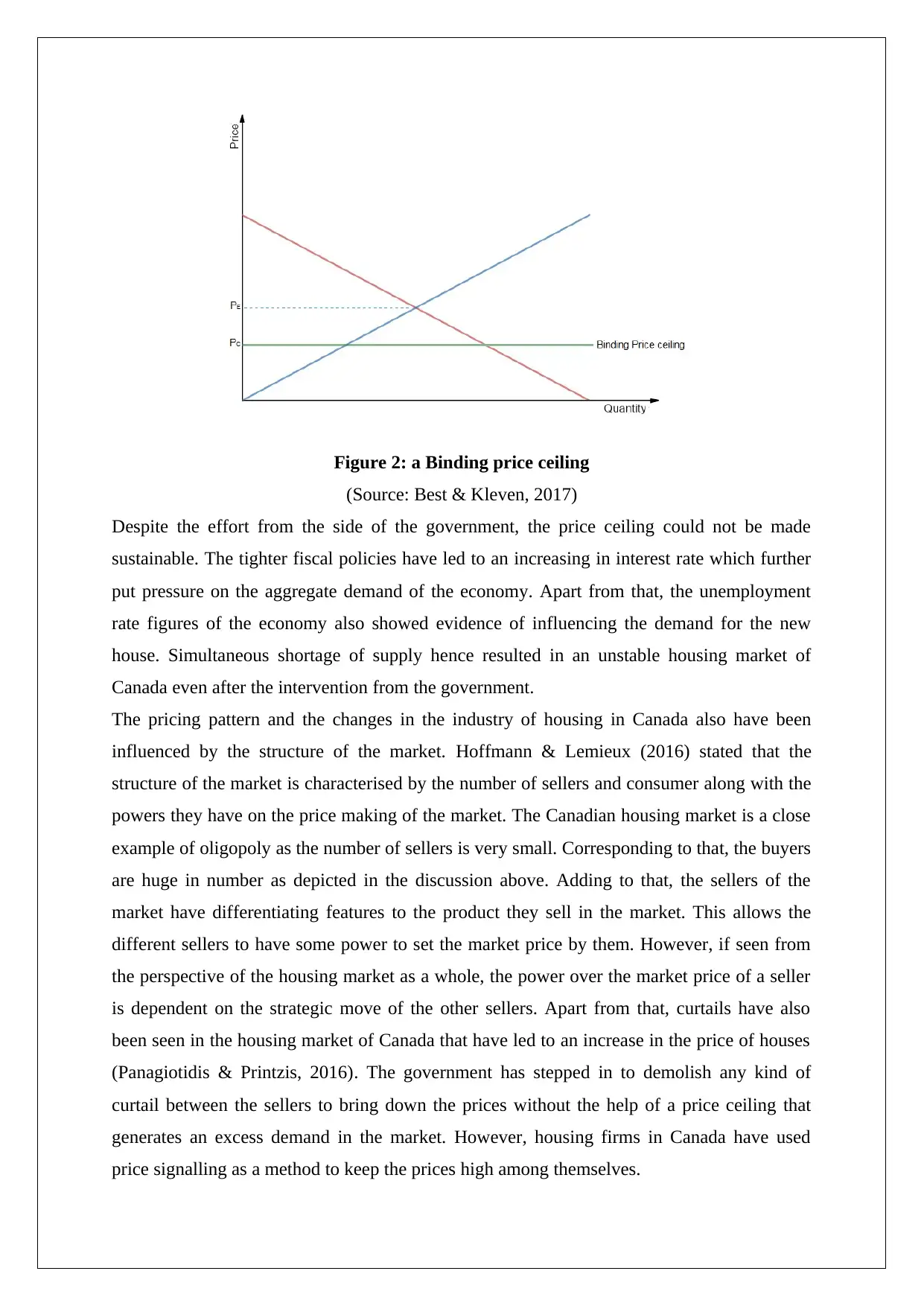
price ceiling in the housing market below the equilibrium price level. Muehlenbachs, Spiller
& Timmins (2015) noted that a price ceiling below the equilibrium price can become a
binding price ceiling leading to an excess demand in the market compared to the supply.
Document Page
Figure 2: a Binding price ceiling
(Source: Best & Kleven, 2017)
Despite the effort from the side of the government, the price ceiling could not be made
sustainable. The tighter fiscal policies have led to an increasing in interest rate which further
put pressure on the aggregate demand of the economy. Apart from that, the unemployment
rate figures of the economy also showed evidence of influencing the demand for the new
house. Simultaneous shortage of supply hence resulted in an unstable housing market of
Canada even after the intervention from the government.
The pricing pattern and the changes in the industry of housing in Canada also have been
influenced by the structure of the market. Hoffmann & Lemieux (2016) stated that the
structure of the market is characterised by the number of sellers and consumer along with the
powers they have on the price making of the market. The Canadian housing market is a close
example of oligopoly as the number of sellers is very small. Corresponding to that, the buyers
are huge in number as depicted in the discussion above. Adding to that, the sellers of the
market have differentiating features to the product they sell in the market. This allows the
different sellers to have some power to set the market price by them. However, if seen from
the perspective of the housing market as a whole, the power over the market price of a seller
is dependent on the strategic move of the other sellers. Apart from that, curtails have also
been seen in the housing market of Canada that have led to an increase in the price of houses
(Panagiotidis & Printzis, 2016). The government has stepped in to demolish any kind of
curtail between the sellers to bring down the prices without the help of a price ceiling that
generates an excess demand in the market. However, housing firms in Canada have used
price signalling as a method to keep the prices high among themselves.
tabler-icon-diamond-filled.svg

Paraphrase This Document

Need a fresh take? Get an instant paraphrase of this document with our AI Paraphraser
Document Page
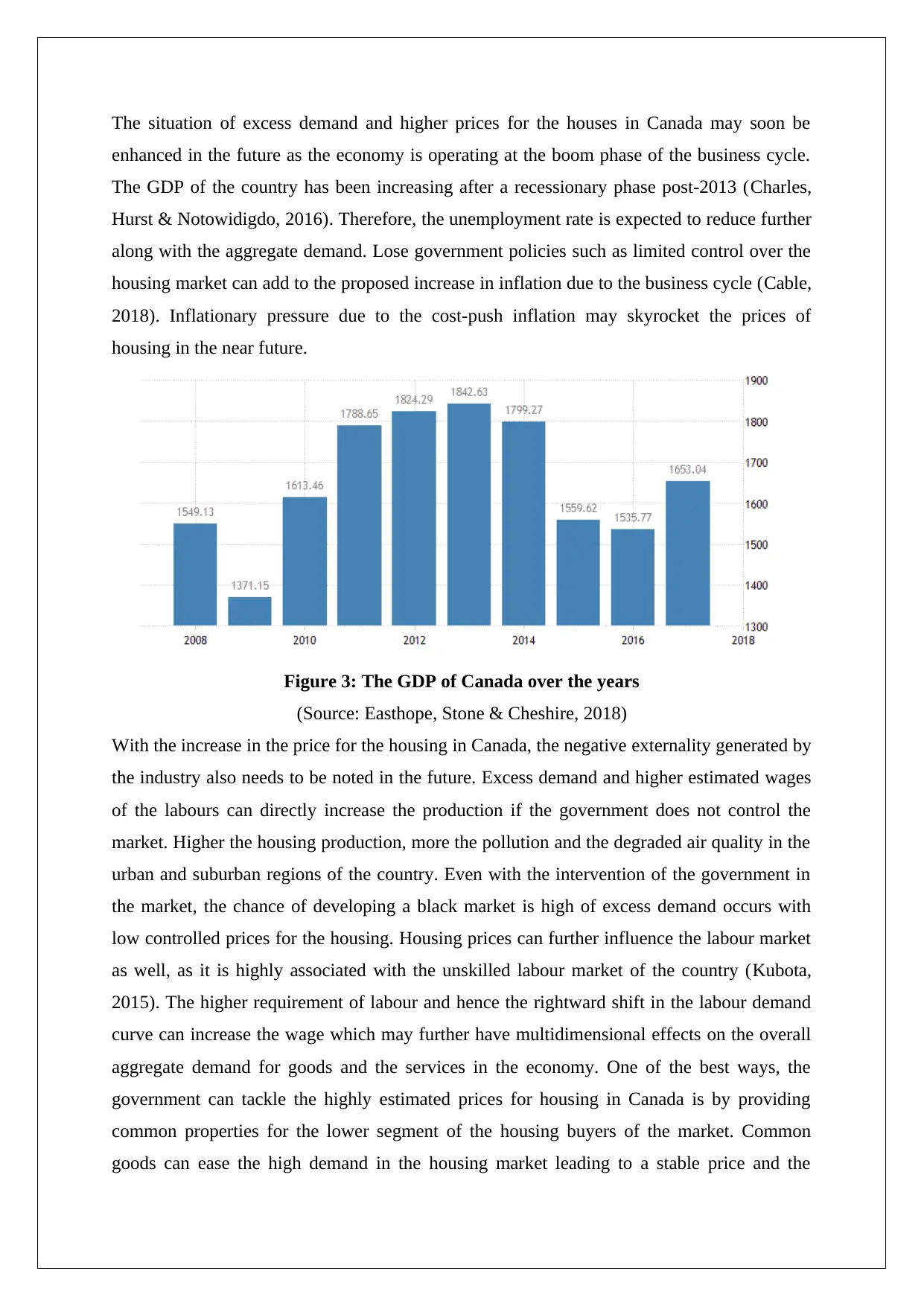
The situation of excess demand and higher prices for the houses in Canada may soon be
enhanced in the future as the economy is operating at the boom phase of the business cycle.
The GDP of the country has been increasing after a recessionary phase post-2013 (Charles,
Hurst & Notowidigdo, 2016). Therefore, the unemployment rate is expected to reduce further
along with the aggregate demand. Lose government policies such as limited control over the
housing market can add to the proposed increase in inflation due to the business cycle (Cable,
2018). Inflationary pressure due to the cost-push inflation may skyrocket the prices of
housing in the near future.
Figure 3: The GDP of Canada over the years
(Source: Easthope, Stone & Cheshire, 2018)
With the increase in the price for the housing in Canada, the negative externality generated by
the industry also needs to be noted in the future. Excess demand and higher estimated wages
of the labours can directly increase the production if the government does not control the
market. Higher the housing production, more the pollution and the degraded air quality in the
urban and suburban regions of the country. Even with the intervention of the government in
the market, the chance of developing a black market is high of excess demand occurs with
low controlled prices for the housing. Housing prices can further influence the labour market
as well, as it is highly associated with the unskilled labour market of the country (Kubota,
2015). The higher requirement of labour and hence the rightward shift in the labour demand
curve can increase the wage which may further have multidimensional effects on the overall
aggregate demand for goods and the services in the economy. One of the best ways, the
government can tackle the highly estimated prices for housing in Canada is by providing
common properties for the lower segment of the housing buyers of the market. Common
goods can ease the high demand in the housing market leading to a stable price and the
Document Page
equilibrium in the housing market in the future (Anundsen et al. 2016). From the perspective
of the government, a stable housing market is important to have a stable national economy.
Conclusion
Therefore, rising housing prices are going to be a great challenge for the Canadian
government in the coming years. While abolishing curtails among the sellers needs to be
governed, provision of common resources can also help ease the pressure from the demand
side of the market.
Document Page
Reference
Anundsen, A. K., Gerdrup, K., Hansen, F., & KraghSørensen, K. (2016). Bubbles and crises:
The role of house prices and credit. Journal of Applied Econometrics, 31(7), 1291-
1311.
Best, M. C., & Kleven, H. J. (2017). Housing market responses to transaction taxes: Evidence
from notches and stimulus in the UK. The Review of Economic Studies, 85(1), 157-
193.
Cable, J. (2018). Rate rises, red tape to keep a ceiling on Canadian house prices: Reuters
poll. REUTERS. Retrieved from
https://ca.reuters.com/article/domesticNews/idCAKBN1H505U-OCADN
Charles, K. K., Hurst, E., & Notowidigdo, M. J. (2016). Housing Booms, Manufacturing
Decline, and Labor Market Outcomes. The Economic Journal.
Easthope, H., Stone, W., & Cheshire, L. (2018). The decline of ‘advantageous
disadvantage’in gateway suburbs in Australia: The challenge of private housing
market settlement for newly arrived migrants. Urban Studies, 55(9), 1904-1923.
Hoffmann, F., & Lemieux, T. (2016). Unemployment in the Great Recession: a comparison
of Germany, Canada, and the United States. Journal of Labor Economics, 34(S1),
S95-S139.
Kubota, R. (2015). Race and language learning in multicultural Canada: Towards critical
antiracism. Journal of Multilingual and Multicultural Development, 36(1), 3-12.
Muehlenbachs, L., Spiller, E., & Timmins, C. (2015). The housing market impacts of shale
gas development. American Economic Review, 105(12), 3633-59.
Panagiotidis, T., & Printzis, P. (2016). On the macroeconomic determinants of the housing
market in Greece: A VECM approach. International Economics and Economic
Policy, 13(3), 387-409.
Rathore, M. (2018). Canada's urban hotspots set for subdued house-price rises in 2019:
Reuters poll. REUTERS. Retrieved from https://in.reuters.com/article/us-property-
tabler-icon-diamond-filled.svg

Paraphrase This Document

Need a fresh take? Get an instant paraphrase of this document with our AI Paraphraser
Document Page
canada-poll/canadas-urban-hotspots-set-for-subdued-house-price-rises-in-2019-
reuters-poll-idINKCN1NZ02Y
chevron_up_icon
1 out of 8
circle_padding
hide_on_mobile
zoom_out_icon
[object Object]