University Report: Housing Issues and Solutions in the UK, SS6058
VerifiedAdded on 2022/09/11
|12
|3674
|16
Report
AI Summary
This report examines critical housing issues in the UK, addressing anti-social behavior, the impact of Universal Credit, and the importance of resident participation. The report begins by defining anti-social behavior, exploring its consequences, and providing real-world examples of landlord initiatives, such as the Paintbrush initiative and the Market Estate Youth Works program, aimed at mitigating these issues. It then delves into Universal Credit, explaining its function, its drawbacks concerning rent arrears, and examples of effective housing management. The report further explores resident participation, defining it and referencing Arnstein's Ladder of Participation, which illustrates different levels of resident involvement in decision-making. It highlights the benefits of active resident participation, providing examples of successful initiatives by social landlords like Pinnacle PSG and JMB Leathermarket. The report concludes with recommendations for stricter laws, formal training for landlords, and the proper implementation of Arnstein's ladder to improve the lives of social housing tenants.

Running head: HOUSING ISSUES IN UK
Housing issues in UK
Name of the student:
Name of the university:
Name of the Author:
Housing issues in UK
Name of the student:
Name of the university:
Name of the Author:

Paraphrase This Document
Need a fresh take? Get an instant paraphrase of this document with our AI Paraphraser
HOUSING ISSUES IN UK
Table of Contents
Summary:..............................................................................................................................................3
Recommendations:................................................................................................................................3
Part A.....................................................................................................................................................4
Anti-social behavior being a key issue...............................................................................................4
Two real-world examples..................................................................................................................4
Universal Credit.................................................................................................................................5
Two-real world examples......................................................................................................................5
Part B.....................................................................................................................................................5
Resident participation.......................................................................................................................5
Benefits of real resident participation...............................................................................................7
Two real world examples...................................................................................................................9
Reference List......................................................................................................................................10
1
Table of Contents
Summary:..............................................................................................................................................3
Recommendations:................................................................................................................................3
Part A.....................................................................................................................................................4
Anti-social behavior being a key issue...............................................................................................4
Two real-world examples..................................................................................................................4
Universal Credit.................................................................................................................................5
Two-real world examples......................................................................................................................5
Part B.....................................................................................................................................................5
Resident participation.......................................................................................................................5
Benefits of real resident participation...............................................................................................7
Two real world examples...................................................................................................................9
Reference List......................................................................................................................................10
1

HOUSING ISSUES IN UK
Title: Housing issues in England
Report from: Report to:
Report type: information/discussion/decision
2
Title: Housing issues in England
Report from: Report to:
Report type: information/discussion/decision
2
⊘ This is a preview!⊘
Do you want full access?
Subscribe today to unlock all pages.

Trusted by 1+ million students worldwide
HOUSING ISSUES IN UK
Summary:
The main aim of the report is to understand the meaning of anti-social behavior and the various
functions of the landlords in overcoming the problems. In the starting of the report the reason
anti-social behavior is a major issue have been explained. Real world examples explaining the
various ways by the help of which the landlords of UK have solved the problem of anti-social two
problems have been explained. A clear explanation of universal credit have been given later in the
report along with two examples by the aid of which landlords of UK have elevated the life of the
tenants under them. A clear explanation of the Arnestein’s ladder have been provided to provide
the definition of resident participation. The various benefits of real resident participation have
been explained along with two real life examples.
Recommendations:
To recommend it can be said that the laws regarding anti-social behavior needs to be more strict
so that the citizens in the country follow the rules in a proper way. It is important to assess that
the landlords of the country might be provided with some formal training about the various
process by the aid of which they can help the residents in their housings and also top anti-social
activities. With the implementation of Arnstein’s ladder rule, UK might be better country in the
future. A proper implementation of the various steps which have been [presented in the
Arnstein’s ladder needs to be followed by the country in a proper way so that the life of the
residents in the country are improved.
Part A
Anti-social behavior being a key issue
Antisocial behavior can be defined as the term which incorporates a plethora of behavior which
includes offensive acts as well as serious criminal acts (Haller, Harold, Sandi and Neumann 2014).
Antisocial problem is becoming more and more prominent in different countries with time. The
behavior causes many problems for the local community as well as the people who are associated
with it. The safety and the integrity of the people living in the community are harmed with the
presence of anti-social behavior. For residing in a cohesive manner in a community it is very
important that people live in harmony and they respect each other. With the presence of
antisocial behavior among people the establishment of a peaceful community is threatened by a
huge margin. It have been seen that the younger generation of people are both creating antisocial
behavior and they are the most affected by antisocial behavior. It has been reported by Crime
Survey of England and Wales that 37 per cent of the adult people residing in England have been
victim to antisocial behavior in their local community (Alati et al. 2014). In 2018, the department
of police of England have reported a total of 1.4 million cases of antisocial behavior. There are
presence of local laws which are against antisocial activities but people have been known to
ignore them. By getting involved in anti-social behaviors individuals risks themselves from not
being involved in many important aspects of the community. The people who show anti-social
behavior are mostly excluded from the local community and people avoid interacting with them.
There are increased risks of coming under the jurisdiction of the law among the people who
exercise anti-social behavior (Flint, Batty and McNeill 2016). The involvement in the exercising of
antisocial behavior have been seen to persist from the adolescence till childhood (Flint 2017).
Antisocial behavior have many consequences among the people who are residing in a local
3
Summary:
The main aim of the report is to understand the meaning of anti-social behavior and the various
functions of the landlords in overcoming the problems. In the starting of the report the reason
anti-social behavior is a major issue have been explained. Real world examples explaining the
various ways by the help of which the landlords of UK have solved the problem of anti-social two
problems have been explained. A clear explanation of universal credit have been given later in the
report along with two examples by the aid of which landlords of UK have elevated the life of the
tenants under them. A clear explanation of the Arnestein’s ladder have been provided to provide
the definition of resident participation. The various benefits of real resident participation have
been explained along with two real life examples.
Recommendations:
To recommend it can be said that the laws regarding anti-social behavior needs to be more strict
so that the citizens in the country follow the rules in a proper way. It is important to assess that
the landlords of the country might be provided with some formal training about the various
process by the aid of which they can help the residents in their housings and also top anti-social
activities. With the implementation of Arnstein’s ladder rule, UK might be better country in the
future. A proper implementation of the various steps which have been [presented in the
Arnstein’s ladder needs to be followed by the country in a proper way so that the life of the
residents in the country are improved.
Part A
Anti-social behavior being a key issue
Antisocial behavior can be defined as the term which incorporates a plethora of behavior which
includes offensive acts as well as serious criminal acts (Haller, Harold, Sandi and Neumann 2014).
Antisocial problem is becoming more and more prominent in different countries with time. The
behavior causes many problems for the local community as well as the people who are associated
with it. The safety and the integrity of the people living in the community are harmed with the
presence of anti-social behavior. For residing in a cohesive manner in a community it is very
important that people live in harmony and they respect each other. With the presence of
antisocial behavior among people the establishment of a peaceful community is threatened by a
huge margin. It have been seen that the younger generation of people are both creating antisocial
behavior and they are the most affected by antisocial behavior. It has been reported by Crime
Survey of England and Wales that 37 per cent of the adult people residing in England have been
victim to antisocial behavior in their local community (Alati et al. 2014). In 2018, the department
of police of England have reported a total of 1.4 million cases of antisocial behavior. There are
presence of local laws which are against antisocial activities but people have been known to
ignore them. By getting involved in anti-social behaviors individuals risks themselves from not
being involved in many important aspects of the community. The people who show anti-social
behavior are mostly excluded from the local community and people avoid interacting with them.
There are increased risks of coming under the jurisdiction of the law among the people who
exercise anti-social behavior (Flint, Batty and McNeill 2016). The involvement in the exercising of
antisocial behavior have been seen to persist from the adolescence till childhood (Flint 2017).
Antisocial behavior have many consequences among the people who are residing in a local
3
Paraphrase This Document
Need a fresh take? Get an instant paraphrase of this document with our AI Paraphraser
HOUSING ISSUES IN UK
community and the harmony and peace of the community is lost.
Two real-world examples
It is very important for the landlords to take care of the various anti-social behavior which
is caused by the residents in the area so that there tenants can reside in a peaceful way.
Paintbrush initiative was taken up by Richmond Housing landlord as a part of non-housing
plus project (Cullen 2020). Many teenagers have been seen to be drawing up graffiti and
paintings on walls and are creating a bad environment. The landlord have been listening
to a lot of complains from the tenants. It is the optimum duty of the landlord to take care
of the nuisance. So with the implementation of Paintbrush initiative the problem was
solved to some extent by the landlord. The main aim of the project was to provide certain
benefits to the young people who will be cleaning up those paintings on walls and graffiti.
This gathered the attention of a lot of individuals and they actively participated in the
campaign. The main aim of the people was to remove as much as paint they can from the
walls so that they are given certain benefits. When the tenants who complained about the
presence of graffiti were asked about the implications of the Paintbrush project stated
that though the problem might not have been solved totally yet it have been improved by
a huge margin.
Market Estate Youth Works program was launched in 2003 and it aimed in providing a
better life to the young individuals who were aged between 8 to 25 years (Cullen 2020).
The selected young individuals are the ones who have been involved in certain anti-social
activities in the past or they might get involved in the future. The main aim of the project
was to take care of the local community and also take care of the peace and harmony of
the tenants living in the housings. The program was carried out by the landlords Hyde
Northside and Hyde Plus (Cullen 2020). The target audience of the program were a total
of 50 people who were trained adequately to be a part of the community and also form a
better career in the future.
Universal Credit
Universal credit can be explained as the money which help people to cope up with their costs of
living (Dwyer and Wright 2014). The Universal credit is generally paid once a month but to some
people it is offered twice in Scotland (San Pedro, Proserpio and Oliver 2015). People who are out
of work or have a very low income are provided with universal credit. The universal credit
replaces other kinds of tax credits which are housing benefit, income support, jobseeker’s
allowance based on income, child tax credit, working tax credit and employment and support
allowance based on income. For getting access to universal credit a person must be over the age
of 18 and even there are some exceptions when people aged 16 or 17 are provided with universal
credit (Omar, Weerakkody and Sivarajah 2017). Universal credit is only available for people
residing in England and for a couple to avail it both of them must be under the age of pension and
they might have less than 16,000 pound in their savings (Brewer and De Agostini 2015). The
people residing in England or wales are helped with universal credit so that they can pay their
house rent.
The drawback which have been addressed of universal credit is that the tenants who are availing
the benefit are falling behind their rent. With the availability of universal credit the people are
thinking that they will be able to eventually be able to pay their rents in due time which is causing
the delays of the rent payments. This major flaw in the universal credit have been addressed by
the government of UK and many services and measures have been implemented to avoid this
problem. The main reason this delay in payment is being caused is because the people who are
signing up for the universal credit are not receiving the money on time. There have been many
instances in which the people are getting their universal credit after two to three months which is
causing the gap in the rent payment. In Angus, Scotland 94 per cent of the people living on rent
4
community and the harmony and peace of the community is lost.
Two real-world examples
It is very important for the landlords to take care of the various anti-social behavior which
is caused by the residents in the area so that there tenants can reside in a peaceful way.
Paintbrush initiative was taken up by Richmond Housing landlord as a part of non-housing
plus project (Cullen 2020). Many teenagers have been seen to be drawing up graffiti and
paintings on walls and are creating a bad environment. The landlord have been listening
to a lot of complains from the tenants. It is the optimum duty of the landlord to take care
of the nuisance. So with the implementation of Paintbrush initiative the problem was
solved to some extent by the landlord. The main aim of the project was to provide certain
benefits to the young people who will be cleaning up those paintings on walls and graffiti.
This gathered the attention of a lot of individuals and they actively participated in the
campaign. The main aim of the people was to remove as much as paint they can from the
walls so that they are given certain benefits. When the tenants who complained about the
presence of graffiti were asked about the implications of the Paintbrush project stated
that though the problem might not have been solved totally yet it have been improved by
a huge margin.
Market Estate Youth Works program was launched in 2003 and it aimed in providing a
better life to the young individuals who were aged between 8 to 25 years (Cullen 2020).
The selected young individuals are the ones who have been involved in certain anti-social
activities in the past or they might get involved in the future. The main aim of the project
was to take care of the local community and also take care of the peace and harmony of
the tenants living in the housings. The program was carried out by the landlords Hyde
Northside and Hyde Plus (Cullen 2020). The target audience of the program were a total
of 50 people who were trained adequately to be a part of the community and also form a
better career in the future.
Universal Credit
Universal credit can be explained as the money which help people to cope up with their costs of
living (Dwyer and Wright 2014). The Universal credit is generally paid once a month but to some
people it is offered twice in Scotland (San Pedro, Proserpio and Oliver 2015). People who are out
of work or have a very low income are provided with universal credit. The universal credit
replaces other kinds of tax credits which are housing benefit, income support, jobseeker’s
allowance based on income, child tax credit, working tax credit and employment and support
allowance based on income. For getting access to universal credit a person must be over the age
of 18 and even there are some exceptions when people aged 16 or 17 are provided with universal
credit (Omar, Weerakkody and Sivarajah 2017). Universal credit is only available for people
residing in England and for a couple to avail it both of them must be under the age of pension and
they might have less than 16,000 pound in their savings (Brewer and De Agostini 2015). The
people residing in England or wales are helped with universal credit so that they can pay their
house rent.
The drawback which have been addressed of universal credit is that the tenants who are availing
the benefit are falling behind their rent. With the availability of universal credit the people are
thinking that they will be able to eventually be able to pay their rents in due time which is causing
the delays of the rent payments. This major flaw in the universal credit have been addressed by
the government of UK and many services and measures have been implemented to avoid this
problem. The main reason this delay in payment is being caused is because the people who are
signing up for the universal credit are not receiving the money on time. There have been many
instances in which the people are getting their universal credit after two to three months which is
causing the gap in the rent payment. In Angus, Scotland 94 per cent of the people living on rent
4
HOUSING ISSUES IN UK
were one month behind their rent payment. All these tenants were receiver of universal credit.
Two-real world examples
Pinnacle PSG have been awarded as the best contract of housing management by
Hammersmith and Fulham Council for providing best services to the tenants. Customer
services which were provided by PSG have been very good and a lot of tenants in the
housings have appreciated the efforts (London.gov.uk 2020). The various process by
which PSG have handled the tenancy management and snit-social behavior I the area
have provided a better life for the tenants. There have been proper engagement of
resident in the place along with cleaning of the estate in regular intervals.
JMB leathermarket have been providing better services to the tenants over the years
(London.gov.uk 2020). The various functions of JMB includes collecting rents and taking
care of the tenants who are residing in the area.
Part B
Resident participation
Resident participation can be defined as the involvement of the resident of a country in shaping
the structure of the country. The distribution of power among the citizen must be done equally
since they are a major part of the country. Resident participation aids in improving the process by
the aid of which the redistribution of power is done among the individuals who are not given the
power initially. Starting from economic to political power, the power must be distributed among
the residents of the country (Kotus and Sowada 2017). With the help of this process there will be
gathering of different kinds of opinion and ideas in determining the future steps to be taken by
the country in shaping it. The various goals of the country will be set by the residents and the
various resources of the tax will be allocated in accordance to the need of the country. Various
programs will be operated in a proper way and other benefits like contracts and patronage will be
solved in a proper way. With the implementation of involving the residents of a country there will
be a significant reform in the society and there will be an existence of affluent society. The people
of country must be given the similar rights as compared to other leaders of the country so that the
decisions which will be taken about the future of a country will be done in a proper way and the
people of the country feel like they are a part of the country and they will be operating as a
responsible citizen of the country.
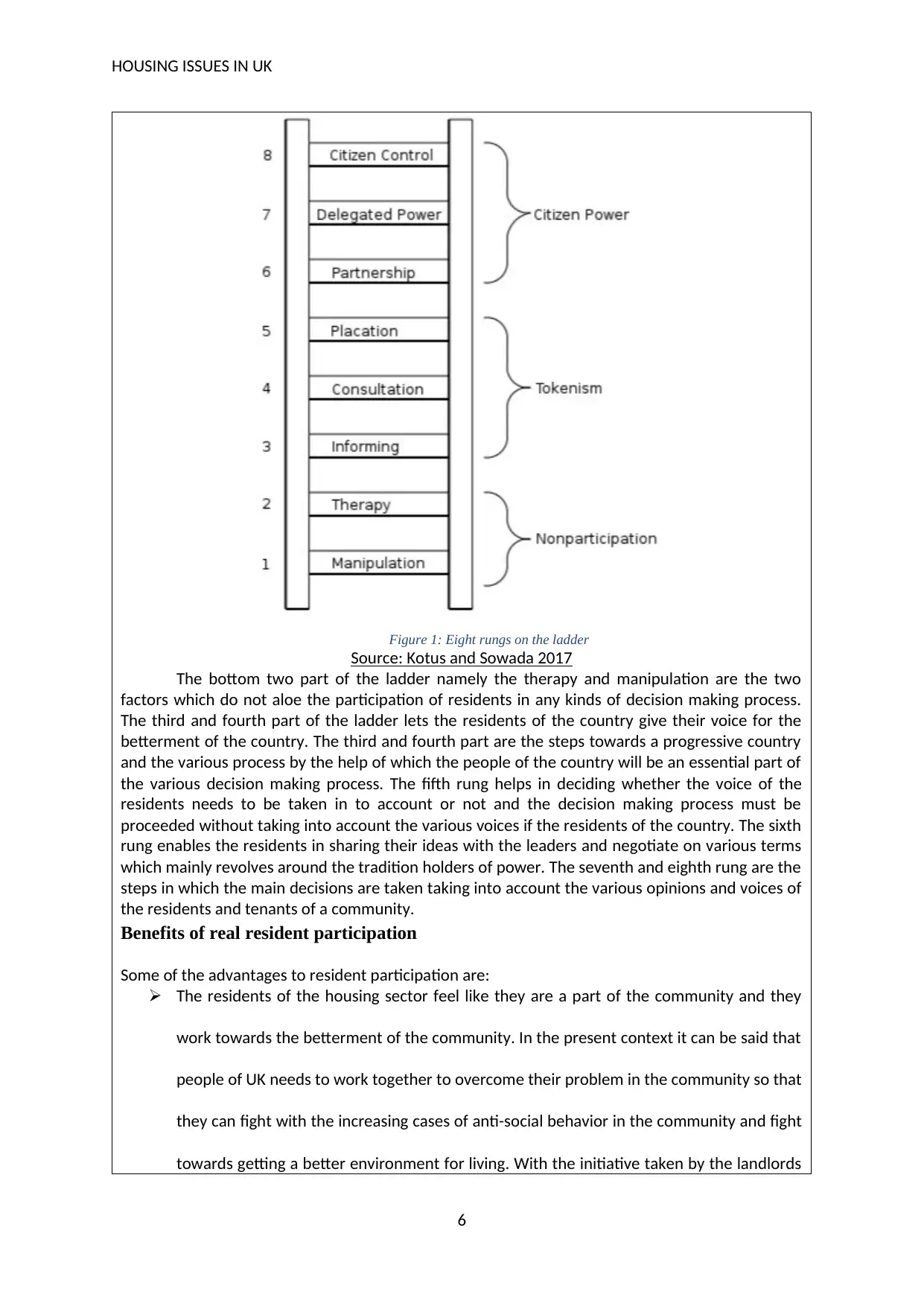
Arnstein made use of a ladder to explain the different aspect of resident participation:
5
were one month behind their rent payment. All these tenants were receiver of universal credit.
Two-real world examples
Pinnacle PSG have been awarded as the best contract of housing management by
Hammersmith and Fulham Council for providing best services to the tenants. Customer
services which were provided by PSG have been very good and a lot of tenants in the
housings have appreciated the efforts (London.gov.uk 2020). The various process by
which PSG have handled the tenancy management and snit-social behavior I the area
have provided a better life for the tenants. There have been proper engagement of
resident in the place along with cleaning of the estate in regular intervals.
JMB leathermarket have been providing better services to the tenants over the years
(London.gov.uk 2020). The various functions of JMB includes collecting rents and taking
care of the tenants who are residing in the area.
Part B
Resident participation
Resident participation can be defined as the involvement of the resident of a country in shaping
the structure of the country. The distribution of power among the citizen must be done equally
since they are a major part of the country. Resident participation aids in improving the process by
the aid of which the redistribution of power is done among the individuals who are not given the
power initially. Starting from economic to political power, the power must be distributed among
the residents of the country (Kotus and Sowada 2017). With the help of this process there will be
gathering of different kinds of opinion and ideas in determining the future steps to be taken by
the country in shaping it. The various goals of the country will be set by the residents and the
various resources of the tax will be allocated in accordance to the need of the country. Various
programs will be operated in a proper way and other benefits like contracts and patronage will be
solved in a proper way. With the implementation of involving the residents of a country there will
be a significant reform in the society and there will be an existence of affluent society. The people
of country must be given the similar rights as compared to other leaders of the country so that the
decisions which will be taken about the future of a country will be done in a proper way and the
people of the country feel like they are a part of the country and they will be operating as a
responsible citizen of the country.
Arnstein made use of a ladder to explain the different aspect of resident participation:
5
⊘ This is a preview!⊘
Do you want full access?
Subscribe today to unlock all pages.
Trusted by 1+ million students worldwide
HOUSING ISSUES IN UK
Figure 1: Eight rungs on the ladder
Source: Kotus and Sowada 2017
The bottom two part of the ladder namely the therapy and manipulation are the two
factors which do not aloe the participation of residents in any kinds of decision making process.
The third and fourth part of the ladder lets the residents of the country give their voice for the
betterment of the country. The third and fourth part are the steps towards a progressive country
and the various process by the help of which the people of the country will be an essential part of
the various decision making process. The fifth rung helps in deciding whether the voice of the
residents needs to be taken in to account or not and the decision making process must be
proceeded without taking into account the various voices if the residents of the country. The sixth
rung enables the residents in sharing their ideas with the leaders and negotiate on various terms
which mainly revolves around the tradition holders of power. The seventh and eighth rung are the
steps in which the main decisions are taken taking into account the various opinions and voices of
the residents and tenants of a community.
Benefits of real resident participation
Some of the advantages to resident participation are:
The residents of the housing sector feel like they are a part of the community and they
work towards the betterment of the community. In the present context it can be said that
people of UK needs to work together to overcome their problem in the community so that
they can fight with the increasing cases of anti-social behavior in the community and fight
towards getting a better environment for living. With the initiative taken by the landlords
6
Figure 1: Eight rungs on the ladder
Source: Kotus and Sowada 2017
The bottom two part of the ladder namely the therapy and manipulation are the two
factors which do not aloe the participation of residents in any kinds of decision making process.
The third and fourth part of the ladder lets the residents of the country give their voice for the
betterment of the country. The third and fourth part are the steps towards a progressive country
and the various process by the help of which the people of the country will be an essential part of
the various decision making process. The fifth rung helps in deciding whether the voice of the
residents needs to be taken in to account or not and the decision making process must be
proceeded without taking into account the various voices if the residents of the country. The sixth
rung enables the residents in sharing their ideas with the leaders and negotiate on various terms
which mainly revolves around the tradition holders of power. The seventh and eighth rung are the
steps in which the main decisions are taken taking into account the various opinions and voices of
the residents and tenants of a community.
Benefits of real resident participation
Some of the advantages to resident participation are:
The residents of the housing sector feel like they are a part of the community and they
work towards the betterment of the community. In the present context it can be said that
people of UK needs to work together to overcome their problem in the community so that
they can fight with the increasing cases of anti-social behavior in the community and fight
towards getting a better environment for living. With the initiative taken by the landlords
6
Paraphrase This Document
Need a fresh take? Get an instant paraphrase of this document with our AI Paraphraser
HOUSING ISSUES IN UK
in involving individuals in taking their views into account the tenants will feel like they
belong to the community and they will work towards the betterment of the community.
If the decision making process about the various changes in the community is
implemented with the help of the tenants then there will be a presence of changes in the
attitudes of the local community. There will be feeling of mutual understanding among
the people of the community and they will be working together in becoming a peaceful
and united community (Jarvis 2015). If the council of the households manage all the
decision themselves then the various needs of the tenants will not be met and they will
not be happy with the landlords.
With the involvement of the residents in the decision making process the managers of the
housing community feel confident that they are taking the right decision in making the
people happy and the end result of the decision will be for all the tenants in the
community.
With the involvement of the tenants there will be significant improve in the building skills
as well as capacity in them. These set of skills will then be used by the individuals in their
works as well as education. With the implementation of involvement of the tenants the
children in the community will be learning about the various aspects of equality and
staying strong together.
With the involvement of tenants in the community there will be significant increase in the
money achieved. The various services of tenants in the goods and procurement methods
will be a very great revenue generator. A lot of money of the landlord will be saved with
the inclusion of tenants as the landlord will be defied of the taking wrong steps for the
betterment of the people and the community. The landlord of the community will be
aiming in getting better functions from the tenants and also help the tenants in achieving
better goals for their life.
The most important outcome from the involvement of the tenants in the community
7
in involving individuals in taking their views into account the tenants will feel like they
belong to the community and they will work towards the betterment of the community.
If the decision making process about the various changes in the community is
implemented with the help of the tenants then there will be a presence of changes in the
attitudes of the local community. There will be feeling of mutual understanding among
the people of the community and they will be working together in becoming a peaceful
and united community (Jarvis 2015). If the council of the households manage all the
decision themselves then the various needs of the tenants will not be met and they will
not be happy with the landlords.
With the involvement of the residents in the decision making process the managers of the
housing community feel confident that they are taking the right decision in making the
people happy and the end result of the decision will be for all the tenants in the
community.
With the involvement of the tenants there will be significant improve in the building skills
as well as capacity in them. These set of skills will then be used by the individuals in their
works as well as education. With the implementation of involvement of the tenants the
children in the community will be learning about the various aspects of equality and
staying strong together.
With the involvement of tenants in the community there will be significant increase in the
money achieved. The various services of tenants in the goods and procurement methods
will be a very great revenue generator. A lot of money of the landlord will be saved with
the inclusion of tenants as the landlord will be defied of the taking wrong steps for the
betterment of the people and the community. The landlord of the community will be
aiming in getting better functions from the tenants and also help the tenants in achieving
better goals for their life.
The most important outcome from the involvement of the tenants in the community
7

HOUSING ISSUES IN UK
decision makings is that there will be an implementation of morale among the local
community. With the increased contact with the tenants the staffs of the housing
committee feel comfortable in taking their decisions and they are more loosened in their
job (Lang and Novy 2014). With the feeling of doing something good for the community it
becomes easier for the officials in taking better decisions for the community and also
ensure that the people living in the community are given proper attention.
With the involvement of the tenants the local spots will be under constant supervision. If
the people of the community are thinking together then they will be working together in
protecting the various places surrounding the community (Taylor 2018). There will be
presence of lesser pollution as the people will be more concerned about the safety and
sincerity of the place they are residing in.
There will be a presence of unity among the people and they will be celebrating festivals
together. The various changes which needs to be brought about in the houses will be
stated by the tenants to the landlord and the landlord does not need to hire special
officers for the job. With the inclusion of the tenants in the decision making process the
perfect step which needs to be taken to take care of the people in the community will be
stated by the tenants and the landlord will not have to come up with solutions to solve
certain problems (Darcy and Manzi 2017).
Two real world examples
Optivo have been actively taking into account the views of residents in making various
decisions. A pathless systems have been created by Optivo in collaboration with the
residents. A proper implementation of the patchless system have been rolled out by
Optivo (London.gov.uk 2020). In addition to the housing officers for the project Optivo
implemented a special tem which was taking in consideration the various financial needs
of the residents in the place and their various views on the project. The views of the
residents have been actively taken into consideration for the completion of this project
which is the reason it might be successful in the future.
For redesigning the residents in the area Kingston Council have made use of co-design
approach in which the views of the residents have been taken into account
(London.gov.uk 2020). For the successful implementation of the project the various use of
ideas of the housing officers and residents have been taken into account. This facilitated a
good relationship between the residents and the housing officials. The residents of the
8
decision makings is that there will be an implementation of morale among the local
community. With the increased contact with the tenants the staffs of the housing
committee feel comfortable in taking their decisions and they are more loosened in their
job (Lang and Novy 2014). With the feeling of doing something good for the community it
becomes easier for the officials in taking better decisions for the community and also
ensure that the people living in the community are given proper attention.
With the involvement of the tenants the local spots will be under constant supervision. If
the people of the community are thinking together then they will be working together in
protecting the various places surrounding the community (Taylor 2018). There will be
presence of lesser pollution as the people will be more concerned about the safety and
sincerity of the place they are residing in.
There will be a presence of unity among the people and they will be celebrating festivals
together. The various changes which needs to be brought about in the houses will be
stated by the tenants to the landlord and the landlord does not need to hire special
officers for the job. With the inclusion of the tenants in the decision making process the
perfect step which needs to be taken to take care of the people in the community will be
stated by the tenants and the landlord will not have to come up with solutions to solve
certain problems (Darcy and Manzi 2017).
Two real world examples
Optivo have been actively taking into account the views of residents in making various
decisions. A pathless systems have been created by Optivo in collaboration with the
residents. A proper implementation of the patchless system have been rolled out by
Optivo (London.gov.uk 2020). In addition to the housing officers for the project Optivo
implemented a special tem which was taking in consideration the various financial needs
of the residents in the place and their various views on the project. The views of the
residents have been actively taken into consideration for the completion of this project
which is the reason it might be successful in the future.
For redesigning the residents in the area Kingston Council have made use of co-design
approach in which the views of the residents have been taken into account
(London.gov.uk 2020). For the successful implementation of the project the various use of
ideas of the housing officers and residents have been taken into account. This facilitated a
good relationship between the residents and the housing officials. The residents of the
8
⊘ This is a preview!⊘
Do you want full access?
Subscribe today to unlock all pages.
Trusted by 1+ million students worldwide

HOUSING ISSUES IN UK
place also felt like their views are taken into account by their social landlords.
9
place also felt like their views are taken into account by their social landlords.
9
Paraphrase This Document
Need a fresh take? Get an instant paraphrase of this document with our AI Paraphraser
HOUSING ISSUES IN UK
Reference List
Alati, R., Baker, P., Betts, K.S., Connor, J.P., Little, K., Sanson, A. and Olsson, C.A., 2014. The role of
parental alcohol use, parental discipline and antisocial behaviour on adolescent drinking trajectories.
Drug and alcohol dependence, 134, pp.178-184.
Brewer, M. and De Agostini, P., 2015. Credit crunched: Single parents, universal credit and the
struggle to make work pay (No. EM3/15). EUROMOD Working Paper.
Cullen, S., 2020. Back On Track: A Good Practice Guide To Addressing Anti-Social Behaviour - Shelter
England. [online] England.shelter.org.uk. Available at:
<http://england.shelter.org.uk/professional_resources/policy_and_research/policy_library/
policy_library_folder/back_on_track_a_good_practice_guide_to_addressing_anti-social_behaviour>
[Accessed 15 April 2020].
Darcy, M. and Manzi, T., 2017. Organisational research: conflict and power within UK and Australian
social housing organisations. In Social constructionism in housing research (pp. 142-158). Routledge.
Dwyer, P. and Wright, S., 2014. Universal credit, ubiquitous conditionality and its implications for
social citizenship. The Journal of Poverty and Social Justice, 22(1), p.27.
Flint, J., 2017. Foucault’s duel: Constructed narratives and webs of meaning in anti-social behaviour
and welfare benefits governance in the United Kingdom. In Decentring Urban Governance (pp. 15-
37). Routledge.
Flint, J., Batty, E. and McNeill, E., 2016. First Wave Findings: Anti-social Behaviour. York: University of
York.
Haller, J., Harold, G., Sandi, C. and Neumann, I.D., 2014. Effects of adverse early life events on‐
aggression and anti social behaviours in animals and humans.‐ Journal of neuroendocrinology, 26(10),
pp.724-738.
Jarvis, H., 2015. Community led housing and ‘slow’opposition to corporate development: citizen‐
participation as common ground?. Geography Compass, 9(4), pp.202-213.
10
Reference List
Alati, R., Baker, P., Betts, K.S., Connor, J.P., Little, K., Sanson, A. and Olsson, C.A., 2014. The role of
parental alcohol use, parental discipline and antisocial behaviour on adolescent drinking trajectories.
Drug and alcohol dependence, 134, pp.178-184.
Brewer, M. and De Agostini, P., 2015. Credit crunched: Single parents, universal credit and the
struggle to make work pay (No. EM3/15). EUROMOD Working Paper.
Cullen, S., 2020. Back On Track: A Good Practice Guide To Addressing Anti-Social Behaviour - Shelter
England. [online] England.shelter.org.uk. Available at:
<http://england.shelter.org.uk/professional_resources/policy_and_research/policy_library/
policy_library_folder/back_on_track_a_good_practice_guide_to_addressing_anti-social_behaviour>
[Accessed 15 April 2020].
Darcy, M. and Manzi, T., 2017. Organisational research: conflict and power within UK and Australian
social housing organisations. In Social constructionism in housing research (pp. 142-158). Routledge.
Dwyer, P. and Wright, S., 2014. Universal credit, ubiquitous conditionality and its implications for
social citizenship. The Journal of Poverty and Social Justice, 22(1), p.27.
Flint, J., 2017. Foucault’s duel: Constructed narratives and webs of meaning in anti-social behaviour
and welfare benefits governance in the United Kingdom. In Decentring Urban Governance (pp. 15-
37). Routledge.
Flint, J., Batty, E. and McNeill, E., 2016. First Wave Findings: Anti-social Behaviour. York: University of
York.
Haller, J., Harold, G., Sandi, C. and Neumann, I.D., 2014. Effects of adverse early life events on‐
aggression and anti social behaviours in animals and humans.‐ Journal of neuroendocrinology, 26(10),
pp.724-738.
Jarvis, H., 2015. Community led housing and ‘slow’opposition to corporate development: citizen‐
participation as common ground?. Geography Compass, 9(4), pp.202-213.
10
HOUSING ISSUES IN UK
Kotus, J. and Sowada, T., 2017. Behavioural model of collaborative urban management: extending
the concept of Arnstein's ladder. Cities, 65, pp.78-86.
Lang, R. and Novy, A., 2014. Cooperative housing and social cohesion: The role of linking social
capital. European Planning Studies, 22(8), pp.1744-1764.
London.gov.uk. 2020. [online] Available at:
<https://www.london.gov.uk/sites/default/files/06.11.2018_london_assembly_housing_committee_
report__0.pdf> [Accessed 15 April 2020].
Omar, A., Weerakkody, V. and Sivarajah, U., 2017. Digitally enabled service transformation in UK
public sector: A case analysis of universal credit. International Journal of Information Management,
37(4), pp.350-356.
San Pedro, J., Proserpio, D. and Oliver, N., 2015, June. MobiScore: towards universal credit scoring
from mobile phone data. In international conference on user modeling, adaptation, and
personalization (pp. 195-207). Springer, Cham.
Taylor, M., 2018. Achieving community participation: the experience of resident involvement in
urban regeneration in the UK. In Community and Sustainable Development (pp. 163-181). Routledge.
11
Kotus, J. and Sowada, T., 2017. Behavioural model of collaborative urban management: extending
the concept of Arnstein's ladder. Cities, 65, pp.78-86.
Lang, R. and Novy, A., 2014. Cooperative housing and social cohesion: The role of linking social
capital. European Planning Studies, 22(8), pp.1744-1764.
London.gov.uk. 2020. [online] Available at:
<https://www.london.gov.uk/sites/default/files/06.11.2018_london_assembly_housing_committee_
report__0.pdf> [Accessed 15 April 2020].
Omar, A., Weerakkody, V. and Sivarajah, U., 2017. Digitally enabled service transformation in UK
public sector: A case analysis of universal credit. International Journal of Information Management,
37(4), pp.350-356.
San Pedro, J., Proserpio, D. and Oliver, N., 2015, June. MobiScore: towards universal credit scoring
from mobile phone data. In international conference on user modeling, adaptation, and
personalization (pp. 195-207). Springer, Cham.
Taylor, M., 2018. Achieving community participation: the experience of resident involvement in
urban regeneration in the UK. In Community and Sustainable Development (pp. 163-181). Routledge.
11
⊘ This is a preview!⊘
Do you want full access?
Subscribe today to unlock all pages.
Trusted by 1+ million students worldwide

1 out of 12


Related Documents


Your All-in-One AI-Powered Toolkit for Academic Success.
+13062052269
info@desklib.com
Available 24*7 on WhatsApp / Email
![[object Object]](/_next/static/media/star-bottom.7253800d.svg)
Unlock your academic potential
Copyright © 2020–2026 A2Z Services. All Rights Reserved. Developed and managed by ZUCOL.