Validation of HPLC Method for Cocaine and Metabolites Analysis

Verified

Added on  2020/04/15

|3
|675
|57
Report
AI Summary
This report details the validation of a High-Performance Liquid Chromatography (HPLC) method for the quantitative analysis of cocaine and its metabolites (benzoylecgonine, norcocaine, and cocaethylene) in human urine samples. The method utilizes UV detection and a cation exchange extraction column to isolate the analytes. The study establishes the linearity of the method with calibration curves ranging from 50 to 1500 ng/ml, achieving correlation coefficients of at least 0.99 for each analyte. The report presents data on intraday and interday variability, extraction recovery, and the limits of detection (LOD) and quantification (LOQ) for each compound. The extraction recovery was optimized to more than 80%, and the LOD was determined to be 1 ng/ml while LOQ was 10 ng/ml for all analytes. The study concludes that the validated HPLC method is sensitive and precise for the analysis of cocaine and its metabolites, supported by references to relevant literature.
Document Page
Analytical Method Validation
1
tabler-icon-diamond-filled.svg

Paraphrase This Document

Need a fresh take? Get an instant paraphrase of this document with our AI Paraphraser
Document Page
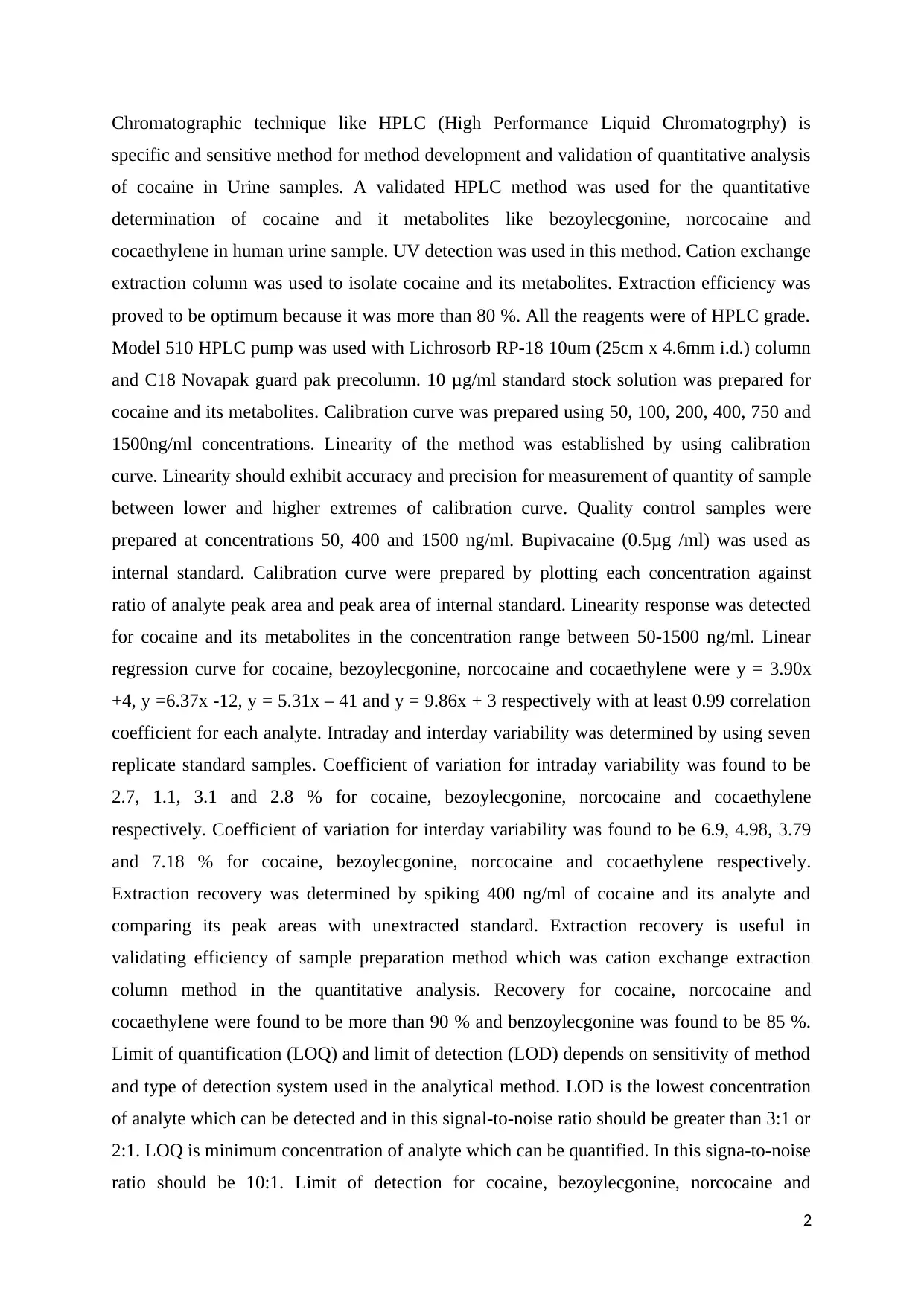
Chromatographic technique like HPLC (High Performance Liquid Chromatogrphy) is
specific and sensitive method for method development and validation of quantitative analysis
of cocaine in Urine samples. A validated HPLC method was used for the quantitative
determination of cocaine and it metabolites like bezoylecgonine, norcocaine and
cocaethylene in human urine sample. UV detection was used in this method. Cation exchange
extraction column was used to isolate cocaine and its metabolites. Extraction efficiency was
proved to be optimum because it was more than 80 %. All the reagents were of HPLC grade.
Model 510 HPLC pump was used with Lichrosorb RP-18 10um (25cm x 4.6mm i.d.) column
and C18 Novapak guard pak precolumn. 10 μg/ml standard stock solution was prepared for
cocaine and its metabolites. Calibration curve was prepared using 50, 100, 200, 400, 750 and
1500ng/ml concentrations. Linearity of the method was established by using calibration
curve. Linearity should exhibit accuracy and precision for measurement of quantity of sample
between lower and higher extremes of calibration curve. Quality control samples were
prepared at concentrations 50, 400 and 1500 ng/ml. Bupivacaine (0.5μg /ml) was used as
internal standard. Calibration curve were prepared by plotting each concentration against
ratio of analyte peak area and peak area of internal standard. Linearity response was detected
for cocaine and its metabolites in the concentration range between 50-1500 ng/ml. Linear
regression curve for cocaine, bezoylecgonine, norcocaine and cocaethylene were y = 3.90x
+4, y =6.37x -12, y = 5.31x – 41 and y = 9.86x + 3 respectively with at least 0.99 correlation
coefficient for each analyte. Intraday and interday variability was determined by using seven
replicate standard samples. Coefficient of variation for intraday variability was found to be
2.7, 1.1, 3.1 and 2.8 % for cocaine, bezoylecgonine, norcocaine and cocaethylene
respectively. Coefficient of variation for interday variability was found to be 6.9, 4.98, 3.79
and 7.18 % for cocaine, bezoylecgonine, norcocaine and cocaethylene respectively.
Extraction recovery was determined by spiking 400 ng/ml of cocaine and its analyte and
comparing its peak areas with unextracted standard. Extraction recovery is useful in
validating efficiency of sample preparation method which was cation exchange extraction
column method in the quantitative analysis. Recovery for cocaine, norcocaine and
cocaethylene were found to be more than 90 % and benzoylecgonine was found to be 85 %.
Limit of quantification (LOQ) and limit of detection (LOD) depends on sensitivity of method
and type of detection system used in the analytical method. LOD is the lowest concentration
of analyte which can be detected and in this signal-to-noise ratio should be greater than 3:1 or
2:1. LOQ is minimum concentration of analyte which can be quantified. In this signa-to-noise
ratio should be 10:1. Limit of detection for cocaine, bezoylecgonine, norcocaine and
2
Document Page
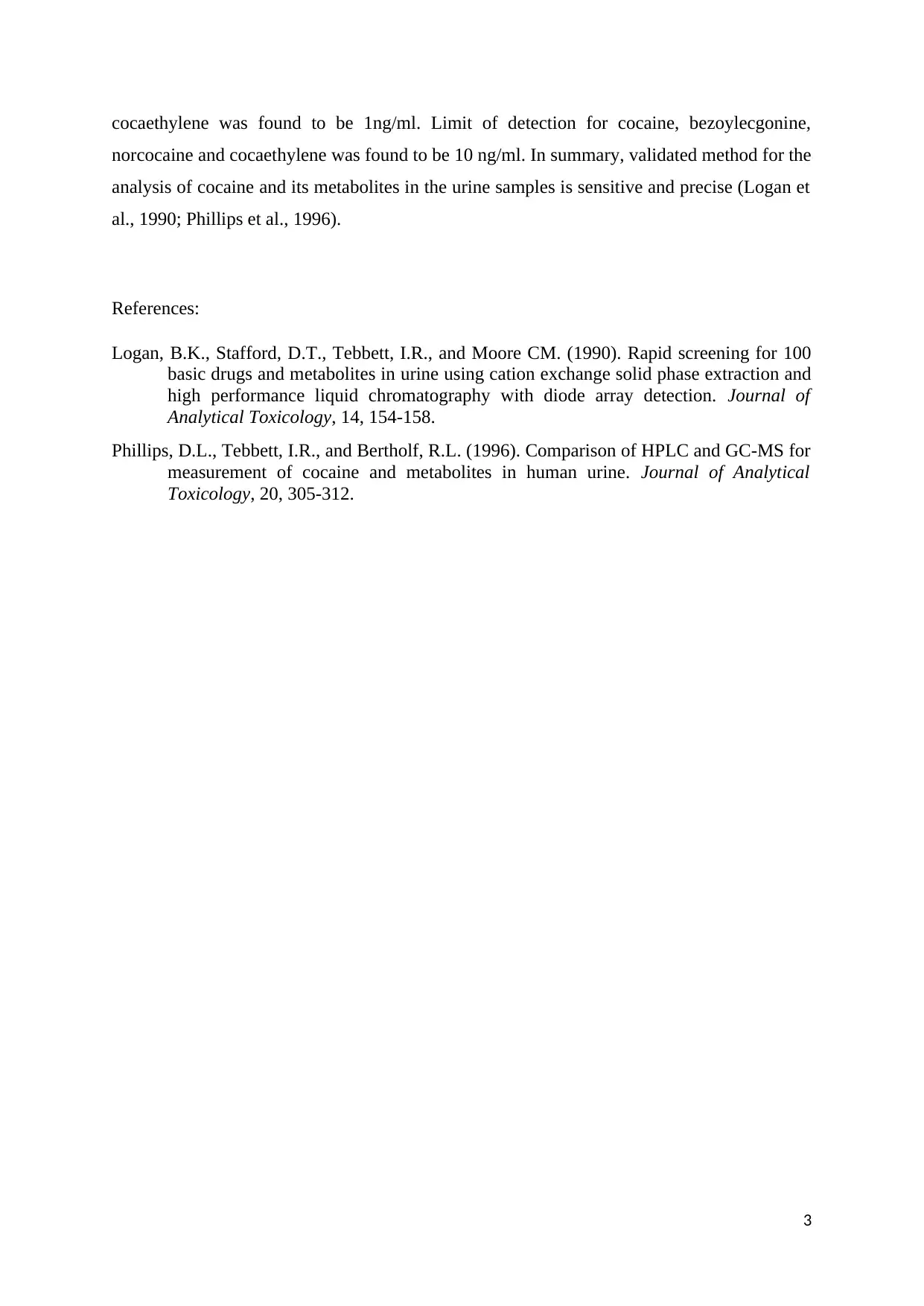
cocaethylene was found to be 1ng/ml. Limit of detection for cocaine, bezoylecgonine,
norcocaine and cocaethylene was found to be 10 ng/ml. In summary, validated method for the
analysis of cocaine and its metabolites in the urine samples is sensitive and precise (Logan et
al., 1990; Phillips et al., 1996).
References:
Logan, B.K., Stafford, D.T., Tebbett, I.R., and Moore CM. (1990). Rapid screening for 100
basic drugs and metabolites in urine using cation exchange solid phase extraction and
high performance liquid chromatography with diode array detection. Journal of
Analytical Toxicology, 14, 154-158.
Phillips, D.L., Tebbett, I.R., and Bertholf, R.L. (1996). Comparison of HPLC and GC-MS for
measurement of cocaine and metabolites in human urine. Journal of Analytical
Toxicology, 20, 305-312.
3
chevron_up_icon
1 out of 3
circle_padding
hide_on_mobile
zoom_out_icon
[object Object]