Assessing Vibration Hazard Awareness and HAVS in HPWJ Workers Report
VerifiedAdded on 2021/04/16
|57
|11440
|189
Report
AI Summary
This report investigates the awareness of vibration hazards and Hand-Arm Vibration Syndrome (HAVS) among personnel involved in High-Pressure Water Jetting (HPWJ), focusing on a case study at Dyna-Jet Pte Ltd. The research assesses the knowledge, attitudes, and beliefs of workers and supervisors regarding the health impacts of prolonged HPWJ operation. It reviews local regulations and international standards to evaluate the adequacy of current risk management practices. The study aims to identify gaps in awareness and recommend potential solutions and control measures to mitigate vibration hazards. The report includes a literature review on HAVS, a detailed methodology section outlining the survey-based research design, and a data analysis chapter presenting findings from workers, supervisors, and operational managers. The conclusion offers recommendations for improving worker safety and health outcomes related to HPWJ operations.
Are Personnel Involved in High Pressure Water Jetting (HPWJ) Aware of Vibration
Hazard Causing Hand Arm Vibration Syndrome (HAVS)?
Hazard Causing Hand Arm Vibration Syndrome (HAVS)?

Paraphrase This Document
Need a fresh take? Get an instant paraphrase of this document with our AI Paraphraser
1
Executive summary
Prolonged use of hand-held vibration instruments and tools has been found to result in hand-arm
vibration syndrome (HAVS). This syndrome is commonly manifested by neurological, vascular
or musculoskeletal abnormalities. Owing to the high prevalence of HAVS among workers who
operate powerful tools, such as high pressure water jet engines, the desire to conduct a review for
evaluating awareness on the condition was developed. The research is based on a survey that is
conducted in a company Dyna-Jet Pte Ltdthat operates in the oil and petrochemical sector. The
company has a range of services, one of which includes high pressure water jetting that currently
employs 40 workers. The research is aimed to investigate the knowledge, attitude and beliefs of
the workers and their supervisors regarding the impact on prolonged operation of HPWJ on the
overall health and wellbeing of the individuals, with the use of surveys. Furthermore, the survey
will also help in assessing awareness of the participants on occurrence of hand-arm vibration
syndrome due to their nature of work.
Executive summary
Prolonged use of hand-held vibration instruments and tools has been found to result in hand-arm
vibration syndrome (HAVS). This syndrome is commonly manifested by neurological, vascular
or musculoskeletal abnormalities. Owing to the high prevalence of HAVS among workers who
operate powerful tools, such as high pressure water jet engines, the desire to conduct a review for
evaluating awareness on the condition was developed. The research is based on a survey that is
conducted in a company Dyna-Jet Pte Ltdthat operates in the oil and petrochemical sector. The
company has a range of services, one of which includes high pressure water jetting that currently
employs 40 workers. The research is aimed to investigate the knowledge, attitude and beliefs of
the workers and their supervisors regarding the impact on prolonged operation of HPWJ on the
overall health and wellbeing of the individuals, with the use of surveys. Furthermore, the survey
will also help in assessing awareness of the participants on occurrence of hand-arm vibration
syndrome due to their nature of work.
2
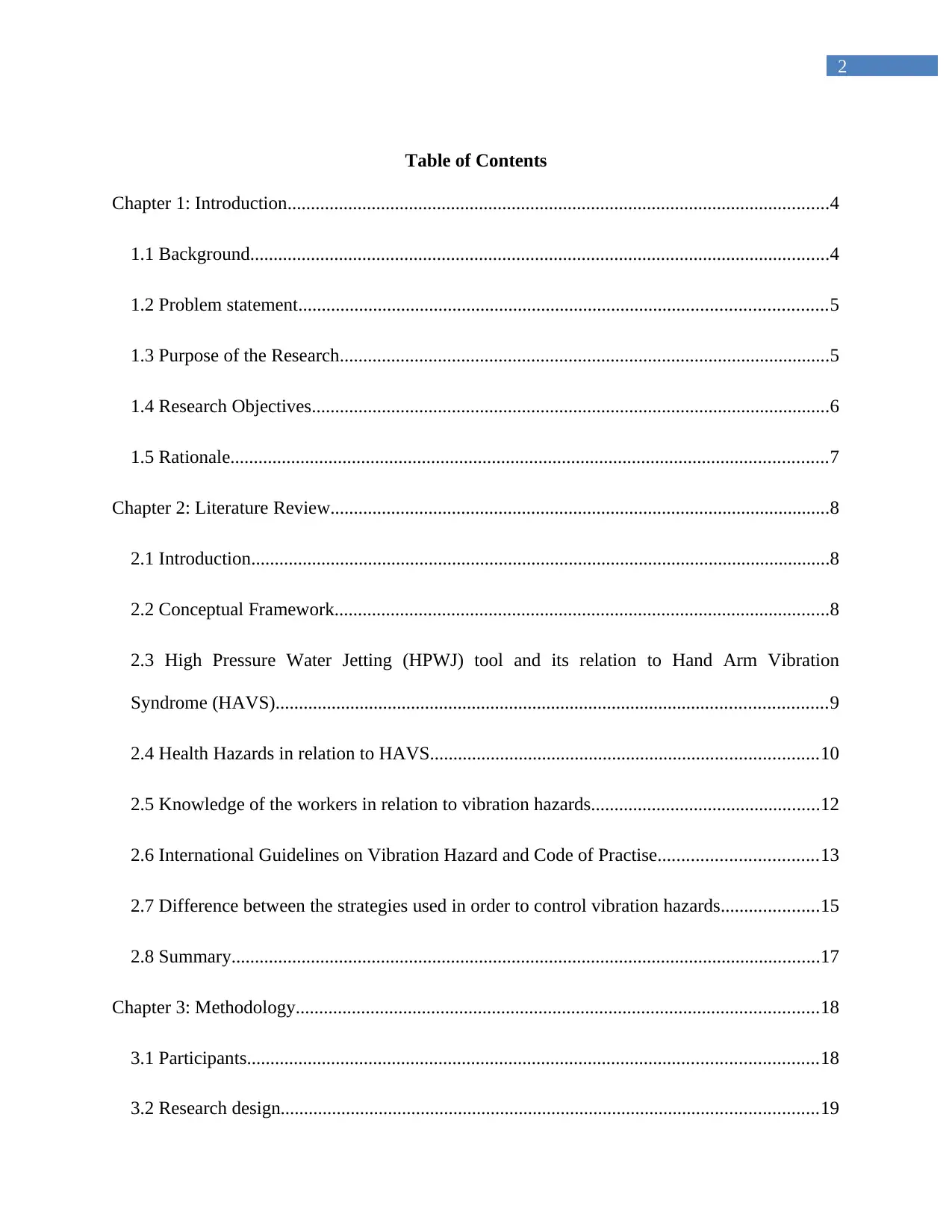
Table of Contents
Chapter 1: Introduction....................................................................................................................4
1.1 Background............................................................................................................................4
1.2 Problem statement.................................................................................................................5
1.3 Purpose of the Research.........................................................................................................5
1.4 Research Objectives...............................................................................................................6
1.5 Rationale................................................................................................................................7
Chapter 2: Literature Review...........................................................................................................8
2.1 Introduction............................................................................................................................8
2.2 Conceptual Framework..........................................................................................................8
2.3 High Pressure Water Jetting (HPWJ) tool and its relation to Hand Arm Vibration
Syndrome (HAVS)......................................................................................................................9
2.4 Health Hazards in relation to HAVS...................................................................................10
2.5 Knowledge of the workers in relation to vibration hazards.................................................12
2.6 International Guidelines on Vibration Hazard and Code of Practise..................................13
2.7 Difference between the strategies used in order to control vibration hazards.....................15
2.8 Summary..............................................................................................................................17
Chapter 3: Methodology................................................................................................................18
3.1 Participants..........................................................................................................................18
3.2 Research design...................................................................................................................19
Table of Contents
Chapter 1: Introduction....................................................................................................................4
1.1 Background............................................................................................................................4
1.2 Problem statement.................................................................................................................5
1.3 Purpose of the Research.........................................................................................................5
1.4 Research Objectives...............................................................................................................6
1.5 Rationale................................................................................................................................7
Chapter 2: Literature Review...........................................................................................................8
2.1 Introduction............................................................................................................................8
2.2 Conceptual Framework..........................................................................................................8
2.3 High Pressure Water Jetting (HPWJ) tool and its relation to Hand Arm Vibration
Syndrome (HAVS)......................................................................................................................9
2.4 Health Hazards in relation to HAVS...................................................................................10
2.5 Knowledge of the workers in relation to vibration hazards.................................................12
2.6 International Guidelines on Vibration Hazard and Code of Practise..................................13
2.7 Difference between the strategies used in order to control vibration hazards.....................15
2.8 Summary..............................................................................................................................17
Chapter 3: Methodology................................................................................................................18
3.1 Participants..........................................................................................................................18
3.2 Research design...................................................................................................................19
⊘ This is a preview!⊘
Do you want full access?
Subscribe today to unlock all pages.

Trusted by 1+ million students worldwide
3
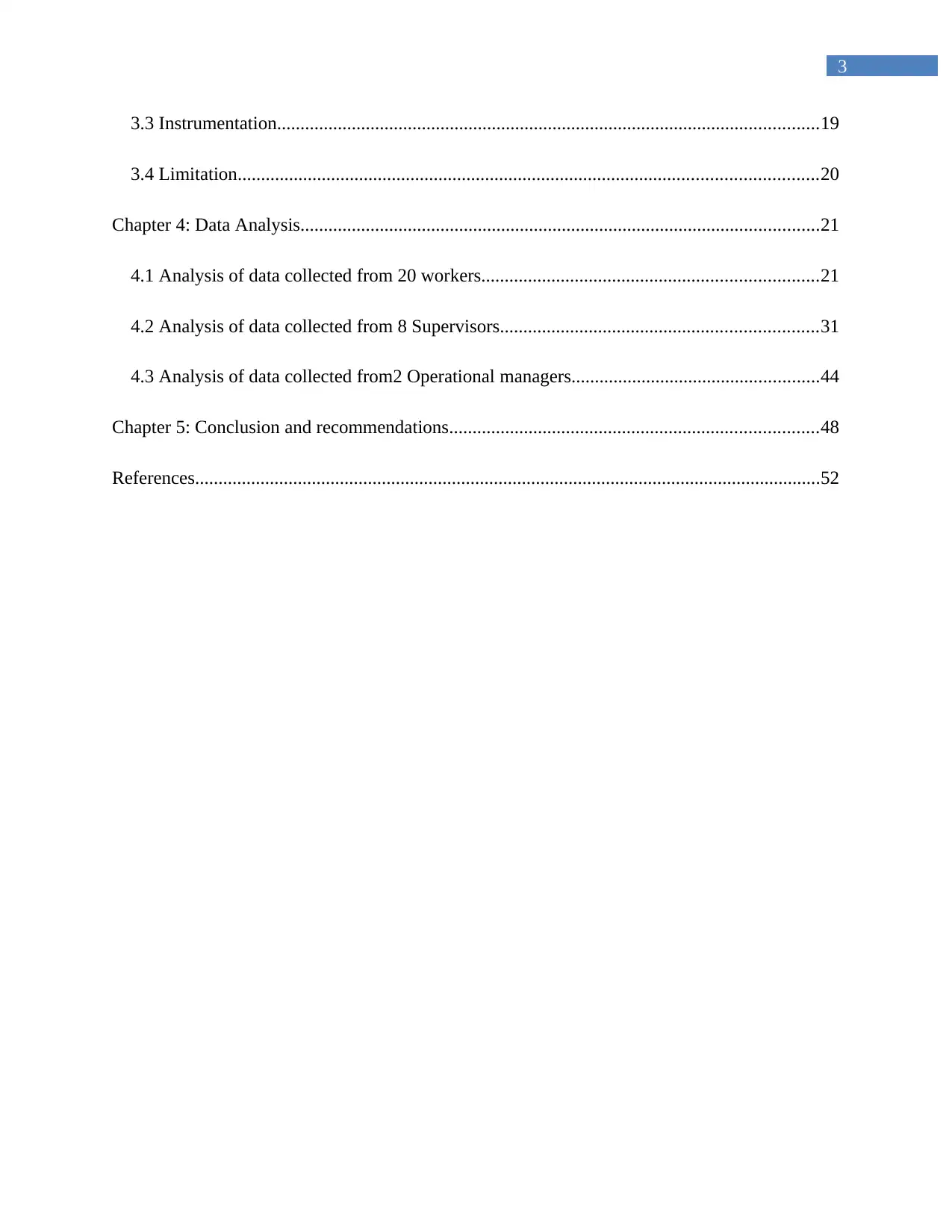
3.3 Instrumentation....................................................................................................................19
3.4 Limitation............................................................................................................................20
Chapter 4: Data Analysis...............................................................................................................21
4.1 Analysis of data collected from 20 workers........................................................................21
4.2 Analysis of data collected from 8 Supervisors....................................................................31
4.3 Analysis of data collected from2 Operational managers.....................................................44
Chapter 5: Conclusion and recommendations...............................................................................48
References......................................................................................................................................52
3.3 Instrumentation....................................................................................................................19
3.4 Limitation............................................................................................................................20
Chapter 4: Data Analysis...............................................................................................................21
4.1 Analysis of data collected from 20 workers........................................................................21
4.2 Analysis of data collected from 8 Supervisors....................................................................31
4.3 Analysis of data collected from2 Operational managers.....................................................44
Chapter 5: Conclusion and recommendations...............................................................................48
References......................................................................................................................................52
Paraphrase This Document
Need a fresh take? Get an instant paraphrase of this document with our AI Paraphraser
4
Chapter 1: Introduction
1.1 Background
Vibration refers to rapid back and forth or oscillating movements. Mechanical vibrators
that are utilized at work places are found to expose the workers to whole-body vibration (WBV)
or hand-arm vibration (HAV). Hand arm vibrations refer to conditions that occur among
individuals due to continuous use of hand-held power tools and are a major type of occupational
hazard. However, they are most often unrecognized by the organizations and government
authorities. Thus, according to the terms of occupational safety, hand arm vibrations are regarded
as a specific kind of occupational hazard and are directly responsible for causing hand arm
vibration syndrome among workers (Chiementin et al. 2013). While the effects of such
vibrations have been found to create adverse impacts on the health and overall wellbeing of
workers since many years, there is less concern over the damage it creates, upon comparison to
chemical and noise related occupational hazards. Hand arm vibration syndrome can be defined as
forms of industrial injuries that are triggered by prolonged and continuous use of vibration based
machinery in the hands. This is a widespread industrial disease and affects thousands of workers
globally (Rolke et al. 2013).
The condition is found to exert direct negative impacts on the functioning of nerves and
muscles. Furthermore, the blood vessels, joints of wrist, hands, and arms are also found to get
severely affected as a result of this condition. Dyna-Jet Pte Ltd is a company that acts as a
solution provider for unique and difficult cleaning problems that are most commonly found in
the oil and petrochemical sector. It offers a plethora of services that encompass underwater and
topside cleaning of various pipework, structures, and tanks (Dynajet.com.sg 2018). The specialty
Chapter 1: Introduction
1.1 Background
Vibration refers to rapid back and forth or oscillating movements. Mechanical vibrators
that are utilized at work places are found to expose the workers to whole-body vibration (WBV)
or hand-arm vibration (HAV). Hand arm vibrations refer to conditions that occur among
individuals due to continuous use of hand-held power tools and are a major type of occupational
hazard. However, they are most often unrecognized by the organizations and government
authorities. Thus, according to the terms of occupational safety, hand arm vibrations are regarded
as a specific kind of occupational hazard and are directly responsible for causing hand arm
vibration syndrome among workers (Chiementin et al. 2013). While the effects of such
vibrations have been found to create adverse impacts on the health and overall wellbeing of
workers since many years, there is less concern over the damage it creates, upon comparison to
chemical and noise related occupational hazards. Hand arm vibration syndrome can be defined as
forms of industrial injuries that are triggered by prolonged and continuous use of vibration based
machinery in the hands. This is a widespread industrial disease and affects thousands of workers
globally (Rolke et al. 2013).
The condition is found to exert direct negative impacts on the functioning of nerves and
muscles. Furthermore, the blood vessels, joints of wrist, hands, and arms are also found to get
severely affected as a result of this condition. Dyna-Jet Pte Ltd is a company that acts as a
solution provider for unique and difficult cleaning problems that are most commonly found in
the oil and petrochemical sector. It offers a plethora of services that encompass underwater and
topside cleaning of various pipework, structures, and tanks (Dynajet.com.sg 2018). The specialty
5
of the company is associated with cold cutting of concrete and steel. Its services include high
pressure water jetting, the effects of which in causing hand arm vibration syndrome will be
evaluated.
1.2 Problem statement
In Singapore the control requirement of the hazard is only briefly stated under The
Reduction of Vibration, WSH Regulations Part II of Singapore contain a brief overview of the
control requirements related to vibrational hazard. These have been included in the form of a
subtopic and included as a sub topic in the WSH Guidelines related to Improving Ergonomics in
the Workplace (Geiger et al. 2014). No particular codes of practice or regulations are followed in
Singapore for addressing such vibrational hazards. The Dyna-Jet Pte Ltd line of business that
focuses in high pressure water jetting has around 40 employees. High pressure water jetting has
been proved effective for cleaning (Dynajet.com.sg 2018). However, due to the high pressures
that are involved, this water jetting equipment can become potentially dangerous on incorrect
usage (Shen et al. 2013). A background investigation of the aforementioned company that has
provisions for HPWJ services suggests that the jetting machines operate at high pressure. These
pressures range from 15,000-40,000psi, for considerable period. Employees working in such
HWJ services are exposed constantly to vibration hazards. These systems discharge sprays of
water that flows at rates, which ranges between 1.5-10 gallons per minute (Hough 2016). Owing
to the fact that there is a lack of adequate guideline regarding safe operation of these
equipment’s, the key stakeholders can suffer damaging effects due to such vibration hazards.
1.3 Purpose of the Research
Hand arm vibration syndrome is avoidable and preventable. However, they are found to
create permanent damages, if undetected for a considerable period of time. This is a major cause
of the company is associated with cold cutting of concrete and steel. Its services include high
pressure water jetting, the effects of which in causing hand arm vibration syndrome will be
evaluated.
1.2 Problem statement
In Singapore the control requirement of the hazard is only briefly stated under The
Reduction of Vibration, WSH Regulations Part II of Singapore contain a brief overview of the
control requirements related to vibrational hazard. These have been included in the form of a
subtopic and included as a sub topic in the WSH Guidelines related to Improving Ergonomics in
the Workplace (Geiger et al. 2014). No particular codes of practice or regulations are followed in
Singapore for addressing such vibrational hazards. The Dyna-Jet Pte Ltd line of business that
focuses in high pressure water jetting has around 40 employees. High pressure water jetting has
been proved effective for cleaning (Dynajet.com.sg 2018). However, due to the high pressures
that are involved, this water jetting equipment can become potentially dangerous on incorrect
usage (Shen et al. 2013). A background investigation of the aforementioned company that has
provisions for HPWJ services suggests that the jetting machines operate at high pressure. These
pressures range from 15,000-40,000psi, for considerable period. Employees working in such
HWJ services are exposed constantly to vibration hazards. These systems discharge sprays of
water that flows at rates, which ranges between 1.5-10 gallons per minute (Hough 2016). Owing
to the fact that there is a lack of adequate guideline regarding safe operation of these
equipment’s, the key stakeholders can suffer damaging effects due to such vibration hazards.
1.3 Purpose of the Research
Hand arm vibration syndrome is avoidable and preventable. However, they are found to
create permanent damages, if undetected for a considerable period of time. This is a major cause
⊘ This is a preview!⊘
Do you want full access?
Subscribe today to unlock all pages.
Trusted by 1+ million students worldwide
6
of disabilities among workers and puts more than 2 million people at a risk of suffering negative
health consequences (Carlsson and Dahlin 2014). The most common damage include
impairments in the ability to perform fine work. Furthermore, it also triggers set of painful or
finger blanching attacks (House et al. 2014). The objective of this research is to enhance
knowledge about workplace vibration hazards and create an awareness on its potential effects
among workers or employees working with HPWJ in the company, Dyna-Jet Pte Ltd. Moreover,
the research also aims to assess knowledge of the existing employees regarding vibration
hazards, thereby gaining a deeper understanding of their perceptions and opinions. The research
will be carried out in a way that will facilitate collecting information from the local authorities
and regulations on the workplace hazard, thereby addressing the adequacy of the existing
guidelines. Due to the fact that mechanical automation has shown rapid advancements in all
developing nations of the world, especially in most countries of South East Asia, there is an
immediate need to address the aforementioned problem. Thus, early recognition of the hazard
will pave the way for prevention and management of the hazard and its associated health risks.
1.4 Research Objectives
The three principle objectives of the research activity include the following:
To assess current awareness level of all personnel involved in HPWJ using handheld
guns on Vibration hazards and HAVS – in order to understand how well the Vibration
hazard is and HAVS is perceived.
To review local regulations, code of practices and organization’s RMP on Vibration
hazard against International standards and industry best practices – in order to gauge
of disabilities among workers and puts more than 2 million people at a risk of suffering negative
health consequences (Carlsson and Dahlin 2014). The most common damage include
impairments in the ability to perform fine work. Furthermore, it also triggers set of painful or
finger blanching attacks (House et al. 2014). The objective of this research is to enhance
knowledge about workplace vibration hazards and create an awareness on its potential effects
among workers or employees working with HPWJ in the company, Dyna-Jet Pte Ltd. Moreover,
the research also aims to assess knowledge of the existing employees regarding vibration
hazards, thereby gaining a deeper understanding of their perceptions and opinions. The research
will be carried out in a way that will facilitate collecting information from the local authorities
and regulations on the workplace hazard, thereby addressing the adequacy of the existing
guidelines. Due to the fact that mechanical automation has shown rapid advancements in all
developing nations of the world, especially in most countries of South East Asia, there is an
immediate need to address the aforementioned problem. Thus, early recognition of the hazard
will pave the way for prevention and management of the hazard and its associated health risks.
1.4 Research Objectives
The three principle objectives of the research activity include the following:
To assess current awareness level of all personnel involved in HPWJ using handheld
guns on Vibration hazards and HAVS – in order to understand how well the Vibration
hazard is and HAVS is perceived.
To review local regulations, code of practices and organization’s RMP on Vibration
hazard against International standards and industry best practices – in order to gauge
Paraphrase This Document
Need a fresh take? Get an instant paraphrase of this document with our AI Paraphraser
7
adequacy, efficacy of current risk management and/or control of vibration hazard
involving HPWJ.
To examine the company’s risk management procedure on Vibration Hazard and
investigate the extent of mitigation that has been taken.
Recommend suitable, possible solutions and/or control measures on Vibration hazard and
HAVS.
1.5 Rationale
Hand arm vibrations are most commonly transmitted from an industrial site or workplace
to the hands and arms of several workers. They are generally caused due to prolonged operation
of hand-guided equipment, hand-held power tools, or holding heavy vibration instruments. The
most common symptoms apart from hand arm vibration syndrome include Raynaud’s syndrome
or white finger, tendinitis, and carpel tunnel syndrome (Su et al. 2012). These collective
symptoms are found to result in pain, and numbness in the fingers. High pressure water jetting
equipment are composeof a straight jet that emits a uniform stream of liquid through a circular
aperture. The typical energy of such straight jet nozzles are estimated to be around 20%. Thus,
the straight jets are found to be highly effective on brittle and hard deposits, thereby leading to
their subsequent shatter when hit by the jet device (Huang et al. 2012). Failure of the government
of Singapore in formulating and enforcing such laws directly lead to decreased awareness and
low level of knowledge among the workers, frequently exposed to such workplace vibration
threats. The research will first conduct a literature review and draw relevant information in
adequacy, efficacy of current risk management and/or control of vibration hazard
involving HPWJ.
To examine the company’s risk management procedure on Vibration Hazard and
investigate the extent of mitigation that has been taken.
Recommend suitable, possible solutions and/or control measures on Vibration hazard and
HAVS.
1.5 Rationale
Hand arm vibrations are most commonly transmitted from an industrial site or workplace
to the hands and arms of several workers. They are generally caused due to prolonged operation
of hand-guided equipment, hand-held power tools, or holding heavy vibration instruments. The
most common symptoms apart from hand arm vibration syndrome include Raynaud’s syndrome
or white finger, tendinitis, and carpel tunnel syndrome (Su et al. 2012). These collective
symptoms are found to result in pain, and numbness in the fingers. High pressure water jetting
equipment are composeof a straight jet that emits a uniform stream of liquid through a circular
aperture. The typical energy of such straight jet nozzles are estimated to be around 20%. Thus,
the straight jets are found to be highly effective on brittle and hard deposits, thereby leading to
their subsequent shatter when hit by the jet device (Huang et al. 2012). Failure of the government
of Singapore in formulating and enforcing such laws directly lead to decreased awareness and
low level of knowledge among the workers, frequently exposed to such workplace vibration
threats. The research will first conduct a literature review and draw relevant information in

8
regards to the research objective from recent literature articles, following which it will categories
the findings into themes that will help in drawing conclusion.
regards to the research objective from recent literature articles, following which it will categories
the findings into themes that will help in drawing conclusion.
⊘ This is a preview!⊘
Do you want full access?
Subscribe today to unlock all pages.
Trusted by 1+ million students worldwide
9
Chapter 2: Literature Review
2.1 Introduction
This is the second chapter of the dissertation and is mainly concerned with the core study
of health hazards associated with the high-pressure water jetting (HPWJ) with a special mention
to hand arm vibration syndrome (HAVS). This chapter provides the theoretical concept
underlying the HPWJ and HAVS in details. HPWJ is associated with numerous health related
vibration hazards, which give rise to HAVS (House 2010). However, awareness in the domain of
proper usage of HPWJ along with the observance of several precautions helps in reducing the
severity of the hazard(Arquero and Taylor 2016). The following chapter will help to the
researcher to understand the concept underlying the vibration hazard arising out of HPJW and
subsequent guidelines, which are required to be followed in order to avoid the development of
HAVS.
Chapter 2: Literature Review
2.1 Introduction
This is the second chapter of the dissertation and is mainly concerned with the core study
of health hazards associated with the high-pressure water jetting (HPWJ) with a special mention
to hand arm vibration syndrome (HAVS). This chapter provides the theoretical concept
underlying the HPWJ and HAVS in details. HPWJ is associated with numerous health related
vibration hazards, which give rise to HAVS (House 2010). However, awareness in the domain of
proper usage of HPWJ along with the observance of several precautions helps in reducing the
severity of the hazard(Arquero and Taylor 2016). The following chapter will help to the
researcher to understand the concept underlying the vibration hazard arising out of HPJW and
subsequent guidelines, which are required to be followed in order to avoid the development of
HAVS.
Paraphrase This Document
Need a fresh take? Get an instant paraphrase of this document with our AI Paraphraser
10
2.2 Conceptual Framework
2.3 High Pressure Water Jetting (HPWJ) tool and its relation to Hand Arm Vibration
Syndrome (HAVS)
Hand-arm vibration syndrome (HAVS) is a type of occupational disease which may
afflict workers who work via using hand-held vibrating tools (Nyantumbu et al. 2006). Hand-
arm-vibration is defined as the transfer of vibration from the HPWJ tool to the hand or arms of
the worker using the tool (Heaver et al. 2011). According to the reports published by House
(2010), HAVS is a common problem arising out of exposure to hand-arm vibration from HPWJ
tool. Heaver et al. (2011) have opined that at least 300,000 working days are lost every year in
UK because of HAVS related absenteeism. The reports published by US National Institute for
Occupational Safety and Health (1998) stated that stated that there lies a strong evidence of
positive association between high level of exposure of HAV and HAVS. The percentage of
HAVS resulting out of HPWJ is mainly common among the male in comparison to female. The
2.2 Conceptual Framework
2.3 High Pressure Water Jetting (HPWJ) tool and its relation to Hand Arm Vibration
Syndrome (HAVS)
Hand-arm vibration syndrome (HAVS) is a type of occupational disease which may
afflict workers who work via using hand-held vibrating tools (Nyantumbu et al. 2006). Hand-
arm-vibration is defined as the transfer of vibration from the HPWJ tool to the hand or arms of
the worker using the tool (Heaver et al. 2011). According to the reports published by House
(2010), HAVS is a common problem arising out of exposure to hand-arm vibration from HPWJ
tool. Heaver et al. (2011) have opined that at least 300,000 working days are lost every year in
UK because of HAVS related absenteeism. The reports published by US National Institute for
Occupational Safety and Health (1998) stated that stated that there lies a strong evidence of
positive association between high level of exposure of HAV and HAVS. The percentage of
HAVS resulting out of HPWJ is mainly common among the male in comparison to female. The
11
group of workers affected by this syndrome includes forestry workers, stonecutters, stone drillers
and shipyard workers (Heaver et al. 2011). The research conducted by Kim et al. (2001) revealed
that risk of developing HAVS is high among the group of worker population who falls under the
occupational category of pneumatic drills, impact wrenches and grinders. Kim et al. (2001) have
opined that the rate the percentage of susceptibility among this group of population is 70%. The
main factors, which decrease the latency of time of developing HAVS, include the frequency of
vibration, the duration of exposure and transmissibility. Other occupational risk factors, which
lead to the development of the disease, include the time-span of HPWJ tool use, cold climatic
condition, the acceleration of the tool, the maintenance or the state of the tool. The grip force
required to operate the tool, the design of the handle of the tool, the posture framed while
handling the tool and the sensitivity of the rest breaks present in the tool are other occupational
risk factors associated with the development of HAVS (Heaver et al. 2011). However, the
research reports published by Heaver et al. (2011) also highlighted that apart using HPWJ tool
there are other factors too that increases the susceptibility of developing HAVS. The main non-
occupational risk stated by Heaver et al. (2011) include the smoking, individual susceptibility,
exposure to non-occupational vibration, diabetes mellitus, and previous reported cases of hand
injury and diabetes mellitus.
2.4 Health Hazards in relation to HAVS
According to House (2010), HAVS cause vascular, musculoskeletal and neurological
abnormalities. The majority of the studies conducted in HAVS showed that there lies a positive
co-relation with the high level of exposure to HAV and vascularanomalies arising out of it
(Heaver et al. 2011). The tenure of time between exposure to vibration and subsequent
development of symptoms is variable. According to Rolke et al. (2013), the latency period is
group of workers affected by this syndrome includes forestry workers, stonecutters, stone drillers
and shipyard workers (Heaver et al. 2011). The research conducted by Kim et al. (2001) revealed
that risk of developing HAVS is high among the group of worker population who falls under the
occupational category of pneumatic drills, impact wrenches and grinders. Kim et al. (2001) have
opined that the rate the percentage of susceptibility among this group of population is 70%. The
main factors, which decrease the latency of time of developing HAVS, include the frequency of
vibration, the duration of exposure and transmissibility. Other occupational risk factors, which
lead to the development of the disease, include the time-span of HPWJ tool use, cold climatic
condition, the acceleration of the tool, the maintenance or the state of the tool. The grip force
required to operate the tool, the design of the handle of the tool, the posture framed while
handling the tool and the sensitivity of the rest breaks present in the tool are other occupational
risk factors associated with the development of HAVS (Heaver et al. 2011). However, the
research reports published by Heaver et al. (2011) also highlighted that apart using HPWJ tool
there are other factors too that increases the susceptibility of developing HAVS. The main non-
occupational risk stated by Heaver et al. (2011) include the smoking, individual susceptibility,
exposure to non-occupational vibration, diabetes mellitus, and previous reported cases of hand
injury and diabetes mellitus.
2.4 Health Hazards in relation to HAVS
According to House (2010), HAVS cause vascular, musculoskeletal and neurological
abnormalities. The majority of the studies conducted in HAVS showed that there lies a positive
co-relation with the high level of exposure to HAV and vascularanomalies arising out of it
(Heaver et al. 2011). The tenure of time between exposure to vibration and subsequent
development of symptoms is variable. According to Rolke et al. (2013), the latency period is
⊘ This is a preview!⊘
Do you want full access?
Subscribe today to unlock all pages.
Trusted by 1+ million students worldwide

1 out of 57


Your All-in-One AI-Powered Toolkit for Academic Success.
+13062052269
info@desklib.com
Available 24*7 on WhatsApp / Email
![[object Object]](/_next/static/media/star-bottom.7253800d.svg)
Unlock your academic potential
Copyright © 2020–2025 A2Z Services. All Rights Reserved. Developed and managed by ZUCOL.