HR's Role: Business Issues and Contexts Analysis Report
VerifiedAdded on 2023/03/17
|22
|4239
|42
Report
AI Summary
This report delves into the critical business issues and the context of human resources, examining the range of factors impacting organizations, both internal and external. It analyzes the development process of organizational and HR strategies, including the forces shaping the HR agenda and various analytical tools such as SWOT and PEST analyses. The report also explores the key stages in strategy formation and the significant contribution of HR to business performance and change management, using Honda, UK as a reference point. Furthermore, it identifies how organizations respond to changes in the business environment, focusing on contextual data for planning purposes. The report emphasizes the vital role of HR professionals in driving organizational success, productivity, and competitiveness within a constantly evolving business landscape.
BUSINESS ISSUES AND THE CONTEXTS OF HUMAN RESOURCES

Paraphrase This Document
Need a fresh take? Get an instant paraphrase of this document with our AI Paraphraser
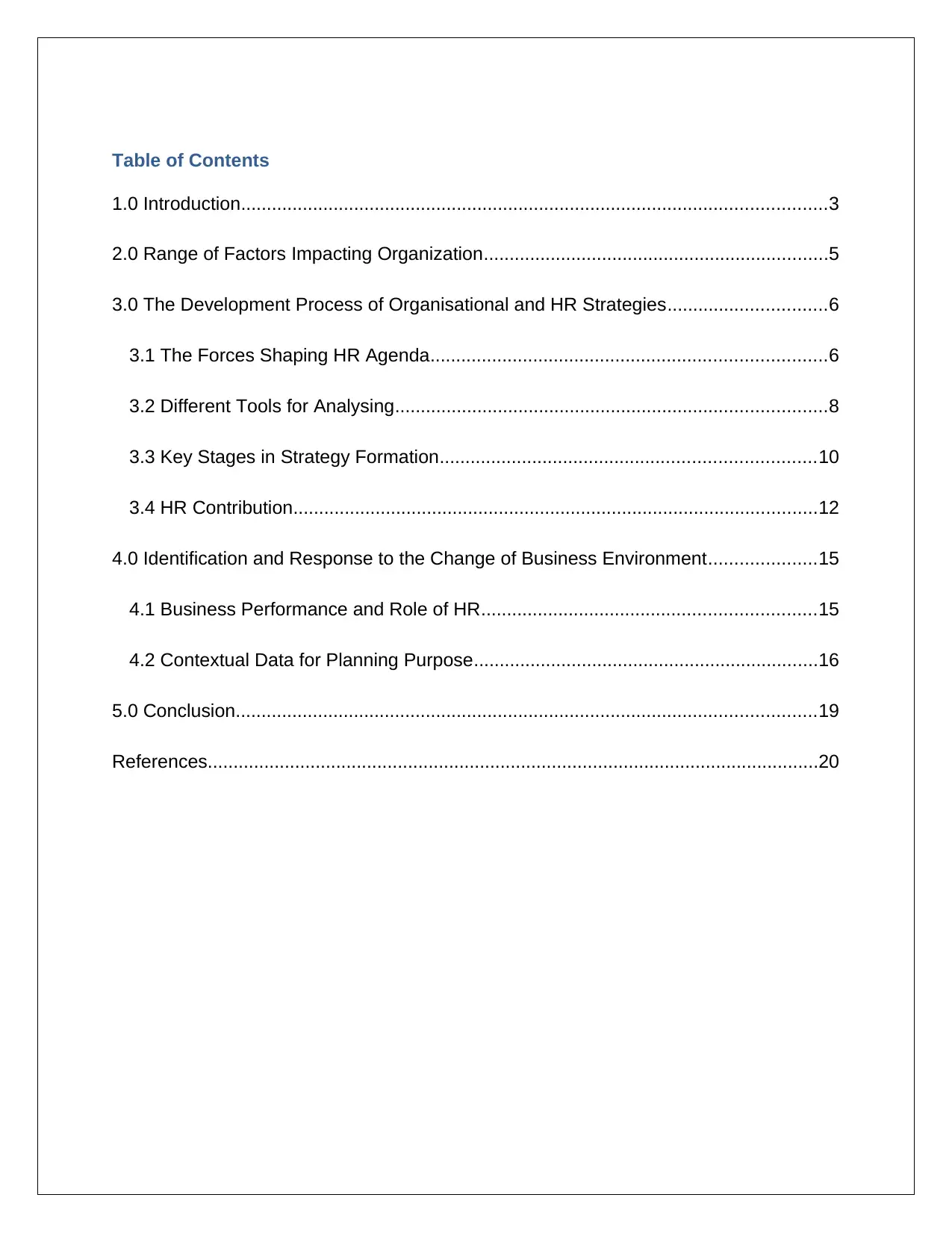
Table of Contents
1.0 Introduction..................................................................................................................3
2.0 Range of Factors Impacting Organization...................................................................5
3.0 The Development Process of Organisational and HR Strategies...............................6
3.1 The Forces Shaping HR Agenda.............................................................................6
3.2 Different Tools for Analysing....................................................................................8
3.3 Key Stages in Strategy Formation.........................................................................10
3.4 HR Contribution......................................................................................................12
4.0 Identification and Response to the Change of Business Environment.....................15
4.1 Business Performance and Role of HR.................................................................15
4.2 Contextual Data for Planning Purpose...................................................................16
5.0 Conclusion.................................................................................................................19
References.......................................................................................................................20
1.0 Introduction..................................................................................................................3
2.0 Range of Factors Impacting Organization...................................................................5
3.0 The Development Process of Organisational and HR Strategies...............................6
3.1 The Forces Shaping HR Agenda.............................................................................6
3.2 Different Tools for Analysing....................................................................................8
3.3 Key Stages in Strategy Formation.........................................................................10
3.4 HR Contribution......................................................................................................12
4.0 Identification and Response to the Change of Business Environment.....................15
4.1 Business Performance and Role of HR.................................................................15
4.2 Contextual Data for Planning Purpose...................................................................16
5.0 Conclusion.................................................................................................................19
References.......................................................................................................................20
1.0 Introduction
HR (Human resource) is referred to as the people who are responsible for making the
workforce of a particular organization and the business sector of the human capital. The
HR performs human resource management overseeing the various aspects of the
employment, and also the labour law, the employing standards, employee benefits and
the recruitment aspects of the employee and also makes such strategies that are
beneficial for the organization (Prieto, Mathur-Helm and Dawson, 2018). HR planning is
crucial for the success of the business as the same directly enables the management to
devise the workforce and attune the same towards the broader corporate aims and
objectives in a sustainable manner (Van der Togt and Rasmussen, 2017).
In this report the different range of factors which affect the organization is analysed, the
range of forces which affect the organization is discussed, the tools used in the world for
the carrying out the method of analysing effectively and productively, The strategies
formation of the human resource management are analysed in brief in the report a
proper and brief discussion on each aspect is carried out in the report with respect to
Honda, UK.
In the report the role and the contribution of the HR in the business and change
management are evaluated in brief, the roles of HR in business planning are also
evaluated in the report, and some of the different sources that will help the company to
access profit are also mentioned in brief. All these aspects are being assessed in this
report a brief discussion on each aspect is carried out in the report. The information
HR (Human resource) is referred to as the people who are responsible for making the
workforce of a particular organization and the business sector of the human capital. The
HR performs human resource management overseeing the various aspects of the
employment, and also the labour law, the employing standards, employee benefits and
the recruitment aspects of the employee and also makes such strategies that are
beneficial for the organization (Prieto, Mathur-Helm and Dawson, 2018). HR planning is
crucial for the success of the business as the same directly enables the management to
devise the workforce and attune the same towards the broader corporate aims and
objectives in a sustainable manner (Van der Togt and Rasmussen, 2017).
In this report the different range of factors which affect the organization is analysed, the
range of forces which affect the organization is discussed, the tools used in the world for
the carrying out the method of analysing effectively and productively, The strategies
formation of the human resource management are analysed in brief in the report a
proper and brief discussion on each aspect is carried out in the report with respect to
Honda, UK.
In the report the role and the contribution of the HR in the business and change
management are evaluated in brief, the roles of HR in business planning are also
evaluated in the report, and some of the different sources that will help the company to
access profit are also mentioned in brief. All these aspects are being assessed in this
report a brief discussion on each aspect is carried out in the report. The information
⊘ This is a preview!⊘
Do you want full access?
Subscribe today to unlock all pages.

Trusted by 1+ million students worldwide
provided in the report is very accurate and correct (Prieto, Mathur-Helm and Dawson,
2018).
This report depicts how important the HR person is in the management system of the
company. How the human resource manager works or the human resource body
functions to carry out a successful management plan that will help the company or the
organization in carrying out the strategies effectively and eventually gaining maximum
profit (Reilly and Williams, 2016).
2018).
This report depicts how important the HR person is in the management system of the
company. How the human resource manager works or the human resource body
functions to carry out a successful management plan that will help the company or the
organization in carrying out the strategies effectively and eventually gaining maximum
profit (Reilly and Williams, 2016).
Paraphrase This Document
Need a fresh take? Get an instant paraphrase of this document with our AI Paraphraser
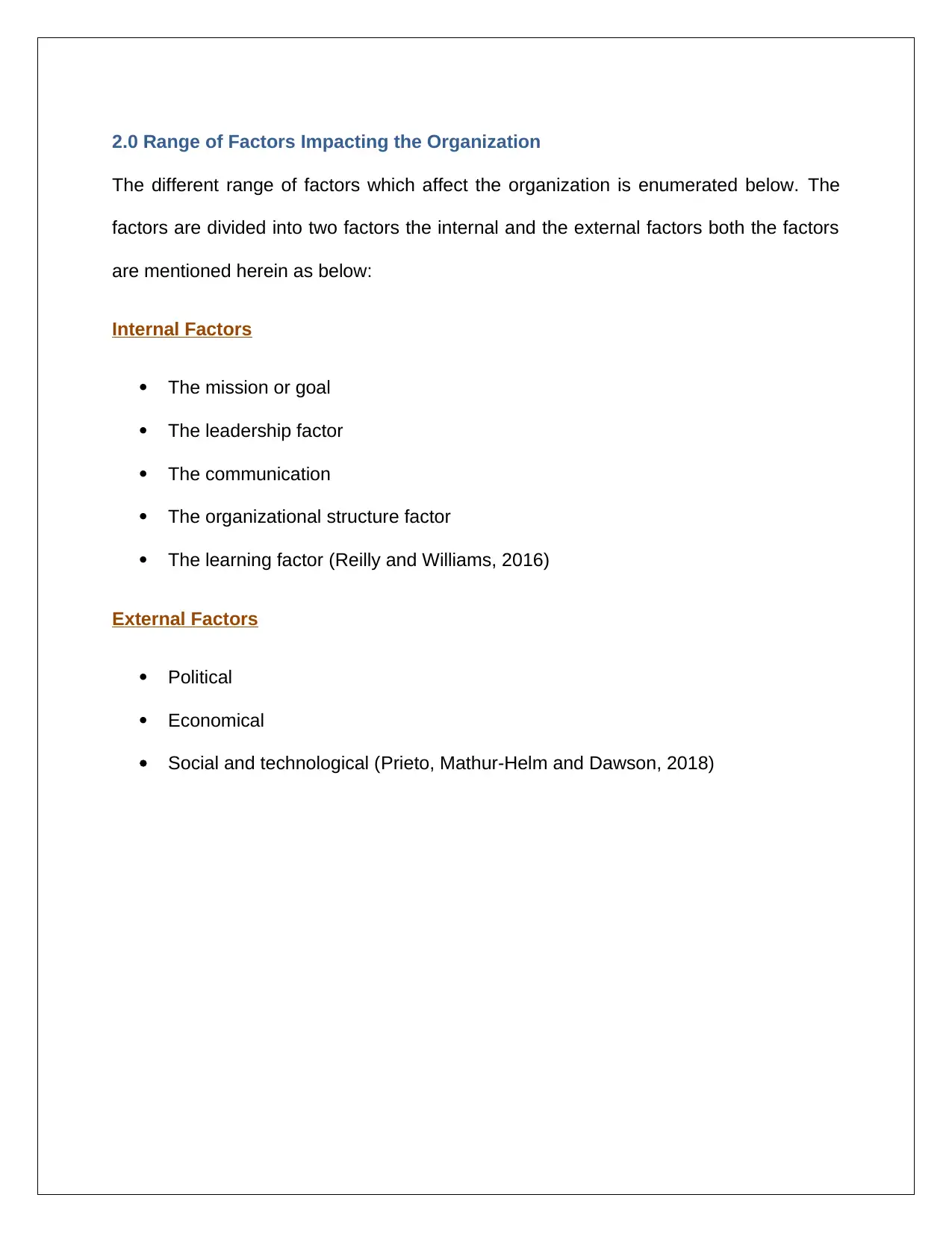
2.0 Range of Factors Impacting the Organization
The different range of factors which affect the organization is enumerated below. The
factors are divided into two factors the internal and the external factors both the factors
are mentioned herein as below:
Internal Factors
The mission or goal
The leadership factor
The communication
The organizational structure factor
The learning factor (Reilly and Williams, 2016)
External Factors
Political
Economical
Social and technological (Prieto, Mathur-Helm and Dawson, 2018)
The different range of factors which affect the organization is enumerated below. The
factors are divided into two factors the internal and the external factors both the factors
are mentioned herein as below:
Internal Factors
The mission or goal
The leadership factor
The communication
The organizational structure factor
The learning factor (Reilly and Williams, 2016)
External Factors
Political
Economical
Social and technological (Prieto, Mathur-Helm and Dawson, 2018)
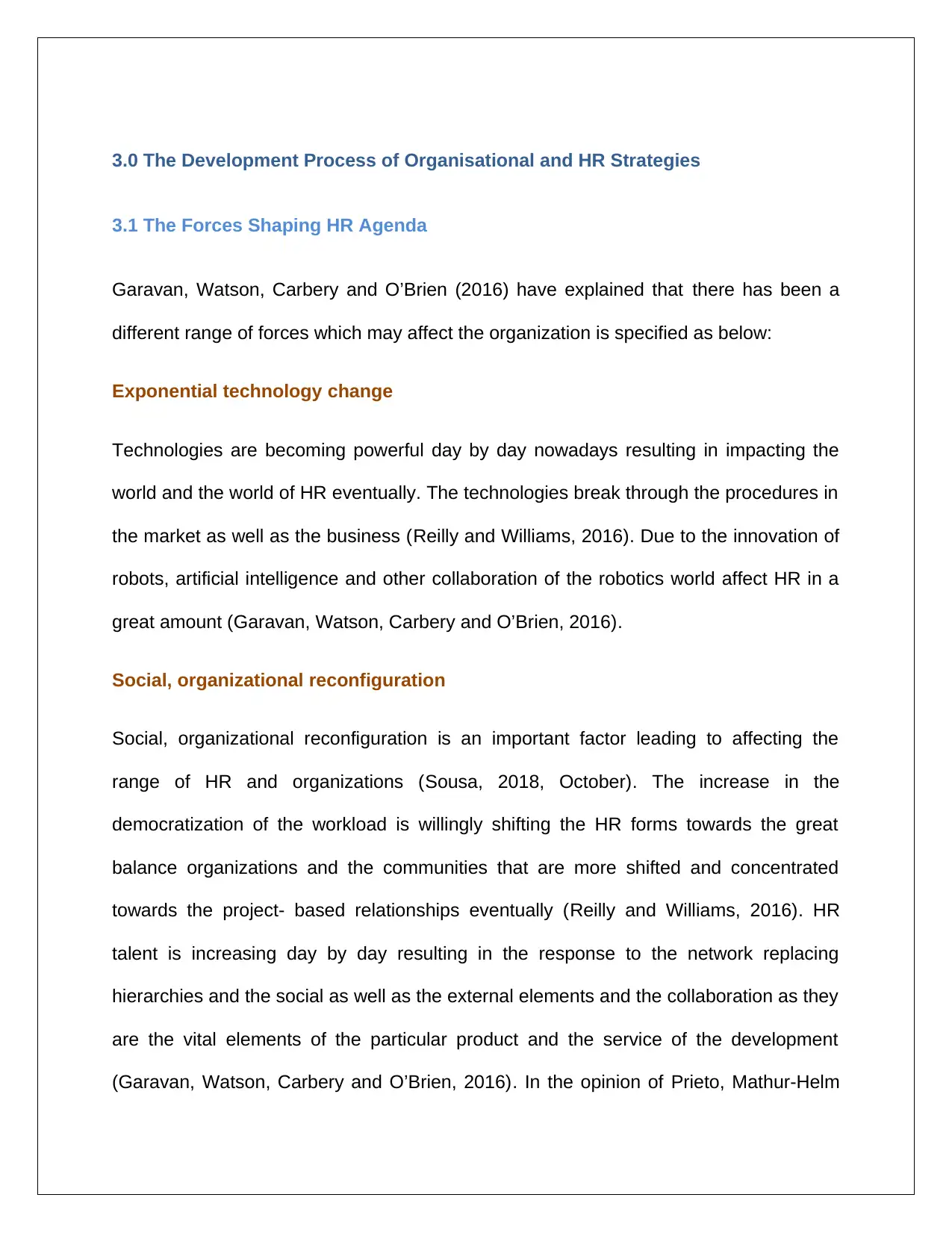
3.0 The Development Process of Organisational and HR Strategies
3.1 The Forces Shaping HR Agenda
Garavan, Watson, Carbery and O’Brien (2016) have explained that there has been a
different range of forces which may affect the organization is specified as below:
Exponential technology change
Technologies are becoming powerful day by day nowadays resulting in impacting the
world and the world of HR eventually. The technologies break through the procedures in
the market as well as the business (Reilly and Williams, 2016). Due to the innovation of
robots, artificial intelligence and other collaboration of the robotics world affect HR in a
great amount (Garavan, Watson, Carbery and O’Brien, 2016).
Social, organizational reconfiguration
Social, organizational reconfiguration is an important factor leading to affecting the
range of HR and organizations (Sousa, 2018, October). The increase in the
democratization of the workload is willingly shifting the HR forms towards the great
balance organizations and the communities that are more shifted and concentrated
towards the project- based relationships eventually (Reilly and Williams, 2016). HR
talent is increasing day by day resulting in the response to the network replacing
hierarchies and the social as well as the external elements and the collaboration as they
are the vital elements of the particular product and the service of the development
(Garavan, Watson, Carbery and O’Brien, 2016). In the opinion of Prieto, Mathur-Helm
3.1 The Forces Shaping HR Agenda
Garavan, Watson, Carbery and O’Brien (2016) have explained that there has been a
different range of forces which may affect the organization is specified as below:
Exponential technology change
Technologies are becoming powerful day by day nowadays resulting in impacting the
world and the world of HR eventually. The technologies break through the procedures in
the market as well as the business (Reilly and Williams, 2016). Due to the innovation of
robots, artificial intelligence and other collaboration of the robotics world affect HR in a
great amount (Garavan, Watson, Carbery and O’Brien, 2016).
Social, organizational reconfiguration
Social, organizational reconfiguration is an important factor leading to affecting the
range of HR and organizations (Sousa, 2018, October). The increase in the
democratization of the workload is willingly shifting the HR forms towards the great
balance organizations and the communities that are more shifted and concentrated
towards the project- based relationships eventually (Reilly and Williams, 2016). HR
talent is increasing day by day resulting in the response to the network replacing
hierarchies and the social as well as the external elements and the collaboration as they
are the vital elements of the particular product and the service of the development
(Garavan, Watson, Carbery and O’Brien, 2016). In the opinion of Prieto, Mathur-Helm
⊘ This is a preview!⊘
Do you want full access?
Subscribe today to unlock all pages.
Trusted by 1+ million students worldwide
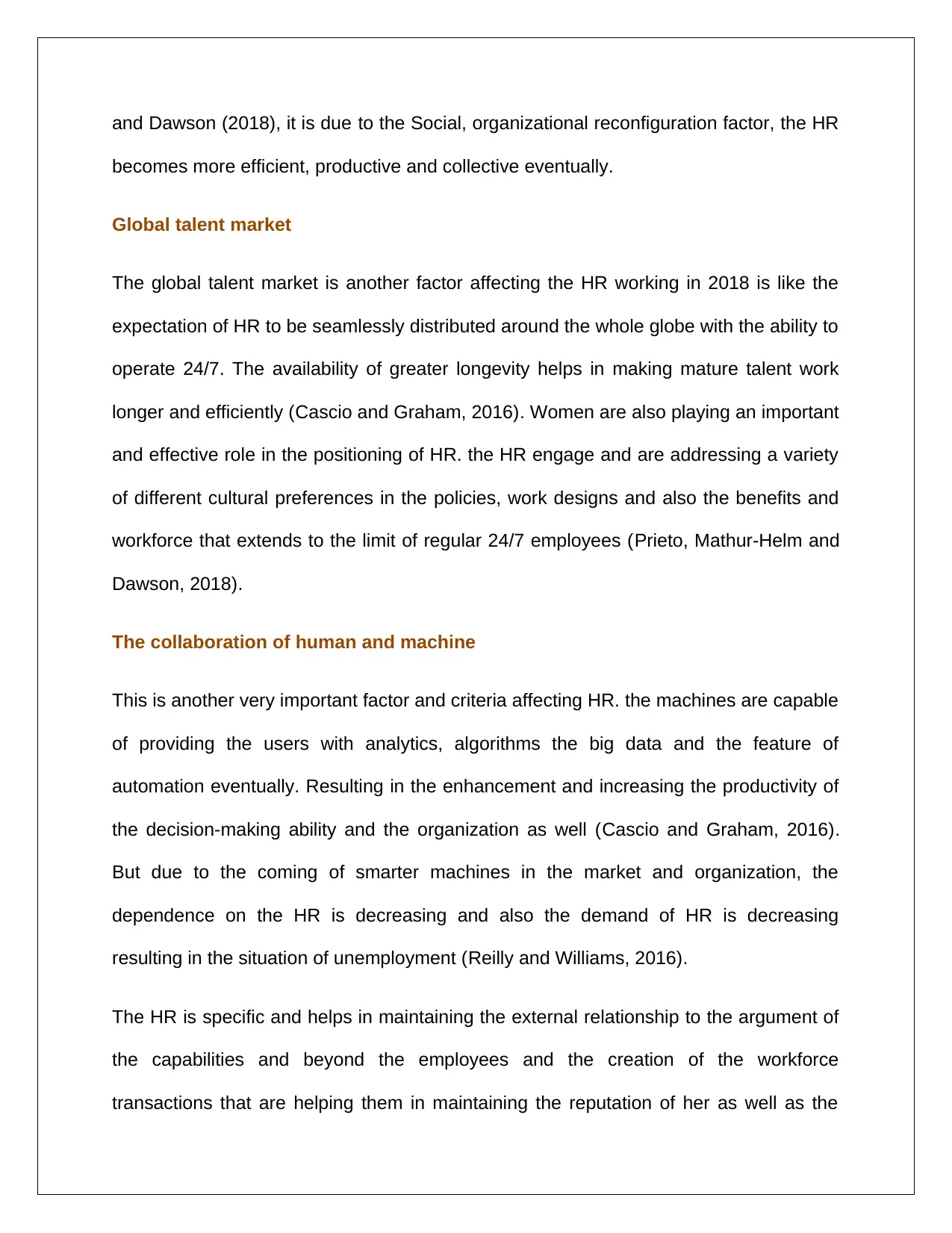
and Dawson (2018), it is due to the Social, organizational reconfiguration factor, the HR
becomes more efficient, productive and collective eventually.
Global talent market
The global talent market is another factor affecting the HR working in 2018 is like the
expectation of HR to be seamlessly distributed around the whole globe with the ability to
operate 24/7. The availability of greater longevity helps in making mature talent work
longer and efficiently (Cascio and Graham, 2016). Women are also playing an important
and effective role in the positioning of HR. the HR engage and are addressing a variety
of different cultural preferences in the policies, work designs and also the benefits and
workforce that extends to the limit of regular 24/7 employees (Prieto, Mathur-Helm and
Dawson, 2018).
The collaboration of human and machine
This is another very important factor and criteria affecting HR. the machines are capable
of providing the users with analytics, algorithms the big data and the feature of
automation eventually. Resulting in the enhancement and increasing the productivity of
the decision-making ability and the organization as well (Cascio and Graham, 2016).
But due to the coming of smarter machines in the market and organization, the
dependence on the HR is decreasing and also the demand of HR is decreasing
resulting in the situation of unemployment (Reilly and Williams, 2016).
The HR is specific and helps in maintaining the external relationship to the argument of
the capabilities and beyond the employees and the creation of the workforce
transactions that are helping them in maintaining the reputation of her as well as the
becomes more efficient, productive and collective eventually.
Global talent market
The global talent market is another factor affecting the HR working in 2018 is like the
expectation of HR to be seamlessly distributed around the whole globe with the ability to
operate 24/7. The availability of greater longevity helps in making mature talent work
longer and efficiently (Cascio and Graham, 2016). Women are also playing an important
and effective role in the positioning of HR. the HR engage and are addressing a variety
of different cultural preferences in the policies, work designs and also the benefits and
workforce that extends to the limit of regular 24/7 employees (Prieto, Mathur-Helm and
Dawson, 2018).
The collaboration of human and machine
This is another very important factor and criteria affecting HR. the machines are capable
of providing the users with analytics, algorithms the big data and the feature of
automation eventually. Resulting in the enhancement and increasing the productivity of
the decision-making ability and the organization as well (Cascio and Graham, 2016).
But due to the coming of smarter machines in the market and organization, the
dependence on the HR is decreasing and also the demand of HR is decreasing
resulting in the situation of unemployment (Reilly and Williams, 2016).
The HR is specific and helps in maintaining the external relationship to the argument of
the capabilities and beyond the employees and the creation of the workforce
transactions that are helping them in maintaining the reputation of her as well as the
Paraphrase This Document
Need a fresh take? Get an instant paraphrase of this document with our AI Paraphraser
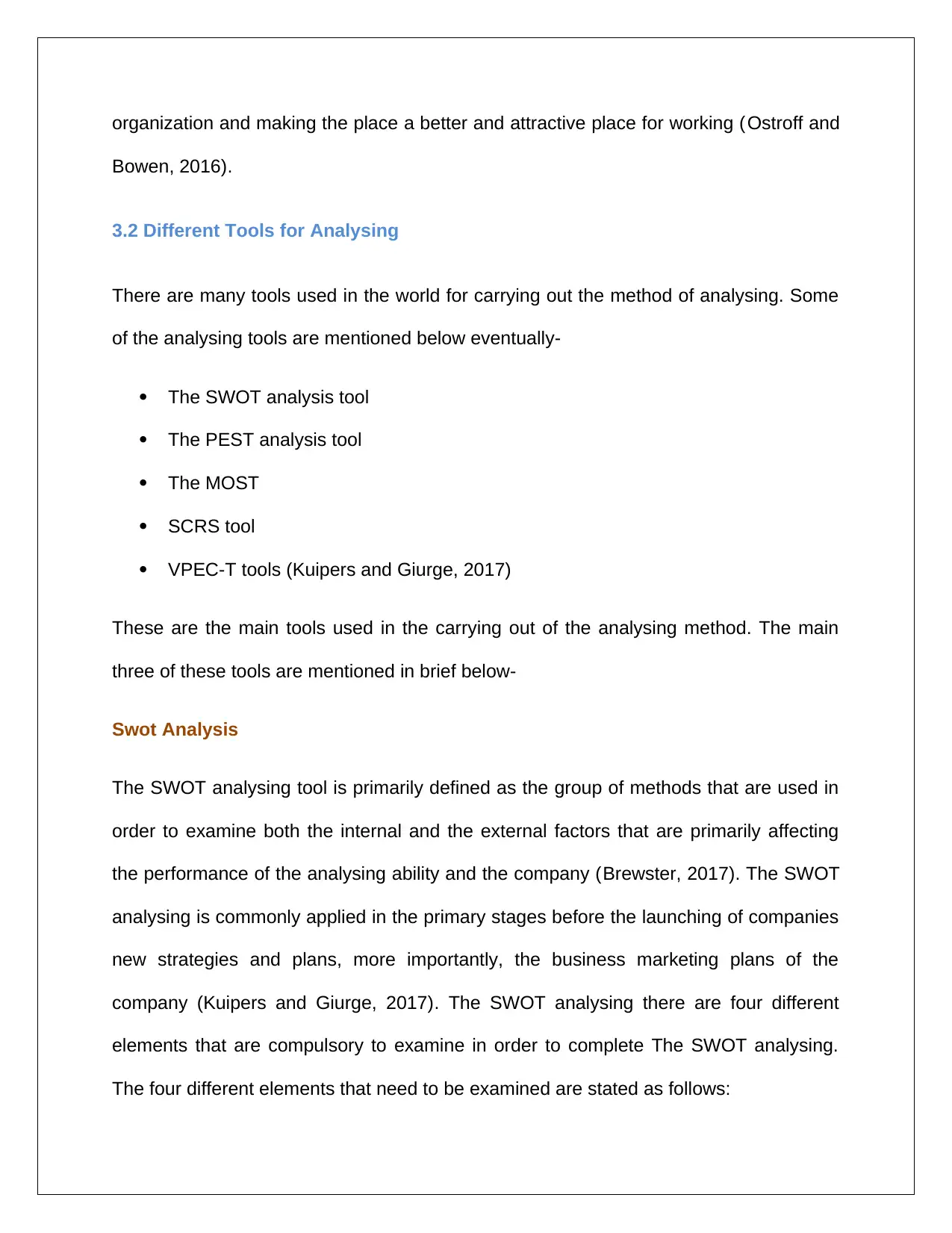
organization and making the place a better and attractive place for working (Ostroff and
Bowen, 2016).
3.2 Different Tools for Analysing
There are many tools used in the world for carrying out the method of analysing. Some
of the analysing tools are mentioned below eventually-
The SWOT analysis tool
The PEST analysis tool
The MOST
SCRS tool
VPEC-T tools (Kuipers and Giurge, 2017)
These are the main tools used in the carrying out of the analysing method. The main
three of these tools are mentioned in brief below-
Swot Analysis
The SWOT analysing tool is primarily defined as the group of methods that are used in
order to examine both the internal and the external factors that are primarily affecting
the performance of the analysing ability and the company (Brewster, 2017). The SWOT
analysing is commonly applied in the primary stages before the launching of companies
new strategies and plans, more importantly, the business marketing plans of the
company (Kuipers and Giurge, 2017). The SWOT analysing there are four different
elements that are compulsory to examine in order to complete The SWOT analysing.
The four different elements that need to be examined are stated as follows:
Bowen, 2016).
3.2 Different Tools for Analysing
There are many tools used in the world for carrying out the method of analysing. Some
of the analysing tools are mentioned below eventually-
The SWOT analysis tool
The PEST analysis tool
The MOST
SCRS tool
VPEC-T tools (Kuipers and Giurge, 2017)
These are the main tools used in the carrying out of the analysing method. The main
three of these tools are mentioned in brief below-
Swot Analysis
The SWOT analysing tool is primarily defined as the group of methods that are used in
order to examine both the internal and the external factors that are primarily affecting
the performance of the analysing ability and the company (Brewster, 2017). The SWOT
analysing is commonly applied in the primary stages before the launching of companies
new strategies and plans, more importantly, the business marketing plans of the
company (Kuipers and Giurge, 2017). The SWOT analysing there are four different
elements that are compulsory to examine in order to complete The SWOT analysing.
The four different elements that need to be examined are stated as follows:
Strengths Weakness Opportunities and Threats (Ostroff and Bowen, 2016)
In the Strengths and Weaknesses criteria, the two elements tend to lay in the control of
the company and the HR and thus are called as the internal factors. And the remaining
two elements Opportunities and Threats lay in the external factors (Kuipers and Giurge,
2017).
THE PEST ANALYSIS
The PEST analysis of this tool full-form is (Political, Economic, Sociological and
Technological) this analysis is used in order to analyse the external impacts on the
performance of the enterprises (Reilly and Williams, 2016). The PEST analysis the
business owners and the HR are believed to provide with the common external effects
that affect the business internally or externally depending upon the situation and the
impact (Brewster, 2017). The key elements are acknowledged below eventually-
Political
The Political aspect consists of the prediction and the current workflow of the company
and also the political situation of the company (Kuipers and Giurge, 2017).
Economical
This Economical aspect consists of two local and global scale factors (Noe, Hollenbeck,
Gerhart and Wright, 2017).
In the Strengths and Weaknesses criteria, the two elements tend to lay in the control of
the company and the HR and thus are called as the internal factors. And the remaining
two elements Opportunities and Threats lay in the external factors (Kuipers and Giurge,
2017).
THE PEST ANALYSIS
The PEST analysis of this tool full-form is (Political, Economic, Sociological and
Technological) this analysis is used in order to analyse the external impacts on the
performance of the enterprises (Reilly and Williams, 2016). The PEST analysis the
business owners and the HR are believed to provide with the common external effects
that affect the business internally or externally depending upon the situation and the
impact (Brewster, 2017). The key elements are acknowledged below eventually-
Political
The Political aspect consists of the prediction and the current workflow of the company
and also the political situation of the company (Kuipers and Giurge, 2017).
Economical
This Economical aspect consists of two local and global scale factors (Noe, Hollenbeck,
Gerhart and Wright, 2017).
⊘ This is a preview!⊘
Do you want full access?
Subscribe today to unlock all pages.
Trusted by 1+ million students worldwide
Sociological
This sociological aspect affects the situation of the decision-making process of the
company. The customer demands and the other examine criteria (Sousa, 2018,
October).
Technological
This technological aspect is believed to be important in examining the outburst of the
fourth industrial revolutions and also due to innovations of such great technologies is
resulting in helping the business owners to keep up with the pace of modern technology
and the market (Ostroff and Bowen, 2016).
The MOST
The MOST aspect is a very suitable and important tool for every company as the
company looks to developing the internal analysis of the HR management and the
company as the tool helps the owner of the company to ensure and know that the
company is going on the right path eventually (Brewster, 2017).
3.3 Key Stages in Strategy Formation
The strategies formation of human resource management refers to the appropriate
course of the realization of the organizational goals and the objective to be achieved by
the company and the organization eventually (Kuipers and Giurge, 2017). Some of the
steps of the strategies formation are provided in brief below-
Setting the organizational objectives eventually
This sociological aspect affects the situation of the decision-making process of the
company. The customer demands and the other examine criteria (Sousa, 2018,
October).
Technological
This technological aspect is believed to be important in examining the outburst of the
fourth industrial revolutions and also due to innovations of such great technologies is
resulting in helping the business owners to keep up with the pace of modern technology
and the market (Ostroff and Bowen, 2016).
The MOST
The MOST aspect is a very suitable and important tool for every company as the
company looks to developing the internal analysis of the HR management and the
company as the tool helps the owner of the company to ensure and know that the
company is going on the right path eventually (Brewster, 2017).
3.3 Key Stages in Strategy Formation
The strategies formation of human resource management refers to the appropriate
course of the realization of the organizational goals and the objective to be achieved by
the company and the organization eventually (Kuipers and Giurge, 2017). Some of the
steps of the strategies formation are provided in brief below-
Setting the organizational objectives eventually
Paraphrase This Document
Need a fresh take? Get an instant paraphrase of this document with our AI Paraphraser
Setting the organizational objectives eventually this is the main aspect of the strategy
formation and in order to set a long term non-objective through the organization (Noe,
Hollenbeck, Gerhart and Wright, 2017). The setting is the aspect through which the
general realization of the objective set by the organizations will reach (Barratt-Pugh and
Bahn, 2015). The strategies involve the fixing of the objectives as well as the medium to
be used in order to realize the objectives. Therefore the setting the organizational
objectives strategies mainly believe in the deployment of the resources to achieve the
objectives (Barratt-Pugh and Bahn, 2015).
Evaluation of the organization environment
Ostroff and Bowen (2016), states that the next step in the strategy formation is the
Evaluation of the organization environment this step includes the evolution of the
general economy and the industrial environment through which the organization
operates efficiently and productively. This information consists of the reviewing of the
organization existing product line and strategic management (Reilly and Williams,
2017). The main aim of the review is to make sure that the factors are important for
competing for success in the market and can be discovered eventually. And HR
management can even identify the strengths and weaknesses of the competitive
strengths and weaknesses (Brewster, 2017).
The setting of the quantitative targets
In the step of the setting of the quantitative targets, the management may need to
resolve any issues regarding the quantitative target values which are critical for the
achievement of organizational objectives. The main aim behind this step of this
formation and in order to set a long term non-objective through the organization (Noe,
Hollenbeck, Gerhart and Wright, 2017). The setting is the aspect through which the
general realization of the objective set by the organizations will reach (Barratt-Pugh and
Bahn, 2015). The strategies involve the fixing of the objectives as well as the medium to
be used in order to realize the objectives. Therefore the setting the organizational
objectives strategies mainly believe in the deployment of the resources to achieve the
objectives (Barratt-Pugh and Bahn, 2015).
Evaluation of the organization environment
Ostroff and Bowen (2016), states that the next step in the strategy formation is the
Evaluation of the organization environment this step includes the evolution of the
general economy and the industrial environment through which the organization
operates efficiently and productively. This information consists of the reviewing of the
organization existing product line and strategic management (Reilly and Williams,
2017). The main aim of the review is to make sure that the factors are important for
competing for success in the market and can be discovered eventually. And HR
management can even identify the strengths and weaknesses of the competitive
strengths and weaknesses (Brewster, 2017).
The setting of the quantitative targets
In the step of the setting of the quantitative targets, the management may need to
resolve any issues regarding the quantitative target values which are critical for the
achievement of organizational objectives. The main aim behind this step of this
quantitative target is to help in the comparison of the long term customers in order to
evaluate the contribution of the organization and the organization's products or the
organizational departments (Momin and Mishra, 2015).
Aiming in the divisional plans
In the consideration of Noe, Hollenbeck, Gerhart and Wright (2017), this step of Aiming
in the divisional plans consists of the contributions of the department on the division or
even the product categories within the organizations is also identified as per the plan
laid out by the organization in each and every zone of the organization (Ostroff and
Bowen, 2016).
3.4 HR Contribution
In the consideration of Ostroff and Bowen (2016), the HR professional is one of the
most important and success-critical persons in any organization. The effectiveness,
productivity, and efficiency of any company depend upon the contribution of HR
(Garavan, Watson, Carbery and O’Brien, 2016). In order to gain development and
competitiveness, the organizations keep on changing the management plans and
strategies and here the HR plays an important role in this change (Reilly and Williams,
2017). The role of HR in this changing strategy is presented in these paragraphs.
The role and the contribution of HR in the business and change management are listed
down as below.
Watchdog
Communicating with employees
evaluate the contribution of the organization and the organization's products or the
organizational departments (Momin and Mishra, 2015).
Aiming in the divisional plans
In the consideration of Noe, Hollenbeck, Gerhart and Wright (2017), this step of Aiming
in the divisional plans consists of the contributions of the department on the division or
even the product categories within the organizations is also identified as per the plan
laid out by the organization in each and every zone of the organization (Ostroff and
Bowen, 2016).
3.4 HR Contribution
In the consideration of Ostroff and Bowen (2016), the HR professional is one of the
most important and success-critical persons in any organization. The effectiveness,
productivity, and efficiency of any company depend upon the contribution of HR
(Garavan, Watson, Carbery and O’Brien, 2016). In order to gain development and
competitiveness, the organizations keep on changing the management plans and
strategies and here the HR plays an important role in this change (Reilly and Williams,
2017). The role of HR in this changing strategy is presented in these paragraphs.
The role and the contribution of HR in the business and change management are listed
down as below.
Watchdog
Communicating with employees
⊘ This is a preview!⊘
Do you want full access?
Subscribe today to unlock all pages.
Trusted by 1+ million students worldwide

1 out of 22


Related Documents


Your All-in-One AI-Powered Toolkit for Academic Success.
+13062052269
info@desklib.com
Available 24*7 on WhatsApp / Email
![[object Object]](/_next/static/media/star-bottom.7253800d.svg)
Unlock your academic potential
Copyright © 2020–2026 A2Z Services. All Rights Reserved. Developed and managed by ZUCOL.