CIPD Certification Report: HR Data Recording, Storing, and Legalities
VerifiedAdded on 2023/06/03
|7
|1482
|304
Report
AI Summary
This CIPD certification report delves into the critical importance of HR records and data, emphasizing their role in talent management, employee relations, and organizational productivity. It explores the range of HR data collected, including demographic information, skills segmentation, and employee feedback, highlighting the significance of each category. The report also examines various data recording and storing systems, from traditional physical records to contemporary digital methods, with a focus on maintaining data security and confidentiality. Furthermore, it addresses the legal requirements under the UK Data Protection Act 1998 and the General Data Protection Regulation, emphasizing the need for transparency, consent, and lawful data processing. The report concludes with personal reflections on the enhanced understanding of data protection laws and the sensitivity required in data handling.
Running head: CIPD
CIPD Certification Module 2
Name of the Student
Name of the University
Author’s note
CIPD Certification Module 2
Name of the Student
Name of the University
Author’s note
Paraphrase This Document
Need a fresh take? Get an instant paraphrase of this document with our AI Paraphraser

1CIPD
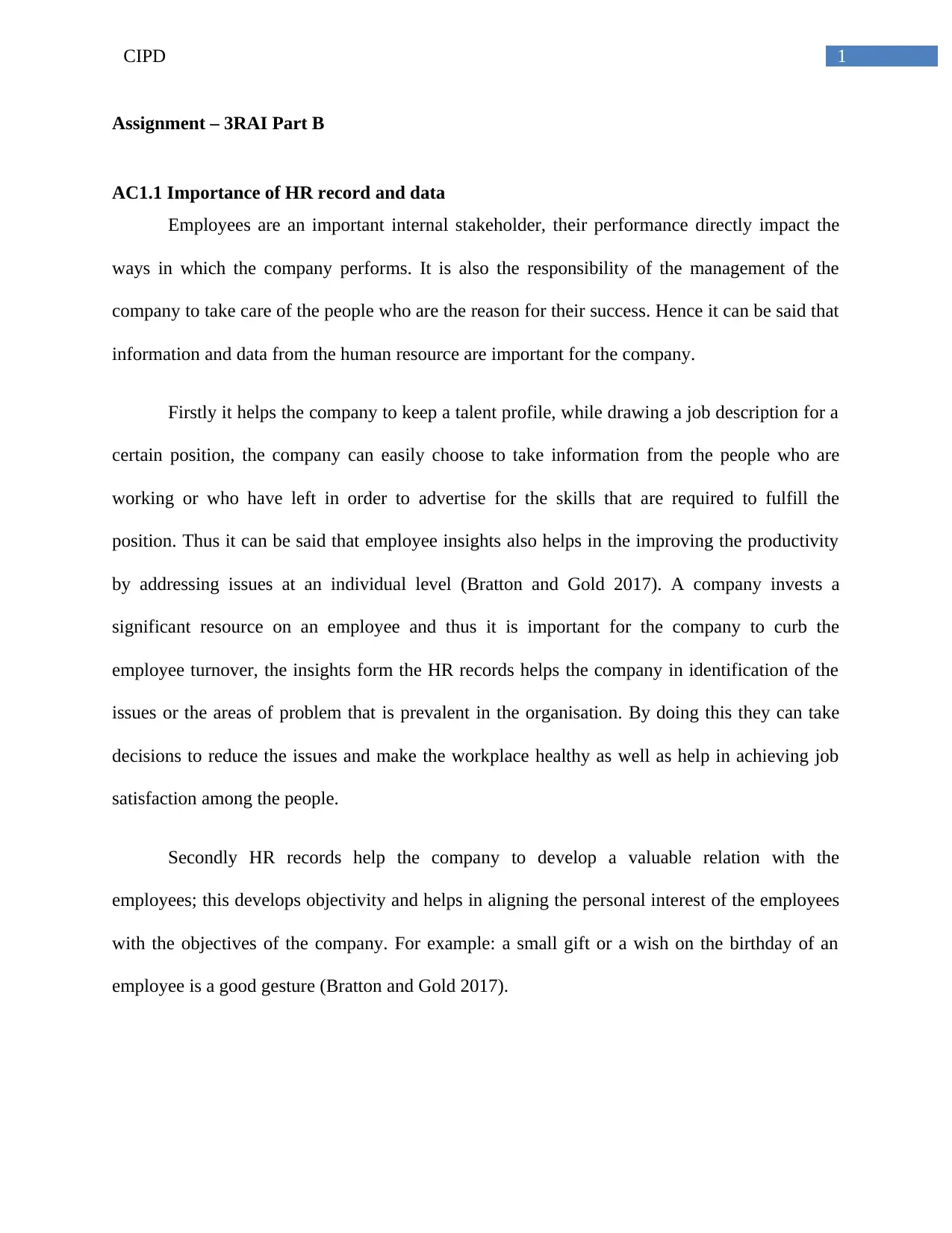
Assignment – 3RAI Part B
AC1.1 Importance of HR record and data
Employees are an important internal stakeholder, their performance directly impact the
ways in which the company performs. It is also the responsibility of the management of the
company to take care of the people who are the reason for their success. Hence it can be said that
information and data from the human resource are important for the company.
Firstly it helps the company to keep a talent profile, while drawing a job description for a
certain position, the company can easily choose to take information from the people who are
working or who have left in order to advertise for the skills that are required to fulfill the
position. Thus it can be said that employee insights also helps in the improving the productivity
by addressing issues at an individual level (Bratton and Gold 2017). A company invests a
significant resource on an employee and thus it is important for the company to curb the
employee turnover, the insights form the HR records helps the company in identification of the
issues or the areas of problem that is prevalent in the organisation. By doing this they can take
decisions to reduce the issues and make the workplace healthy as well as help in achieving job
satisfaction among the people.
Secondly HR records help the company to develop a valuable relation with the
employees; this develops objectivity and helps in aligning the personal interest of the employees
with the objectives of the company. For example: a small gift or a wish on the birthday of an
employee is a good gesture (Bratton and Gold 2017).
Assignment – 3RAI Part B
AC1.1 Importance of HR record and data
Employees are an important internal stakeholder, their performance directly impact the
ways in which the company performs. It is also the responsibility of the management of the
company to take care of the people who are the reason for their success. Hence it can be said that
information and data from the human resource are important for the company.
Firstly it helps the company to keep a talent profile, while drawing a job description for a
certain position, the company can easily choose to take information from the people who are
working or who have left in order to advertise for the skills that are required to fulfill the
position. Thus it can be said that employee insights also helps in the improving the productivity
by addressing issues at an individual level (Bratton and Gold 2017). A company invests a
significant resource on an employee and thus it is important for the company to curb the
employee turnover, the insights form the HR records helps the company in identification of the
issues or the areas of problem that is prevalent in the organisation. By doing this they can take
decisions to reduce the issues and make the workplace healthy as well as help in achieving job
satisfaction among the people.
Secondly HR records help the company to develop a valuable relation with the
employees; this develops objectivity and helps in aligning the personal interest of the employees
with the objectives of the company. For example: a small gift or a wish on the birthday of an
employee is a good gesture (Bratton and Gold 2017).

2CIPD
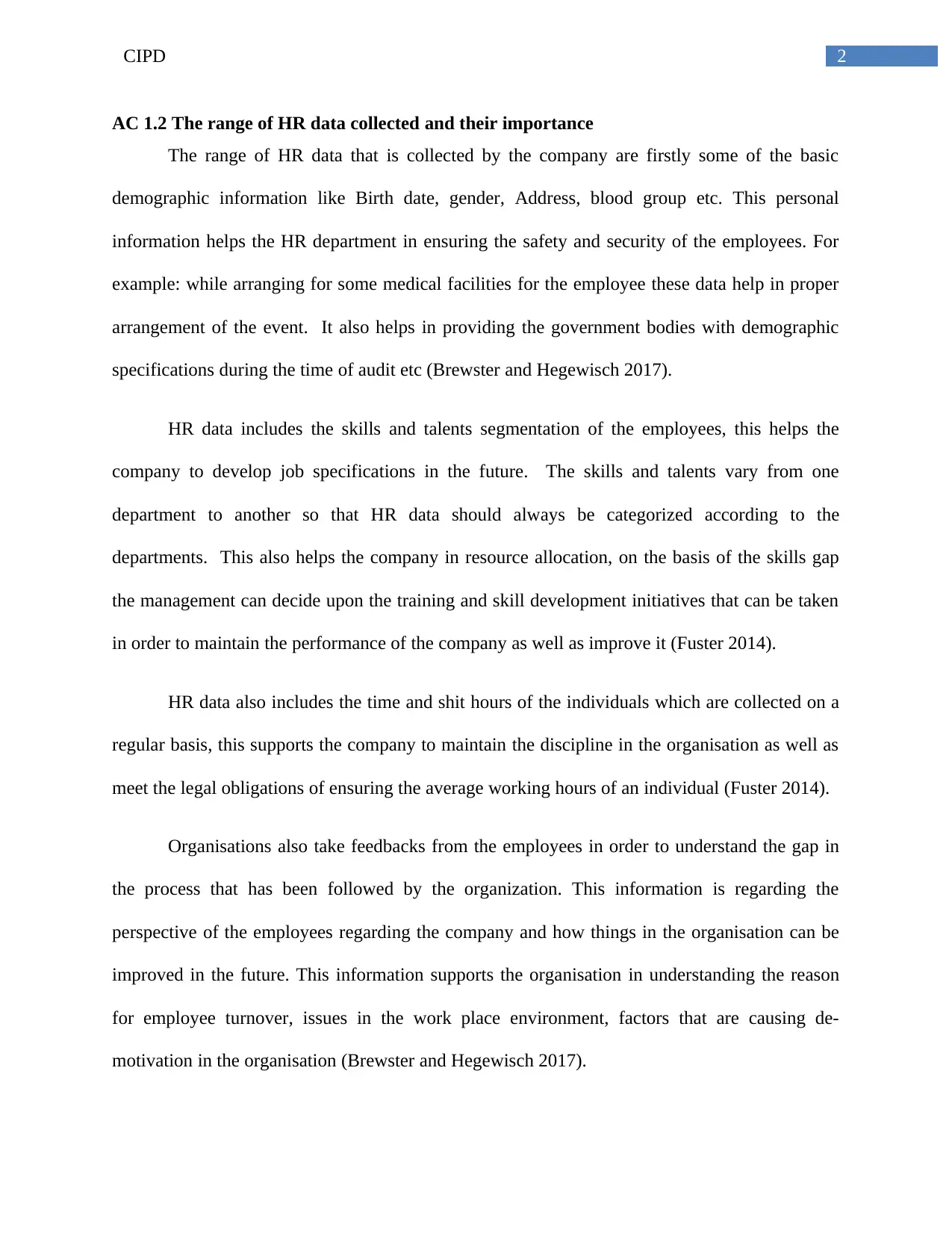
AC 1.2 The range of HR data collected and their importance
The range of HR data that is collected by the company are firstly some of the basic
demographic information like Birth date, gender, Address, blood group etc. This personal
information helps the HR department in ensuring the safety and security of the employees. For
example: while arranging for some medical facilities for the employee these data help in proper
arrangement of the event. It also helps in providing the government bodies with demographic
specifications during the time of audit etc (Brewster and Hegewisch 2017).
HR data includes the skills and talents segmentation of the employees, this helps the
company to develop job specifications in the future. The skills and talents vary from one
department to another so that HR data should always be categorized according to the
departments. This also helps the company in resource allocation, on the basis of the skills gap
the management can decide upon the training and skill development initiatives that can be taken
in order to maintain the performance of the company as well as improve it (Fuster 2014).
HR data also includes the time and shit hours of the individuals which are collected on a
regular basis, this supports the company to maintain the discipline in the organisation as well as
meet the legal obligations of ensuring the average working hours of an individual (Fuster 2014).
Organisations also take feedbacks from the employees in order to understand the gap in
the process that has been followed by the organization. This information is regarding the
perspective of the employees regarding the company and how things in the organisation can be
improved in the future. This information supports the organisation in understanding the reason
for employee turnover, issues in the work place environment, factors that are causing de-
motivation in the organisation (Brewster and Hegewisch 2017).
AC 1.2 The range of HR data collected and their importance
The range of HR data that is collected by the company are firstly some of the basic
demographic information like Birth date, gender, Address, blood group etc. This personal
information helps the HR department in ensuring the safety and security of the employees. For
example: while arranging for some medical facilities for the employee these data help in proper
arrangement of the event. It also helps in providing the government bodies with demographic
specifications during the time of audit etc (Brewster and Hegewisch 2017).
HR data includes the skills and talents segmentation of the employees, this helps the
company to develop job specifications in the future. The skills and talents vary from one
department to another so that HR data should always be categorized according to the
departments. This also helps the company in resource allocation, on the basis of the skills gap
the management can decide upon the training and skill development initiatives that can be taken
in order to maintain the performance of the company as well as improve it (Fuster 2014).
HR data also includes the time and shit hours of the individuals which are collected on a
regular basis, this supports the company to maintain the discipline in the organisation as well as
meet the legal obligations of ensuring the average working hours of an individual (Fuster 2014).
Organisations also take feedbacks from the employees in order to understand the gap in
the process that has been followed by the organization. This information is regarding the
perspective of the employees regarding the company and how things in the organisation can be
improved in the future. This information supports the organisation in understanding the reason
for employee turnover, issues in the work place environment, factors that are causing de-
motivation in the organisation (Brewster and Hegewisch 2017).
⊘ This is a preview!⊘
Do you want full access?
Subscribe today to unlock all pages.

Trusted by 1+ million students worldwide

3CIPD
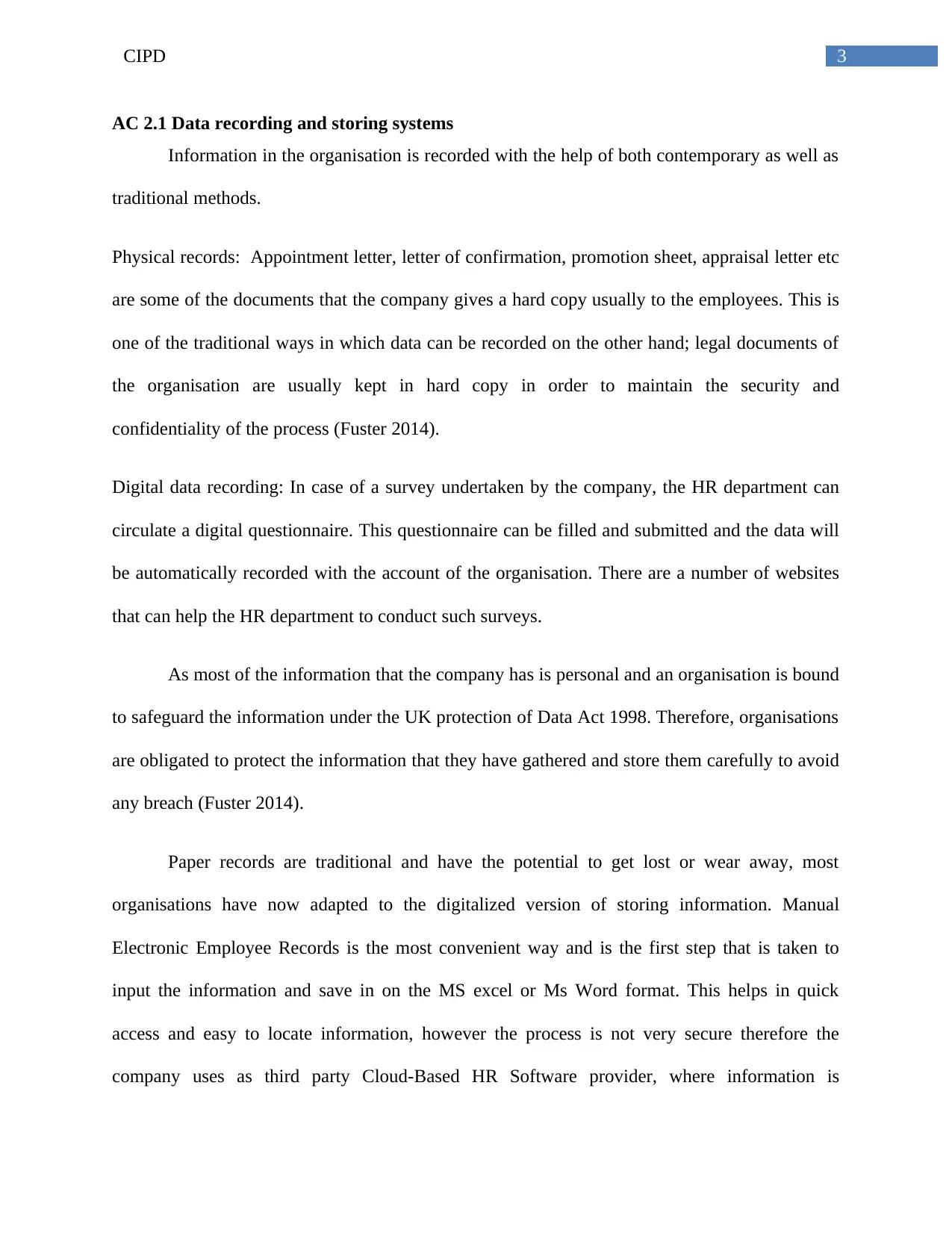
AC 2.1 Data recording and storing systems
Information in the organisation is recorded with the help of both contemporary as well as
traditional methods.
Physical records: Appointment letter, letter of confirmation, promotion sheet, appraisal letter etc
are some of the documents that the company gives a hard copy usually to the employees. This is
one of the traditional ways in which data can be recorded on the other hand; legal documents of
the organisation are usually kept in hard copy in order to maintain the security and
confidentiality of the process (Fuster 2014).
Digital data recording: In case of a survey undertaken by the company, the HR department can
circulate a digital questionnaire. This questionnaire can be filled and submitted and the data will
be automatically recorded with the account of the organisation. There are a number of websites
that can help the HR department to conduct such surveys.
As most of the information that the company has is personal and an organisation is bound
to safeguard the information under the UK protection of Data Act 1998. Therefore, organisations
are obligated to protect the information that they have gathered and store them carefully to avoid
any breach (Fuster 2014).
Paper records are traditional and have the potential to get lost or wear away, most
organisations have now adapted to the digitalized version of storing information. Manual
Electronic Employee Records is the most convenient way and is the first step that is taken to
input the information and save in on the MS excel or Ms Word format. This helps in quick
access and easy to locate information, however the process is not very secure therefore the
company uses as third party Cloud-Based HR Software provider, where information is
AC 2.1 Data recording and storing systems
Information in the organisation is recorded with the help of both contemporary as well as
traditional methods.
Physical records: Appointment letter, letter of confirmation, promotion sheet, appraisal letter etc
are some of the documents that the company gives a hard copy usually to the employees. This is
one of the traditional ways in which data can be recorded on the other hand; legal documents of
the organisation are usually kept in hard copy in order to maintain the security and
confidentiality of the process (Fuster 2014).
Digital data recording: In case of a survey undertaken by the company, the HR department can
circulate a digital questionnaire. This questionnaire can be filled and submitted and the data will
be automatically recorded with the account of the organisation. There are a number of websites
that can help the HR department to conduct such surveys.
As most of the information that the company has is personal and an organisation is bound
to safeguard the information under the UK protection of Data Act 1998. Therefore, organisations
are obligated to protect the information that they have gathered and store them carefully to avoid
any breach (Fuster 2014).
Paper records are traditional and have the potential to get lost or wear away, most
organisations have now adapted to the digitalized version of storing information. Manual
Electronic Employee Records is the most convenient way and is the first step that is taken to
input the information and save in on the MS excel or Ms Word format. This helps in quick
access and easy to locate information, however the process is not very secure therefore the
company uses as third party Cloud-Based HR Software provider, where information is
Paraphrase This Document
Need a fresh take? Get an instant paraphrase of this document with our AI Paraphraser

4CIPD
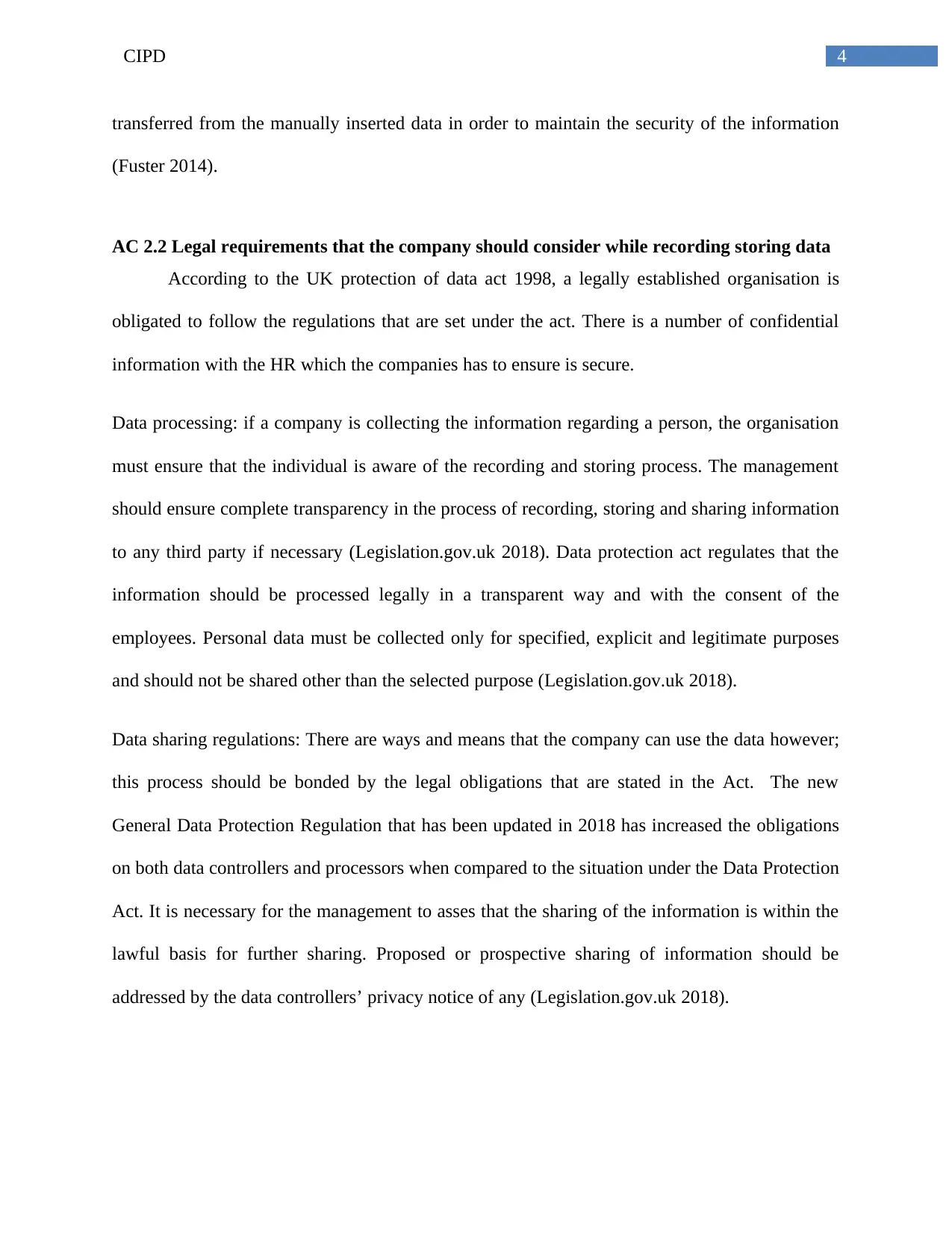
transferred from the manually inserted data in order to maintain the security of the information
(Fuster 2014).
AC 2.2 Legal requirements that the company should consider while recording storing data
According to the UK protection of data act 1998, a legally established organisation is
obligated to follow the regulations that are set under the act. There is a number of confidential
information with the HR which the companies has to ensure is secure.
Data processing: if a company is collecting the information regarding a person, the organisation
must ensure that the individual is aware of the recording and storing process. The management
should ensure complete transparency in the process of recording, storing and sharing information
to any third party if necessary (Legislation.gov.uk 2018). Data protection act regulates that the
information should be processed legally in a transparent way and with the consent of the
employees. Personal data must be collected only for specified, explicit and legitimate purposes
and should not be shared other than the selected purpose (Legislation.gov.uk 2018).
Data sharing regulations: There are ways and means that the company can use the data however;
this process should be bonded by the legal obligations that are stated in the Act. The new
General Data Protection Regulation that has been updated in 2018 has increased the obligations
on both data controllers and processors when compared to the situation under the Data Protection
Act. It is necessary for the management to asses that the sharing of the information is within the
lawful basis for further sharing. Proposed or prospective sharing of information should be
addressed by the data controllers’ privacy notice of any (Legislation.gov.uk 2018).
transferred from the manually inserted data in order to maintain the security of the information
(Fuster 2014).
AC 2.2 Legal requirements that the company should consider while recording storing data
According to the UK protection of data act 1998, a legally established organisation is
obligated to follow the regulations that are set under the act. There is a number of confidential
information with the HR which the companies has to ensure is secure.
Data processing: if a company is collecting the information regarding a person, the organisation
must ensure that the individual is aware of the recording and storing process. The management
should ensure complete transparency in the process of recording, storing and sharing information
to any third party if necessary (Legislation.gov.uk 2018). Data protection act regulates that the
information should be processed legally in a transparent way and with the consent of the
employees. Personal data must be collected only for specified, explicit and legitimate purposes
and should not be shared other than the selected purpose (Legislation.gov.uk 2018).
Data sharing regulations: There are ways and means that the company can use the data however;
this process should be bonded by the legal obligations that are stated in the Act. The new
General Data Protection Regulation that has been updated in 2018 has increased the obligations
on both data controllers and processors when compared to the situation under the Data Protection
Act. It is necessary for the management to asses that the sharing of the information is within the
lawful basis for further sharing. Proposed or prospective sharing of information should be
addressed by the data controllers’ privacy notice of any (Legislation.gov.uk 2018).

5CIPD
Additional requirement:
Previously I had no idea of the details of the Data Protection Act, I also learnt that with
the UK existing the EU, the Data protection act is being renewed and is called the General Data
Protection Regulation; this is being enforced by the Information Commission in the UK as of 25
May 2018. I also learnt in the module that the process of recording and sharing data has to be
very sensitive in order to ensure that none of the information is leaked.
Additional requirement:
Previously I had no idea of the details of the Data Protection Act, I also learnt that with
the UK existing the EU, the Data protection act is being renewed and is called the General Data
Protection Regulation; this is being enforced by the Information Commission in the UK as of 25
May 2018. I also learnt in the module that the process of recording and sharing data has to be
very sensitive in order to ensure that none of the information is leaked.
⊘ This is a preview!⊘
Do you want full access?
Subscribe today to unlock all pages.

Trusted by 1+ million students worldwide

6CIPD
Reference list:
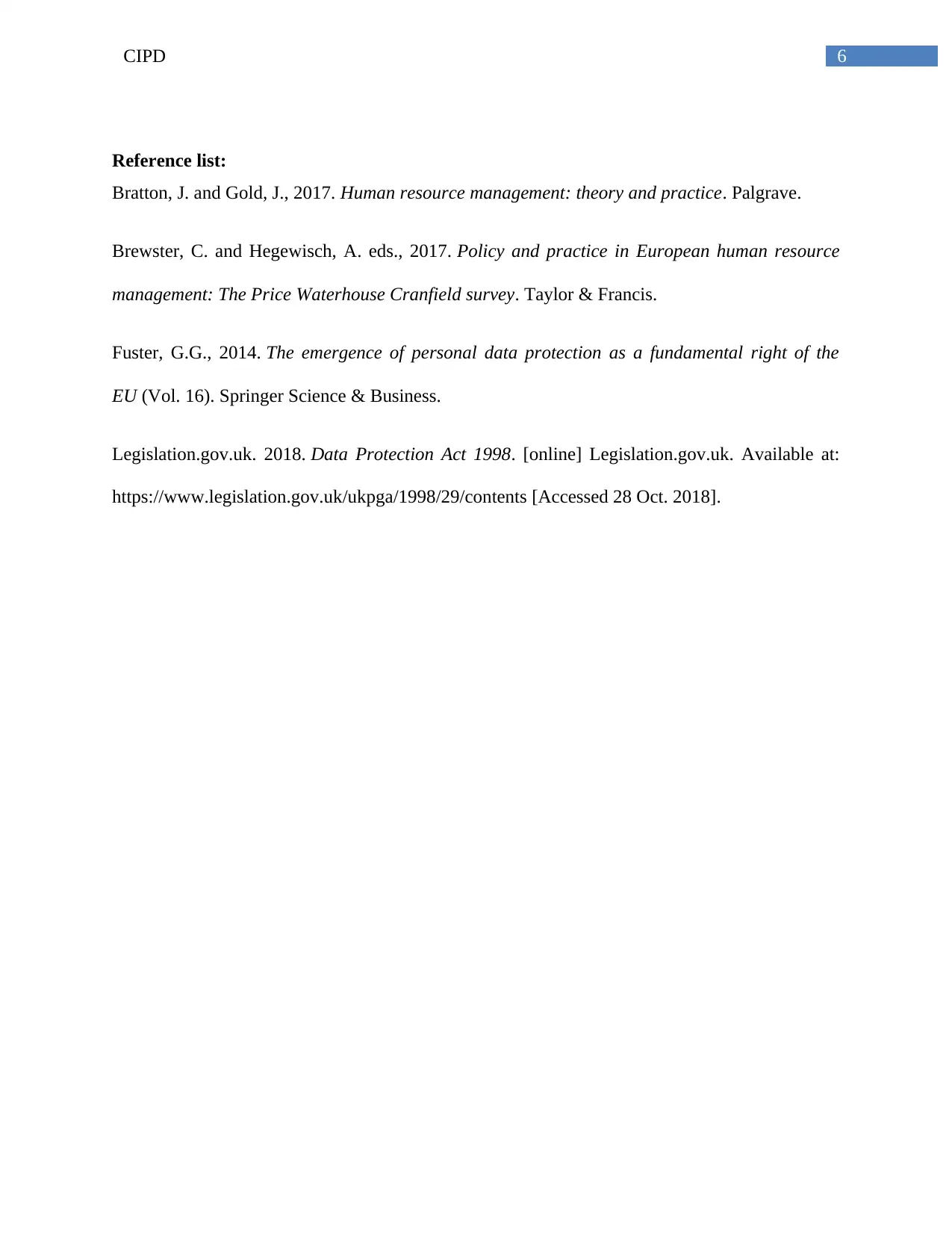
Bratton, J. and Gold, J., 2017. Human resource management: theory and practice. Palgrave.
Brewster, C. and Hegewisch, A. eds., 2017. Policy and practice in European human resource
management: The Price Waterhouse Cranfield survey. Taylor & Francis.
Fuster, G.G., 2014. The emergence of personal data protection as a fundamental right of the
EU (Vol. 16). Springer Science & Business.
Legislation.gov.uk. 2018. Data Protection Act 1998. [online] Legislation.gov.uk. Available at:
https://www.legislation.gov.uk/ukpga/1998/29/contents [Accessed 28 Oct. 2018].
Reference list:
Bratton, J. and Gold, J., 2017. Human resource management: theory and practice. Palgrave.
Brewster, C. and Hegewisch, A. eds., 2017. Policy and practice in European human resource
management: The Price Waterhouse Cranfield survey. Taylor & Francis.
Fuster, G.G., 2014. The emergence of personal data protection as a fundamental right of the
EU (Vol. 16). Springer Science & Business.
Legislation.gov.uk. 2018. Data Protection Act 1998. [online] Legislation.gov.uk. Available at:
https://www.legislation.gov.uk/ukpga/1998/29/contents [Accessed 28 Oct. 2018].
1 out of 7
Related Documents
Your All-in-One AI-Powered Toolkit for Academic Success.
+13062052269
info@desklib.com
Available 24*7 on WhatsApp / Email
Unlock your academic potential
Copyright © 2020–2025 A2Z Services. All Rights Reserved. Developed and managed by ZUCOL.