McDonald's HR Development: Improving Training Effectiveness

Verified

Added on  2021/05/31

|7
|1031
|87
Report
AI Summary
This report provides an analysis of Human Resource Development (HRD) within McDonald's, focusing on the alignment of organizational goals with employee training and development. It addresses the need for improved customer satisfaction through effective training programs designed to meet individual, technological, and organizational needs. The report details a comprehensive approach encompassing needs assessment, design, implementation, and evaluation stages. Specific attention is given to creating a learning culture, prioritizing employee safety and motivation, and addressing issues such as bullying and cultural differences. The implementation phase emphasizes interactive media, mentorship, and on-the-job coaching. Evaluation methods include surveys, quizzes, and performance reviews, with results communicated to stakeholders through regular reports and meetings. The ultimate aim is to enhance employee performance, improve customer satisfaction, and achieve the organization's overarching goal of being customers' favorite place to eat and drink.
Document Page
HUMAN RESOURCE DEVELOPMENT
Student’s Name
Professor’s Name
Course
City/State
Date
tabler-icon-diamond-filled.svg

Paraphrase This Document

Need a fresh take? Get an instant paraphrase of this document with our AI Paraphraser
Document Page
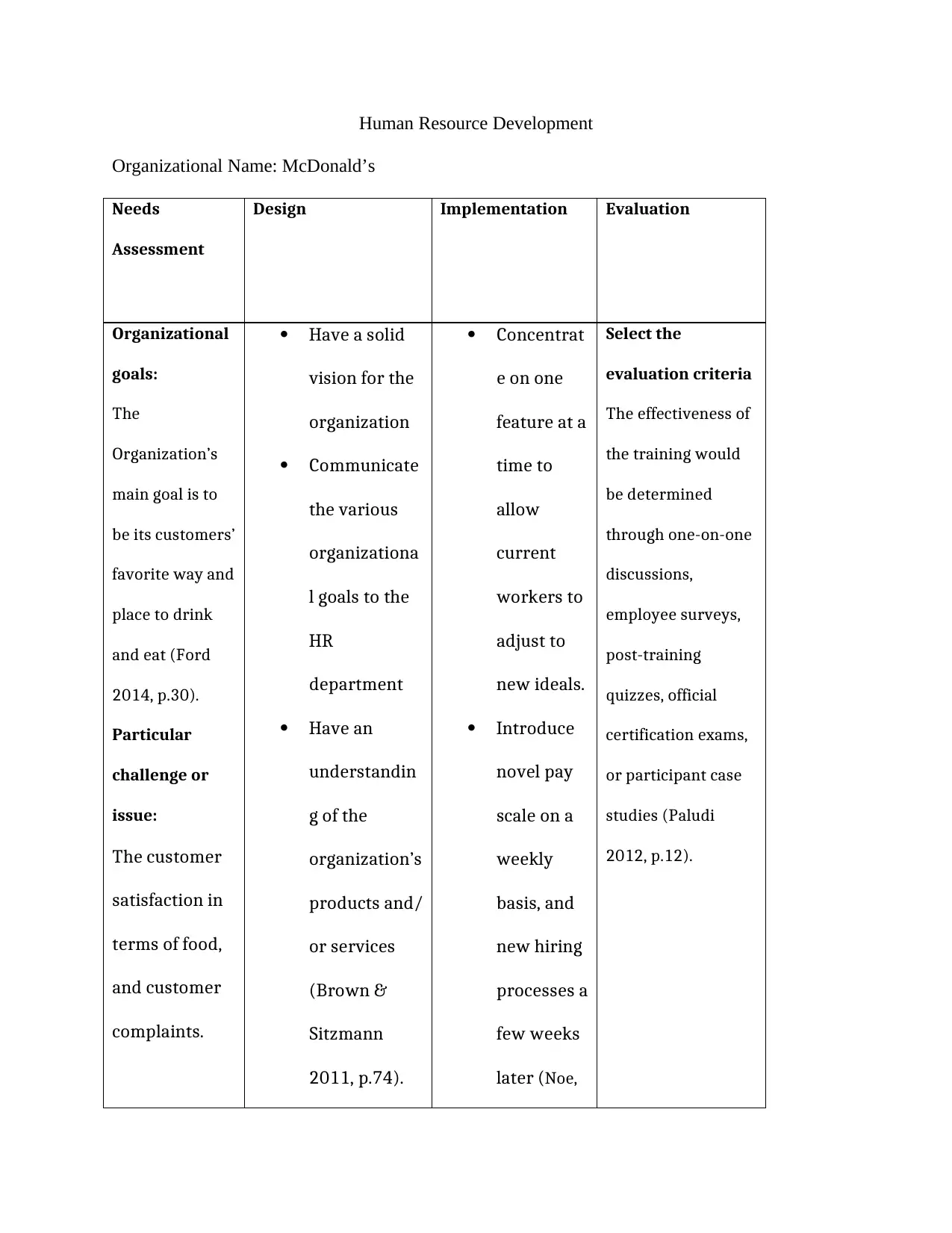
Human Resource Development
Organizational Name: McDonald’s
Needs
Assessment
Design Implementation Evaluation
Organizational
goals:
The
Organization’s
main goal is to
be its customers’
favorite way and
place to drink
and eat (Ford
2014, p.30).
Particular
challenge or
issue:
The customer
satisfaction in
terms of food,
and customer
complaints.
Have a solid
vision for the
organization
Communicate
the various
organizationa
l goals to the
HR
department
Have an
understandin
g of the
organization’s
products and/
or services
(Brown &
Sitzmann
2011, p.74).
Concentrat
e on one
feature at a
time to
allow
current
workers to
adjust to
new ideals.
Introduce
novel pay
scale on a
weekly
basis, and
new hiring
processes a
few weeks
later (Noe,
Select the
evaluation criteria
The effectiveness of
the training would
be determined
through one-on-one
discussions,
employee surveys,
post-training
quizzes, official
certification exams,
or participant case
studies (Paludi
2012, p.12).
Document Page
Alena &
Howard
2014,
p.261).
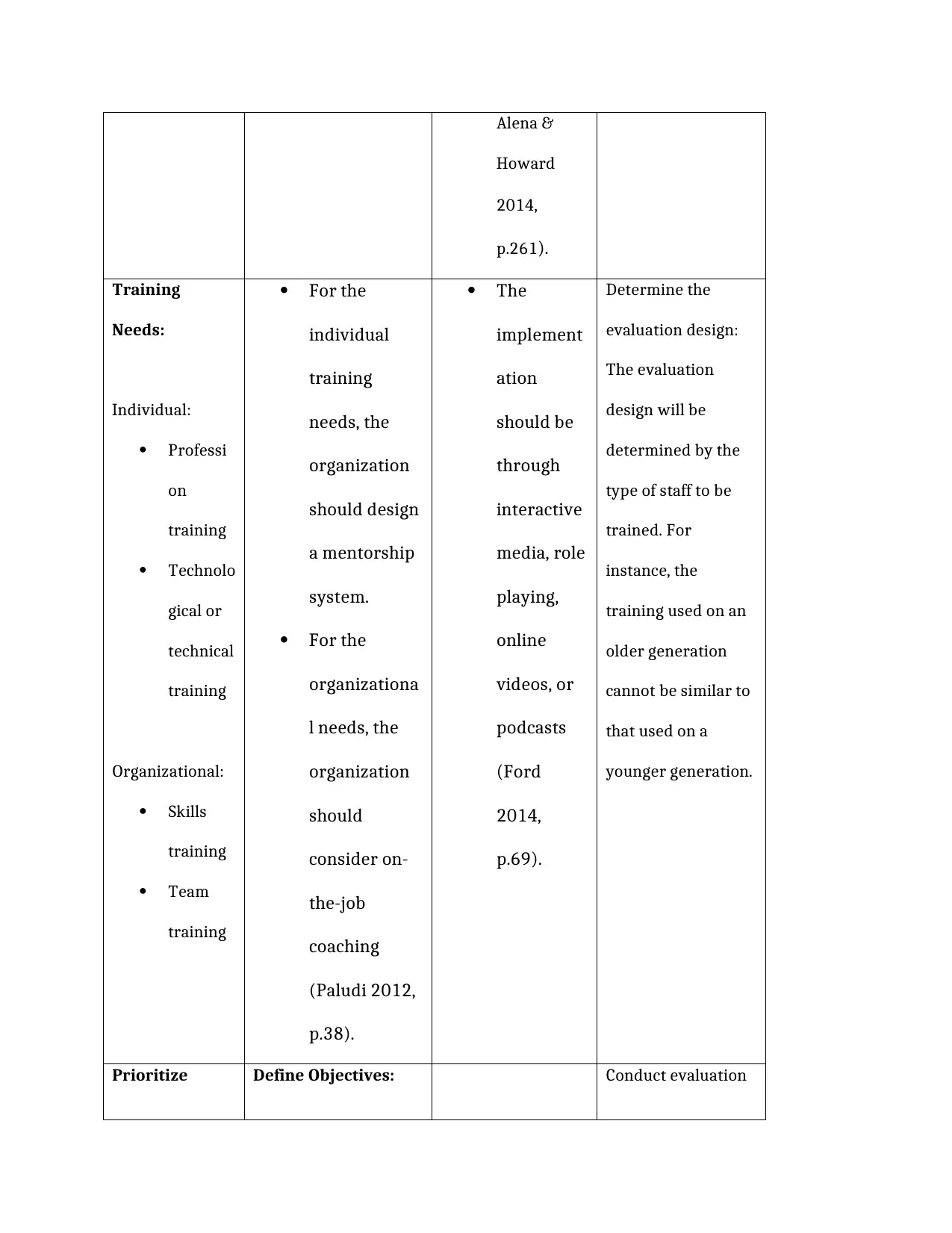
Training
Needs:
Individual:
Professi
on
training
Technolo
gical or
technical
training
Organizational:
Skills
training
Team
training
For the
individual
training
needs, the
organization
should design
a mentorship
system.
For the
organizationa
l needs, the
organization
should
consider on-
the-job
coaching
(Paludi 2012,
p.38).
The
implement
ation
should be
through
interactive
media, role
playing,
online
videos, or
podcasts
(Ford
2014,
p.69).
Determine the
evaluation design:
The evaluation
design will be
determined by the
type of staff to be
trained. For
instance, the
training used on an
older generation
cannot be similar to
that used on a
younger generation.
Prioritize Define Objectives: Conduct evaluation
Document Page
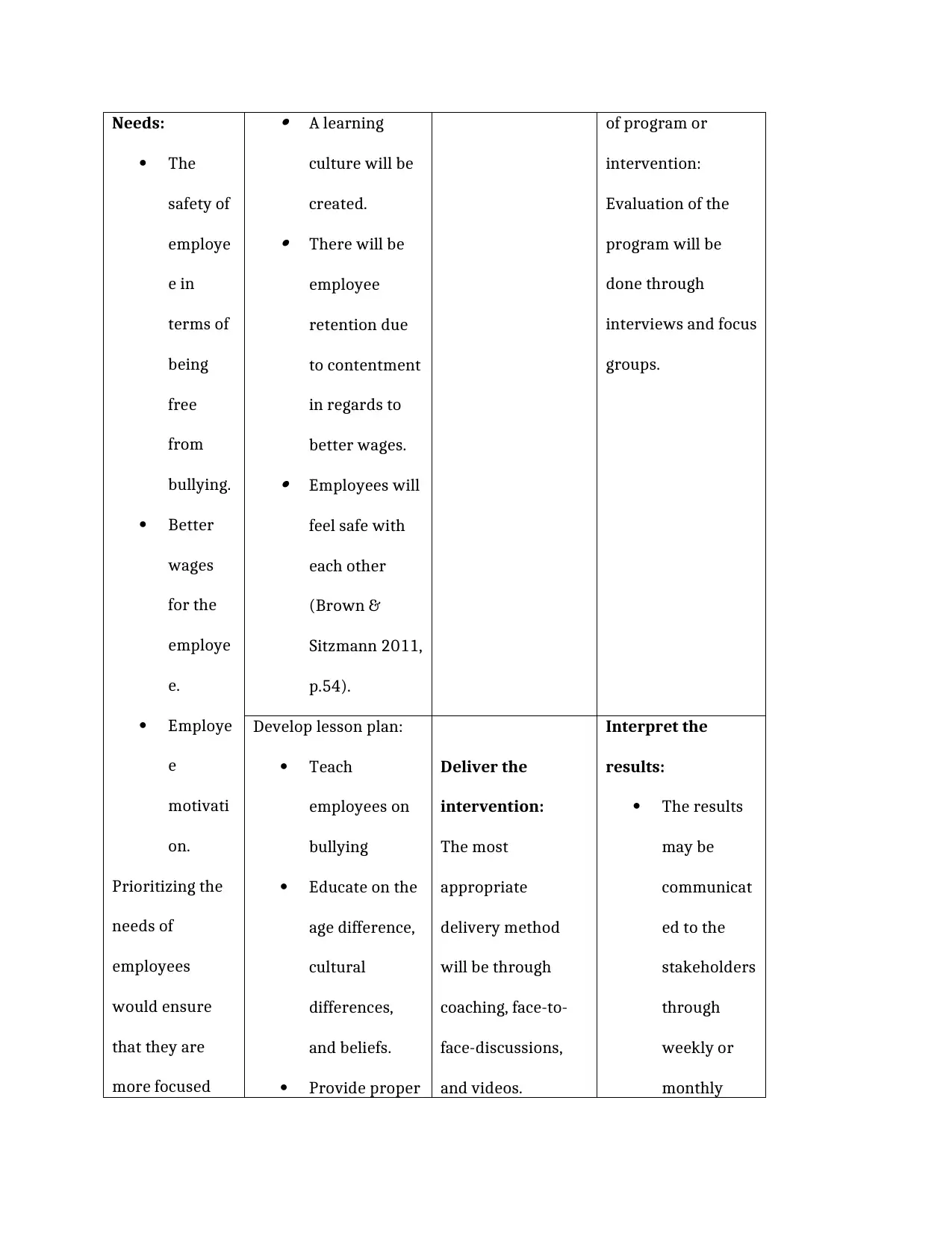
Needs:
The
safety of
employe
e in
terms of
being
free
from
bullying.
Better
wages
for the
employe
e.
Employe
e
motivati
on.
Prioritizing the
needs of
employees
would ensure
that they are
more focused
A learning
culture will be
created.
There will be
employee
retention due
to contentment
in regards to
better wages.
Employees will
feel safe with
each other
(Brown &
Sitzmann 2011,
p.54).
of program or
intervention:
Evaluation of the
program will be
done through
interviews and focus
groups.
Develop lesson plan:
Teach
employees on
bullying
Educate on the
age difference,
cultural
differences,
and beliefs.
Provide proper
Deliver the
intervention:
The most
appropriate
delivery method
will be through
coaching, face-to-
face-discussions,
and videos.
Interpret the
results:
The results
may be
communicat
ed to the
stakeholders
through
weekly or
monthly
tabler-icon-diamond-filled.svg

Paraphrase This Document

Need a fresh take? Get an instant paraphrase of this document with our AI Paraphraser
Document Page
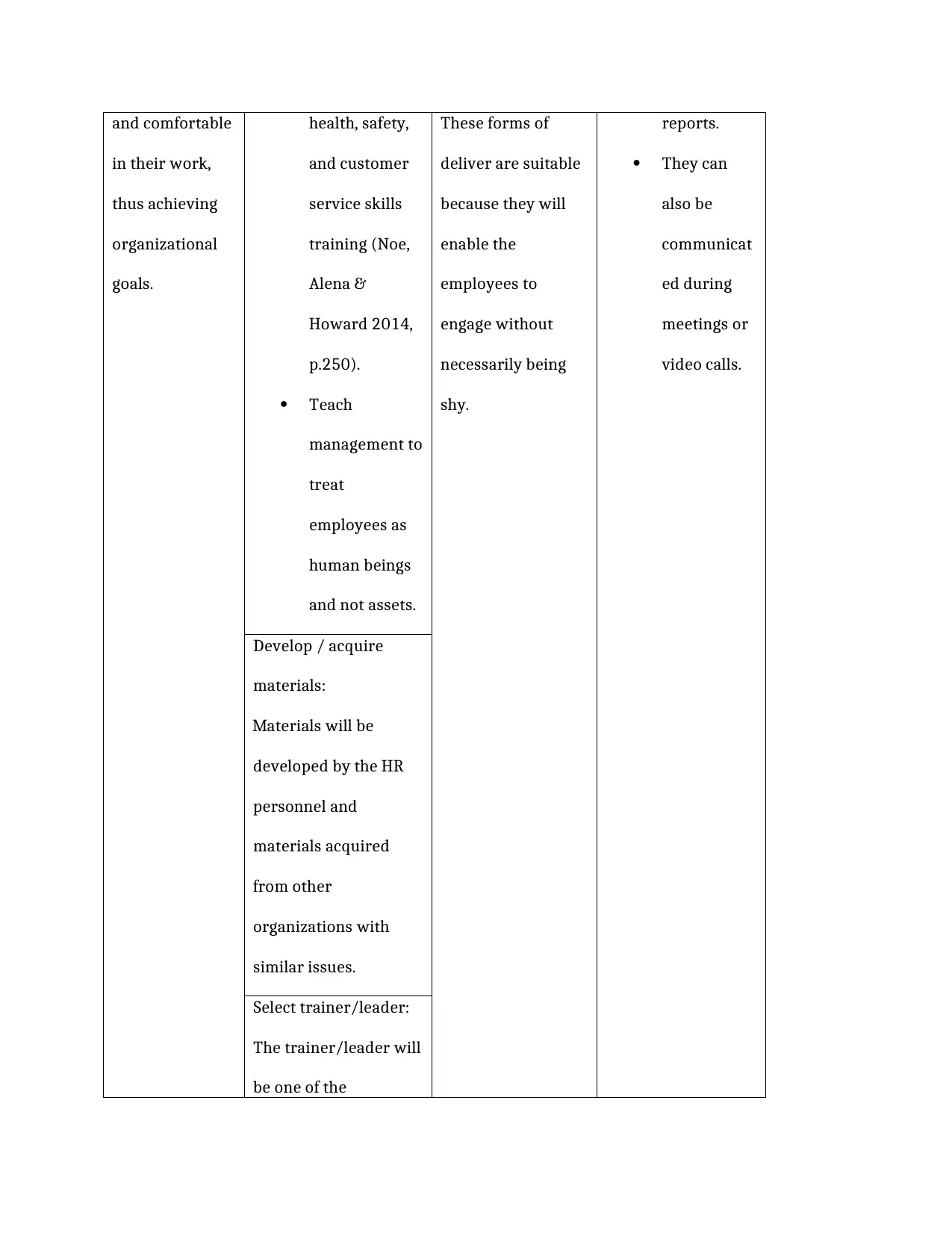
and comfortable
in their work,
thus achieving
organizational
goals.
health, safety,
and customer
service skills
training (Noe,
Alena &
Howard 2014,
p.250).
Teach
management to
treat
employees as
human beings
and not assets.
These forms of
deliver are suitable
because they will
enable the
employees to
engage without
necessarily being
shy.
reports.
They can
also be
communicat
ed during
meetings or
video calls.
Develop / acquire
materials:
Materials will be
developed by the HR
personnel and
materials acquired
from other
organizations with
similar issues.
Select trainer/leader:
The trainer/leader will
be one of the
Document Page
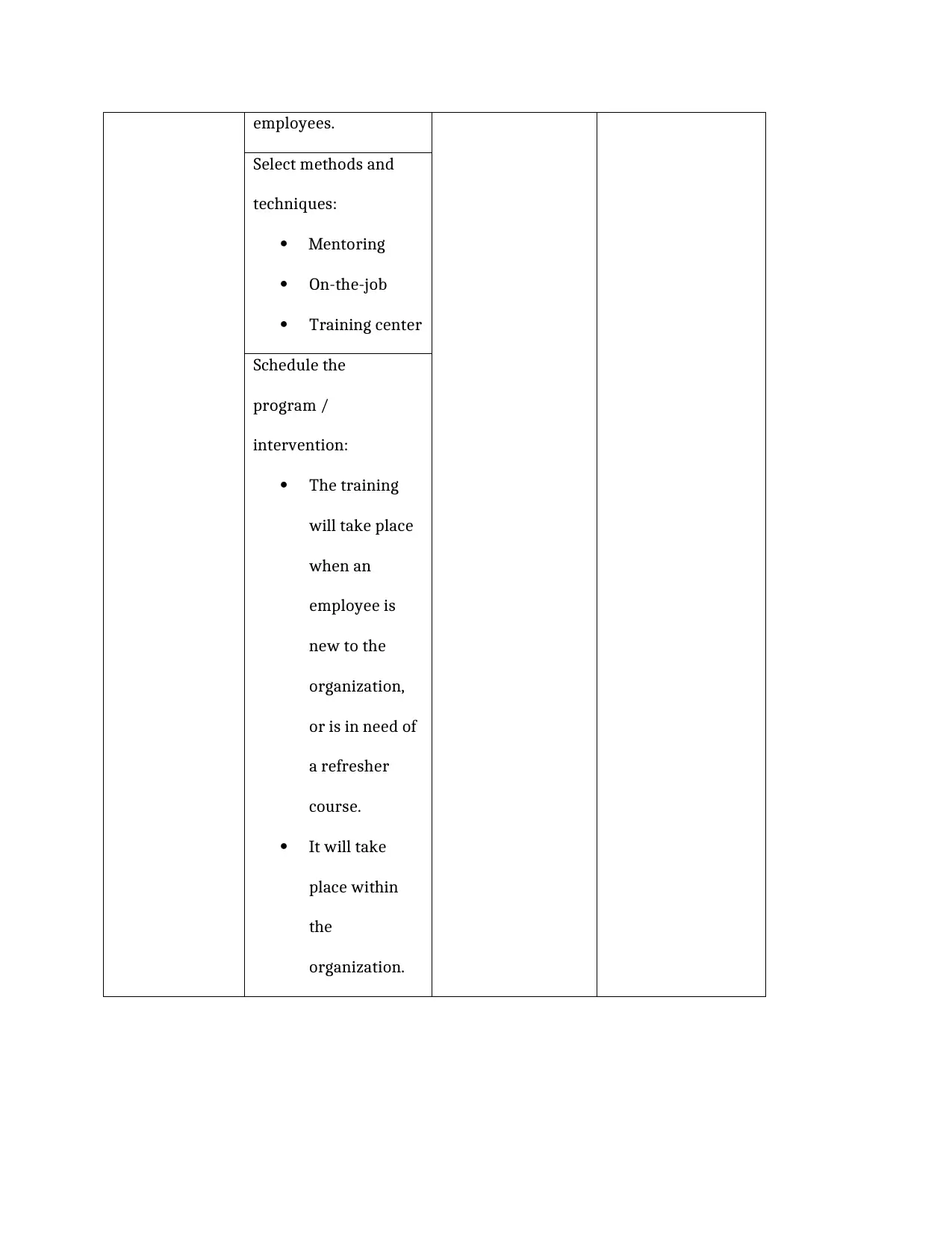
employees.
Select methods and
techniques:
Mentoring
On-the-job
Training center
Schedule the
program /
intervention:
The training
will take place
when an
employee is
new to the
organization,
or is in need of
a refresher
course.
It will take
place within
the
organization.
Document Page
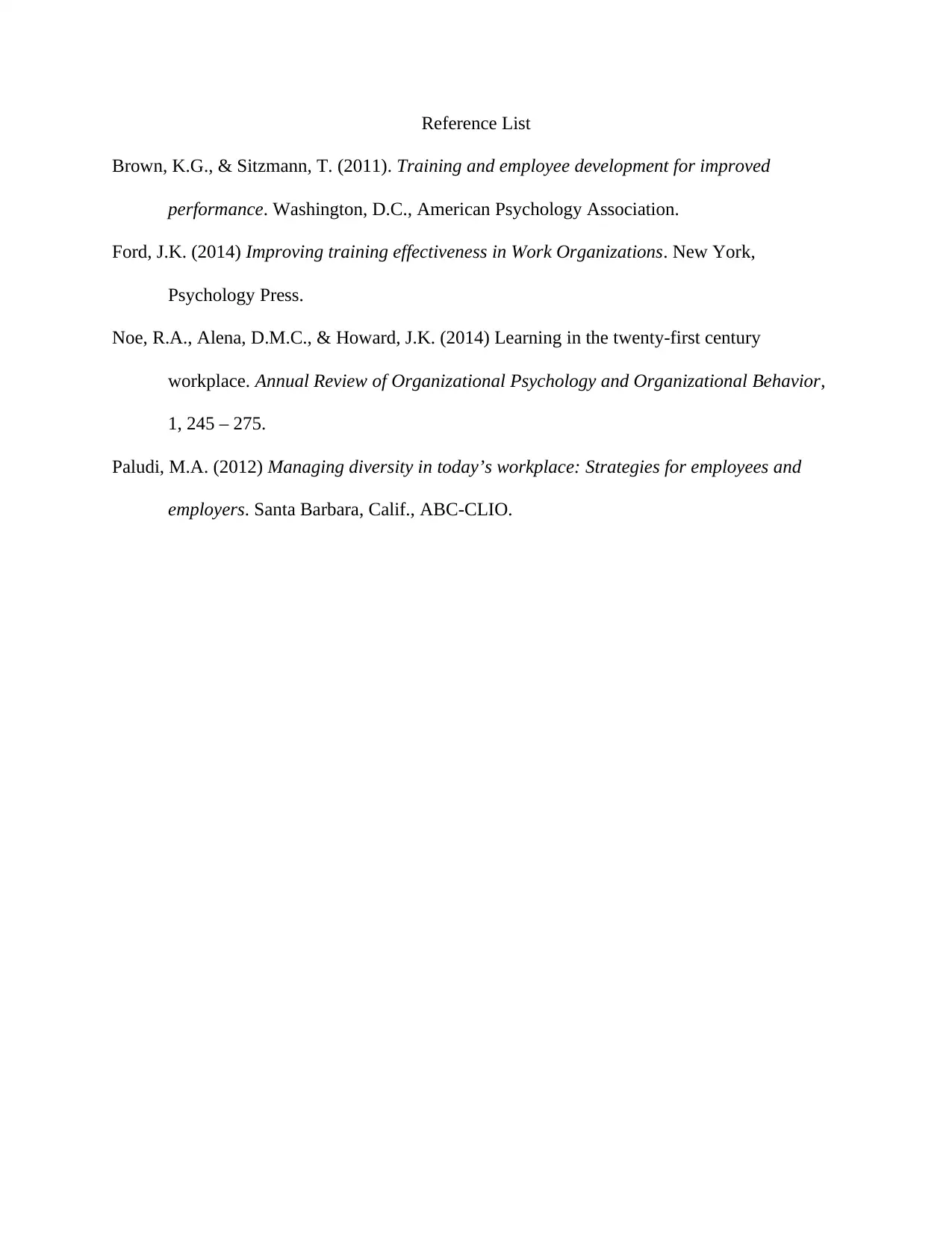
Reference List
Brown, K.G., & Sitzmann, T. (2011). Training and employee development for improved
performance. Washington, D.C., American Psychology Association.
Ford, J.K. (2014) Improving training effectiveness in Work Organizations. New York,
Psychology Press.
Noe, R.A., Alena, D.M.C., & Howard, J.K. (2014) Learning in the twenty-first century
workplace. Annual Review of Organizational Psychology and Organizational Behavior,
1, 245 – 275.
Paludi, M.A. (2012) Managing diversity in today’s workplace: Strategies for employees and
employers. Santa Barbara, Calif., ABC-CLIO.
chevron_up_icon
1 out of 7
circle_padding
hide_on_mobile
zoom_out_icon
[object Object]