Human Resource Management: Employee Motivation and Performance Report
VerifiedAdded on 2022/12/30
|14
|4266
|467
Report
AI Summary
This report, focused on business research methods, investigates the critical impact of employee motivation on productivity and performance within organizations, using Marks & Spencer as a case study. The research addresses the problem of employee motivation by exploring the concept's significance, benefits of motivation, and the adverse effects of its absence. It poses research questions to guide the study, aiming to analyze the effects of a lack of motivation on employee performance and productivity. The report outlines the research aim, objectives, and rationale for selecting this study, emphasizing the importance of employee motivation for organizational success. It reviews key readings on motivation, discussing its significance, benefits, and the impact of its absence. The report also details two appropriate research methods, including research philosophy and approach. The report concludes by examining the relevance and audience of the research, and discusses the communication of research findings.

Business Research
Methods
1
Methods
1

Paraphrase This Document
Need a fresh take? Get an instant paraphrase of this document with our AI Paraphraser
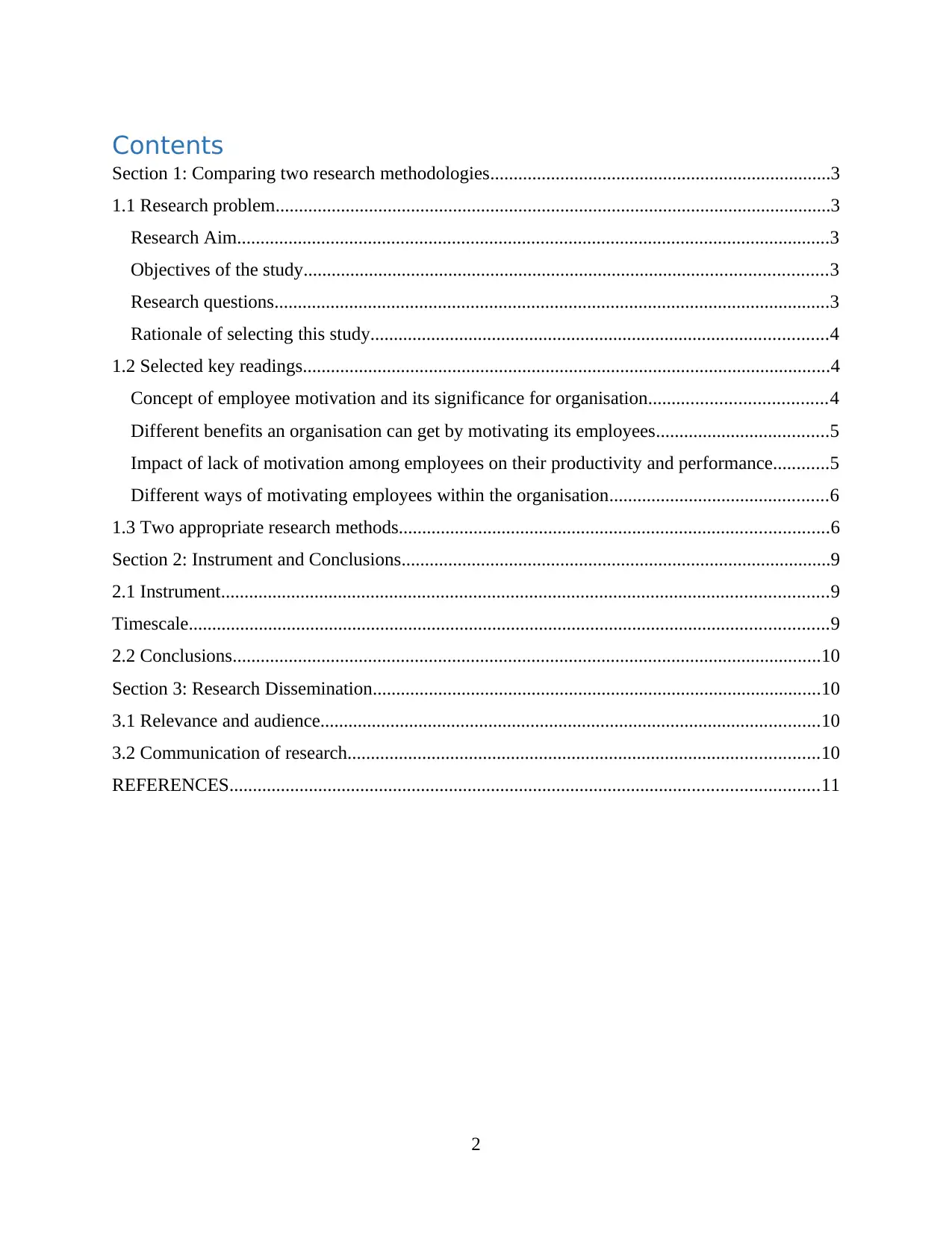
Contents
Section 1: Comparing two research methodologies.........................................................................3
1.1 Research problem.......................................................................................................................3
Research Aim...............................................................................................................................3
Objectives of the study................................................................................................................3
Research questions.......................................................................................................................3
Rationale of selecting this study..................................................................................................4
1.2 Selected key readings.................................................................................................................4
Concept of employee motivation and its significance for organisation......................................4
Different benefits an organisation can get by motivating its employees.....................................5
Impact of lack of motivation among employees on their productivity and performance............5
Different ways of motivating employees within the organisation...............................................6
1.3 Two appropriate research methods............................................................................................6
Section 2: Instrument and Conclusions............................................................................................9
2.1 Instrument..................................................................................................................................9
Timescale.........................................................................................................................................9
2.2 Conclusions..............................................................................................................................10
Section 3: Research Dissemination................................................................................................10
3.1 Relevance and audience...........................................................................................................10
3.2 Communication of research.....................................................................................................10
REFERENCES..............................................................................................................................11
2
Section 1: Comparing two research methodologies.........................................................................3
1.1 Research problem.......................................................................................................................3
Research Aim...............................................................................................................................3
Objectives of the study................................................................................................................3
Research questions.......................................................................................................................3
Rationale of selecting this study..................................................................................................4
1.2 Selected key readings.................................................................................................................4
Concept of employee motivation and its significance for organisation......................................4
Different benefits an organisation can get by motivating its employees.....................................5
Impact of lack of motivation among employees on their productivity and performance............5
Different ways of motivating employees within the organisation...............................................6
1.3 Two appropriate research methods............................................................................................6
Section 2: Instrument and Conclusions............................................................................................9
2.1 Instrument..................................................................................................................................9
Timescale.........................................................................................................................................9
2.2 Conclusions..............................................................................................................................10
Section 3: Research Dissemination................................................................................................10
3.1 Relevance and audience...........................................................................................................10
3.2 Communication of research.....................................................................................................10
REFERENCES..............................................................................................................................11
2
TITLE – “Human Resource Management - Impact of employee motivation on
productivity and performance of employees”
Section 1: Comparing two research methodologies
1.1 Research problem
Employee Motivation can be stated as the level of commitment, energy, creativity and
persistence which the employees of an organisation brings to their job. Motivated workforce is
the asset to company as they highly contribute in its success. It is an intrinsic drive to put forth
the required actions and efforts towards activities related to work. Employee Motivation is the
most significant aspect in an organisation which leads it towards high growth and sustainability
in the market and assist in attaining organisational goals effectively. Marks and Spencer is a
leading British National retailer which specialise in selling home products, clothing and food
products and is headquarters in London. It was established in year 1884 and now operating its
business all over the world. Employee motivation is very necessary for the organisation as if
there is lack of motivation, then organisation is not able to attain success. This business research
project intent to assess the influence of lack of employee motivation on performance and
productivity of employees. This project will help in determining the impact effectively so that
organisation is able to adopt various ways to keep its employees stay motivated within the firm.
Research Aim
The aim in relation to this particular research study is "To analyze the impact of lack of
motivation on productivity and performance of employees. A case study on Marks & Spencer"
Objectives of the study
1. To understand the concept of employee motivation and its significance for organisation.
2. To identify the different benefits an organisation can get by motivating its employees.
3. To assess the impact of lack of motivation among employees on their productivity and
performance.
4. To ascertain different ways of motivating employees within the organisation.
Research questions
1. What is the concept of employee motivation and its significance for organisation?
2. What are the different benefits an organisation can get by motivating its employees?
3
productivity and performance of employees”
Section 1: Comparing two research methodologies
1.1 Research problem
Employee Motivation can be stated as the level of commitment, energy, creativity and
persistence which the employees of an organisation brings to their job. Motivated workforce is
the asset to company as they highly contribute in its success. It is an intrinsic drive to put forth
the required actions and efforts towards activities related to work. Employee Motivation is the
most significant aspect in an organisation which leads it towards high growth and sustainability
in the market and assist in attaining organisational goals effectively. Marks and Spencer is a
leading British National retailer which specialise in selling home products, clothing and food
products and is headquarters in London. It was established in year 1884 and now operating its
business all over the world. Employee motivation is very necessary for the organisation as if
there is lack of motivation, then organisation is not able to attain success. This business research
project intent to assess the influence of lack of employee motivation on performance and
productivity of employees. This project will help in determining the impact effectively so that
organisation is able to adopt various ways to keep its employees stay motivated within the firm.
Research Aim
The aim in relation to this particular research study is "To analyze the impact of lack of
motivation on productivity and performance of employees. A case study on Marks & Spencer"
Objectives of the study
1. To understand the concept of employee motivation and its significance for organisation.
2. To identify the different benefits an organisation can get by motivating its employees.
3. To assess the impact of lack of motivation among employees on their productivity and
performance.
4. To ascertain different ways of motivating employees within the organisation.
Research questions
1. What is the concept of employee motivation and its significance for organisation?
2. What are the different benefits an organisation can get by motivating its employees?
3
⊘ This is a preview!⊘
Do you want full access?
Subscribe today to unlock all pages.

Trusted by 1+ million students worldwide
3. How lack of motivation among employees can impact on their productivity and performance
within the company?
4. Which are the different ways of motivating employees within the organisation?
Rationale of selecting this study
This study aims to analyze the impact of lack of motivation on productivity and performance
of employees. The reason behind selecting this specific study topic is that employee motivation
is very important aspect for each and every organisation. And if lack of motivation takes place,
then it impacts adversely on the performance and productivity of employees. So, performing this
research study is significant as it helps in gaining understanding of the concept and its
importance for the company in an effective way. It also helps in determining the benefits of
keeping the employees motivated for organisation and the impact of lack of motivation among
them on their performance and productivity. Apart from this, it helps in determining the different
ways through which an organisation can motivate its employees and issue associated with lack of
motivation can be resolved. This study also helps in improving the knowledge of researcher
about the topic and help the organisation to keep its employees stay motivated within firm.
1.2 Selected key readings
Concept of employee motivation and its significance for organisation
Motivation is defined as the inducement or incitement to move or act. It is the procedure of
inducing the workforce of the company to act in desired manner so as to accomplish the goals of
company. There are three significant sub concepts associated with this concept including motive,
motivation and motivator. According to the view point of Hemavathi S, 2016, motivation is very
crucial concept in an organisation improve the performance level. The ability to perform work
and willingness affect the efficiency of an individual. With the help of training and education,
the ability to do work is acquired and the willingness to do work is acquired with the assistance
of motivation. It is very important to have willingness to perform any work. A highly motivated
individual can only be able to do the work willingly. Apart from this, motivation assists in
changing the negative attitudes of employees and leads to stability of workforce. This help in
improving reputation and goodwill of company by assisting in reducing the employee turnover.
In addition to this, motivated employees wants to stay more in the organisation and perform their
4
within the company?
4. Which are the different ways of motivating employees within the organisation?
Rationale of selecting this study
This study aims to analyze the impact of lack of motivation on productivity and performance
of employees. The reason behind selecting this specific study topic is that employee motivation
is very important aspect for each and every organisation. And if lack of motivation takes place,
then it impacts adversely on the performance and productivity of employees. So, performing this
research study is significant as it helps in gaining understanding of the concept and its
importance for the company in an effective way. It also helps in determining the benefits of
keeping the employees motivated for organisation and the impact of lack of motivation among
them on their performance and productivity. Apart from this, it helps in determining the different
ways through which an organisation can motivate its employees and issue associated with lack of
motivation can be resolved. This study also helps in improving the knowledge of researcher
about the topic and help the organisation to keep its employees stay motivated within firm.
1.2 Selected key readings
Concept of employee motivation and its significance for organisation
Motivation is defined as the inducement or incitement to move or act. It is the procedure of
inducing the workforce of the company to act in desired manner so as to accomplish the goals of
company. There are three significant sub concepts associated with this concept including motive,
motivation and motivator. According to the view point of Hemavathi S, 2016, motivation is very
crucial concept in an organisation improve the performance level. The ability to perform work
and willingness affect the efficiency of an individual. With the help of training and education,
the ability to do work is acquired and the willingness to do work is acquired with the assistance
of motivation. It is very important to have willingness to perform any work. A highly motivated
individual can only be able to do the work willingly. Apart from this, motivation assists in
changing the negative attitudes of employees and leads to stability of workforce. This help in
improving reputation and goodwill of company by assisting in reducing the employee turnover.
In addition to this, motivated employees wants to stay more in the organisation and perform their
4
Paraphrase This Document
Need a fresh take? Get an instant paraphrase of this document with our AI Paraphraser
works and responsibilities willingly. This also reduces the absenteeism in the organisation and
improves productivity.
Employee motivation can be expressed as energy level, excitement, imagination and
responsibility of workers towards association. It is all about keeping the representatives fulfilled
in the association by improving their assurance and inspiration. Roused labour force is the
essential resource of organization and are straightforwardly relative to the achievement of
business. Representative inspiration is significant for association as it empowers it to achieve its
objectives and targets. Without propelled workers, an association can't be developing and
achievement. Spurred workers lead an organization towards upgraded profitability and make it
ready to achieve significant level of yield. Aside from this, representative inspiration additionally
makes a difference in fulfilling the representatives and improving their productivity to perform
their jobs and duties in a successful and productive way.
Different benefits an organisation can get by motivating its employees
As per the opinion of Idowu, (2017), Employee motivation play very significant role in
growth and success of an organisation. Employees are the very important part of organisation
and without them, no business can be able to attain growth and success. So, it is very essential
for the company keep its employees motivated and satisfied so that their efficiency can be
improved and they are committed towards company. Motivated and satisfied employees perform
their roles and responsibilities effectively which lead the organisation towards growth and
success. Apart from this, it not only improves the productivity of employees, but the
organizational productivity will also be enhancing if the employees stay motivated. Thus,
maximized the profitability of company and leads the organisation towards accomplishment of
its goals and objectives. This highly contributes the organisation in achieving competitive
advantage in market and attaining growth and success (De Sousa Sabbagha, Ledimo, and
Martins, 2018).
There are several benefits that an organisation can get by motivating its employees. These
benefits include improving productivity as the process of motivation meet the needs of
employees and thus, improve the productivity. It ensures the efficiency of organisation by
changing the attitude of employees towards it. It makes sure loyal workforce within the
workplace by ensuring high level of commitment and morale towards the organisation along
5
improves productivity.
Employee motivation can be expressed as energy level, excitement, imagination and
responsibility of workers towards association. It is all about keeping the representatives fulfilled
in the association by improving their assurance and inspiration. Roused labour force is the
essential resource of organization and are straightforwardly relative to the achievement of
business. Representative inspiration is significant for association as it empowers it to achieve its
objectives and targets. Without propelled workers, an association can't be developing and
achievement. Spurred workers lead an organization towards upgraded profitability and make it
ready to achieve significant level of yield. Aside from this, representative inspiration additionally
makes a difference in fulfilling the representatives and improving their productivity to perform
their jobs and duties in a successful and productive way.
Different benefits an organisation can get by motivating its employees
As per the opinion of Idowu, (2017), Employee motivation play very significant role in
growth and success of an organisation. Employees are the very important part of organisation
and without them, no business can be able to attain growth and success. So, it is very essential
for the company keep its employees motivated and satisfied so that their efficiency can be
improved and they are committed towards company. Motivated and satisfied employees perform
their roles and responsibilities effectively which lead the organisation towards growth and
success. Apart from this, it not only improves the productivity of employees, but the
organizational productivity will also be enhancing if the employees stay motivated. Thus,
maximized the profitability of company and leads the organisation towards accomplishment of
its goals and objectives. This highly contributes the organisation in achieving competitive
advantage in market and attaining growth and success (De Sousa Sabbagha, Ledimo, and
Martins, 2018).
There are several benefits that an organisation can get by motivating its employees. These
benefits include improving productivity as the process of motivation meet the needs of
employees and thus, improve the productivity. It ensures the efficiency of organisation by
changing the attitude of employees towards it. It makes sure loyal workforce within the
workplace by ensuring high level of commitment and morale towards the organisation along
5
with its goals and objectives. In addition to this, motivation is a vital part in facilitating direction
implies so that they can perform their roles and responsibilities in more effective way.
Impact of lack of motivation among employees on their productivity and performance
As per the view point of Hanaysha, J.R. and Majid, M., 2018, Lack of motivation
negatively impacts on the performance and productivity of employees. If employees are not
motivated, then they are not able to work effectively in the organisation and not contribute
towards accomplishing the goals of the company. Apart from this, lack of motivation develops
an ineffective culture within the organisation which in turn impact negatively on other people
which leads to reduced productivity and performance. It is very important for an organisation to
keep its employees motivated as by the help of this, organisation is able to accomplish its
predetermined goals and objectives. If employees work willingly towards accomplishing the
goals, then this leads to impact positively on the performance and productivity company. it also
provides an organisation with the competitive advantage in market over the rivals and improve
its brand reputation.
Different ways of motivating employees within the organisation
As per the opinion presented by Závadský, Hitka, and Potkány, (2015), there are several
ways through which an organisation can motivate its employees. Some of the ways are define
below:
Providing rewards and recognition: if the organisation will provide appropriate reward
and recognition to its employees for the work they performed in the organisation, then it
assists in improving their motivation level and developed a sense of satisfaction among
them.
Training and development opportunities: this is also the another way through which a
company can motivate its employees. Providing all the employees with regular training
and development opportunities help in improving their skills and competency level which
will further supports in their future growth and development. This also improves
motivation of employees.
Apart from this, the another way to motivate employees includes take regular breaks- taking
a small healthy break leaves a positive impact on employee’s body and mind. Be transparent-
relationships built in trust. Transparent environment is good way to keep team motivated. It also
ensures that all employees are working with same piece of information. Provide clarity- in order
6
implies so that they can perform their roles and responsibilities in more effective way.
Impact of lack of motivation among employees on their productivity and performance
As per the view point of Hanaysha, J.R. and Majid, M., 2018, Lack of motivation
negatively impacts on the performance and productivity of employees. If employees are not
motivated, then they are not able to work effectively in the organisation and not contribute
towards accomplishing the goals of the company. Apart from this, lack of motivation develops
an ineffective culture within the organisation which in turn impact negatively on other people
which leads to reduced productivity and performance. It is very important for an organisation to
keep its employees motivated as by the help of this, organisation is able to accomplish its
predetermined goals and objectives. If employees work willingly towards accomplishing the
goals, then this leads to impact positively on the performance and productivity company. it also
provides an organisation with the competitive advantage in market over the rivals and improve
its brand reputation.
Different ways of motivating employees within the organisation
As per the opinion presented by Závadský, Hitka, and Potkány, (2015), there are several
ways through which an organisation can motivate its employees. Some of the ways are define
below:
Providing rewards and recognition: if the organisation will provide appropriate reward
and recognition to its employees for the work they performed in the organisation, then it
assists in improving their motivation level and developed a sense of satisfaction among
them.
Training and development opportunities: this is also the another way through which a
company can motivate its employees. Providing all the employees with regular training
and development opportunities help in improving their skills and competency level which
will further supports in their future growth and development. This also improves
motivation of employees.
Apart from this, the another way to motivate employees includes take regular breaks- taking
a small healthy break leaves a positive impact on employee’s body and mind. Be transparent-
relationships built in trust. Transparent environment is good way to keep team motivated. It also
ensures that all employees are working with same piece of information. Provide clarity- in order
6
⊘ This is a preview!⊘
Do you want full access?
Subscribe today to unlock all pages.
Trusted by 1+ million students worldwide
to stay motivated, it is important to know about your objectives and goals first. For most
Employees, understanding starts from transparency and it ends with clarity.
1.3 Two appropriate research methods
Research methodology one of the significant part of research which involves specific
techniques or procedures that researcher use to perform the study systematically. The
methodological choices are made by the researchers on the basis of distinction between
quantitative and qualitative data. In the literature that has reviewed, quantitative research
methodology is used. Apart from this, deductive approach is utilized in which the authors utilise
wide range of theories in order to find out the answers from existing study and findings regarding
employee motivation and employee performance. In the literature reviewed, the research initiates
with sample questionnaire and the outcomes of it are analysed through arranging the
motivational forces perceived through workforce towards their performance. The reviewed study
aims to analyse the role of motivation and improving the performance of employees using the
Maslow’s need hierarchy theory as the base to accomplish the same. The quantitative methods
used in the study are based on previously decided as well as well-structured questions that are
asked from the respondents. In relation to this particular study of business research methods, the
different methods of research that will be used by the researcher are as follows:
Research philosophy: It is referred as the development of knowledge as well as the nature
of knowledge. These involves positivism and interpretevism philosophy. As per the positivism
philosophy, reality is stable and can be observed through objective point of view. On the other
hand, interpretivism is based on subjective interpretation and states that investigator plays
specific role in observing social world. This study use positivism research philosophy as it is
based on quantifiable observations which leads to statistical analysis. The main advantage of
using this approach is that it is a reliable approach and the data is based on objectivity. However,
the philosophy doesn't provide in-depth data and is low in validity which is the disadvantage of
positivism philosophy.
Research approach: the approaches of research includes inductive and deductive research
approach. These are the two approaches which are mainly utilised by researchers in performing
study. The inductive research approach is based on developing a theory and the deductive
approach of research aims to testing an existing theory. This study emphasizes on using
deductive research approach as it initiates with existing theory, develop hypothesis based on that,
7
Employees, understanding starts from transparency and it ends with clarity.
1.3 Two appropriate research methods
Research methodology one of the significant part of research which involves specific
techniques or procedures that researcher use to perform the study systematically. The
methodological choices are made by the researchers on the basis of distinction between
quantitative and qualitative data. In the literature that has reviewed, quantitative research
methodology is used. Apart from this, deductive approach is utilized in which the authors utilise
wide range of theories in order to find out the answers from existing study and findings regarding
employee motivation and employee performance. In the literature reviewed, the research initiates
with sample questionnaire and the outcomes of it are analysed through arranging the
motivational forces perceived through workforce towards their performance. The reviewed study
aims to analyse the role of motivation and improving the performance of employees using the
Maslow’s need hierarchy theory as the base to accomplish the same. The quantitative methods
used in the study are based on previously decided as well as well-structured questions that are
asked from the respondents. In relation to this particular study of business research methods, the
different methods of research that will be used by the researcher are as follows:
Research philosophy: It is referred as the development of knowledge as well as the nature
of knowledge. These involves positivism and interpretevism philosophy. As per the positivism
philosophy, reality is stable and can be observed through objective point of view. On the other
hand, interpretivism is based on subjective interpretation and states that investigator plays
specific role in observing social world. This study use positivism research philosophy as it is
based on quantifiable observations which leads to statistical analysis. The main advantage of
using this approach is that it is a reliable approach and the data is based on objectivity. However,
the philosophy doesn't provide in-depth data and is low in validity which is the disadvantage of
positivism philosophy.
Research approach: the approaches of research includes inductive and deductive research
approach. These are the two approaches which are mainly utilised by researchers in performing
study. The inductive research approach is based on developing a theory and the deductive
approach of research aims to testing an existing theory. This study emphasizes on using
deductive research approach as it initiates with existing theory, develop hypothesis based on that,
7
Paraphrase This Document
Need a fresh take? Get an instant paraphrase of this document with our AI Paraphraser
collect data or information to test the hypothesis as well as analyse results. The advantage of
using deductive approach is that it is possible to measure concepts quantitatively with this
approach along with generalize the findings of study to a certain extent. However, the
disadvantage of using this approach is that it is highly rely upon initial premises being correct.
Research strategy: there are different types of research strategies which can be used by
researches while performing study. The strategies involve quantitative survey, action oriented
research, qualitative interview, systematic literature review, case study research, experimental
research etc. This particular research study make use of quantitative survey method in which data
is collected by using questionnaire which consists well-structured set of questions that
respondents needs to answer. The main advantage of using this method is that it enables
researcher to reach to higher sample size and by the help of this, researcher can quickly get the
information and data. However, there is also some disadvantages of using this method. One of
the disadvantage is that it sometimes develops unnatural environment some effort at
randomisation not develop usable information.
Research design: the two main research design includes quantitative and qualitative
research design. The quantitative research design deals with statistics and numbers and the
qualitative design of research deals with meanings and words. This research study makes use of
quantitative research design as this enable researcher to test hypothesis through systematically
gathering as well as analysing data. Apart from this, objectivity and accuracy and easy and quick
collection of data are the main advantages of quantitative research design. However, it is very
difficult to understand the context of phenomena in this research design which is the weakness of
this design.
Data collection method: data collection is a process through which data can be collected by
the investigator. The data about the particular topic is collected by using primary data collection
method and secondary method. The primary data can be gathered by collecting first-hand
information which is completely new and never collected before by anyone. On the other side,
the second hand data is already collected and is not new. In this particular research study, the
method uses for collecting data are both primary and secondary methods of data collection.
Questionnaire is used for collecting the primary data and books, journals and articles, which are
published previously, are used to collect secondary data. the main advantage of using both
8
using deductive approach is that it is possible to measure concepts quantitatively with this
approach along with generalize the findings of study to a certain extent. However, the
disadvantage of using this approach is that it is highly rely upon initial premises being correct.
Research strategy: there are different types of research strategies which can be used by
researches while performing study. The strategies involve quantitative survey, action oriented
research, qualitative interview, systematic literature review, case study research, experimental
research etc. This particular research study make use of quantitative survey method in which data
is collected by using questionnaire which consists well-structured set of questions that
respondents needs to answer. The main advantage of using this method is that it enables
researcher to reach to higher sample size and by the help of this, researcher can quickly get the
information and data. However, there is also some disadvantages of using this method. One of
the disadvantage is that it sometimes develops unnatural environment some effort at
randomisation not develop usable information.
Research design: the two main research design includes quantitative and qualitative
research design. The quantitative research design deals with statistics and numbers and the
qualitative design of research deals with meanings and words. This research study makes use of
quantitative research design as this enable researcher to test hypothesis through systematically
gathering as well as analysing data. Apart from this, objectivity and accuracy and easy and quick
collection of data are the main advantages of quantitative research design. However, it is very
difficult to understand the context of phenomena in this research design which is the weakness of
this design.
Data collection method: data collection is a process through which data can be collected by
the investigator. The data about the particular topic is collected by using primary data collection
method and secondary method. The primary data can be gathered by collecting first-hand
information which is completely new and never collected before by anyone. On the other side,
the second hand data is already collected and is not new. In this particular research study, the
method uses for collecting data are both primary and secondary methods of data collection.
Questionnaire is used for collecting the primary data and books, journals and articles, which are
published previously, are used to collect secondary data. the main advantage of using both
8
method is that through this, researcher is able to gather information in huge amount. However,
the disadvantage is that it takes a lot of time to collect the data by using both the methods.
Sampling: it is the method by which researcher collect sample size from large population.
For collecting the sample size, two methods can be adopted including probability and
nonprobability sampling method. In probability method of sampling, the chances of getting
selected are equal for each respondent. Whereas, the non-probability sampling method do not
provide equal chances to each respondent of being selected. In this research, the method use for
sampling is probability sampling method in which simple random sampling method is used. The
main reason of selecting this method is it provides equal chances and eliminates biasness during
the study which is an advantage of this method. However, disadvantage of the method is that it is
difficult in assessing the list of full population.
Section 2: Instrument and Conclusions
2.1 Instrument
A research instrument can be survey, checklist, interviews and test. It is usually determined
by the investigator and is tied to study the methodology. The proposed research instrument in
relation to this research study is questionnaire. It is the commonly used instrument for gathering
data associated with the research from the participants. It seeks the opinions of people in sample
on the issues which are directly associated to the objectives of research. The questionnaire tool
consists of unstructured and structured questions which are developed by the researcher in order
to acquire data from respondents. It has various advantages including anonymity of respondents
is guaranteed, supports collection of huge amount of data in less time as well as it is cheap to
utilise as the cost occurring is less. However, there are some disadvantages of using this method
including that some miss leading and confusing questions cannot be clarified as the investigator
may not be there for explaining the questions to the respondents as well as sometimes, the
question might not be comprehensible easily to the people who are less educated or illiterate,
therefore, the survey method is restricted to educated respondents only.
Timescale
9
the disadvantage is that it takes a lot of time to collect the data by using both the methods.
Sampling: it is the method by which researcher collect sample size from large population.
For collecting the sample size, two methods can be adopted including probability and
nonprobability sampling method. In probability method of sampling, the chances of getting
selected are equal for each respondent. Whereas, the non-probability sampling method do not
provide equal chances to each respondent of being selected. In this research, the method use for
sampling is probability sampling method in which simple random sampling method is used. The
main reason of selecting this method is it provides equal chances and eliminates biasness during
the study which is an advantage of this method. However, disadvantage of the method is that it is
difficult in assessing the list of full population.
Section 2: Instrument and Conclusions
2.1 Instrument
A research instrument can be survey, checklist, interviews and test. It is usually determined
by the investigator and is tied to study the methodology. The proposed research instrument in
relation to this research study is questionnaire. It is the commonly used instrument for gathering
data associated with the research from the participants. It seeks the opinions of people in sample
on the issues which are directly associated to the objectives of research. The questionnaire tool
consists of unstructured and structured questions which are developed by the researcher in order
to acquire data from respondents. It has various advantages including anonymity of respondents
is guaranteed, supports collection of huge amount of data in less time as well as it is cheap to
utilise as the cost occurring is less. However, there are some disadvantages of using this method
including that some miss leading and confusing questions cannot be clarified as the investigator
may not be there for explaining the questions to the respondents as well as sometimes, the
question might not be comprehensible easily to the people who are less educated or illiterate,
therefore, the survey method is restricted to educated respondents only.
Timescale
9
⊘ This is a preview!⊘
Do you want full access?
Subscribe today to unlock all pages.
Trusted by 1+ million students worldwide
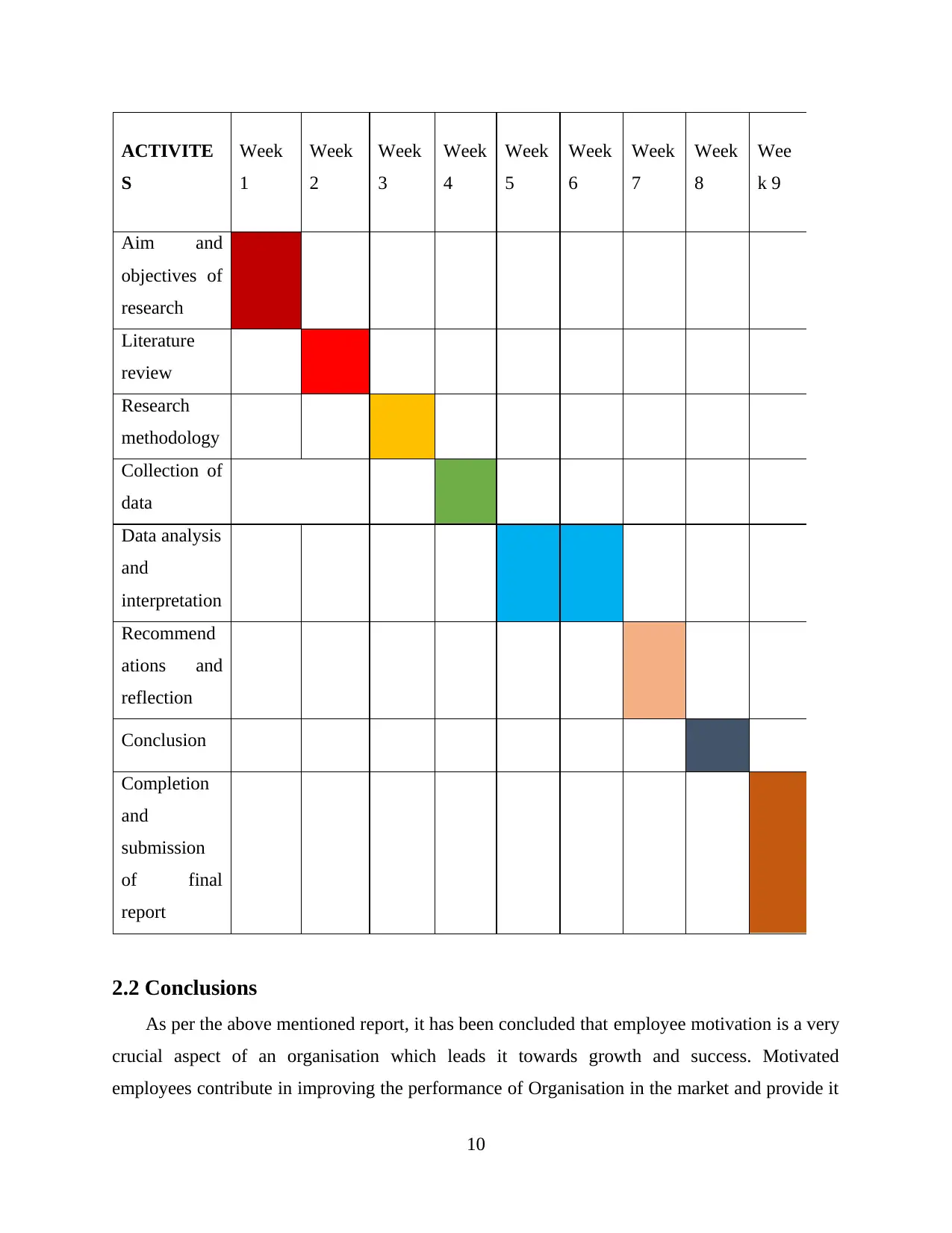
ACTIVITE
S
Week
1
Week
2
Week
3
Week
4
Week
5
Week
6
Week
7
Week
8
Wee
k 9
Aim and
objectives of
research
Literature
review
Research
methodology
Collection of
data
Data analysis
and
interpretation
Recommend
ations and
reflection
Conclusion
Completion
and
submission
of final
report
2.2 Conclusions
As per the above mentioned report, it has been concluded that employee motivation is a very
crucial aspect of an organisation which leads it towards growth and success. Motivated
employees contribute in improving the performance of Organisation in the market and provide it
10
S
Week
1
Week
2
Week
3
Week
4
Week
5
Week
6
Week
7
Week
8
Wee
k 9
Aim and
objectives of
research
Literature
review
Research
methodology
Collection of
data
Data analysis
and
interpretation
Recommend
ations and
reflection
Conclusion
Completion
and
submission
of final
report
2.2 Conclusions
As per the above mentioned report, it has been concluded that employee motivation is a very
crucial aspect of an organisation which leads it towards growth and success. Motivated
employees contribute in improving the performance of Organisation in the market and provide it
10
Paraphrase This Document
Need a fresh take? Get an instant paraphrase of this document with our AI Paraphraser
with the competitive advantage. The managers of the organisation need to emphasize on keep
motivating its employees so that they are able to work effectively within the company. It is very
necessary to provide employees with rewards and recognition so that they feel a sense of
belongingness within the company and perform their roles and responsibilities more effectively.
In addition to this, the research instrument used in this research will highly contributes in
accomplishing the objectives of research in an effective and efficient way and this research also
helpful in future in performing further investigation on the topic.
Section 3: Research Dissemination
3.1 Relevance and audience
This investigation is all about analysing the impact of lack of motivation on productivity and
performance of employees. This study is highly significant in understanding the concept of
motivation along with its significance for the organisation. Apart from this, it helps in
determining the different benefits that an organisation can get by motivating its employees.
Moreover, it assesses the influence of lack of motivation among the workforce on their
performance and productivity. The research is also assist in determining the various ways
through which an organisation can motivate its employees and keep them happy and satisfied
within the organisation. It acts as a base for performing further research on the topic. In order to
implementing the potential findings of research, the employees within the organisation is the
right audience. This research is highly effective in determining the significance of motivation for
the organisation as well as the various benefits of motivating the employees. The suggested
research is highly effective for the taken organisation in motivating its employees and improving
productivity and performance in an effective and efficient way.
3.2 Communication of research
In order to communicate the findings of research, effective communication tools will be
used like social media, newspapers etc. use of communication tools will help in communicating
all the information associated with the research in an effective way so that all the stakeholders of
the company, or the partners or the customers will be able to gain the information regarding how
significant the motivation concept is for an organisation and different types of benefits that it
provides to the organisation. Apart from this, the communication tools also help in
communicating the ways through which an organisation can keep its employees motivated and
11
motivating its employees so that they are able to work effectively within the company. It is very
necessary to provide employees with rewards and recognition so that they feel a sense of
belongingness within the company and perform their roles and responsibilities more effectively.
In addition to this, the research instrument used in this research will highly contributes in
accomplishing the objectives of research in an effective and efficient way and this research also
helpful in future in performing further investigation on the topic.
Section 3: Research Dissemination
3.1 Relevance and audience
This investigation is all about analysing the impact of lack of motivation on productivity and
performance of employees. This study is highly significant in understanding the concept of
motivation along with its significance for the organisation. Apart from this, it helps in
determining the different benefits that an organisation can get by motivating its employees.
Moreover, it assesses the influence of lack of motivation among the workforce on their
performance and productivity. The research is also assist in determining the various ways
through which an organisation can motivate its employees and keep them happy and satisfied
within the organisation. It acts as a base for performing further research on the topic. In order to
implementing the potential findings of research, the employees within the organisation is the
right audience. This research is highly effective in determining the significance of motivation for
the organisation as well as the various benefits of motivating the employees. The suggested
research is highly effective for the taken organisation in motivating its employees and improving
productivity and performance in an effective and efficient way.
3.2 Communication of research
In order to communicate the findings of research, effective communication tools will be
used like social media, newspapers etc. use of communication tools will help in communicating
all the information associated with the research in an effective way so that all the stakeholders of
the company, or the partners or the customers will be able to gain the information regarding how
significant the motivation concept is for an organisation and different types of benefits that it
provides to the organisation. Apart from this, the communication tools also help in
communicating the ways through which an organisation can keep its employees motivated and
11

happy. In addition to this, use of email is a most appropriate way to disseminate the findings or
outcomes of the study properly and most effectively. In the private sector organisation in retail
industry, the partners can be the stakeholders, customers, suppliers etc. It is very necessary to
communicate all the information clearly about the findings of research.
12
outcomes of the study properly and most effectively. In the private sector organisation in retail
industry, the partners can be the stakeholders, customers, suppliers etc. It is very necessary to
communicate all the information clearly about the findings of research.
12
⊘ This is a preview!⊘
Do you want full access?
Subscribe today to unlock all pages.
Trusted by 1+ million students worldwide

1 out of 14


Related Documents


Your All-in-One AI-Powered Toolkit for Academic Success.
+13062052269
info@desklib.com
Available 24*7 on WhatsApp / Email
![[object Object]](/_next/static/media/star-bottom.7253800d.svg)
Unlock your academic potential
Copyright © 2020–2025 A2Z Services. All Rights Reserved. Developed and managed by ZUCOL.