HR Skills and Development: Individual, Team and Organisational Growth
VerifiedAdded on 2020/07/22
|17
|5014
|39
Report
AI Summary
This report examines the crucial role of HR professionals in organizational success, focusing on the skills, behaviors, and knowledge required for effective human resource management within Tesco Plc. It analyzes essential HR skills such as communication, decision-making, and negotiation, alongside the importance of integrity, empathy, and adaptability. The report details the use of skill audits to identify development needs, providing examples of skill assessments and development plans. It also differentiates between organizational and individual learning, training, and development, highlighting the benefits of inclusive learning and the impact of individual development on organizational growth. Furthermore, the report explores the contribution of high-performance work systems to employee engagement and competitive advantage, and evaluates various management approaches. The analysis underscores the importance of continuous professional development and effective HR practices in fostering a productive and engaged workforce, ultimately contributing to organizational success.
Developing Individual,
Teams and Organisations
Teams and Organisations

Paraphrase This Document
Need a fresh take? Get an instant paraphrase of this document with our AI Paraphraser
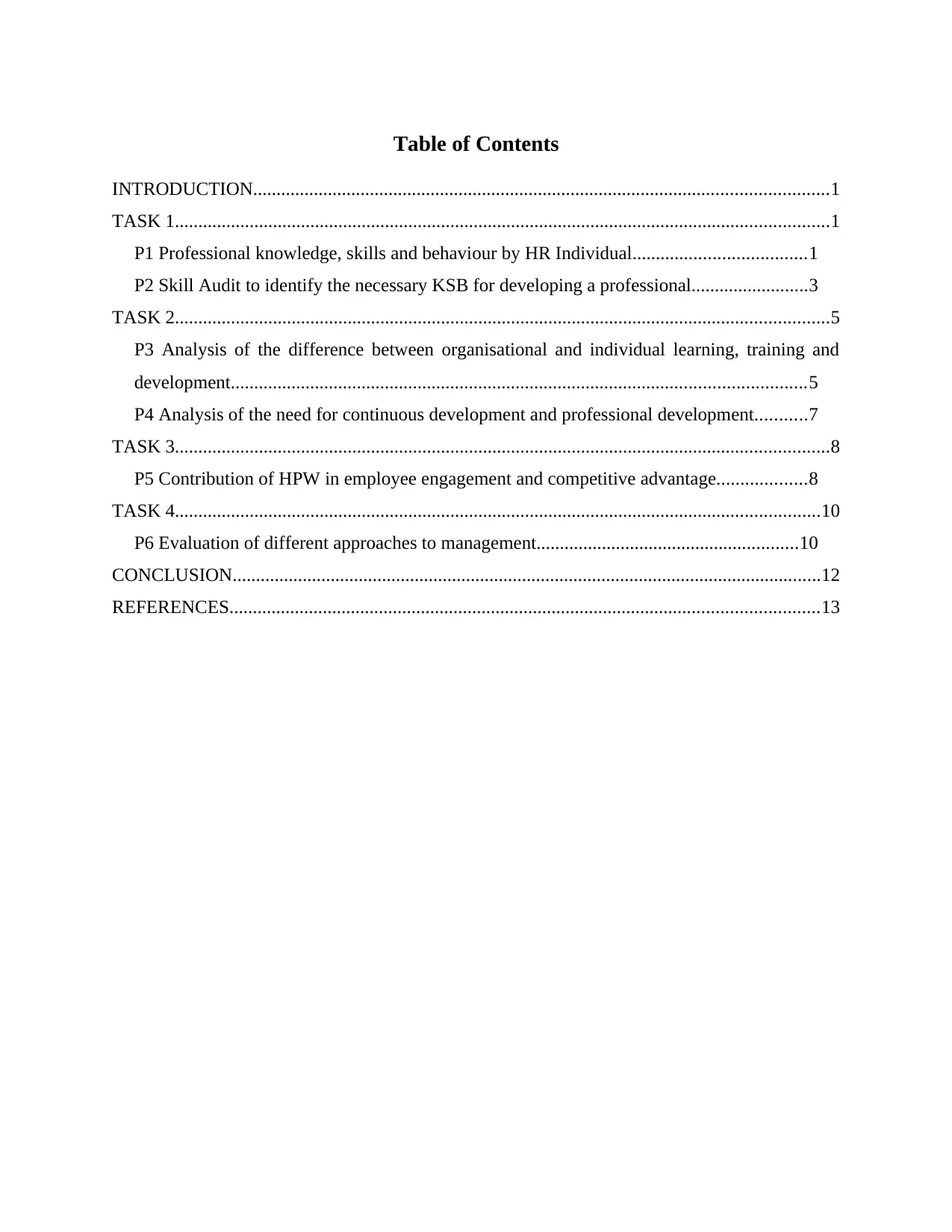
Table of Contents
INTRODUCTION...........................................................................................................................1
TASK 1............................................................................................................................................1
P1 Professional knowledge, skills and behaviour by HR Individual.....................................1
P2 Skill Audit to identify the necessary KSB for developing a professional.........................3
TASK 2............................................................................................................................................5
P3 Analysis of the difference between organisational and individual learning, training and
development...........................................................................................................................5
P4 Analysis of the need for continuous development and professional development...........7
TASK 3............................................................................................................................................8
P5 Contribution of HPW in employee engagement and competitive advantage...................8
TASK 4..........................................................................................................................................10
P6 Evaluation of different approaches to management........................................................10
CONCLUSION..............................................................................................................................12
REFERENCES..............................................................................................................................13
INTRODUCTION...........................................................................................................................1
TASK 1............................................................................................................................................1
P1 Professional knowledge, skills and behaviour by HR Individual.....................................1
P2 Skill Audit to identify the necessary KSB for developing a professional.........................3
TASK 2............................................................................................................................................5
P3 Analysis of the difference between organisational and individual learning, training and
development...........................................................................................................................5
P4 Analysis of the need for continuous development and professional development...........7
TASK 3............................................................................................................................................8
P5 Contribution of HPW in employee engagement and competitive advantage...................8
TASK 4..........................................................................................................................................10
P6 Evaluation of different approaches to management........................................................10
CONCLUSION..............................................................................................................................12
REFERENCES..............................................................................................................................13

⊘ This is a preview!⊘
Do you want full access?
Subscribe today to unlock all pages.

Trusted by 1+ million students worldwide
INTRODUCTION
Human capital of a company is the most important part of an organisation. The success
and failure of the company depends upon employees in the organisation. The individual
performance have a direct relation to the results of an organisation. Therefore it is the duty of the
Human Resource department to ensure continuous effective management and development of
individual in an organisation. There are various training and development programmes organised
by the HR Dept. to ensure short and long term sustainability of individuals in the
company(Berry, 2011). This assignment focuses on the analyses of the skills behaviour essential
by a HR professionals in Tesco Plc. It is #1 retailing chain in United Kingdom and employs
around 476,000 people around the globe. The comparison will be done on the several training
and development methods and their impact on the professional and constant learning. The role of
high performance on the engagement and development of competitive advantage will be
assessed.
TASK 1
P1 Professional knowledge, skills and behaviour by HR Individual
The HR professional is one the important part of an organisation. He is responsible to
maintain and develop employees in an organisation along with building cordial relations amongst
all. There are certain set of skills and behaviours which are essential in an HR professional in
order to complete its task effectively. Tesco is an multinational company therefore the tasks are
complicated compared to other companies. In addition to development of employee they have to
look after maintaining diversity, health and safety of employees, conflict resolution, grievance
handling and negotiations. The major skills and behavioural in an HR professional are: Effective communicator: The one of the most crucial skill of an HR is to effectively
communicate with others. He should be able to convey his message in an appropriate
manner with the feeling of empathy.
Decision Making: This is another crucial behaviour necessary in a HR. these professional
are faced with circumstances which force them to make prompt decisions (Bolman and
Deal, 2017). Rapid analysis of the situation helps in decision making.
Collaborative: In a competitive environment like Tesco the professional should be able to
collaborate their efforts for the organisational gains.
1
Human capital of a company is the most important part of an organisation. The success
and failure of the company depends upon employees in the organisation. The individual
performance have a direct relation to the results of an organisation. Therefore it is the duty of the
Human Resource department to ensure continuous effective management and development of
individual in an organisation. There are various training and development programmes organised
by the HR Dept. to ensure short and long term sustainability of individuals in the
company(Berry, 2011). This assignment focuses on the analyses of the skills behaviour essential
by a HR professionals in Tesco Plc. It is #1 retailing chain in United Kingdom and employs
around 476,000 people around the globe. The comparison will be done on the several training
and development methods and their impact on the professional and constant learning. The role of
high performance on the engagement and development of competitive advantage will be
assessed.
TASK 1
P1 Professional knowledge, skills and behaviour by HR Individual
The HR professional is one the important part of an organisation. He is responsible to
maintain and develop employees in an organisation along with building cordial relations amongst
all. There are certain set of skills and behaviours which are essential in an HR professional in
order to complete its task effectively. Tesco is an multinational company therefore the tasks are
complicated compared to other companies. In addition to development of employee they have to
look after maintaining diversity, health and safety of employees, conflict resolution, grievance
handling and negotiations. The major skills and behavioural in an HR professional are: Effective communicator: The one of the most crucial skill of an HR is to effectively
communicate with others. He should be able to convey his message in an appropriate
manner with the feeling of empathy.
Decision Making: This is another crucial behaviour necessary in a HR. these professional
are faced with circumstances which force them to make prompt decisions (Bolman and
Deal, 2017). Rapid analysis of the situation helps in decision making.
Collaborative: In a competitive environment like Tesco the professional should be able to
collaborate their efforts for the organisational gains.
1
Paraphrase This Document
Need a fresh take? Get an instant paraphrase of this document with our AI Paraphraser
Negotiable: It is one of the another crucial skill for an HR individual. The situation of
conflict in organisation erupt on regular basis and negotiation skills helps in resolution of
the same.
Role Model: the association of positive behaviours makes a professional a role model for
its subordinates. The act of guiding through examples and the acts of impartiality,
fairness and honesty are the essential features of a HR individual.
Knowledge of HR professional
HRM and Personnel Management: HR professional should be familiar with the
concepts, knowledge theories, and practices of the human resource management. He should
posses the detailed knowledge about the administration process, recruitment process and
effective management of employees.
Management and Psychology: Psychology consist of discipline related to understanding
the behaviour of a person (Ford, 2014). The management takes in account the proper use of
resources for the purpose of constructing plans.
Customer services: The main aim of the Tesco is to satisfy the needs of the consumer and
this task only fulfilled by HR professional by ensuring customer are satisfied and handling
grievances. The requirements of consumers are also assessed by a HR professional.
Legal Knowledge: the HR professional should have adequate knowledge of the laws and
policies of the regarding the employees. The labour laws, minimum wages and policies about the
working hours are to be adhered.
Training and education: The training and education needs are to be assessed by the
professional. In order to effectively evaluate an individual's requirements for developmental
programs the professional should be equipped with adequate knowledge on the same.
Behaviour of a HR professional
Integrity: It refers to the qualities of being honest and addition of strong moral principles
when it comes to performing its duties and responsible.
Empathy: It is one crucial aspect of behavioural which is necessary for a HR. It is the
ability of human resource manager to understand and share feeling and emotions to one another.
HR should be a person to whom employees can share their inner feelings and emotions.
Accountability:Accountability is defined as the person who takes responsibility for
certain task and should be answerable if something happens under its authority.
2
conflict in organisation erupt on regular basis and negotiation skills helps in resolution of
the same.
Role Model: the association of positive behaviours makes a professional a role model for
its subordinates. The act of guiding through examples and the acts of impartiality,
fairness and honesty are the essential features of a HR individual.
Knowledge of HR professional
HRM and Personnel Management: HR professional should be familiar with the
concepts, knowledge theories, and practices of the human resource management. He should
posses the detailed knowledge about the administration process, recruitment process and
effective management of employees.
Management and Psychology: Psychology consist of discipline related to understanding
the behaviour of a person (Ford, 2014). The management takes in account the proper use of
resources for the purpose of constructing plans.
Customer services: The main aim of the Tesco is to satisfy the needs of the consumer and
this task only fulfilled by HR professional by ensuring customer are satisfied and handling
grievances. The requirements of consumers are also assessed by a HR professional.
Legal Knowledge: the HR professional should have adequate knowledge of the laws and
policies of the regarding the employees. The labour laws, minimum wages and policies about the
working hours are to be adhered.
Training and education: The training and education needs are to be assessed by the
professional. In order to effectively evaluate an individual's requirements for developmental
programs the professional should be equipped with adequate knowledge on the same.
Behaviour of a HR professional
Integrity: It refers to the qualities of being honest and addition of strong moral principles
when it comes to performing its duties and responsible.
Empathy: It is one crucial aspect of behavioural which is necessary for a HR. It is the
ability of human resource manager to understand and share feeling and emotions to one another.
HR should be a person to whom employees can share their inner feelings and emotions.
Accountability:Accountability is defined as the person who takes responsibility for
certain task and should be answerable if something happens under its authority.
2

Adaptability: A HR should be able to adapt to changes in a rapid manner. Its behaviour
includes responding to various demands and expectations of people in a ideal manner. Develops
a environment which welcomes change in an organisation.
A human resource manager in an organisation is responsible for formulating of policies
and practices in an organisation. The task of management of human resources relies on the
shoulder of HR manager. An HR professional with the use of skills and knowledge aims to
understand human behaviour so that training and development needs of staff can be assessed.
The aim is to obtain the best out of employees so that goals of organisational can be fulfilled. HR
professional should be decisive and collaborative so that prompt decision making regarding the
policies and practices can be chosen. The employees with the right standards in health and safety
and compensation aims to be part of this organisation and this can be only be achieved through a
competent human resource professional.
P2 Skill Audit to identify the necessary KSB for developing a professional
Skill Audit is a tool to identify the deviation between the ideal skill set and actual skill
set. The skills of an individual are recorded and measured in this tool tool. It helps in identifying
the current necessary skills required to do a job. After the identification the developmental needs
are assessed on the necessary skills for the purpose of development. Tesco conducts skill audit of
its employees at regular intervals. This helps in identification of skills in the employees which
are to be developed to improve the provision of service and enhance their productivity (Hoch,
2013). The HR manager after conducting skill Audit identifies the training and education
programmes which can be constructive in these circumstances. It gives a clear view of the
strengths and weaknesses of an individual or teams. So the company can use the strengths up to
their potential and formulate strategies to overcome the weaknesses. The information obtained
also helps an HR professional in formulating strategies for the future along with development of
positive working environment. The analysis of strength and weaknesses of a candidate are as
follows:
Strengths
Fluent in MS office
Effective communicator
Efficient user of web related activities
Weaknesses
Lack of experience
Less knowledge of HR software
Irregularity
3
includes responding to various demands and expectations of people in a ideal manner. Develops
a environment which welcomes change in an organisation.
A human resource manager in an organisation is responsible for formulating of policies
and practices in an organisation. The task of management of human resources relies on the
shoulder of HR manager. An HR professional with the use of skills and knowledge aims to
understand human behaviour so that training and development needs of staff can be assessed.
The aim is to obtain the best out of employees so that goals of organisational can be fulfilled. HR
professional should be decisive and collaborative so that prompt decision making regarding the
policies and practices can be chosen. The employees with the right standards in health and safety
and compensation aims to be part of this organisation and this can be only be achieved through a
competent human resource professional.
P2 Skill Audit to identify the necessary KSB for developing a professional
Skill Audit is a tool to identify the deviation between the ideal skill set and actual skill
set. The skills of an individual are recorded and measured in this tool tool. It helps in identifying
the current necessary skills required to do a job. After the identification the developmental needs
are assessed on the necessary skills for the purpose of development. Tesco conducts skill audit of
its employees at regular intervals. This helps in identification of skills in the employees which
are to be developed to improve the provision of service and enhance their productivity (Hoch,
2013). The HR manager after conducting skill Audit identifies the training and education
programmes which can be constructive in these circumstances. It gives a clear view of the
strengths and weaknesses of an individual or teams. So the company can use the strengths up to
their potential and formulate strategies to overcome the weaknesses. The information obtained
also helps an HR professional in formulating strategies for the future along with development of
positive working environment. The analysis of strength and weaknesses of a candidate are as
follows:
Strengths
Fluent in MS office
Effective communicator
Efficient user of web related activities
Weaknesses
Lack of experience
Less knowledge of HR software
Irregularity
3
⊘ This is a preview!⊘
Do you want full access?
Subscribe today to unlock all pages.
Trusted by 1+ million students worldwide
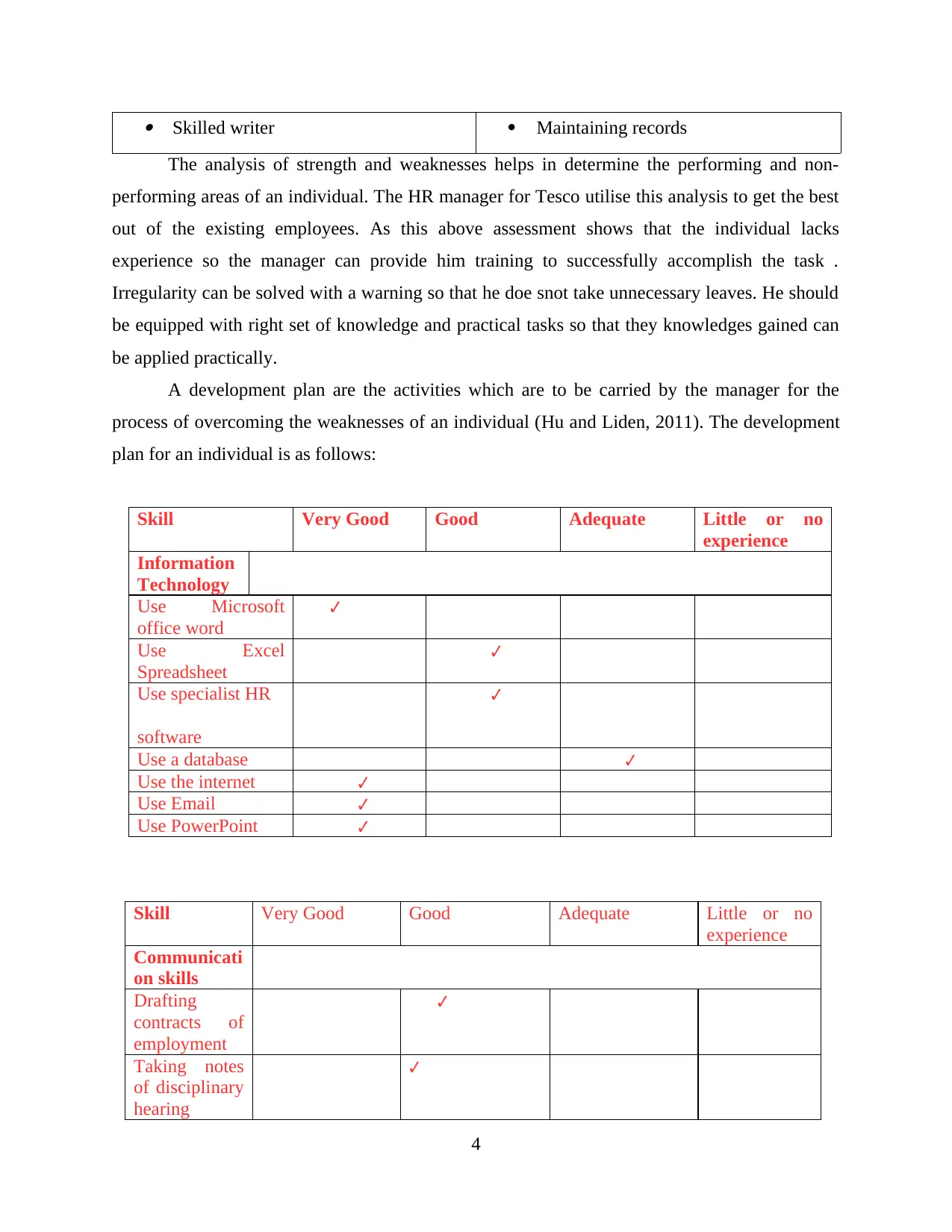
Skilled writer Maintaining records
The analysis of strength and weaknesses helps in determine the performing and non-
performing areas of an individual. The HR manager for Tesco utilise this analysis to get the best
out of the existing employees. As this above assessment shows that the individual lacks
experience so the manager can provide him training to successfully accomplish the task .
Irregularity can be solved with a warning so that he doe snot take unnecessary leaves. He should
be equipped with right set of knowledge and practical tasks so that they knowledges gained can
be applied practically.
A development plan are the activities which are to be carried by the manager for the
process of overcoming the weaknesses of an individual (Hu and Liden, 2011). The development
plan for an individual is as follows:
Skill Very Good Good Adequate Little or no
experience
Information
Technology
Use Microsoft
office word
✔
Use Excel
Spreadsheet
✔
Use specialist HR
software
✔
Use a database ✔
Use the internet ✔
Use Email ✔
Use PowerPoint ✔
Skill Very Good Good Adequate Little or no
experience
Communicati
on skills
Drafting
contracts of
employment
✔
Taking notes
of disciplinary
hearing
✔
4
The analysis of strength and weaknesses helps in determine the performing and non-
performing areas of an individual. The HR manager for Tesco utilise this analysis to get the best
out of the existing employees. As this above assessment shows that the individual lacks
experience so the manager can provide him training to successfully accomplish the task .
Irregularity can be solved with a warning so that he doe snot take unnecessary leaves. He should
be equipped with right set of knowledge and practical tasks so that they knowledges gained can
be applied practically.
A development plan are the activities which are to be carried by the manager for the
process of overcoming the weaknesses of an individual (Hu and Liden, 2011). The development
plan for an individual is as follows:
Skill Very Good Good Adequate Little or no
experience
Information
Technology
Use Microsoft
office word
✔
Use Excel
Spreadsheet
✔
Use specialist HR
software
✔
Use a database ✔
Use the internet ✔
Use Email ✔
Use PowerPoint ✔
Skill Very Good Good Adequate Little or no
experience
Communicati
on skills
Drafting
contracts of
employment
✔
Taking notes
of disciplinary
hearing
✔
4
Paraphrase This Document
Need a fresh take? Get an instant paraphrase of this document with our AI Paraphraser
Write reports ✔
Produce
materials to
support
presentations
✔
Delivering a
training
session
✔
Resolving
disputes
✔
Interviewing ✔
Advising on
HR issues
✔
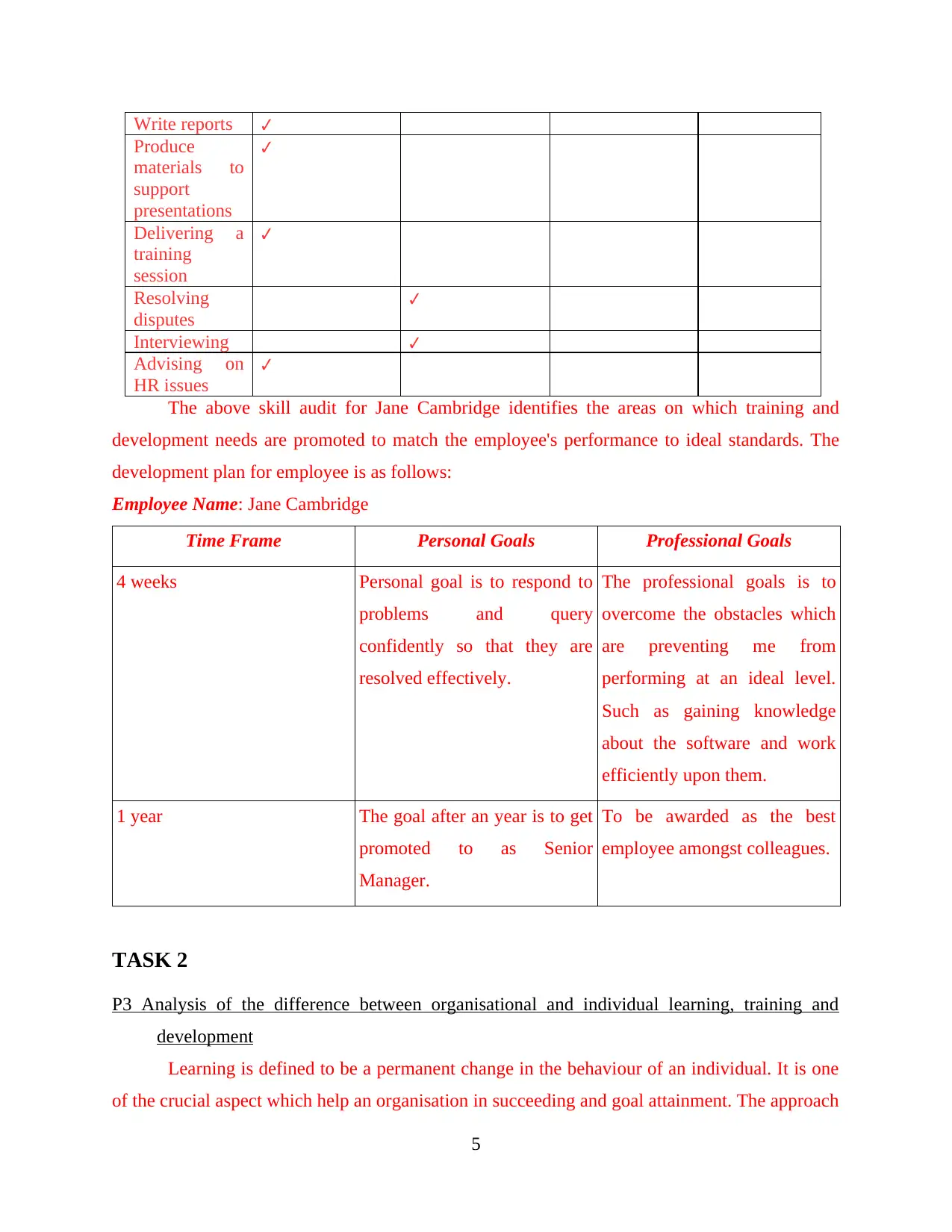
The above skill audit for Jane Cambridge identifies the areas on which training and
development needs are promoted to match the employee's performance to ideal standards. The
development plan for employee is as follows:
Employee Name: Jane Cambridge
Time Frame Personal Goals Professional Goals
4 weeks Personal goal is to respond to
problems and query
confidently so that they are
resolved effectively.
The professional goals is to
overcome the obstacles which
are preventing me from
performing at an ideal level.
Such as gaining knowledge
about the software and work
efficiently upon them.
1 year The goal after an year is to get
promoted to as Senior
Manager.
To be awarded as the best
employee amongst colleagues.
TASK 2
P3 Analysis of the difference between organisational and individual learning, training and
development
Learning is defined to be a permanent change in the behaviour of an individual. It is one
of the crucial aspect which help an organisation in succeeding and goal attainment. The approach
5
Produce
materials to
support
presentations
✔
Delivering a
training
session
✔
Resolving
disputes
✔
Interviewing ✔
Advising on
HR issues
✔
The above skill audit for Jane Cambridge identifies the areas on which training and
development needs are promoted to match the employee's performance to ideal standards. The
development plan for employee is as follows:
Employee Name: Jane Cambridge
Time Frame Personal Goals Professional Goals
4 weeks Personal goal is to respond to
problems and query
confidently so that they are
resolved effectively.
The professional goals is to
overcome the obstacles which
are preventing me from
performing at an ideal level.
Such as gaining knowledge
about the software and work
efficiently upon them.
1 year The goal after an year is to get
promoted to as Senior
Manager.
To be awarded as the best
employee amongst colleagues.
TASK 2
P3 Analysis of the difference between organisational and individual learning, training and
development
Learning is defined to be a permanent change in the behaviour of an individual. It is one
of the crucial aspect which help an organisation in succeeding and goal attainment. The approach
5
preferred in the organisation is inclusive learning. It is a process which ensures participation of
diverse people in the learning process. The strategies developed with this process help in address
different employee in an organisation. The Benefits of Inclusive learning is as follows:
1. There is an increased employee engagement in organisation through differentiated
approach. Every employee in organisation is treated different.
2. The resources of the organisation are effectively utilised when environment of inclusive
learning is developed.
3. The environment of inclusive learning respects diversity, therefore promotes a
welcoming environment.
4. Rise in standard of product output post learning session. This have a positive
environment on business functioning as well.
Individual Development
Individual development is defined as the process of evolving the skills and competencies
of an individual. Individual development is defined to be gradual and never ending. It is essential
for a person to evolve and develop with the changing circumstances to survive in an
organisation. The lesson can be learnt consciously and unconsciously. The learning in an
individual can affect the personal output, quality of the work done and efficiency in task done.
The learning can also facilitate creativity and innovation in the tasks (Légaré and et. al., 2011.).
The development of the individual contribute to the development of the organisation. The
training and development of an individual is important as it helps in expansion of knowledge.
The training are costly but they are essential in an organisation.
There are several benefits to the employee training as it helps in building the morale of
the individual when they are able to complete task in an efficient manner. Increase in
productivity and reduction in employee turnover are assisted through these developmental
programs. The main techniques are individual study, coaching, mentoring and on-the- job
training.
Organisation Development
Organisation training and development are the measures organised to improve the
effectiveness of the organisation as a whole (Lloyd-Walker and Walker, 2011). It is necessary for
an organisation to evolve in order to maintain its position in the market. The development
programs makes the organisation future oriented. The development in regards to environment
6
diverse people in the learning process. The strategies developed with this process help in address
different employee in an organisation. The Benefits of Inclusive learning is as follows:
1. There is an increased employee engagement in organisation through differentiated
approach. Every employee in organisation is treated different.
2. The resources of the organisation are effectively utilised when environment of inclusive
learning is developed.
3. The environment of inclusive learning respects diversity, therefore promotes a
welcoming environment.
4. Rise in standard of product output post learning session. This have a positive
environment on business functioning as well.
Individual Development
Individual development is defined as the process of evolving the skills and competencies
of an individual. Individual development is defined to be gradual and never ending. It is essential
for a person to evolve and develop with the changing circumstances to survive in an
organisation. The lesson can be learnt consciously and unconsciously. The learning in an
individual can affect the personal output, quality of the work done and efficiency in task done.
The learning can also facilitate creativity and innovation in the tasks (Légaré and et. al., 2011.).
The development of the individual contribute to the development of the organisation. The
training and development of an individual is important as it helps in expansion of knowledge.
The training are costly but they are essential in an organisation.
There are several benefits to the employee training as it helps in building the morale of
the individual when they are able to complete task in an efficient manner. Increase in
productivity and reduction in employee turnover are assisted through these developmental
programs. The main techniques are individual study, coaching, mentoring and on-the- job
training.
Organisation Development
Organisation training and development are the measures organised to improve the
effectiveness of the organisation as a whole (Lloyd-Walker and Walker, 2011). It is necessary for
an organisation to evolve in order to maintain its position in the market. The development
programs makes the organisation future oriented. The development in regards to environment
6
⊘ This is a preview!⊘
Do you want full access?
Subscribe today to unlock all pages.
Trusted by 1+ million students worldwide

can be categorised into two major parts: Hard issues (strategies and policies) and soft issues
(such as skill, attitudes and behaviours). The contemporary business world have understood the
value of organisational development. The Tesco Plc can have the advantage of organisation
development in form of competitive advantage and innovation.
The difference between Organisational learning and individual learning are:
Organisational learning Individual learning
1. The organisational learning is promotes the
development of organisation as one. It focuses
on attaining competitive advantage and
reduction in the barrier of service barrier.
2. The tools and techniques of Organisational
development preferred by Tesco help in
growth of the business.
3. Vision of the company is shared as it
promotes achievement of objectives.
4. The learning in the organisational
environment is incorporated for achieving
desired outcome.
1. The individual learning focus on enhancing
the skill, capabilities and knowledges of an
employee so that the tasks are carried out in a
creative and efficient manner.
2. The tools of individual learning are
coaching, mentoring, on the job training etc.
3. Individual Vision can be shared with co-
workers. But in this case it is not necessary.
4. Individual can focus on achieving their
personal as well as professional goals with the
help of learning.
Learning organisation is an contemporary way to improve the performance of
organisation through its employees. The introduction of inclusive learning in the organisation
help build its efficiency and productivity. The programs are focused on individual, team and
organisational development. The evaluation of skills and competencies help in identify the areas
which carry a scope of improvement. The learning process helps in fulfilling scope through its
programs and events. The employees of Tesco are identified with need to build confidence and
communication in the employees to enhance customer satisfaction. Inclusive learning help in
development of an approach and practice which is to be implemented. The analysis of the same
help in finding deviation between average current skill and ideal skill. The teacher can begin
with class room sessions, role play and simulations so that effective learning can be achieved.
7
(such as skill, attitudes and behaviours). The contemporary business world have understood the
value of organisational development. The Tesco Plc can have the advantage of organisation
development in form of competitive advantage and innovation.
The difference between Organisational learning and individual learning are:
Organisational learning Individual learning
1. The organisational learning is promotes the
development of organisation as one. It focuses
on attaining competitive advantage and
reduction in the barrier of service barrier.
2. The tools and techniques of Organisational
development preferred by Tesco help in
growth of the business.
3. Vision of the company is shared as it
promotes achievement of objectives.
4. The learning in the organisational
environment is incorporated for achieving
desired outcome.
1. The individual learning focus on enhancing
the skill, capabilities and knowledges of an
employee so that the tasks are carried out in a
creative and efficient manner.
2. The tools of individual learning are
coaching, mentoring, on the job training etc.
3. Individual Vision can be shared with co-
workers. But in this case it is not necessary.
4. Individual can focus on achieving their
personal as well as professional goals with the
help of learning.
Learning organisation is an contemporary way to improve the performance of
organisation through its employees. The introduction of inclusive learning in the organisation
help build its efficiency and productivity. The programs are focused on individual, team and
organisational development. The evaluation of skills and competencies help in identify the areas
which carry a scope of improvement. The learning process helps in fulfilling scope through its
programs and events. The employees of Tesco are identified with need to build confidence and
communication in the employees to enhance customer satisfaction. Inclusive learning help in
development of an approach and practice which is to be implemented. The analysis of the same
help in finding deviation between average current skill and ideal skill. The teacher can begin
with class room sessions, role play and simulations so that effective learning can be achieved.
7
Paraphrase This Document
Need a fresh take? Get an instant paraphrase of this document with our AI Paraphraser
P4 Analysis of the need for continuous development and professional development
The continuous development and professional development both constitute as a important
part of individual's life. Continuous development can be defined as the on-going process which
ensures evolvement of skills, competencies and knowledge of an individual (Marquardt and et.
al., 2011). The environment of business is driven by change so in order to match pace with the
environment the individual needs to develop himself pertaining to the environment. On a
personal level it can be physical and emotional development and on a professional level it can be
the ability of accomplishing a task in a competent manner. For instance, Introduction of a new
machinery requires the operator to develop their skills in order to operate that machine properly.
In context of Tesco the development of individual personally and professionally is very
important. The professional development helps in accomplishment of the objectives in a
effective and a rapid manner. Where as on a personal level it can assist in maintaining harmony
in the company.
The learning and development activities have multi-benefits it ensures that the morale of
the people is boosted and aids in spreading a positive environment in the organisation as they are
developing (Shin and et. al., 2012). The continuous professional development shortened for CPD
is essential in the business environment. It helps in a company to sustain and improve its
performance. Requirement of CPD is as follows:
Enhance performance and knowledge: The first and most critical role that CPD plays is
that it help an individual in gaining knowledge that can be utilised by individual in performing
the task competently so that organisational objectives can be achieved.
Update information: The development of knowledge helps in identifying the horizons
which were not covered earlier. In order to maintain their speciality in a field the organisation
have to keep themselves updated in terms of knowledge. This can only be achieved through its
employees.
Development of Personal skills: the learning and development programs have a direct
impact on the performance of the employees. When the employees of an organisation do well in
the task assigned it have a direct positive environment on the sustainability of business of Tesco.
Business sustainability is totally dependent upon the continuous learning. The process of
continuous learning focuses on developing and training the existing workforce rather than hiring
a new one. The existing employees are familiar with the environment and working of an
8
The continuous development and professional development both constitute as a important
part of individual's life. Continuous development can be defined as the on-going process which
ensures evolvement of skills, competencies and knowledge of an individual (Marquardt and et.
al., 2011). The environment of business is driven by change so in order to match pace with the
environment the individual needs to develop himself pertaining to the environment. On a
personal level it can be physical and emotional development and on a professional level it can be
the ability of accomplishing a task in a competent manner. For instance, Introduction of a new
machinery requires the operator to develop their skills in order to operate that machine properly.
In context of Tesco the development of individual personally and professionally is very
important. The professional development helps in accomplishment of the objectives in a
effective and a rapid manner. Where as on a personal level it can assist in maintaining harmony
in the company.
The learning and development activities have multi-benefits it ensures that the morale of
the people is boosted and aids in spreading a positive environment in the organisation as they are
developing (Shin and et. al., 2012). The continuous professional development shortened for CPD
is essential in the business environment. It helps in a company to sustain and improve its
performance. Requirement of CPD is as follows:
Enhance performance and knowledge: The first and most critical role that CPD plays is
that it help an individual in gaining knowledge that can be utilised by individual in performing
the task competently so that organisational objectives can be achieved.
Update information: The development of knowledge helps in identifying the horizons
which were not covered earlier. In order to maintain their speciality in a field the organisation
have to keep themselves updated in terms of knowledge. This can only be achieved through its
employees.
Development of Personal skills: the learning and development programs have a direct
impact on the performance of the employees. When the employees of an organisation do well in
the task assigned it have a direct positive environment on the sustainability of business of Tesco.
Business sustainability is totally dependent upon the continuous learning. The process of
continuous learning focuses on developing and training the existing workforce rather than hiring
a new one. The existing employees are familiar with the environment and working of an
8
enterprise so that they are developed so that the task is done by them in a competent manner and
assists in achieving business sustainability (Warrick, 2011).
The enhancement in knowledge and behaviour results in benefit of business performance.
An individual can enhance its skills and capabilities with the learning event implemented in its
working. The task now can be completed with more efficiency which gives rise to the
productivity of an organisation. The attitude of the employees will be more work oriented
therefore will perform the task in an optimum manner. The continuous learning environment
gives rise to innovation and creativity in an task fulfilled which again carries a positive impact on
the business performance.
TASK 3
P5 Contribution of HPW in employee engagement and competitive advantage
High performance working is defined as the process to excite better employee
engagement so that performance of organisation can be enhanced. It is one of the contemporary
way to achieve objectives through employee participation. It is a management practice used by
Tesco to equip employees with a greater sense of involvement so that employees remain
committed and loyal to the organisation and work more efficiently. The performance is measured
with the help of SPI's (sustainability performance indicators) and monitored their progress in the
achievements of objectives. The HR Dept. of the Tesco ensures a working culture which
contribute towards the goal attainment. The culture consist of right mix of creditability,
transparent and honesty in the environment and there is an effective channel of communication
for conflict resolution and problem solving.
9
assists in achieving business sustainability (Warrick, 2011).
The enhancement in knowledge and behaviour results in benefit of business performance.
An individual can enhance its skills and capabilities with the learning event implemented in its
working. The task now can be completed with more efficiency which gives rise to the
productivity of an organisation. The attitude of the employees will be more work oriented
therefore will perform the task in an optimum manner. The continuous learning environment
gives rise to innovation and creativity in an task fulfilled which again carries a positive impact on
the business performance.
TASK 3
P5 Contribution of HPW in employee engagement and competitive advantage
High performance working is defined as the process to excite better employee
engagement so that performance of organisation can be enhanced. It is one of the contemporary
way to achieve objectives through employee participation. It is a management practice used by
Tesco to equip employees with a greater sense of involvement so that employees remain
committed and loyal to the organisation and work more efficiently. The performance is measured
with the help of SPI's (sustainability performance indicators) and monitored their progress in the
achievements of objectives. The HR Dept. of the Tesco ensures a working culture which
contribute towards the goal attainment. The culture consist of right mix of creditability,
transparent and honesty in the environment and there is an effective channel of communication
for conflict resolution and problem solving.
9
⊘ This is a preview!⊘
Do you want full access?
Subscribe today to unlock all pages.
Trusted by 1+ million students worldwide

1 out of 17


Related Documents


Your All-in-One AI-Powered Toolkit for Academic Success.
+13062052269
info@desklib.com
Available 24*7 on WhatsApp / Email
![[object Object]](/_next/static/media/star-bottom.7253800d.svg)
Unlock your academic potential
Copyright © 2020–2026 A2Z Services. All Rights Reserved. Developed and managed by ZUCOL.