HR Practice, Leadership and People Management: Rolls Royce Report
VerifiedAdded on 2021/02/19
|22
|7522
|391
Report
AI Summary
This report provides a comprehensive analysis of human resource management (HRM) practices, leadership principles, and people management strategies within organizations. It explores contemporary approaches to HRM and HR development, including strategic, integrative, and human capital appraisal frameworks. The report delves into the main theories of motivation, commitment, and employee engagement, examining their relevance in modern organizational contexts, and highlights the significance of effective management practices. It identifies the key factors that define a leader, evaluates the roles and characteristics of effective leadership, and discusses suitable leadership development activities. Furthermore, the report examines the crucial role of HR management and development in organizational effectiveness, emphasizing the need for professional HR practitioners and the influence of HR practices on ethics and organizational culture, using Rolls Royce as a case study to illustrate these concepts.

HR Practice, Leadership
and Managing People
and Managing People

Paraphrase This Document
Need a fresh take? Get an instant paraphrase of this document with our AI Paraphraser

Table of Contents
INTRODUCTION...........................................................................................................................1
TASK 1............................................................................................................................................2
1.1 Contemporary approaches to human resource management and development................2
1.2 Approaches to human resource management, learning and development practice:.........3
1.3 People management practices that have changed and led to positive organisational
outcomes, citing real examples...............................................................................................4
TASK 2............................................................................................................................................5
2.1 Main theories on motivation, commitment and employee engagement in context to
contemporary organisation.....................................................................................................5
2.2 Importance of management practices or developed theoretical model in companies......8
2.3 Employee engagement is a positive factor in organisational health terms.......................8
TASK 3............................................................................................................................................8
3.1 Determination of factors that makes a leader...................................................................8
3.2 Evaluation of role and characteristics of effective leaders...............................................9
3.3 Relevant and suitable leadership development activities and experiences....................10
TASK 4..........................................................................................................................................10
4.1 Role of HR management and development in organisations to work effectively.........10
4.2 Need for professional and qualified HR practitioners in organisations........................11
4.3 Evaluation upon ethics and organisational culture can be influenced by HR practices. 13
CONCLUSION..............................................................................................................................14
REFERENCES..............................................................................................................................15
INTRODUCTION...........................................................................................................................1
TASK 1............................................................................................................................................2
1.1 Contemporary approaches to human resource management and development................2
1.2 Approaches to human resource management, learning and development practice:.........3
1.3 People management practices that have changed and led to positive organisational
outcomes, citing real examples...............................................................................................4
TASK 2............................................................................................................................................5
2.1 Main theories on motivation, commitment and employee engagement in context to
contemporary organisation.....................................................................................................5
2.2 Importance of management practices or developed theoretical model in companies......8
2.3 Employee engagement is a positive factor in organisational health terms.......................8
TASK 3............................................................................................................................................8
3.1 Determination of factors that makes a leader...................................................................8
3.2 Evaluation of role and characteristics of effective leaders...............................................9
3.3 Relevant and suitable leadership development activities and experiences....................10
TASK 4..........................................................................................................................................10
4.1 Role of HR management and development in organisations to work effectively.........10
4.2 Need for professional and qualified HR practitioners in organisations........................11
4.3 Evaluation upon ethics and organisational culture can be influenced by HR practices. 13
CONCLUSION..............................................................................................................................14
REFERENCES..............................................................................................................................15

INTRODUCTION
Human resource management is a policy strategy to effectively managing staff and the
individuals who work throughout the company in order to assist the company achieve a
comparative advantage. It can be a method or a manner for an organization to recruit and train
staff to assist the business attain its organizational goals. There are various useful HR practices
that are define as a series of universal human resource procedure which help business entity to
improve performance of operations and activities, irrespective of the kind of industry they are
working. In the current company situation, human resource management performs both the
inherent and elementary function in handling the organization's demands, execution of the
employees and workforce scheduling (Alfes and et. al., 2013). The HRM relates to the registered
business section that performs tasks such as recruiting, handling and shooting the workers or
staff. It is an essential feature conducted by the HRM that is analysed to observe the data
pertaining to each individual work. It helps the organization to decide the requirement for
employment and assess the work of the organization's existing staff. It primarily deals with
people's role within the company, maintaining that best practices will be in location at all
moments. Practices of human resources are of a strategic sort. They are an essential mechanism
of instruction that corresponds with companies marketing plan. This is essentially intended to
maximize employee productivity by collaborating on policy formulation, responding to worker
problems, recompense and compensation for staff. HR procedures are the basis that supports
how the human capital of company operates depending on the basis of services offered by
company. Leadership is defined as leading a unit of individual within an organisation developing
a clear vision, provide enough knowledge and tactics in order to accomplish that vision. Leader
are the one which guide or help other employee to do best because they map out the new
direction that will be essential to win the predefined objective of company. In this report, to
better understand the topic Rolls Royce have been selected that is a leading British Luxury auto-
mobile maker.
In this report, proper evaluation of research has been made on human resource
management and development, effective debate on theory and practices relating to commitment,
motivation and employee engagement within business firm have been discussed. In addition, role
and meaningful characteristics of leader and its development, valuable discussion of role of HR
management and their practices in overall development are defined in this report.
1
Human resource management is a policy strategy to effectively managing staff and the
individuals who work throughout the company in order to assist the company achieve a
comparative advantage. It can be a method or a manner for an organization to recruit and train
staff to assist the business attain its organizational goals. There are various useful HR practices
that are define as a series of universal human resource procedure which help business entity to
improve performance of operations and activities, irrespective of the kind of industry they are
working. In the current company situation, human resource management performs both the
inherent and elementary function in handling the organization's demands, execution of the
employees and workforce scheduling (Alfes and et. al., 2013). The HRM relates to the registered
business section that performs tasks such as recruiting, handling and shooting the workers or
staff. It is an essential feature conducted by the HRM that is analysed to observe the data
pertaining to each individual work. It helps the organization to decide the requirement for
employment and assess the work of the organization's existing staff. It primarily deals with
people's role within the company, maintaining that best practices will be in location at all
moments. Practices of human resources are of a strategic sort. They are an essential mechanism
of instruction that corresponds with companies marketing plan. This is essentially intended to
maximize employee productivity by collaborating on policy formulation, responding to worker
problems, recompense and compensation for staff. HR procedures are the basis that supports
how the human capital of company operates depending on the basis of services offered by
company. Leadership is defined as leading a unit of individual within an organisation developing
a clear vision, provide enough knowledge and tactics in order to accomplish that vision. Leader
are the one which guide or help other employee to do best because they map out the new
direction that will be essential to win the predefined objective of company. In this report, to
better understand the topic Rolls Royce have been selected that is a leading British Luxury auto-
mobile maker.
In this report, proper evaluation of research has been made on human resource
management and development, effective debate on theory and practices relating to commitment,
motivation and employee engagement within business firm have been discussed. In addition, role
and meaningful characteristics of leader and its development, valuable discussion of role of HR
management and their practices in overall development are defined in this report.
1
⊘ This is a preview!⊘
Do you want full access?
Subscribe today to unlock all pages.

Trusted by 1+ million students worldwide

TASK 1
1.1 Contemporary approaches to human resource management and development
HRM is defined as the process of managing and controlling individual within company in
structured and meaningful manner which would cover the different section such as staffing or
hiring, managing and setting pay scale of employees, retention of individual, managing
performance, includes valuable modification in order to gain the maximum benefit and achieve
the competitive advantage (Amberg and McGaughey, 2019). HR development is a series of
deliberate and scheduled operations intended by an organisation to give its employees the
abilities they need to satisfy present and prospective work requirements. In general, HRD is an
effective procedure to increase the skills, ability, knowledge and capabilities of entire individual
working within organisation. There are various effective and meaningful approaches that help in
human resource management and development. Such as:
Strategies HR framework approach: In this method the main elements are business
strategy, HRD practices and organisational capabilities which have the main aim to
leverage valuable practices to build critical organisation ability which further support in
order to attain the desired goals. At Rolls Royce this is consider to be an effective
framework that offer a particular tool and path to determine which would be beneficial to
leverage business firm within is essential HR practices.
Integrative framework: This approach of human resource management and
development is related with determination of three path which support HRD practices to
provide meaningful contribution in improving and increasing performance of company
and different employees engaged in different operations. These paths are developing
organisation capabilities, improvement with employee satisfaction and shaping customer
experience.
Human capital appraisal approach: This procedure is related with defining the crucial
stages of management of human capital which are clarification stage, assessment stage,
design stage, implementation stage and monitoring stage. These stages are mainly
focused on important area of human capital management such as recruitment retention
and retirement rewards and professional growth of quality leadership, progression
scheduling and coaching organizational framework and enablers of natural resources.
2
1.1 Contemporary approaches to human resource management and development
HRM is defined as the process of managing and controlling individual within company in
structured and meaningful manner which would cover the different section such as staffing or
hiring, managing and setting pay scale of employees, retention of individual, managing
performance, includes valuable modification in order to gain the maximum benefit and achieve
the competitive advantage (Amberg and McGaughey, 2019). HR development is a series of
deliberate and scheduled operations intended by an organisation to give its employees the
abilities they need to satisfy present and prospective work requirements. In general, HRD is an
effective procedure to increase the skills, ability, knowledge and capabilities of entire individual
working within organisation. There are various effective and meaningful approaches that help in
human resource management and development. Such as:
Strategies HR framework approach: In this method the main elements are business
strategy, HRD practices and organisational capabilities which have the main aim to
leverage valuable practices to build critical organisation ability which further support in
order to attain the desired goals. At Rolls Royce this is consider to be an effective
framework that offer a particular tool and path to determine which would be beneficial to
leverage business firm within is essential HR practices.
Integrative framework: This approach of human resource management and
development is related with determination of three path which support HRD practices to
provide meaningful contribution in improving and increasing performance of company
and different employees engaged in different operations. These paths are developing
organisation capabilities, improvement with employee satisfaction and shaping customer
experience.
Human capital appraisal approach: This procedure is related with defining the crucial
stages of management of human capital which are clarification stage, assessment stage,
design stage, implementation stage and monitoring stage. These stages are mainly
focused on important area of human capital management such as recruitment retention
and retirement rewards and professional growth of quality leadership, progression
scheduling and coaching organizational framework and enablers of natural resources.
2
Paraphrase This Document
Need a fresh take? Get an instant paraphrase of this document with our AI Paraphraser
PCMM approach: This is related with providing crucial aim which enable manager to
improve the ability of software within an organisation to create, motivate, organise and
hold the talented employee in order to improve their software development capability. It
mainly state that Rolls Royce by original, repeatable, established, controlled and
optimizing skill rates, increases people management exercise. Each amount of
competence includes several Key Process Areas (KPA) identifying groups of associated
job activities.
Integrated system approach: It consider distinct HRD division to develop and maintain
human service development systems effectively. This approach considers at point of
reference and focuses on all technologies for achieving company objectives and
employee engagement.
HRD score card approach: This method aid to provide connection between different
function and actual goals and objective of company. In Rolls Royce manager uses
scorecard to evaluate the different HR functions affectivity and efficiency while
producing employee behavioural that support to attain the company strategies goals
(Armstrong and Taylor, 2014).
1.2 Approaches to human resource management, learning and development practice:
Following are key approaches of HR Management, development practices and learning,
as follows:
For successful and stable organisations: This approach begins with inside
organisational information which is evaluated and applied by expert planners' group at upper
level within entity. HRM determines strategical objectives based on company's previous
performance and succession of such objectives thoroughly the company' hierarchy. Target
achievement reporting goes straight back to the preceding professionals via hierarchy. HR should
concentrate on maintaining a culture of centralized command, hierarchy, and conformity when
applying this type of organizational planning. Skill requirements typically involve technical
specialists (often with economic backgrounds) who set objectives and direction with the
execution-focused mass of staff. This approach applies learnings and development practices to
attain target of stable and successful business organisation.
For portfolio diversification organizations: The second approach begins with external
information and data obtained from outside and then converted into objectives and policies
3
improve the ability of software within an organisation to create, motivate, organise and
hold the talented employee in order to improve their software development capability. It
mainly state that Rolls Royce by original, repeatable, established, controlled and
optimizing skill rates, increases people management exercise. Each amount of
competence includes several Key Process Areas (KPA) identifying groups of associated
job activities.
Integrated system approach: It consider distinct HRD division to develop and maintain
human service development systems effectively. This approach considers at point of
reference and focuses on all technologies for achieving company objectives and
employee engagement.
HRD score card approach: This method aid to provide connection between different
function and actual goals and objective of company. In Rolls Royce manager uses
scorecard to evaluate the different HR functions affectivity and efficiency while
producing employee behavioural that support to attain the company strategies goals
(Armstrong and Taylor, 2014).
1.2 Approaches to human resource management, learning and development practice:
Following are key approaches of HR Management, development practices and learning,
as follows:
For successful and stable organisations: This approach begins with inside
organisational information which is evaluated and applied by expert planners' group at upper
level within entity. HRM determines strategical objectives based on company's previous
performance and succession of such objectives thoroughly the company' hierarchy. Target
achievement reporting goes straight back to the preceding professionals via hierarchy. HR should
concentrate on maintaining a culture of centralized command, hierarchy, and conformity when
applying this type of organizational planning. Skill requirements typically involve technical
specialists (often with economic backgrounds) who set objectives and direction with the
execution-focused mass of staff. This approach applies learnings and development practices to
attain target of stable and successful business organisation.
For portfolio diversification organizations: The second approach begins with external
information and data obtained from outside and then converted into objectives and policies
3

across the organization. This approach often focuses on industry analysis applying Porter's Five
Forces scenario. As in first approach, the implementation of policy is carried out by a relatively
small strategic planners' group, who pass through organisational structure their objectives and
proposals for strategy design and implementation. Strategy planners prefer to always have
powerful records in the assessment of economics. They ascertain which company setup will
include the commercial portfolio together with the outsourced or in-sourced company operations.
Under this approach learning and practices concerned with development comprises need of
modification in existing business portfolio while emphasising on diversifications (Banfield, Kay
and Royles, 2018).
For entrepreneurial organisations making expansion in key capacities: The third one
approach starts with an internal capability assessment that provides the baseline for competitive
advantage. Strategic skills are decided by huge numbers of staff being dynamically involved.
The culture is participating and innovative. There is widespread sharing and discussion of
internal data or information. Individuals are employed and formulated to make contribution in
existing and coming organizational efficiencies. Leadership body supports activities of initiating
ideas. HRM emphasizes on teamwork and cooperation instead of hierarchical administration.
Such approach assist in strategic and business planning for finding essential variables in
entrepreneurial organisations that develop on current basic capabilities and resource as it
explores developing potentials of new capabilities. Using learning and organisation's
development approaches HRM, explores new capabilities with aims to make expansion.
For organisations in fast moving ecosystems: The fourth approach to HRM planning
and management is also dynamic and extremely productive, but the point of departure for
discussion is really the specification of external ecosystem instead of concentrating on inner
capacities. The culture is concentrated on the outside, vibrant and extremely engaging. Huge
numbers of staff continuously monitor and review external data in order to build the internal
capacities needed. As individuals throughout the organization prioritize, exchange and analyse
external information, the eradication of diagonal silos is a necessity.
1.3 People management practices that have changed and led to positive organisational outcomes,
citing real examples.
In business world the main focus of company is on managing and controlling entire
workforce so that the maximum benefit can be achieved to them and they are able to maintain a
4
Forces scenario. As in first approach, the implementation of policy is carried out by a relatively
small strategic planners' group, who pass through organisational structure their objectives and
proposals for strategy design and implementation. Strategy planners prefer to always have
powerful records in the assessment of economics. They ascertain which company setup will
include the commercial portfolio together with the outsourced or in-sourced company operations.
Under this approach learning and practices concerned with development comprises need of
modification in existing business portfolio while emphasising on diversifications (Banfield, Kay
and Royles, 2018).
For entrepreneurial organisations making expansion in key capacities: The third one
approach starts with an internal capability assessment that provides the baseline for competitive
advantage. Strategic skills are decided by huge numbers of staff being dynamically involved.
The culture is participating and innovative. There is widespread sharing and discussion of
internal data or information. Individuals are employed and formulated to make contribution in
existing and coming organizational efficiencies. Leadership body supports activities of initiating
ideas. HRM emphasizes on teamwork and cooperation instead of hierarchical administration.
Such approach assist in strategic and business planning for finding essential variables in
entrepreneurial organisations that develop on current basic capabilities and resource as it
explores developing potentials of new capabilities. Using learning and organisation's
development approaches HRM, explores new capabilities with aims to make expansion.
For organisations in fast moving ecosystems: The fourth approach to HRM planning
and management is also dynamic and extremely productive, but the point of departure for
discussion is really the specification of external ecosystem instead of concentrating on inner
capacities. The culture is concentrated on the outside, vibrant and extremely engaging. Huge
numbers of staff continuously monitor and review external data in order to build the internal
capacities needed. As individuals throughout the organization prioritize, exchange and analyse
external information, the eradication of diagonal silos is a necessity.
1.3 People management practices that have changed and led to positive organisational outcomes,
citing real examples.
In business world the main focus of company is on managing and controlling entire
workforce so that the maximum benefit can be achieved to them and they are able to maintain a
4
⊘ This is a preview!⊘
Do you want full access?
Subscribe today to unlock all pages.
Trusted by 1+ million students worldwide

good global image in competitive world. There have been number of people management
practices that have been adopted by large number of companies that lead to development and
growth of company. These are explained below:
Recruitment and selection: These practices are related with hiring the best person for
the desired job within company. It is one of the most important practice that help to recruit and
select the ideal employee to respective position which result in maximum benefit in upcoming
time. The process of recruitment and selection have transformed form year, specific research
provide crucial evidence that in nowadays companies are focused on improved way to hire
employee and select for respective position (Bloom and Van Reenen, 2011). For example: In
google there is a systematic method for recruiting and selecting employee like it start with
screening of each resume, then recruiter contact appropriate candidate through phone and
describe complete process, then there is on site interview for about 45 minutes, then interviewer
tells the feedback about candidates to management team. Afterwards work of hiring committee
start in which senior manager and director use to consider potential candidate to particular job in
a specific field, then compensation commission calculate and identify the offer to be offered for
candidates that are appoints for certain job. The last round is related with final executive review
in which top manager check the employment offer before employing a candidate in last an offer
letter is given that explained the complete information related to job.
Training and Development: In recent time companies are focused to provide continuous
learning and developing program that makes employee more efficient and effective to attain the
desired results. Management use to provide constant training, tuition reimbursement option
which help employees to react in tough situation in appropriate manner. In recent time the
concept of training has been upgraded such as in Tesco, management uses Hands-on-training
method that enables an employee to get their hand on what they are learning as soon as possible.
It is one of the quickest method as it increases knowledge to deal with different problems arising
within company.
5
practices that have been adopted by large number of companies that lead to development and
growth of company. These are explained below:
Recruitment and selection: These practices are related with hiring the best person for
the desired job within company. It is one of the most important practice that help to recruit and
select the ideal employee to respective position which result in maximum benefit in upcoming
time. The process of recruitment and selection have transformed form year, specific research
provide crucial evidence that in nowadays companies are focused on improved way to hire
employee and select for respective position (Bloom and Van Reenen, 2011). For example: In
google there is a systematic method for recruiting and selecting employee like it start with
screening of each resume, then recruiter contact appropriate candidate through phone and
describe complete process, then there is on site interview for about 45 minutes, then interviewer
tells the feedback about candidates to management team. Afterwards work of hiring committee
start in which senior manager and director use to consider potential candidate to particular job in
a specific field, then compensation commission calculate and identify the offer to be offered for
candidates that are appoints for certain job. The last round is related with final executive review
in which top manager check the employment offer before employing a candidate in last an offer
letter is given that explained the complete information related to job.
Training and Development: In recent time companies are focused to provide continuous
learning and developing program that makes employee more efficient and effective to attain the
desired results. Management use to provide constant training, tuition reimbursement option
which help employees to react in tough situation in appropriate manner. In recent time the
concept of training has been upgraded such as in Tesco, management uses Hands-on-training
method that enables an employee to get their hand on what they are learning as soon as possible.
It is one of the quickest method as it increases knowledge to deal with different problems arising
within company.
5
Paraphrase This Document
Need a fresh take? Get an instant paraphrase of this document with our AI Paraphraser
TASK 2
2.1 Main theories on motivation, commitment and employee engagement in context to
contemporary organisation.
Motivation implies to an impulsive variable which enforces actions and determines
behaviour. It promotes individuals within an organisation to bring new actions with aim to
accomplish objectives, execute actions for fulfilment of organisation's expectations.
Knowing what factors or actions motivates officials and employees at work assures that
organisation's employees not only have knowledge, ability and different skills but also they are
dedicated to attain an advanced standard in their operations. It also consists of:
Intrinsic Reward: Satisfaction being received during the process of accomplishing tasks.
External Reward: Generally honoured by another person.
Following are the theories of motivation, commitment and employee engagement in context to
contemporary organisation, as discussed below:
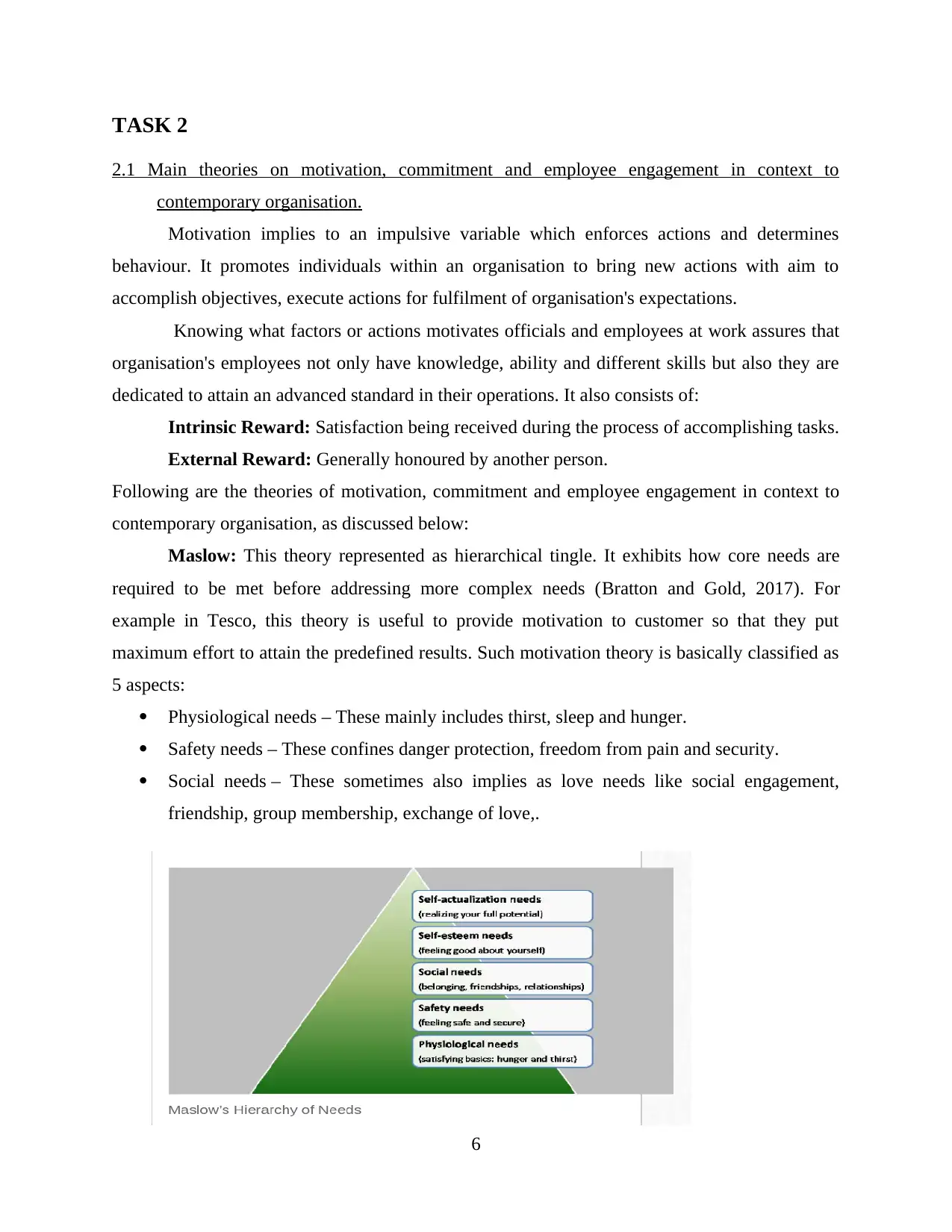
Maslow: This theory represented as hierarchical tingle. It exhibits how core needs are
required to be met before addressing more complex needs (Bratton and Gold, 2017). For
example in Tesco, this theory is useful to provide motivation to customer so that they put
maximum effort to attain the predefined results. Such motivation theory is basically classified as
5 aspects:
Physiological needs – These mainly includes thirst, sleep and hunger.
Safety needs – These confines danger protection, freedom from pain and security.
Social needs – These sometimes also implies as love needs like social engagement,
friendship, group membership, exchange of love,.
6
2.1 Main theories on motivation, commitment and employee engagement in context to
contemporary organisation.
Motivation implies to an impulsive variable which enforces actions and determines
behaviour. It promotes individuals within an organisation to bring new actions with aim to
accomplish objectives, execute actions for fulfilment of organisation's expectations.
Knowing what factors or actions motivates officials and employees at work assures that
organisation's employees not only have knowledge, ability and different skills but also they are
dedicated to attain an advanced standard in their operations. It also consists of:
Intrinsic Reward: Satisfaction being received during the process of accomplishing tasks.
External Reward: Generally honoured by another person.
Following are the theories of motivation, commitment and employee engagement in context to
contemporary organisation, as discussed below:
Maslow: This theory represented as hierarchical tingle. It exhibits how core needs are
required to be met before addressing more complex needs (Bratton and Gold, 2017). For
example in Tesco, this theory is useful to provide motivation to customer so that they put
maximum effort to attain the predefined results. Such motivation theory is basically classified as
5 aspects:
Physiological needs – These mainly includes thirst, sleep and hunger.
Safety needs – These confines danger protection, freedom from pain and security.
Social needs – These sometimes also implies as love needs like social engagement,
friendship, group membership, exchange of love,.
6

Esteem needs – These include esteem of others and self-respect. For instance, tendency
for achievement and self-confidence, and appreciation or recognition.
Self-actualization – This is majorly concerned with tendency to realize and develop full
potential develop.
Alderfer's ERG Theory: Alderfer’s ERG Theory is simply an extension of Maslow’s
model of needs, in these instead of five needs, only three needs are specified combining all such
five needs.
Existence Needs: The Existence Needs encompasses all of those requirements that
pertain to living beings ' physical and safety issues and are therefore a precondition for
survival. Therefore, Maslow's behavioural and safety requirements are categorized into
one group due to their identical nature and comparable effect on an individual's
behaviour.
Relatedness Needs: The need to contribute to social requirements by which a person
aims to create interactions with those he cares for. These demands encompass the social
requirements of the Maslow's and some of the requirements of esteem obtained from the
partnership with others.
Growth Needs: The development needs encompass self-actualization requirements of
Maslow and element of the requirements of esteem that are external to the person,
including a sense of being special, development of staff, etc. Therefore, expansion
requirements are those desires that affect a person to discover in the current setting their
highest potential.
7
for achievement and self-confidence, and appreciation or recognition.
Self-actualization – This is majorly concerned with tendency to realize and develop full
potential develop.
Alderfer's ERG Theory: Alderfer’s ERG Theory is simply an extension of Maslow’s
model of needs, in these instead of five needs, only three needs are specified combining all such
five needs.
Existence Needs: The Existence Needs encompasses all of those requirements that
pertain to living beings ' physical and safety issues and are therefore a precondition for
survival. Therefore, Maslow's behavioural and safety requirements are categorized into
one group due to their identical nature and comparable effect on an individual's
behaviour.
Relatedness Needs: The need to contribute to social requirements by which a person
aims to create interactions with those he cares for. These demands encompass the social
requirements of the Maslow's and some of the requirements of esteem obtained from the
partnership with others.
Growth Needs: The development needs encompass self-actualization requirements of
Maslow and element of the requirements of esteem that are external to the person,
including a sense of being special, development of staff, etc. Therefore, expansion
requirements are those desires that affect a person to discover in the current setting their
highest potential.
7
⊘ This is a preview!⊘
Do you want full access?
Subscribe today to unlock all pages.
Trusted by 1+ million students worldwide

McGregor's Theory X and Theory Y: These Theory X and Theory Y were initially
formed by McGregor and they proposed two styles: Authoritarian (Theory X) and Participative
(Theory Y). Following are the explanation about both these theories:
Theory X
Executives of theory X generally take a fatalistic perspective of their individuals,
assuming they are obviously unmotivated and detest work. As a consequence, they believe that
group members have to be continuously encouraged, rewarded, or penalized to ensure they finish
their duties. Working in such organisations could be repeated, and individuals are sometimes
driven by a "carrot and stick" strategy. Productivity and remuneration assessments are generally
based on concrete outcomes, like sales statistics or product production, which are used to
monitor and "Keep tabs" on employees. This style implies that:
Employees do not like their job.
Elite accountability and need steady guidance.
The job must be regulated, compelled and endangered.
Need to be monitored at each step.
Have no motivation to work or desire and therefore must be lured to attain
objectives by incentives.
Theory Y
Theory Y executives have their person's optimistic, favourable view, using a
decentralized, participatory style of leadership. This promotes a connection between executives
and their teammates that is more cooperative, trust-based.
2.2 Importance of management practices or developed theoretical model in companies.
Management practices facilitates a customised effective framework for preparation and
implementation of most appropriate strategies. Companies adopts different approaches for
selecting effective management practices, as such practices provides help in resolving different
problems. Managerial personnel’s are responsible for choosing and applying managerial
practices. Organisation's generally determines profitability as its final objective so these practices
are more focused on achieving a profitability level. Practices may be universal but ultimate
objective of these all managerial practices is to attain company's objectives. A modification in
already adopted managerial practices could be done by if any requirement of such modification
arise. Practices also facilitates adaption or developing theoretical models which defines
8
formed by McGregor and they proposed two styles: Authoritarian (Theory X) and Participative
(Theory Y). Following are the explanation about both these theories:
Theory X
Executives of theory X generally take a fatalistic perspective of their individuals,
assuming they are obviously unmotivated and detest work. As a consequence, they believe that
group members have to be continuously encouraged, rewarded, or penalized to ensure they finish
their duties. Working in such organisations could be repeated, and individuals are sometimes
driven by a "carrot and stick" strategy. Productivity and remuneration assessments are generally
based on concrete outcomes, like sales statistics or product production, which are used to
monitor and "Keep tabs" on employees. This style implies that:
Employees do not like their job.
Elite accountability and need steady guidance.
The job must be regulated, compelled and endangered.
Need to be monitored at each step.
Have no motivation to work or desire and therefore must be lured to attain
objectives by incentives.
Theory Y
Theory Y executives have their person's optimistic, favourable view, using a
decentralized, participatory style of leadership. This promotes a connection between executives
and their teammates that is more cooperative, trust-based.
2.2 Importance of management practices or developed theoretical model in companies.
Management practices facilitates a customised effective framework for preparation and
implementation of most appropriate strategies. Companies adopts different approaches for
selecting effective management practices, as such practices provides help in resolving different
problems. Managerial personnel’s are responsible for choosing and applying managerial
practices. Organisation's generally determines profitability as its final objective so these practices
are more focused on achieving a profitability level. Practices may be universal but ultimate
objective of these all managerial practices is to attain company's objectives. A modification in
already adopted managerial practices could be done by if any requirement of such modification
arise. Practices also facilitates adaption or developing theoretical models which defines
8
Paraphrase This Document
Need a fresh take? Get an instant paraphrase of this document with our AI Paraphraser

organisation's internal and external operational structure. As in Tesco, an retail market chain of
UK, managerial personnels determines managerial practices and applies them in developing and
adopting theoretical models and other internal policies with aim to achieve profitability targets.
2.3 Employee engagement is a positive factor in organisational health terms.
Employee engagement is one of the greatest factor that support a business firm to
accomplish goals in meaningful manner (Wiegmann and Shappell, 2017). It is defined as the
valid and valuable connection between employee and company so that work can be completed as
per the important information provided by the upper level management. It is considering to be
the actual level of dedication and enthusiasm a worker feels towards the particular job they are
engaged within company. In a workplace its is one of the effective approach that results in better
working environment for every employee of business firm to put their best effort and be more
committed towards attainment of company gaols and values, be motivated to contribute for
organisational success with an enhance sense of their own well-being. Therefore employee
engagement is one of the most important and a positive factors that support and improve
organisation performance across a number of functional areas like profitability, productivity,
innovation, safety and healthy, turnover and well-being and most vital customer satisfaction
(Real example of employee engagement, 2019). There are number of real life example related
with positive impact of employee engagement in different companies that are as follows:
Google- Transparency: The idea of creating transparency in culture is one of the best
method to engage employee in number of business operation that are beneficial for
company. In Google manager use to break the barriers, promote creative thinking and
collaboration which makes employee to feel empowered by transparency. It is very clear
that employee wants to be engaged in something that is transparent and nothing is hidden
so they can experience honest and reliable perspective that can be either and good or bad.
Virgin- Listening: This company have a significant habit that is related with listening to
their workforce that shows that they value their employee. Management use to listen to
their employee in order to obtain different opinion and idea of getting something new and
innovative in company. This approach of Virgin helps to get maximum employee
engagement as they are listened to, wants to act, put their best efforts as they feel
important and valued.
9
UK, managerial personnels determines managerial practices and applies them in developing and
adopting theoretical models and other internal policies with aim to achieve profitability targets.
2.3 Employee engagement is a positive factor in organisational health terms.
Employee engagement is one of the greatest factor that support a business firm to
accomplish goals in meaningful manner (Wiegmann and Shappell, 2017). It is defined as the
valid and valuable connection between employee and company so that work can be completed as
per the important information provided by the upper level management. It is considering to be
the actual level of dedication and enthusiasm a worker feels towards the particular job they are
engaged within company. In a workplace its is one of the effective approach that results in better
working environment for every employee of business firm to put their best effort and be more
committed towards attainment of company gaols and values, be motivated to contribute for
organisational success with an enhance sense of their own well-being. Therefore employee
engagement is one of the most important and a positive factors that support and improve
organisation performance across a number of functional areas like profitability, productivity,
innovation, safety and healthy, turnover and well-being and most vital customer satisfaction
(Real example of employee engagement, 2019). There are number of real life example related
with positive impact of employee engagement in different companies that are as follows:
Google- Transparency: The idea of creating transparency in culture is one of the best
method to engage employee in number of business operation that are beneficial for
company. In Google manager use to break the barriers, promote creative thinking and
collaboration which makes employee to feel empowered by transparency. It is very clear
that employee wants to be engaged in something that is transparent and nothing is hidden
so they can experience honest and reliable perspective that can be either and good or bad.
Virgin- Listening: This company have a significant habit that is related with listening to
their workforce that shows that they value their employee. Management use to listen to
their employee in order to obtain different opinion and idea of getting something new and
innovative in company. This approach of Virgin helps to get maximum employee
engagement as they are listened to, wants to act, put their best efforts as they feel
important and valued.
9
Hyatt- Employee Development: The respective hotel group is known for its high
employee turnover as they are more focused on employee promoting and developing that
support in attainment of predefined goals. Management is also focused on developing the
way to empower employee so that they can communication in better manner with other
associate and visitors, able to provide meaningful solution to problem and making each
and every guest feel special.
TASK 3
3.1 Determination of factors that makes a leader.
In business world, an individual that have a unique personality to influence, guide or lead
other and most importantly impacting behaviour of other to perform a certain task or work to
maximise results makes person or individual a good leader (Brunstein, 2016). It is observed that
leadership is not related to the seniority or respective position in the hierarchy of particular
company, not related to management or relates to personal attributes. In general, it has been
stated that leader is not born they are made, such as in on organisation upper management use to
analyse the performance of employees on regular basis and from a group of member they use to
appoint a leader those have the skills and ability to lead and influence other. There are some
meaningful characteristics of a good leader which aid to create skills and assist Rolls Royce to
cultivate leaders. These features are:
1. Strategic Thinking: Good leader are considering to be leadership abilities and sense of
direction to be an efficient leader. They are known and remain focused about where an
organisation is headed and dedicated to its long-term achievement and everybody
engaged's success. Leader majorly correspond their operations with a clear objective and
purpose and make financial choices based on scientific information and evidence-based
practices. They comprehend an firm's culture and statistics and internal influences like
politics, economics, law, community, society and their potential effect on the
organisation.
2. Communication Skills: Leader must be good listener, speaker as well as good writer
also so that they are able to have good and effective communication and be genuine and
honest at every level of company. Leader in respective company are responsible to
10
employee turnover as they are more focused on employee promoting and developing that
support in attainment of predefined goals. Management is also focused on developing the
way to empower employee so that they can communication in better manner with other
associate and visitors, able to provide meaningful solution to problem and making each
and every guest feel special.
TASK 3
3.1 Determination of factors that makes a leader.
In business world, an individual that have a unique personality to influence, guide or lead
other and most importantly impacting behaviour of other to perform a certain task or work to
maximise results makes person or individual a good leader (Brunstein, 2016). It is observed that
leadership is not related to the seniority or respective position in the hierarchy of particular
company, not related to management or relates to personal attributes. In general, it has been
stated that leader is not born they are made, such as in on organisation upper management use to
analyse the performance of employees on regular basis and from a group of member they use to
appoint a leader those have the skills and ability to lead and influence other. There are some
meaningful characteristics of a good leader which aid to create skills and assist Rolls Royce to
cultivate leaders. These features are:
1. Strategic Thinking: Good leader are considering to be leadership abilities and sense of
direction to be an efficient leader. They are known and remain focused about where an
organisation is headed and dedicated to its long-term achievement and everybody
engaged's success. Leader majorly correspond their operations with a clear objective and
purpose and make financial choices based on scientific information and evidence-based
practices. They comprehend an firm's culture and statistics and internal influences like
politics, economics, law, community, society and their potential effect on the
organisation.
2. Communication Skills: Leader must be good listener, speaker as well as good writer
also so that they are able to have good and effective communication and be genuine and
honest at every level of company. Leader in respective company are responsible to
10
⊘ This is a preview!⊘
Do you want full access?
Subscribe today to unlock all pages.
Trusted by 1+ million students worldwide

1 out of 22


Related Documents


Your All-in-One AI-Powered Toolkit for Academic Success.
+13062052269
info@desklib.com
Available 24*7 on WhatsApp / Email
![[object Object]](/_next/static/media/star-bottom.7253800d.svg)
Unlock your academic potential
Copyright © 2020–2026 A2Z Services. All Rights Reserved. Developed and managed by ZUCOL.