Business Studies: Unilever's HR, Marketing, and Financial Roles

Verified

Added on  2023/06/18

|6
|1284
|116
Report
AI Summary
This report provides an overview of the roles and functions of Human Resources (HR), marketing, and finance departments within a business context, using Unilever as a case study. It details the responsibilities of HR, including compensation, training, and recruitment, and explains how the marketing department contributes to sales and brand reputation. The role of finance is examined in terms of fund allocation and financial statement preparation. Furthermore, the report discusses the significance of financial management, emphasizing its role in financial decision-making, planning, protecting funds, and improving business profitability. The conclusion underscores the interconnectedness of these departments and the importance of financial management in achieving organizational objectives. Desklib provides access to similar solved assignments for students.

Document Page
Introduction to
Business Studies
tabler-icon-diamond-filled.svg

Paraphrase This Document

Need a fresh take? Get an instant paraphrase of this document with our AI Paraphraser
Document Page
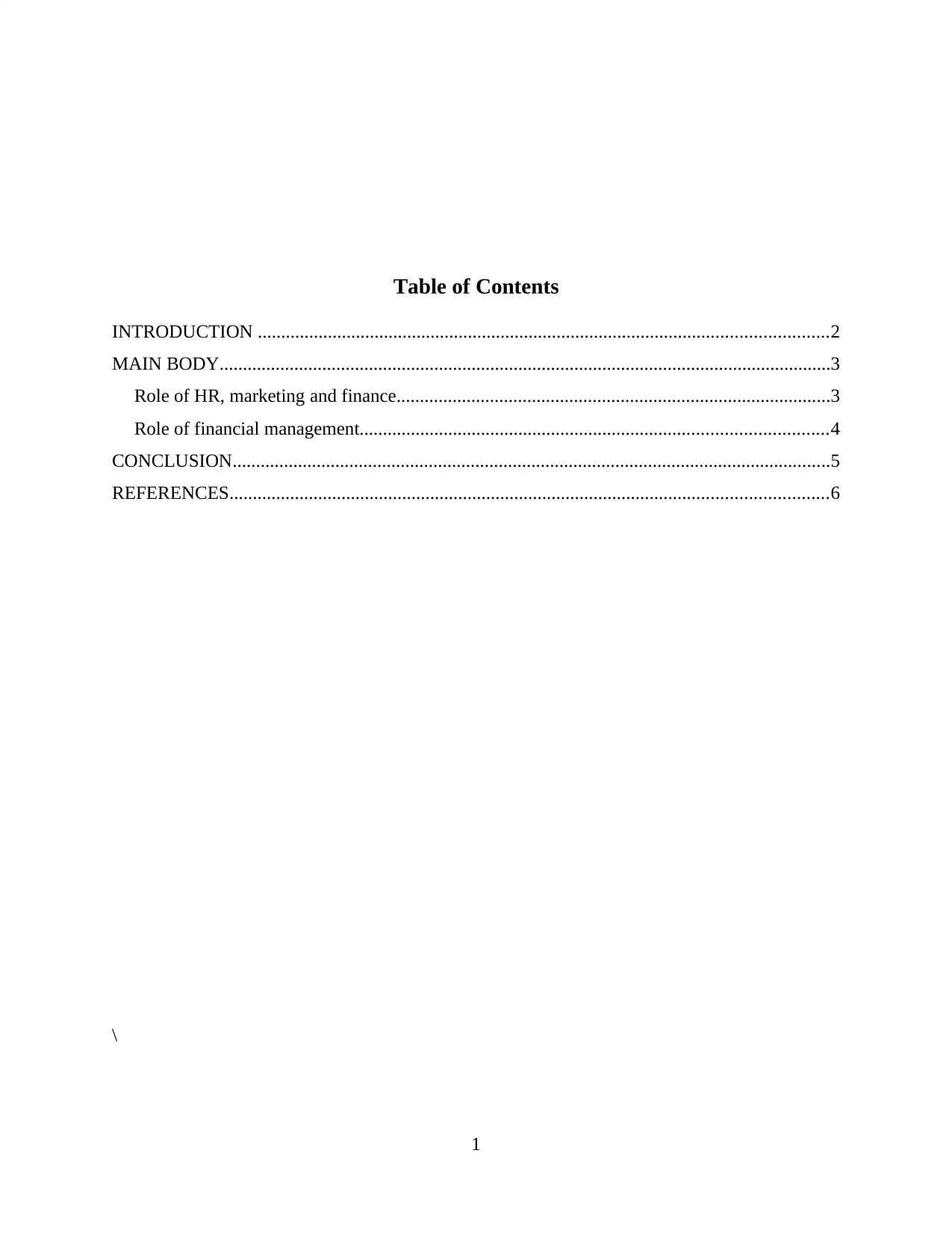
Table of Contents
INTRODUCTION ..........................................................................................................................2
MAIN BODY...................................................................................................................................3
Role of HR, marketing and finance.............................................................................................3
Role of financial management....................................................................................................4
CONCLUSION................................................................................................................................5
REFERENCES................................................................................................................................6
\
1
Document Page
INTRODUCTION
Business studies is a subject which provides the information and understanding of work
or any other activity which is productive(Isaac and et. al.,2019). Productive activity can be
termed as those in which the resources are used in an effective way so that the needs and wants
of humans can be satisfied. It is also the study of different methods and techniques which are
used for running and setting of a business. It provides the overview of different departments
which are established in a business with their different roles as they help in achieving the
objectives of a company effectively. Unilever is a consumer based goods company which was
established in the year 1929 and is headquarters is located in London, UK. This report will cover
role and functions of HR, marketing and finance and the role of financial management.
MAIN BODY
Role of HR, marketing and finance
Human resource- Human resource department are those who makes the management of human
resource in the workplace. They are required to provide the training and development session so
that the capability of employees can be increased. Unilever human resource department performs
the activities which helps them in the development of culture and policies which are beneficial
for the success of a company.
Role of human resource-
Compensation and benefits- They are the one who are responsible for providing the
benefits and compensation to the employees(Asakawa and et. al., 2018). Unilever HR
department provides the talented people compensation who have done excellent work and
have contributed in the success of a company.
Training and development- Every individual who is selected for any of the job role in a
company then it is not a surety that they are equipped with every skill. So at this time it is
important that they are provided with training and development programmes which will
be helpful for them in their self development. Selecting right candidates- Human resource department of every company is
responsible for selecting the right candidate which will match their skills and the job role.
If every job position is vacant in the company then they are responsible for filling that
jobs.
2
Document Page
Marketing- Marketing department of a company is responsible for making promotion and
advertisement activities with which the success of a company is related and linked. Unilever
marketing team also conducts different promotional activities in which they target consumers
and according to it they develop their strategy.
Role of marketing-
Helps in increasing the sales- Marketing team is responsible for promoting the products
of a company with which the consumers get to know about the products which are
available in the market(Weigert, 2019). Unilever marketing team provides all the
information in regard with range of new products which the company is manufacturing. Build a reputation for a brand- Another benefit which is provided by the marketing
team is that they help in building the reputation of a brand in a significant manner. They
implement different marketing strategies which is useful for the company in developing
and building their reputation.
Finance- Finance department in a company is responsible for managing all the funds and on the
basis of it they make the allocation of funds.
Role of finance-
Allocation of funds- They are responsible for allocating the funds in different
department according to the requirement. This helps the department to make their own
planning in context with the budget provided. Preparation of financial statements- They prepares the financial statement on the basis
of which company position is identified that if they are in profits or facing any losses.
Role of financial management
Financial management can be described as a process in which the planning, organizing and
controlling of funds takes place so that it can provide success to the company.
Financial decisions- All the decisions in context with finances is made under this
because only because of money every company can operate their activities. So the
financial management helps the company to work in a smooth manner so that effective
decisions can be made(Mumford and Banks, 2018).
3
tabler-icon-diamond-filled.svg

Paraphrase This Document

Need a fresh take? Get an instant paraphrase of this document with our AI Paraphraser
Document Page
Financial planning- Financial planning can be done when the funds are managed in an
effective way by the company. This attribute is provided by the company when they are
managing and planning the funds in a proper and effective way. Financial planning
means that the finances of a company is planned on the basis of objectives so that they
might run of funds.
Protecting funds- Financial management also helps in protecting and safeguarding the
funds as they have to ensure that the funds are provided on time and accurately. It is
because when the funds will be kept in those areas where there will be wastage then it
will not be good for the company itself(Jackson and Deeg, 2019). Unilever at some point
of time spends most of the funds in those projects which is not productive or which will
either not provide them the results. So, in this case it becomes very important that the
funds gets protected and is utilised in a protective way.
Improves in profitability of a business- Financial management is helpful in the
profitability of a business because finance is like a blood to the business and without it ,
this would be impossible for the Unilever to achieve profits. This helps in improving the
profits of a company also(Öberg and Shams, 2019).
CONCLUSION
From the above report it can be concluded that every department in the organisation are
important and they plays an effective role which are directly related with the achievement of
organisation objectives. They all are inter-linked with one another as the work of every
department is related with each of them. Similarly financial management is also an important
method which is helpful in planning the finances and in the allocation of funds in a proper way.
4
Document Page
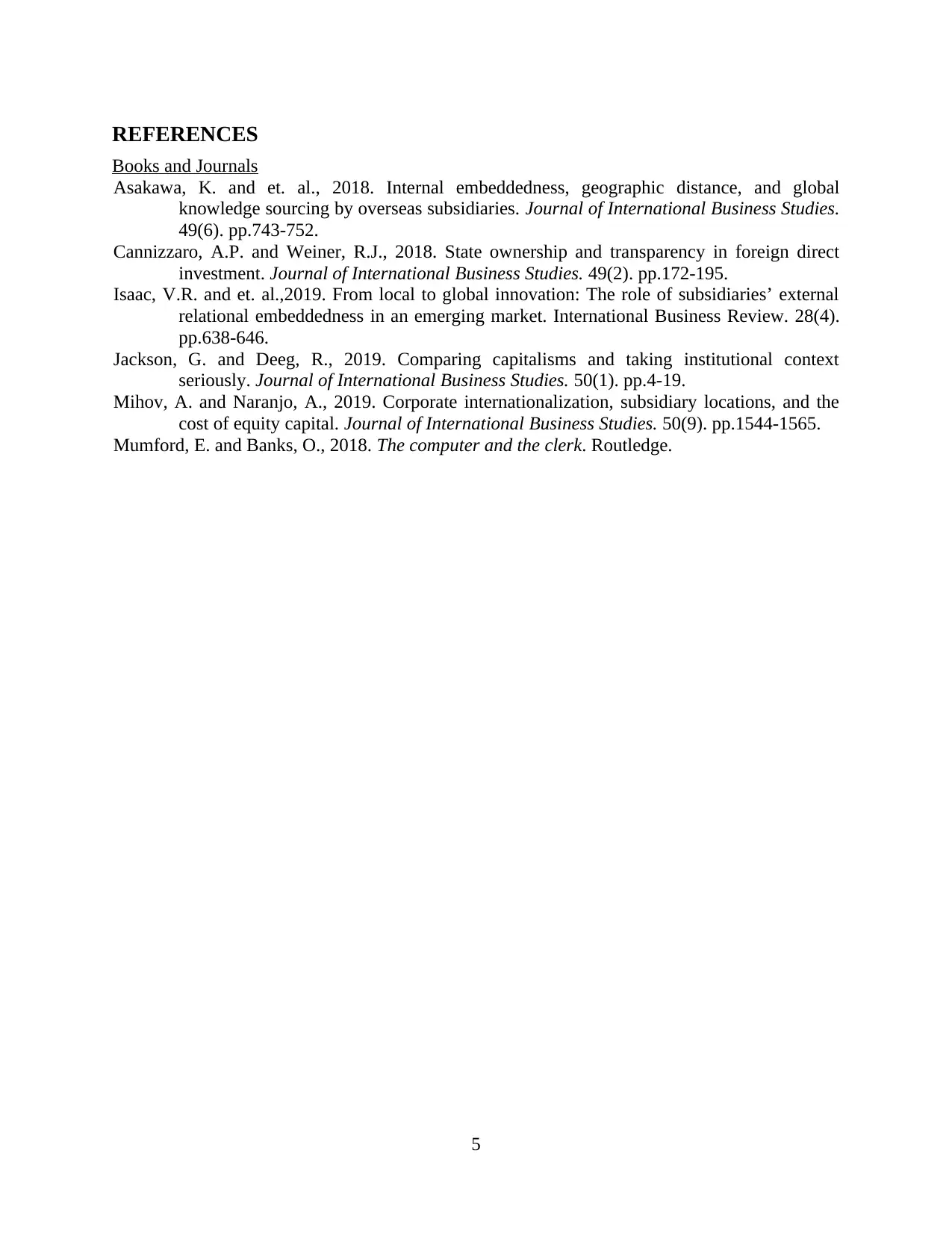
REFERENCES
Books and Journals
Asakawa, K. and et. al., 2018. Internal embeddedness, geographic distance, and global
knowledge sourcing by overseas subsidiaries. Journal of International Business Studies.
49(6). pp.743-752.
Cannizzaro, A.P. and Weiner, R.J., 2018. State ownership and transparency in foreign direct
investment. Journal of International Business Studies. 49(2). pp.172-195.
Isaac, V.R. and et. al.,2019. From local to global innovation: The role of subsidiaries’ external
relational embeddedness in an emerging market. International Business Review. 28(4).
pp.638-646.
Jackson, G. and Deeg, R., 2019. Comparing capitalisms and taking institutional context
seriously. Journal of International Business Studies. 50(1). pp.4-19.
Mihov, A. and Naranjo, A., 2019. Corporate internationalization, subsidiary locations, and the
cost of equity capital. Journal of International Business Studies. 50(9). pp.1544-1565.
Mumford, E. and Banks, O., 2018. The computer and the clerk. Routledge.
5
chevron_up_icon
1 out of 6
circle_padding
hide_on_mobile
zoom_out_icon
[object Object]