HR Practices, Group Dynamics, Conflict Resolution, Development Report
VerifiedAdded on 2020/06/06
|14
|4332
|44
Report
AI Summary
This report delves into the essential roles and best practices for HR professionals, emphasizing the importance of continuous skill development in today's competitive landscape. It references the CIPD professional map to outline key responsibilities such as maintaining employee relations, organizational design, and talent planning. The report also explores the elements of group dynamics, including group structure, communication, and decision-making processes, alongside various conflict resolution methods like accommodating, avoiding, collaborating, and negotiation, and how they apply in an HR context. Furthermore, the report provides insights into self-assessment for identifying professional development needs and outlines a professional development plan, covering areas like courage to challenge, collaborative skills, and decisive thinking to enhance HR effectiveness. The document provides a comprehensive overview of HR management, group dynamics, conflict resolution, and professional development.
Developing Professional
Problem
Problem

Paraphrase This Document
Need a fresh take? Get an instant paraphrase of this document with our AI Paraphraser
Table of Contents
INTRODUCTION...........................................................................................................................1
TASK 1............................................................................................................................................1
HR personnels as per the CIPD professional map......................................................................1
TASK 2............................................................................................................................................4
Describe the elements of group dynamics and methods of conflict resolution...........................4
TASK 3............................................................................................................................................6
Providing evidence of using project management and problem solving techniques..................6
Influenced, persuaded and negotiated with others......................................................................7
TASK 4............................................................................................................................................7
Undertaking self assessment of one area of practice to identify professional development
needs............................................................................................................................................7
Professional development plan to meet professional development needs..................................8
CONCLUSION................................................................................................................................9
REFERENCES..............................................................................................................................10
INTRODUCTION...........................................................................................................................1
TASK 1............................................................................................................................................1
HR personnels as per the CIPD professional map......................................................................1
TASK 2............................................................................................................................................4
Describe the elements of group dynamics and methods of conflict resolution...........................4
TASK 3............................................................................................................................................6
Providing evidence of using project management and problem solving techniques..................6
Influenced, persuaded and negotiated with others......................................................................7
TASK 4............................................................................................................................................7
Undertaking self assessment of one area of practice to identify professional development
needs............................................................................................................................................7
Professional development plan to meet professional development needs..................................8
CONCLUSION................................................................................................................................9
REFERENCES..............................................................................................................................10
INTRODUCTION
In the present times when the competition is so high it is not only important for
organisations to develop themselves but it is also essential for the individuals to develop their
skills at regular intervals. HR mangers plays one of the most significant role in the organisation
as they maintain the most essential resource within an organisation i.e. Human Resources. It is
important for the HR managers to apply best practices in this professionalism so as to develop to
be able to manage things in a better way (Archibald and et. al., 2011). There must be a map using
which the HR must develop his or her professional level. This report highlights the best practices
that a HR must follow so as to become effective. It also showcases the elements of group
dynamics and the methods that help in resolving the conflicts at the workplace. The professional
development needs are to be accessed using this as well as the professional development plan is
illustrated here.
TASK 1
HR personnels as per the CIPD professional map.
In the modern business environment the role of the HR professionals have increased.
Being a HR means that they have to manage lots of things related to the human resource present
inside the company. They have very significant roles. There roles are defines as per the map that
is best for the HR professional known as the CIPD professional map.
Maintaining employee relations: It is the essential role of the HR professional to
maintain a healthy relationship between the human resource and the management of the firm.
Service delivery and information: It is important for the HR managers to deliver services
and information to the staff members so that they can work work in a better way.
Organisation design: It is the role of HR to design the structure for an organisation. It is
important so that information can flow within the organisation in a structured manner.
Organisation development: It is the role of HR to develop the feeling of being an
organisational part so that they can also understand themselves as the essential element of the
firm (Armstrong and Taylor, 2014).
Resourcing and talent planning: It is the basic role of HR to maintain the manage the
resources such as the staffs and their training needs. At various times there is requirement of the
1
In the present times when the competition is so high it is not only important for
organisations to develop themselves but it is also essential for the individuals to develop their
skills at regular intervals. HR mangers plays one of the most significant role in the organisation
as they maintain the most essential resource within an organisation i.e. Human Resources. It is
important for the HR managers to apply best practices in this professionalism so as to develop to
be able to manage things in a better way (Archibald and et. al., 2011). There must be a map using
which the HR must develop his or her professional level. This report highlights the best practices
that a HR must follow so as to become effective. It also showcases the elements of group
dynamics and the methods that help in resolving the conflicts at the workplace. The professional
development needs are to be accessed using this as well as the professional development plan is
illustrated here.
TASK 1
HR personnels as per the CIPD professional map.
In the modern business environment the role of the HR professionals have increased.
Being a HR means that they have to manage lots of things related to the human resource present
inside the company. They have very significant roles. There roles are defines as per the map that
is best for the HR professional known as the CIPD professional map.
Maintaining employee relations: It is the essential role of the HR professional to
maintain a healthy relationship between the human resource and the management of the firm.
Service delivery and information: It is important for the HR managers to deliver services
and information to the staff members so that they can work work in a better way.
Organisation design: It is the role of HR to design the structure for an organisation. It is
important so that information can flow within the organisation in a structured manner.
Organisation development: It is the role of HR to develop the feeling of being an
organisational part so that they can also understand themselves as the essential element of the
firm (Armstrong and Taylor, 2014).
Resourcing and talent planning: It is the basic role of HR to maintain the manage the
resources such as the staffs and their training needs. At various times there is requirement of the
1
⊘ This is a preview!⊘
Do you want full access?
Subscribe today to unlock all pages.

Trusted by 1+ million students worldwide
workforce for several units it is the role of the HR to manage all these. It is also one of the
important duty of the HR professional to plan so that talent can be managed inside the firm.
Learning and development: It is also the role of HR to manage training sessions so that
staffs can learn the essential professional deficiencies in them as well as develop as a better
employee of the firm. It needs to done on a regular basis so that they do not lack in any of the
opportunities that comes to them. It helps in increasing the productivity of the overall firm.
Performance and Reward: It is the function of HR professional to check the
performance of each staff and hence taking the record of each staff members. It will help at the
time of reward distribution which is one of the important things that needs to be done in an
organisation (Bratton and Gold, 2012). It increases the motivational level of the employee and
also helps in retaining the valuable staffs within an organisation.
Employee engagement: The best HR professional in the world ensures that lower staff
members also gets the chance of participating in the decision making process. It increases the
motivational level of staffs in multifold which is important for enhancing the productivity of the
employee.
HR in the company must have certain qualities which increases their working efficiency:
Courage to challenge: They must have the courage to face various situations that are
posed inside the firm. Apart from this also must have the challenge taking ability so that can
achieve desired results in difficult situations.
Role model: It is important for the HR professional to make their role models as well as
become the role models for various staffs. Like following the rules and regulations set inside the
firm in a better way. It helps them to have control over other workers in a better way.
Driven to deliver: They must be driven with the proper set of rules and ethics set by an
organisation so as to deliver the best practice in the industry (Busse, Aboneh and Tefera, 2014).
It is important for HR to have have best drivers for their working process.
Collaborative: HR must be able to work in a collaborative manner with staffs so that they
can imbibe the feeling of team work inside the firm. It is essential for increasing the performance
of the staff members as they can help each other in their difficult times
Personally credible: It is the first and for most requirement of the HR professional to be
personally credible. If they fail to do so they will be unable to imbibe feeling of trust in the
minds of the workers which is essential for their personal growth.
2
important duty of the HR professional to plan so that talent can be managed inside the firm.
Learning and development: It is also the role of HR to manage training sessions so that
staffs can learn the essential professional deficiencies in them as well as develop as a better
employee of the firm. It needs to done on a regular basis so that they do not lack in any of the
opportunities that comes to them. It helps in increasing the productivity of the overall firm.
Performance and Reward: It is the function of HR professional to check the
performance of each staff and hence taking the record of each staff members. It will help at the
time of reward distribution which is one of the important things that needs to be done in an
organisation (Bratton and Gold, 2012). It increases the motivational level of the employee and
also helps in retaining the valuable staffs within an organisation.
Employee engagement: The best HR professional in the world ensures that lower staff
members also gets the chance of participating in the decision making process. It increases the
motivational level of staffs in multifold which is important for enhancing the productivity of the
employee.
HR in the company must have certain qualities which increases their working efficiency:
Courage to challenge: They must have the courage to face various situations that are
posed inside the firm. Apart from this also must have the challenge taking ability so that can
achieve desired results in difficult situations.
Role model: It is important for the HR professional to make their role models as well as
become the role models for various staffs. Like following the rules and regulations set inside the
firm in a better way. It helps them to have control over other workers in a better way.
Driven to deliver: They must be driven with the proper set of rules and ethics set by an
organisation so as to deliver the best practice in the industry (Busse, Aboneh and Tefera, 2014).
It is important for HR to have have best drivers for their working process.
Collaborative: HR must be able to work in a collaborative manner with staffs so that they
can imbibe the feeling of team work inside the firm. It is essential for increasing the performance
of the staff members as they can help each other in their difficult times
Personally credible: It is the first and for most requirement of the HR professional to be
personally credible. If they fail to do so they will be unable to imbibe feeling of trust in the
minds of the workers which is essential for their personal growth.
2
Paraphrase This Document
Need a fresh take? Get an instant paraphrase of this document with our AI Paraphraser
Skilled Influencer: A HR is that individuals who has a good skill of influencing others.
This persuading power of his or her helps them in influencing the thinking of other staff
members. They have to manage other staff members form time to time which is important for the
making them work in desired way.
Decisive thinker: It is the good quality of HR to be decisive thinker which means he or
she must be able to take decisions based on an excellent thinking capabilities (Danielson, 2011).
Decisive thinking comes from the ability to use the past experience and knowledge in a better
way. It guides them in their decision making.
Curious: It is a quality that every HR must have. It relates to the ability of his or her to
have jest to learn something from time to time. Its the curiosity of the HR managers that helps
him in making better HR plans for the development of staffs.
3
(source 1: Roles of HR, 2017)
This persuading power of his or her helps them in influencing the thinking of other staff
members. They have to manage other staff members form time to time which is important for the
making them work in desired way.
Decisive thinker: It is the good quality of HR to be decisive thinker which means he or
she must be able to take decisions based on an excellent thinking capabilities (Danielson, 2011).
Decisive thinking comes from the ability to use the past experience and knowledge in a better
way. It guides them in their decision making.
Curious: It is a quality that every HR must have. It relates to the ability of his or her to
have jest to learn something from time to time. Its the curiosity of the HR managers that helps
him in making better HR plans for the development of staffs.
3
(source 1: Roles of HR, 2017)
TASK 2
Describe the elements of group dynamics and methods of conflict resolution.
There are various elements of group dynamics which is as follows:
Group structure: It is considered as the underlying order of the group. It defines the
communication, boundaries and process of making decisions and authority relationship within a
team. It offers stability.
Group communication: It is the pattern in which team reveals the ways in which it approaches
its task and psychosocial functions. It is of various forms interpersonal, intra personal, public,
latent as well as manifest communication.
Content and Process: What is being stated at the discussion is content as well as the ways in
which group handles its communication is process.
Task vs. relationship: All groups has two basic needs or functions i.e. need to work on complete
task or goal and the need of satisfying emotional needs (Dul and et. al., 2012). Task refers to as
job that has to be done and relationship refers to as the ways in which people work in a team.
There are various task roles like initiators, Information givers, clarifier and elaborators,
summarizer, energizer and coordinator. Apart from these there are various relationship roles like
harmonizer, gate keeper, encourager, compromiser, follower. Other than these two there are
certain self oriented roles like dominator, negativist, aggressor and storyteller.
Decision: Many decisions are made in a group without considering the impact that will be made
by that on the group members. Some tries to impose their decisions on the group members and
some allows participation of staffs.
Influence: It is considered as the sense that many speaks little even then they are able to capture
the attention of the whole group and other may talk much still does not have impact at the same
levels (Lengnick-Hall, Beck and Lengnick-Hall, 2011).
Membership: It refers to as the degree of acceptance they feel within the group. For example do
member feel that they are outsider or some moves in and out of the group.
Feelings: It is the feeling that is developed in the team while having discussion it can be noted
through the voice tones facial expressions etc.
Group atmosphere: It is about the ways in which team work creates an atmosphere which in turn
will be revealed by general expression.
4
Describe the elements of group dynamics and methods of conflict resolution.
There are various elements of group dynamics which is as follows:
Group structure: It is considered as the underlying order of the group. It defines the
communication, boundaries and process of making decisions and authority relationship within a
team. It offers stability.
Group communication: It is the pattern in which team reveals the ways in which it approaches
its task and psychosocial functions. It is of various forms interpersonal, intra personal, public,
latent as well as manifest communication.
Content and Process: What is being stated at the discussion is content as well as the ways in
which group handles its communication is process.
Task vs. relationship: All groups has two basic needs or functions i.e. need to work on complete
task or goal and the need of satisfying emotional needs (Dul and et. al., 2012). Task refers to as
job that has to be done and relationship refers to as the ways in which people work in a team.
There are various task roles like initiators, Information givers, clarifier and elaborators,
summarizer, energizer and coordinator. Apart from these there are various relationship roles like
harmonizer, gate keeper, encourager, compromiser, follower. Other than these two there are
certain self oriented roles like dominator, negativist, aggressor and storyteller.
Decision: Many decisions are made in a group without considering the impact that will be made
by that on the group members. Some tries to impose their decisions on the group members and
some allows participation of staffs.
Influence: It is considered as the sense that many speaks little even then they are able to capture
the attention of the whole group and other may talk much still does not have impact at the same
levels (Lengnick-Hall, Beck and Lengnick-Hall, 2011).
Membership: It refers to as the degree of acceptance they feel within the group. For example do
member feel that they are outsider or some moves in and out of the group.
Feelings: It is the feeling that is developed in the team while having discussion it can be noted
through the voice tones facial expressions etc.
Group atmosphere: It is about the ways in which team work creates an atmosphere which in turn
will be revealed by general expression.
4
⊘ This is a preview!⊘
Do you want full access?
Subscribe today to unlock all pages.
Trusted by 1+ million students worldwide
Group power: Power is the member ability to influence the team and other members for
conducting a task in professional manner so that all group member could feel self motivated.
Group maturity: It is the ability and willingness of team members to set targets and working
harder so as to achieve them.
Group cohesion: It is the strength of desire of the member to work collaboratively so as to
achieve common goals and to support one another (10 BEST PRACTICES FOR YOUR HUMAN
RESOURCES DEPARTMENT. 2017). It is associated with the positive group outcomes.
Methods of resolving conflicts in HR context
Some of the methods are as follows:
Accommodating: It is the approach that emphasises on cooperation instead of
assertiveness. A person places his interest at the last and allows other parties to to perceive their
interests.
Avoiding: This is a process in which parties avoids communication about confronting to
the problem and hence do not take part in the problem solving process (Ployhart, Van Iddekinge
and MacKenzie, 2011). In this process conflict might go away if other party doesn't press for
resolution.
Collaborating: It is the method in which parties works together for resolving issues and
both side comes to the table with the win win attitude. It is the formal style of dispute resolving.
Compromise: Bargaining is the hall mark for this approach so as to resolve the conflicts.
The parties that have conflict can determine the interest and are willing to compromise so as to
come to a conclusion.
Confrontation: It s the style of resolving conflicts in which party placing their desire
above all those who are involved in conflict. Being assertive is the trade mark of this approach.
Negotiation: This is a very basic solution of conflict differences. In this method, person
can directly contact with respective person and negotiate with him regarding their problems and
still problem is not solved then human resource manager will take corrective action on this clash.
This methodology allows a person to participate in those actions that are affecting employees in
negative manner. This is a common method that are being used at workplaces on regular basis.
There are some characteristics which are listed below:
Voluntary.
Private and Confidential
5
conducting a task in professional manner so that all group member could feel self motivated.
Group maturity: It is the ability and willingness of team members to set targets and working
harder so as to achieve them.
Group cohesion: It is the strength of desire of the member to work collaboratively so as to
achieve common goals and to support one another (10 BEST PRACTICES FOR YOUR HUMAN
RESOURCES DEPARTMENT. 2017). It is associated with the positive group outcomes.
Methods of resolving conflicts in HR context
Some of the methods are as follows:
Accommodating: It is the approach that emphasises on cooperation instead of
assertiveness. A person places his interest at the last and allows other parties to to perceive their
interests.
Avoiding: This is a process in which parties avoids communication about confronting to
the problem and hence do not take part in the problem solving process (Ployhart, Van Iddekinge
and MacKenzie, 2011). In this process conflict might go away if other party doesn't press for
resolution.
Collaborating: It is the method in which parties works together for resolving issues and
both side comes to the table with the win win attitude. It is the formal style of dispute resolving.
Compromise: Bargaining is the hall mark for this approach so as to resolve the conflicts.
The parties that have conflict can determine the interest and are willing to compromise so as to
come to a conclusion.
Confrontation: It s the style of resolving conflicts in which party placing their desire
above all those who are involved in conflict. Being assertive is the trade mark of this approach.
Negotiation: This is a very basic solution of conflict differences. In this method, person
can directly contact with respective person and negotiate with him regarding their problems and
still problem is not solved then human resource manager will take corrective action on this clash.
This methodology allows a person to participate in those actions that are affecting employees in
negative manner. This is a common method that are being used at workplaces on regular basis.
There are some characteristics which are listed below:
Voluntary.
Private and Confidential
5
Paraphrase This Document
Need a fresh take? Get an instant paraphrase of this document with our AI Paraphraser
Quick and Inexpensive.
Informal and Unstructured etc.
Arbitration: It means whole matter is send to person for further decision and he/she will
take judgement on the basis of analysing whole case and that personnel is called as Arbitrator.
This is a out-of-court approach and an outsider person is hired of making solutions of grievances
that are arising at workplace. In this approach, arbitrator will establish a hearing and here al,
parties will present their viewpoints regarding their conflicts.
Litigation: It means when an employees takes support of court when he is not satisfied
with provided solution. This term is properly used when legal complications are raised at
workplace. Process of litigation is begun by filing a case in court and then full procedure is to be
followed then all evidence should be present in front of respective judge. Hearing of all aspects
would be conduct.
Unilateral Decisions: In this all conflicts are solved on short term basis as a judgement is
made on temporary basis and if association wants long term bond with any employee than this
method would not work. This approach affects relationship of employer and employees
positively on short term basis and negatively on long term basis. This approach shows abilities of
that person who is having conflict and managers prove those personnel that how much he is more
capable than the other person.
TASK 3
Providing evidence of using project management and problem solving techniques
I led the project of making performance appraisal in company. It was important to
manage the project in an effective manner. There were several issue that are posed in the
performance appraisal. Identifying the role of project management in performance appraisal.
After it is identified innovative strategies to address organisational opportunities and problem
relating to the project. It is important to gauge the quality of the evidence in the domain of
project management and use those so as to inform about the effective course of action. At last
developing the portfolio approach to realise organisational and strategic benefits from the
project.
6
Informal and Unstructured etc.
Arbitration: It means whole matter is send to person for further decision and he/she will
take judgement on the basis of analysing whole case and that personnel is called as Arbitrator.
This is a out-of-court approach and an outsider person is hired of making solutions of grievances
that are arising at workplace. In this approach, arbitrator will establish a hearing and here al,
parties will present their viewpoints regarding their conflicts.
Litigation: It means when an employees takes support of court when he is not satisfied
with provided solution. This term is properly used when legal complications are raised at
workplace. Process of litigation is begun by filing a case in court and then full procedure is to be
followed then all evidence should be present in front of respective judge. Hearing of all aspects
would be conduct.
Unilateral Decisions: In this all conflicts are solved on short term basis as a judgement is
made on temporary basis and if association wants long term bond with any employee than this
method would not work. This approach affects relationship of employer and employees
positively on short term basis and negatively on long term basis. This approach shows abilities of
that person who is having conflict and managers prove those personnel that how much he is more
capable than the other person.
TASK 3
Providing evidence of using project management and problem solving techniques
I led the project of making performance appraisal in company. It was important to
manage the project in an effective manner. There were several issue that are posed in the
performance appraisal. Identifying the role of project management in performance appraisal.
After it is identified innovative strategies to address organisational opportunities and problem
relating to the project. It is important to gauge the quality of the evidence in the domain of
project management and use those so as to inform about the effective course of action. At last
developing the portfolio approach to realise organisational and strategic benefits from the
project.
6
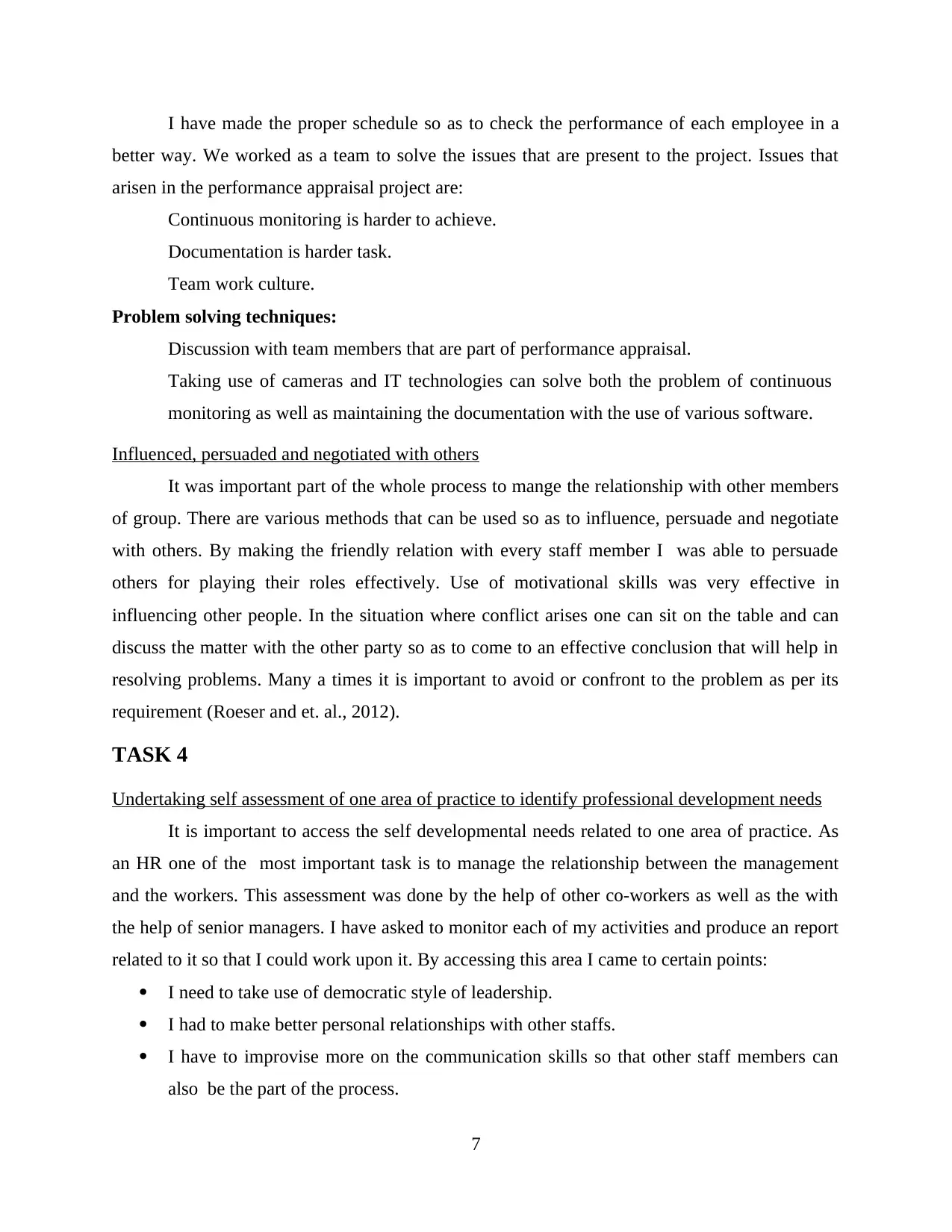
I have made the proper schedule so as to check the performance of each employee in a
better way. We worked as a team to solve the issues that are present to the project. Issues that
arisen in the performance appraisal project are:
Continuous monitoring is harder to achieve.
Documentation is harder task.
Team work culture.
Problem solving techniques:
Discussion with team members that are part of performance appraisal.
Taking use of cameras and IT technologies can solve both the problem of continuous
monitoring as well as maintaining the documentation with the use of various software.
Influenced, persuaded and negotiated with others
It was important part of the whole process to mange the relationship with other members
of group. There are various methods that can be used so as to influence, persuade and negotiate
with others. By making the friendly relation with every staff member I was able to persuade
others for playing their roles effectively. Use of motivational skills was very effective in
influencing other people. In the situation where conflict arises one can sit on the table and can
discuss the matter with the other party so as to come to an effective conclusion that will help in
resolving problems. Many a times it is important to avoid or confront to the problem as per its
requirement (Roeser and et. al., 2012).
TASK 4
Undertaking self assessment of one area of practice to identify professional development needs
It is important to access the self developmental needs related to one area of practice. As
an HR one of the most important task is to manage the relationship between the management
and the workers. This assessment was done by the help of other co-workers as well as the with
the help of senior managers. I have asked to monitor each of my activities and produce an report
related to it so that I could work upon it. By accessing this area I came to certain points:
I need to take use of democratic style of leadership.
I had to make better personal relationships with other staffs.
I have to improvise more on the communication skills so that other staff members can
also be the part of the process.
7
better way. We worked as a team to solve the issues that are present to the project. Issues that
arisen in the performance appraisal project are:
Continuous monitoring is harder to achieve.
Documentation is harder task.
Team work culture.
Problem solving techniques:
Discussion with team members that are part of performance appraisal.
Taking use of cameras and IT technologies can solve both the problem of continuous
monitoring as well as maintaining the documentation with the use of various software.
Influenced, persuaded and negotiated with others
It was important part of the whole process to mange the relationship with other members
of group. There are various methods that can be used so as to influence, persuade and negotiate
with others. By making the friendly relation with every staff member I was able to persuade
others for playing their roles effectively. Use of motivational skills was very effective in
influencing other people. In the situation where conflict arises one can sit on the table and can
discuss the matter with the other party so as to come to an effective conclusion that will help in
resolving problems. Many a times it is important to avoid or confront to the problem as per its
requirement (Roeser and et. al., 2012).
TASK 4
Undertaking self assessment of one area of practice to identify professional development needs
It is important to access the self developmental needs related to one area of practice. As
an HR one of the most important task is to manage the relationship between the management
and the workers. This assessment was done by the help of other co-workers as well as the with
the help of senior managers. I have asked to monitor each of my activities and produce an report
related to it so that I could work upon it. By accessing this area I came to certain points:
I need to take use of democratic style of leadership.
I had to make better personal relationships with other staffs.
I have to improvise more on the communication skills so that other staff members can
also be the part of the process.
7
⊘ This is a preview!⊘
Do you want full access?
Subscribe today to unlock all pages.
Trusted by 1+ million students worldwide
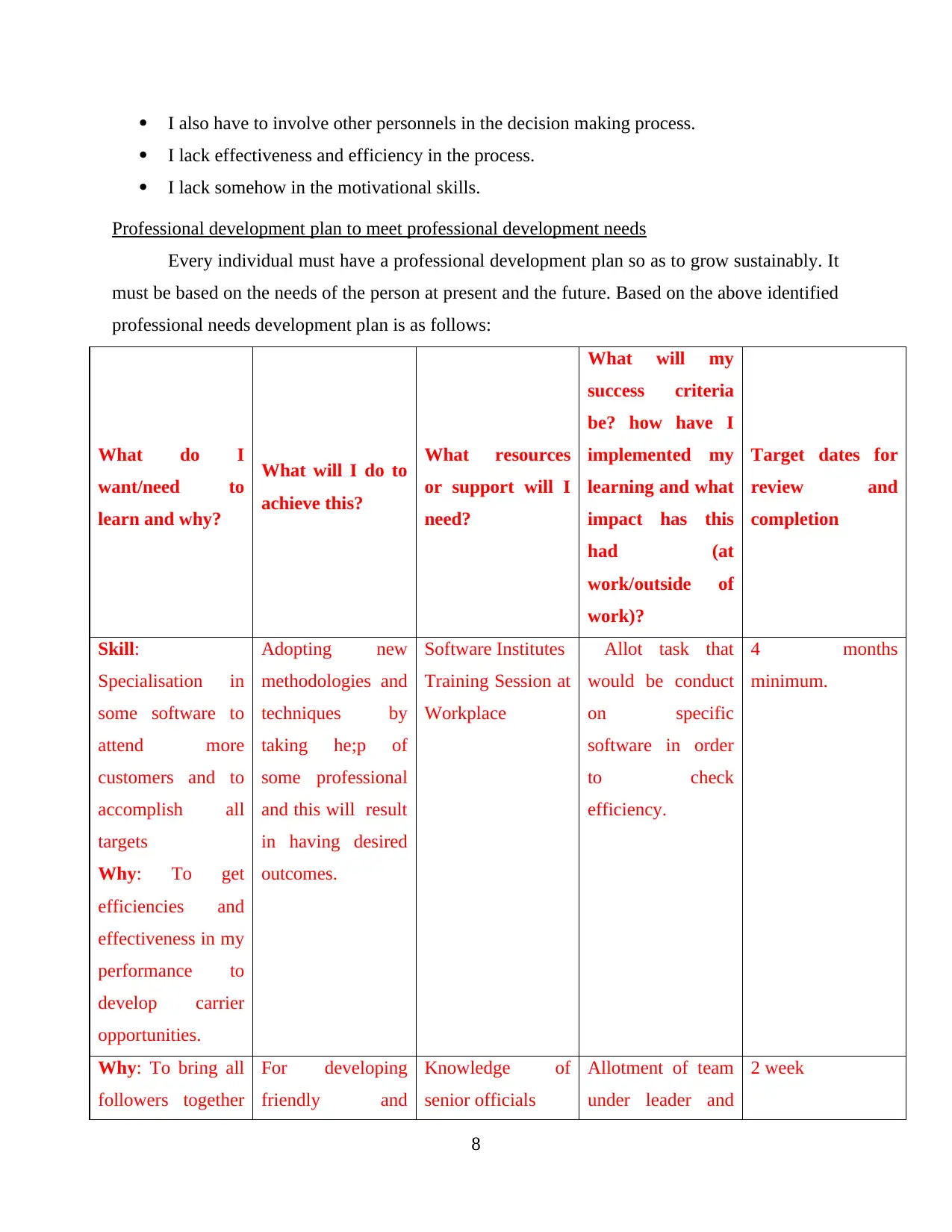
I also have to involve other personnels in the decision making process.
I lack effectiveness and efficiency in the process.
I lack somehow in the motivational skills.
Professional development plan to meet professional development needs
Every individual must have a professional development plan so as to grow sustainably. It
must be based on the needs of the person at present and the future. Based on the above identified
professional needs development plan is as follows:
What do I
want/need to
learn and why?
What will I do to
achieve this?
What resources
or support will I
need?
What will my
success criteria
be? how have I
implemented my
learning and what
impact has this
had (at
work/outside of
work)?
Target dates for
review and
completion
Skill:
Specialisation in
some software to
attend more
customers and to
accomplish all
targets
Why: To get
efficiencies and
effectiveness in my
performance to
develop carrier
opportunities.
Adopting new
methodologies and
techniques by
taking he;p of
some professional
and this will result
in having desired
outcomes.
Software Institutes
Training Session at
Workplace
Allot task that
would be conduct
on specific
software in order
to check
efficiency.
4 months
minimum.
Why: To bring all
followers together
For developing
friendly and
Knowledge of
senior officials
Allotment of team
under leader and
2 week
8
I lack effectiveness and efficiency in the process.
I lack somehow in the motivational skills.
Professional development plan to meet professional development needs
Every individual must have a professional development plan so as to grow sustainably. It
must be based on the needs of the person at present and the future. Based on the above identified
professional needs development plan is as follows:
What do I
want/need to
learn and why?
What will I do to
achieve this?
What resources
or support will I
need?
What will my
success criteria
be? how have I
implemented my
learning and what
impact has this
had (at
work/outside of
work)?
Target dates for
review and
completion
Skill:
Specialisation in
some software to
attend more
customers and to
accomplish all
targets
Why: To get
efficiencies and
effectiveness in my
performance to
develop carrier
opportunities.
Adopting new
methodologies and
techniques by
taking he;p of
some professional
and this will result
in having desired
outcomes.
Software Institutes
Training Session at
Workplace
Allot task that
would be conduct
on specific
software in order
to check
efficiency.
4 months
minimum.
Why: To bring all
followers together
For developing
friendly and
Knowledge of
senior officials
Allotment of team
under leader and
2 week
8
Paraphrase This Document
Need a fresh take? Get an instant paraphrase of this document with our AI Paraphraser
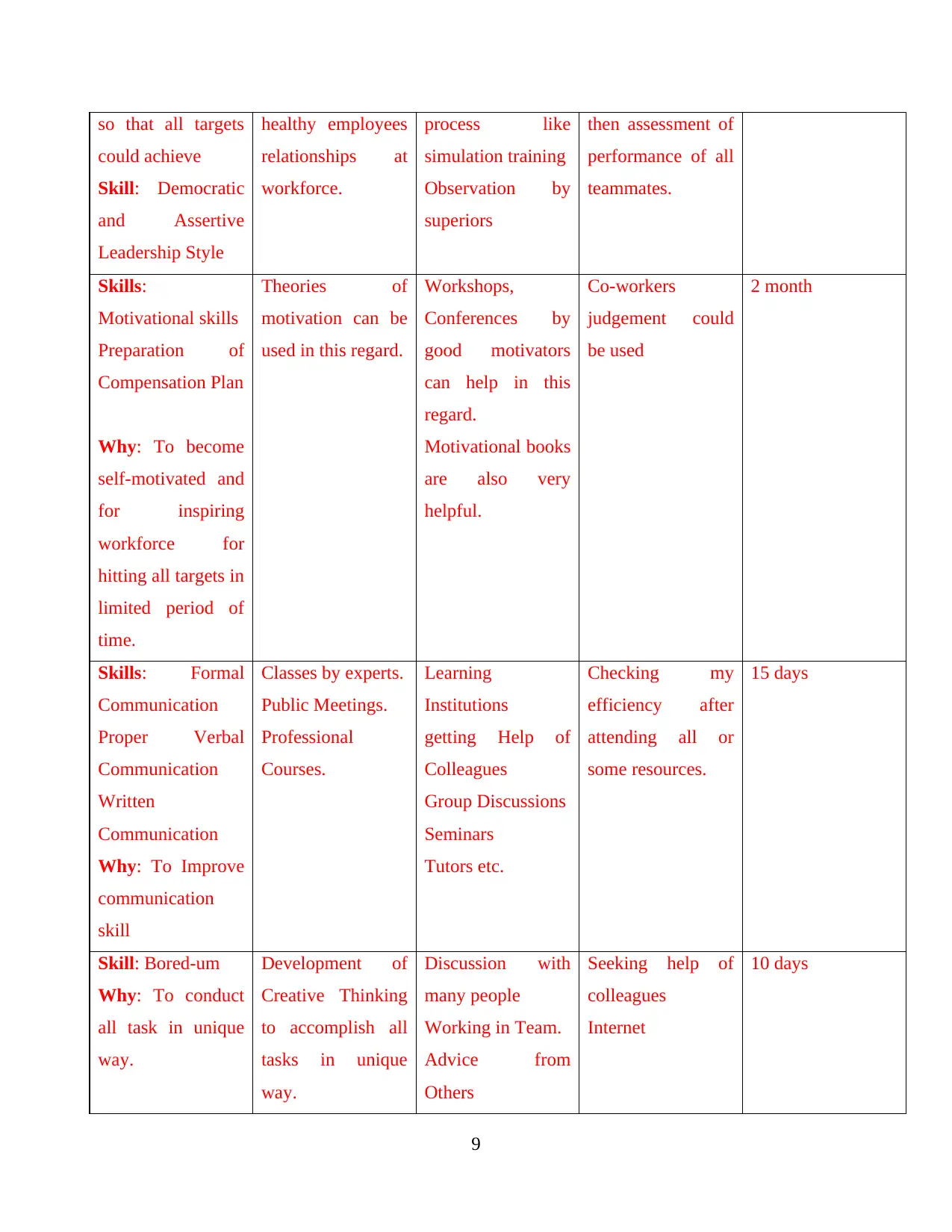
so that all targets
could achieve
Skill: Democratic
and Assertive
Leadership Style
healthy employees
relationships at
workforce.
process like
simulation training
Observation by
superiors
then assessment of
performance of all
teammates.
Skills:
Motivational skills
Preparation of
Compensation Plan
Why: To become
self-motivated and
for inspiring
workforce for
hitting all targets in
limited period of
time.
Theories of
motivation can be
used in this regard.
Workshops,
Conferences by
good motivators
can help in this
regard.
Motivational books
are also very
helpful.
Co-workers
judgement could
be used
2 month
Skills: Formal
Communication
Proper Verbal
Communication
Written
Communication
Why: To Improve
communication
skill
Classes by experts.
Public Meetings.
Professional
Courses.
Learning
Institutions
getting Help of
Colleagues
Group Discussions
Seminars
Tutors etc.
Checking my
efficiency after
attending all or
some resources.
15 days
Skill: Bored-um
Why: To conduct
all task in unique
way.
Development of
Creative Thinking
to accomplish all
tasks in unique
way.
Discussion with
many people
Working in Team.
Advice from
Others
Seeking help of
colleagues
Internet
10 days
9
could achieve
Skill: Democratic
and Assertive
Leadership Style
healthy employees
relationships at
workforce.
process like
simulation training
Observation by
superiors
then assessment of
performance of all
teammates.
Skills:
Motivational skills
Preparation of
Compensation Plan
Why: To become
self-motivated and
for inspiring
workforce for
hitting all targets in
limited period of
time.
Theories of
motivation can be
used in this regard.
Workshops,
Conferences by
good motivators
can help in this
regard.
Motivational books
are also very
helpful.
Co-workers
judgement could
be used
2 month
Skills: Formal
Communication
Proper Verbal
Communication
Written
Communication
Why: To Improve
communication
skill
Classes by experts.
Public Meetings.
Professional
Courses.
Learning
Institutions
getting Help of
Colleagues
Group Discussions
Seminars
Tutors etc.
Checking my
efficiency after
attending all or
some resources.
15 days
Skill: Bored-um
Why: To conduct
all task in unique
way.
Development of
Creative Thinking
to accomplish all
tasks in unique
way.
Discussion with
many people
Working in Team.
Advice from
Others
Seeking help of
colleagues
Internet
10 days
9
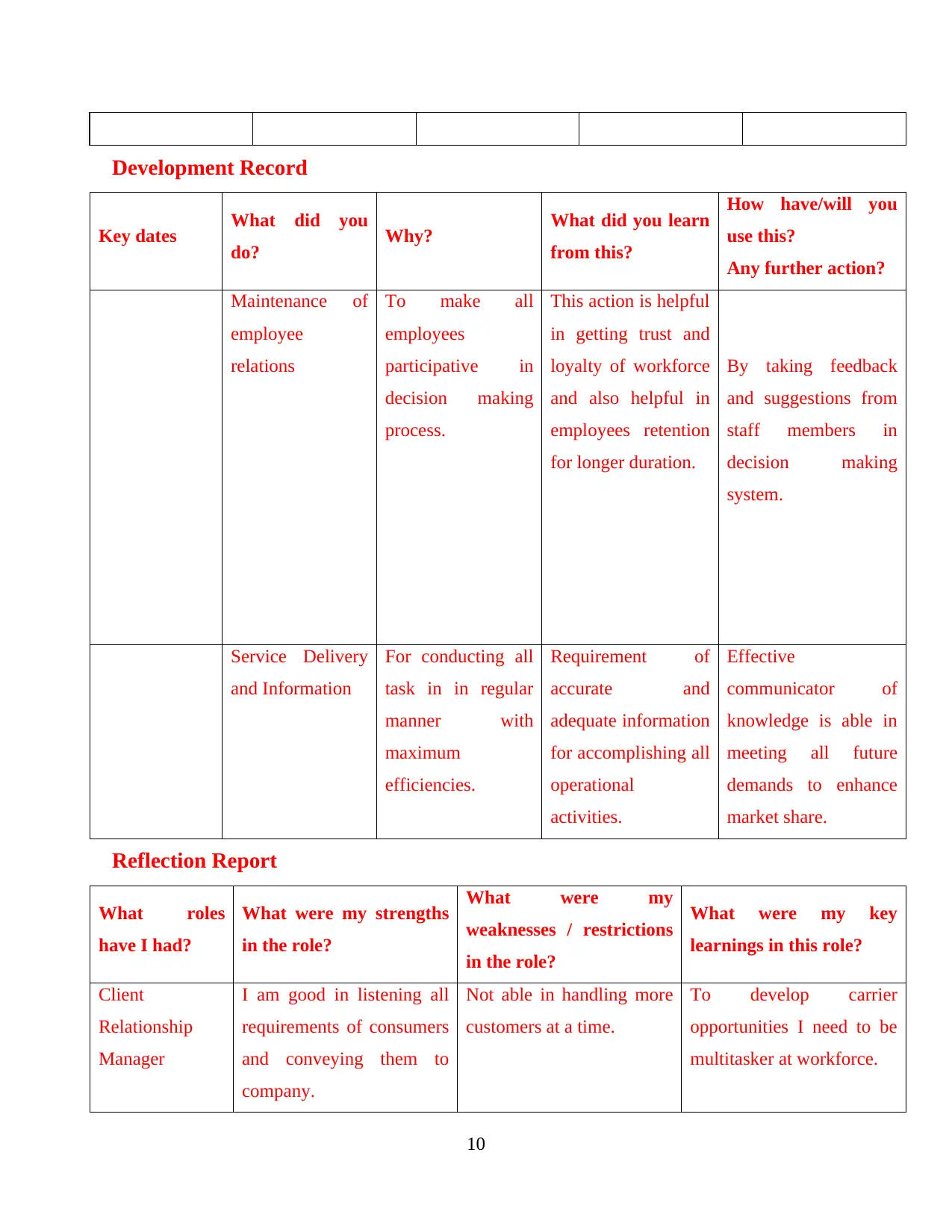
Development Record
Key dates What did you
do? Why? What did you learn
from this?
How have/will you
use this?
Any further action?
Maintenance of
employee
relations
To make all
employees
participative in
decision making
process.
This action is helpful
in getting trust and
loyalty of workforce
and also helpful in
employees retention
for longer duration.
By taking feedback
and suggestions from
staff members in
decision making
system.
Service Delivery
and Information
For conducting all
task in in regular
manner with
maximum
efficiencies.
Requirement of
accurate and
adequate information
for accomplishing all
operational
activities.
Effective
communicator of
knowledge is able in
meeting all future
demands to enhance
market share.
Reflection Report
What roles
have I had?
What were my strengths
in the role?
What were my
weaknesses / restrictions
in the role?
What were my key
learnings in this role?
Client
Relationship
Manager
I am good in listening all
requirements of consumers
and conveying them to
company.
Not able in handling more
customers at a time.
To develop carrier
opportunities I need to be
multitasker at workforce.
10
Key dates What did you
do? Why? What did you learn
from this?
How have/will you
use this?
Any further action?
Maintenance of
employee
relations
To make all
employees
participative in
decision making
process.
This action is helpful
in getting trust and
loyalty of workforce
and also helpful in
employees retention
for longer duration.
By taking feedback
and suggestions from
staff members in
decision making
system.
Service Delivery
and Information
For conducting all
task in in regular
manner with
maximum
efficiencies.
Requirement of
accurate and
adequate information
for accomplishing all
operational
activities.
Effective
communicator of
knowledge is able in
meeting all future
demands to enhance
market share.
Reflection Report
What roles
have I had?
What were my strengths
in the role?
What were my
weaknesses / restrictions
in the role?
What were my key
learnings in this role?
Client
Relationship
Manager
I am good in listening all
requirements of consumers
and conveying them to
company.
Not able in handling more
customers at a time.
To develop carrier
opportunities I need to be
multitasker at workforce.
10
⊘ This is a preview!⊘
Do you want full access?
Subscribe today to unlock all pages.
Trusted by 1+ million students worldwide

1 out of 14


Related Documents


Your All-in-One AI-Powered Toolkit for Academic Success.
+13062052269
info@desklib.com
Available 24*7 on WhatsApp / Email
![[object Object]](/_next/static/media/star-bottom.7253800d.svg)
Unlock your academic potential
Copyright © 2020–2026 A2Z Services. All Rights Reserved. Developed and managed by ZUCOL.