HR Professional Skills, Training, and Development at Whirlpool
VerifiedAdded on 2020/07/23
|18
|6305
|53
Report
AI Summary
This report provides a comprehensive analysis of HR skills, training, and development, focusing on the context of Whirlpool. It begins by identifying the essential skills, knowledge, and behaviors required for HR professionals, followed by an analysis of a skills audit and the development of a professional development plan. The report then assesses the differences between organizational and individual training and development, emphasizing the need for continuous learning. It explores the contribution of high-performance work systems (HPW) to employee engagement and competitive advantage. The report concludes by examining different approaches to performance management. The student report, available on Desklib, offers a valuable resource for students studying leadership, management, and HR practices, providing practical insights into enhancing individual, team, and organizational performance through effective HR strategies.
Developing individuals,
Teams and Organisations
Teams and Organisations

Paraphrase This Document
Need a fresh take? Get an instant paraphrase of this document with our AI Paraphraser
Table of Contents
INTRODUCTION...........................................................................................................................3
TASK 1............................................................................................................................................3
P1 Determine appropriate skills, knowledge and behaviour required for HR professionals. 3
P2 Analysis of skill audit for professional development of HR.............................................5
M1 Professional skills audit...................................................................................................6
D1 Professional development plan.........................................................................................6
TASK 2............................................................................................................................................7
P3 Assess the difference between organisational and individual training and development 7
P4 Assess need for continuous learning and professional development................................9
Difference between Training and Development are discussed below:..........................................12
M2 Learning cycle theories..................................................................................................13
TASK 3..........................................................................................................................................13
P5 HPW contribution to employee engagement and competitive advantage.......................13
M3 Benefits of applying HPW.............................................................................................14
D2 Synthesis of knowledge and information.......................................................................15
TASK 4..........................................................................................................................................15
P6 Different Approaches To Performance Management.....................................................15
M4 Different approaches......................................................................................................17
CONCLUSION..............................................................................................................................17
REFERENCES..............................................................................................................................18
INTRODUCTION...........................................................................................................................3
TASK 1............................................................................................................................................3
P1 Determine appropriate skills, knowledge and behaviour required for HR professionals. 3
P2 Analysis of skill audit for professional development of HR.............................................5
M1 Professional skills audit...................................................................................................6
D1 Professional development plan.........................................................................................6
TASK 2............................................................................................................................................7
P3 Assess the difference between organisational and individual training and development 7
P4 Assess need for continuous learning and professional development................................9
Difference between Training and Development are discussed below:..........................................12
M2 Learning cycle theories..................................................................................................13
TASK 3..........................................................................................................................................13
P5 HPW contribution to employee engagement and competitive advantage.......................13
M3 Benefits of applying HPW.............................................................................................14
D2 Synthesis of knowledge and information.......................................................................15
TASK 4..........................................................................................................................................15
P6 Different Approaches To Performance Management.....................................................15
M4 Different approaches......................................................................................................17
CONCLUSION..............................................................................................................................17
REFERENCES..............................................................................................................................18
INTRODUCTION
The development of individual, team and organisation is required in every company.
Grooming these helps in growth of the entity and individual. The report is based on whirlpool,
which deals in electronic products and provide services on time to the customer so that they can
become a permanent customer of the company. This analyses advantages of developing
knowledge, skills, which leads to high performance in Whirlpool. It assists in recognising the
importance of professional development of individuals, teams and overall concern. This will help
in bringing awareness regarding learning and the way it is linked with improvement needs. This
will analyse the skills and behaviour required for HR professionals and factors to be considered
while implementing this process. It would evaluate the formal and informal learning in
Whirlpool. Significance of training and development will be explained through this project.
Barriers to learning will also be recognised here in the report. This evaluates the need of
effective communication in business.
TASK 1
P1 Determine appropriate skills, knowledge and behaviour required for HR professionals
HR professionals are key employees in whirlpool. They are the one who manges overall
workforce in organisation. It is very essential to develop their knowledge, skills and behaviour.
This will result in increased productivity of all employees as they can get better guidance. There
are certain important characteristics that are necessary for HR professionals are as follows-
Curiosity- It is very important to have attitude and willingness to learn new things which
are important for their role (Bolman, and Deal, 2017). They need to have curiosity to learn
unknown information. This will help them in knowing better ways to educate their co-workers
individually and collectively. It is important to understand new trends occurring in marketplace.
Role model- As an HR it is important to set good examples for other employees. For this,
they need to act by considering impartiality, integrity, and independence. Their aim should be
providing sound judgement in every case. This will help them to influence other workers to
behave in same manner.
Multitasking- An HR professional deals with various issues related with the workforce.
They performs different tasks at workplace such as recruitment, retention, forming wages and
The development of individual, team and organisation is required in every company.
Grooming these helps in growth of the entity and individual. The report is based on whirlpool,
which deals in electronic products and provide services on time to the customer so that they can
become a permanent customer of the company. This analyses advantages of developing
knowledge, skills, which leads to high performance in Whirlpool. It assists in recognising the
importance of professional development of individuals, teams and overall concern. This will help
in bringing awareness regarding learning and the way it is linked with improvement needs. This
will analyse the skills and behaviour required for HR professionals and factors to be considered
while implementing this process. It would evaluate the formal and informal learning in
Whirlpool. Significance of training and development will be explained through this project.
Barriers to learning will also be recognised here in the report. This evaluates the need of
effective communication in business.
TASK 1
P1 Determine appropriate skills, knowledge and behaviour required for HR professionals
HR professionals are key employees in whirlpool. They are the one who manges overall
workforce in organisation. It is very essential to develop their knowledge, skills and behaviour.
This will result in increased productivity of all employees as they can get better guidance. There
are certain important characteristics that are necessary for HR professionals are as follows-
Curiosity- It is very important to have attitude and willingness to learn new things which
are important for their role (Bolman, and Deal, 2017). They need to have curiosity to learn
unknown information. This will help them in knowing better ways to educate their co-workers
individually and collectively. It is important to understand new trends occurring in marketplace.
Role model- As an HR it is important to set good examples for other employees. For this,
they need to act by considering impartiality, integrity, and independence. Their aim should be
providing sound judgement in every case. This will help them to influence other workers to
behave in same manner.
Multitasking- An HR professional deals with various issues related with the workforce.
They performs different tasks at workplace such as recruitment, retention, forming wages and
⊘ This is a preview!⊘
Do you want full access?
Subscribe today to unlock all pages.

Trusted by 1+ million students worldwide
salary strategies, training and development of employees and many more. Therefore, to actively
and effectively deal with all activities, they should be multitasker.
Negotiation-In every organisation, conflicts amongst employees is common scenario.
HR is the one who deals with such issues. It is very important to dissolve conflict by satisfying
both the parties with the judgement. Therefore, these professionals should be able to negotiate
such conflicts and end up by agreeing both parties with the outcome.
Communication- They have to communicate with upper management, middle level
employees and potential workers. To convince and get listeners attention, they need to have good
and effective communication skills. This will help in reducing confusions and delivering the
message properly.
Problem solving- They should be able in solving problems occurring in organisation.
They need to find ways to actively deal with problems by providing accurate solutions. To be a
expert in this skill, it is required that they analyse practical environment properly as this will help
them in giving best way to dissolve the problem.
Change management- Human resource department includes lots of complex issues that
keeps on changing constantly. To adopt these changes they need to have the ability of managing
that change. HR has to help other employees to cooperate with continuous changes.
Leadership- This is very essential behavioural attribute required in such professionals. It
is the quality to influence others and make them focussed towards a common goal. An HR
should have leadership quality so that they can easily make other employees involved in every
task and with full interest.
Integrity- Another important skill required for these managers is to bring integrity in
organisation. They need to be fair and equitable with each employee. They should have strong
knowledge of labour law and other related laws that regulates a business concern. Sense of
integrity is very essential for benefit of workplace environment.
Expertise- One of the very important skill required for HR is their specialized knowledge
in this field. It means that, they should have proper ability to perform their roles and
responsibilities such as, compensation benefits, risk management, maintaining employee
relations, recruitment and selection, training and development etc. it will help them in becoming
specialists in their areas and perform their tasks effectively.
and effectively deal with all activities, they should be multitasker.
Negotiation-In every organisation, conflicts amongst employees is common scenario.
HR is the one who deals with such issues. It is very important to dissolve conflict by satisfying
both the parties with the judgement. Therefore, these professionals should be able to negotiate
such conflicts and end up by agreeing both parties with the outcome.
Communication- They have to communicate with upper management, middle level
employees and potential workers. To convince and get listeners attention, they need to have good
and effective communication skills. This will help in reducing confusions and delivering the
message properly.
Problem solving- They should be able in solving problems occurring in organisation.
They need to find ways to actively deal with problems by providing accurate solutions. To be a
expert in this skill, it is required that they analyse practical environment properly as this will help
them in giving best way to dissolve the problem.
Change management- Human resource department includes lots of complex issues that
keeps on changing constantly. To adopt these changes they need to have the ability of managing
that change. HR has to help other employees to cooperate with continuous changes.
Leadership- This is very essential behavioural attribute required in such professionals. It
is the quality to influence others and make them focussed towards a common goal. An HR
should have leadership quality so that they can easily make other employees involved in every
task and with full interest.
Integrity- Another important skill required for these managers is to bring integrity in
organisation. They need to be fair and equitable with each employee. They should have strong
knowledge of labour law and other related laws that regulates a business concern. Sense of
integrity is very essential for benefit of workplace environment.
Expertise- One of the very important skill required for HR is their specialized knowledge
in this field. It means that, they should have proper ability to perform their roles and
responsibilities such as, compensation benefits, risk management, maintaining employee
relations, recruitment and selection, training and development etc. it will help them in becoming
specialists in their areas and perform their tasks effectively.
Paraphrase This Document
Need a fresh take? Get an instant paraphrase of this document with our AI Paraphraser
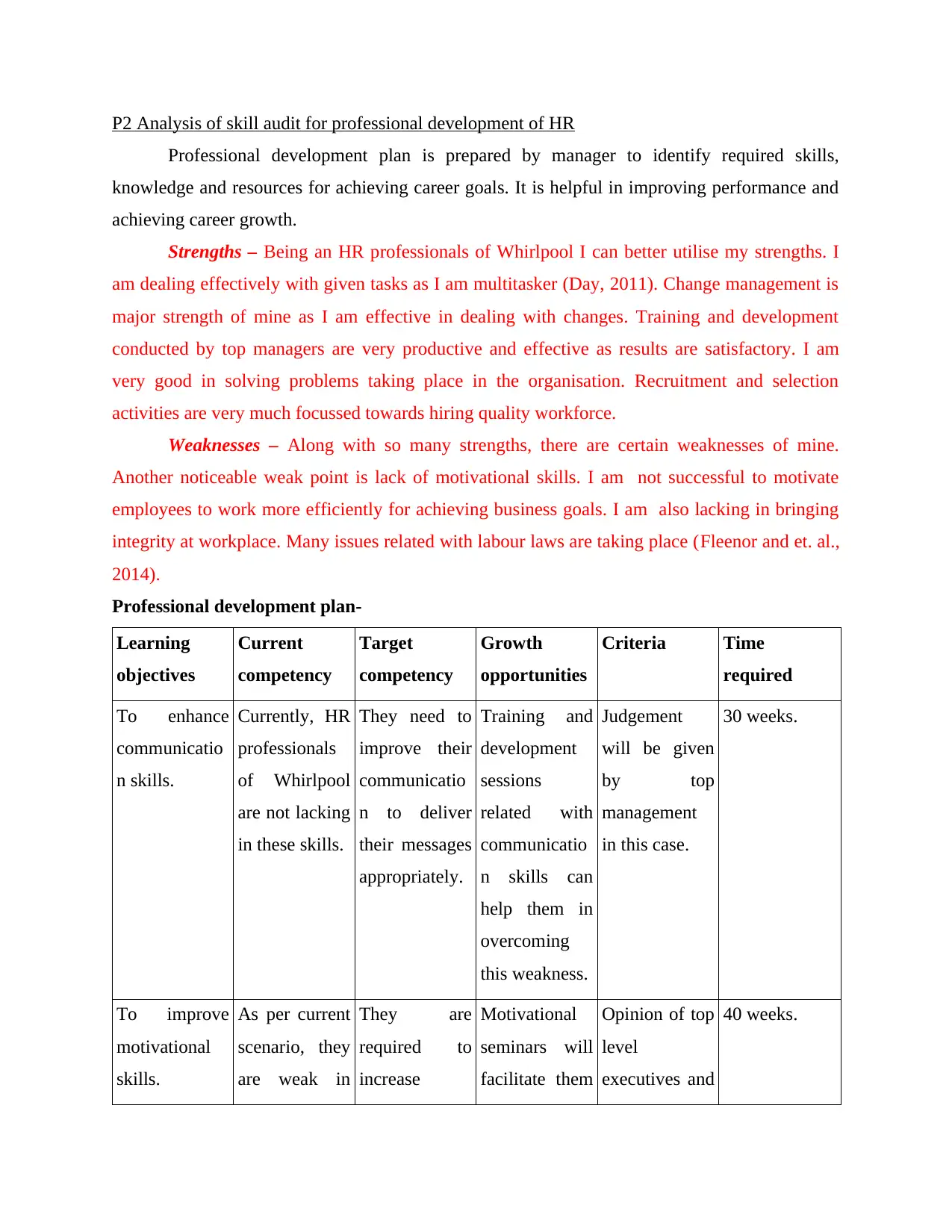
P2 Analysis of skill audit for professional development of HR
Professional development plan is prepared by manager to identify required skills,
knowledge and resources for achieving career goals. It is helpful in improving performance and
achieving career growth.
Strengths – Being an HR professionals of Whirlpool I can better utilise my strengths. I
am dealing effectively with given tasks as I am multitasker (Day, 2011). Change management is
major strength of mine as I am effective in dealing with changes. Training and development
conducted by top managers are very productive and effective as results are satisfactory. I am
very good in solving problems taking place in the organisation. Recruitment and selection
activities are very much focussed towards hiring quality workforce.
Weaknesses – Along with so many strengths, there are certain weaknesses of mine.
Another noticeable weak point is lack of motivational skills. I am not successful to motivate
employees to work more efficiently for achieving business goals. I am also lacking in bringing
integrity at workplace. Many issues related with labour laws are taking place (Fleenor and et. al.,
2014).
Professional development plan-
Learning
objectives
Current
competency
Target
competency
Growth
opportunities
Criteria Time
required
To enhance
communicatio
n skills.
Currently, HR
professionals
of Whirlpool
are not lacking
in these skills.
They need to
improve their
communicatio
n to deliver
their messages
appropriately.
Training and
development
sessions
related with
communicatio
n skills can
help them in
overcoming
this weakness.
Judgement
will be given
by top
management
in this case.
30 weeks.
To improve
motivational
skills.
As per current
scenario, they
are weak in
They are
required to
increase
Motivational
seminars will
facilitate them
Opinion of top
level
executives and
40 weeks.
Professional development plan is prepared by manager to identify required skills,
knowledge and resources for achieving career goals. It is helpful in improving performance and
achieving career growth.
Strengths – Being an HR professionals of Whirlpool I can better utilise my strengths. I
am dealing effectively with given tasks as I am multitasker (Day, 2011). Change management is
major strength of mine as I am effective in dealing with changes. Training and development
conducted by top managers are very productive and effective as results are satisfactory. I am
very good in solving problems taking place in the organisation. Recruitment and selection
activities are very much focussed towards hiring quality workforce.
Weaknesses – Along with so many strengths, there are certain weaknesses of mine.
Another noticeable weak point is lack of motivational skills. I am not successful to motivate
employees to work more efficiently for achieving business goals. I am also lacking in bringing
integrity at workplace. Many issues related with labour laws are taking place (Fleenor and et. al.,
2014).
Professional development plan-
Learning
objectives
Current
competency
Target
competency
Growth
opportunities
Criteria Time
required
To enhance
communicatio
n skills.
Currently, HR
professionals
of Whirlpool
are not lacking
in these skills.
They need to
improve their
communicatio
n to deliver
their messages
appropriately.
Training and
development
sessions
related with
communicatio
n skills can
help them in
overcoming
this weakness.
Judgement
will be given
by top
management
in this case.
30 weeks.
To improve
motivational
skills.
As per current
scenario, they
are weak in
They are
required to
increase
Motivational
seminars will
facilitate them
Opinion of top
level
executives and
40 weeks.
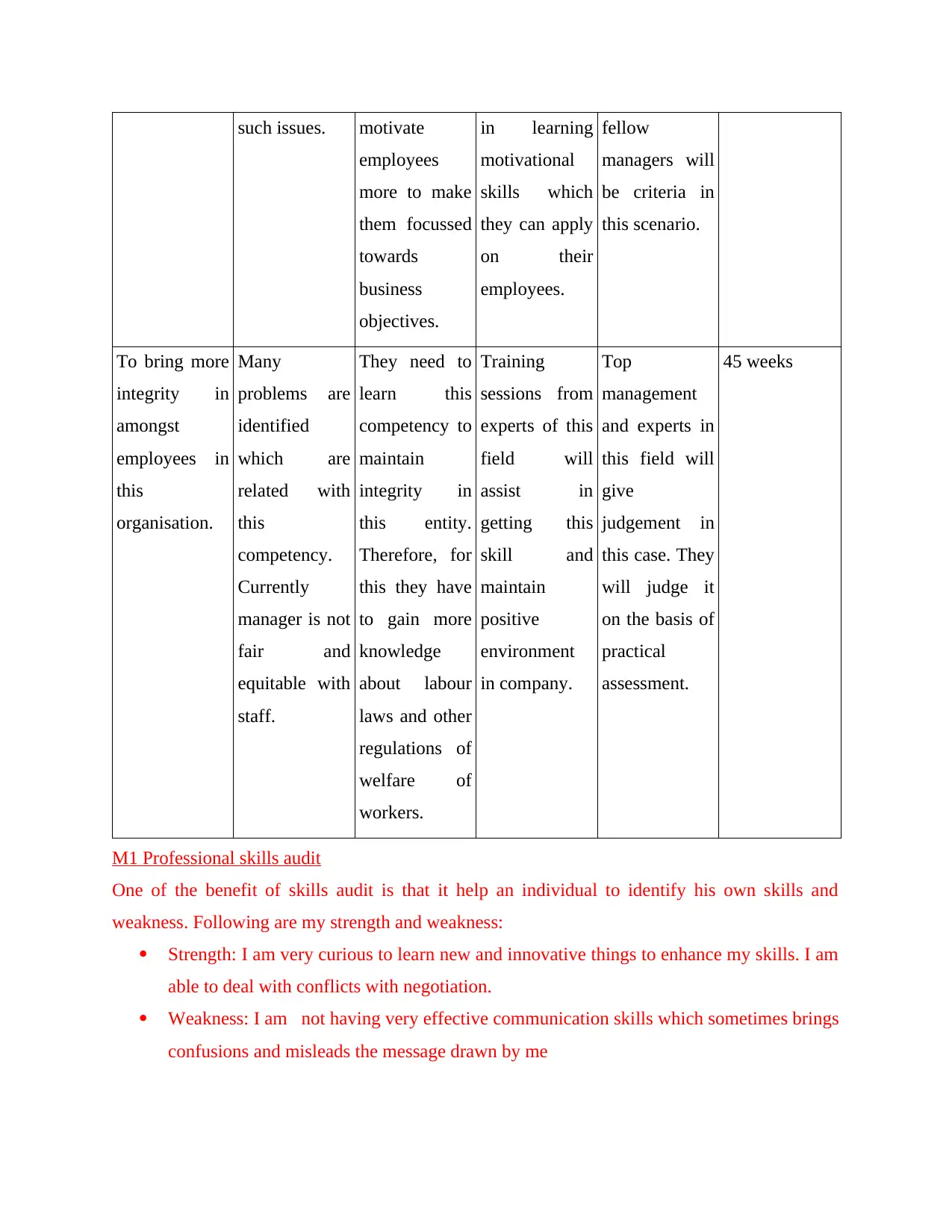
such issues. motivate
employees
more to make
them focussed
towards
business
objectives.
in learning
motivational
skills which
they can apply
on their
employees.
fellow
managers will
be criteria in
this scenario.
To bring more
integrity in
amongst
employees in
this
organisation.
Many
problems are
identified
which are
related with
this
competency.
Currently
manager is not
fair and
equitable with
staff.
They need to
learn this
competency to
maintain
integrity in
this entity.
Therefore, for
this they have
to gain more
knowledge
about labour
laws and other
regulations of
welfare of
workers.
Training
sessions from
experts of this
field will
assist in
getting this
skill and
maintain
positive
environment
in company.
Top
management
and experts in
this field will
give
judgement in
this case. They
will judge it
on the basis of
practical
assessment.
45 weeks
M1 Professional skills audit
One of the benefit of skills audit is that it help an individual to identify his own skills and
weakness. Following are my strength and weakness:
Strength: I am very curious to learn new and innovative things to enhance my skills. I am
able to deal with conflicts with negotiation.
Weakness: I am not having very effective communication skills which sometimes brings
confusions and misleads the message drawn by me
employees
more to make
them focussed
towards
business
objectives.
in learning
motivational
skills which
they can apply
on their
employees.
fellow
managers will
be criteria in
this scenario.
To bring more
integrity in
amongst
employees in
this
organisation.
Many
problems are
identified
which are
related with
this
competency.
Currently
manager is not
fair and
equitable with
staff.
They need to
learn this
competency to
maintain
integrity in
this entity.
Therefore, for
this they have
to gain more
knowledge
about labour
laws and other
regulations of
welfare of
workers.
Training
sessions from
experts of this
field will
assist in
getting this
skill and
maintain
positive
environment
in company.
Top
management
and experts in
this field will
give
judgement in
this case. They
will judge it
on the basis of
practical
assessment.
45 weeks
M1 Professional skills audit
One of the benefit of skills audit is that it help an individual to identify his own skills and
weakness. Following are my strength and weakness:
Strength: I am very curious to learn new and innovative things to enhance my skills. I am
able to deal with conflicts with negotiation.
Weakness: I am not having very effective communication skills which sometimes brings
confusions and misleads the message drawn by me
⊘ This is a preview!⊘
Do you want full access?
Subscribe today to unlock all pages.
Trusted by 1+ million students worldwide
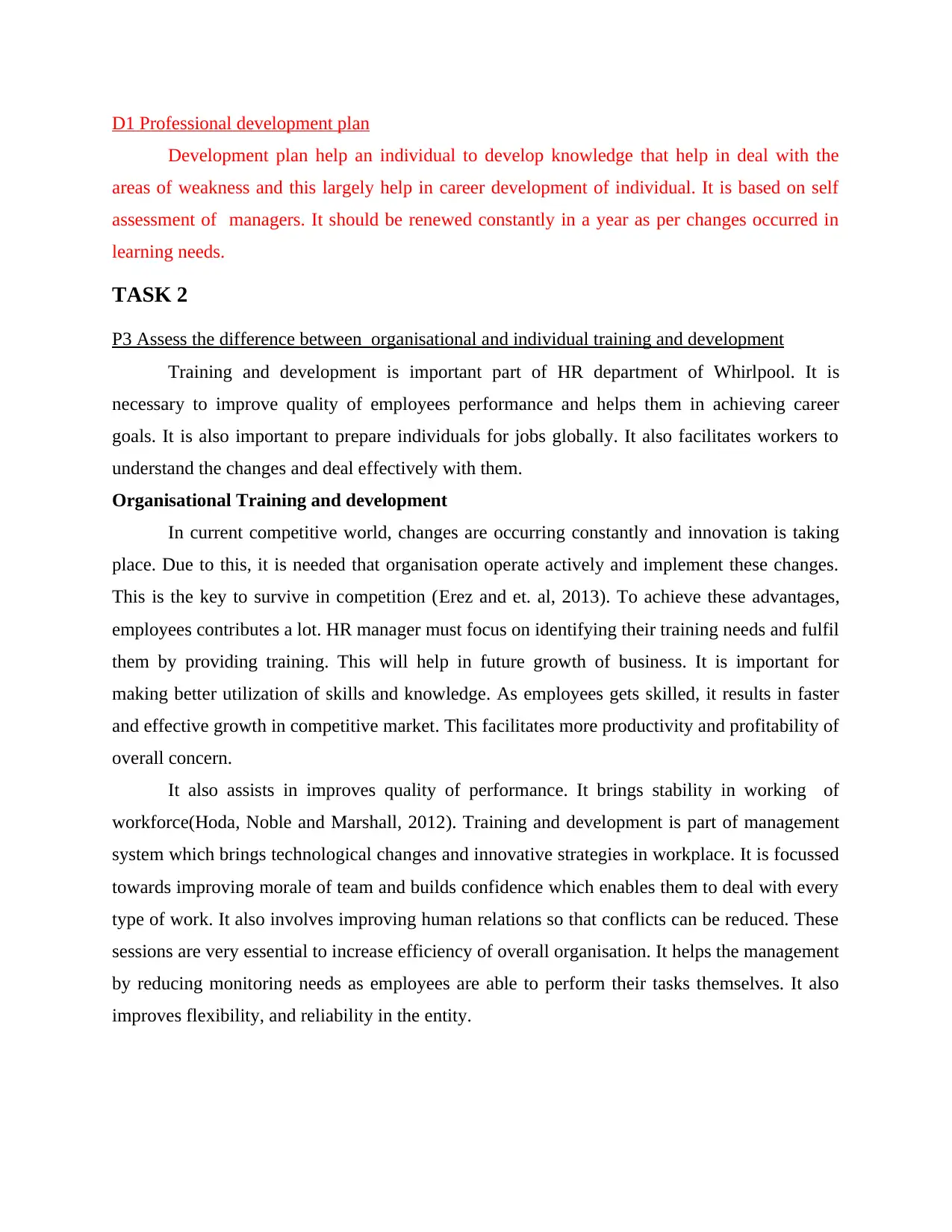
D1 Professional development plan
Development plan help an individual to develop knowledge that help in deal with the
areas of weakness and this largely help in career development of individual. It is based on self
assessment of managers. It should be renewed constantly in a year as per changes occurred in
learning needs.
TASK 2
P3 Assess the difference between organisational and individual training and development
Training and development is important part of HR department of Whirlpool. It is
necessary to improve quality of employees performance and helps them in achieving career
goals. It is also important to prepare individuals for jobs globally. It also facilitates workers to
understand the changes and deal effectively with them.
Organisational Training and development
In current competitive world, changes are occurring constantly and innovation is taking
place. Due to this, it is needed that organisation operate actively and implement these changes.
This is the key to survive in competition (Erez and et. al, 2013). To achieve these advantages,
employees contributes a lot. HR manager must focus on identifying their training needs and fulfil
them by providing training. This will help in future growth of business. It is important for
making better utilization of skills and knowledge. As employees gets skilled, it results in faster
and effective growth in competitive market. This facilitates more productivity and profitability of
overall concern.
It also assists in improves quality of performance. It brings stability in working of
workforce(Hoda, Noble and Marshall, 2012). Training and development is part of management
system which brings technological changes and innovative strategies in workplace. It is focussed
towards improving morale of team and builds confidence which enables them to deal with every
type of work. It also involves improving human relations so that conflicts can be reduced. These
sessions are very essential to increase efficiency of overall organisation. It helps the management
by reducing monitoring needs as employees are able to perform their tasks themselves. It also
improves flexibility, and reliability in the entity.
Development plan help an individual to develop knowledge that help in deal with the
areas of weakness and this largely help in career development of individual. It is based on self
assessment of managers. It should be renewed constantly in a year as per changes occurred in
learning needs.
TASK 2
P3 Assess the difference between organisational and individual training and development
Training and development is important part of HR department of Whirlpool. It is
necessary to improve quality of employees performance and helps them in achieving career
goals. It is also important to prepare individuals for jobs globally. It also facilitates workers to
understand the changes and deal effectively with them.
Organisational Training and development
In current competitive world, changes are occurring constantly and innovation is taking
place. Due to this, it is needed that organisation operate actively and implement these changes.
This is the key to survive in competition (Erez and et. al, 2013). To achieve these advantages,
employees contributes a lot. HR manager must focus on identifying their training needs and fulfil
them by providing training. This will help in future growth of business. It is important for
making better utilization of skills and knowledge. As employees gets skilled, it results in faster
and effective growth in competitive market. This facilitates more productivity and profitability of
overall concern.
It also assists in improves quality of performance. It brings stability in working of
workforce(Hoda, Noble and Marshall, 2012). Training and development is part of management
system which brings technological changes and innovative strategies in workplace. It is focussed
towards improving morale of team and builds confidence which enables them to deal with every
type of work. It also involves improving human relations so that conflicts can be reduced. These
sessions are very essential to increase efficiency of overall organisation. It helps the management
by reducing monitoring needs as employees are able to perform their tasks themselves. It also
improves flexibility, and reliability in the entity.
Paraphrase This Document
Need a fresh take? Get an instant paraphrase of this document with our AI Paraphraser
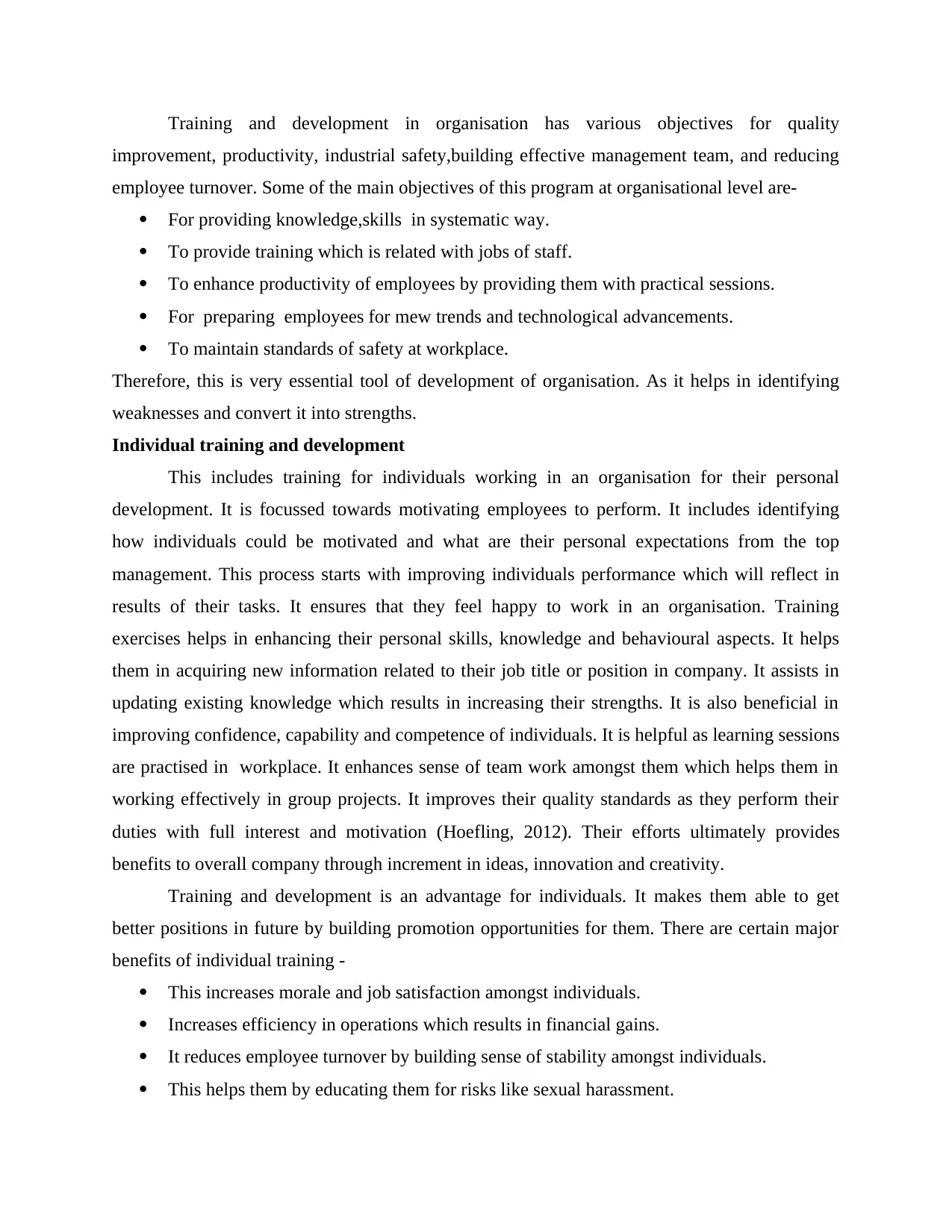
Training and development in organisation has various objectives for quality
improvement, productivity, industrial safety,building effective management team, and reducing
employee turnover. Some of the main objectives of this program at organisational level are-
For providing knowledge,skills in systematic way.
To provide training which is related with jobs of staff.
To enhance productivity of employees by providing them with practical sessions.
For preparing employees for mew trends and technological advancements.
To maintain standards of safety at workplace.
Therefore, this is very essential tool of development of organisation. As it helps in identifying
weaknesses and convert it into strengths.
Individual training and development
This includes training for individuals working in an organisation for their personal
development. It is focussed towards motivating employees to perform. It includes identifying
how individuals could be motivated and what are their personal expectations from the top
management. This process starts with improving individuals performance which will reflect in
results of their tasks. It ensures that they feel happy to work in an organisation. Training
exercises helps in enhancing their personal skills, knowledge and behavioural aspects. It helps
them in acquiring new information related to their job title or position in company. It assists in
updating existing knowledge which results in increasing their strengths. It is also beneficial in
improving confidence, capability and competence of individuals. It is helpful as learning sessions
are practised in workplace. It enhances sense of team work amongst them which helps them in
working effectively in group projects. It improves their quality standards as they perform their
duties with full interest and motivation (Hoefling, 2012). Their efforts ultimately provides
benefits to overall company through increment in ideas, innovation and creativity.
Training and development is an advantage for individuals. It makes them able to get
better positions in future by building promotion opportunities for them. There are certain major
benefits of individual training -
This increases morale and job satisfaction amongst individuals.
Increases efficiency in operations which results in financial gains.
It reduces employee turnover by building sense of stability amongst individuals.
This helps them by educating them for risks like sexual harassment.
improvement, productivity, industrial safety,building effective management team, and reducing
employee turnover. Some of the main objectives of this program at organisational level are-
For providing knowledge,skills in systematic way.
To provide training which is related with jobs of staff.
To enhance productivity of employees by providing them with practical sessions.
For preparing employees for mew trends and technological advancements.
To maintain standards of safety at workplace.
Therefore, this is very essential tool of development of organisation. As it helps in identifying
weaknesses and convert it into strengths.
Individual training and development
This includes training for individuals working in an organisation for their personal
development. It is focussed towards motivating employees to perform. It includes identifying
how individuals could be motivated and what are their personal expectations from the top
management. This process starts with improving individuals performance which will reflect in
results of their tasks. It ensures that they feel happy to work in an organisation. Training
exercises helps in enhancing their personal skills, knowledge and behavioural aspects. It helps
them in acquiring new information related to their job title or position in company. It assists in
updating existing knowledge which results in increasing their strengths. It is also beneficial in
improving confidence, capability and competence of individuals. It is helpful as learning sessions
are practised in workplace. It enhances sense of team work amongst them which helps them in
working effectively in group projects. It improves their quality standards as they perform their
duties with full interest and motivation (Hoefling, 2012). Their efforts ultimately provides
benefits to overall company through increment in ideas, innovation and creativity.
Training and development is an advantage for individuals. It makes them able to get
better positions in future by building promotion opportunities for them. There are certain major
benefits of individual training -
This increases morale and job satisfaction amongst individuals.
Increases efficiency in operations which results in financial gains.
It reduces employee turnover by building sense of stability amongst individuals.
This helps them by educating them for risks like sexual harassment.
All these factors leads to enhancing company image by improving work environment.
Along with these advantages they gets various personal benefits like improving their
communication skills, human relation skills, and leadership skills which will facilitate
their future growth.
P4 Assess need for continuous learning and professional development
Every organisation needs to focus on conducting continuous learning and professional
development. It is essential for Whirlpool and its employees to get success in today's competitive
market place. There are certain benefits of this which are as follows-
Increased productivity-Workers feels happy at their jobs when they gets extra attention
from their bosses. It increases their loyalty and trust in company. Due to this, retention rates
increases as employees are satisfied with working in this organisation. This leads to improved
productivity as employees becomes highly skilled. They starts working without wasting time and
money of company. Retaining employees of top level and those who are talented helps in long
term profits and success (Hughes and Jones, 2011). Professional development reduces their
chances of leaving jobs as they get what they expect. One of the major role of this scenario is
that improving employees skills is much better than replacing them. Current employees can
contribute more to success of company as compare to new ones.
Creates lifelong learners- Professional development programs are designed to make
lifelong learners. Company need to invest in workshops, seminars, off site programs and lectures
offered by colleges and universities. Such formal learning methods helps in creating lifelong
learnings.
Profitability -Business concerns that, should emphasis more on continuous learning than
only they can attract key players in this industry. This will help in preparing employees to work
in competitive marketplace. This assists in enhancing profitability of company and helps in
achieving long term goals (Katzenbach and Smith, 2015). Professional development results in
following benefits-
This helps in adopting industry changes which can be achieved through ongoing training,
updating skills and knowledges of staff.
It assists in getting touch with new technologies by conducting sessions to provide them
ways to use these technological advancements.
Along with these advantages they gets various personal benefits like improving their
communication skills, human relation skills, and leadership skills which will facilitate
their future growth.
P4 Assess need for continuous learning and professional development
Every organisation needs to focus on conducting continuous learning and professional
development. It is essential for Whirlpool and its employees to get success in today's competitive
market place. There are certain benefits of this which are as follows-
Increased productivity-Workers feels happy at their jobs when they gets extra attention
from their bosses. It increases their loyalty and trust in company. Due to this, retention rates
increases as employees are satisfied with working in this organisation. This leads to improved
productivity as employees becomes highly skilled. They starts working without wasting time and
money of company. Retaining employees of top level and those who are talented helps in long
term profits and success (Hughes and Jones, 2011). Professional development reduces their
chances of leaving jobs as they get what they expect. One of the major role of this scenario is
that improving employees skills is much better than replacing them. Current employees can
contribute more to success of company as compare to new ones.
Creates lifelong learners- Professional development programs are designed to make
lifelong learners. Company need to invest in workshops, seminars, off site programs and lectures
offered by colleges and universities. Such formal learning methods helps in creating lifelong
learnings.
Profitability -Business concerns that, should emphasis more on continuous learning than
only they can attract key players in this industry. This will help in preparing employees to work
in competitive marketplace. This assists in enhancing profitability of company and helps in
achieving long term goals (Katzenbach and Smith, 2015). Professional development results in
following benefits-
This helps in adopting industry changes which can be achieved through ongoing training,
updating skills and knowledges of staff.
It assists in getting touch with new technologies by conducting sessions to provide them
ways to use these technological advancements.
⊘ This is a preview!⊘
Do you want full access?
Subscribe today to unlock all pages.
Trusted by 1+ million students worldwide
Can also helps in providing internal promotion opportunities by enhancing their skills and
knowledge.
This also facilitates organisation by attracting new talent to work in it. When such talent
becomes part of company then they brings fresh and innovative ideas for benefit if
company. Continuous learning and professional development helps in filling the gap
between actual performance and standards set for that.
Can leads to increase confidence of public in company and its individuals.
It ensures that knowledge will stay updated and relevant so that it can cooperate with emerging
trends. It builds competencies to work in dynamic environment.
In order to retain quality people, manager need to build well- developed professional
development plans. It helps in systematic way of developing their skills and bring
lifelong learning (Yakovleva, Reilly and Werko, 2010). Some of the methods of
professional development are conferences, coaching, seminars, on the job training
methods, case study,simulations etc.
Therefore, for achieving competitive advantages and personal development of employees
organisation should focus more on conducting continuous learning and professional development
of individuals.
Learning is a procedure of acquiring novel and modified knowledge, skills, value or
preferences. This is quite important for en employee for conducting all business operations with
maximum efficiency. There are some methods which are helpful in continuous learning.
Elaboration of these methodologies are stated as beneath:
Honey & Mumford and Kolb Professional Development: This method is developed
by Peter Honey and Alan Mumford. This approach is based upon working of Kolb and Both
professors presented four type of learning styles named as activist, theorist, pragmatist and
Reflector. These techniques are preferred by individuals in their learning process. Below is all
four type learning style' elaboration:
Learning Style Attributes Activities
Activist In this, people learn through conducting
activities in reality. Activists are those who get
their hands dirty, to dive in both feet first. This
is an open minded method of learning and
Problem Solving
Brainstorming
Role-play
knowledge.
This also facilitates organisation by attracting new talent to work in it. When such talent
becomes part of company then they brings fresh and innovative ideas for benefit if
company. Continuous learning and professional development helps in filling the gap
between actual performance and standards set for that.
Can leads to increase confidence of public in company and its individuals.
It ensures that knowledge will stay updated and relevant so that it can cooperate with emerging
trends. It builds competencies to work in dynamic environment.
In order to retain quality people, manager need to build well- developed professional
development plans. It helps in systematic way of developing their skills and bring
lifelong learning (Yakovleva, Reilly and Werko, 2010). Some of the methods of
professional development are conferences, coaching, seminars, on the job training
methods, case study,simulations etc.
Therefore, for achieving competitive advantages and personal development of employees
organisation should focus more on conducting continuous learning and professional development
of individuals.
Learning is a procedure of acquiring novel and modified knowledge, skills, value or
preferences. This is quite important for en employee for conducting all business operations with
maximum efficiency. There are some methods which are helpful in continuous learning.
Elaboration of these methodologies are stated as beneath:
Honey & Mumford and Kolb Professional Development: This method is developed
by Peter Honey and Alan Mumford. This approach is based upon working of Kolb and Both
professors presented four type of learning styles named as activist, theorist, pragmatist and
Reflector. These techniques are preferred by individuals in their learning process. Below is all
four type learning style' elaboration:
Learning Style Attributes Activities
Activist In this, people learn through conducting
activities in reality. Activists are those who get
their hands dirty, to dive in both feet first. This
is an open minded method of learning and
Problem Solving
Brainstorming
Role-play
Paraphrase This Document
Need a fresh take? Get an instant paraphrase of this document with our AI Paraphraser
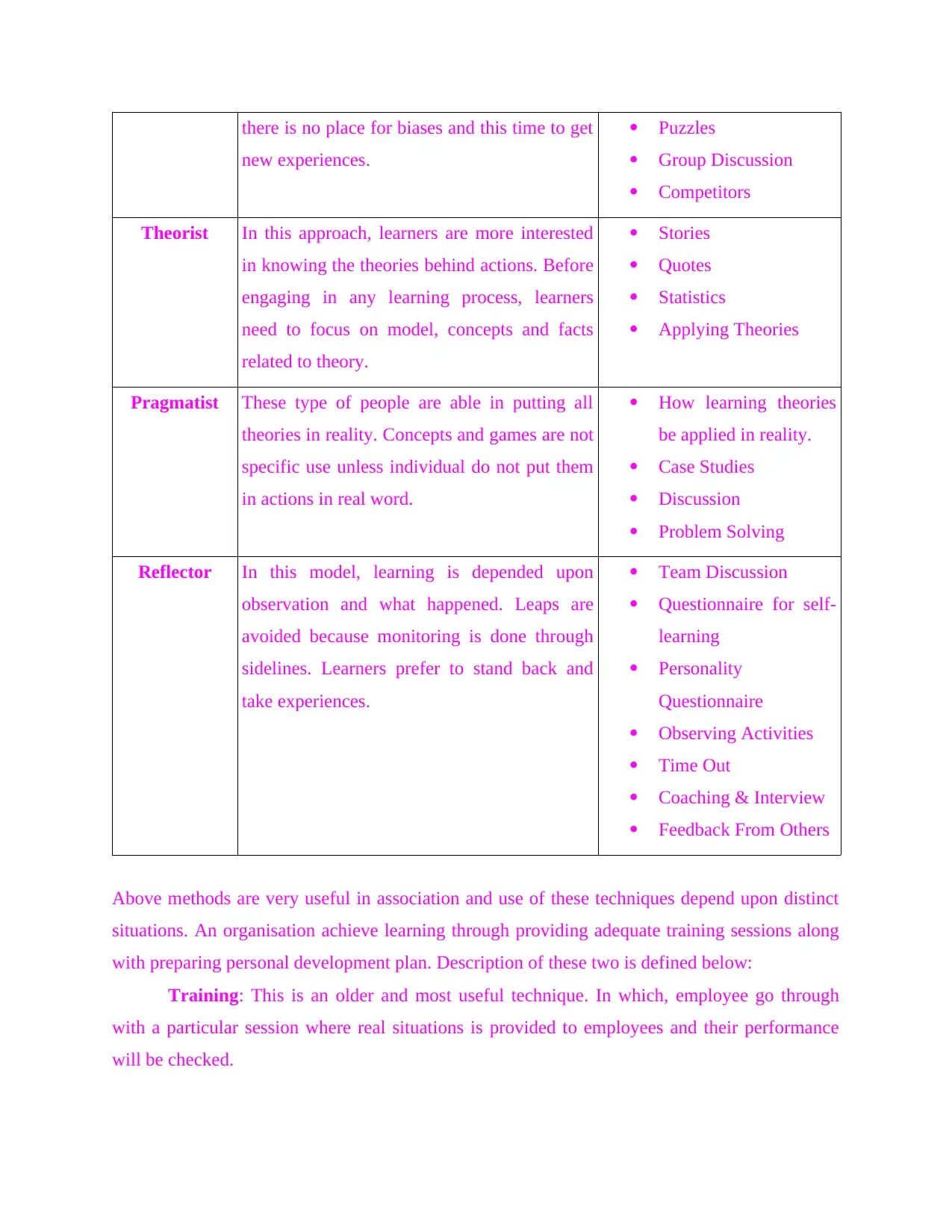
there is no place for biases and this time to get
new experiences.
Puzzles
Group Discussion
Competitors
Theorist In this approach, learners are more interested
in knowing the theories behind actions. Before
engaging in any learning process, learners
need to focus on model, concepts and facts
related to theory.
Stories
Quotes
Statistics
Applying Theories
Pragmatist These type of people are able in putting all
theories in reality. Concepts and games are not
specific use unless individual do not put them
in actions in real word.
How learning theories
be applied in reality.
Case Studies
Discussion
Problem Solving
Reflector In this model, learning is depended upon
observation and what happened. Leaps are
avoided because monitoring is done through
sidelines. Learners prefer to stand back and
take experiences.
Team Discussion
Questionnaire for self-
learning
Personality
Questionnaire
Observing Activities
Time Out
Coaching & Interview
Feedback From Others
Above methods are very useful in association and use of these techniques depend upon distinct
situations. An organisation achieve learning through providing adequate training sessions along
with preparing personal development plan. Description of these two is defined below:
Training: This is an older and most useful technique. In which, employee go through
with a particular session where real situations is provided to employees and their performance
will be checked.
new experiences.
Puzzles
Group Discussion
Competitors
Theorist In this approach, learners are more interested
in knowing the theories behind actions. Before
engaging in any learning process, learners
need to focus on model, concepts and facts
related to theory.
Stories
Quotes
Statistics
Applying Theories
Pragmatist These type of people are able in putting all
theories in reality. Concepts and games are not
specific use unless individual do not put them
in actions in real word.
How learning theories
be applied in reality.
Case Studies
Discussion
Problem Solving
Reflector In this model, learning is depended upon
observation and what happened. Leaps are
avoided because monitoring is done through
sidelines. Learners prefer to stand back and
take experiences.
Team Discussion
Questionnaire for self-
learning
Personality
Questionnaire
Observing Activities
Time Out
Coaching & Interview
Feedback From Others
Above methods are very useful in association and use of these techniques depend upon distinct
situations. An organisation achieve learning through providing adequate training sessions along
with preparing personal development plan. Description of these two is defined below:
Training: This is an older and most useful technique. In which, employee go through
with a particular session where real situations is provided to employees and their performance
will be checked.
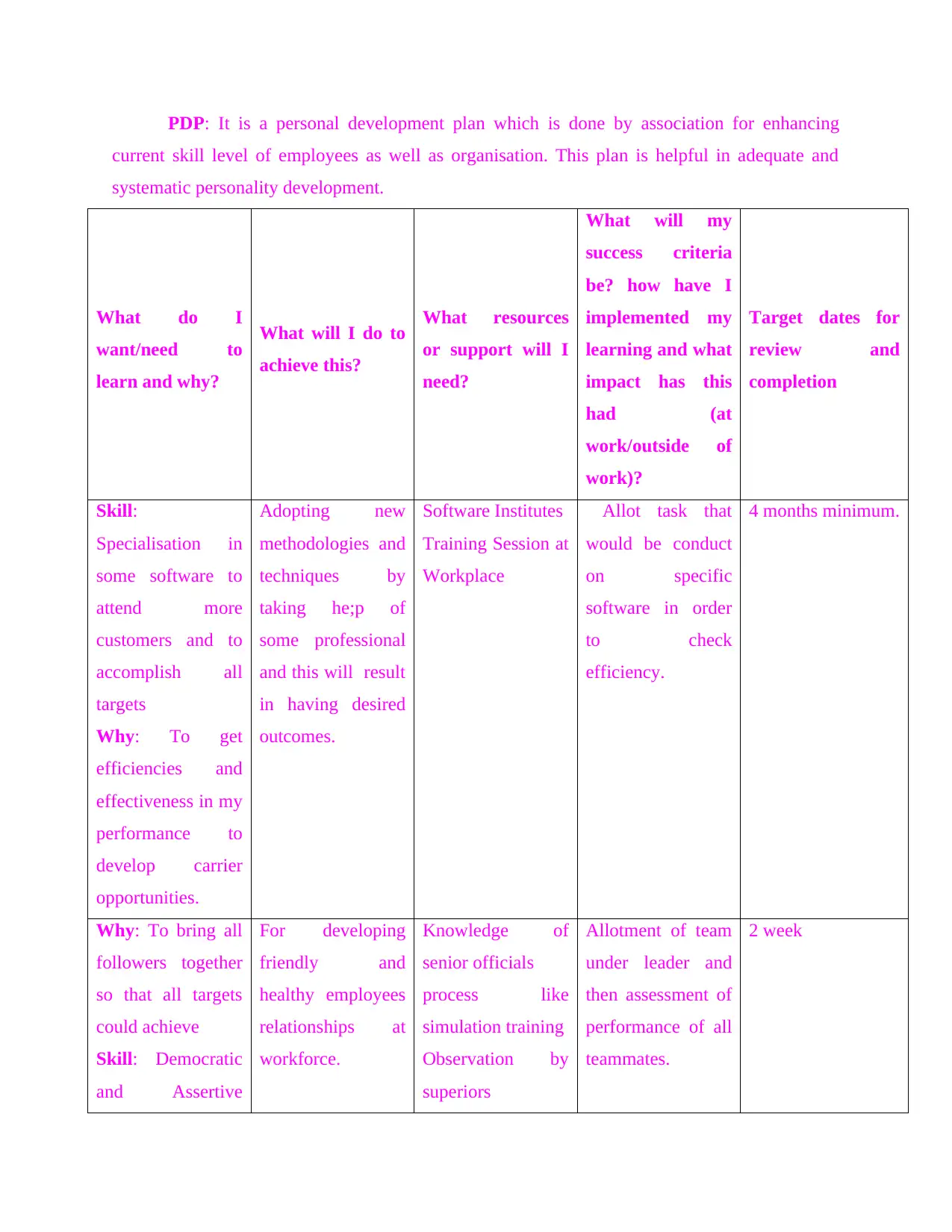
PDP: It is a personal development plan which is done by association for enhancing
current skill level of employees as well as organisation. This plan is helpful in adequate and
systematic personality development.
What do I
want/need to
learn and why?
What will I do to
achieve this?
What resources
or support will I
need?
What will my
success criteria
be? how have I
implemented my
learning and what
impact has this
had (at
work/outside of
work)?
Target dates for
review and
completion
Skill:
Specialisation in
some software to
attend more
customers and to
accomplish all
targets
Why: To get
efficiencies and
effectiveness in my
performance to
develop carrier
opportunities.
Adopting new
methodologies and
techniques by
taking he;p of
some professional
and this will result
in having desired
outcomes.
Software Institutes
Training Session at
Workplace
Allot task that
would be conduct
on specific
software in order
to check
efficiency.
4 months minimum.
Why: To bring all
followers together
so that all targets
could achieve
Skill: Democratic
and Assertive
For developing
friendly and
healthy employees
relationships at
workforce.
Knowledge of
senior officials
process like
simulation training
Observation by
superiors
Allotment of team
under leader and
then assessment of
performance of all
teammates.
2 week
current skill level of employees as well as organisation. This plan is helpful in adequate and
systematic personality development.
What do I
want/need to
learn and why?
What will I do to
achieve this?
What resources
or support will I
need?
What will my
success criteria
be? how have I
implemented my
learning and what
impact has this
had (at
work/outside of
work)?
Target dates for
review and
completion
Skill:
Specialisation in
some software to
attend more
customers and to
accomplish all
targets
Why: To get
efficiencies and
effectiveness in my
performance to
develop carrier
opportunities.
Adopting new
methodologies and
techniques by
taking he;p of
some professional
and this will result
in having desired
outcomes.
Software Institutes
Training Session at
Workplace
Allot task that
would be conduct
on specific
software in order
to check
efficiency.
4 months minimum.
Why: To bring all
followers together
so that all targets
could achieve
Skill: Democratic
and Assertive
For developing
friendly and
healthy employees
relationships at
workforce.
Knowledge of
senior officials
process like
simulation training
Observation by
superiors
Allotment of team
under leader and
then assessment of
performance of all
teammates.
2 week
⊘ This is a preview!⊘
Do you want full access?
Subscribe today to unlock all pages.
Trusted by 1+ million students worldwide

1 out of 18


Related Documents


Your All-in-One AI-Powered Toolkit for Academic Success.
+13062052269
info@desklib.com
Available 24*7 on WhatsApp / Email
![[object Object]](/_next/static/media/star-bottom.7253800d.svg)
Unlock your academic potential
Copyright © 2020–2026 A2Z Services. All Rights Reserved. Developed and managed by ZUCOL.