HR Report: Skills, Development, and Performance at Whirlpool
VerifiedAdded on 2020/11/23
|19
|5800
|354
Report
AI Summary
This report examines human resource management practices within Whirlpool, a multinational home appliance company. It begins by defining key employee knowledge, skills, and behaviors crucial for HR professionals, including administration, employment, training, health and safety, and communication. The report then presents a personal skills audit, identifying gaps in areas like coordination, technical skills, and time management. A professional development plan is outlined to address these gaps, focusing on improvements in coordination, mathematical skills, time management, technical skills, team development, communication, presentation skills, and IT skills. Furthermore, the report discusses the differences between organizational and individual learning, emphasizing the need for continuous learning to drive sustainable business performance. The report also explores how high-performance work systems contribute to employee engagement and competitive advantage, as well as approaches to performance management. Overall, the report offers a comprehensive analysis of HR strategies to enhance employee capabilities and organizational success.
Developing Individuals, Teams And
Organisations
Organisations

Paraphrase This Document
Need a fresh take? Get an instant paraphrase of this document with our AI Paraphraser
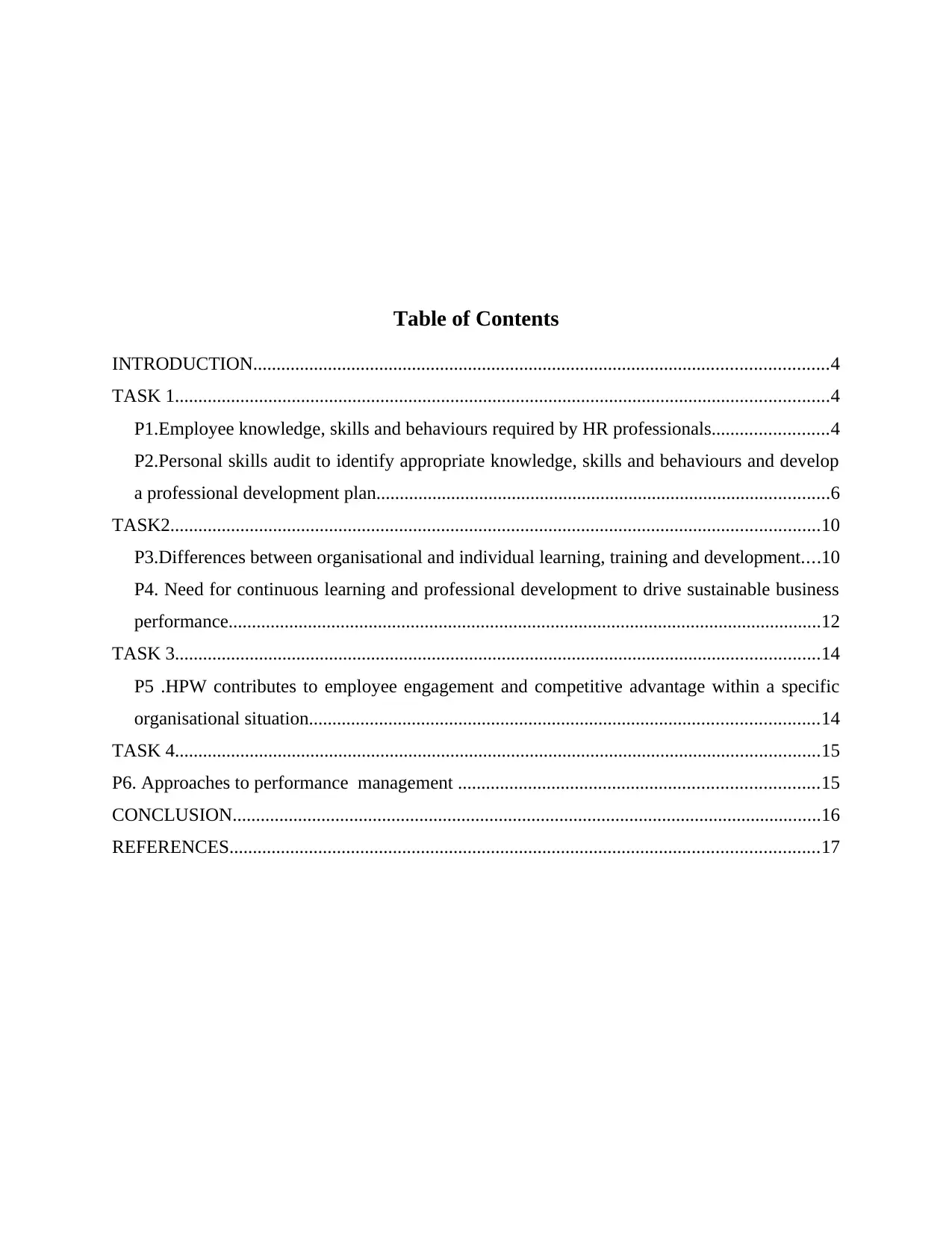
Table of Contents
INTRODUCTION...........................................................................................................................4
TASK 1............................................................................................................................................4
P1.Employee knowledge, skills and behaviours required by HR professionals.........................4
P2.Personal skills audit to identify appropriate knowledge, skills and behaviours and develop
a professional development plan.................................................................................................6
TASK2...........................................................................................................................................10
P3.Differences between organisational and individual learning, training and development....10
P4. Need for continuous learning and professional development to drive sustainable business
performance...............................................................................................................................12
TASK 3..........................................................................................................................................14
P5 .HPW contributes to employee engagement and competitive advantage within a specific
organisational situation.............................................................................................................14
TASK 4..........................................................................................................................................15
P6. Approaches to performance management .............................................................................15
CONCLUSION..............................................................................................................................16
REFERENCES..............................................................................................................................17
INTRODUCTION...........................................................................................................................4
TASK 1............................................................................................................................................4
P1.Employee knowledge, skills and behaviours required by HR professionals.........................4
P2.Personal skills audit to identify appropriate knowledge, skills and behaviours and develop
a professional development plan.................................................................................................6
TASK2...........................................................................................................................................10
P3.Differences between organisational and individual learning, training and development....10
P4. Need for continuous learning and professional development to drive sustainable business
performance...............................................................................................................................12
TASK 3..........................................................................................................................................14
P5 .HPW contributes to employee engagement and competitive advantage within a specific
organisational situation.............................................................................................................14
TASK 4..........................................................................................................................................15
P6. Approaches to performance management .............................................................................15
CONCLUSION..............................................................................................................................16
REFERENCES..............................................................................................................................17
INTRODUCTION
The main reason for excel performance in a top ranked organisation is the level of work
performance of the employees and efficiency and effectiveness of the groups and teams within
them. The interconnection between the capacity of an individual, groups, team and organisation
that sanction the companies to take into consideration the development and training of people as
the essential part of the business. This report is based on the human resource management in the
Whirlpool company. Whirlpool is a multinational company which produce home appliances. Its
headquarters in Benton Charter Township, Micigan and United States. In this report the
employees skills and knowledge which is beneficial for them is included.
TASK 1
P1.Employee knowledge, skills and behaviours
Knowledge
It is the awareness, understanding, information and intelligence that has been obtained by
experience. It is a fact or coordination of knowing something with familiarity gained through
association or experience (Holden 2012).
Administration
It is a process of arrangement and tasks needed to control the operation of a plan or
organisation. In Whirlpool, it is a range of activities connected with supervising and organising
the way that an organisation or institution functions.
Employment
It is about in individuals works which they do partly or fully on the contract base. In
whirlpool it is a relationship between two parties based on a contract where work is paid for the
employer and other is the employee. It means a person who is hired for a wage, salary, fee or
payment to perform work for an employer. Employees in some fields or sectors may receive
gratuities, bonus payment or stock options. There are various types of employment in which the
employees and employer get different benefits. It can be in the form of penssion, fund and illness
and sicknes policy.(Belbin, R. M., 2012).
Training
The process in which the organisation provide teaching the new and present employees
the basic skills they need to effectively perform their jobs. In the organisation. It is a program
The main reason for excel performance in a top ranked organisation is the level of work
performance of the employees and efficiency and effectiveness of the groups and teams within
them. The interconnection between the capacity of an individual, groups, team and organisation
that sanction the companies to take into consideration the development and training of people as
the essential part of the business. This report is based on the human resource management in the
Whirlpool company. Whirlpool is a multinational company which produce home appliances. Its
headquarters in Benton Charter Township, Micigan and United States. In this report the
employees skills and knowledge which is beneficial for them is included.
TASK 1
P1.Employee knowledge, skills and behaviours
Knowledge
It is the awareness, understanding, information and intelligence that has been obtained by
experience. It is a fact or coordination of knowing something with familiarity gained through
association or experience (Holden 2012).
Administration
It is a process of arrangement and tasks needed to control the operation of a plan or
organisation. In Whirlpool, it is a range of activities connected with supervising and organising
the way that an organisation or institution functions.
Employment
It is about in individuals works which they do partly or fully on the contract base. In
whirlpool it is a relationship between two parties based on a contract where work is paid for the
employer and other is the employee. It means a person who is hired for a wage, salary, fee or
payment to perform work for an employer. Employees in some fields or sectors may receive
gratuities, bonus payment or stock options. There are various types of employment in which the
employees and employer get different benefits. It can be in the form of penssion, fund and illness
and sicknes policy.(Belbin, R. M., 2012).
Training
The process in which the organisation provide teaching the new and present employees
the basic skills they need to effectively perform their jobs. In the organisation. It is a program
⊘ This is a preview!⊘
Do you want full access?
Subscribe today to unlock all pages.

Trusted by 1+ million students worldwide
that is designed to increase the technical skills, knowledge, efficiency and value of the
employees for the growth of the organisation. There are different types of trainings such as
technical, skills, quality, managerial and professional training which are provided by the
organisation to improve or enhance the knowledge of the new employees and present (Blandford,
2012).
Health and Safety
The process in which all workers are entitled to work in environments where risks to
their health and safety are properly controlled. It is possible by identifying, assessing and
controlling risks to employees in all workplace operations. It is important because it protects
employers, visitors and customers. Looking after health and safety they makes good business
sense and achieve organisational goals.
Communication system and procedure
Communication system is a conversation between employees and employer. In this act
the employees make opinions, feelings, information understood or known by other through
speech, writing or bodily movement (Bolden,2016).
Skills
It is capacity and ability of an individual gain from sustain, systematic efforts involving
ideas skills to carry out complex work. There are different types of skills which are important for
the growth of HR professionals.
Coordination skills
The process of organising people or groups so that they can work properly in teams or
individually within the organisation.
Mathematical skills
It is the ability to count accurately, representation by using symbols, words, picture, and
objects.
Technical skills
It is related to computer knowledge. In the organisation or HR professionals it needs to
have technical skills for the organisation growth and increase profit or productivity effectively
with the employees and employers (Dixon-Woods and et. al., 2014).
Communication skills
employees for the growth of the organisation. There are different types of trainings such as
technical, skills, quality, managerial and professional training which are provided by the
organisation to improve or enhance the knowledge of the new employees and present (Blandford,
2012).
Health and Safety
The process in which all workers are entitled to work in environments where risks to
their health and safety are properly controlled. It is possible by identifying, assessing and
controlling risks to employees in all workplace operations. It is important because it protects
employers, visitors and customers. Looking after health and safety they makes good business
sense and achieve organisational goals.
Communication system and procedure
Communication system is a conversation between employees and employer. In this act
the employees make opinions, feelings, information understood or known by other through
speech, writing or bodily movement (Bolden,2016).
Skills
It is capacity and ability of an individual gain from sustain, systematic efforts involving
ideas skills to carry out complex work. There are different types of skills which are important for
the growth of HR professionals.
Coordination skills
The process of organising people or groups so that they can work properly in teams or
individually within the organisation.
Mathematical skills
It is the ability to count accurately, representation by using symbols, words, picture, and
objects.
Technical skills
It is related to computer knowledge. In the organisation or HR professionals it needs to
have technical skills for the organisation growth and increase profit or productivity effectively
with the employees and employers (Dixon-Woods and et. al., 2014).
Communication skills
Paraphrase This Document
Need a fresh take? Get an instant paraphrase of this document with our AI Paraphraser
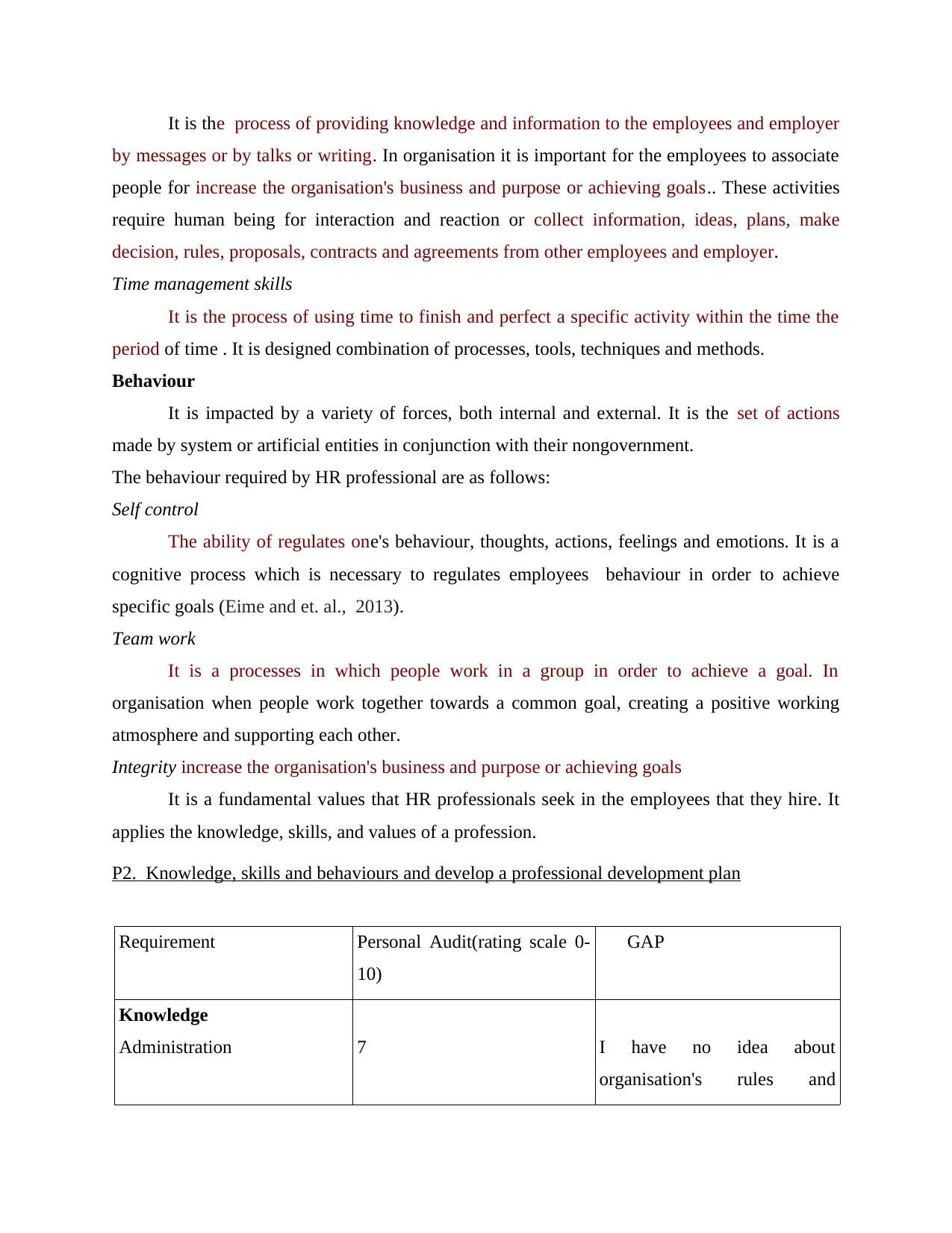
It is the process of providing knowledge and information to the employees and employer
by messages or by talks or writing. In organisation it is important for the employees to associate
people for increase the organisation's business and purpose or achieving goals.. These activities
require human being for interaction and reaction or collect information, ideas, plans, make
decision, rules, proposals, contracts and agreements from other employees and employer.
Time management skills
It is the process of using time to finish and perfect a specific activity within the time the
period of time . It is designed combination of processes, tools, techniques and methods.
Behaviour
It is impacted by a variety of forces, both internal and external. It is the set of actions
made by system or artificial entities in conjunction with their nongovernment.
The behaviour required by HR professional are as follows:
Self control
The ability of regulates one's behaviour, thoughts, actions, feelings and emotions. It is a
cognitive process which is necessary to regulates employees behaviour in order to achieve
specific goals (Eime and et. al., 2013).
Team work
It is a processes in which people work in a group in order to achieve a goal. In
organisation when people work together towards a common goal, creating a positive working
atmosphere and supporting each other.
Integrity increase the organisation's business and purpose or achieving goals
It is a fundamental values that HR professionals seek in the employees that they hire. It
applies the knowledge, skills, and values of a profession.
P2. Knowledge, skills and behaviours and develop a professional development plan
Requirement Personal Audit(rating scale 0-
10)
GAP
Knowledge
Administration 7 I have no idea about
organisation's rules and
by messages or by talks or writing. In organisation it is important for the employees to associate
people for increase the organisation's business and purpose or achieving goals.. These activities
require human being for interaction and reaction or collect information, ideas, plans, make
decision, rules, proposals, contracts and agreements from other employees and employer.
Time management skills
It is the process of using time to finish and perfect a specific activity within the time the
period of time . It is designed combination of processes, tools, techniques and methods.
Behaviour
It is impacted by a variety of forces, both internal and external. It is the set of actions
made by system or artificial entities in conjunction with their nongovernment.
The behaviour required by HR professional are as follows:
Self control
The ability of regulates one's behaviour, thoughts, actions, feelings and emotions. It is a
cognitive process which is necessary to regulates employees behaviour in order to achieve
specific goals (Eime and et. al., 2013).
Team work
It is a processes in which people work in a group in order to achieve a goal. In
organisation when people work together towards a common goal, creating a positive working
atmosphere and supporting each other.
Integrity increase the organisation's business and purpose or achieving goals
It is a fundamental values that HR professionals seek in the employees that they hire. It
applies the knowledge, skills, and values of a profession.
P2. Knowledge, skills and behaviours and develop a professional development plan
Requirement Personal Audit(rating scale 0-
10)
GAP
Knowledge
Administration 7 I have no idea about
organisation's rules and
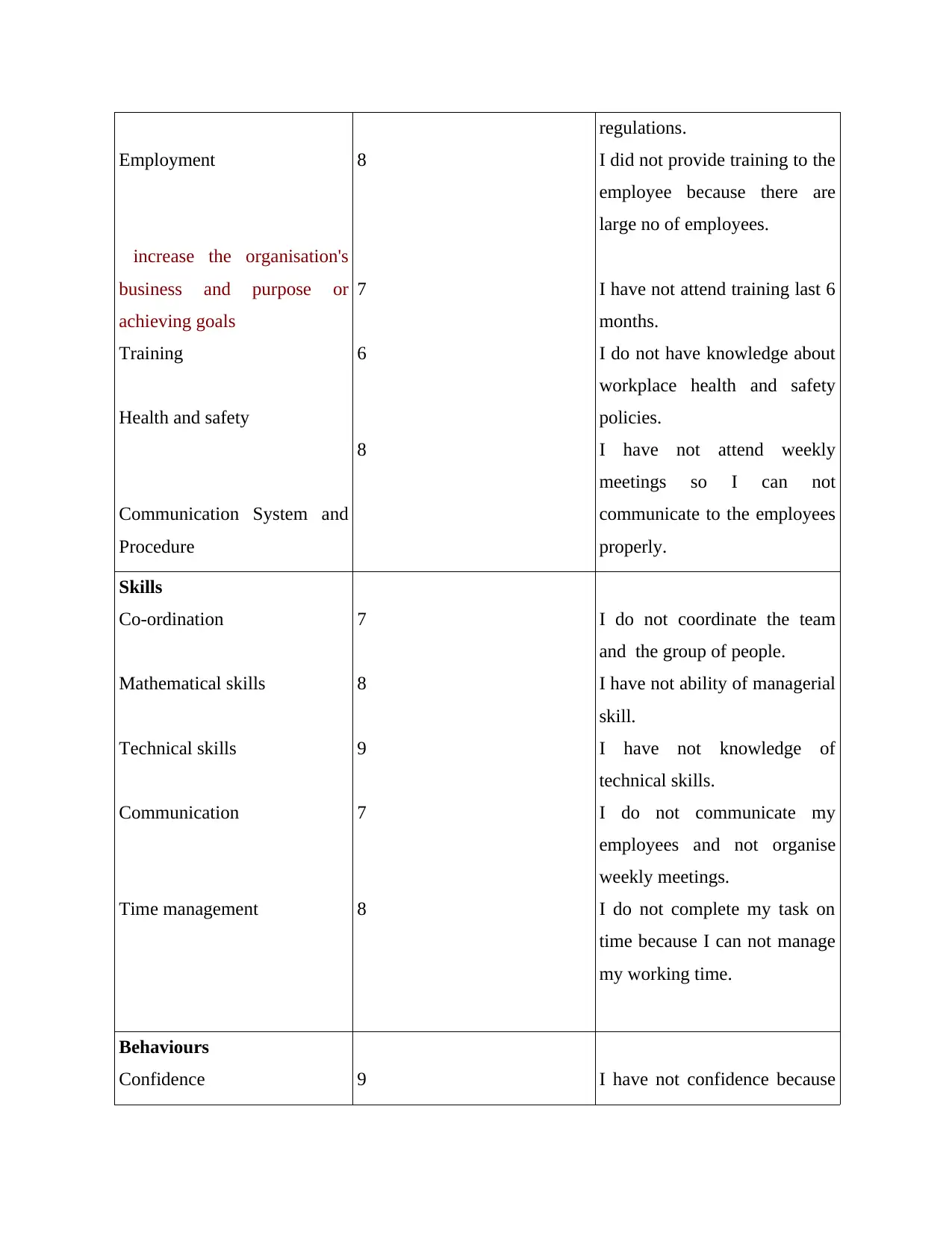
Employment
increase the organisation's
business and purpose or
achieving goals
Training
Health and safety
Communication System and
Procedure
8
7
6
8
regulations.
I did not provide training to the
employee because there are
large no of employees.
I have not attend training last 6
months.
I do not have knowledge about
workplace health and safety
policies.
I have not attend weekly
meetings so I can not
communicate to the employees
properly.
Skills
Co-ordination
Mathematical skills
Technical skills
Communication
Time management
7
8
9
7
8
I do not coordinate the team
and the group of people.
I have not ability of managerial
skill.
I have not knowledge of
technical skills.
I do not communicate my
employees and not organise
weekly meetings.
I do not complete my task on
time because I can not manage
my working time.
Behaviours
Confidence 9 I have not confidence because
increase the organisation's
business and purpose or
achieving goals
Training
Health and safety
Communication System and
Procedure
8
7
6
8
regulations.
I did not provide training to the
employee because there are
large no of employees.
I have not attend training last 6
months.
I do not have knowledge about
workplace health and safety
policies.
I have not attend weekly
meetings so I can not
communicate to the employees
properly.
Skills
Co-ordination
Mathematical skills
Technical skills
Communication
Time management
7
8
9
7
8
I do not coordinate the team
and the group of people.
I have not ability of managerial
skill.
I have not knowledge of
technical skills.
I do not communicate my
employees and not organise
weekly meetings.
I do not complete my task on
time because I can not manage
my working time.
Behaviours
Confidence 9 I have not confidence because
⊘ This is a preview!⊘
Do you want full access?
Subscribe today to unlock all pages.
Trusted by 1+ million students worldwide
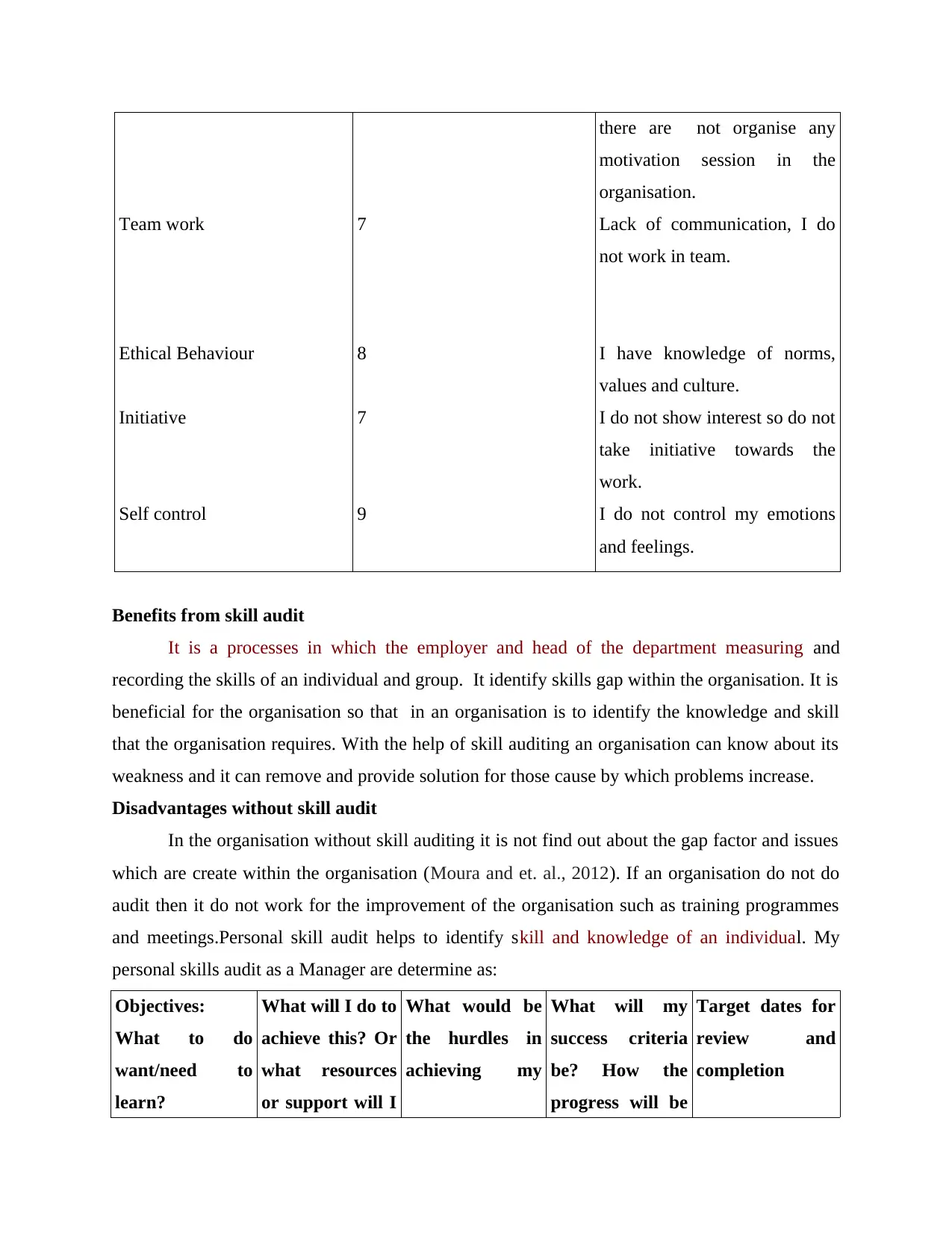
Team work
Ethical Behaviour
Initiative
Self control
7
8
7
9
there are not organise any
motivation session in the
organisation.
Lack of communication, I do
not work in team.
I have knowledge of norms,
values and culture.
I do not show interest so do not
take initiative towards the
work.
I do not control my emotions
and feelings.
Benefits from skill audit
It is a processes in which the employer and head of the department measuring and
recording the skills of an individual and group. It identify skills gap within the organisation. It is
beneficial for the organisation so that in an organisation is to identify the knowledge and skill
that the organisation requires. With the help of skill auditing an organisation can know about its
weakness and it can remove and provide solution for those cause by which problems increase.
Disadvantages without skill audit
In the organisation without skill auditing it is not find out about the gap factor and issues
which are create within the organisation (Moura and et. al., 2012). If an organisation do not do
audit then it do not work for the improvement of the organisation such as training programmes
and meetings.Personal skill audit helps to identify skill and knowledge of an individual. My
personal skills audit as a Manager are determine as:
Objectives:
What to do
want/need to
learn?
What will I do to
achieve this? Or
what resources
or support will I
What would be
the hurdles in
achieving my
What will my
success criteria
be? How the
progress will be
Target dates for
review and
completion
Ethical Behaviour
Initiative
Self control
7
8
7
9
there are not organise any
motivation session in the
organisation.
Lack of communication, I do
not work in team.
I have knowledge of norms,
values and culture.
I do not show interest so do not
take initiative towards the
work.
I do not control my emotions
and feelings.
Benefits from skill audit
It is a processes in which the employer and head of the department measuring and
recording the skills of an individual and group. It identify skills gap within the organisation. It is
beneficial for the organisation so that in an organisation is to identify the knowledge and skill
that the organisation requires. With the help of skill auditing an organisation can know about its
weakness and it can remove and provide solution for those cause by which problems increase.
Disadvantages without skill audit
In the organisation without skill auditing it is not find out about the gap factor and issues
which are create within the organisation (Moura and et. al., 2012). If an organisation do not do
audit then it do not work for the improvement of the organisation such as training programmes
and meetings.Personal skill audit helps to identify skill and knowledge of an individual. My
personal skills audit as a Manager are determine as:
Objectives:
What to do
want/need to
learn?
What will I do to
achieve this? Or
what resources
or support will I
What would be
the hurdles in
achieving my
What will my
success criteria
be? How the
progress will be
Target dates for
review and
completion
Paraphrase This Document
Need a fresh take? Get an instant paraphrase of this document with our AI Paraphraser
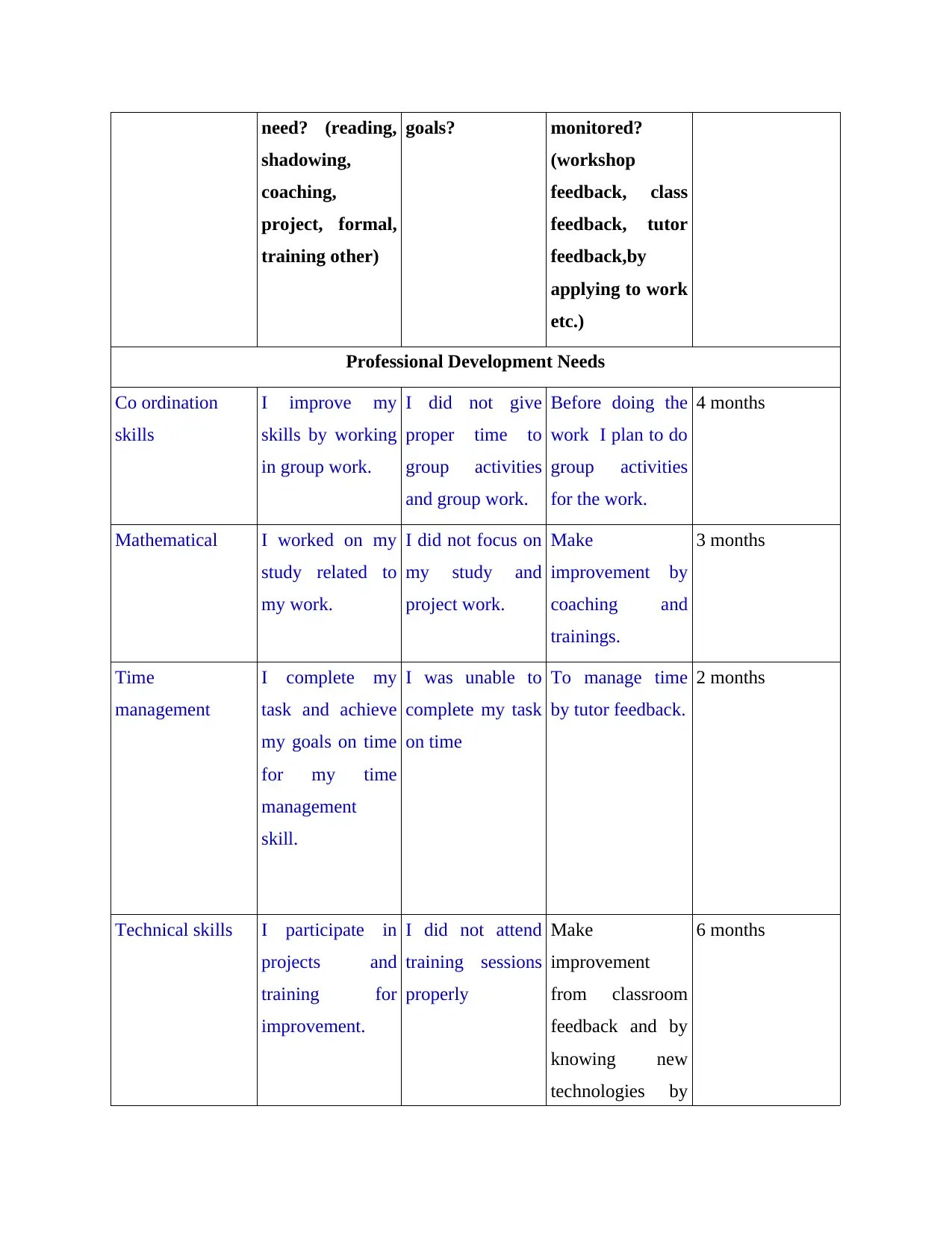
need? (reading,
shadowing,
coaching,
project, formal,
training other)
goals? monitored?
(workshop
feedback, class
feedback, tutor
feedback,by
applying to work
etc.)
Professional Development Needs
Co ordination
skills
I improve my
skills by working
in group work.
I did not give
proper time to
group activities
and group work.
Before doing the
work I plan to do
group activities
for the work.
4 months
Mathematical I worked on my
study related to
my work.
I did not focus on
my study and
project work.
Make
improvement by
coaching and
trainings.
3 months
Time
management
I complete my
task and achieve
my goals on time
for my time
management
skill.
I was unable to
complete my task
on time
To manage time
by tutor feedback.
2 months
Technical skills I participate in
projects and
training for
improvement.
I did not attend
training sessions
properly
Make
improvement
from classroom
feedback and by
knowing new
technologies by
6 months
shadowing,
coaching,
project, formal,
training other)
goals? monitored?
(workshop
feedback, class
feedback, tutor
feedback,by
applying to work
etc.)
Professional Development Needs
Co ordination
skills
I improve my
skills by working
in group work.
I did not give
proper time to
group activities
and group work.
Before doing the
work I plan to do
group activities
for the work.
4 months
Mathematical I worked on my
study related to
my work.
I did not focus on
my study and
project work.
Make
improvement by
coaching and
trainings.
3 months
Time
management
I complete my
task and achieve
my goals on time
for my time
management
skill.
I was unable to
complete my task
on time
To manage time
by tutor feedback.
2 months
Technical skills I participate in
projects and
training for
improvement.
I did not attend
training sessions
properly
Make
improvement
from classroom
feedback and by
knowing new
technologies by
6 months
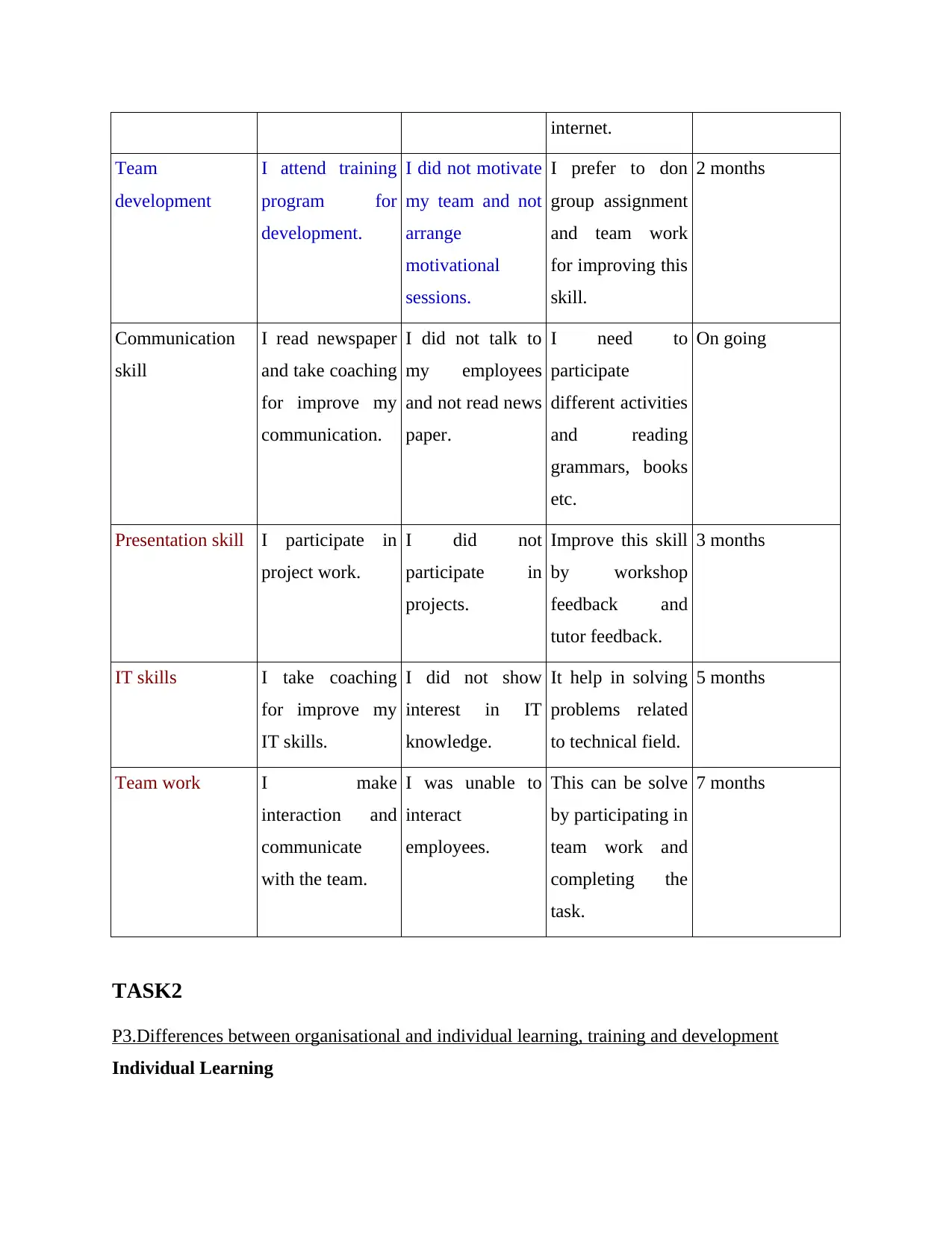
internet.
Team
development
I attend training
program for
development.
I did not motivate
my team and not
arrange
motivational
sessions.
I prefer to don
group assignment
and team work
for improving this
skill.
2 months
Communication
skill
I read newspaper
and take coaching
for improve my
communication.
I did not talk to
my employees
and not read news
paper.
I need to
participate
different activities
and reading
grammars, books
etc.
On going
Presentation skill I participate in
project work.
I did not
participate in
projects.
Improve this skill
by workshop
feedback and
tutor feedback.
3 months
IT skills I take coaching
for improve my
IT skills.
I did not show
interest in IT
knowledge.
It help in solving
problems related
to technical field.
5 months
Team work I make
interaction and
communicate
with the team.
I was unable to
interact
employees.
This can be solve
by participating in
team work and
completing the
task.
7 months
TASK2
P3.Differences between organisational and individual learning, training and development
Individual Learning
Team
development
I attend training
program for
development.
I did not motivate
my team and not
arrange
motivational
sessions.
I prefer to don
group assignment
and team work
for improving this
skill.
2 months
Communication
skill
I read newspaper
and take coaching
for improve my
communication.
I did not talk to
my employees
and not read news
paper.
I need to
participate
different activities
and reading
grammars, books
etc.
On going
Presentation skill I participate in
project work.
I did not
participate in
projects.
Improve this skill
by workshop
feedback and
tutor feedback.
3 months
IT skills I take coaching
for improve my
IT skills.
I did not show
interest in IT
knowledge.
It help in solving
problems related
to technical field.
5 months
Team work I make
interaction and
communicate
with the team.
I was unable to
interact
employees.
This can be solve
by participating in
team work and
completing the
task.
7 months
TASK2
P3.Differences between organisational and individual learning, training and development
Individual Learning
⊘ This is a preview!⊘
Do you want full access?
Subscribe today to unlock all pages.
Trusted by 1+ million students worldwide
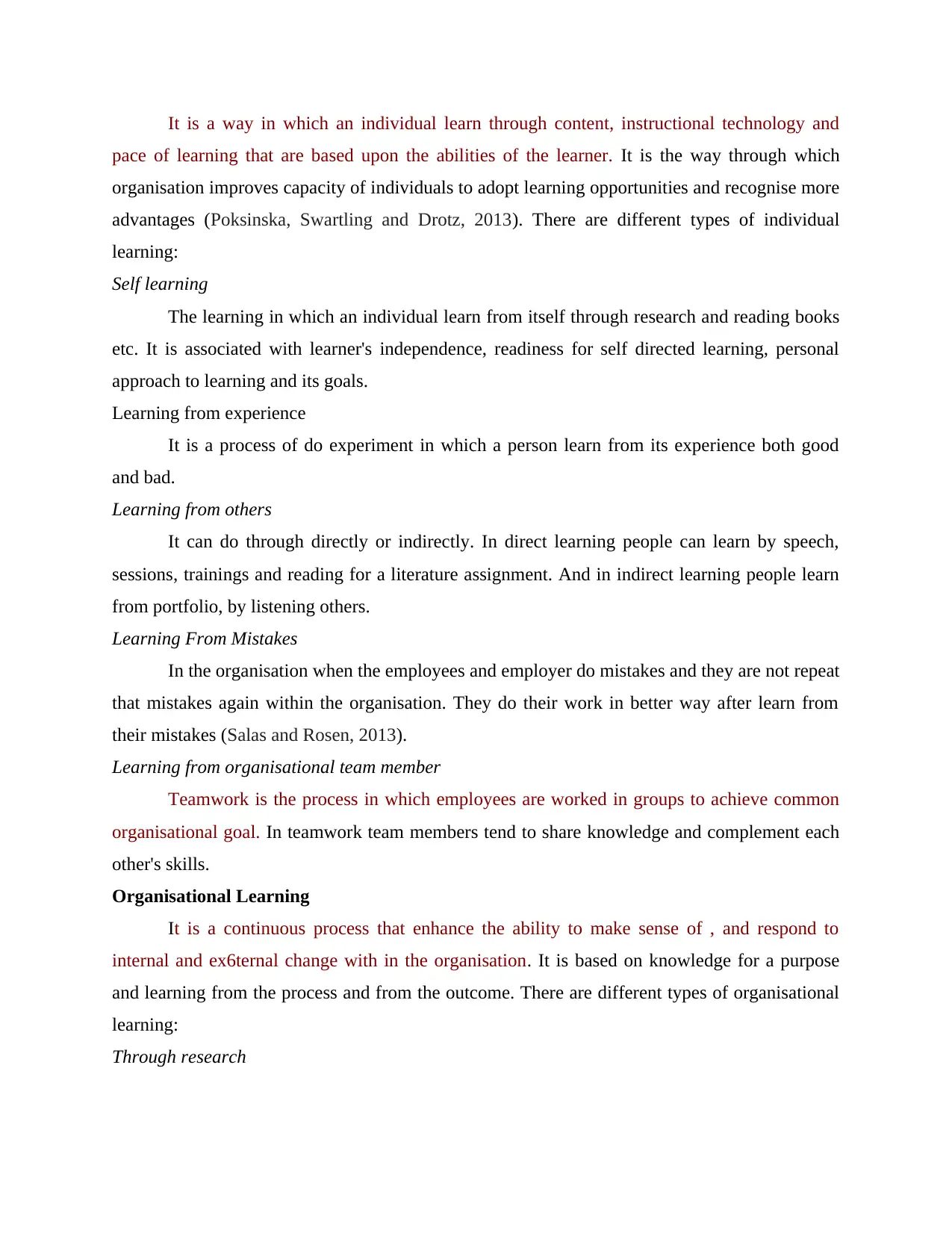
It is a way in which an individual learn through content, instructional technology and
pace of learning that are based upon the abilities of the learner. It is the way through which
organisation improves capacity of individuals to adopt learning opportunities and recognise more
advantages (Poksinska, Swartling and Drotz, 2013). There are different types of individual
learning:
Self learning
The learning in which an individual learn from itself through research and reading books
etc. It is associated with learner's independence, readiness for self directed learning, personal
approach to learning and its goals.
Learning from experience
It is a process of do experiment in which a person learn from its experience both good
and bad.
Learning from others
It can do through directly or indirectly. In direct learning people can learn by speech,
sessions, trainings and reading for a literature assignment. And in indirect learning people learn
from portfolio, by listening others.
Learning From Mistakes
In the organisation when the employees and employer do mistakes and they are not repeat
that mistakes again within the organisation. They do their work in better way after learn from
their mistakes (Salas and Rosen, 2013).
Learning from organisational team member
Teamwork is the process in which employees are worked in groups to achieve common
organisational goal. In teamwork team members tend to share knowledge and complement each
other's skills.
Organisational Learning
It is a continuous process that enhance the ability to make sense of , and respond to
internal and ex6ternal change with in the organisation. It is based on knowledge for a purpose
and learning from the process and from the outcome. There are different types of organisational
learning:
Through research
pace of learning that are based upon the abilities of the learner. It is the way through which
organisation improves capacity of individuals to adopt learning opportunities and recognise more
advantages (Poksinska, Swartling and Drotz, 2013). There are different types of individual
learning:
Self learning
The learning in which an individual learn from itself through research and reading books
etc. It is associated with learner's independence, readiness for self directed learning, personal
approach to learning and its goals.
Learning from experience
It is a process of do experiment in which a person learn from its experience both good
and bad.
Learning from others
It can do through directly or indirectly. In direct learning people can learn by speech,
sessions, trainings and reading for a literature assignment. And in indirect learning people learn
from portfolio, by listening others.
Learning From Mistakes
In the organisation when the employees and employer do mistakes and they are not repeat
that mistakes again within the organisation. They do their work in better way after learn from
their mistakes (Salas and Rosen, 2013).
Learning from organisational team member
Teamwork is the process in which employees are worked in groups to achieve common
organisational goal. In teamwork team members tend to share knowledge and complement each
other's skills.
Organisational Learning
It is a continuous process that enhance the ability to make sense of , and respond to
internal and ex6ternal change with in the organisation. It is based on knowledge for a purpose
and learning from the process and from the outcome. There are different types of organisational
learning:
Through research
Paraphrase This Document
Need a fresh take? Get an instant paraphrase of this document with our AI Paraphraser
In the organisation when people learn from R&D method. They do research and learn
from own knowledge.
From Mistakes
In the organisation when the e]employees do mistakes its impact wear by the
organisation. The productivity can be low and it will not be achieve its future goal on time.
From Markets
An organisation can learn from markets. By example of whirlpool if it want to launch a
product with extra features then it analyse whole market and related products and make the
product with new features (Sharma, Mithas and Kankanhalli, 2014).
From competitors
Organisation can learn from its competitors such as Whirlpool launch a new product and
its competitor also launch that product with some extra features. Whirlpool can have knowledge
about those features.
From teams
The employees of the organisation learn from team work if they do work in team they
communicate with their team members and share knowledge with them which is beneficial for
the organisation.
Single loop learning
It is the process by which one learns through errors and mistakes, to make incremental
adjustments to one's actions. This learning involves knowledge to solve specific problems,
starting from existing assumptions and focusing on what has worked in the past.
Double loop learning
In double loop learning the employees are focused to think about actions in the
framework of operating assumptions (Von Krogh, Rossi-Lamastra and Haefliger, 2012). It is
used when it is necessary to change the mental model on which a decision depends.
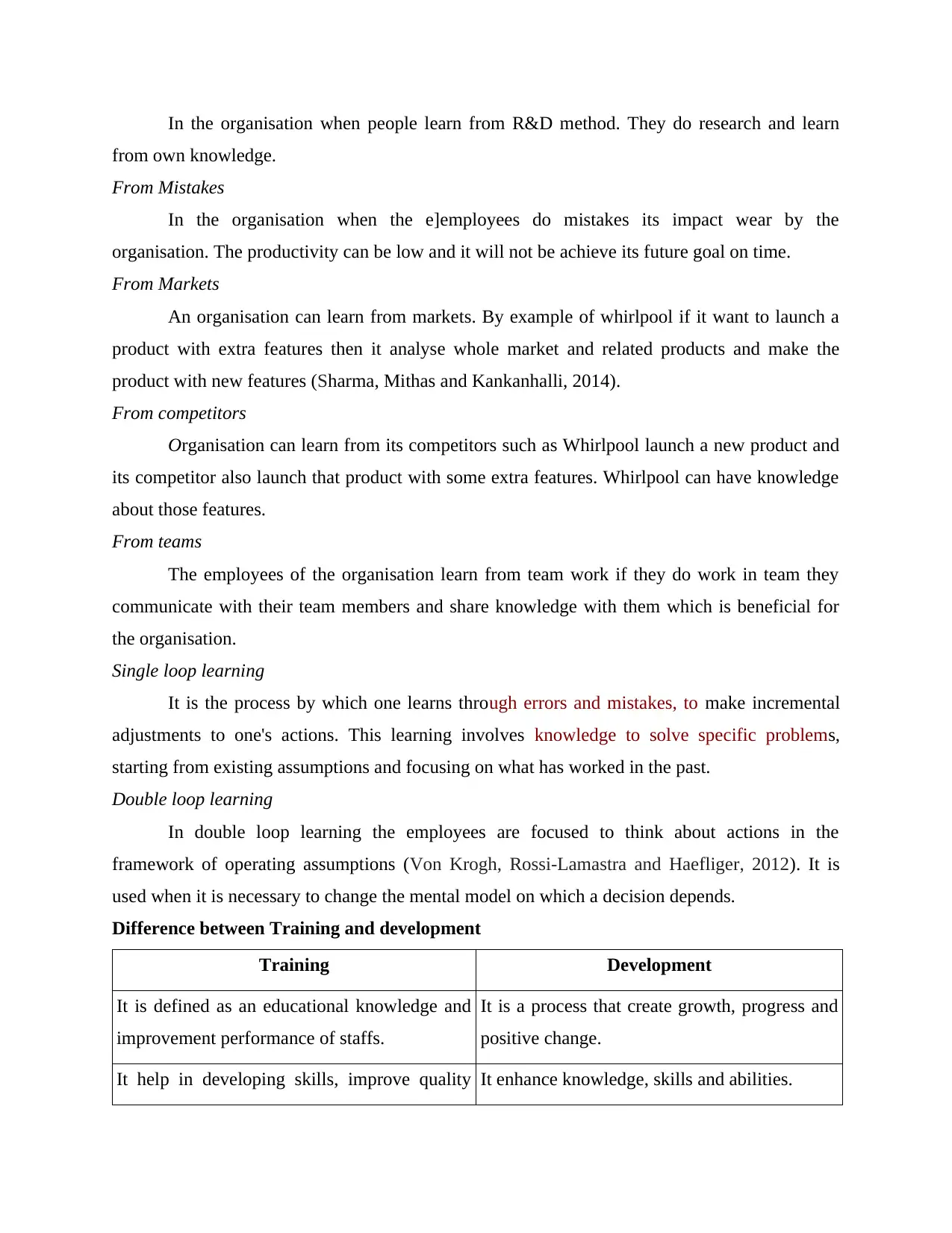
Difference between Training and development
Training Development
It is defined as an educational knowledge and
improvement performance of staffs.
It is a process that create growth, progress and
positive change.
It help in developing skills, improve quality It enhance knowledge, skills and abilities.
from own knowledge.
From Mistakes
In the organisation when the e]employees do mistakes its impact wear by the
organisation. The productivity can be low and it will not be achieve its future goal on time.
From Markets
An organisation can learn from markets. By example of whirlpool if it want to launch a
product with extra features then it analyse whole market and related products and make the
product with new features (Sharma, Mithas and Kankanhalli, 2014).
From competitors
Organisation can learn from its competitors such as Whirlpool launch a new product and
its competitor also launch that product with some extra features. Whirlpool can have knowledge
about those features.
From teams
The employees of the organisation learn from team work if they do work in team they
communicate with their team members and share knowledge with them which is beneficial for
the organisation.
Single loop learning
It is the process by which one learns through errors and mistakes, to make incremental
adjustments to one's actions. This learning involves knowledge to solve specific problems,
starting from existing assumptions and focusing on what has worked in the past.
Double loop learning
In double loop learning the employees are focused to think about actions in the
framework of operating assumptions (Von Krogh, Rossi-Lamastra and Haefliger, 2012). It is
used when it is necessary to change the mental model on which a decision depends.
Difference between Training and development
Training Development
It is defined as an educational knowledge and
improvement performance of staffs.
It is a process that create growth, progress and
positive change.
It help in developing skills, improve quality It enhance knowledge, skills and abilities.
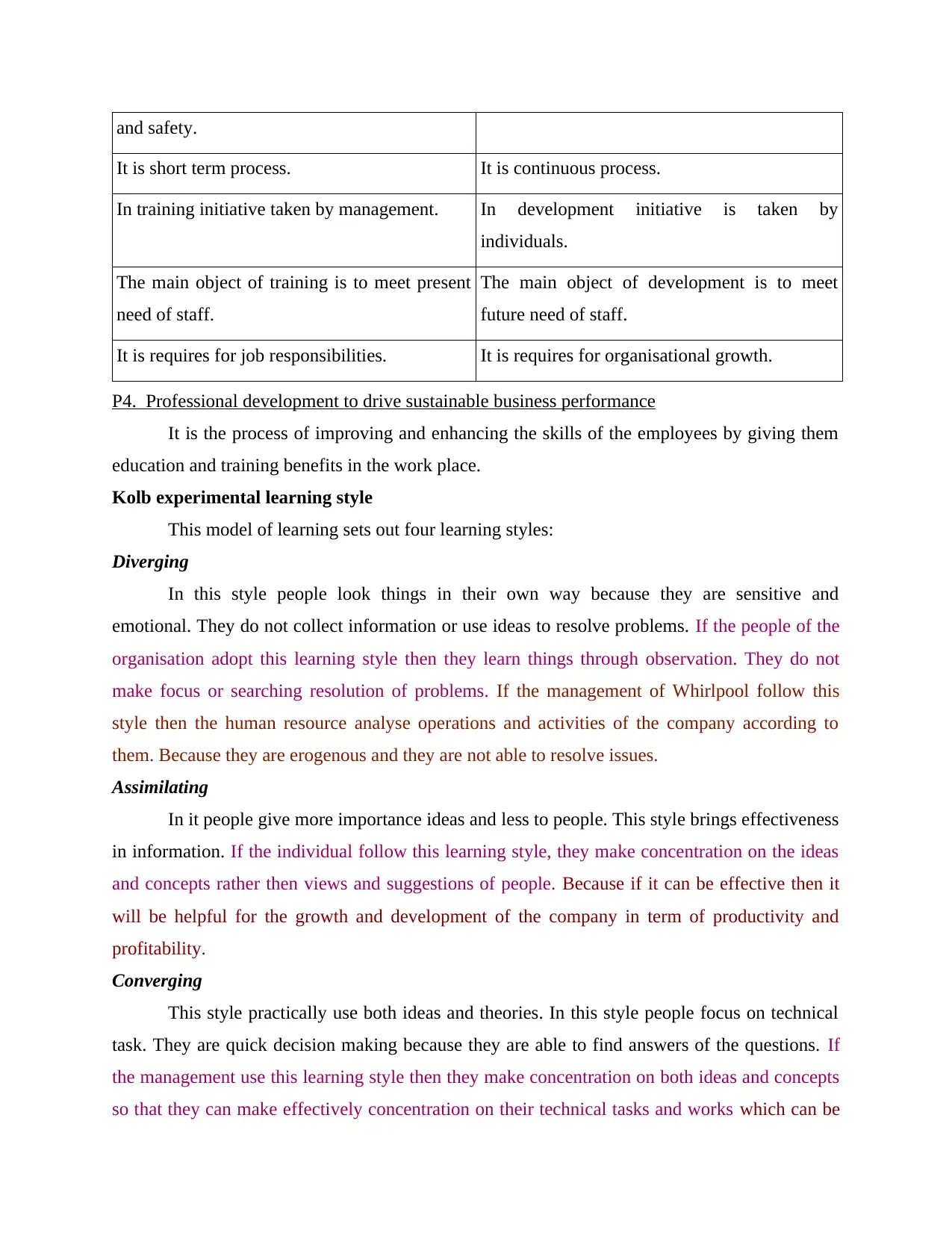
and safety.
It is short term process. It is continuous process.
In training initiative taken by management. In development initiative is taken by
individuals.
The main object of training is to meet present
need of staff.
The main object of development is to meet
future need of staff.
It is requires for job responsibilities. It is requires for organisational growth.
P4. Professional development to drive sustainable business performance
It is the process of improving and enhancing the skills of the employees by giving them
education and training benefits in the work place.
Kolb experimental learning style
This model of learning sets out four learning styles:
Diverging
In this style people look things in their own way because they are sensitive and
emotional. They do not collect information or use ideas to resolve problems. If the people of the
organisation adopt this learning style then they learn things through observation. They do not
make focus or searching resolution of problems. If the management of Whirlpool follow this
style then the human resource analyse operations and activities of the company according to
them. Because they are erogenous and they are not able to resolve issues.
Assimilating
In it people give more importance ideas and less to people. This style brings effectiveness
in information. If the individual follow this learning style, they make concentration on the ideas
and concepts rather then views and suggestions of people. Because if it can be effective then it
will be helpful for the growth and development of the company in term of productivity and
profitability.
Converging
This style practically use both ideas and theories. In this style people focus on technical
task. They are quick decision making because they are able to find answers of the questions. If
the management use this learning style then they make concentration on both ideas and concepts
so that they can make effectively concentration on their technical tasks and works which can be
It is short term process. It is continuous process.
In training initiative taken by management. In development initiative is taken by
individuals.
The main object of training is to meet present
need of staff.
The main object of development is to meet
future need of staff.
It is requires for job responsibilities. It is requires for organisational growth.
P4. Professional development to drive sustainable business performance
It is the process of improving and enhancing the skills of the employees by giving them
education and training benefits in the work place.
Kolb experimental learning style
This model of learning sets out four learning styles:
Diverging
In this style people look things in their own way because they are sensitive and
emotional. They do not collect information or use ideas to resolve problems. If the people of the
organisation adopt this learning style then they learn things through observation. They do not
make focus or searching resolution of problems. If the management of Whirlpool follow this
style then the human resource analyse operations and activities of the company according to
them. Because they are erogenous and they are not able to resolve issues.
Assimilating
In it people give more importance ideas and less to people. This style brings effectiveness
in information. If the individual follow this learning style, they make concentration on the ideas
and concepts rather then views and suggestions of people. Because if it can be effective then it
will be helpful for the growth and development of the company in term of productivity and
profitability.
Converging
This style practically use both ideas and theories. In this style people focus on technical
task. They are quick decision making because they are able to find answers of the questions. If
the management use this learning style then they make concentration on both ideas and concepts
so that they can make effectively concentration on their technical tasks and works which can be
⊘ This is a preview!⊘
Do you want full access?
Subscribe today to unlock all pages.
Trusted by 1+ million students worldwide

1 out of 19


Related Documents


Your All-in-One AI-Powered Toolkit for Academic Success.
+13062052269
info@desklib.com
Available 24*7 on WhatsApp / Email
![[object Object]](/_next/static/media/star-bottom.7253800d.svg)
Unlock your academic potential
Copyright © 2020–2026 A2Z Services. All Rights Reserved. Developed and managed by ZUCOL.