Case Study: HR Strategies and Employee Management at HealthReach
VerifiedAdded on 2022/10/07
|9
|2321
|29
Case Study
AI Summary
This case study examines the HR challenges faced by HealthReach, a large Australian healthcare provider struggling with employee turnover, absenteeism, and declining morale among nursing staff. The analysis identifies key issues such as hierarchical organizational structure, lack of performance incentives, inadequate training, and limited employee autonomy. The paper recommends four key HR strategies: implementing a fair evaluation system linked to individual performance, establishing comprehensive training and development programs, utilizing selective recruitment strategies, and fostering employee autonomy to enhance engagement and job satisfaction. The recommendations are grounded in HR management theories, including Maslow's hierarchy of needs, Kolb's experiential learning, and Vroom's expectancy theory, to provide practical solutions for improving employee performance and retention within the healthcare setting. The study concludes by emphasizing the critical role of effective HR practices in addressing the company's employee management issues and achieving its organizational goals.

Running head: CASE STUDY: HR STRATEGIES
CASE STUDY: HR STRATEGIES
Name of the student
Name of the university
Author Note
CASE STUDY: HR STRATEGIES
Name of the student
Name of the university
Author Note

Paraphrase This Document
Need a fresh take? Get an instant paraphrase of this document with our AI Paraphraser
1CASE STUDY: HR STRATEGIES
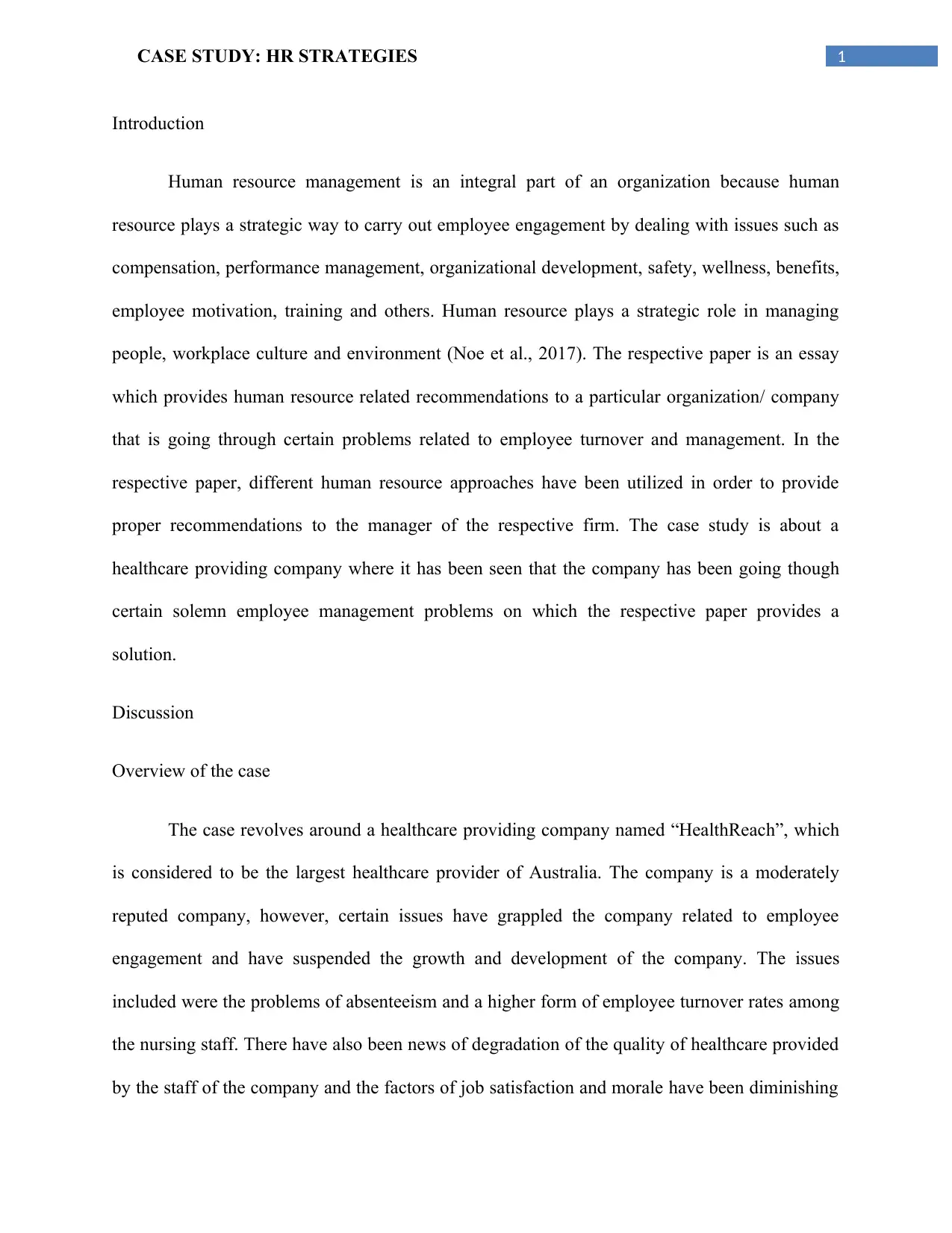
Introduction
Human resource management is an integral part of an organization because human
resource plays a strategic way to carry out employee engagement by dealing with issues such as
compensation, performance management, organizational development, safety, wellness, benefits,
employee motivation, training and others. Human resource plays a strategic role in managing
people, workplace culture and environment (Noe et al., 2017). The respective paper is an essay
which provides human resource related recommendations to a particular organization/ company
that is going through certain problems related to employee turnover and management. In the
respective paper, different human resource approaches have been utilized in order to provide
proper recommendations to the manager of the respective firm. The case study is about a
healthcare providing company where it has been seen that the company has been going though
certain solemn employee management problems on which the respective paper provides a
solution.
Discussion
Overview of the case
The case revolves around a healthcare providing company named “HealthReach”, which
is considered to be the largest healthcare provider of Australia. The company is a moderately
reputed company, however, certain issues have grappled the company related to employee
engagement and have suspended the growth and development of the company. The issues
included were the problems of absenteeism and a higher form of employee turnover rates among
the nursing staff. There have also been news of degradation of the quality of healthcare provided
by the staff of the company and the factors of job satisfaction and morale have been diminishing
Introduction
Human resource management is an integral part of an organization because human
resource plays a strategic way to carry out employee engagement by dealing with issues such as
compensation, performance management, organizational development, safety, wellness, benefits,
employee motivation, training and others. Human resource plays a strategic role in managing
people, workplace culture and environment (Noe et al., 2017). The respective paper is an essay
which provides human resource related recommendations to a particular organization/ company
that is going through certain problems related to employee turnover and management. In the
respective paper, different human resource approaches have been utilized in order to provide
proper recommendations to the manager of the respective firm. The case study is about a
healthcare providing company where it has been seen that the company has been going though
certain solemn employee management problems on which the respective paper provides a
solution.
Discussion
Overview of the case
The case revolves around a healthcare providing company named “HealthReach”, which
is considered to be the largest healthcare provider of Australia. The company is a moderately
reputed company, however, certain issues have grappled the company related to employee
engagement and have suspended the growth and development of the company. The issues
included were the problems of absenteeism and a higher form of employee turnover rates among
the nursing staff. There have also been news of degradation of the quality of healthcare provided
by the staff of the company and the factors of job satisfaction and morale have been diminishing
2CASE STUDY: HR STRATEGIES
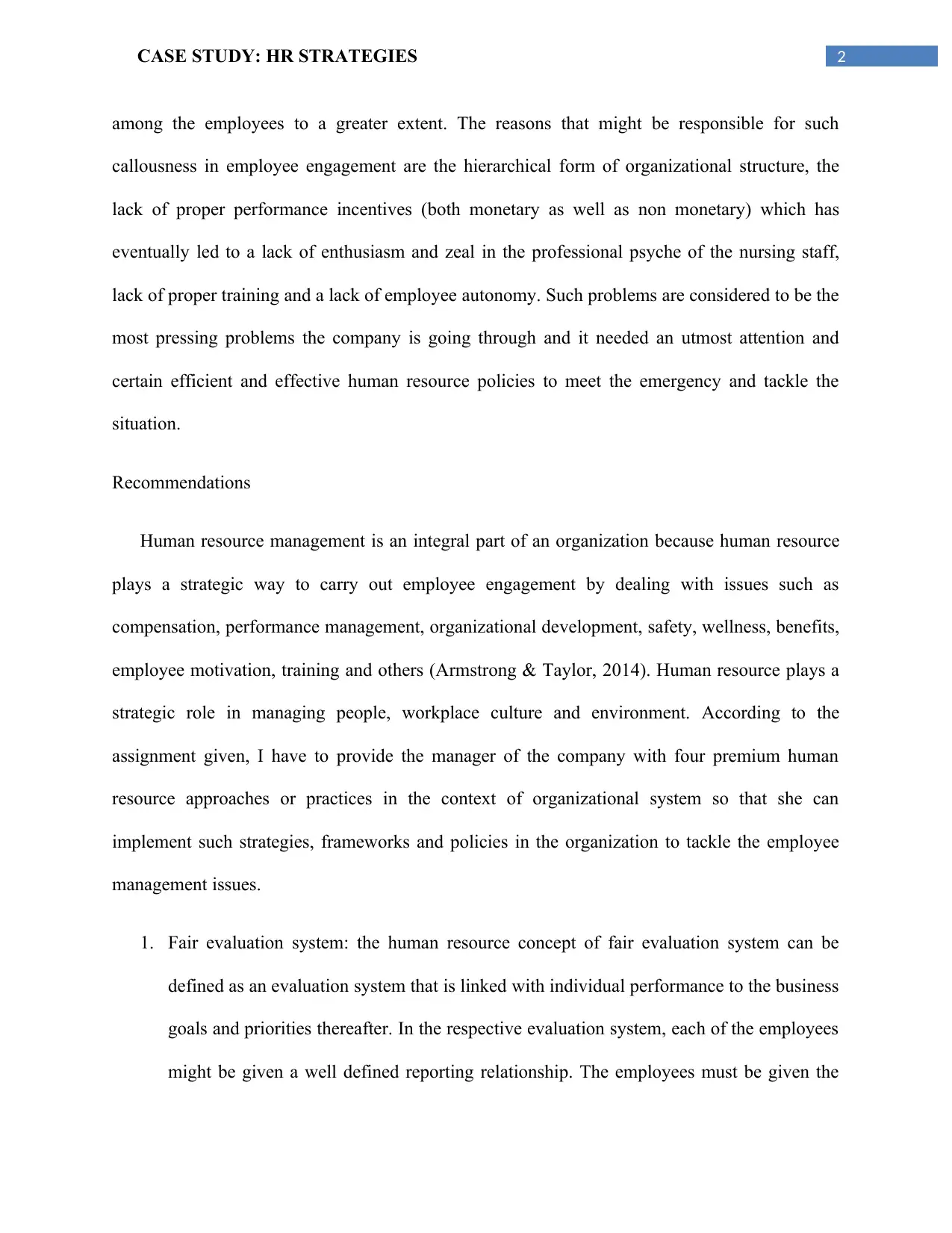
among the employees to a greater extent. The reasons that might be responsible for such
callousness in employee engagement are the hierarchical form of organizational structure, the
lack of proper performance incentives (both monetary as well as non monetary) which has
eventually led to a lack of enthusiasm and zeal in the professional psyche of the nursing staff,
lack of proper training and a lack of employee autonomy. Such problems are considered to be the
most pressing problems the company is going through and it needed an utmost attention and
certain efficient and effective human resource policies to meet the emergency and tackle the
situation.
Recommendations
Human resource management is an integral part of an organization because human resource
plays a strategic way to carry out employee engagement by dealing with issues such as
compensation, performance management, organizational development, safety, wellness, benefits,
employee motivation, training and others (Armstrong & Taylor, 2014). Human resource plays a
strategic role in managing people, workplace culture and environment. According to the
assignment given, I have to provide the manager of the company with four premium human
resource approaches or practices in the context of organizational system so that she can
implement such strategies, frameworks and policies in the organization to tackle the employee
management issues.
1. Fair evaluation system: the human resource concept of fair evaluation system can be
defined as an evaluation system that is linked with individual performance to the business
goals and priorities thereafter. In the respective evaluation system, each of the employees
might be given a well defined reporting relationship. The employees must be given the
among the employees to a greater extent. The reasons that might be responsible for such
callousness in employee engagement are the hierarchical form of organizational structure, the
lack of proper performance incentives (both monetary as well as non monetary) which has
eventually led to a lack of enthusiasm and zeal in the professional psyche of the nursing staff,
lack of proper training and a lack of employee autonomy. Such problems are considered to be the
most pressing problems the company is going through and it needed an utmost attention and
certain efficient and effective human resource policies to meet the emergency and tackle the
situation.
Recommendations
Human resource management is an integral part of an organization because human resource
plays a strategic way to carry out employee engagement by dealing with issues such as
compensation, performance management, organizational development, safety, wellness, benefits,
employee motivation, training and others (Armstrong & Taylor, 2014). Human resource plays a
strategic role in managing people, workplace culture and environment. According to the
assignment given, I have to provide the manager of the company with four premium human
resource approaches or practices in the context of organizational system so that she can
implement such strategies, frameworks and policies in the organization to tackle the employee
management issues.
1. Fair evaluation system: the human resource concept of fair evaluation system can be
defined as an evaluation system that is linked with individual performance to the business
goals and priorities thereafter. In the respective evaluation system, each of the employees
might be given a well defined reporting relationship. The employees must be given the
⊘ This is a preview!⊘
Do you want full access?
Subscribe today to unlock all pages.

Trusted by 1+ million students worldwide
3CASE STUDY: HR STRATEGIES
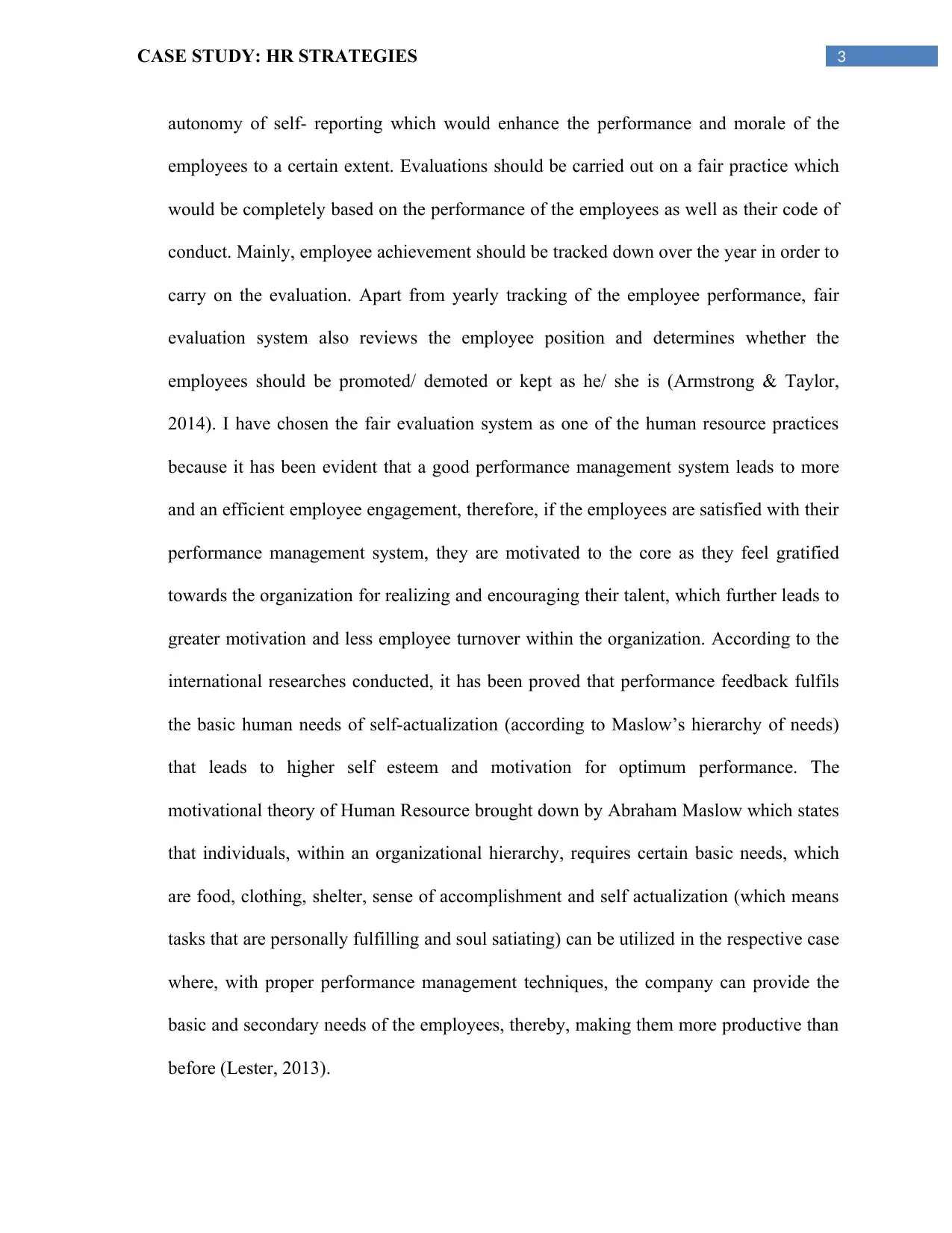
autonomy of self- reporting which would enhance the performance and morale of the
employees to a certain extent. Evaluations should be carried out on a fair practice which
would be completely based on the performance of the employees as well as their code of
conduct. Mainly, employee achievement should be tracked down over the year in order to
carry on the evaluation. Apart from yearly tracking of the employee performance, fair
evaluation system also reviews the employee position and determines whether the
employees should be promoted/ demoted or kept as he/ she is (Armstrong & Taylor,
2014). I have chosen the fair evaluation system as one of the human resource practices
because it has been evident that a good performance management system leads to more
and an efficient employee engagement, therefore, if the employees are satisfied with their
performance management system, they are motivated to the core as they feel gratified
towards the organization for realizing and encouraging their talent, which further leads to
greater motivation and less employee turnover within the organization. According to the
international researches conducted, it has been proved that performance feedback fulfils
the basic human needs of self-actualization (according to Maslow’s hierarchy of needs)
that leads to higher self esteem and motivation for optimum performance. The
motivational theory of Human Resource brought down by Abraham Maslow which states
that individuals, within an organizational hierarchy, requires certain basic needs, which
are food, clothing, shelter, sense of accomplishment and self actualization (which means
tasks that are personally fulfilling and soul satiating) can be utilized in the respective case
where, with proper performance management techniques, the company can provide the
basic and secondary needs of the employees, thereby, making them more productive than
before (Lester, 2013).
autonomy of self- reporting which would enhance the performance and morale of the
employees to a certain extent. Evaluations should be carried out on a fair practice which
would be completely based on the performance of the employees as well as their code of
conduct. Mainly, employee achievement should be tracked down over the year in order to
carry on the evaluation. Apart from yearly tracking of the employee performance, fair
evaluation system also reviews the employee position and determines whether the
employees should be promoted/ demoted or kept as he/ she is (Armstrong & Taylor,
2014). I have chosen the fair evaluation system as one of the human resource practices
because it has been evident that a good performance management system leads to more
and an efficient employee engagement, therefore, if the employees are satisfied with their
performance management system, they are motivated to the core as they feel gratified
towards the organization for realizing and encouraging their talent, which further leads to
greater motivation and less employee turnover within the organization. According to the
international researches conducted, it has been proved that performance feedback fulfils
the basic human needs of self-actualization (according to Maslow’s hierarchy of needs)
that leads to higher self esteem and motivation for optimum performance. The
motivational theory of Human Resource brought down by Abraham Maslow which states
that individuals, within an organizational hierarchy, requires certain basic needs, which
are food, clothing, shelter, sense of accomplishment and self actualization (which means
tasks that are personally fulfilling and soul satiating) can be utilized in the respective case
where, with proper performance management techniques, the company can provide the
basic and secondary needs of the employees, thereby, making them more productive than
before (Lester, 2013).
Paraphrase This Document
Need a fresh take? Get an instant paraphrase of this document with our AI Paraphraser
4CASE STUDY: HR STRATEGIES
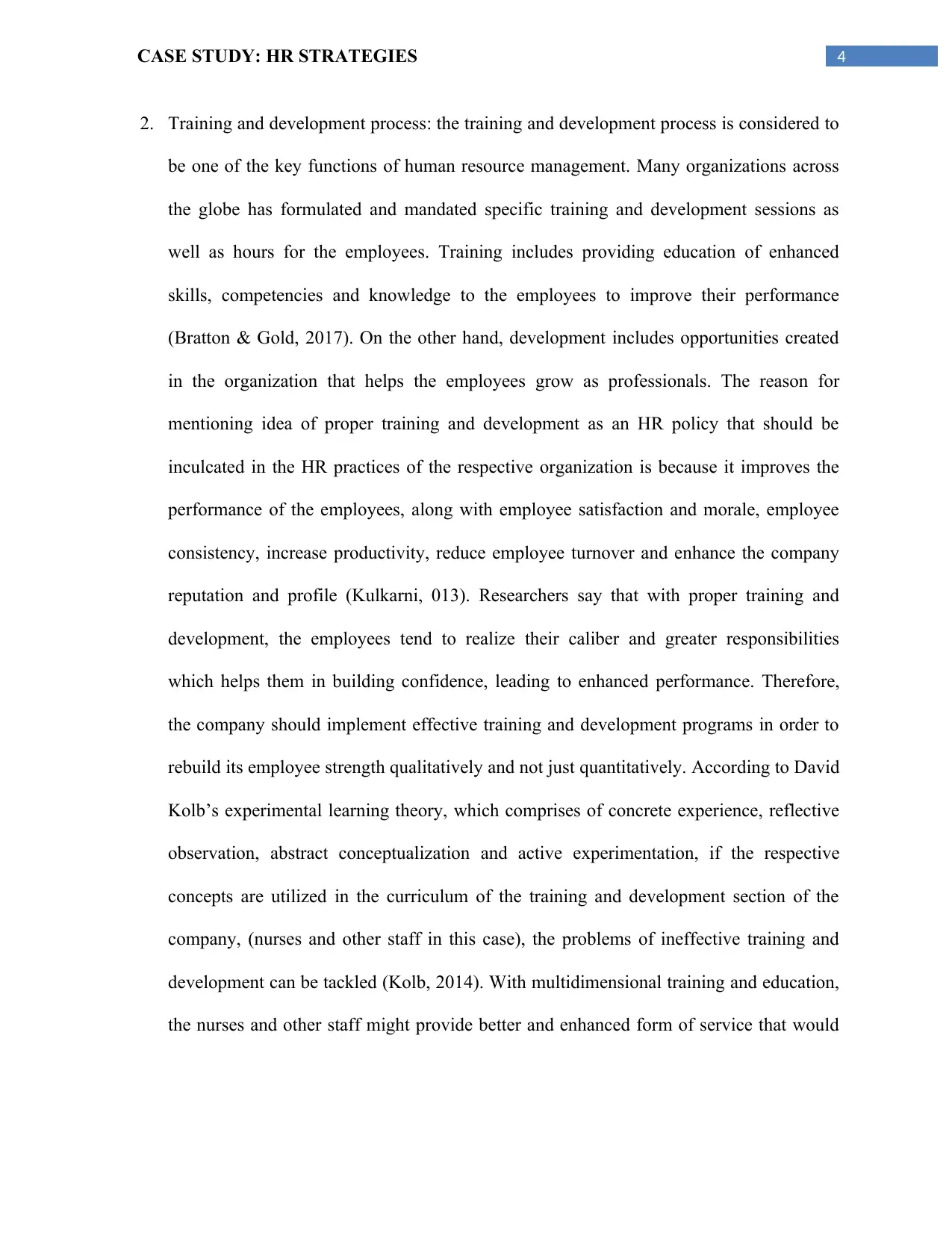
2. Training and development process: the training and development process is considered to
be one of the key functions of human resource management. Many organizations across
the globe has formulated and mandated specific training and development sessions as
well as hours for the employees. Training includes providing education of enhanced
skills, competencies and knowledge to the employees to improve their performance
(Bratton & Gold, 2017). On the other hand, development includes opportunities created
in the organization that helps the employees grow as professionals. The reason for
mentioning idea of proper training and development as an HR policy that should be
inculcated in the HR practices of the respective organization is because it improves the
performance of the employees, along with employee satisfaction and morale, employee
consistency, increase productivity, reduce employee turnover and enhance the company
reputation and profile (Kulkarni, 013). Researchers say that with proper training and
development, the employees tend to realize their caliber and greater responsibilities
which helps them in building confidence, leading to enhanced performance. Therefore,
the company should implement effective training and development programs in order to
rebuild its employee strength qualitatively and not just quantitatively. According to David
Kolb’s experimental learning theory, which comprises of concrete experience, reflective
observation, abstract conceptualization and active experimentation, if the respective
concepts are utilized in the curriculum of the training and development section of the
company, (nurses and other staff in this case), the problems of ineffective training and
development can be tackled (Kolb, 2014). With multidimensional training and education,
the nurses and other staff might provide better and enhanced form of service that would
2. Training and development process: the training and development process is considered to
be one of the key functions of human resource management. Many organizations across
the globe has formulated and mandated specific training and development sessions as
well as hours for the employees. Training includes providing education of enhanced
skills, competencies and knowledge to the employees to improve their performance
(Bratton & Gold, 2017). On the other hand, development includes opportunities created
in the organization that helps the employees grow as professionals. The reason for
mentioning idea of proper training and development as an HR policy that should be
inculcated in the HR practices of the respective organization is because it improves the
performance of the employees, along with employee satisfaction and morale, employee
consistency, increase productivity, reduce employee turnover and enhance the company
reputation and profile (Kulkarni, 013). Researchers say that with proper training and
development, the employees tend to realize their caliber and greater responsibilities
which helps them in building confidence, leading to enhanced performance. Therefore,
the company should implement effective training and development programs in order to
rebuild its employee strength qualitatively and not just quantitatively. According to David
Kolb’s experimental learning theory, which comprises of concrete experience, reflective
observation, abstract conceptualization and active experimentation, if the respective
concepts are utilized in the curriculum of the training and development section of the
company, (nurses and other staff in this case), the problems of ineffective training and
development can be tackled (Kolb, 2014). With multidimensional training and education,
the nurses and other staff might provide better and enhanced form of service that would
5CASE STUDY: HR STRATEGIES
not only increase the productivity of the workers but also improve the performance of the
company.
3. It is evident that skill shortages are a reality in the era of advanced technological
apocalypse. Selective recruitment is the act of hiring candidates from a specific group,
who are generally with a specific skill set or those from an under-represented ethnicity.
As seen in the case of the company that it hired casual nurses over the last two years, the
problem the company is facing is improper management of the casual nurses which has
resulted in absenteeism and lack of productivity among them. Therefore, selective
recruitment (casual nurse’s recruitment in this case) should be done efficiently with
regular engagement of the groups which would lead to creating a talent pool within the
organization (Noe et al., 2015). Investigations state that a proper and efficient selective
recruitment carried out by any organization increases its productivity and performance
gradually and within a short period of time. By utilizing the concept of Vroom’s
expectancy theory of motivation, which focuses least on the needs and more on the
outcomes, where Vroom says that in order to get a person completely motivated, the
factors such as effort and performance must be linked with the motivational factors. In
case of selective recruitment of casual employees where the employees tend to lose
interest in the job due to lack of job security, Vroom’s expectancy theory can be
inculcated to bring out the best even among the casual workers (Parijat & Bagga, 2014).
4. Employee autonomy: Employee autonomy should be the priority of the human resource
management of the respective company. Employee autonomy can be defined as the
practice by which the employees are provided with autonomy of their own job and
employment. The most important part of employee autonomy is that it provides the
not only increase the productivity of the workers but also improve the performance of the
company.
3. It is evident that skill shortages are a reality in the era of advanced technological
apocalypse. Selective recruitment is the act of hiring candidates from a specific group,
who are generally with a specific skill set or those from an under-represented ethnicity.
As seen in the case of the company that it hired casual nurses over the last two years, the
problem the company is facing is improper management of the casual nurses which has
resulted in absenteeism and lack of productivity among them. Therefore, selective
recruitment (casual nurse’s recruitment in this case) should be done efficiently with
regular engagement of the groups which would lead to creating a talent pool within the
organization (Noe et al., 2015). Investigations state that a proper and efficient selective
recruitment carried out by any organization increases its productivity and performance
gradually and within a short period of time. By utilizing the concept of Vroom’s
expectancy theory of motivation, which focuses least on the needs and more on the
outcomes, where Vroom says that in order to get a person completely motivated, the
factors such as effort and performance must be linked with the motivational factors. In
case of selective recruitment of casual employees where the employees tend to lose
interest in the job due to lack of job security, Vroom’s expectancy theory can be
inculcated to bring out the best even among the casual workers (Parijat & Bagga, 2014).
4. Employee autonomy: Employee autonomy should be the priority of the human resource
management of the respective company. Employee autonomy can be defined as the
practice by which the employees are provided with autonomy of their own job and
employment. The most important part of employee autonomy is that it provides the
⊘ This is a preview!⊘
Do you want full access?
Subscribe today to unlock all pages.
Trusted by 1+ million students worldwide
6CASE STUDY: HR STRATEGIES
employees with confidence and control. Autonomy leads to reengagement of the
employees, according to the industrial psychologists. According to the extensive study
done in the field of organizational behavior and psychology, it was found out that in the
vertical hierarchy, where employees are given the tasks by the superiors from top to
bottom, the brain’s emotional response often happens with a decreased magnitude of
cognitive functioning, which means the more vertical hierarchy among the subordinates
and the superiors, the less will be holistic cognitive functioning. If the employees are
micromanaged, sometimes the employees show the signs of discomfort and lack of zeal.
Whereas, in the case of autonomy of the employees, the practice of giving the employees
the freedom to set their own hours of work and freedom to perform task according to
their style, a sense of belonging and responsibility arouses in the mind of the employees
(Anitha, 2014). With an increased feeling of ownership and loyalty, the employees
generally feel happy, joyful and less stressed which often positively leads to job
satisfaction and an ultimate employee experience and engagement. Every employee is
unique and if every worker is given the opportunity to work independently, they might as
well contribute to the innovation and creativity within the organization. With greater
employee autonomy within an organization, the employees are encouraged to exhibit
their range of unique and remarkable skills and strengths, which otherwise might not
have come to the forefront of the organization. Such actions have always helped the
human resource management to recognize potential positions for them across the
organization. In this case, too, if Maslow’s hierarchy of needs is utilized, it can be seen
that the practice of employee autonomy actually enhances the “self- realization” and “self
actualization” concepts of the respective theory, which means that the practice of
employees with confidence and control. Autonomy leads to reengagement of the
employees, according to the industrial psychologists. According to the extensive study
done in the field of organizational behavior and psychology, it was found out that in the
vertical hierarchy, where employees are given the tasks by the superiors from top to
bottom, the brain’s emotional response often happens with a decreased magnitude of
cognitive functioning, which means the more vertical hierarchy among the subordinates
and the superiors, the less will be holistic cognitive functioning. If the employees are
micromanaged, sometimes the employees show the signs of discomfort and lack of zeal.
Whereas, in the case of autonomy of the employees, the practice of giving the employees
the freedom to set their own hours of work and freedom to perform task according to
their style, a sense of belonging and responsibility arouses in the mind of the employees
(Anitha, 2014). With an increased feeling of ownership and loyalty, the employees
generally feel happy, joyful and less stressed which often positively leads to job
satisfaction and an ultimate employee experience and engagement. Every employee is
unique and if every worker is given the opportunity to work independently, they might as
well contribute to the innovation and creativity within the organization. With greater
employee autonomy within an organization, the employees are encouraged to exhibit
their range of unique and remarkable skills and strengths, which otherwise might not
have come to the forefront of the organization. Such actions have always helped the
human resource management to recognize potential positions for them across the
organization. In this case, too, if Maslow’s hierarchy of needs is utilized, it can be seen
that the practice of employee autonomy actually enhances the “self- realization” and “self
actualization” concepts of the respective theory, which means that the practice of
Paraphrase This Document
Need a fresh take? Get an instant paraphrase of this document with our AI Paraphraser
7CASE STUDY: HR STRATEGIES
employee autonomy provides a sense of holistic (both professional and personal)
achievement and enrichment which further enhances the productivity and performance of
the employees which is related to the goals and objectives of the company (Lester, 2013).
Conclusion
Human resource management is an integral and important part of an organization. The
respective paper concludes to be an essay which provides human resource related
recommendations to a particular organization/ company that is going through certain problems
related to employee turnover and management. In the respective paper, different human resource
approaches have been utilized in order to provide proper recommendations to the manager of the
respective firm. The case study is about a healthcare providing company where it has been seen
that the company has been going though certain solemn employee management problems on
which the respective paper concludes to provide a solution.
employee autonomy provides a sense of holistic (both professional and personal)
achievement and enrichment which further enhances the productivity and performance of
the employees which is related to the goals and objectives of the company (Lester, 2013).
Conclusion
Human resource management is an integral and important part of an organization. The
respective paper concludes to be an essay which provides human resource related
recommendations to a particular organization/ company that is going through certain problems
related to employee turnover and management. In the respective paper, different human resource
approaches have been utilized in order to provide proper recommendations to the manager of the
respective firm. The case study is about a healthcare providing company where it has been seen
that the company has been going though certain solemn employee management problems on
which the respective paper concludes to provide a solution.
8CASE STUDY: HR STRATEGIES
References:
Noe, R. A., Hollenbeck, J. R., Gerhart, B., & Wright, P. M. (2017). Human resource
management: Gaining a competitive advantage. New York, NY: McGraw-Hill Education.
Armstrong, M., & Taylor, S. (2014). Armstrong's handbook of human resource management
practice. Kogan Page Publishers.
Bratton, J., & Gold, J. (2017). Human resource management: theory and practice. Palgrave.
Noe, R. A., Hollenbeck, J. R., Gerhart, B., & Wright, P. M. (2015). Human resources
management. Instructor, 2015.
Lester, D. (2013). Measuring Maslow's hierarchy of needs. Psychological Reports, 113(1),
15-17.
Parijat, P., & Bagga, S. (2014). Victor Vroom’s expectancy theory of motivation–An
evaluation. International Research Journal of Business and Management, 7(9), 1-8.
Kolb, D. A. (2014). Experiential learning: Experience as the source of learning and
development. FT press.
Anitha, J. (2014). Determinants of employee engagement and their impact on employee
performance. International journal of productivity and performance management, 63(3),
308.
Kulkarni, P. P. (2013). A literature review on training & development and quality of work
life. Researchers World, 4(2), 136.
References:
Noe, R. A., Hollenbeck, J. R., Gerhart, B., & Wright, P. M. (2017). Human resource
management: Gaining a competitive advantage. New York, NY: McGraw-Hill Education.
Armstrong, M., & Taylor, S. (2014). Armstrong's handbook of human resource management
practice. Kogan Page Publishers.
Bratton, J., & Gold, J. (2017). Human resource management: theory and practice. Palgrave.
Noe, R. A., Hollenbeck, J. R., Gerhart, B., & Wright, P. M. (2015). Human resources
management. Instructor, 2015.
Lester, D. (2013). Measuring Maslow's hierarchy of needs. Psychological Reports, 113(1),
15-17.
Parijat, P., & Bagga, S. (2014). Victor Vroom’s expectancy theory of motivation–An
evaluation. International Research Journal of Business and Management, 7(9), 1-8.
Kolb, D. A. (2014). Experiential learning: Experience as the source of learning and
development. FT press.
Anitha, J. (2014). Determinants of employee engagement and their impact on employee
performance. International journal of productivity and performance management, 63(3),
308.
Kulkarni, P. P. (2013). A literature review on training & development and quality of work
life. Researchers World, 4(2), 136.
⊘ This is a preview!⊘
Do you want full access?
Subscribe today to unlock all pages.
Trusted by 1+ million students worldwide

1 out of 9


Related Documents


Your All-in-One AI-Powered Toolkit for Academic Success.
+13062052269
info@desklib.com
Available 24*7 on WhatsApp / Email
![[object Object]](/_next/static/media/star-bottom.7253800d.svg)
Unlock your academic potential
Copyright © 2020–2026 A2Z Services. All Rights Reserved. Developed and managed by ZUCOL.