Delivering High Performance in NZ Post: HR Strategy, DB744
VerifiedAdded on 2023/04/20
|13
|756
|443
Report
AI Summary
This report investigates strategies for delivering high performance at New Zealand Post, focusing on the role of Human Resources as a strategic partner. It evaluates two change strategies: the Normative-Re-educative Strategy, emphasizing changes in employee attitudes and values through collaboration and communication, and the Environmental-Adaptive Strategy, which shifts the burden of change by exploiting natural adaptation. The report analyzes the company's PEST environment and concludes that both strategies are suitable for NZ Post, with the Normative-Re-educative approach fostering new norms and values, and the Environmental-Adaptive Strategy leveraging employees' adaptability when faced with limited options. The document references academic sources to support its analysis and recommendations.

Delivering High
Performance in New
Zealand Post: The Role of
HR as a Strategic Partner
N a m e o f t h e S t u d e n t :
N a m e o f t h e Tu t o r :
S t u d e n t ’ s I D :
C o u r s e C o d e :
Performance in New
Zealand Post: The Role of
HR as a Strategic Partner
N a m e o f t h e S t u d e n t :
N a m e o f t h e Tu t o r :
S t u d e n t ’ s I D :
C o u r s e C o d e :
Paraphrase This Document
Need a fresh take? Get an instant paraphrase of this document with our AI Paraphraser

Investigation and
evaluation of proposed
alternative change strategy
1
evaluation of proposed
alternative change strategy
1

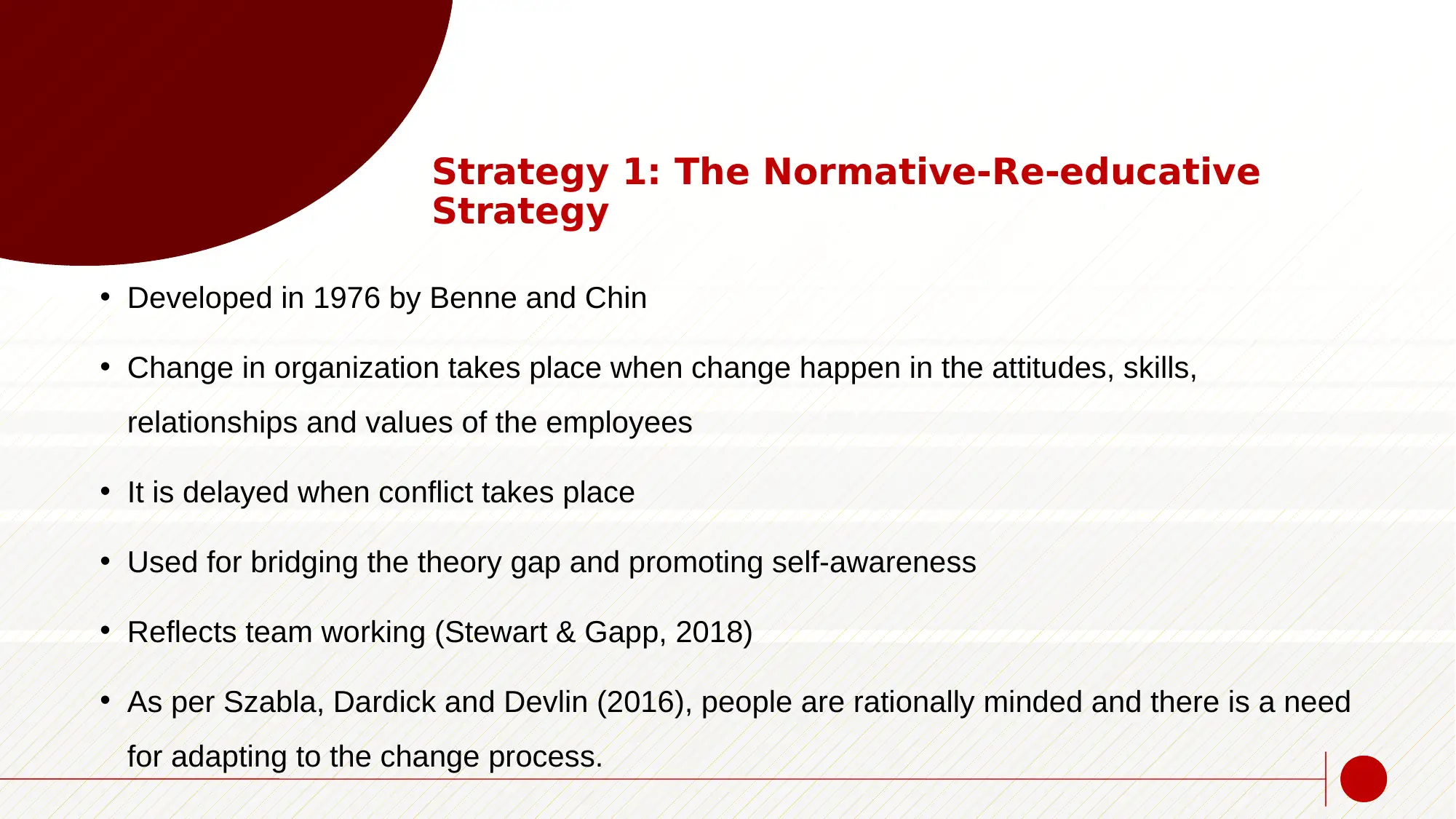
Strategy 1: The Normative-Re-educative
Strategy
• Developed in 1976 by Benne and Chin
• Change in organization takes place when change happen in the attitudes, skills,
relationships and values of the employees
• It is delayed when conflict takes place
• Used for bridging the theory gap and promoting self-awareness
• Reflects team working (Stewart & Gapp, 2018)
• As per Szabla, Dardick and Devlin (2016), people are rationally minded and there is a need
for adapting to the change process.
Strategy
• Developed in 1976 by Benne and Chin
• Change in organization takes place when change happen in the attitudes, skills,
relationships and values of the employees
• It is delayed when conflict takes place
• Used for bridging the theory gap and promoting self-awareness
• Reflects team working (Stewart & Gapp, 2018)
• As per Szabla, Dardick and Devlin (2016), people are rationally minded and there is a need
for adapting to the change process.
⊘ This is a preview!⊘
Do you want full access?
Subscribe today to unlock all pages.

Trusted by 1+ million students worldwide

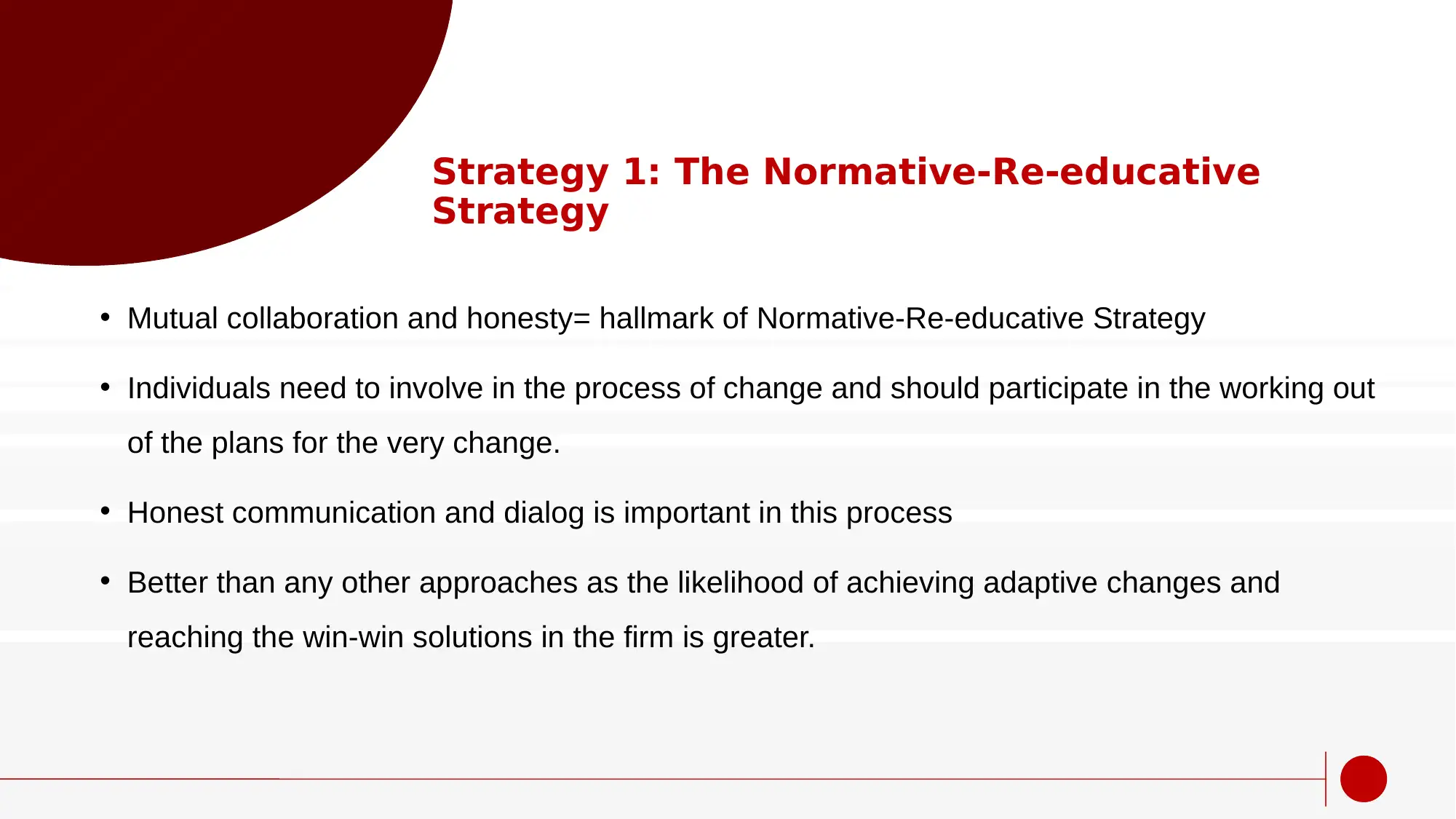
Strategy 1: The Normative-Re-educative
Strategy
• Mutual collaboration and honesty= hallmark of Normative-Re-educative Strategy
• Individuals need to involve in the process of change and should participate in the working out
of the plans for the very change.
• Honest communication and dialog is important in this process
• Better than any other approaches as the likelihood of achieving adaptive changes and
reaching the win-win solutions in the firm is greater.
Strategy
• Mutual collaboration and honesty= hallmark of Normative-Re-educative Strategy
• Individuals need to involve in the process of change and should participate in the working out
of the plans for the very change.
• Honest communication and dialog is important in this process
• Better than any other approaches as the likelihood of achieving adaptive changes and
reaching the win-win solutions in the firm is greater.
Paraphrase This Document
Need a fresh take? Get an instant paraphrase of this document with our AI Paraphraser

Investigation and
evaluation of proposed
alternative change strategy
2
evaluation of proposed
alternative change strategy
2

Strategy 2: Environmental-Adaptive Strategy
• Developed by Fred Nickols
• Suitable for the situations where transformative and radical change is called for
• It helps in shifting the burden of change to the people from the management and
organisation.
• It exploits the natural adaptive nature
• It is also known as “the die-on-the-vine” strategy (Apreda, 2016).
• Developed by Fred Nickols
• Suitable for the situations where transformative and radical change is called for
• It helps in shifting the burden of change to the people from the management and
organisation.
• It exploits the natural adaptive nature
• It is also known as “the die-on-the-vine” strategy (Apreda, 2016).
⊘ This is a preview!⊘
Do you want full access?
Subscribe today to unlock all pages.

Trusted by 1+ million students worldwide

Selection factors
• Time frames are not any factor in this strategy. It can work in shorter time frames
• Associated risk- Managing what can be explosive growth and development in the
organisation and, if not properly seeded with the employees, the growing influx of the
individuals from the old culture could infuse the organisation
• Time frames are not any factor in this strategy. It can work in shorter time frames
• Associated risk- Managing what can be explosive growth and development in the
organisation and, if not properly seeded with the employees, the growing influx of the
individuals from the old culture could infuse the organisation
Paraphrase This Document
Need a fresh take? Get an instant paraphrase of this document with our AI Paraphraser

Company’s PEST analysis
• Managers should pay close attention to all the constituencies, particularly customers
• They should initiate the changes whenever it is necessary for serving their legitimate
interests
• The organisational managers are required to care about the customers, the existing
employees and the involved stockholders (Shimell et al., 2018).
• Managers should pay close attention to all the constituencies, particularly customers
• They should initiate the changes whenever it is necessary for serving their legitimate
interests
• The organisational managers are required to care about the customers, the existing
employees and the involved stockholders (Shimell et al., 2018).

Assumptions
• Employees often oppose the distribution and the loss
• Employees are required to adapt in readily way for the new circumstances
• Changes are based on developing new organisation and gradually transferring the people
from the old organisation to the new one
• It avoids the several different complications that are linked with trying to change culture or
organisational people.
• Employees often oppose the distribution and the loss
• Employees are required to adapt in readily way for the new circumstances
• Changes are based on developing new organisation and gradually transferring the people
from the old organisation to the new one
• It avoids the several different complications that are linked with trying to change culture or
organisational people.
⊘ This is a preview!⊘
Do you want full access?
Subscribe today to unlock all pages.

Trusted by 1+ million students worldwide

Conclusion
• The two best suitable strategies for the New Zealand Post case are that of:
• The Normative-Re-educative Strategy
• The Environmental-Adaptive Strategy
• The Normative Re-educative strategy would help the company in exposing the employees to the
new norms and values as well as the necessities for adopting those new norms and values
• The Environmental-Adaptive Strategy is built on the notion that although people at first, resist
change, they eventually adapt themselves to it when they find themselves left with no other option to
choose from.
• The two best suitable strategies for the New Zealand Post case are that of:
• The Normative-Re-educative Strategy
• The Environmental-Adaptive Strategy
• The Normative Re-educative strategy would help the company in exposing the employees to the
new norms and values as well as the necessities for adopting those new norms and values
• The Environmental-Adaptive Strategy is built on the notion that although people at first, resist
change, they eventually adapt themselves to it when they find themselves left with no other option to
choose from.
Paraphrase This Document
Need a fresh take? Get an instant paraphrase of this document with our AI Paraphraser

References:
• Apreda, C. (2016). Climate change, urban vulnerability and adaptation strategies to pluvial
flooding. UPLanD-Journal of Urban Planning, Landscape & environmental Design, 1(1), 233.
• Shimell, M., Pan, X., Martin, F. A., Ghosh, A. C., Leopold, P., O'Connor, M. B., & Romero, N.
M. (2018). Prothoracicotropic hormone modulates environmental adaptive plasticity through
the control of developmental timing. Development, dev-159699.
• Stewart, H., & Gapp, R. (2018). 14. The tree of knowledge: sustainable management
practices for a collaborative. Research Handbook on Small Business Social Responsibility:
Global Perspectives, 341.
• Szabla, D. B., Dardick, W., & Devlin, J. A. (2016). The perception of change strategy scale:
Validating the measure. In Research in organizational change and development (pp. 83-111).
Emerald Group Publishing Limited.
• Apreda, C. (2016). Climate change, urban vulnerability and adaptation strategies to pluvial
flooding. UPLanD-Journal of Urban Planning, Landscape & environmental Design, 1(1), 233.
• Shimell, M., Pan, X., Martin, F. A., Ghosh, A. C., Leopold, P., O'Connor, M. B., & Romero, N.
M. (2018). Prothoracicotropic hormone modulates environmental adaptive plasticity through
the control of developmental timing. Development, dev-159699.
• Stewart, H., & Gapp, R. (2018). 14. The tree of knowledge: sustainable management
practices for a collaborative. Research Handbook on Small Business Social Responsibility:
Global Perspectives, 341.
• Szabla, D. B., Dardick, W., & Devlin, J. A. (2016). The perception of change strategy scale:
Validating the measure. In Research in organizational change and development (pp. 83-111).
Emerald Group Publishing Limited.

“
12
Any Questtion?
12
Any Questtion?
⊘ This is a preview!⊘
Do you want full access?
Subscribe today to unlock all pages.

Trusted by 1+ million students worldwide
1 out of 13
Related Documents
Your All-in-One AI-Powered Toolkit for Academic Success.
+13062052269
info@desklib.com
Available 24*7 on WhatsApp / Email
Unlock your academic potential
Copyright © 2020–2026 A2Z Services. All Rights Reserved. Developed and managed by ZUCOL.