HRD Strategies: Learning Styles, Training Evaluation at Sun Court Ltd.
VerifiedAdded on 2020/07/22
|18
|5603
|72
Report
AI Summary
This report provides a comprehensive analysis of human resource development (HRD) strategies within Sun Court Ltd., a property management firm. It delves into various learning styles, including cognitive, social, and behaviorism theories, and their contribution to designing effective training events. The report also discusses the role of the learning curve and the importance of transferring learning to the workplace, emphasizing how these elements enhance employee skills and knowledge. Furthermore, it examines the needs of training at different levels within the organization, highlighting the advantages and disadvantages of various training methods such as classroom learning, practical training, and case study methods. The report also covers a systematic approach to planning a training event and evaluating its success using suitable techniques. Finally, it addresses the role of the UK government in training and development, the impact of the competency movement on public and private sectors, and the contribution of contemporary training initiatives in human resources development.

HUMAN RESOURCE
DEVELOPMENT
DEVELOPMENT

Paraphrase This Document
Need a fresh take? Get an instant paraphrase of this document with our AI Paraphraser
Table of Contents
INTRODUCTION...........................................................................................................................1
TASK 1............................................................................................................................................1
1.1 Different learning styles........................................................................................................1
1.2 Role of learning curve & the importance of transferring learning........................................3
1.3 Contribution of learning styles and theories.........................................................................4
TASK 2............................................................................................................................................5
2.1 Needs of training at different levels......................................................................................5
2.2 Advantages and disadvantages of training methods............................................................6
2.3 Systematic approach to plan a training event........................................................................7
TASK 3............................................................................................................................................8
3.1 Evaluation by using suitable techniques...............................................................................8
3.2 Evaluation of a training event..............................................................................................9
3.3 Success of evaluation methods............................................................................................10
TASK 4..........................................................................................................................................11
4.1 Role of government in training and development ..............................................................11
3.2 Impact of competency movement upon public and private sectors...................................12
4.3 Contribution of contemporary training initiatives in human resources development ......12
CONCLUSION..............................................................................................................................13
REFERENCES..............................................................................................................................15
INTRODUCTION...........................................................................................................................1
TASK 1............................................................................................................................................1
1.1 Different learning styles........................................................................................................1
1.2 Role of learning curve & the importance of transferring learning........................................3
1.3 Contribution of learning styles and theories.........................................................................4
TASK 2............................................................................................................................................5
2.1 Needs of training at different levels......................................................................................5
2.2 Advantages and disadvantages of training methods............................................................6
2.3 Systematic approach to plan a training event........................................................................7
TASK 3............................................................................................................................................8
3.1 Evaluation by using suitable techniques...............................................................................8
3.2 Evaluation of a training event..............................................................................................9
3.3 Success of evaluation methods............................................................................................10
TASK 4..........................................................................................................................................11
4.1 Role of government in training and development ..............................................................11
3.2 Impact of competency movement upon public and private sectors...................................12
4.3 Contribution of contemporary training initiatives in human resources development ......12
CONCLUSION..............................................................................................................................13
REFERENCES..............................................................................................................................15
INTRODUCTION
Human resource development plays a significant role within workplace; it is concern with
providing training and education to employees. When a person is hired, it becomes essential for
managers to provide him or her new opportunities to learn something and distributing resources
so as he or she can perform various tasks effectively. Apart from this, the aim of HRD is to
create a platform for superior workforce so that company can easily achieve its goals and
objectives in an adequate manner (Beck, 2011). It includes several opportunities, such as – career
development, employee training, succession planning, performance management, mentoring,
coaching etc. Sun Court Ltd. is the selected organisation in this present assignment which deals
in property management firm. There will be a discussion on different learning styles and their
roles in designing of learning event. Training is essential at different levels so that it is necessary
for managers to use a systematic approach for this. The role of UK government in training and
development have also been explained in this report. There will be use various techniques for
providing training to employees in the best possible manner.
TASK 1
1.1 Different learning styles
In order to stay in competitive market, it is essential for business entities to grow or
develop their plans and policies. This modification brings an enormous challenge for the
workforces. Therefore, learning is required for improving skills and capabilities of staff
members. Managers of Sun Court Ltd. can use various learning styles so as to generate a
flexibility in training and development sessions. Below mentioned different types of learning
styles: -
Cognitive learning theory – It is based upon assumptions, observation or perception. The
cognitive learning theory explains brain is most incredible network through which
individuals can process any information and interpret anything. It implies that by using
diverse methods of learning managers can analyse mentality of an individual. In addition,
adequate cognitive activities can make easier as well as flexible learning with which
people can store new information in their mind for a long-term period (DENG, ZHANG
and LI, 2013). It is classified into two categories, such as – social cognitive theory and
the cognitive behavioural theory.
1
Human resource development plays a significant role within workplace; it is concern with
providing training and education to employees. When a person is hired, it becomes essential for
managers to provide him or her new opportunities to learn something and distributing resources
so as he or she can perform various tasks effectively. Apart from this, the aim of HRD is to
create a platform for superior workforce so that company can easily achieve its goals and
objectives in an adequate manner (Beck, 2011). It includes several opportunities, such as – career
development, employee training, succession planning, performance management, mentoring,
coaching etc. Sun Court Ltd. is the selected organisation in this present assignment which deals
in property management firm. There will be a discussion on different learning styles and their
roles in designing of learning event. Training is essential at different levels so that it is necessary
for managers to use a systematic approach for this. The role of UK government in training and
development have also been explained in this report. There will be use various techniques for
providing training to employees in the best possible manner.
TASK 1
1.1 Different learning styles
In order to stay in competitive market, it is essential for business entities to grow or
develop their plans and policies. This modification brings an enormous challenge for the
workforces. Therefore, learning is required for improving skills and capabilities of staff
members. Managers of Sun Court Ltd. can use various learning styles so as to generate a
flexibility in training and development sessions. Below mentioned different types of learning
styles: -
Cognitive learning theory – It is based upon assumptions, observation or perception. The
cognitive learning theory explains brain is most incredible network through which
individuals can process any information and interpret anything. It implies that by using
diverse methods of learning managers can analyse mentality of an individual. In addition,
adequate cognitive activities can make easier as well as flexible learning with which
people can store new information in their mind for a long-term period (DENG, ZHANG
and LI, 2013). It is classified into two categories, such as – social cognitive theory and
the cognitive behavioural theory.
1
⊘ This is a preview!⊘
Do you want full access?
Subscribe today to unlock all pages.

Trusted by 1+ million students worldwide
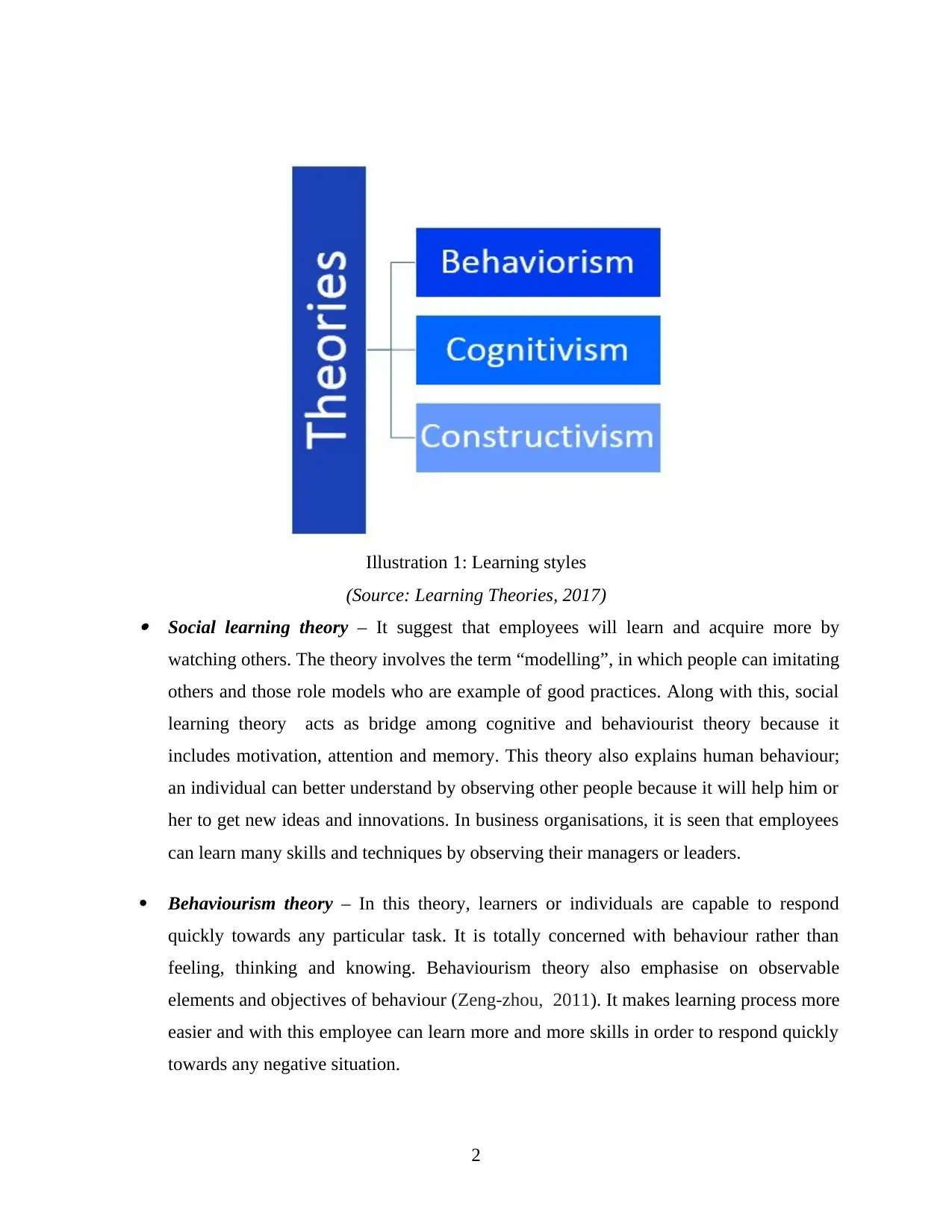
(Source: Learning Theories, 2017) Social learning theory – It suggest that employees will learn and acquire more by
watching others. The theory involves the term “modelling”, in which people can imitating
others and those role models who are example of good practices. Along with this, social
learning theory acts as bridge among cognitive and behaviourist theory because it
includes motivation, attention and memory. This theory also explains human behaviour;
an individual can better understand by observing other people because it will help him or
her to get new ideas and innovations. In business organisations, it is seen that employees
can learn many skills and techniques by observing their managers or leaders.
Behaviourism theory – In this theory, learners or individuals are capable to respond
quickly towards any particular task. It is totally concerned with behaviour rather than
feeling, thinking and knowing. Behaviourism theory also emphasise on observable
elements and objectives of behaviour (Zeng-zhou, 2011). It makes learning process more
easier and with this employee can learn more and more skills in order to respond quickly
towards any negative situation.
2
Illustration 1: Learning styles
watching others. The theory involves the term “modelling”, in which people can imitating
others and those role models who are example of good practices. Along with this, social
learning theory acts as bridge among cognitive and behaviourist theory because it
includes motivation, attention and memory. This theory also explains human behaviour;
an individual can better understand by observing other people because it will help him or
her to get new ideas and innovations. In business organisations, it is seen that employees
can learn many skills and techniques by observing their managers or leaders.
Behaviourism theory – In this theory, learners or individuals are capable to respond
quickly towards any particular task. It is totally concerned with behaviour rather than
feeling, thinking and knowing. Behaviourism theory also emphasise on observable
elements and objectives of behaviour (Zeng-zhou, 2011). It makes learning process more
easier and with this employee can learn more and more skills in order to respond quickly
towards any negative situation.
2
Illustration 1: Learning styles
Paraphrase This Document
Need a fresh take? Get an instant paraphrase of this document with our AI Paraphraser
1.2 Role of learning curve & the importance of transferring learning
Learning curve has a crucial role in learning process, it shows overall record of
performance of people or learners. Beside this, learning will not work if it is not used in
practical manner. Managers of Sun Court Ltd. uses various learning styles in order to achieve
manufacturing goals and objectives in a certain time period.
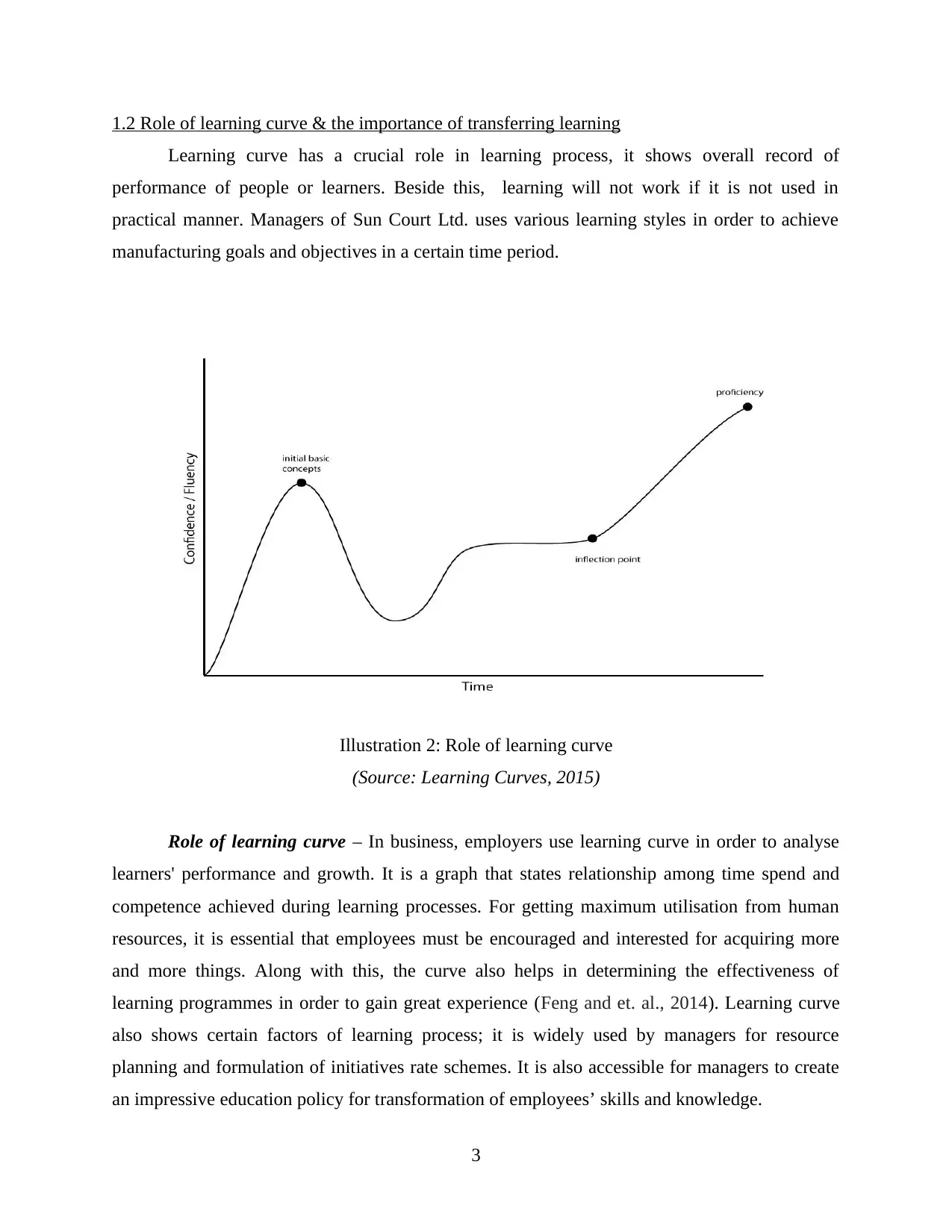
(Source: Learning Curves, 2015)
Role of learning curve – In business, employers use learning curve in order to analyse
learners' performance and growth. It is a graph that states relationship among time spend and
competence achieved during learning processes. For getting maximum utilisation from human
resources, it is essential that employees must be encouraged and interested for acquiring more
and more things. Along with this, the curve also helps in determining the effectiveness of
learning programmes in order to gain great experience (Feng and et. al., 2014). Learning curve
also shows certain factors of learning process; it is widely used by managers for resource
planning and formulation of initiatives rate schemes. It is also accessible for managers to create
an impressive education policy for transformation of employees’ skills and knowledge.
3
Illustration 2: Role of learning curve
Learning curve has a crucial role in learning process, it shows overall record of
performance of people or learners. Beside this, learning will not work if it is not used in
practical manner. Managers of Sun Court Ltd. uses various learning styles in order to achieve
manufacturing goals and objectives in a certain time period.
(Source: Learning Curves, 2015)
Role of learning curve – In business, employers use learning curve in order to analyse
learners' performance and growth. It is a graph that states relationship among time spend and
competence achieved during learning processes. For getting maximum utilisation from human
resources, it is essential that employees must be encouraged and interested for acquiring more
and more things. Along with this, the curve also helps in determining the effectiveness of
learning programmes in order to gain great experience (Feng and et. al., 2014). Learning curve
also shows certain factors of learning process; it is widely used by managers for resource
planning and formulation of initiatives rate schemes. It is also accessible for managers to create
an impressive education policy for transformation of employees’ skills and knowledge.
3
Illustration 2: Role of learning curve
Importance of transfer learning at workplace: -
Transfer of learning refers to the capabilities that can be applied in knowledge from one
context to another. It occurs when a learner finds out certain general features in learning
concepts, principles and skills and if there is a linkage in information or facts. Transfer of
learning is very important because if an individual does not share his or her knowledge then
learning sessions would begin from start. Therefore, many business organisations organise
training and development programmes for different employees where they can exchange their
prior knowledge and get something new from each other. For this, managers use time, money
and energy so as to effectively train people in order to gain some advantages from competitive
marketplace.
Main aim of learning programmes that is assistive to add value at workplace by
improvising technical or non-technical skills of staff members.
Learning sessions must be interested and the knowledge is able to transferred across the
company. Then it can be said that it is helpful in proper utilisation of finance in the best
possible manner (ZHANG and et. al., 2011).
Generally, staff members are being faced various obstacles and challenges due to the lack
of prior knowledge. Transfer of learning will assist employees to cope up with these
barriers and get better outcomes.
1.3 Contribution of learning styles and theories
There are various types of learning theories and styles that assists in rendering a
conceptual framework in order to achieve learning requirements and objectives. But selection of
learning style totally rely upon managers of Sun Court Ltd. It also involves how quick workers
can endorse new situation. Hence, while selecting and formulating training events, business
owners have to evaluate company's desires and goals (Fuhua, 2011). Because the successful
study of all learning methods will contributes in effectively organising various learning events.
On the other hand, it is too difficult for managers to select a particular learning style
because all of them has its own goals and objectives. Combination of different learning styles
will help in planning and designing impressive training events. It is necessary for Sun Court Ltd.
to improve or develop the abilities of employees, i.e. decision making ability, leadership or
technical skills, teamwork, efficiency, increasing responsibilities etc. Along with this, effective
4
Transfer of learning refers to the capabilities that can be applied in knowledge from one
context to another. It occurs when a learner finds out certain general features in learning
concepts, principles and skills and if there is a linkage in information or facts. Transfer of
learning is very important because if an individual does not share his or her knowledge then
learning sessions would begin from start. Therefore, many business organisations organise
training and development programmes for different employees where they can exchange their
prior knowledge and get something new from each other. For this, managers use time, money
and energy so as to effectively train people in order to gain some advantages from competitive
marketplace.
Main aim of learning programmes that is assistive to add value at workplace by
improvising technical or non-technical skills of staff members.
Learning sessions must be interested and the knowledge is able to transferred across the
company. Then it can be said that it is helpful in proper utilisation of finance in the best
possible manner (ZHANG and et. al., 2011).
Generally, staff members are being faced various obstacles and challenges due to the lack
of prior knowledge. Transfer of learning will assist employees to cope up with these
barriers and get better outcomes.
1.3 Contribution of learning styles and theories
There are various types of learning theories and styles that assists in rendering a
conceptual framework in order to achieve learning requirements and objectives. But selection of
learning style totally rely upon managers of Sun Court Ltd. It also involves how quick workers
can endorse new situation. Hence, while selecting and formulating training events, business
owners have to evaluate company's desires and goals (Fuhua, 2011). Because the successful
study of all learning methods will contributes in effectively organising various learning events.
On the other hand, it is too difficult for managers to select a particular learning style
because all of them has its own goals and objectives. Combination of different learning styles
will help in planning and designing impressive training events. It is necessary for Sun Court Ltd.
to improve or develop the abilities of employees, i.e. decision making ability, leadership or
technical skills, teamwork, efficiency, increasing responsibilities etc. Along with this, effective
4
⊘ This is a preview!⊘
Do you want full access?
Subscribe today to unlock all pages.
Trusted by 1+ million students worldwide
learning theories are helpful defining kinds, framework and theoretical explanation so as to
effectively designed most suitable target objectives.
Diverse learning styles and theories are used by Sun Court Ltd. so as to obtain better
outcomes by learning programmes. To plan and design learning events, business entities have to
emphasis on implementing best learning methods that can prioritise by the staff members.
Additionally, managers have to identify and understand various learning styles or theories so as
to effectively recognise an individual's acquiring needs and patterns. It would help in executing a
goal oriented and focused training objectives.
TASK 2
2.1 Needs of training at different levels
Training is the essential part of human resource development; it is must for top to bottom
level. Training should be provided in order to evolve personnel who are employed at workplace.
In Sun Court Ltd. training helps in improving workers abilities or competencies so as firm can
effectively perform in competitive market.
Training requirements in different departments: -
Finance department Marketing department Production department
In this department, managers
are required training more than
their subordinator. Because if
managers have proper as they
can properly guide to their
teams. In addition, training is
must for finance managers
because after that they can
effectively use financial tools
and techniques in order to
achieve specific goals and
objectives of the firm.
Additionally, employees will
also get aware about analytical
In this, managers are provided
training as the company
become a market leader by
providing qualitative products
and services to customers. In
context of marketing, training
sessions helps in knowing
needs and wants of potential
buyers of the firm (GU and
DENG, 2012). It will also
accessible for marketing
executives as they get a chance
to become a part of decision
making process at workplace.
In production department,
training is very necessary
because operational managers
are needed to produce
qualitative and branded which
are able to meet needs and
wants of marketplace.
Production managers have to
be provided training as they
can do effective and innovative
production work that can
follow the code of conduct of
production unit (Wilson,
2014).
5
effectively designed most suitable target objectives.
Diverse learning styles and theories are used by Sun Court Ltd. so as to obtain better
outcomes by learning programmes. To plan and design learning events, business entities have to
emphasis on implementing best learning methods that can prioritise by the staff members.
Additionally, managers have to identify and understand various learning styles or theories so as
to effectively recognise an individual's acquiring needs and patterns. It would help in executing a
goal oriented and focused training objectives.
TASK 2
2.1 Needs of training at different levels
Training is the essential part of human resource development; it is must for top to bottom
level. Training should be provided in order to evolve personnel who are employed at workplace.
In Sun Court Ltd. training helps in improving workers abilities or competencies so as firm can
effectively perform in competitive market.
Training requirements in different departments: -
Finance department Marketing department Production department
In this department, managers
are required training more than
their subordinator. Because if
managers have proper as they
can properly guide to their
teams. In addition, training is
must for finance managers
because after that they can
effectively use financial tools
and techniques in order to
achieve specific goals and
objectives of the firm.
Additionally, employees will
also get aware about analytical
In this, managers are provided
training as the company
become a market leader by
providing qualitative products
and services to customers. In
context of marketing, training
sessions helps in knowing
needs and wants of potential
buyers of the firm (GU and
DENG, 2012). It will also
accessible for marketing
executives as they get a chance
to become a part of decision
making process at workplace.
In production department,
training is very necessary
because operational managers
are needed to produce
qualitative and branded which
are able to meet needs and
wants of marketplace.
Production managers have to
be provided training as they
can do effective and innovative
production work that can
follow the code of conduct of
production unit (Wilson,
2014).
5
Paraphrase This Document
Need a fresh take? Get an instant paraphrase of this document with our AI Paraphraser

financial tools in order to
analyse future financial
performance of the in the best
possible way.
2.2 Advantages and disadvantages of training methods
Every company select training methods according to its budget or financial condition.
There is given different types of training methods, such are stated as below: - The classroom learning method – It is very common way of learning. In classroom
learning employees are places in classrooms like schools and then one or more instructor
gives speech or talking about a particular topic. Such lectures can be given through white
boards or by a power point presentation. Practical training method – In this, training is given to a specific field of employees.
Managers of business organisation create a demonstrative atmosphere and employees can
learning by watching the demonstration. Afterwards, there is held a question and answer
session in order to clear employees issues and queries (Huang, 2011). Case study method – In this methods, the manager or instructor gives a certain situation
to employees and it is essential for them to deal with the same by finding out an
appropriate solution for it. Case study method is applicable on individuals as well as a
team.
Mixed training method – In this, all training methods are combined together so as to
improve employees skills and knowledge.
Advantages and disadvantages of training methods
Methods Merits Demerits
Classroom method It is easily applicable when a
training event is conducted for
a large group of people in a
single time. It is very cost
effective.
It is monotonous and does not
give any scope to laboratory
presentation.
6
analyse future financial
performance of the in the best
possible way.
2.2 Advantages and disadvantages of training methods
Every company select training methods according to its budget or financial condition.
There is given different types of training methods, such are stated as below: - The classroom learning method – It is very common way of learning. In classroom
learning employees are places in classrooms like schools and then one or more instructor
gives speech or talking about a particular topic. Such lectures can be given through white
boards or by a power point presentation. Practical training method – In this, training is given to a specific field of employees.
Managers of business organisation create a demonstrative atmosphere and employees can
learning by watching the demonstration. Afterwards, there is held a question and answer
session in order to clear employees issues and queries (Huang, 2011). Case study method – In this methods, the manager or instructor gives a certain situation
to employees and it is essential for them to deal with the same by finding out an
appropriate solution for it. Case study method is applicable on individuals as well as a
team.
Mixed training method – In this, all training methods are combined together so as to
improve employees skills and knowledge.
Advantages and disadvantages of training methods
Methods Merits Demerits
Classroom method It is easily applicable when a
training event is conducted for
a large group of people in a
single time. It is very cost
effective.
It is monotonous and does not
give any scope to laboratory
presentation.
6
Practical training method It is very appropriate for
production or operational
department for Sun Court Ltd.
Furthermore, practical training
method helps in motivating
and productive to staff
members (Zhangjun,
Zhongquan and Kun, 2011Z).
It does not comply at
management level because
there decisions are taken on
practical reality.
Case study method This method is beneficial for
management level by
increasing the effectiveness of
decision making process of the
firm.
Case study method has not
impacted upon subordinate
level.
Mixed training method It is useful and suitable
training method for Sun Court
Ltd. Because there is various
departments.
Mixed training method is too
costly and time intense
method.
2.3 Systematic approach to plan a training event
In order to resolve employees' issues and obstacles during while training, it is essential
for managers to use a systematic training approach. It would help business organisation by
enhancing employees performance and company's productivity. By rendering a meaningful
training managers of Sun Court Ltd., can enjoy potential benefits from competitive market. It is
also accessible in maintaining a suitable as well as sufficient range of strengths of workers. Thus,
to accomplish improvements in job performance of staff members, it is necessary for managers
to plan a compelling training event, this will maximise value of firm in labour market (Jian-hua
and Ruo-gang, 2012).
Training plan for a business industry: - Define organisation's aims and targets - The prime objective of Sun Court Ltd. is to
deliver branded and value added products and services to its customers so as to extend
7
production or operational
department for Sun Court Ltd.
Furthermore, practical training
method helps in motivating
and productive to staff
members (Zhangjun,
Zhongquan and Kun, 2011Z).
It does not comply at
management level because
there decisions are taken on
practical reality.
Case study method This method is beneficial for
management level by
increasing the effectiveness of
decision making process of the
firm.
Case study method has not
impacted upon subordinate
level.
Mixed training method It is useful and suitable
training method for Sun Court
Ltd. Because there is various
departments.
Mixed training method is too
costly and time intense
method.
2.3 Systematic approach to plan a training event
In order to resolve employees' issues and obstacles during while training, it is essential
for managers to use a systematic training approach. It would help business organisation by
enhancing employees performance and company's productivity. By rendering a meaningful
training managers of Sun Court Ltd., can enjoy potential benefits from competitive market. It is
also accessible in maintaining a suitable as well as sufficient range of strengths of workers. Thus,
to accomplish improvements in job performance of staff members, it is necessary for managers
to plan a compelling training event, this will maximise value of firm in labour market (Jian-hua
and Ruo-gang, 2012).
Training plan for a business industry: - Define organisation's aims and targets - The prime objective of Sun Court Ltd. is to
deliver branded and value added products and services to its customers so as to extend
7
⊘ This is a preview!⊘
Do you want full access?
Subscribe today to unlock all pages.
Trusted by 1+ million students worldwide
sales in target market. Another goal of the firm is to prevail the overall market by
producing innovative and efficient goods. For achieving its goals, the company has to
develop a comprehensive product line. Identify training need – Afterwards, managers have to determine training needs in
different departments. For example- he needs to analyse that there is coordination
between marketing and production workers, without this company will not attain its
objectives. Formulate training strategies – In this step, a demonstrative training strategy is designed
for workers so as to get high performance of employees (Shuck and Herd, 2012). It
involves future marketing plans, production costs etc.
Implementing and monitoring – At last, the overall study is executed within workplace
for effective improvisation of employees knowledge. But, the managers also have to
measure the plan whether it is going in right direction or not.
TASK 3
3.1 Evaluation by using suitable techniques
There are described suitable techniques for evaluation of training methods, such are
stated as below: -
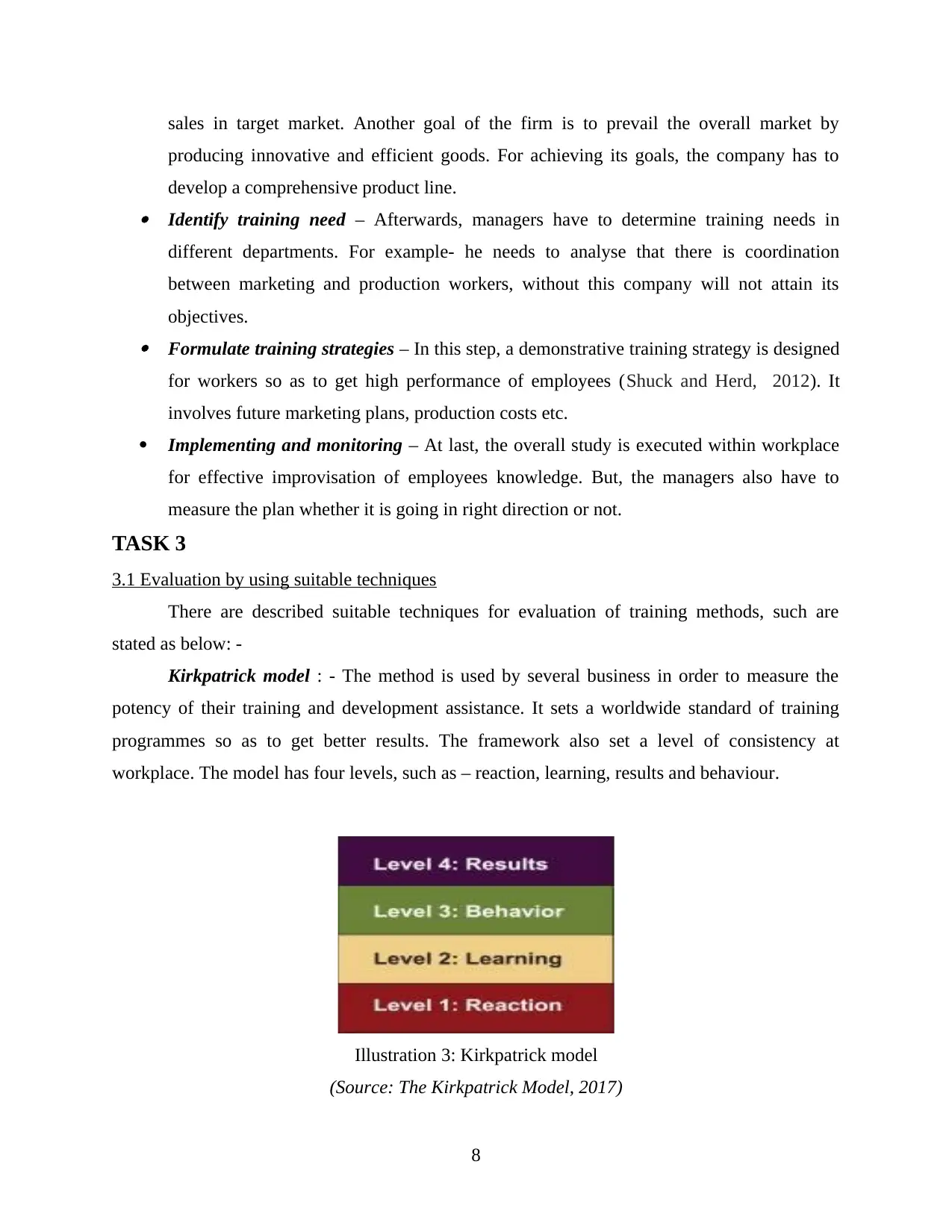
Kirkpatrick model : - The method is used by several business in order to measure the
potency of their training and development assistance. It sets a worldwide standard of training
programmes so as to get better results. The framework also set a level of consistency at
workplace. The model has four levels, such as – reaction, learning, results and behaviour.
(Source: The Kirkpatrick Model, 2017)
8
Illustration 3: Kirkpatrick model
producing innovative and efficient goods. For achieving its goals, the company has to
develop a comprehensive product line. Identify training need – Afterwards, managers have to determine training needs in
different departments. For example- he needs to analyse that there is coordination
between marketing and production workers, without this company will not attain its
objectives. Formulate training strategies – In this step, a demonstrative training strategy is designed
for workers so as to get high performance of employees (Shuck and Herd, 2012). It
involves future marketing plans, production costs etc.
Implementing and monitoring – At last, the overall study is executed within workplace
for effective improvisation of employees knowledge. But, the managers also have to
measure the plan whether it is going in right direction or not.
TASK 3
3.1 Evaluation by using suitable techniques
There are described suitable techniques for evaluation of training methods, such are
stated as below: -
Kirkpatrick model : - The method is used by several business in order to measure the
potency of their training and development assistance. It sets a worldwide standard of training
programmes so as to get better results. The framework also set a level of consistency at
workplace. The model has four levels, such as – reaction, learning, results and behaviour.
(Source: The Kirkpatrick Model, 2017)
8
Illustration 3: Kirkpatrick model
Paraphrase This Document
Need a fresh take? Get an instant paraphrase of this document with our AI Paraphraser
The first level, refers the respond of trainees towards training. Managers wants that
training gives a valuable experience to staff members (Jin and Zhong, 2011).
Measurement of reaction is very important because it helps in analysing how well
training is got by audiences.
Learning – In this level, employers are assessed that what their trainees have learned. At
the end of training how much knowledge is increased. Whenever, a training session is
going to be planned, there is set certain objectives that must be achieved by the managers.
Behaviour – At this level, there is an examination of employees' behaviour and their
attitude after training. It is seen as how they are applied techniques while performing any
task. But the behaviour is changed only in favourable conditions.
Results - At last, employers are assessed final outcomes of their training sessions. It
involves that objectives which are achieved in training sessions must be profitable or
beneficial for overall firm as well as employees.
CIRO model – The another training evaluation technique is CIRO model; the
abbreviation of the model is – context, input, reaction and outcome.
The context level – It can determine performance needs as well as expected results from
training sessions. There is required to change the knowledge, skills and attitude of
trainee.
Input level helps in recognising the resources and methods which could be used in
planning, designing and managing training programmes. It is also included that
maximum utilisation of available resources in order to attain desired objectives of the
firm (Liu, Shi and Cao, 2011).
Reaction – It is all about evaluating the reaction of people during training sessions so as
to make essential improvements.
Outcome – Desired outcomes are measured at the end of training sessions. They can be
monitor on four levels, such as – the learner level, workplace level, business level and
team or department level.
3.2 Evaluation of a training event
There is given below certain methods which can used by the managers of Sun Court Ltd.,
in order to evaluate a training session. These methods are stated as below: -
9
training gives a valuable experience to staff members (Jin and Zhong, 2011).
Measurement of reaction is very important because it helps in analysing how well
training is got by audiences.
Learning – In this level, employers are assessed that what their trainees have learned. At
the end of training how much knowledge is increased. Whenever, a training session is
going to be planned, there is set certain objectives that must be achieved by the managers.
Behaviour – At this level, there is an examination of employees' behaviour and their
attitude after training. It is seen as how they are applied techniques while performing any
task. But the behaviour is changed only in favourable conditions.
Results - At last, employers are assessed final outcomes of their training sessions. It
involves that objectives which are achieved in training sessions must be profitable or
beneficial for overall firm as well as employees.
CIRO model – The another training evaluation technique is CIRO model; the
abbreviation of the model is – context, input, reaction and outcome.
The context level – It can determine performance needs as well as expected results from
training sessions. There is required to change the knowledge, skills and attitude of
trainee.
Input level helps in recognising the resources and methods which could be used in
planning, designing and managing training programmes. It is also included that
maximum utilisation of available resources in order to attain desired objectives of the
firm (Liu, Shi and Cao, 2011).
Reaction – It is all about evaluating the reaction of people during training sessions so as
to make essential improvements.
Outcome – Desired outcomes are measured at the end of training sessions. They can be
monitor on four levels, such as – the learner level, workplace level, business level and
team or department level.
3.2 Evaluation of a training event
There is given below certain methods which can used by the managers of Sun Court Ltd.,
in order to evaluate a training session. These methods are stated as below: -
9
Activity observation – It is one of the important method of analysing skills of trainees. In
this method, each and every activity is observed by managers and at the same time there
is given appropriate solutions for the same. In addition, a pre-planned checklist is
prepared so as to assess employees' performance. Therefore, on the job training is used so
as to evolve specific abilities by using advance equipments. Interviews – By conducting structured interview sessions, managers can easily examine
the effectiveness of training programmes. For this, they can conduct face to face
interview round in order to know problems and queries of employees which are being
faced by them during training sessions (WANG, LIU and LI, 2012). Interview are more
expensive rather than questionnaire but it helps in analysing effectiveness of training
events in an adequate manner. Performance tests – In this trainees are asked to present their capabilities for a particular
job role. However, such test are beneficial only for certain employees; the prime aim of
these test is to recognise that workers are capable to perform a particular task or activity.
Questionnaire – By conducting, online and offline surveys, managers can know the
impact of training sessions upon employees performance and organisational productivity.
Apart from this, such questionnaire are helpful in getting effective and better results in a
certain time period.
3.3 Success of evaluation methods
It is crucial for the managers of business industries to evaluate the potency of training and
development programmes. Evaluation is also accessible in assessing intrinsic merits of training
events; it supports accountability and boost up the plan of training. Along with this, in Sun Court
Ltd. evaluation is useful in gathering information about experience, results and nature of learning
programmes. It also permits to stakeholders as they can present their feedbacks and gives
suggestions in training (Wang and Yang, 2011). Apart from this, for strong assessment of
learning events, there are considered some factors, i.e.
It helps in examining quality of products whether it is improved or not.
Customer services are also considered in evaluation, as is it met core values of the firm.
The main aim of training is to bring motivation and efficiency at workplace. Managers
can easily measure variation in production process by using effective evaluation
techniques.
10
this method, each and every activity is observed by managers and at the same time there
is given appropriate solutions for the same. In addition, a pre-planned checklist is
prepared so as to assess employees' performance. Therefore, on the job training is used so
as to evolve specific abilities by using advance equipments. Interviews – By conducting structured interview sessions, managers can easily examine
the effectiveness of training programmes. For this, they can conduct face to face
interview round in order to know problems and queries of employees which are being
faced by them during training sessions (WANG, LIU and LI, 2012). Interview are more
expensive rather than questionnaire but it helps in analysing effectiveness of training
events in an adequate manner. Performance tests – In this trainees are asked to present their capabilities for a particular
job role. However, such test are beneficial only for certain employees; the prime aim of
these test is to recognise that workers are capable to perform a particular task or activity.
Questionnaire – By conducting, online and offline surveys, managers can know the
impact of training sessions upon employees performance and organisational productivity.
Apart from this, such questionnaire are helpful in getting effective and better results in a
certain time period.
3.3 Success of evaluation methods
It is crucial for the managers of business industries to evaluate the potency of training and
development programmes. Evaluation is also accessible in assessing intrinsic merits of training
events; it supports accountability and boost up the plan of training. Along with this, in Sun Court
Ltd. evaluation is useful in gathering information about experience, results and nature of learning
programmes. It also permits to stakeholders as they can present their feedbacks and gives
suggestions in training (Wang and Yang, 2011). Apart from this, for strong assessment of
learning events, there are considered some factors, i.e.
It helps in examining quality of products whether it is improved or not.
Customer services are also considered in evaluation, as is it met core values of the firm.
The main aim of training is to bring motivation and efficiency at workplace. Managers
can easily measure variation in production process by using effective evaluation
techniques.
10
⊘ This is a preview!⊘
Do you want full access?
Subscribe today to unlock all pages.
Trusted by 1+ million students worldwide

1 out of 18


Related Documents


Your All-in-One AI-Powered Toolkit for Academic Success.
+13062052269
info@desklib.com
Available 24*7 on WhatsApp / Email
![[object Object]](/_next/static/media/star-bottom.7253800d.svg)
Unlock your academic potential
Copyright © 2020–2025 A2Z Services. All Rights Reserved. Developed and managed by ZUCOL.