Human Resource Development: Training, Needs, and Evaluation Report
VerifiedAdded on 2019/12/03
|18
|5004
|371
Report
AI Summary
This report on Human Resource Development (HRD) delves into various aspects of employee training and development. It begins by exploring different learning styles (visual, auditory, and kinesthetic) and the role of the learning curve in enhancing employee efficiency. The report then discusses the contribution of these learning styles in designing effective training events, followed by an analysis of training needs at different organizational levels, using Hotel Marriott as a case study. It examines the advantages and disadvantages of various training methods, including on-the-job and off-the-job approaches. Furthermore, the report outlines a systematic approach for planning training and development programs, alongside an evaluation plan to assess program effectiveness. It also explores the role of government in training and development, the impact of competency movements, and contemporary training initiatives within the HRD framework. Tables are used to illustrate training needs and methods, providing a structured overview of the topics discussed.

HUMAN
RESOURCE
DEVELOPMENT
RESOURCE
DEVELOPMENT

Paraphrase This Document
Need a fresh take? Get an instant paraphrase of this document with our AI Paraphraser
TABLE OF CONTENTS
INTRODUCTION...........................................................................................................................3
TASK 1............................................................................................................................................3
1.1 Different learning styles.........................................................................................................3
1.2 Role of the learning curve......................................................................................................4
1.3 Contribution of different learning styles in designing of a learning/training event...............5
TASK 2............................................................................................................................................5
2.1 Discuss the training needs of staff at different levels............................................................5
2.2 Advantages and disadvantages of training methods..............................................................6
2.3 Systematic approach for planning training and development................................................8
TASK 3 ...........................................................................................................................................9
3.1 Evaluation plan of training program......................................................................................9
3.2 Implementation of the evaluation plan..................................................................................9
3.3 Success of the evaluation methods......................................................................................10
TASK 4..........................................................................................................................................12
4.1 Role of government in training and development................................................................12
4.2 Impact of development of the competency movement on public and private sector...........12
4.3 Contemporary training initiatives contribute to human resources development.................13
CONCLUSION..............................................................................................................................13
REFERENCES..............................................................................................................................14
2
INTRODUCTION...........................................................................................................................3
TASK 1............................................................................................................................................3
1.1 Different learning styles.........................................................................................................3
1.2 Role of the learning curve......................................................................................................4
1.3 Contribution of different learning styles in designing of a learning/training event...............5
TASK 2............................................................................................................................................5
2.1 Discuss the training needs of staff at different levels............................................................5
2.2 Advantages and disadvantages of training methods..............................................................6
2.3 Systematic approach for planning training and development................................................8
TASK 3 ...........................................................................................................................................9
3.1 Evaluation plan of training program......................................................................................9
3.2 Implementation of the evaluation plan..................................................................................9
3.3 Success of the evaluation methods......................................................................................10
TASK 4..........................................................................................................................................12
4.1 Role of government in training and development................................................................12
4.2 Impact of development of the competency movement on public and private sector...........12
4.3 Contemporary training initiatives contribute to human resources development.................13
CONCLUSION..............................................................................................................................13
REFERENCES..............................................................................................................................14
2

INDEX OF TABLES
Table 1: Training Needs...................................................................................................................6
Table 2: Training methods...............................................................................................................7
Table 3: Strengths and Weaknesses...............................................................................................11
3
Table 1: Training Needs...................................................................................................................6
Table 2: Training methods...............................................................................................................7
Table 3: Strengths and Weaknesses...............................................................................................11
3
⊘ This is a preview!⊘
Do you want full access?
Subscribe today to unlock all pages.

Trusted by 1+ million students worldwide
INTRODUCTION
Human Resource Development is the framework which is designed to help employees to
develop their personal and organizational skills, knowledge, and abilities. Human Resource
Development includes various opportunities such as employee training, employee career
development, performance management and development, coaching, mentoring, succession
planning, key employee identification and organization development (Bell, 2012). In this report,
discussion has been made on various learning theories and styles and also the designing of the
plan for training and development. Further, the ability of the HR manager has been discussed for
evaluating training event. Furthermore, this report consist the skills development initiatives by
the government.
TASK 1
1.1 Different learning styles
According to Fleming's model, there are three types of learning styles which can be
helpful for the HR manager to design effective training program (Brooks and Nafukho, 2006).
For this purpose, HR manager should analyze the learning style of the human resource so that
those learning styles can be adopted and employees can be made learnt according to those styles.
Three learning styles are enumerated as follows:
1. Visual: This style uses graphs, charts, pictures, etc. Through these objects people get the
learning about the topic for which training session has been conducted. Some employees
may grasp the thing easily if taught through these visual objects (Köster, 2007).
2. Auditory: In this, information can be retained through hearing and speaking. Some
employees have the ability of learning through this style (Werner and DeSimone, 2011).
3. Kinesthetic: Employees who get the learning through practical aspects comes under this
category (Wilson, 2005). In this, learning is done by exercising case studies, performing
the activities, etc.
Every employee has their own learning styles. Some can learn through visuals, some
through aural and some by Kinesthetic. All three styles are similar and different in their own
way. They are similar because all three are used for the same motive of learning, if learnt
through either style will result in the development of the employees (Ellinger and Ellinger,
4
Human Resource Development is the framework which is designed to help employees to
develop their personal and organizational skills, knowledge, and abilities. Human Resource
Development includes various opportunities such as employee training, employee career
development, performance management and development, coaching, mentoring, succession
planning, key employee identification and organization development (Bell, 2012). In this report,
discussion has been made on various learning theories and styles and also the designing of the
plan for training and development. Further, the ability of the HR manager has been discussed for
evaluating training event. Furthermore, this report consist the skills development initiatives by
the government.
TASK 1
1.1 Different learning styles
According to Fleming's model, there are three types of learning styles which can be
helpful for the HR manager to design effective training program (Brooks and Nafukho, 2006).
For this purpose, HR manager should analyze the learning style of the human resource so that
those learning styles can be adopted and employees can be made learnt according to those styles.
Three learning styles are enumerated as follows:
1. Visual: This style uses graphs, charts, pictures, etc. Through these objects people get the
learning about the topic for which training session has been conducted. Some employees
may grasp the thing easily if taught through these visual objects (Köster, 2007).
2. Auditory: In this, information can be retained through hearing and speaking. Some
employees have the ability of learning through this style (Werner and DeSimone, 2011).
3. Kinesthetic: Employees who get the learning through practical aspects comes under this
category (Wilson, 2005). In this, learning is done by exercising case studies, performing
the activities, etc.
Every employee has their own learning styles. Some can learn through visuals, some
through aural and some by Kinesthetic. All three styles are similar and different in their own
way. They are similar because all three are used for the same motive of learning, if learnt
through either style will result in the development of the employees (Ellinger and Ellinger,
4
Paraphrase This Document
Need a fresh take? Get an instant paraphrase of this document with our AI Paraphraser
2014). They are different because every individual has its own style through which they can
learn in lesser time and in easier manner.
1.2 Role of the learning curve
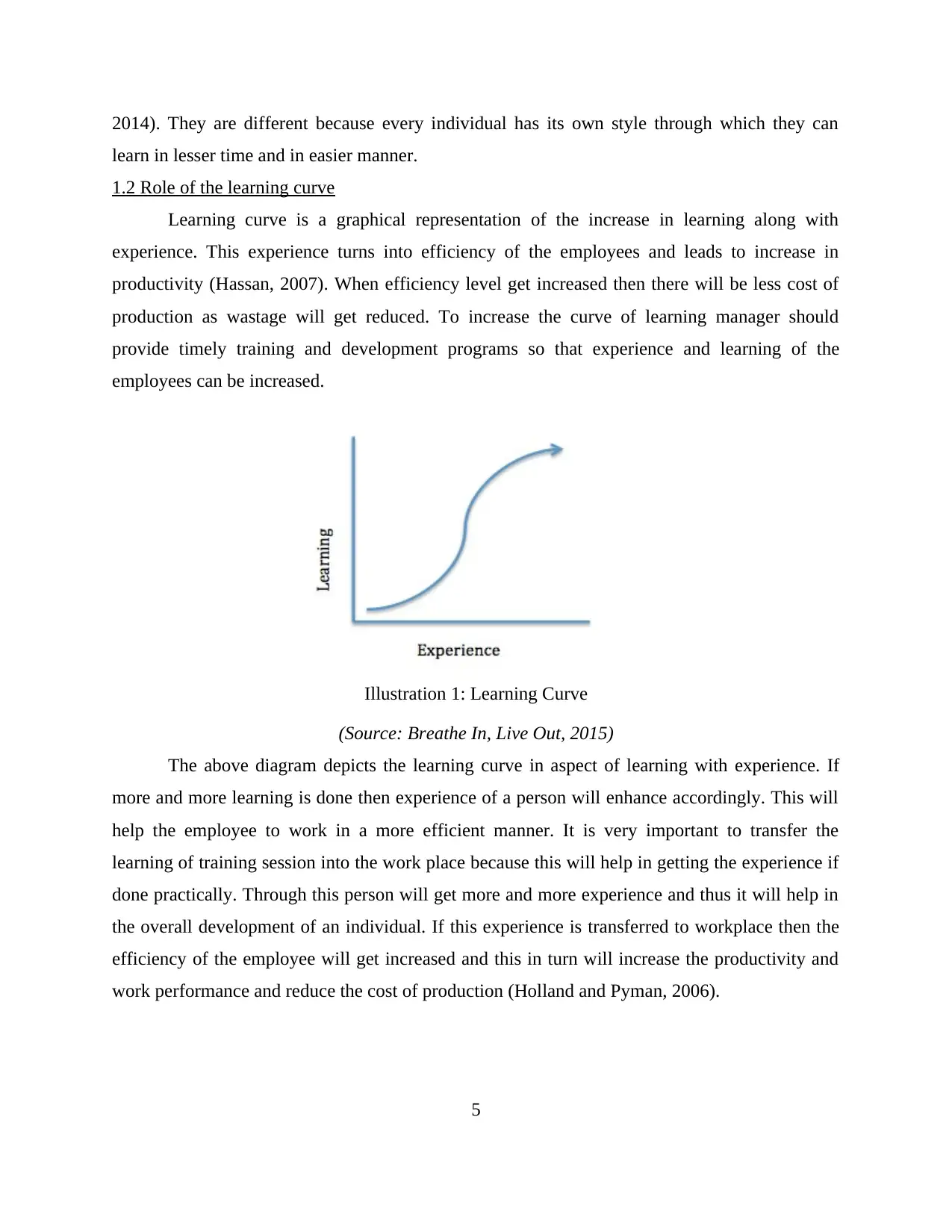
Learning curve is a graphical representation of the increase in learning along with
experience. This experience turns into efficiency of the employees and leads to increase in
productivity (Hassan, 2007). When efficiency level get increased then there will be less cost of
production as wastage will get reduced. To increase the curve of learning manager should
provide timely training and development programs so that experience and learning of the
employees can be increased.
(Source: Breathe In, Live Out, 2015)
The above diagram depicts the learning curve in aspect of learning with experience. If
more and more learning is done then experience of a person will enhance accordingly. This will
help the employee to work in a more efficient manner. It is very important to transfer the
learning of training session into the work place because this will help in getting the experience if
done practically. Through this person will get more and more experience and thus it will help in
the overall development of an individual. If this experience is transferred to workplace then the
efficiency of the employee will get increased and this in turn will increase the productivity and
work performance and reduce the cost of production (Holland and Pyman, 2006).
5
Illustration 1: Learning Curve
learn in lesser time and in easier manner.
1.2 Role of the learning curve
Learning curve is a graphical representation of the increase in learning along with
experience. This experience turns into efficiency of the employees and leads to increase in
productivity (Hassan, 2007). When efficiency level get increased then there will be less cost of
production as wastage will get reduced. To increase the curve of learning manager should
provide timely training and development programs so that experience and learning of the
employees can be increased.
(Source: Breathe In, Live Out, 2015)
The above diagram depicts the learning curve in aspect of learning with experience. If
more and more learning is done then experience of a person will enhance accordingly. This will
help the employee to work in a more efficient manner. It is very important to transfer the
learning of training session into the work place because this will help in getting the experience if
done practically. Through this person will get more and more experience and thus it will help in
the overall development of an individual. If this experience is transferred to workplace then the
efficiency of the employee will get increased and this in turn will increase the productivity and
work performance and reduce the cost of production (Holland and Pyman, 2006).
5
Illustration 1: Learning Curve
1.3 Contribution of different learning styles in designing of a learning/training event
The discussion about the learning styles and theories have been done in the above
questions. To design the effective training program manager has to understand the learning styles
and individual behaviours. As it is known that there are three types of learning styles viz. Visual,
Auditory and Kinesthetic. Manager has to analyze the the employees and their preferred learning
styles and accordingly (Jain, 2005). When knowledge about the individual style has been gained
then manager can divide the employees into groups and provide the session as per their learning
styles. This will help the manager in making the training event successful. If learning style is
adopted then trainer can make the learner's learn in their style. After knowing the individuals
style trainer can make trainees aware about the other styles too so that learner can develop other
styles also which will help them in the overall development. For these purposes, trainer should
have the complete knowledge about all the learning styles so that they can deliver the lecture in a
efficient manner. Thus, training program can be designed in a effective manner if the manager
knows the learning style of each individual and the manager itself have the knowledge about all
the learning styles. If training is provided according to their style then individual will grasp in a
more easier and simplified manner (Khan and Sheikh, 2012).
M1
As it is known that every person has different style of learning that is some employees
learn through visuals, some by reading and writing and many by doing the things practical. To
make the training programmes effective, it is important that a manager should understand the
learning style of every employee. If manager know the learning styles of every employee than it
will be easier for them to provide training by using those styles as a medium (Holland and
Pyman, 2006). Through this, employees will learn the things in a quick manner and hence, lesser
time will be consumed for the training. If the training is provided using the preferred style than
employees will grasp it easily and thus, effective performance will be done by them. Thus, it can
be said that it is important for the managers to asses the learni9ng style of all the employees in
order to ,make the training program effective.
M2
In order to assess the effectiveness of training event manager should follow these
methods which are described below:
6
The discussion about the learning styles and theories have been done in the above
questions. To design the effective training program manager has to understand the learning styles
and individual behaviours. As it is known that there are three types of learning styles viz. Visual,
Auditory and Kinesthetic. Manager has to analyze the the employees and their preferred learning
styles and accordingly (Jain, 2005). When knowledge about the individual style has been gained
then manager can divide the employees into groups and provide the session as per their learning
styles. This will help the manager in making the training event successful. If learning style is
adopted then trainer can make the learner's learn in their style. After knowing the individuals
style trainer can make trainees aware about the other styles too so that learner can develop other
styles also which will help them in the overall development. For these purposes, trainer should
have the complete knowledge about all the learning styles so that they can deliver the lecture in a
efficient manner. Thus, training program can be designed in a effective manner if the manager
knows the learning style of each individual and the manager itself have the knowledge about all
the learning styles. If training is provided according to their style then individual will grasp in a
more easier and simplified manner (Khan and Sheikh, 2012).
M1
As it is known that every person has different style of learning that is some employees
learn through visuals, some by reading and writing and many by doing the things practical. To
make the training programmes effective, it is important that a manager should understand the
learning style of every employee. If manager know the learning styles of every employee than it
will be easier for them to provide training by using those styles as a medium (Holland and
Pyman, 2006). Through this, employees will learn the things in a quick manner and hence, lesser
time will be consumed for the training. If the training is provided using the preferred style than
employees will grasp it easily and thus, effective performance will be done by them. Thus, it can
be said that it is important for the managers to asses the learni9ng style of all the employees in
order to ,make the training program effective.
M2
In order to assess the effectiveness of training event manager should follow these
methods which are described below:
6
⊘ This is a preview!⊘
Do you want full access?
Subscribe today to unlock all pages.
Trusted by 1+ million students worldwide
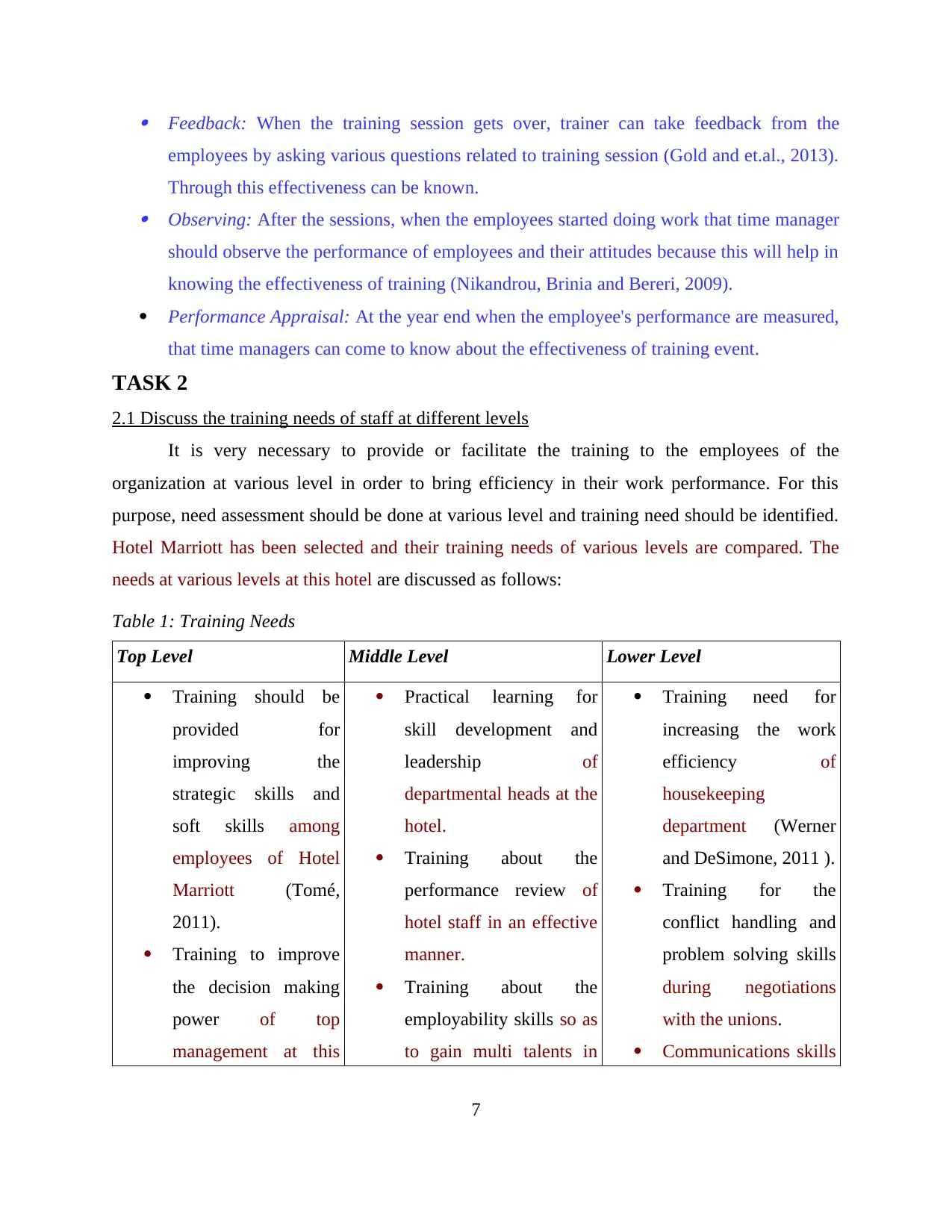
Feedback: When the training session gets over, trainer can take feedback from the
employees by asking various questions related to training session (Gold and et.al., 2013).
Through this effectiveness can be known. Observing: After the sessions, when the employees started doing work that time manager
should observe the performance of employees and their attitudes because this will help in
knowing the effectiveness of training (Nikandrou, Brinia and Bereri, 2009).
Performance Appraisal: At the year end when the employee's performance are measured,
that time managers can come to know about the effectiveness of training event.
TASK 2
2.1 Discuss the training needs of staff at different levels
It is very necessary to provide or facilitate the training to the employees of the
organization at various level in order to bring efficiency in their work performance. For this
purpose, need assessment should be done at various level and training need should be identified.
Hotel Marriott has been selected and their training needs of various levels are compared. The
needs at various levels at this hotel are discussed as follows:
Table 1: Training Needs
Top Level Middle Level Lower Level
Training should be
provided for
improving the
strategic skills and
soft skills among
employees of Hotel
Marriott (Tomé,
2011).
Training to improve
the decision making
power of top
management at this
Practical learning for
skill development and
leadership of
departmental heads at the
hotel.
Training about the
performance review of
hotel staff in an effective
manner.
Training about the
employability skills so as
to gain multi talents in
Training need for
increasing the work
efficiency of
housekeeping
department (Werner
and DeSimone, 2011 ).
Training for the
conflict handling and
problem solving skills
during negotiations
with the unions.
Communications skills
7
employees by asking various questions related to training session (Gold and et.al., 2013).
Through this effectiveness can be known. Observing: After the sessions, when the employees started doing work that time manager
should observe the performance of employees and their attitudes because this will help in
knowing the effectiveness of training (Nikandrou, Brinia and Bereri, 2009).
Performance Appraisal: At the year end when the employee's performance are measured,
that time managers can come to know about the effectiveness of training event.
TASK 2
2.1 Discuss the training needs of staff at different levels
It is very necessary to provide or facilitate the training to the employees of the
organization at various level in order to bring efficiency in their work performance. For this
purpose, need assessment should be done at various level and training need should be identified.
Hotel Marriott has been selected and their training needs of various levels are compared. The
needs at various levels at this hotel are discussed as follows:
Table 1: Training Needs
Top Level Middle Level Lower Level
Training should be
provided for
improving the
strategic skills and
soft skills among
employees of Hotel
Marriott (Tomé,
2011).
Training to improve
the decision making
power of top
management at this
Practical learning for
skill development and
leadership of
departmental heads at the
hotel.
Training about the
performance review of
hotel staff in an effective
manner.
Training about the
employability skills so as
to gain multi talents in
Training need for
increasing the work
efficiency of
housekeeping
department (Werner
and DeSimone, 2011 ).
Training for the
conflict handling and
problem solving skills
during negotiations
with the unions.
Communications skills
7
Paraphrase This Document
Need a fresh take? Get an instant paraphrase of this document with our AI Paraphraser
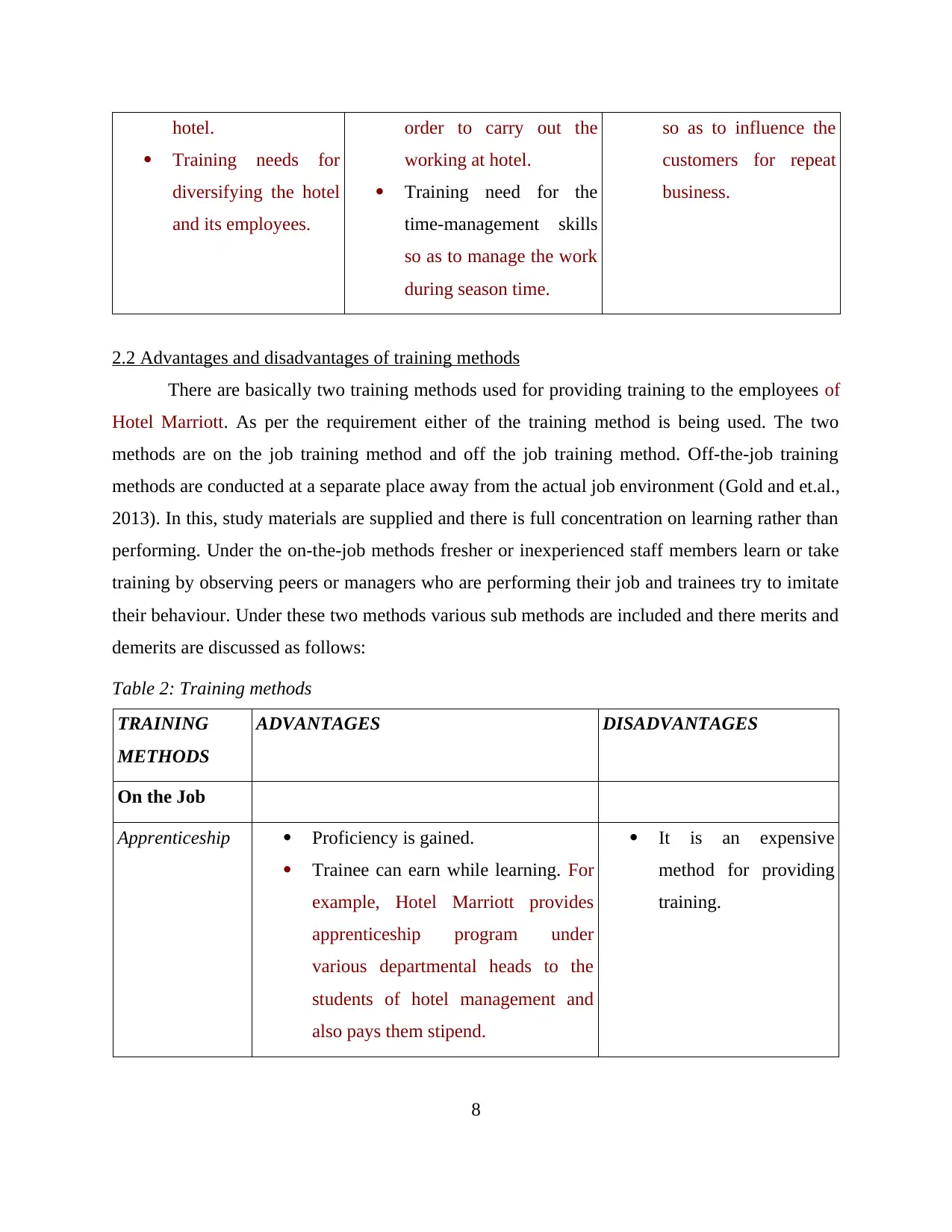
hotel.
Training needs for
diversifying the hotel
and its employees.
order to carry out the
working at hotel.
Training need for the
time-management skills
so as to manage the work
during season time.
so as to influence the
customers for repeat
business.
2.2 Advantages and disadvantages of training methods
There are basically two training methods used for providing training to the employees of
Hotel Marriott. As per the requirement either of the training method is being used. The two
methods are on the job training method and off the job training method. Off-the-job training
methods are conducted at a separate place away from the actual job environment (Gold and et.al.,
2013). In this, study materials are supplied and there is full concentration on learning rather than
performing. Under the on-the-job methods fresher or inexperienced staff members learn or take
training by observing peers or managers who are performing their job and trainees try to imitate
their behaviour. Under these two methods various sub methods are included and there merits and
demerits are discussed as follows:
Table 2: Training methods
TRAINING
METHODS
ADVANTAGES DISADVANTAGES
On the Job
Apprenticeship Proficiency is gained.
Trainee can earn while learning. For
example, Hotel Marriott provides
apprenticeship program under
various departmental heads to the
students of hotel management and
also pays them stipend.
It is an expensive
method for providing
training.
8
Training needs for
diversifying the hotel
and its employees.
order to carry out the
working at hotel.
Training need for the
time-management skills
so as to manage the work
during season time.
so as to influence the
customers for repeat
business.
2.2 Advantages and disadvantages of training methods
There are basically two training methods used for providing training to the employees of
Hotel Marriott. As per the requirement either of the training method is being used. The two
methods are on the job training method and off the job training method. Off-the-job training
methods are conducted at a separate place away from the actual job environment (Gold and et.al.,
2013). In this, study materials are supplied and there is full concentration on learning rather than
performing. Under the on-the-job methods fresher or inexperienced staff members learn or take
training by observing peers or managers who are performing their job and trainees try to imitate
their behaviour. Under these two methods various sub methods are included and there merits and
demerits are discussed as follows:
Table 2: Training methods
TRAINING
METHODS
ADVANTAGES DISADVANTAGES
On the Job
Apprenticeship Proficiency is gained.
Trainee can earn while learning. For
example, Hotel Marriott provides
apprenticeship program under
various departmental heads to the
students of hotel management and
also pays them stipend.
It is an expensive
method for providing
training.
8
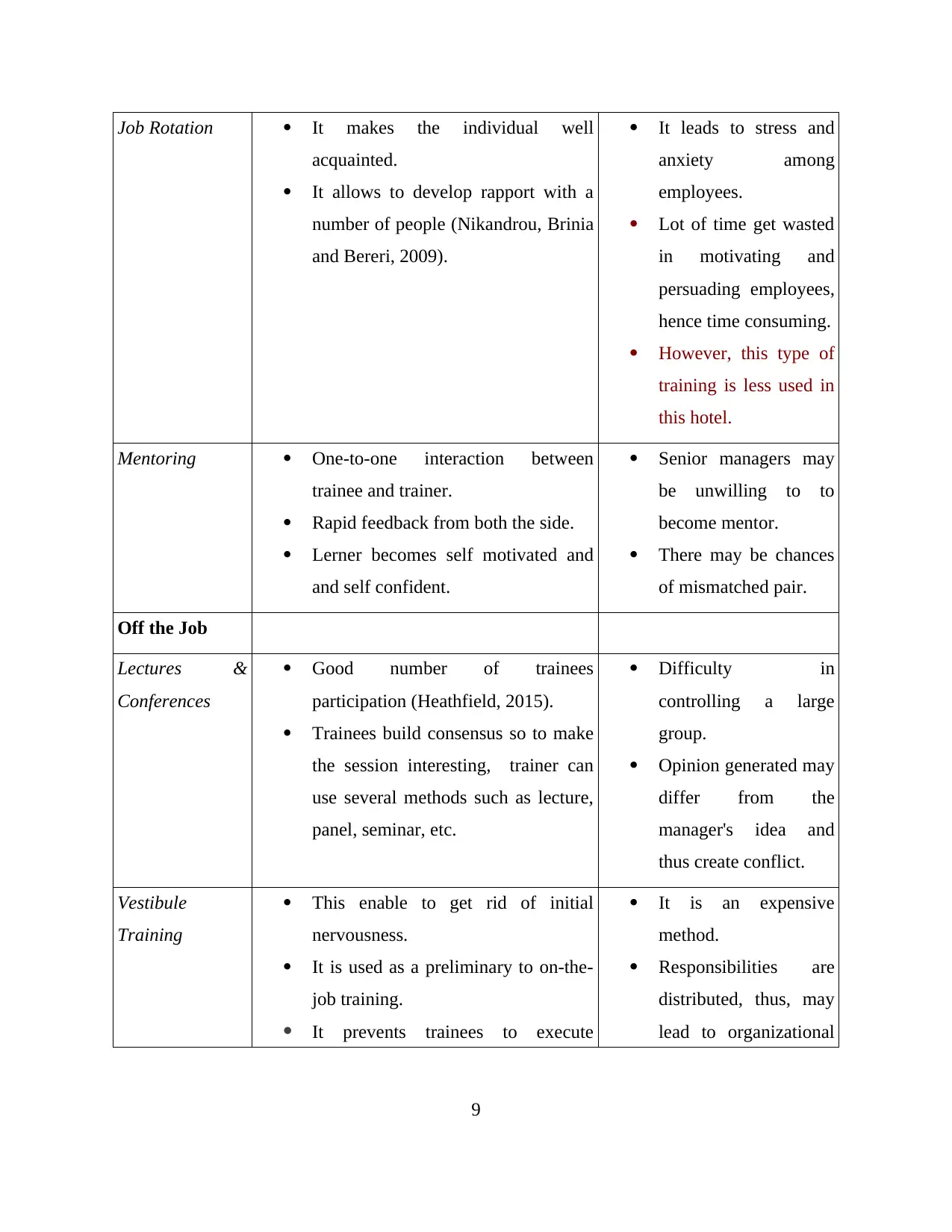
Job Rotation It makes the individual well
acquainted.
It allows to develop rapport with a
number of people (Nikandrou, Brinia
and Bereri, 2009).
It leads to stress and
anxiety among
employees.
Lot of time get wasted
in motivating and
persuading employees,
hence time consuming.
However, this type of
training is less used in
this hotel.
Mentoring One-to-one interaction between
trainee and trainer.
Rapid feedback from both the side.
Lerner becomes self motivated and
and self confident.
Senior managers may
be unwilling to to
become mentor.
There may be chances
of mismatched pair.
Off the Job
Lectures &
Conferences
Good number of trainees
participation (Heathfield, 2015).
Trainees build consensus so to make
the session interesting, trainer can
use several methods such as lecture,
panel, seminar, etc.
Difficulty in
controlling a large
group.
Opinion generated may
differ from the
manager's idea and
thus create conflict.
Vestibule
Training
This enable to get rid of initial
nervousness.
It is used as a preliminary to on-the-
job training.
It prevents trainees to execute
It is an expensive
method.
Responsibilities are
distributed, thus, may
lead to organizational
9
acquainted.
It allows to develop rapport with a
number of people (Nikandrou, Brinia
and Bereri, 2009).
It leads to stress and
anxiety among
employees.
Lot of time get wasted
in motivating and
persuading employees,
hence time consuming.
However, this type of
training is less used in
this hotel.
Mentoring One-to-one interaction between
trainee and trainer.
Rapid feedback from both the side.
Lerner becomes self motivated and
and self confident.
Senior managers may
be unwilling to to
become mentor.
There may be chances
of mismatched pair.
Off the Job
Lectures &
Conferences
Good number of trainees
participation (Heathfield, 2015).
Trainees build consensus so to make
the session interesting, trainer can
use several methods such as lecture,
panel, seminar, etc.
Difficulty in
controlling a large
group.
Opinion generated may
differ from the
manager's idea and
thus create conflict.
Vestibule
Training
This enable to get rid of initial
nervousness.
It is used as a preliminary to on-the-
job training.
It prevents trainees to execute
It is an expensive
method.
Responsibilities are
distributed, thus, may
lead to organizational
9
⊘ This is a preview!⊘
Do you want full access?
Subscribe today to unlock all pages.
Trusted by 1+ million students worldwide
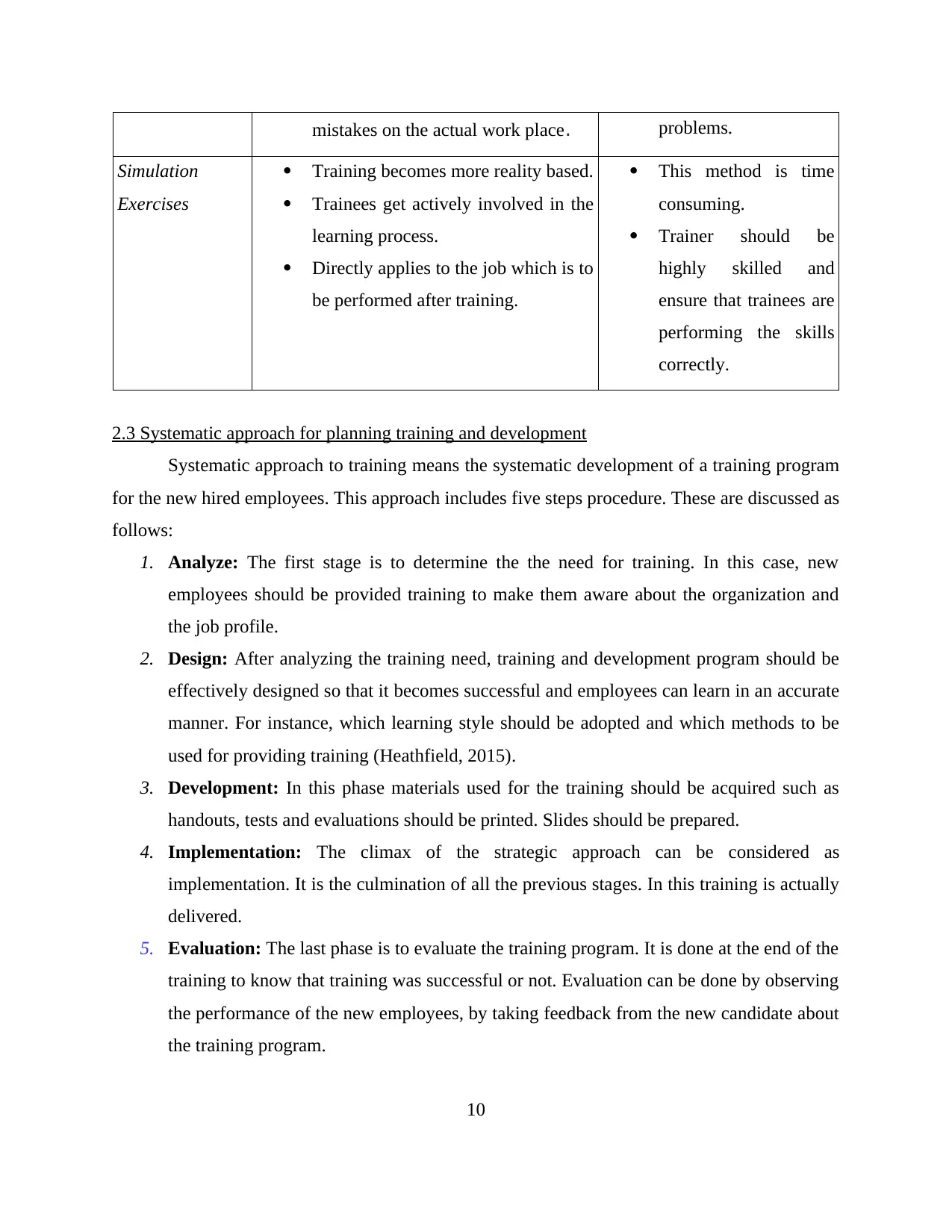
mistakes on the actual work place. problems.
Simulation
Exercises
Training becomes more reality based.
Trainees get actively involved in the
learning process.
Directly applies to the job which is to
be performed after training.
This method is time
consuming.
Trainer should be
highly skilled and
ensure that trainees are
performing the skills
correctly.
2.3 Systematic approach for planning training and development
Systematic approach to training means the systematic development of a training program
for the new hired employees. This approach includes five steps procedure. These are discussed as
follows:
1. Analyze: The first stage is to determine the the need for training. In this case, new
employees should be provided training to make them aware about the organization and
the job profile.
2. Design: After analyzing the training need, training and development program should be
effectively designed so that it becomes successful and employees can learn in an accurate
manner. For instance, which learning style should be adopted and which methods to be
used for providing training (Heathfield, 2015).
3. Development: In this phase materials used for the training should be acquired such as
handouts, tests and evaluations should be printed. Slides should be prepared.
4. Implementation: The climax of the strategic approach can be considered as
implementation. It is the culmination of all the previous stages. In this training is actually
delivered.
5. Evaluation: The last phase is to evaluate the training program. It is done at the end of the
training to know that training was successful or not. Evaluation can be done by observing
the performance of the new employees, by taking feedback from the new candidate about
the training program.
10
Simulation
Exercises
Training becomes more reality based.
Trainees get actively involved in the
learning process.
Directly applies to the job which is to
be performed after training.
This method is time
consuming.
Trainer should be
highly skilled and
ensure that trainees are
performing the skills
correctly.
2.3 Systematic approach for planning training and development
Systematic approach to training means the systematic development of a training program
for the new hired employees. This approach includes five steps procedure. These are discussed as
follows:
1. Analyze: The first stage is to determine the the need for training. In this case, new
employees should be provided training to make them aware about the organization and
the job profile.
2. Design: After analyzing the training need, training and development program should be
effectively designed so that it becomes successful and employees can learn in an accurate
manner. For instance, which learning style should be adopted and which methods to be
used for providing training (Heathfield, 2015).
3. Development: In this phase materials used for the training should be acquired such as
handouts, tests and evaluations should be printed. Slides should be prepared.
4. Implementation: The climax of the strategic approach can be considered as
implementation. It is the culmination of all the previous stages. In this training is actually
delivered.
5. Evaluation: The last phase is to evaluate the training program. It is done at the end of the
training to know that training was successful or not. Evaluation can be done by observing
the performance of the new employees, by taking feedback from the new candidate about
the training program.
10
Paraphrase This Document
Need a fresh take? Get an instant paraphrase of this document with our AI Paraphraser
D1
Training is conducted in every organization irrespective of the nature of the company.
Training plays a very significant role in the success of an organization because when training is
provided to the employees than they yield effective performance which leads to the increase in
the productivity of a company (Nikandrou, Brinia and Bereri, 2009). On the other hand, training
incurs high cost to the company which may reduce the profitability of a firm and moreover, it
consumes lot of time of the company which may delay the working of a company. However, the
loss is for short period of time but the results of training is beneficial for the longer period of
time and effective performance of employees will lead to the better output and thus ultimately
profits of the company will get increase. Lastly, it can be concluded that training and
development program has a crucial role to play because its results will enhance the profitability
of a company and develop the employees efficiency which will reduce the employee turnover
and less resistance for the change (Hassan, 2007).
TASK 3
3.1 Evaluation plan of training program
After planning the training program, evaluation should be planned in order to check the
effectiveness of the program designed. Plan for evaluation will include the time or frequency of
evaluation, this include one during the training session or it can be said that in the middle of the
training session by asking few questions to the trainees in order to ensure that learners are getting
what they are being delivered at the training session (Breathe In, Live Out, 2015). The other time
of doing evaluation will be post training when learner will apply their learning into practical
aspect. Two methods can be used for post evaluation plan:
1. Observation: In this technique, the immediate supervisor will observe the initial
performance of the newly hired employees after training session in order to check the
ability of the trainee while applying their learning on actual task performing. Observation
can be done by the immediate supervisor or the peer groups and feedback can be taken
from the coworkers and other supervisors and manager.
2. Performance Appraisal: This method will be done at the end of a quarter or a year
depending upon the company policy. Through this the overall performance of an
employee will be checked. This will be done by the HR manager by taking the report
11
Training is conducted in every organization irrespective of the nature of the company.
Training plays a very significant role in the success of an organization because when training is
provided to the employees than they yield effective performance which leads to the increase in
the productivity of a company (Nikandrou, Brinia and Bereri, 2009). On the other hand, training
incurs high cost to the company which may reduce the profitability of a firm and moreover, it
consumes lot of time of the company which may delay the working of a company. However, the
loss is for short period of time but the results of training is beneficial for the longer period of
time and effective performance of employees will lead to the better output and thus ultimately
profits of the company will get increase. Lastly, it can be concluded that training and
development program has a crucial role to play because its results will enhance the profitability
of a company and develop the employees efficiency which will reduce the employee turnover
and less resistance for the change (Hassan, 2007).
TASK 3
3.1 Evaluation plan of training program
After planning the training program, evaluation should be planned in order to check the
effectiveness of the program designed. Plan for evaluation will include the time or frequency of
evaluation, this include one during the training session or it can be said that in the middle of the
training session by asking few questions to the trainees in order to ensure that learners are getting
what they are being delivered at the training session (Breathe In, Live Out, 2015). The other time
of doing evaluation will be post training when learner will apply their learning into practical
aspect. Two methods can be used for post evaluation plan:
1. Observation: In this technique, the immediate supervisor will observe the initial
performance of the newly hired employees after training session in order to check the
ability of the trainee while applying their learning on actual task performing. Observation
can be done by the immediate supervisor or the peer groups and feedback can be taken
from the coworkers and other supervisors and manager.
2. Performance Appraisal: This method will be done at the end of a quarter or a year
depending upon the company policy. Through this the overall performance of an
employee will be checked. This will be done by the HR manager by taking the report
11
form the immediate supervisor (Human Resource Development (International
Development) MSc, 2015).
3.2 Implementation of the evaluation plan
The plan which is being prepared in the above question and in the other former question
will be executed (Heathfield, 2015). When systematic approach of training program was made
that time analysis was done and then designing was done. In that several techniques and methods
of learning were included and other training materials were acquired so as to aid the training
program. Those materials and styles should be checked again and should be listed down in order
to execute the evaluation plan. Evaluation should be done during the training session by asking
questions so that effectiveness can be checked. Evaluation should be done on the basis materials
such as handouts, slides, etc. This will enable the trainer to change the learning style on the spot
if learners are not getting what they are being delivered. Post training evaluation should be be
done in order to check the effectiveness by observing and performance appraisal method by
immediate supervisor or the HR manager so that actual performance can be measured
(Nikandrou, Brinia and Bereri, 2009). This would aid the manager to know the effectiveness of
the employees and training session and changes can be made in the program for future training
session.
3.3 Success of the evaluation methods
In order to check the success of the evaluation method the strengths and weaknesses of
the two methods should be assessed. Strengths and weaknesses of the two methods are as
follows:
Table 3: Strengths and Weaknesses
Methods Strengths Weaknesses
Observation It is a very direct method for collecting
information.
Data collected is accurate.
It is less demanding so reduce the
biasness towards the employees.
Supervisor can easily identify the
Past problems of an
individual cannot be
studied.
Controlled observation
may require some tools
which makes it
12
Development) MSc, 2015).
3.2 Implementation of the evaluation plan
The plan which is being prepared in the above question and in the other former question
will be executed (Heathfield, 2015). When systematic approach of training program was made
that time analysis was done and then designing was done. In that several techniques and methods
of learning were included and other training materials were acquired so as to aid the training
program. Those materials and styles should be checked again and should be listed down in order
to execute the evaluation plan. Evaluation should be done during the training session by asking
questions so that effectiveness can be checked. Evaluation should be done on the basis materials
such as handouts, slides, etc. This will enable the trainer to change the learning style on the spot
if learners are not getting what they are being delivered. Post training evaluation should be be
done in order to check the effectiveness by observing and performance appraisal method by
immediate supervisor or the HR manager so that actual performance can be measured
(Nikandrou, Brinia and Bereri, 2009). This would aid the manager to know the effectiveness of
the employees and training session and changes can be made in the program for future training
session.
3.3 Success of the evaluation methods
In order to check the success of the evaluation method the strengths and weaknesses of
the two methods should be assessed. Strengths and weaknesses of the two methods are as
follows:
Table 3: Strengths and Weaknesses
Methods Strengths Weaknesses
Observation It is a very direct method for collecting
information.
Data collected is accurate.
It is less demanding so reduce the
biasness towards the employees.
Supervisor can easily identify the
Past problems of an
individual cannot be
studied.
Controlled observation
may require some tools
which makes it
12
⊘ This is a preview!⊘
Do you want full access?
Subscribe today to unlock all pages.
Trusted by 1+ million students worldwide

1 out of 18


Related Documents


Your All-in-One AI-Powered Toolkit for Academic Success.
+13062052269
info@desklib.com
Available 24*7 on WhatsApp / Email
![[object Object]](/_next/static/media/star-bottom.7253800d.svg)
Unlock your academic potential
Copyright © 2020–2026 A2Z Services. All Rights Reserved. Developed and managed by ZUCOL.