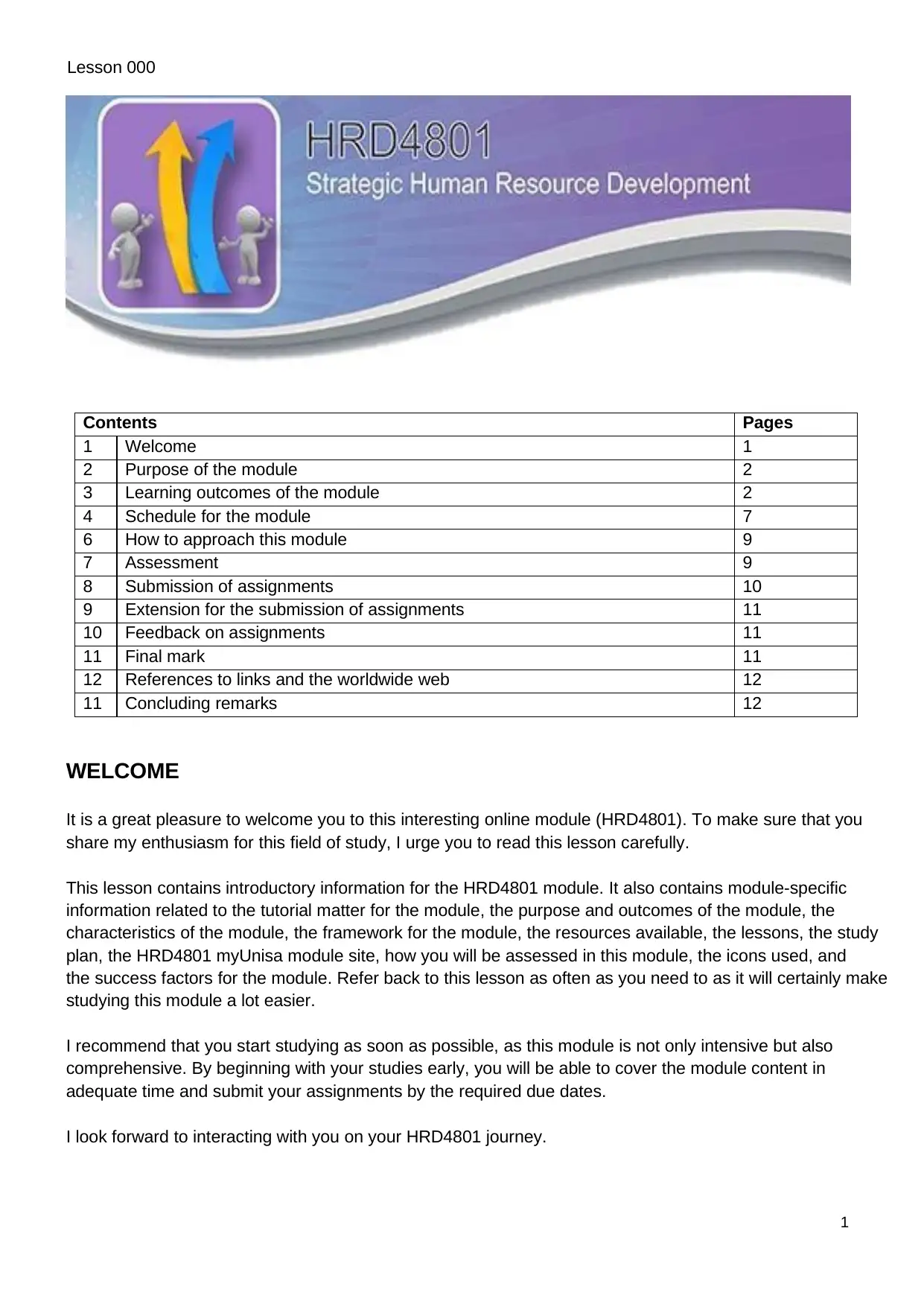
HRD4801 Module Introduction: Purpose, Outcomes, and Schedule
VerifiedAdded on 2021/07/20
|12
|4031
|221
Homework Assignment
AI Summary
This document serves as an introduction to the HRD4801 module, providing a comprehensive overview of its structure, purpose, and objectives. It welcomes students and encourages careful reading to foster enthusiasm for the field of study. The document outlines the module's purpose, which is to equip learners with the skills to establish, manage, and maintain a strategic HRD portfolio, ensuring organizational compliance with HRD-related legislation. It details the learning outcomes, including establishing and managing the HRD function, developing and implementing a strategic HRD plan, and formulating HRD policies. The module also emphasizes critical cross-field outcomes, such as problem-solving, teamwork, and effective communication. The document provides a detailed schedule for the module, outlining the topics covered each month, and includes references to online resources and assessment criteria. This document is a valuable resource for students, guiding them through the module's content and expectations, and also explains the critical outcomes as prescribed by the NQF.
1
Lesson 000
Contents Pages
1 Welcome 1
2 Purpose of the module 2
3 Learning outcomes of the module 2
4 Schedule for the module 7
6 How to approach this module 9
7 Assessment 9
8 Submission of assignments 10
9 Extension for the submission of assignments 11
10 Feedback on assignments 11
11 Final mark 11
12 References to links and the worldwide web 12
11 Concluding remarks 12
WELCOME
It is a great pleasure to welcome you to this interesting online module (HRD4801). To make sure that you
share my enthusiasm for this field of study, I urge you to read this lesson carefully.
This lesson contains introductory information for the HRD4801 module. It also contains module-specific
information related to the tutorial matter for the module, the purpose and outcomes of the module, the
characteristics of the module, the framework for the module, the resources available, the lessons, the study
plan, the HRD4801 myUnisa module site, how you will be assessed in this module, the icons used, and
the success factors for the module. Refer back to this lesson as often as you need to as it will certainly make
studying this module a lot easier.
I recommend that you start studying as soon as possible, as this module is not only intensive but also
comprehensive. By beginning with your studies early, you will be able to cover the module content in
adequate time and submit your assignments by the required due dates.
I look forward to interacting with you on your HRD4801 journey.
Lesson 000
Contents Pages
1 Welcome 1
2 Purpose of the module 2
3 Learning outcomes of the module 2
4 Schedule for the module 7
6 How to approach this module 9
7 Assessment 9
8 Submission of assignments 10
9 Extension for the submission of assignments 11
10 Feedback on assignments 11
11 Final mark 11
12 References to links and the worldwide web 12
11 Concluding remarks 12
WELCOME
It is a great pleasure to welcome you to this interesting online module (HRD4801). To make sure that you
share my enthusiasm for this field of study, I urge you to read this lesson carefully.
This lesson contains introductory information for the HRD4801 module. It also contains module-specific
information related to the tutorial matter for the module, the purpose and outcomes of the module, the
characteristics of the module, the framework for the module, the resources available, the lessons, the study
plan, the HRD4801 myUnisa module site, how you will be assessed in this module, the icons used, and
the success factors for the module. Refer back to this lesson as often as you need to as it will certainly make
studying this module a lot easier.
I recommend that you start studying as soon as possible, as this module is not only intensive but also
comprehensive. By beginning with your studies early, you will be able to cover the module content in
adequate time and submit your assignments by the required due dates.
I look forward to interacting with you on your HRD4801 journey.

Paraphrase This Document
Need a fresh take? Get an instant paraphrase of this document with our AI Paraphraser
2
Lesson 000
PURPOSE OF THE MODULE
The purpose of this module is to allow qualifying learners to establish, manage and maintain a strategic
HRD portfolio and strategy for an organisation, and to ensure organisational compliance with the
legislative prescripts relating to HRD.
This module is intended to deal with the training management or Learning & Development (L&D) process
at strategic level involving a combination of explanations and demonstrations of practical management
activities. These activities are related to the development of HRD strategies, policies and procedures in
line with business strategy, sector requirements, national needs and global trends.
The module is delivered via myUnisa, the internet and peer group interaction in some of the activities.
Your lecturer will interact with the learners on myUnisa and via e-mail.
LEARNING OUTCOMES OF THE MODULE
For this module, there are several outcomes that I hope you will be able to accomplish by the end of
the module:
The specific outcomes are those outcomes that you must achieve in order to complete the
module successfully and be effective in the workplace. Assessment criteria are statements of
evidence for the achievement of a particular outcome. The assessment criteria define how well you
must be able to perform the activity described in the outcome. In other words, the assessment criteria
define the required level and quality of performance.
You will also note that integrated assessment is used which means I will assess your ability to integrate
your knowledge and skills from different parts of the lessons as well as from other sources.
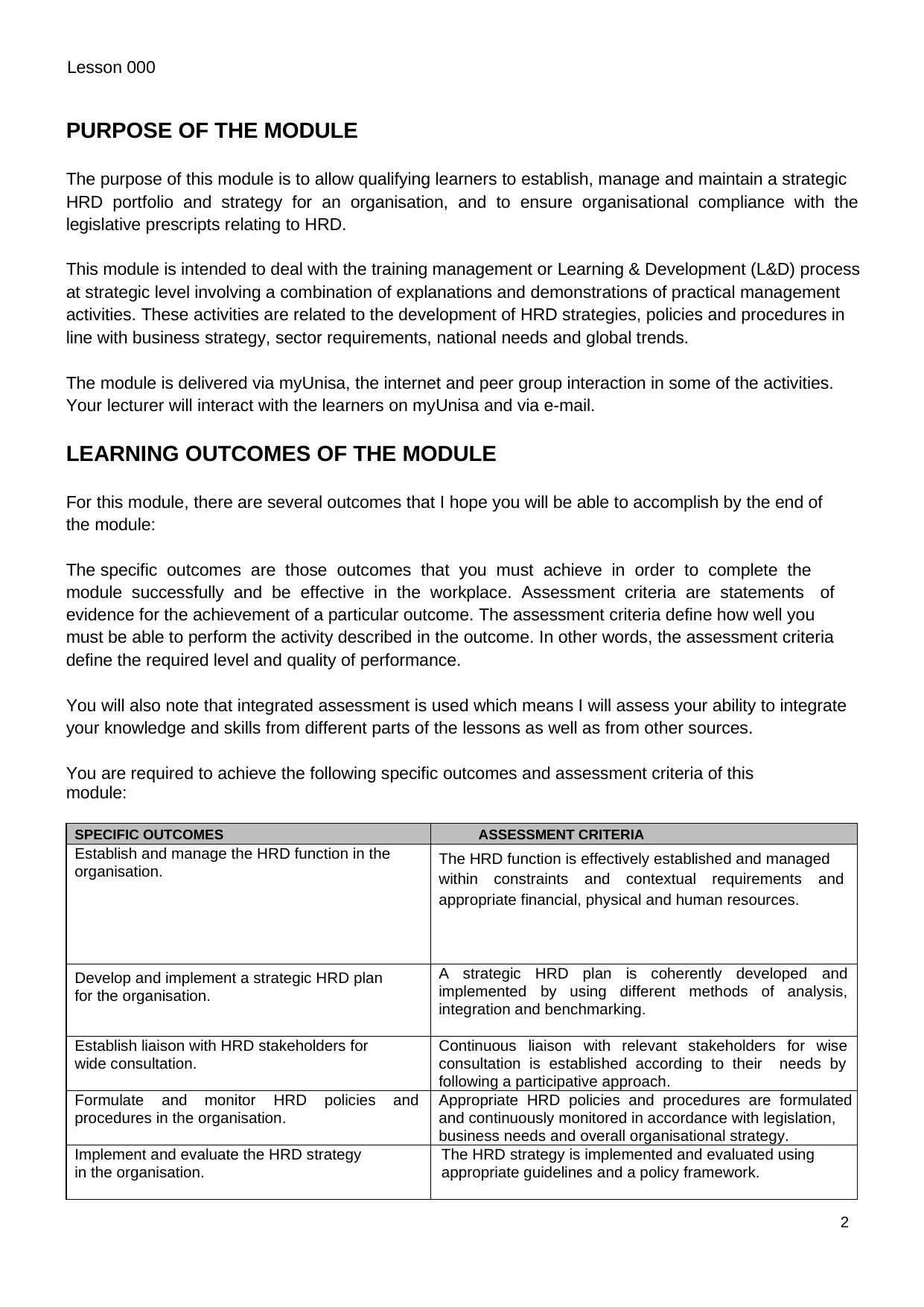
You are required to achieve the following specific outcomes and assessment criteria of this
module:
SPECIFIC OUTCOMES ASSESSMENT CRITERIA
Establish and manage the HRD function in the
organisation. The HRD function is effectively established and managed
within constraints and contextual requirements and
appropriate financial, physical and human resources.
Develop and implement a strategic HRD plan
for the organisation.
A strategic HRD plan is coherently developed and
implemented by using different methods of analysis,
integration and benchmarking.
Establish liaison with HRD stakeholders for
wide consultation.
Continuous liaison with relevant stakeholders for wise
consultation is established according to their needs by
following a participative approach.
Formulate and monitor HRD policies and
procedures in the organisation.
Appropriate HRD policies and procedures are formulated
and continuously monitored in accordance with legislation,
business needs and overall organisational strategy.
Implement and evaluate the HRD strategy
in the organisation.
The HRD strategy is implemented and evaluated using
appropriate guidelines and a policy framework.
Lesson 000
PURPOSE OF THE MODULE
The purpose of this module is to allow qualifying learners to establish, manage and maintain a strategic
HRD portfolio and strategy for an organisation, and to ensure organisational compliance with the
legislative prescripts relating to HRD.
This module is intended to deal with the training management or Learning & Development (L&D) process
at strategic level involving a combination of explanations and demonstrations of practical management
activities. These activities are related to the development of HRD strategies, policies and procedures in
line with business strategy, sector requirements, national needs and global trends.
The module is delivered via myUnisa, the internet and peer group interaction in some of the activities.
Your lecturer will interact with the learners on myUnisa and via e-mail.
LEARNING OUTCOMES OF THE MODULE
For this module, there are several outcomes that I hope you will be able to accomplish by the end of
the module:
The specific outcomes are those outcomes that you must achieve in order to complete the
module successfully and be effective in the workplace. Assessment criteria are statements of
evidence for the achievement of a particular outcome. The assessment criteria define how well you
must be able to perform the activity described in the outcome. In other words, the assessment criteria
define the required level and quality of performance.
You will also note that integrated assessment is used which means I will assess your ability to integrate
your knowledge and skills from different parts of the lessons as well as from other sources.
You are required to achieve the following specific outcomes and assessment criteria of this
module:
SPECIFIC OUTCOMES ASSESSMENT CRITERIA
Establish and manage the HRD function in the
organisation. The HRD function is effectively established and managed
within constraints and contextual requirements and
appropriate financial, physical and human resources.
Develop and implement a strategic HRD plan
for the organisation.
A strategic HRD plan is coherently developed and
implemented by using different methods of analysis,
integration and benchmarking.
Establish liaison with HRD stakeholders for
wide consultation.
Continuous liaison with relevant stakeholders for wise
consultation is established according to their needs by
following a participative approach.
Formulate and monitor HRD policies and
procedures in the organisation.
Appropriate HRD policies and procedures are formulated
and continuously monitored in accordance with legislation,
business needs and overall organisational strategy.
Implement and evaluate the HRD strategy
in the organisation.
The HRD strategy is implemented and evaluated using
appropriate guidelines and a policy framework.
3
Lesson 000
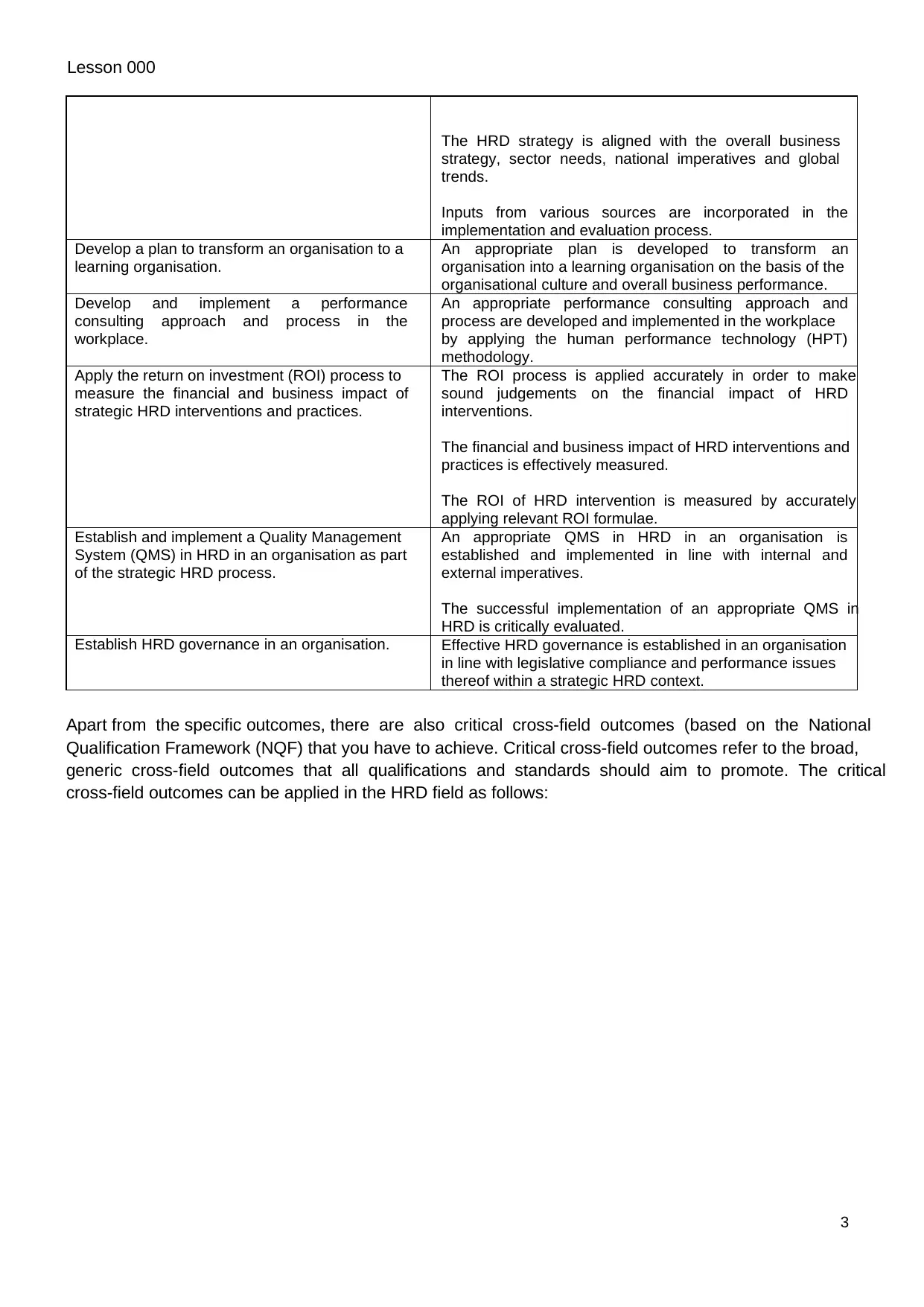
The HRD strategy is aligned with the overall business
strategy, sector needs, national imperatives and global
trends.
Inputs from various sources are incorporated in the
implementation and evaluation process.
Develop a plan to transform an organisation to a
learning organisation.
An appropriate plan is developed to transform an
organisation into a learning organisation on the basis of the
organisational culture and overall business performance.
Develop and implement a performance
consulting approach and process in the
workplace.
An appropriate performance consulting approach and
process are developed and implemented in the workplace
by applying the human performance technology (HPT)
methodology.
Apply the return on investment (ROI) process to
measure the financial and business impact of
strategic HRD interventions and practices.
The ROI process is applied accurately in order to make
sound judgements on the financial impact of HRD
interventions.
The financial and business impact of HRD interventions and
practices is effectively measured.
The ROI of HRD intervention is measured by accurately
applying relevant ROI formulae.
Establish and implement a Quality Management
System (QMS) in HRD in an organisation as part
of the strategic HRD process.
An appropriate QMS in HRD in an organisation is
established and implemented in line with internal and
external imperatives.
The successful implementation of an appropriate QMS in
HRD is critically evaluated.
Establish HRD governance in an organisation. Effective HRD governance is established in an organisation
in line with legislative compliance and performance issues
thereof within a strategic HRD context.
Apart from the specific outcomes, there are also critical cross-field outcomes (based on the National
Qualification Framework (NQF) that you have to achieve. Critical cross-field outcomes refer to the broad,
generic cross-field outcomes that all qualifications and standards should aim to promote. The critical
cross-field outcomes can be applied in the HRD field as follows:
Lesson 000
The HRD strategy is aligned with the overall business
strategy, sector needs, national imperatives and global
trends.
Inputs from various sources are incorporated in the
implementation and evaluation process.
Develop a plan to transform an organisation to a
learning organisation.
An appropriate plan is developed to transform an
organisation into a learning organisation on the basis of the
organisational culture and overall business performance.
Develop and implement a performance
consulting approach and process in the
workplace.
An appropriate performance consulting approach and
process are developed and implemented in the workplace
by applying the human performance technology (HPT)
methodology.
Apply the return on investment (ROI) process to
measure the financial and business impact of
strategic HRD interventions and practices.
The ROI process is applied accurately in order to make
sound judgements on the financial impact of HRD
interventions.
The financial and business impact of HRD interventions and
practices is effectively measured.
The ROI of HRD intervention is measured by accurately
applying relevant ROI formulae.
Establish and implement a Quality Management
System (QMS) in HRD in an organisation as part
of the strategic HRD process.
An appropriate QMS in HRD in an organisation is
established and implemented in line with internal and
external imperatives.
The successful implementation of an appropriate QMS in
HRD is critically evaluated.
Establish HRD governance in an organisation. Effective HRD governance is established in an organisation
in line with legislative compliance and performance issues
thereof within a strategic HRD context.
Apart from the specific outcomes, there are also critical cross-field outcomes (based on the National
Qualification Framework (NQF) that you have to achieve. Critical cross-field outcomes refer to the broad,
generic cross-field outcomes that all qualifications and standards should aim to promote. The critical
cross-field outcomes can be applied in the HRD field as follows:
⊘ This is a preview!⊘
Do you want full access?
Subscribe today to unlock all pages.

Trusted by 1+ million students worldwide
4
Lesson 000
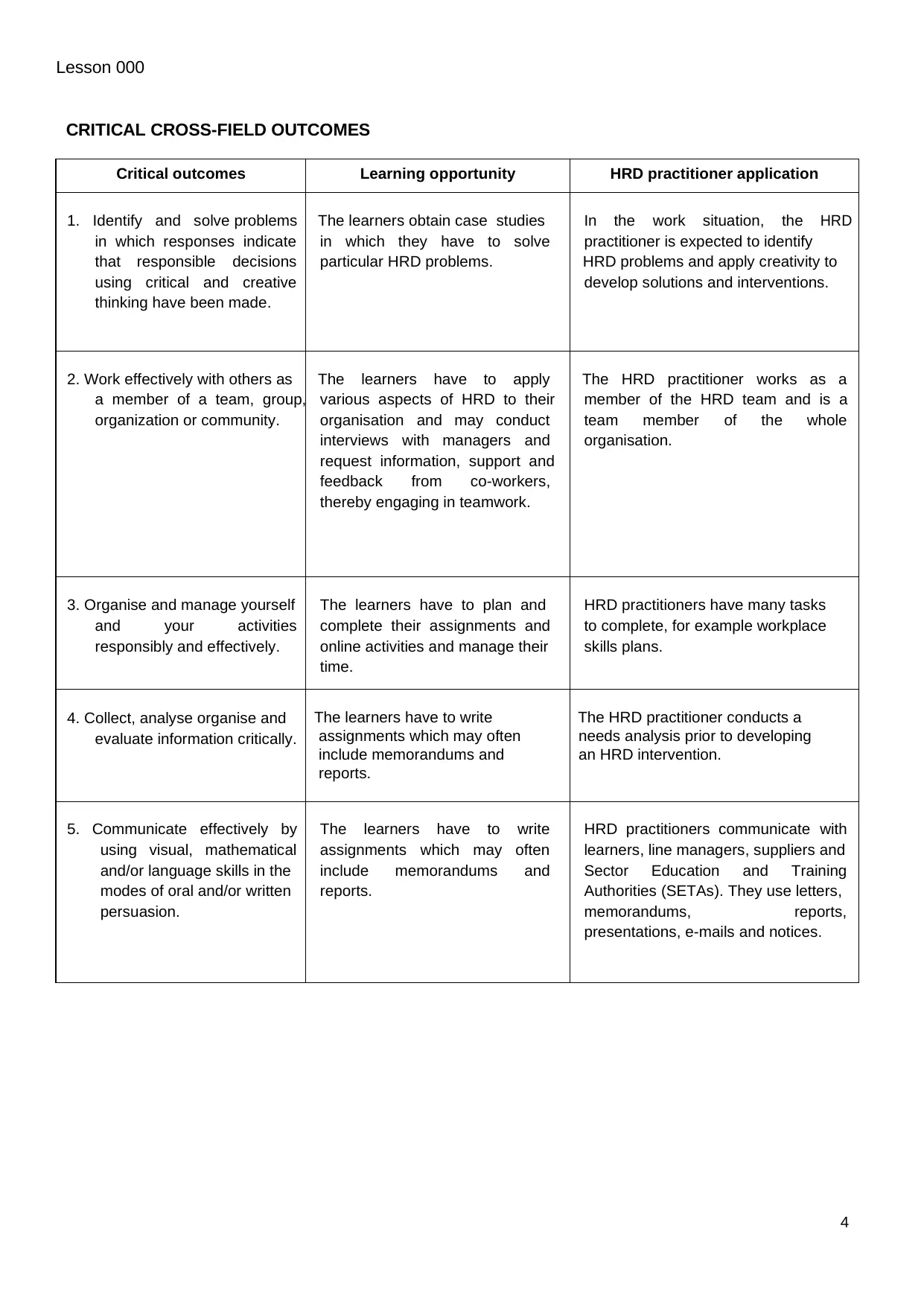
CRITICAL CROSS-FIELD OUTCOMES
Critical outcomes Learning opportunity HRD practitioner application
1. Identify and solve problems
in which responses indicate
that responsible decisions
using critical and creative
thinking have been made.
The learners obtain case studies
in which they have to solve
particular HRD problems.
In the work situation, the HRD
practitioner is expected to identify
HRD problems and apply creativity to
develop solutions and interventions.
2. Work effectively with others as
a member of a team, group,
organization or community.
The learners have to apply
various aspects of HRD to their
organisation and may conduct
interviews with managers and
request information, support and
feedback from co-workers,
thereby engaging in teamwork.
The HRD practitioner works as a
member of the HRD team and is a
team member of the whole
organisation.
3. Organise and manage yourself
and your activities
responsibly and effectively.
The learners have to plan and
complete their assignments and
online activities and manage their
time.
HRD practitioners have many tasks
to complete, for example workplace
skills plans.
4. Collect, analyse organise and
evaluate information critically.
The learners have to write
assignments which may often
include memorandums and
reports.
The HRD practitioner conducts a
needs analysis prior to developing
an HRD intervention.
5. Communicate effectively by
using visual, mathematical
and/or language skills in the
modes of oral and/or written
persuasion.
The learners have to write
assignments which may often
include memorandums and
reports.
HRD practitioners communicate with
learners, line managers, suppliers and
Sector Education and Training
Authorities (SETAs). They use letters,
memorandums, reports,
presentations, e-mails and notices.
Lesson 000
CRITICAL CROSS-FIELD OUTCOMES
Critical outcomes Learning opportunity HRD practitioner application
1. Identify and solve problems
in which responses indicate
that responsible decisions
using critical and creative
thinking have been made.
The learners obtain case studies
in which they have to solve
particular HRD problems.
In the work situation, the HRD
practitioner is expected to identify
HRD problems and apply creativity to
develop solutions and interventions.
2. Work effectively with others as
a member of a team, group,
organization or community.
The learners have to apply
various aspects of HRD to their
organisation and may conduct
interviews with managers and
request information, support and
feedback from co-workers,
thereby engaging in teamwork.
The HRD practitioner works as a
member of the HRD team and is a
team member of the whole
organisation.
3. Organise and manage yourself
and your activities
responsibly and effectively.
The learners have to plan and
complete their assignments and
online activities and manage their
time.
HRD practitioners have many tasks
to complete, for example workplace
skills plans.
4. Collect, analyse organise and
evaluate information critically.
The learners have to write
assignments which may often
include memorandums and
reports.
The HRD practitioner conducts a
needs analysis prior to developing
an HRD intervention.
5. Communicate effectively by
using visual, mathematical
and/or language skills in the
modes of oral and/or written
persuasion.
The learners have to write
assignments which may often
include memorandums and
reports.
HRD practitioners communicate with
learners, line managers, suppliers and
Sector Education and Training
Authorities (SETAs). They use letters,
memorandums, reports,
presentations, e-mails and notices.
Paraphrase This Document
Need a fresh take? Get an instant paraphrase of this document with our AI Paraphraser
5
Lesson 000
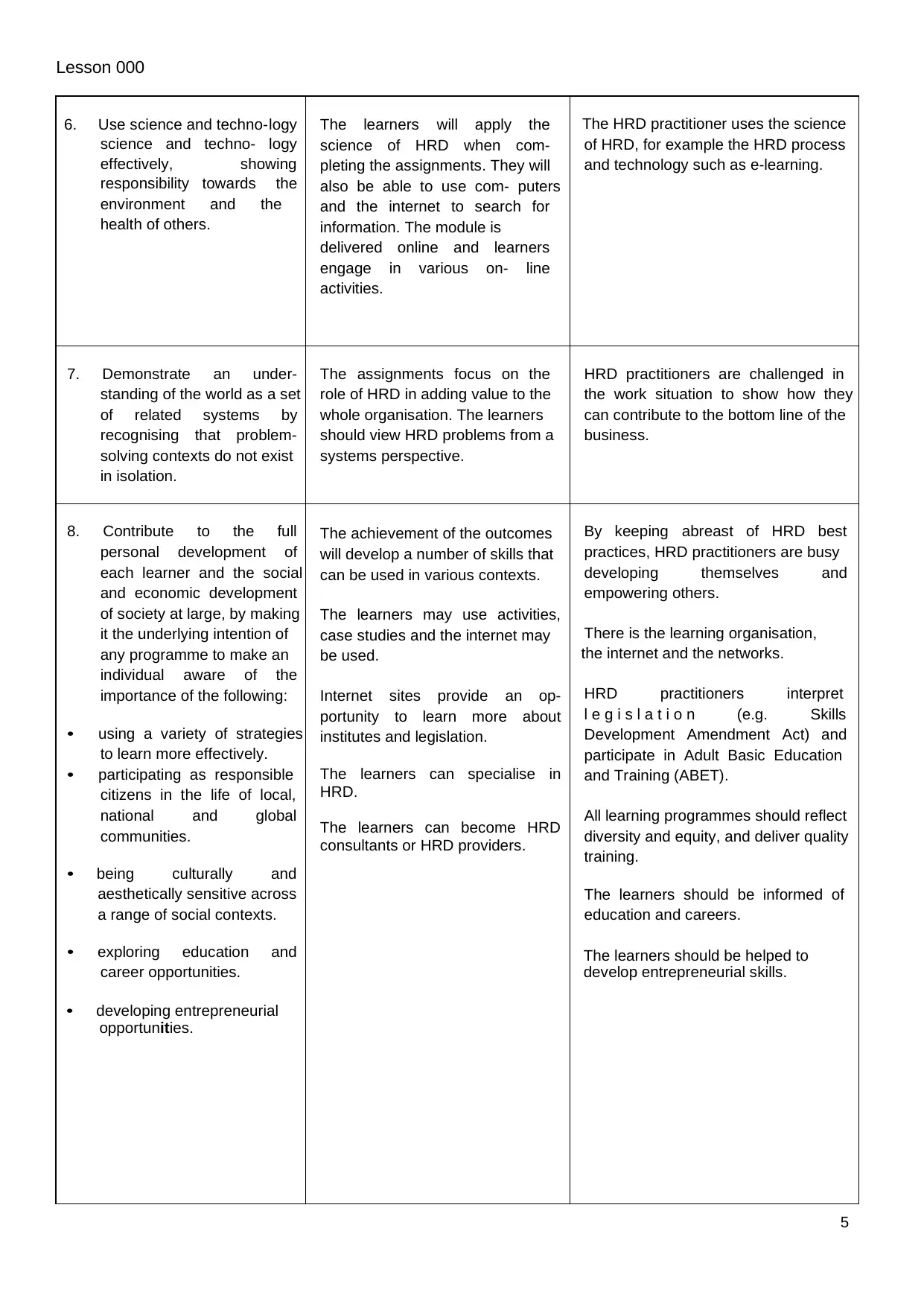
6. Use science and techno- logy
science and techno- logy
effectively, showing
responsibility towards the
environment and the
health of others.
The learners will apply the
science of HRD when com-
pleting the assignments. They will
also be able to use com- puters
and the internet to search for
information. The module is
delivered online and learners
engage in various on- line
activities.
The HRD practitioner uses the science
of HRD, for example the HRD process
and technology such as e-learning.
7. Demonstrate an under-
standing of the world as a set
of related systems by
recognising that problem-
solving contexts do not exist
in isolation.
The assignments focus on the
role of HRD in adding value to the
whole organisation. The learners
should view HRD problems from a
systems perspective.
HRD practitioners are challenged in
the work situation to show how they
can contribute to the bottom line of the
business.
8. Contribute to the full
personal development of
each learner and the social
and economic development
of society at large, by making
it the underlying intention of
any programme to make an
individual aware of the
importance of the following:
• using a variety of strategies
to learn more effectively.
• participating as responsible
citizens in the life of local,
national and global
communities.
• being culturally and
aesthetically sensitive across
a range of social contexts.
• exploring education and
career opportunities.
• developing entrepreneurial
opportunities.
The achievement of the outcomes
will develop a number of skills that
can be used in various contexts.
The learners may use activities,
case studies and the internet may
be used.
Internet sites provide an op-
portunity to learn more about
institutes and legislation.
The learners can specialise in
HRD.
The learners can become HRD
consultants or HRD providers.
By keeping abreast of HRD best
practices, HRD practitioners are busy
developing themselves and
empowering others.
There is the learning organisation,
the internet and the networks.
HRD practitioners interpret
l e g i s l a t i o n (e.g. Skills
Development Amendment Act) and
participate in Adult Basic Education
and Training (ABET).
All learning programmes should reflect
diversity and equity, and deliver quality
training.
The learners should be informed of
education and careers.
The learners should be helped to
develop entrepreneurial skills.
Lesson 000
6. Use science and techno- logy
science and techno- logy
effectively, showing
responsibility towards the
environment and the
health of others.
The learners will apply the
science of HRD when com-
pleting the assignments. They will
also be able to use com- puters
and the internet to search for
information. The module is
delivered online and learners
engage in various on- line
activities.
The HRD practitioner uses the science
of HRD, for example the HRD process
and technology such as e-learning.
7. Demonstrate an under-
standing of the world as a set
of related systems by
recognising that problem-
solving contexts do not exist
in isolation.
The assignments focus on the
role of HRD in adding value to the
whole organisation. The learners
should view HRD problems from a
systems perspective.
HRD practitioners are challenged in
the work situation to show how they
can contribute to the bottom line of the
business.
8. Contribute to the full
personal development of
each learner and the social
and economic development
of society at large, by making
it the underlying intention of
any programme to make an
individual aware of the
importance of the following:
• using a variety of strategies
to learn more effectively.
• participating as responsible
citizens in the life of local,
national and global
communities.
• being culturally and
aesthetically sensitive across
a range of social contexts.
• exploring education and
career opportunities.
• developing entrepreneurial
opportunities.
The achievement of the outcomes
will develop a number of skills that
can be used in various contexts.
The learners may use activities,
case studies and the internet may
be used.
Internet sites provide an op-
portunity to learn more about
institutes and legislation.
The learners can specialise in
HRD.
The learners can become HRD
consultants or HRD providers.
By keeping abreast of HRD best
practices, HRD practitioners are busy
developing themselves and
empowering others.
There is the learning organisation,
the internet and the networks.
HRD practitioners interpret
l e g i s l a t i o n (e.g. Skills
Development Amendment Act) and
participate in Adult Basic Education
and Training (ABET).
All learning programmes should reflect
diversity and equity, and deliver quality
training.
The learners should be informed of
education and careers.
The learners should be helped to
develop entrepreneurial skills.

6
Lesson 000
CRITICAL CROSS-FIELD OUTCOMES
The first column indicates the critical outcomes as prescribed by the NQF. The second column indicates
the learning opportunity you will be afforded this year to apply the critical outcomes as a learner of this
module. The last column deals with the application of all the critical outcomes in practice, in other words
the context in which an HRD practitioner should apply the critical outcomes.
Lesson 000
CRITICAL CROSS-FIELD OUTCOMES
The first column indicates the critical outcomes as prescribed by the NQF. The second column indicates
the learning opportunity you will be afforded this year to apply the critical outcomes as a learner of this
module. The last column deals with the application of all the critical outcomes in practice, in other words
the context in which an HRD practitioner should apply the critical outcomes.
⊘ This is a preview!⊘
Do you want full access?
Subscribe today to unlock all pages.
Trusted by 1+ million students worldwide
7
Lesson 000
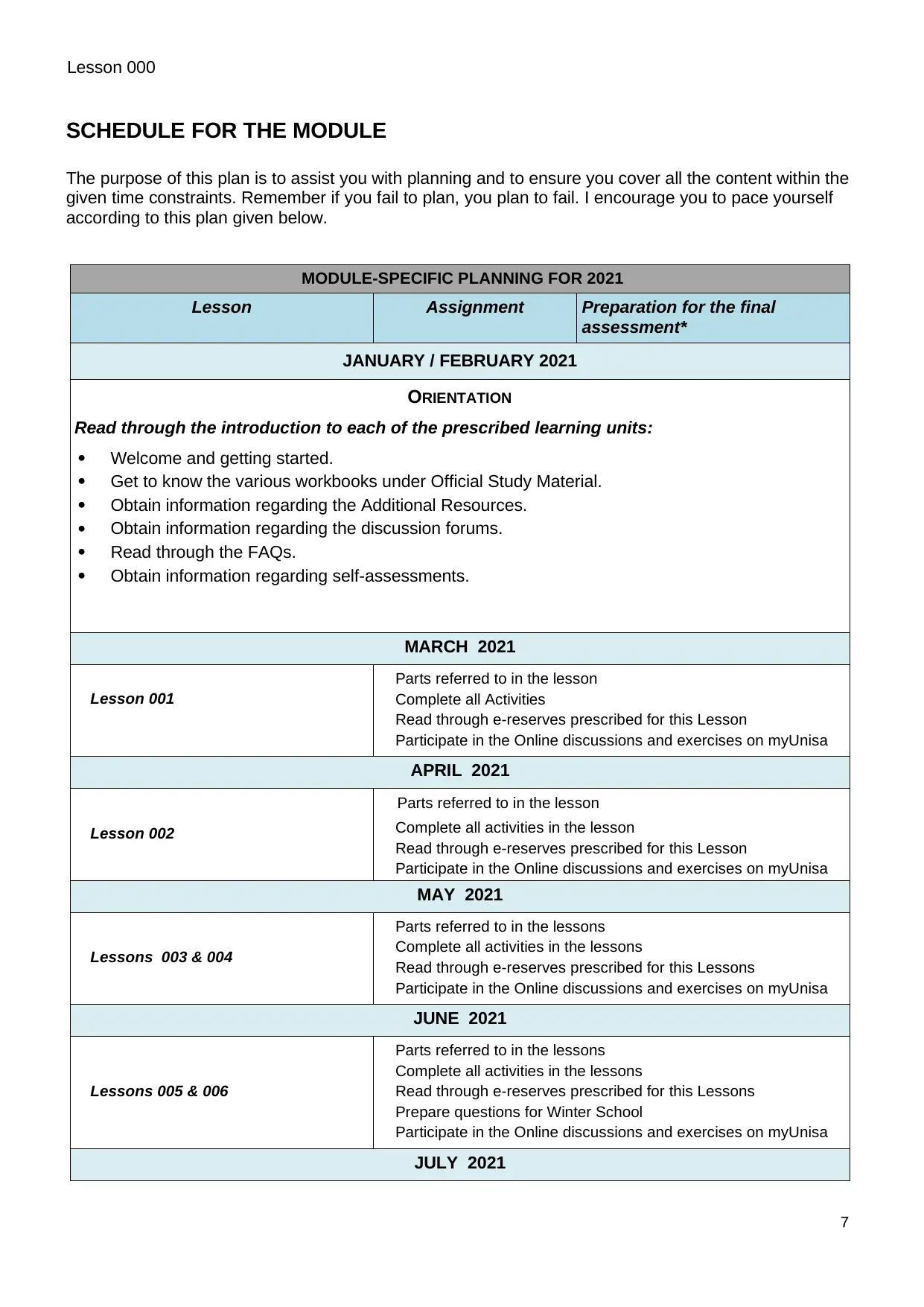
SCHEDULE FOR THE MODULE
The purpose of this plan is to assist you with planning and to ensure you cover all the content within the
given time constraints. Remember if you fail to plan, you plan to fail. I encourage you to pace yourself
according to this plan given below.
MODULE-SPECIFIC PLANNING FOR 2021
Lesson Assignment Preparation for the final
assessment*
JANUARY / FEBRUARY 2021
ORIENTATION
Read through the introduction to each of the prescribed learning units:
Welcome and getting started.
Get to know the various workbooks under Official Study Material.
Obtain information regarding the Additional Resources.
Obtain information regarding the discussion forums.
Read through the FAQs.
Obtain information regarding self-assessments.
MARCH 2021
Lesson 001
Parts referred to in the lesson
Complete all Activities
Read through e-reserves prescribed for this Lesson
Participate in the Online discussions and exercises on myUnisa
APRIL 2021
Lesson 002
Parts referred to in the lesson
Complete all activities in the lesson
Read through e-reserves prescribed for this Lesson
Participate in the Online discussions and exercises on myUnisa
MAY 2021
Lessons 003 & 004
Parts referred to in the lessons
Complete all activities in the lessons
Read through e-reserves prescribed for this Lessons
Participate in the Online discussions and exercises on myUnisa
JUNE 2021
Lessons 005 & 006
Parts referred to in the lessons
Complete all activities in the lessons
Read through e-reserves prescribed for this Lessons
Prepare questions for Winter School
Participate in the Online discussions and exercises on myUnisa
JULY 2021
Lesson 000
SCHEDULE FOR THE MODULE
The purpose of this plan is to assist you with planning and to ensure you cover all the content within the
given time constraints. Remember if you fail to plan, you plan to fail. I encourage you to pace yourself
according to this plan given below.
MODULE-SPECIFIC PLANNING FOR 2021
Lesson Assignment Preparation for the final
assessment*
JANUARY / FEBRUARY 2021
ORIENTATION
Read through the introduction to each of the prescribed learning units:
Welcome and getting started.
Get to know the various workbooks under Official Study Material.
Obtain information regarding the Additional Resources.
Obtain information regarding the discussion forums.
Read through the FAQs.
Obtain information regarding self-assessments.
MARCH 2021
Lesson 001
Parts referred to in the lesson
Complete all Activities
Read through e-reserves prescribed for this Lesson
Participate in the Online discussions and exercises on myUnisa
APRIL 2021
Lesson 002
Parts referred to in the lesson
Complete all activities in the lesson
Read through e-reserves prescribed for this Lesson
Participate in the Online discussions and exercises on myUnisa
MAY 2021
Lessons 003 & 004
Parts referred to in the lessons
Complete all activities in the lessons
Read through e-reserves prescribed for this Lessons
Participate in the Online discussions and exercises on myUnisa
JUNE 2021
Lessons 005 & 006
Parts referred to in the lessons
Complete all activities in the lessons
Read through e-reserves prescribed for this Lessons
Prepare questions for Winter School
Participate in the Online discussions and exercises on myUnisa
JULY 2021
Paraphrase This Document
Need a fresh take? Get an instant paraphrase of this document with our AI Paraphraser
8
Lesson 000
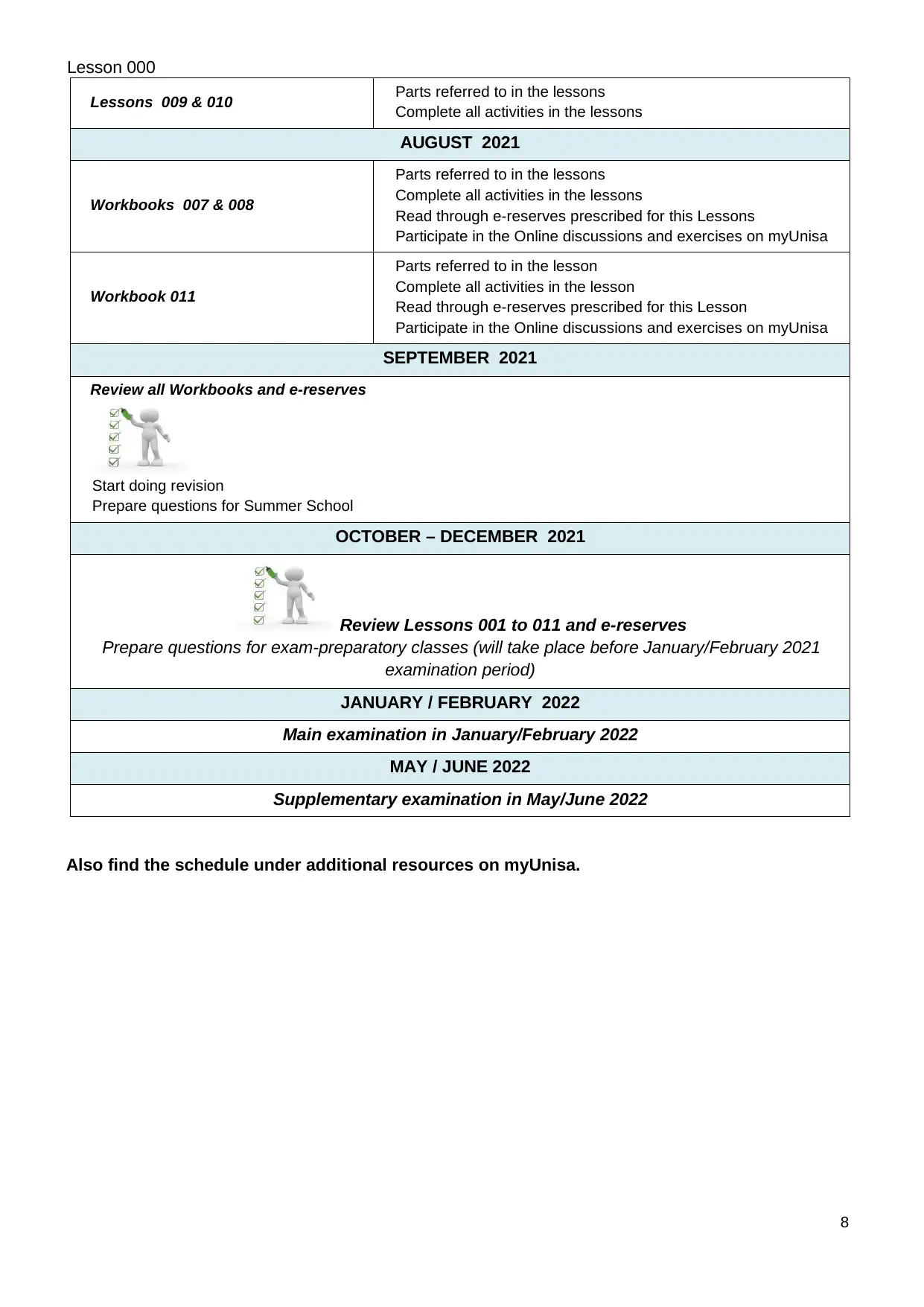
Lessons 009 & 010 Parts referred to in the lessons
Complete all activities in the lessons
AUGUST 2021
Workbooks 007 & 008
Parts referred to in the lessons
Complete all activities in the lessons
Read through e-reserves prescribed for this Lessons
Participate in the Online discussions and exercises on myUnisa
Workbook 011
Parts referred to in the lesson
Complete all activities in the lesson
Read through e-reserves prescribed for this Lesson
Participate in the Online discussions and exercises on myUnisa
SEPTEMBER 2021
Review all Workbooks and e-reserves
Start doing revision
Prepare questions for Summer School
OCTOBER – DECEMBER 2021
Review Lessons 001 to 011 and e-reserves
Prepare questions for exam-preparatory classes (will take place before January/February 2021
examination period)
JANUARY / FEBRUARY 2022
Main examination in January/February 2022
MAY / JUNE 2022
Supplementary examination in May/June 2022
Also find the schedule under additional resources on myUnisa.
Lesson 000
Lessons 009 & 010 Parts referred to in the lessons
Complete all activities in the lessons
AUGUST 2021
Workbooks 007 & 008
Parts referred to in the lessons
Complete all activities in the lessons
Read through e-reserves prescribed for this Lessons
Participate in the Online discussions and exercises on myUnisa
Workbook 011
Parts referred to in the lesson
Complete all activities in the lesson
Read through e-reserves prescribed for this Lesson
Participate in the Online discussions and exercises on myUnisa
SEPTEMBER 2021
Review all Workbooks and e-reserves
Start doing revision
Prepare questions for Summer School
OCTOBER – DECEMBER 2021
Review Lessons 001 to 011 and e-reserves
Prepare questions for exam-preparatory classes (will take place before January/February 2021
examination period)
JANUARY / FEBRUARY 2022
Main examination in January/February 2022
MAY / JUNE 2022
Supplementary examination in May/June 2022
Also find the schedule under additional resources on myUnisa.
9
Lesson 000
HOW TO APPROACH THIS MODULE
You can find almost all of the information that you will need for this module on the HRD4801 myUnisa
module site. This tutorial letter is merely to guide you on where to start and what to do. As mentioned above
it’s really important for you to connect to myUnisa and to use the site and the internet regularly.
To get you started and to assist you with HRD4801 I have included a step-by-step process below:
1. Read this tutorial letter together with the studyguide.
2. Activate your myLife e-mail account.
3. Go to the website https://my.unisa.ac.za and register to use myUnisa.
4. Visit the HRD4801 module site by clicking on HRD4801-20-Y1 in the orange tabs across the top of the
webpage. Remember to also check in the “more” drop down menu if you cannot find it.
5. Read the welcome page.
6. Visit the site regularly to engage in the discussion forums, submit assignments and receive feedback,
download study material, etc.
You may also contact me via the course contact option on myUnisa
ASSESSMENT
Assignments (Formative Assessment)
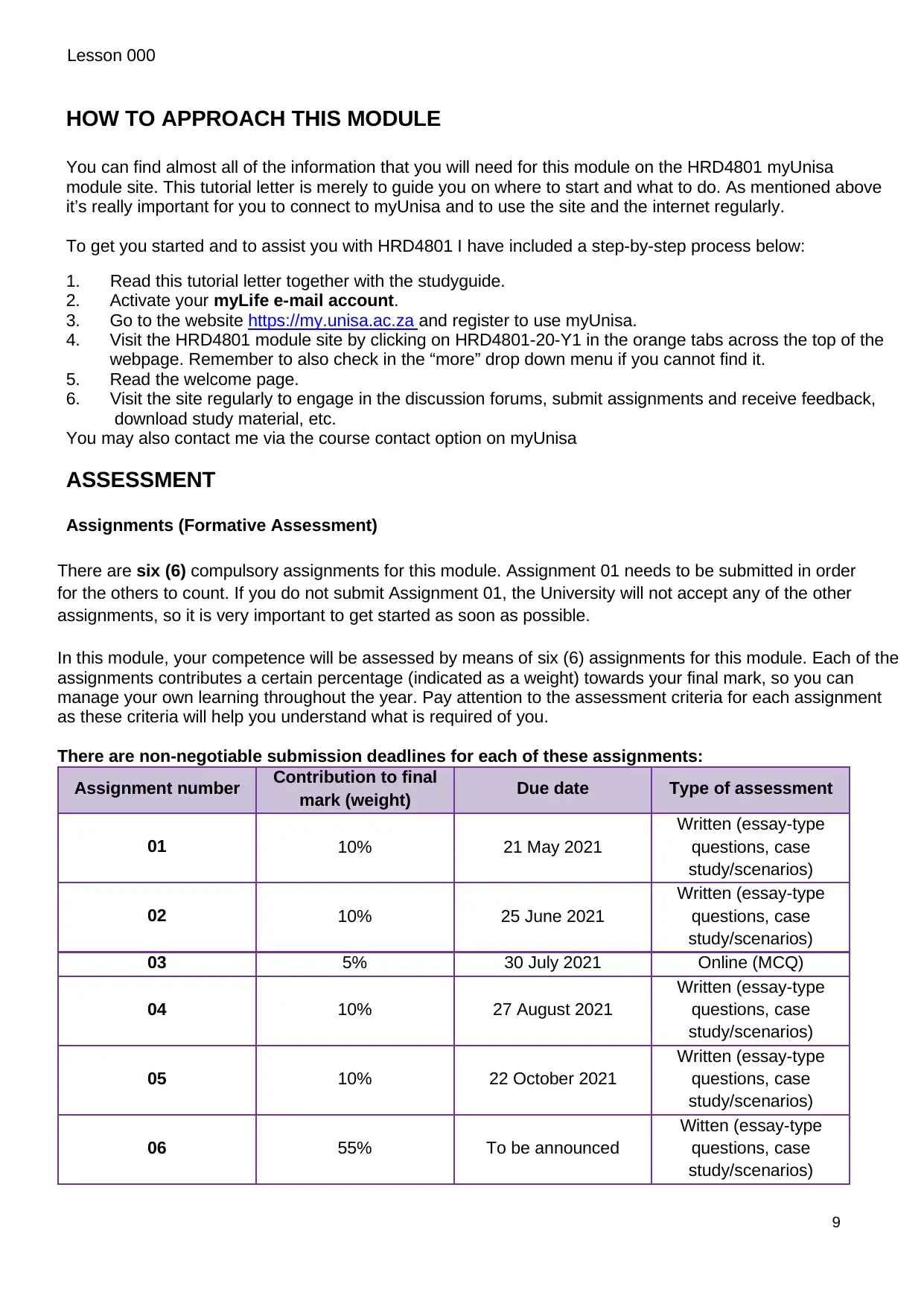
There are six (6) compulsory assignments for this module. Assignment 01 needs to be submitted in order
for the others to count. If you do not submit Assignment 01, the University will not accept any of the other
assignments, so it is very important to get started as soon as possible.
In this module, your competence will be assessed by means of six (6) assignments for this module. Each of the
assignments contributes a certain percentage (indicated as a weight) towards your final mark, so you can
manage your own learning throughout the year. Pay attention to the assessment criteria for each assignment
as these criteria will help you understand what is required of you.
There are non-negotiable submission deadlines for each of these assignments:
Assignment number Contribution to final
mark (weight) Due date Type of assessment
01 10% 21 May 2021
Written (essay-type
questions, case
study/scenarios)
02 10% 25 June 2021
Written (essay-type
questions, case
study/scenarios)
03 5% 30 July 2021 Online (MCQ)
04 10% 27 August 2021
Written (essay-type
questions, case
study/scenarios)
05 10% 22 October 2021
Written (essay-type
questions, case
study/scenarios)
06 55% To be announced
Witten (essay-type
questions, case
study/scenarios)
Lesson 000
HOW TO APPROACH THIS MODULE
You can find almost all of the information that you will need for this module on the HRD4801 myUnisa
module site. This tutorial letter is merely to guide you on where to start and what to do. As mentioned above
it’s really important for you to connect to myUnisa and to use the site and the internet regularly.
To get you started and to assist you with HRD4801 I have included a step-by-step process below:
1. Read this tutorial letter together with the studyguide.
2. Activate your myLife e-mail account.
3. Go to the website https://my.unisa.ac.za and register to use myUnisa.
4. Visit the HRD4801 module site by clicking on HRD4801-20-Y1 in the orange tabs across the top of the
webpage. Remember to also check in the “more” drop down menu if you cannot find it.
5. Read the welcome page.
6. Visit the site regularly to engage in the discussion forums, submit assignments and receive feedback,
download study material, etc.
You may also contact me via the course contact option on myUnisa
ASSESSMENT
Assignments (Formative Assessment)
There are six (6) compulsory assignments for this module. Assignment 01 needs to be submitted in order
for the others to count. If you do not submit Assignment 01, the University will not accept any of the other
assignments, so it is very important to get started as soon as possible.
In this module, your competence will be assessed by means of six (6) assignments for this module. Each of the
assignments contributes a certain percentage (indicated as a weight) towards your final mark, so you can
manage your own learning throughout the year. Pay attention to the assessment criteria for each assignment
as these criteria will help you understand what is required of you.
There are non-negotiable submission deadlines for each of these assignments:
Assignment number Contribution to final
mark (weight) Due date Type of assessment
01 10% 21 May 2021
Written (essay-type
questions, case
study/scenarios)
02 10% 25 June 2021
Written (essay-type
questions, case
study/scenarios)
03 5% 30 July 2021 Online (MCQ)
04 10% 27 August 2021
Written (essay-type
questions, case
study/scenarios)
05 10% 22 October 2021
Written (essay-type
questions, case
study/scenarios)
06 55% To be announced
Witten (essay-type
questions, case
study/scenarios)
⊘ This is a preview!⊘
Do you want full access?
Subscribe today to unlock all pages.
Trusted by 1+ million students worldwide
10
Lesson 000
IMPORTANT NOTE: Because this is an online module, the assignments are not
provided in this tutorial letter. Instead, the assignments will be made available online
two weeks before the due date. An announcement will be sent each time an
assignment is uploaded. You will see them when you visit the myUnisa module site for
HRD4801. Please pay special attention to the instructions and rules of each
assignment. See Appendix A for more information on each of the assignments.
Please note that the assignments are not available upfront; they will only be released on myUnisa two
weeks before each due date.
SUBMISSION OF ASSIGNMENTS
Submit all your assignments online via myUnisa.
There are two types of assignments for HRD4801 – online assessments and written assessments.
The online assessment can only be completed on myUnisa by making use of the “Online Assessment” tool. I
advise you NOT to wait until the last date provided before you complete your assignments on
myUnisa, as the system might be very busy or down for routine maintenance. The written assessments can
be completed on paper or typed but they must be submitted electronically on myUnisa using the “Assessment
info” tool. Please see the instructions below on submitting your assignments on myUnisa.
To complete an assignment via the myUnisa “Online assessment” tool:
Go to myUnisa.
Log in with your student number and password.
Select the module.
Click on “online assessments” in the left-hand menu.
Click on the assignment number you want to complete.
Follow the instructions on the screen.
PLEASE NOTE: You cannot download the assignment to complete on paper and then submit via post.
It has to be completed online.
To submit a written assignment on myUnisa using the “Assessment Info” tool:
Go to myUnisa (http://my.unisa.ac.za) and log in with your student number and password.
Select the relevant module for the assignment you want to submit.
Click on Assessment info in the menu on the left-hand side of the screen.
Click on the number of the assignment that you wish to submit and follow the instructions.
Once you have uploaded an assignment, do not resubmit it. When the due date for a specific
assignment has lapsed, the option to upload it will no longer be available.
You can check on myUnisa whether we have received your assignments.
After you have submitted an assignment, print or save the proof of submission page.
Always keep a copy of your assignments.
PLEASE NOTE: For HRD4801, we only accept PDF files. Please ensure that the PDF is not secured
or protected, otherwise it will be returned unmarked and you may miss the deadline.
Lesson 000
IMPORTANT NOTE: Because this is an online module, the assignments are not
provided in this tutorial letter. Instead, the assignments will be made available online
two weeks before the due date. An announcement will be sent each time an
assignment is uploaded. You will see them when you visit the myUnisa module site for
HRD4801. Please pay special attention to the instructions and rules of each
assignment. See Appendix A for more information on each of the assignments.
Please note that the assignments are not available upfront; they will only be released on myUnisa two
weeks before each due date.
SUBMISSION OF ASSIGNMENTS
Submit all your assignments online via myUnisa.
There are two types of assignments for HRD4801 – online assessments and written assessments.
The online assessment can only be completed on myUnisa by making use of the “Online Assessment” tool. I
advise you NOT to wait until the last date provided before you complete your assignments on
myUnisa, as the system might be very busy or down for routine maintenance. The written assessments can
be completed on paper or typed but they must be submitted electronically on myUnisa using the “Assessment
info” tool. Please see the instructions below on submitting your assignments on myUnisa.
To complete an assignment via the myUnisa “Online assessment” tool:
Go to myUnisa.
Log in with your student number and password.
Select the module.
Click on “online assessments” in the left-hand menu.
Click on the assignment number you want to complete.
Follow the instructions on the screen.
PLEASE NOTE: You cannot download the assignment to complete on paper and then submit via post.
It has to be completed online.
To submit a written assignment on myUnisa using the “Assessment Info” tool:
Go to myUnisa (http://my.unisa.ac.za) and log in with your student number and password.
Select the relevant module for the assignment you want to submit.
Click on Assessment info in the menu on the left-hand side of the screen.
Click on the number of the assignment that you wish to submit and follow the instructions.
Once you have uploaded an assignment, do not resubmit it. When the due date for a specific
assignment has lapsed, the option to upload it will no longer be available.
You can check on myUnisa whether we have received your assignments.
After you have submitted an assignment, print or save the proof of submission page.
Always keep a copy of your assignments.
PLEASE NOTE: For HRD4801, we only accept PDF files. Please ensure that the PDF is not secured
or protected, otherwise it will be returned unmarked and you may miss the deadline.
Paraphrase This Document
Need a fresh take? Get an instant paraphrase of this document with our AI Paraphraser
11
Lesson 000
EXTENSION FOR THE SUBMISSION OF ASSIGNMENTS
No extension for the submission of the assignments will be granted.
FEEDBACK ON ASSIGNMENTS
Feedback on the assignments will be released online on the HRD4801 module site.
Feedback to the online assessment can be found under Submitted Assignments in the Online
Assessment tool on myUnisa. Click on the Feedback link next to the assignment you want to view.
Written assessments (submitted via the Assessment Info tool) will be returned to you with extensive
personal feedback and comments. Feedback to Assignments 01, 02, 04, and 05 will be provided in Tutorial
Letters HRD4801/201, HRD4801/202, HRD4801/204 and HRD4801/205, respectively.
The assignments and feedback on the assignments are an important part of your learning process and should
help you to be better prepared for the next assignment.
FINAL MARK
The marks obtained for all six (6) compulsory assignments will contribute 100% towards your final mark since
there is no formal examination for this module. The combined weighted total of your assignment marks must
be 50% or higher for you to pass the module.
Below is an example of how you can calculate your final mark for the module:
Below is an example of how you can calculate your final mark for the module:
Example: Calculation of final mark
Assignment number Contribution to final mark
(weight) Your mark
01 10% 60%
02 10% 80%
03 5% 70%
04 10% 40%
05 10% 60%
06 55% 75%
The final mark is calculated as follows:
Final mark = weight of assignment x your mark
= (10% x 60%) + (10% x 80%) + (5% x 70%) + (10% x 40%) + (10% x 60%) +
(55% + 75%)
= 6 + 8 + 3.5 + 4 + 6 + 41.25
= 68.75 (69%)
You will need a final mark of 50% to pass this module.
As indicated above, you must obtain 50% to pass this module. Therefore, you will fail the module if you
obtain 49% or less for the module.
PLEASE NOTE: There is no supplementary opportunity for HRD4801. You must monitor your performance
and year mark throughout the year and adjust your performance as necessary. If your final mark is less than
Lesson 000
EXTENSION FOR THE SUBMISSION OF ASSIGNMENTS
No extension for the submission of the assignments will be granted.
FEEDBACK ON ASSIGNMENTS
Feedback on the assignments will be released online on the HRD4801 module site.
Feedback to the online assessment can be found under Submitted Assignments in the Online
Assessment tool on myUnisa. Click on the Feedback link next to the assignment you want to view.
Written assessments (submitted via the Assessment Info tool) will be returned to you with extensive
personal feedback and comments. Feedback to Assignments 01, 02, 04, and 05 will be provided in Tutorial
Letters HRD4801/201, HRD4801/202, HRD4801/204 and HRD4801/205, respectively.
The assignments and feedback on the assignments are an important part of your learning process and should
help you to be better prepared for the next assignment.
FINAL MARK
The marks obtained for all six (6) compulsory assignments will contribute 100% towards your final mark since
there is no formal examination for this module. The combined weighted total of your assignment marks must
be 50% or higher for you to pass the module.
Below is an example of how you can calculate your final mark for the module:
Below is an example of how you can calculate your final mark for the module:
Example: Calculation of final mark
Assignment number Contribution to final mark
(weight) Your mark
01 10% 60%
02 10% 80%
03 5% 70%
04 10% 40%
05 10% 60%
06 55% 75%
The final mark is calculated as follows:
Final mark = weight of assignment x your mark
= (10% x 60%) + (10% x 80%) + (5% x 70%) + (10% x 40%) + (10% x 60%) +
(55% + 75%)
= 6 + 8 + 3.5 + 4 + 6 + 41.25
= 68.75 (69%)
You will need a final mark of 50% to pass this module.
As indicated above, you must obtain 50% to pass this module. Therefore, you will fail the module if you
obtain 49% or less for the module.
PLEASE NOTE: There is no supplementary opportunity for HRD4801. You must monitor your performance
and year mark throughout the year and adjust your performance as necessary. If your final mark is less than
12
Lesson 000
50%, you will have to reregister for the module.
REFERENCES TO LINKS AND THE WORLDWIDE WEB
If you have access to a computer that is linked to the internet, you can quickly access resources and
information at the university. The myUnisa learning management system is the university's online campus
that will help you communicate with your lecturers, with other students and with the administrative
departments at Unisa – all through the computer and the internet.
You can start at the main Unisa website at http://www.unisa.ac.za and then click on the myUnisa orange
block. This will take you to the myUnisa website. To go to the myUnisa website directly, go to
https://my.unisa.ac.za. Click on the Claim UNISA Login on the right-hand side of the screen on the myUnisa
website. You will then be prompted to give your student number in order to claim your initial myUnisa details
as well as your myLife e-mail login details.
Check your myLife e-mails regularly because all announcements and other module-related
communication will be sent to this address.
Refer to the Study @ Unisa brochure for more information on myUnisa. As mentioned above, this is essential
for this module. To access myUnisa go to http://my.unisa.ac.za.
On the HRD4801 module site myUnisa module site you will find many tools that include among others, a link
to contact your lecturer and also under Additional Resources and Official Study Material you will find the
necessary study material to achieve the learning outcomes of the module.
CONCLUDING REMARKS
Do not hesitate to contact me should you experience any problems with the content of this studyguide or any
aspect of the module. My contact details are available in tutorial letter HRD4801/101/1 or you can use the
course contact tool on the HRD4801 myUnisa modules site.
I wish you a fascinating and satisfying journey through the learning material and trust that you will complete the
module successfully.
Enjoy the journey!
Ms Tebogo Molotsi
Department of Human Resource Management
Unisa
Lesson 000
50%, you will have to reregister for the module.
REFERENCES TO LINKS AND THE WORLDWIDE WEB
If you have access to a computer that is linked to the internet, you can quickly access resources and
information at the university. The myUnisa learning management system is the university's online campus
that will help you communicate with your lecturers, with other students and with the administrative
departments at Unisa – all through the computer and the internet.
You can start at the main Unisa website at http://www.unisa.ac.za and then click on the myUnisa orange
block. This will take you to the myUnisa website. To go to the myUnisa website directly, go to
https://my.unisa.ac.za. Click on the Claim UNISA Login on the right-hand side of the screen on the myUnisa
website. You will then be prompted to give your student number in order to claim your initial myUnisa details
as well as your myLife e-mail login details.
Check your myLife e-mails regularly because all announcements and other module-related
communication will be sent to this address.
Refer to the Study @ Unisa brochure for more information on myUnisa. As mentioned above, this is essential
for this module. To access myUnisa go to http://my.unisa.ac.za.
On the HRD4801 module site myUnisa module site you will find many tools that include among others, a link
to contact your lecturer and also under Additional Resources and Official Study Material you will find the
necessary study material to achieve the learning outcomes of the module.
CONCLUDING REMARKS
Do not hesitate to contact me should you experience any problems with the content of this studyguide or any
aspect of the module. My contact details are available in tutorial letter HRD4801/101/1 or you can use the
course contact tool on the HRD4801 myUnisa modules site.
I wish you a fascinating and satisfying journey through the learning material and trust that you will complete the
module successfully.
Enjoy the journey!
Ms Tebogo Molotsi
Department of Human Resource Management
Unisa
⊘ This is a preview!⊘
Do you want full access?
Subscribe today to unlock all pages.
Trusted by 1+ million students worldwide

1 out of 12


Related Documents


Your All-in-One AI-Powered Toolkit for Academic Success.
+13062052269
info@desklib.com
Available 24*7 on WhatsApp / Email
![[object Object]](/_next/static/media/star-bottom.7253800d.svg)
Unlock your academic potential
Copyright © 2020–2026 A2Z Services. All Rights Reserved. Developed and managed by ZUCOL.