HRES2303: Analyzing a Return to Work Plan in Occupational Safety
VerifiedAdded on 2023/05/31
|11
|2325
|66
Report
AI Summary
This report presents a case study analysis of occupational health and safety within XYZ Company, focusing on the Return to Work (RTW) plan for an employee, John Smith, suffering from morbid obesity and related complications. The analysis covers applicable laws and acts, evaluates the company's disability management program using a provided template, and suggests improvements for the program. A detailed RTW plan is proposed, addressing the worker's functional abilities, necessary job modifications, stakeholder communication, potential barriers, and risk factors. The report concludes with recommendations for a sheltered work environment to facilitate John Smith's successful return to employment, highlighting the importance of clear communication, employee support, and proactive safety measures.
Running head: OCCUPATIONAL HEALTH AND SAFETY
Occupational Health and Safety
-A Case Study
Name of the Student
Name of the University
Author Note
Occupational Health and Safety
-A Case Study
Name of the Student
Name of the University
Author Note

Paraphrase This Document
Need a fresh take? Get an instant paraphrase of this document with our AI Paraphraser
1OCCUPATIONAL HEALTH AND SAFETY
Contents
Part 1. Introduction.....................................................................................................................3
• Company..............................................................................................................................3
• The worker situation............................................................................................................3
• The laws and Acts that apply to the situation......................................................................3
Part 2: Disability Management...................................................................................................3
1. Analysis and evaluation of the organization using Disability Management Template...4
2. For the factors that are limited or missing in the management as per the template:...........5
a. Suggestion on what can be implemented to improve the disability program.................5
b. Expected outcomes from the implementation of the suggestions...................................5
Part 3: Return to work plan........................................................................................................6
a. The current state of the ability of the worker and what type of modification strategy
would be effective..................................................................................................................6
b. Assessment of the functional ability of the worker and whether it fits with the Physical
Demand Analyses (PDA) of the modified work position......................................................7
c. Determination of the stakeholders and who outlines how the communication between
them should take place so that each stakeholder knows the whole situation and can act
accordingly.............................................................................................................................7
d. Barriers to RTW and how to address them.....................................................................8
e. Risk factors......................................................................................................................8
Part 4: Summary.........................................................................................................................8
References:...............................................................................................................................10
Contents
Part 1. Introduction.....................................................................................................................3
• Company..............................................................................................................................3
• The worker situation............................................................................................................3
• The laws and Acts that apply to the situation......................................................................3
Part 2: Disability Management...................................................................................................3
1. Analysis and evaluation of the organization using Disability Management Template...4
2. For the factors that are limited or missing in the management as per the template:...........5
a. Suggestion on what can be implemented to improve the disability program.................5
b. Expected outcomes from the implementation of the suggestions...................................5
Part 3: Return to work plan........................................................................................................6
a. The current state of the ability of the worker and what type of modification strategy
would be effective..................................................................................................................6
b. Assessment of the functional ability of the worker and whether it fits with the Physical
Demand Analyses (PDA) of the modified work position......................................................7
c. Determination of the stakeholders and who outlines how the communication between
them should take place so that each stakeholder knows the whole situation and can act
accordingly.............................................................................................................................7
d. Barriers to RTW and how to address them.....................................................................8
e. Risk factors......................................................................................................................8
Part 4: Summary.........................................................................................................................8
References:...............................................................................................................................10
2OCCUPATIONAL HEALTH AND SAFETY
Part 1. Introduction
• Company
XYZ Company is headquartered in Calgary and has its remote operations in Northern
Alberta. These remote locations acts as a base from where the Field Service Technicians can
work from and collect field samples. The company also has other remote sites in BC and
Alberta from where the operatives collect the environmental samples.
• The worker situation
The work requires the technicians working in harsh outdoor conditions, bearing heat
during the summers and snow during the winters, often carrying heavy equipment and driving
heavy vehicles exposing the workers to several occupational hazards. In the given case
scenario, John Smith have developed morbid obesity during his tenure which further led to
his disability and inability to continue his work.
• The laws and Acts that apply to the situation
Laws and Acts that are applicable to this situation includes:
Canada Occupational Health and Safety Act
Canada Labor Code
Westray Memorandum of Understanding
Employment Equity Act
(Lay et al., 2016; Yazdani et al., 2015; Shea et al., 2016)
Part 2: Disability Management
Part 1. Introduction
• Company
XYZ Company is headquartered in Calgary and has its remote operations in Northern
Alberta. These remote locations acts as a base from where the Field Service Technicians can
work from and collect field samples. The company also has other remote sites in BC and
Alberta from where the operatives collect the environmental samples.
• The worker situation
The work requires the technicians working in harsh outdoor conditions, bearing heat
during the summers and snow during the winters, often carrying heavy equipment and driving
heavy vehicles exposing the workers to several occupational hazards. In the given case
scenario, John Smith have developed morbid obesity during his tenure which further led to
his disability and inability to continue his work.
• The laws and Acts that apply to the situation
Laws and Acts that are applicable to this situation includes:
Canada Occupational Health and Safety Act
Canada Labor Code
Westray Memorandum of Understanding
Employment Equity Act
(Lay et al., 2016; Yazdani et al., 2015; Shea et al., 2016)
Part 2: Disability Management
⊘ This is a preview!⊘
Do you want full access?
Subscribe today to unlock all pages.

Trusted by 1+ million students worldwide
3OCCUPATIONAL HEALTH AND SAFETY
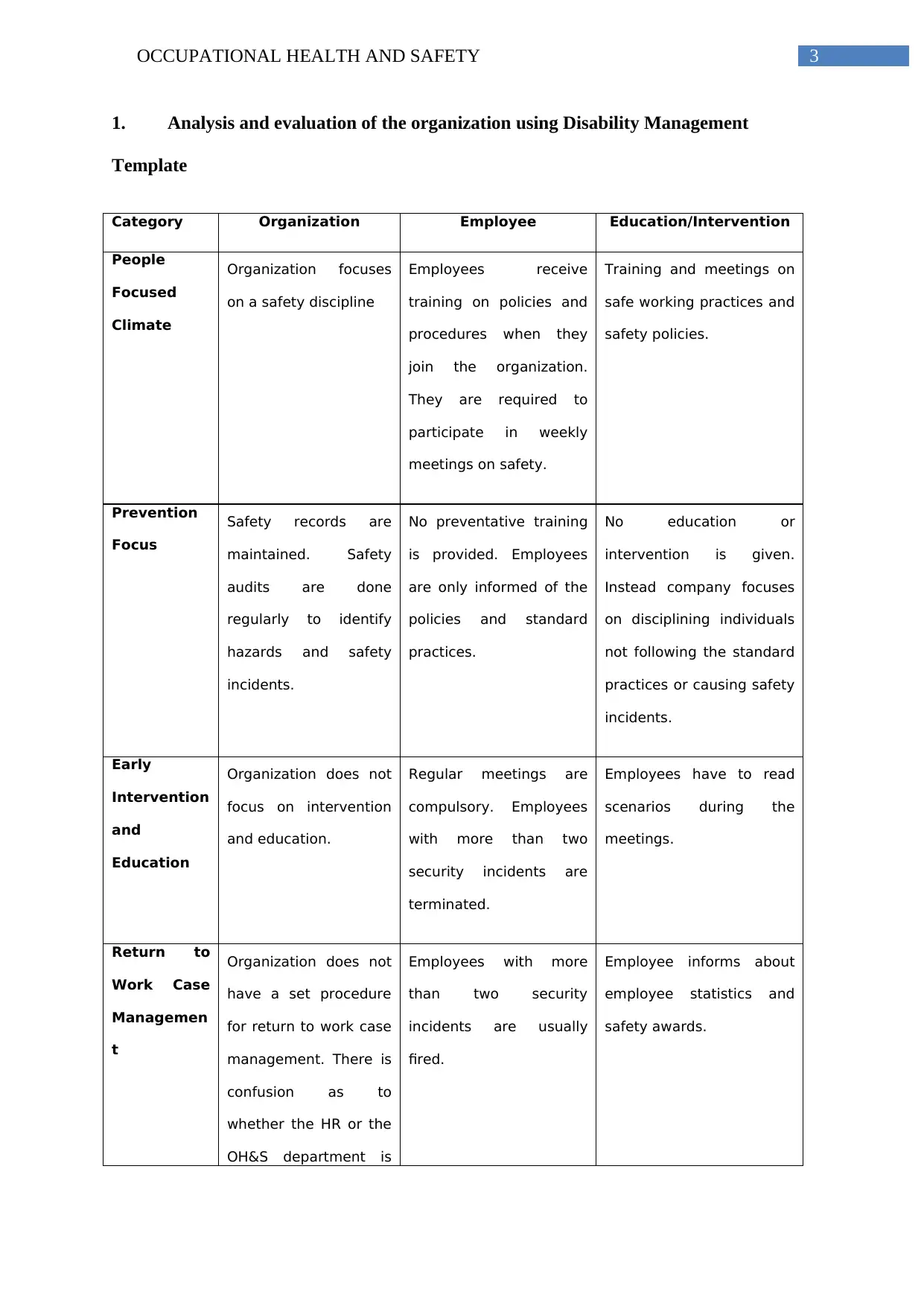
1. Analysis and evaluation of the organization using Disability Management
Template
Category Organization Employee Education/Intervention
People
Focused
Climate
Organization focuses
on a safety discipline
Employees receive
training on policies and
procedures when they
join the organization.
They are required to
participate in weekly
meetings on safety.
Training and meetings on
safe working practices and
safety policies.
Prevention
Focus
Safety records are
maintained. Safety
audits are done
regularly to identify
hazards and safety
incidents.
No preventative training
is provided. Employees
are only informed of the
policies and standard
practices.
No education or
intervention is given.
Instead company focuses
on disciplining individuals
not following the standard
practices or causing safety
incidents.
Early
Intervention
and
Education
Organization does not
focus on intervention
and education.
Regular meetings are
compulsory. Employees
with more than two
security incidents are
terminated.
Employees have to read
scenarios during the
meetings.
Return to
Work Case
Managemen
t
Organization does not
have a set procedure
for return to work case
management. There is
confusion as to
whether the HR or the
OH&S department is
Employees with more
than two security
incidents are usually
fired.
Employee informs about
employee statistics and
safety awards.
1. Analysis and evaluation of the organization using Disability Management
Template
Category Organization Employee Education/Intervention
People
Focused
Climate
Organization focuses
on a safety discipline
Employees receive
training on policies and
procedures when they
join the organization.
They are required to
participate in weekly
meetings on safety.
Training and meetings on
safe working practices and
safety policies.
Prevention
Focus
Safety records are
maintained. Safety
audits are done
regularly to identify
hazards and safety
incidents.
No preventative training
is provided. Employees
are only informed of the
policies and standard
practices.
No education or
intervention is given.
Instead company focuses
on disciplining individuals
not following the standard
practices or causing safety
incidents.
Early
Intervention
and
Education
Organization does not
focus on intervention
and education.
Regular meetings are
compulsory. Employees
with more than two
security incidents are
terminated.
Employees have to read
scenarios during the
meetings.
Return to
Work Case
Managemen
t
Organization does not
have a set procedure
for return to work case
management. There is
confusion as to
whether the HR or the
OH&S department is
Employees with more
than two security
incidents are usually
fired.
Employee informs about
employee statistics and
safety awards.
Paraphrase This Document
Need a fresh take? Get an instant paraphrase of this document with our AI Paraphraser
4OCCUPATIONAL HEALTH AND SAFETY
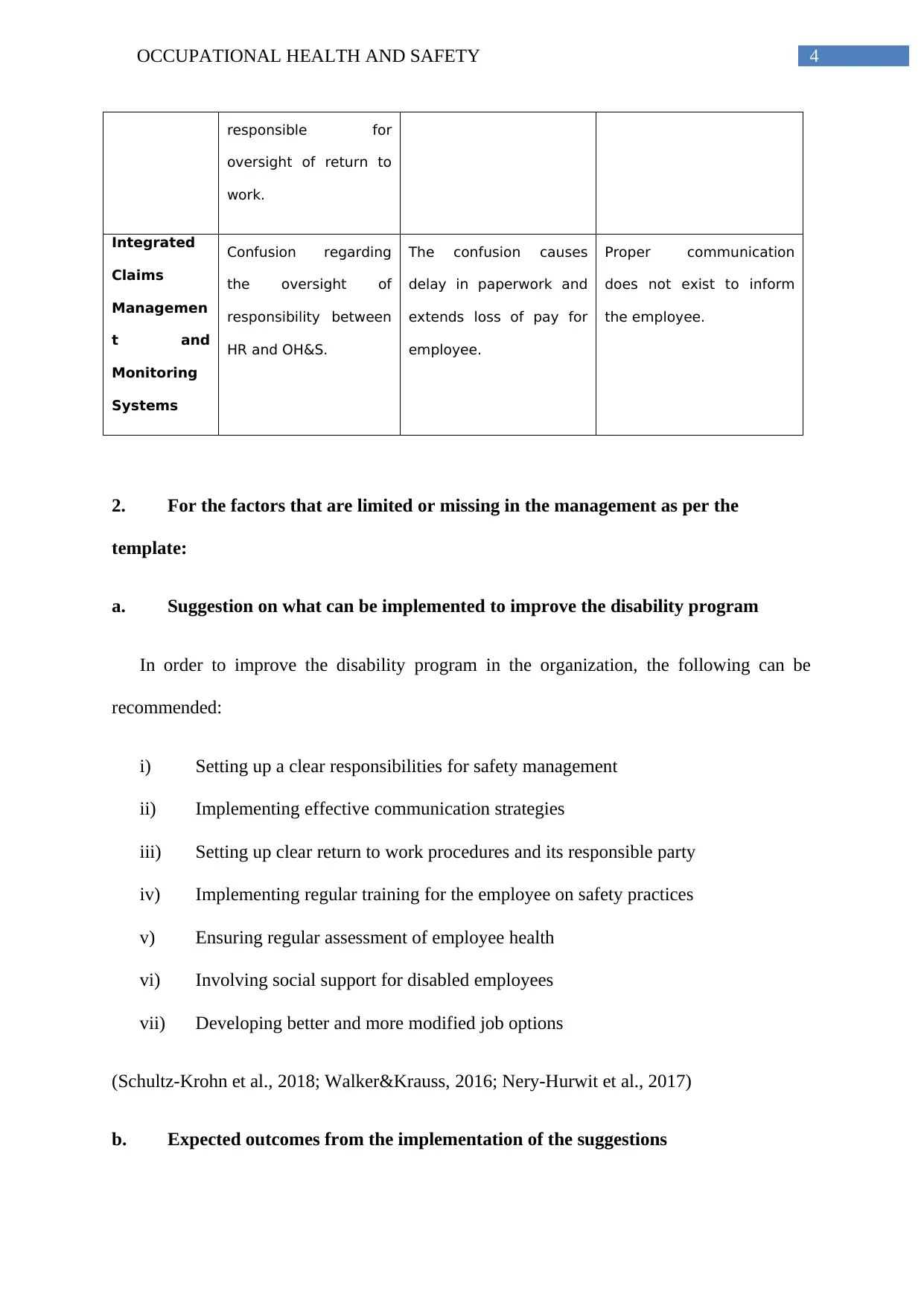
responsible for
oversight of return to
work.
Integrated
Claims
Managemen
t and
Monitoring
Systems
Confusion regarding
the oversight of
responsibility between
HR and OH&S.
The confusion causes
delay in paperwork and
extends loss of pay for
employee.
Proper communication
does not exist to inform
the employee.
2. For the factors that are limited or missing in the management as per the
template:
a. Suggestion on what can be implemented to improve the disability program
In order to improve the disability program in the organization, the following can be
recommended:
i) Setting up a clear responsibilities for safety management
ii) Implementing effective communication strategies
iii) Setting up clear return to work procedures and its responsible party
iv) Implementing regular training for the employee on safety practices
v) Ensuring regular assessment of employee health
vi) Involving social support for disabled employees
vii) Developing better and more modified job options
(Schultz-Krohn et al., 2018; Walker&Krauss, 2016; Nery-Hurwit et al., 2017)
b. Expected outcomes from the implementation of the suggestions
responsible for
oversight of return to
work.
Integrated
Claims
Managemen
t and
Monitoring
Systems
Confusion regarding
the oversight of
responsibility between
HR and OH&S.
The confusion causes
delay in paperwork and
extends loss of pay for
employee.
Proper communication
does not exist to inform
the employee.
2. For the factors that are limited or missing in the management as per the
template:
a. Suggestion on what can be implemented to improve the disability program
In order to improve the disability program in the organization, the following can be
recommended:
i) Setting up a clear responsibilities for safety management
ii) Implementing effective communication strategies
iii) Setting up clear return to work procedures and its responsible party
iv) Implementing regular training for the employee on safety practices
v) Ensuring regular assessment of employee health
vi) Involving social support for disabled employees
vii) Developing better and more modified job options
(Schultz-Krohn et al., 2018; Walker&Krauss, 2016; Nery-Hurwit et al., 2017)
b. Expected outcomes from the implementation of the suggestions

5OCCUPATIONAL HEALTH AND SAFETY
The following outcomes can be expected from the suggestions above:
i) It will prevent confusion as to who is responsible for maintaining safety and safety
practices
ii) Effective transfer of information between the departments and no confusion
iii) Clear and unambiguous return to work policies
iv) Reduction in the number of in incidents and defaulters
v) Better understanding of employee health condition and potential risks to their
wellbeing
vi) Better continuity of support for the disabled employees
vii) More options of return to work for employee with temporary disability and
providing continuity of employment for permanently disabled employees.
(Schultz-Krohn et al., 2018; Walker & Krauss, 2016; Nery-Hurwit et al., 2017)
Part 3: Return to work plan
a. The current state of the ability of the worker and what type of modification
strategy would be effective
John Smith have been classified as morbidly obese and have suffered knee injury
while working in his garage in the weekend. He was prescribed anti-inflammatory
medications and was advised to use crutches while walking. However due to prolonged use
of crutch, he developed a problem in his arm which limits hos ability to use crutch. Due to
this is no longer able to move much, unable to use his crutch for a long time and also unable
to drive because of his knee condition. He currently receives 66% of his regular income as
STD payment but is inadequate to cover his expenses. In such a condition, the modification
The following outcomes can be expected from the suggestions above:
i) It will prevent confusion as to who is responsible for maintaining safety and safety
practices
ii) Effective transfer of information between the departments and no confusion
iii) Clear and unambiguous return to work policies
iv) Reduction in the number of in incidents and defaulters
v) Better understanding of employee health condition and potential risks to their
wellbeing
vi) Better continuity of support for the disabled employees
vii) More options of return to work for employee with temporary disability and
providing continuity of employment for permanently disabled employees.
(Schultz-Krohn et al., 2018; Walker & Krauss, 2016; Nery-Hurwit et al., 2017)
Part 3: Return to work plan
a. The current state of the ability of the worker and what type of modification
strategy would be effective
John Smith have been classified as morbidly obese and have suffered knee injury
while working in his garage in the weekend. He was prescribed anti-inflammatory
medications and was advised to use crutches while walking. However due to prolonged use
of crutch, he developed a problem in his arm which limits hos ability to use crutch. Due to
this is no longer able to move much, unable to use his crutch for a long time and also unable
to drive because of his knee condition. He currently receives 66% of his regular income as
STD payment but is inadequate to cover his expenses. In such a condition, the modification
⊘ This is a preview!⊘
Do you want full access?
Subscribe today to unlock all pages.
Trusted by 1+ million students worldwide
6OCCUPATIONAL HEALTH AND SAFETY
strategy that can be suggested for John Smith is to give him supported and sheltered work in
which he would not be required to move around, such as a desk job.
b. Assessment of the functional ability of the worker and whether it fits with the
Physical Demand Analyses (PDA) of the modified work position
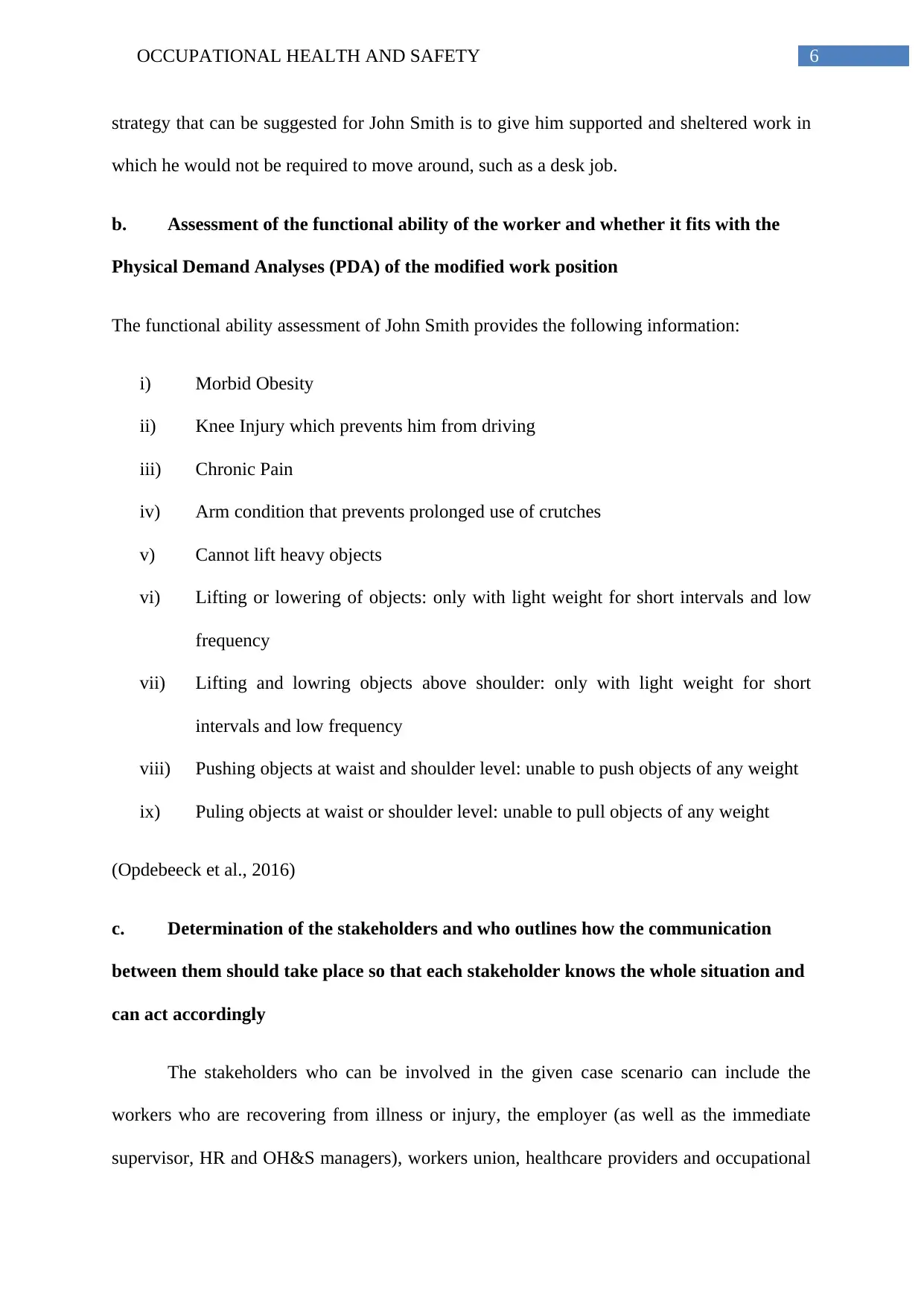
The functional ability assessment of John Smith provides the following information:
i) Morbid Obesity
ii) Knee Injury which prevents him from driving
iii) Chronic Pain
iv) Arm condition that prevents prolonged use of crutches
v) Cannot lift heavy objects
vi) Lifting or lowering of objects: only with light weight for short intervals and low
frequency
vii) Lifting and lowring objects above shoulder: only with light weight for short
intervals and low frequency
viii) Pushing objects at waist and shoulder level: unable to push objects of any weight
ix) Puling objects at waist or shoulder level: unable to pull objects of any weight
(Opdebeeck et al., 2016)
c. Determination of the stakeholders and who outlines how the communication
between them should take place so that each stakeholder knows the whole situation and
can act accordingly
The stakeholders who can be involved in the given case scenario can include the
workers who are recovering from illness or injury, the employer (as well as the immediate
supervisor, HR and OH&S managers), workers union, healthcare providers and occupational
strategy that can be suggested for John Smith is to give him supported and sheltered work in
which he would not be required to move around, such as a desk job.
b. Assessment of the functional ability of the worker and whether it fits with the
Physical Demand Analyses (PDA) of the modified work position
The functional ability assessment of John Smith provides the following information:
i) Morbid Obesity
ii) Knee Injury which prevents him from driving
iii) Chronic Pain
iv) Arm condition that prevents prolonged use of crutches
v) Cannot lift heavy objects
vi) Lifting or lowering of objects: only with light weight for short intervals and low
frequency
vii) Lifting and lowring objects above shoulder: only with light weight for short
intervals and low frequency
viii) Pushing objects at waist and shoulder level: unable to push objects of any weight
ix) Puling objects at waist or shoulder level: unable to pull objects of any weight
(Opdebeeck et al., 2016)
c. Determination of the stakeholders and who outlines how the communication
between them should take place so that each stakeholder knows the whole situation and
can act accordingly
The stakeholders who can be involved in the given case scenario can include the
workers who are recovering from illness or injury, the employer (as well as the immediate
supervisor, HR and OH&S managers), workers union, healthcare providers and occupational
Paraphrase This Document
Need a fresh take? Get an instant paraphrase of this document with our AI Paraphraser

7OCCUPATIONAL HEALTH AND SAFETY
therapists, governing bodies and insurance company(Leka et al., 2017; Sinelnikov et al.,
2015). Communication between the stakeholders can be determined by the governing bodies
and the employers(Lashgari, 2018).
d. Barriers to RTW and how to address them.
The different barriers to returning to work for John Smith can include the following factors:
i) Administrative barrier created by the ambiguity in the responsibility of managing
RTW causing delays in paperwork. This can be prevented by ensuring a clear line
of responsibility and actions related to RTW(Knott et al., 2014).
ii) Barriers due to stigma and body image of the employee- since Mr Smith has
morbid obesity, a condition which is stigmatized, it lead to a barrier in RTW. This
can be overcome by enforcing strict policies in workplace against harassment and
also educating the employees on Mr Smith’s condition and return to work
conditions(Knott et al., 2014).
e. Risk factors
The following risk factors needs to be taken into conditions for Mr Smith’s RTW:
i) Morbid obesity
ii) Arm condition
iii) Limited mobility
iv) Knee problem
Part 4: Summary
XYZ company is involved in environmental services, employing 2500 staff across
Canada and a part of the job profile involves outdoor work such as collection of samples
therapists, governing bodies and insurance company(Leka et al., 2017; Sinelnikov et al.,
2015). Communication between the stakeholders can be determined by the governing bodies
and the employers(Lashgari, 2018).
d. Barriers to RTW and how to address them.
The different barriers to returning to work for John Smith can include the following factors:
i) Administrative barrier created by the ambiguity in the responsibility of managing
RTW causing delays in paperwork. This can be prevented by ensuring a clear line
of responsibility and actions related to RTW(Knott et al., 2014).
ii) Barriers due to stigma and body image of the employee- since Mr Smith has
morbid obesity, a condition which is stigmatized, it lead to a barrier in RTW. This
can be overcome by enforcing strict policies in workplace against harassment and
also educating the employees on Mr Smith’s condition and return to work
conditions(Knott et al., 2014).
e. Risk factors
The following risk factors needs to be taken into conditions for Mr Smith’s RTW:
i) Morbid obesity
ii) Arm condition
iii) Limited mobility
iv) Knee problem
Part 4: Summary
XYZ company is involved in environmental services, employing 2500 staff across
Canada and a part of the job profile involves outdoor work such as collection of samples
8OCCUPATIONAL HEALTH AND SAFETY
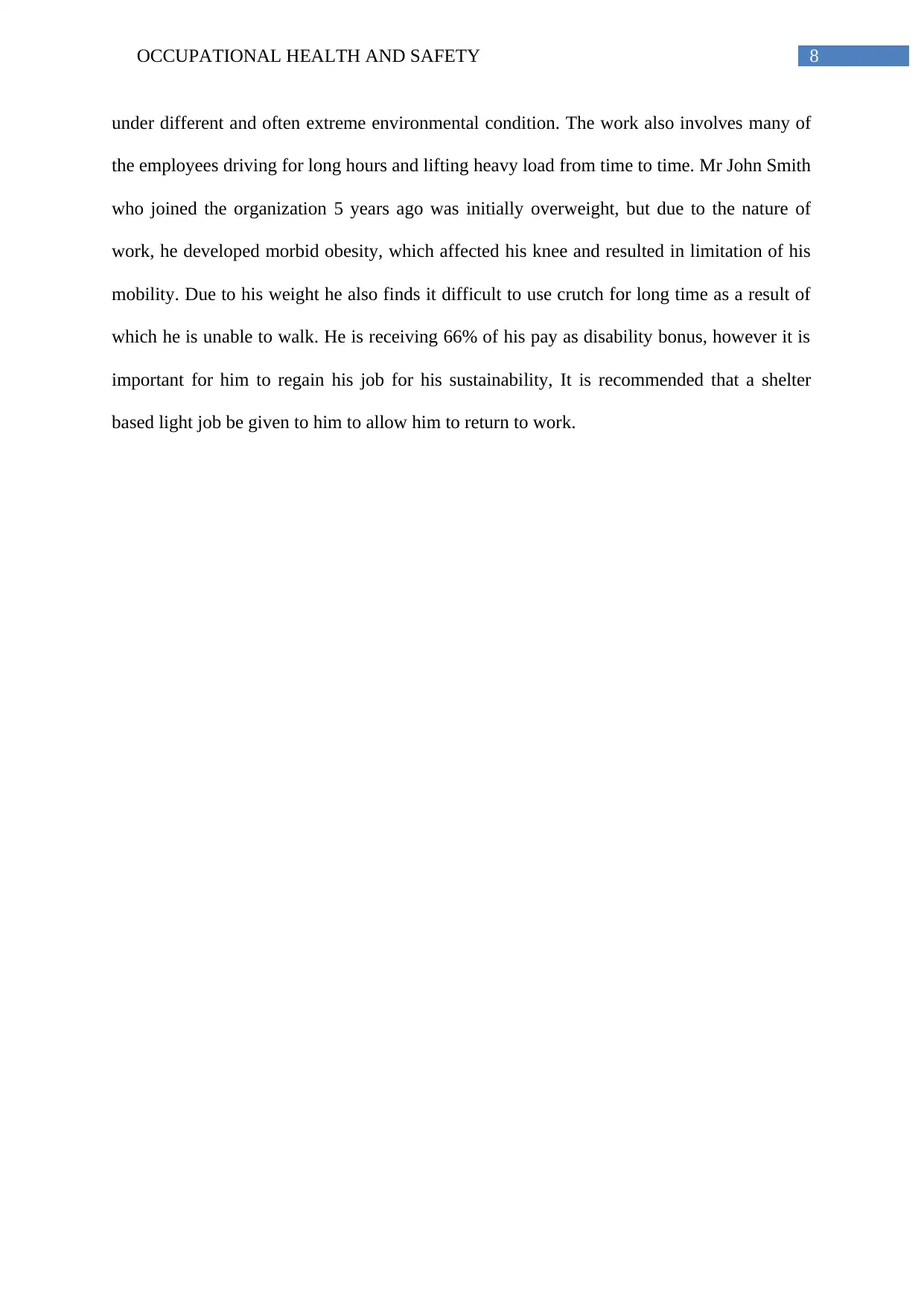
under different and often extreme environmental condition. The work also involves many of
the employees driving for long hours and lifting heavy load from time to time. Mr John Smith
who joined the organization 5 years ago was initially overweight, but due to the nature of
work, he developed morbid obesity, which affected his knee and resulted in limitation of his
mobility. Due to his weight he also finds it difficult to use crutch for long time as a result of
which he is unable to walk. He is receiving 66% of his pay as disability bonus, however it is
important for him to regain his job for his sustainability, It is recommended that a shelter
based light job be given to him to allow him to return to work.
under different and often extreme environmental condition. The work also involves many of
the employees driving for long hours and lifting heavy load from time to time. Mr John Smith
who joined the organization 5 years ago was initially overweight, but due to the nature of
work, he developed morbid obesity, which affected his knee and resulted in limitation of his
mobility. Due to his weight he also finds it difficult to use crutch for long time as a result of
which he is unable to walk. He is receiving 66% of his pay as disability bonus, however it is
important for him to regain his job for his sustainability, It is recommended that a shelter
based light job be given to him to allow him to return to work.
⊘ This is a preview!⊘
Do you want full access?
Subscribe today to unlock all pages.
Trusted by 1+ million students worldwide
9OCCUPATIONAL HEALTH AND SAFETY
References:
Knott, V., Zrim, S., Shanahan, E. M., Anastassiadis, P., Lawn, S., Kichenadasse, G., ... &
Koczwara, B. (2014). Returning to work following curative chemotherapy: A
qualitative study of return to work barriers and preferences for
intervention. Supportive Care in Cancer, 22(12), 3263-3273.
Lashgari, M. (2018). Digital Marketing Strategy: B2B and Stakeholders
Communication (Doctoral dissertation, KTH Royal Institute of Technology).
Lay, A. M., Saunders, R., Lifshen, M., Breslin, C., LaMontagne, A., Tompa, E., & Smith, P.
(2016). Individual, occupational, and workplace correlates of occupational health and
safety vulnerability in a sample of Canadian workers. American journal of industrial
medicine, 59(2), 119-128.
Leka, S., Jain, A., Zwetsloot, G., Andreou, N., & Hollis, D. (2017). The changing landscape
of occupational health and safety policy in the UK: key developments and
implications for stakeholders.
Nery-Hurwit, M., Kincl, L., Driver, S., & Heller, B. (2017). Stakeholder evaluation of an
online program to promote physical activity and workplace safety for individuals with
disability. Evaluation and program planning, 63, 39-44.
Opdebeeck, C., Martyr, A., & Clare, L. (2016). Cognitive reserve and cognitive function in
healthy older people: a meta-analysis. Aging, Neuropsychology, and Cognition, 23(1),
40-60.
Schultz-Krohn, W., Carey, R., Dail, R., & Endish, P. (2018). Effectiveness of an
Occupational Therapy Work Readiness Program for Homeless Parents. American
References:
Knott, V., Zrim, S., Shanahan, E. M., Anastassiadis, P., Lawn, S., Kichenadasse, G., ... &
Koczwara, B. (2014). Returning to work following curative chemotherapy: A
qualitative study of return to work barriers and preferences for
intervention. Supportive Care in Cancer, 22(12), 3263-3273.
Lashgari, M. (2018). Digital Marketing Strategy: B2B and Stakeholders
Communication (Doctoral dissertation, KTH Royal Institute of Technology).
Lay, A. M., Saunders, R., Lifshen, M., Breslin, C., LaMontagne, A., Tompa, E., & Smith, P.
(2016). Individual, occupational, and workplace correlates of occupational health and
safety vulnerability in a sample of Canadian workers. American journal of industrial
medicine, 59(2), 119-128.
Leka, S., Jain, A., Zwetsloot, G., Andreou, N., & Hollis, D. (2017). The changing landscape
of occupational health and safety policy in the UK: key developments and
implications for stakeholders.
Nery-Hurwit, M., Kincl, L., Driver, S., & Heller, B. (2017). Stakeholder evaluation of an
online program to promote physical activity and workplace safety for individuals with
disability. Evaluation and program planning, 63, 39-44.
Opdebeeck, C., Martyr, A., & Clare, L. (2016). Cognitive reserve and cognitive function in
healthy older people: a meta-analysis. Aging, Neuropsychology, and Cognition, 23(1),
40-60.
Schultz-Krohn, W., Carey, R., Dail, R., & Endish, P. (2018). Effectiveness of an
Occupational Therapy Work Readiness Program for Homeless Parents. American
Paraphrase This Document
Need a fresh take? Get an instant paraphrase of this document with our AI Paraphraser

10OCCUPATIONAL HEALTH AND SAFETY
Journal of Occupational Therapy, 72(4_Supplement_1), 7211515227p1-
7211515227p1.
Shea, T., De Cieri, H., Donohue, R., Cooper, B., & Sheehan, C. (2016). Leading indicators of
occupational health and safety: An employee and workplace level validation
study. Safety science, 85, 293-304.
Sinelnikov, S., Inouye, J., & Kerper, S. (2015). Using leading indicators to measure
occupational health and safety performance. Safety science, 72, 240-248.
Walker, J. M., & Krauss, S. A. (2016). Assessing occupational disability following trauma
and impairment. In Assessing Impairment (pp. 283-302). Springer, Boston, MA.
Yazdani, A., Neumann, W. P., Imbeau, D., Bigelow, P., Pagell, M., Theberge, N., ... & Wells,
R. (2015). How compatible are participatory ergonomics programs with occupational
health and safety management systems?. Scandinavian journal of work, environment
& health, 111-123.
Journal of Occupational Therapy, 72(4_Supplement_1), 7211515227p1-
7211515227p1.
Shea, T., De Cieri, H., Donohue, R., Cooper, B., & Sheehan, C. (2016). Leading indicators of
occupational health and safety: An employee and workplace level validation
study. Safety science, 85, 293-304.
Sinelnikov, S., Inouye, J., & Kerper, S. (2015). Using leading indicators to measure
occupational health and safety performance. Safety science, 72, 240-248.
Walker, J. M., & Krauss, S. A. (2016). Assessing occupational disability following trauma
and impairment. In Assessing Impairment (pp. 283-302). Springer, Boston, MA.
Yazdani, A., Neumann, W. P., Imbeau, D., Bigelow, P., Pagell, M., Theberge, N., ... & Wells,
R. (2015). How compatible are participatory ergonomics programs with occupational
health and safety management systems?. Scandinavian journal of work, environment
& health, 111-123.

1 out of 11


Related Documents


Your All-in-One AI-Powered Toolkit for Academic Success.
+13062052269
info@desklib.com
Available 24*7 on WhatsApp / Email
![[object Object]](/_next/static/media/star-bottom.7253800d.svg)
Unlock your academic potential
Copyright © 2020–2026 A2Z Services. All Rights Reserved. Developed and managed by ZUCOL.