A Research Proposal on HRM's Role in Organizational Business Growth
VerifiedAdded on 2023/06/10
|12
|3329
|172
Report
AI Summary
This research proposal aims to investigate the impact of Human Resource Management (HRM) functions on business growth and organizational performance. It begins by outlining the importance of HRM functions such as recruitment, training, and employee well-being in contributing to organizational success. The proposal includes a literature review covering the meaning and importance of HRM, the concept of business growth and its measurement, and the impact of HRM on overall business performance. The research methodology section details the qualitative research type, inductive approach, interpretivism philosophy, and exploratory research design. Data collection methods include both primary (interviews and surveys) and secondary data. The proposal also addresses ethical considerations, research limitations, and provides a Gantt chart for project timeline. The study seeks to understand the role of HRM in fostering business growth and enhancing organizational effectiveness.

RESEARCH METHODS

Paraphrase This Document
Need a fresh take? Get an instant paraphrase of this document with our AI Paraphraser
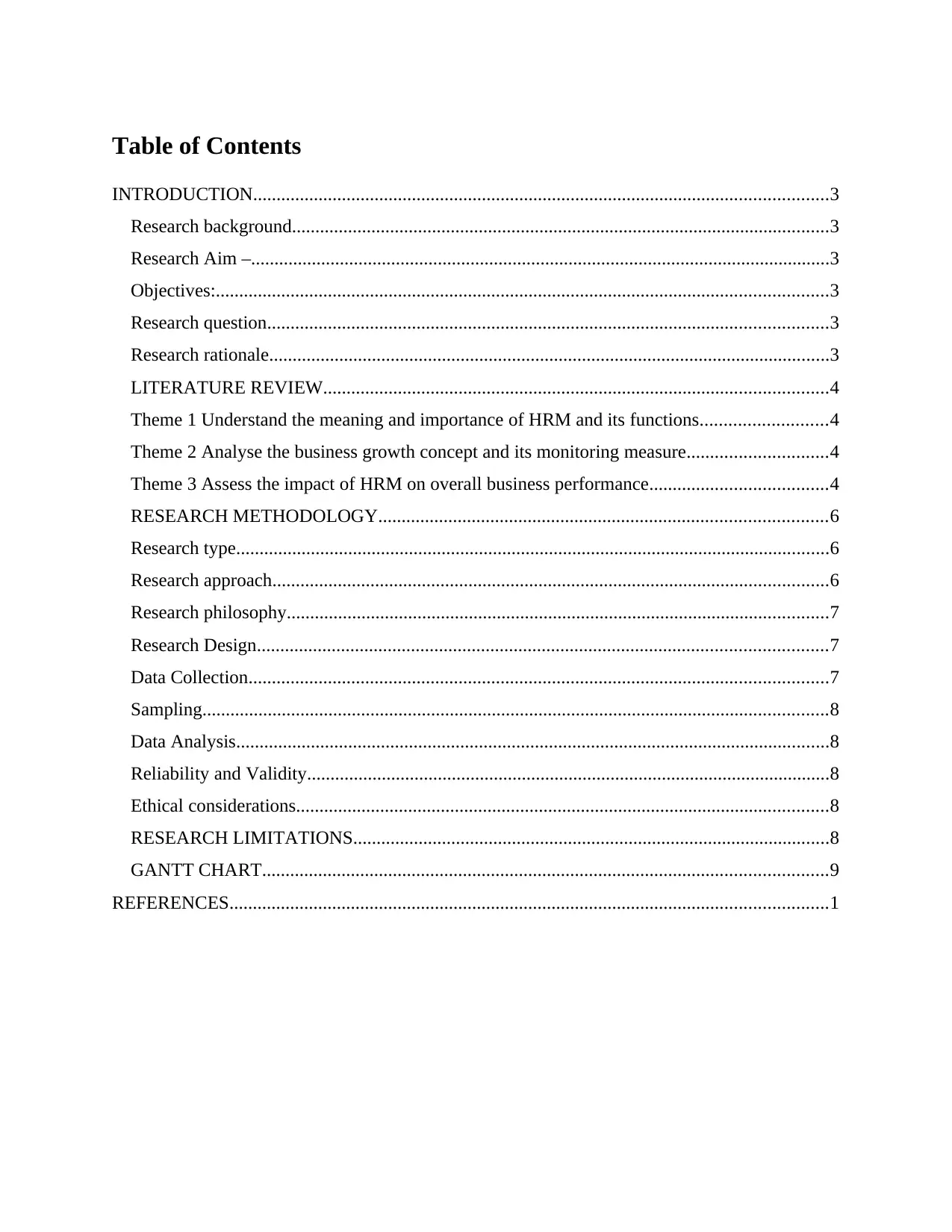
Table of Contents
INTRODUCTION...........................................................................................................................3
Research background...................................................................................................................3
Research Aim –............................................................................................................................3
Objectives:...................................................................................................................................3
Research question........................................................................................................................3
Research rationale........................................................................................................................3
LITERATURE REVIEW............................................................................................................4
Theme 1 Understand the meaning and importance of HRM and its functions...........................4
Theme 2 Analyse the business growth concept and its monitoring measure..............................4
Theme 3 Assess the impact of HRM on overall business performance......................................4
RESEARCH METHODOLOGY................................................................................................6
Research type...............................................................................................................................6
Research approach.......................................................................................................................6
Research philosophy....................................................................................................................7
Research Design..........................................................................................................................7
Data Collection............................................................................................................................7
Sampling......................................................................................................................................8
Data Analysis...............................................................................................................................8
Reliability and Validity................................................................................................................8
Ethical considerations..................................................................................................................8
RESEARCH LIMITATIONS......................................................................................................8
GANTT CHART.........................................................................................................................9
REFERENCES................................................................................................................................1
INTRODUCTION...........................................................................................................................3
Research background...................................................................................................................3
Research Aim –............................................................................................................................3
Objectives:...................................................................................................................................3
Research question........................................................................................................................3
Research rationale........................................................................................................................3
LITERATURE REVIEW............................................................................................................4
Theme 1 Understand the meaning and importance of HRM and its functions...........................4
Theme 2 Analyse the business growth concept and its monitoring measure..............................4
Theme 3 Assess the impact of HRM on overall business performance......................................4
RESEARCH METHODOLOGY................................................................................................6
Research type...............................................................................................................................6
Research approach.......................................................................................................................6
Research philosophy....................................................................................................................7
Research Design..........................................................................................................................7
Data Collection............................................................................................................................7
Sampling......................................................................................................................................8
Data Analysis...............................................................................................................................8
Reliability and Validity................................................................................................................8
Ethical considerations..................................................................................................................8
RESEARCH LIMITATIONS......................................................................................................8
GANTT CHART.........................................................................................................................9
REFERENCES................................................................................................................................1
INTRODUCTION
Research background
In today's times, it has been identified that the HRM and its functions plays an important
role in contributing their part towards the success of an organization. The various functions of
HRM includes recruitment and selection, training and development, planning, well-being and
safety of the workforce, rewards and recognition, performance management and workforce
engagement (Stone, Cox, and Gavin, 2020). Each function has its own importance with respect
to the success of the company.
The current research proposal aims to determine the role of HRM and its functions and how it
plays an essential role in the growth and development of an organization. Moreover, it also
discusses the concept of business growth and the ways in which the performance of an
organization can be measured.
Research Aim –
The research aims to understand how the HRM function impacts the business growth of
organization.
Objectives: To analyse the role of the HRM function of organizations. To analyse the concept of business growth and how it is measured. To examine the impact of HRM on the business growth and well-being of the
organizations.
Research question
What is the role of HRM process in organization?
What is the business growth concept and how it can be measured or monitor?
What are the possible effects of HRM over the business success and for better
organizational performance?
To recommend the use of HRM function in order to enhance the growth and development
of an organization.
Research rationale
Reason behind conducting this study is to bring the concern about the HRM function for
the business as how it helps in promoting the business growth and supports the improvisation of
Research background
In today's times, it has been identified that the HRM and its functions plays an important
role in contributing their part towards the success of an organization. The various functions of
HRM includes recruitment and selection, training and development, planning, well-being and
safety of the workforce, rewards and recognition, performance management and workforce
engagement (Stone, Cox, and Gavin, 2020). Each function has its own importance with respect
to the success of the company.
The current research proposal aims to determine the role of HRM and its functions and how it
plays an essential role in the growth and development of an organization. Moreover, it also
discusses the concept of business growth and the ways in which the performance of an
organization can be measured.
Research Aim –
The research aims to understand how the HRM function impacts the business growth of
organization.
Objectives: To analyse the role of the HRM function of organizations. To analyse the concept of business growth and how it is measured. To examine the impact of HRM on the business growth and well-being of the
organizations.
Research question
What is the role of HRM process in organization?
What is the business growth concept and how it can be measured or monitor?
What are the possible effects of HRM over the business success and for better
organizational performance?
To recommend the use of HRM function in order to enhance the growth and development
of an organization.
Research rationale
Reason behind conducting this study is to bring the concern about the HRM function for
the business as how it helps in promoting the business growth and supports the improvisation of
⊘ This is a preview!⊘
Do you want full access?
Subscribe today to unlock all pages.

Trusted by 1+ million students worldwide
external and internal functionalities. This research study will help the peers and other scholars
who are conducting study on same topic. Also, this study will help in fulfilling the gaps which is
identified in the previous study that done on same research topic.
LITERATURE REVIEW
Theme 1 Understand the meaning and importance of HRM and its functions
Theme 2 Analyse the business growth concept and its monitoring measure
Theme 3 Assess the impact of HRM on overall business performance
According to Boon, Den Hartog, and Lepak, (2019), HRM refers to a strategy that is used
by companies in order to manage the workforce within the enterprise and also ease the process of
managing the environment and culture of the company. The HRM function involves staffing,
recruiting, performance management, acquiring talent for the enterprise and many more
functions. As investigated by Strohmeier, (2020), it can be stated that the HRM and its functions
plays an important role in contributing to the success of the organization. The HRM of an
organization recruits the workforce employed within the enterprise. This is one of the most
important tasks for a company as the performance of the company largely depends on the
performance of its workforce. Similarly, the HRM of an enterprise promotes the learning and
development of the existing personnel within an organization. They keep a track of the
performance of the workforce and ensures that they contribute with their best of the ability and
achieve the organizational goals. They develop a healthy work culture within the company and
promotes a safe, healthy and happy working space for their employees.
Anwar, and Abdullah, (2021) states that the HRM of an enterprise helps in interacting
with the workforce and also managing the conflicts that arises between the colleagues. The HRM
interacts with the employees in order to determine whether the employees are satisfied with jobs,
pay scale, benefits, workplace or the environment of the company or not. If it is found that they
are having issues with any of the specific factors then the HRM takes action in order to mitigate
the issues and promote a happy and healthy working environment among the employees.
Moreover, it is useful in managing the conflicts that arises between the workforce because of
different opinions and views.
who are conducting study on same topic. Also, this study will help in fulfilling the gaps which is
identified in the previous study that done on same research topic.
LITERATURE REVIEW
Theme 1 Understand the meaning and importance of HRM and its functions
Theme 2 Analyse the business growth concept and its monitoring measure
Theme 3 Assess the impact of HRM on overall business performance
According to Boon, Den Hartog, and Lepak, (2019), HRM refers to a strategy that is used
by companies in order to manage the workforce within the enterprise and also ease the process of
managing the environment and culture of the company. The HRM function involves staffing,
recruiting, performance management, acquiring talent for the enterprise and many more
functions. As investigated by Strohmeier, (2020), it can be stated that the HRM and its functions
plays an important role in contributing to the success of the organization. The HRM of an
organization recruits the workforce employed within the enterprise. This is one of the most
important tasks for a company as the performance of the company largely depends on the
performance of its workforce. Similarly, the HRM of an enterprise promotes the learning and
development of the existing personnel within an organization. They keep a track of the
performance of the workforce and ensures that they contribute with their best of the ability and
achieve the organizational goals. They develop a healthy work culture within the company and
promotes a safe, healthy and happy working space for their employees.
Anwar, and Abdullah, (2021) states that the HRM of an enterprise helps in interacting
with the workforce and also managing the conflicts that arises between the colleagues. The HRM
interacts with the employees in order to determine whether the employees are satisfied with jobs,
pay scale, benefits, workplace or the environment of the company or not. If it is found that they
are having issues with any of the specific factors then the HRM takes action in order to mitigate
the issues and promote a happy and healthy working environment among the employees.
Moreover, it is useful in managing the conflicts that arises between the workforce because of
different opinions and views.
Paraphrase This Document
Need a fresh take? Get an instant paraphrase of this document with our AI Paraphraser
As investigated by Otoo, (2019), business growth refers to a stage of a business in which
an enterprise explores different sorts of options with respect to its operating activities in order to
expand the business and increase the profitability of an organization. Author states that there are
several reasons which helps a business in expanding across various regions , one of which is
HRM of organization. There are several ways in which a business enterprise can expand its
business such as providing the existing customers with new and innovative products in the
market. This helps an enterprise in attracting a new range of customers towards the products of
the company and helps in enhancing the profitability of the company. The enterprise can step a
foot forward into the new markets or acquire a completely new business or merge with new
businesses and many more ways.
According to Riana, and et.al (2020), when a business plans to expand across various
regions in terms of engaging the customers or widening the scope of the enterprise, it is essential
for them to measure the performance of the activities conducted by the business organization.
This is so, because it helps them in determining if a business is able to perform up to the mark or
not and to identify the areas in which there is a scope for the enterprise to improve. There are
several methods and software that has been launched in the market which helps an organization
to monitor the performance of the company. In order to keep an eye on the performance of the
company, it is essential for them to constantly look into the financial statements of the company
and keep a track of the profitability of the company, ask for reviews from the customers with
respect to their satisfaction with the offerings of the company, brand loyalty of the customers,
and assess the performance of the company with the set standards in terms of the quality of
products and services provided, and the earning of the business. According to Ho, and Kuvaas,
(2020), all of these measures, helps an organization in identifying their own performance and
taking constant actions in order to constantly improve the same.
As investigated by Zaim, and et.al (2018), there are several functions of HRM of an
organization implementation of which in an appropriate manner within the company may help an
organization in achieving great heights. The training and development function of the HRM of
an organization determines the quality of performance of the workforce and determines if there is
a need for them to improve a specific portion of their abilities. If so, they carry out different sorts
of training and development programmes for those employees which requires training in a
particular field in order to increase the quality of their performance. They also provide trainings
an enterprise explores different sorts of options with respect to its operating activities in order to
expand the business and increase the profitability of an organization. Author states that there are
several reasons which helps a business in expanding across various regions , one of which is
HRM of organization. There are several ways in which a business enterprise can expand its
business such as providing the existing customers with new and innovative products in the
market. This helps an enterprise in attracting a new range of customers towards the products of
the company and helps in enhancing the profitability of the company. The enterprise can step a
foot forward into the new markets or acquire a completely new business or merge with new
businesses and many more ways.
According to Riana, and et.al (2020), when a business plans to expand across various
regions in terms of engaging the customers or widening the scope of the enterprise, it is essential
for them to measure the performance of the activities conducted by the business organization.
This is so, because it helps them in determining if a business is able to perform up to the mark or
not and to identify the areas in which there is a scope for the enterprise to improve. There are
several methods and software that has been launched in the market which helps an organization
to monitor the performance of the company. In order to keep an eye on the performance of the
company, it is essential for them to constantly look into the financial statements of the company
and keep a track of the profitability of the company, ask for reviews from the customers with
respect to their satisfaction with the offerings of the company, brand loyalty of the customers,
and assess the performance of the company with the set standards in terms of the quality of
products and services provided, and the earning of the business. According to Ho, and Kuvaas,
(2020), all of these measures, helps an organization in identifying their own performance and
taking constant actions in order to constantly improve the same.
As investigated by Zaim, and et.al (2018), there are several functions of HRM of an
organization implementation of which in an appropriate manner within the company may help an
organization in achieving great heights. The training and development function of the HRM of
an organization determines the quality of performance of the workforce and determines if there is
a need for them to improve a specific portion of their abilities. If so, they carry out different sorts
of training and development programmes for those employees which requires training in a
particular field in order to increase the quality of their performance. They also provide trainings
to freshers in order to make the new joiners familiar with the activities, rules, regulations and
environment of the enterprise. This helps them in improving the performance of their staff and
contribute to the success of the company.
Similarly, Zeebaree, Shukur, and Hussan, (2019) states that the recruitment and selection
function of the HRM also plays an important role in the success of the company. If the HRM of
an enterprise formulates adequate policies and procedures with respect to the recruitment and
selection of the employees, it will help the company in hiring adequate talent to the company,
determine their abilities in relation to the requirements of the job and then hiring them within the
company. The recruitment and selection of workforce that it is appropriate with respect to the
company helps an organization in achieving the goals and objectives of the company.
However, Ozkeser, (2019) states that if an organization does not have proper HRM then
it might face several issues in the operations of the company. A poor HRM can lead to
mismanagement within the enterprise, lack of recognition of the potential of the employees, and
lead to conflict between the colleagues. When HRM of an organization is unable to recognize the
efforts of the workforce and reward them for the same, the employees might feel that they are not
important for the company and the enterprise does not value their efforts. The development of
this feeling within the employees leads to a feeling of in-satisfaction with the job. This hinders
the growth and development of an organization and hampers the success of the company.
RESEARCH METHODOLOGY
Research type
There are generally two types of research types, namely, qualitative research and
quantitative research. In order to determine the impact of HRM and its functions on the success
of an enterprise, the qualitative research type will be chosen. The qualitative data will include the
feedbacks of the workforce of an organization in order to determine the importance of HRM
within an enterprise with respect to employees as well as the organization. This will involve the
comments and opinions from both the sides of a company and help in formulating the
conclusions with respect to its importance.
Research approach
The research approach that will be suitable for the purpose of conducting a qualitative
research will be inductive approach. The inductive approach helps in examining and analysing
environment of the enterprise. This helps them in improving the performance of their staff and
contribute to the success of the company.
Similarly, Zeebaree, Shukur, and Hussan, (2019) states that the recruitment and selection
function of the HRM also plays an important role in the success of the company. If the HRM of
an enterprise formulates adequate policies and procedures with respect to the recruitment and
selection of the employees, it will help the company in hiring adequate talent to the company,
determine their abilities in relation to the requirements of the job and then hiring them within the
company. The recruitment and selection of workforce that it is appropriate with respect to the
company helps an organization in achieving the goals and objectives of the company.
However, Ozkeser, (2019) states that if an organization does not have proper HRM then
it might face several issues in the operations of the company. A poor HRM can lead to
mismanagement within the enterprise, lack of recognition of the potential of the employees, and
lead to conflict between the colleagues. When HRM of an organization is unable to recognize the
efforts of the workforce and reward them for the same, the employees might feel that they are not
important for the company and the enterprise does not value their efforts. The development of
this feeling within the employees leads to a feeling of in-satisfaction with the job. This hinders
the growth and development of an organization and hampers the success of the company.
RESEARCH METHODOLOGY
Research type
There are generally two types of research types, namely, qualitative research and
quantitative research. In order to determine the impact of HRM and its functions on the success
of an enterprise, the qualitative research type will be chosen. The qualitative data will include the
feedbacks of the workforce of an organization in order to determine the importance of HRM
within an enterprise with respect to employees as well as the organization. This will involve the
comments and opinions from both the sides of a company and help in formulating the
conclusions with respect to its importance.
Research approach
The research approach that will be suitable for the purpose of conducting a qualitative
research will be inductive approach. The inductive approach helps in examining and analysing
⊘ This is a preview!⊘
Do you want full access?
Subscribe today to unlock all pages.
Trusted by 1+ million students worldwide
the qualitative data efficiently and build several theories for the same. The inductive approach
helps in summarizing the raw data that is collected while carrying out a research and link the
summarised data with the objectives of the research and finally generating theories on the basis
of the same.
Research philosophy
A research philosophy is a tool that works as a guide and determines the way in which
the research should be carried out on the basis of the knowledge and the concepts of reality.
There are mainly two types of research philosophies, i.e., positivism and interpretivism. Since,
the research will be a qualitative research, the chosen research philosophy for the current
proposal will be interpretivism (Sivapragasam, and Raya, 2018.). The interpretivism research
philosophy will help in gaining insights with respect to the present study and formulate
conclusions on the basis of the findings of the study. Since, this philosophy is suitable for a small
sample size, it will be suitable for the current proposal too.
Research Design
The research design refers to a tool that is used by the researcher in order to make use of
several methods which are the best suited for the study and analyse the findings of the same.
There are mainly three types of research designs, namely, exploratory, descriptive and case
study. For the present study, the chosen research design will be exploratory as it helps the
researcher in diagnosing a problem and then determining the relevant solutions for the same.
Data Collection
The term data collection can be described as the way through which the researcher
collects the materials, facts, figures and other relevant information that needs to be analysed for
the purpose of conducting research. There are mainly two types of data collection methods which
include the primary method and the secondary method. For the current proposal, the primary as
well as the secondary data will be used for the purpose conducting research. The primary data
includes raw data that has been collected by the research by way of conducting interviews and
surveys and then analyse the data collected. On the other hand, the secondary data collection
refers to collection of the relevant information from the secondary sources such as books,
journals, internet, websites, magazines, newspapers and other sources. The results of the primary
data are more accurate as compared to the secondary sources.
helps in summarizing the raw data that is collected while carrying out a research and link the
summarised data with the objectives of the research and finally generating theories on the basis
of the same.
Research philosophy
A research philosophy is a tool that works as a guide and determines the way in which
the research should be carried out on the basis of the knowledge and the concepts of reality.
There are mainly two types of research philosophies, i.e., positivism and interpretivism. Since,
the research will be a qualitative research, the chosen research philosophy for the current
proposal will be interpretivism (Sivapragasam, and Raya, 2018.). The interpretivism research
philosophy will help in gaining insights with respect to the present study and formulate
conclusions on the basis of the findings of the study. Since, this philosophy is suitable for a small
sample size, it will be suitable for the current proposal too.
Research Design
The research design refers to a tool that is used by the researcher in order to make use of
several methods which are the best suited for the study and analyse the findings of the same.
There are mainly three types of research designs, namely, exploratory, descriptive and case
study. For the present study, the chosen research design will be exploratory as it helps the
researcher in diagnosing a problem and then determining the relevant solutions for the same.
Data Collection
The term data collection can be described as the way through which the researcher
collects the materials, facts, figures and other relevant information that needs to be analysed for
the purpose of conducting research. There are mainly two types of data collection methods which
include the primary method and the secondary method. For the current proposal, the primary as
well as the secondary data will be used for the purpose conducting research. The primary data
includes raw data that has been collected by the research by way of conducting interviews and
surveys and then analyse the data collected. On the other hand, the secondary data collection
refers to collection of the relevant information from the secondary sources such as books,
journals, internet, websites, magazines, newspapers and other sources. The results of the primary
data are more accurate as compared to the secondary sources.
Paraphrase This Document
Need a fresh take? Get an instant paraphrase of this document with our AI Paraphraser
Sampling
For the purpose conducting the survey, the scholar is required to select the appropriate
sample for the purpose of receiving the expected results. Thus, for the purpose of conducting the
survey, a sample size 5 employees belonging to different organizations will be selected. This will
help the researcher in determining the views of the workforce from different organization and
comparing and contrasting their views in order to examine their response responses and
formulate the outcomes (Michael, 2019).
Data Analysis
There are two types of techniques which are generally used by the researchers for the
purpose of analysing the data, they are thematic perception test technique and the SPSS
technique. In the current proposal, the thematic perception test technique will be chosen as it is
suitable for the purpose of analysing the qualitative data effectively. With the use of this
technique, responses received from the survey will be considered and accordingly themes will be
prepared for the same.
Reliability and Validity
For the purpose of ensuring the validity and reliability of the research, the articles,
journals, books or any information that is collected from secondary sources will only be
considered if it is published in or after 2017 (Berber, N., Đorđević, and Milanović, 2018). Also,
only those articles and information will be considered which are relevant to the subject of the
research. Lastly, the information will be collected only from copyright protected sources which
will work as a proof of the authenticity and accuracy of the collected data.
Ethical considerations
While doing the research, the scholar will strictly adhere with certain ethical
considerations. While conducting the survey, only the responses of those employees will be
considered which participate voluntarily in the survey and the responses will not be shared with
anyone without taking consent from the respondent. Also, the responses will remain anonymous
in order to protect the identity of the respondents.
RESEARCH LIMITATIONS
There are several limitations with respect to the particular study, they are:
Due to unavailability of the time, the sample size of the current study is restricted to only
5 people whose responses will be considered for the purpose of collecting the
For the purpose conducting the survey, the scholar is required to select the appropriate
sample for the purpose of receiving the expected results. Thus, for the purpose of conducting the
survey, a sample size 5 employees belonging to different organizations will be selected. This will
help the researcher in determining the views of the workforce from different organization and
comparing and contrasting their views in order to examine their response responses and
formulate the outcomes (Michael, 2019).
Data Analysis
There are two types of techniques which are generally used by the researchers for the
purpose of analysing the data, they are thematic perception test technique and the SPSS
technique. In the current proposal, the thematic perception test technique will be chosen as it is
suitable for the purpose of analysing the qualitative data effectively. With the use of this
technique, responses received from the survey will be considered and accordingly themes will be
prepared for the same.
Reliability and Validity
For the purpose of ensuring the validity and reliability of the research, the articles,
journals, books or any information that is collected from secondary sources will only be
considered if it is published in or after 2017 (Berber, N., Đorđević, and Milanović, 2018). Also,
only those articles and information will be considered which are relevant to the subject of the
research. Lastly, the information will be collected only from copyright protected sources which
will work as a proof of the authenticity and accuracy of the collected data.
Ethical considerations
While doing the research, the scholar will strictly adhere with certain ethical
considerations. While conducting the survey, only the responses of those employees will be
considered which participate voluntarily in the survey and the responses will not be shared with
anyone without taking consent from the respondent. Also, the responses will remain anonymous
in order to protect the identity of the respondents.
RESEARCH LIMITATIONS
There are several limitations with respect to the particular study, they are:
Due to unavailability of the time, the sample size of the current study is restricted to only
5 people whose responses will be considered for the purpose of collecting the
information with respect to the current study. Similarly, due to the shortage of time, the
quantitative data has not been considered for conducting this study (Keegan, and et.al
2018.).
Since, the money required for conducting the research was limited, therefore, the SPSS
technique of data analysis has not been selected. The quality of the data that has been
collected is accurate and includes the information from both primary and the secondary
sources. However, the data collected is qualitative in nature and does not include any
kind of numerical data.
However, for avoiding the quantitative data, the research will be based on the thematic
perception test technique as it is best suited for data that is qualitative in nature.
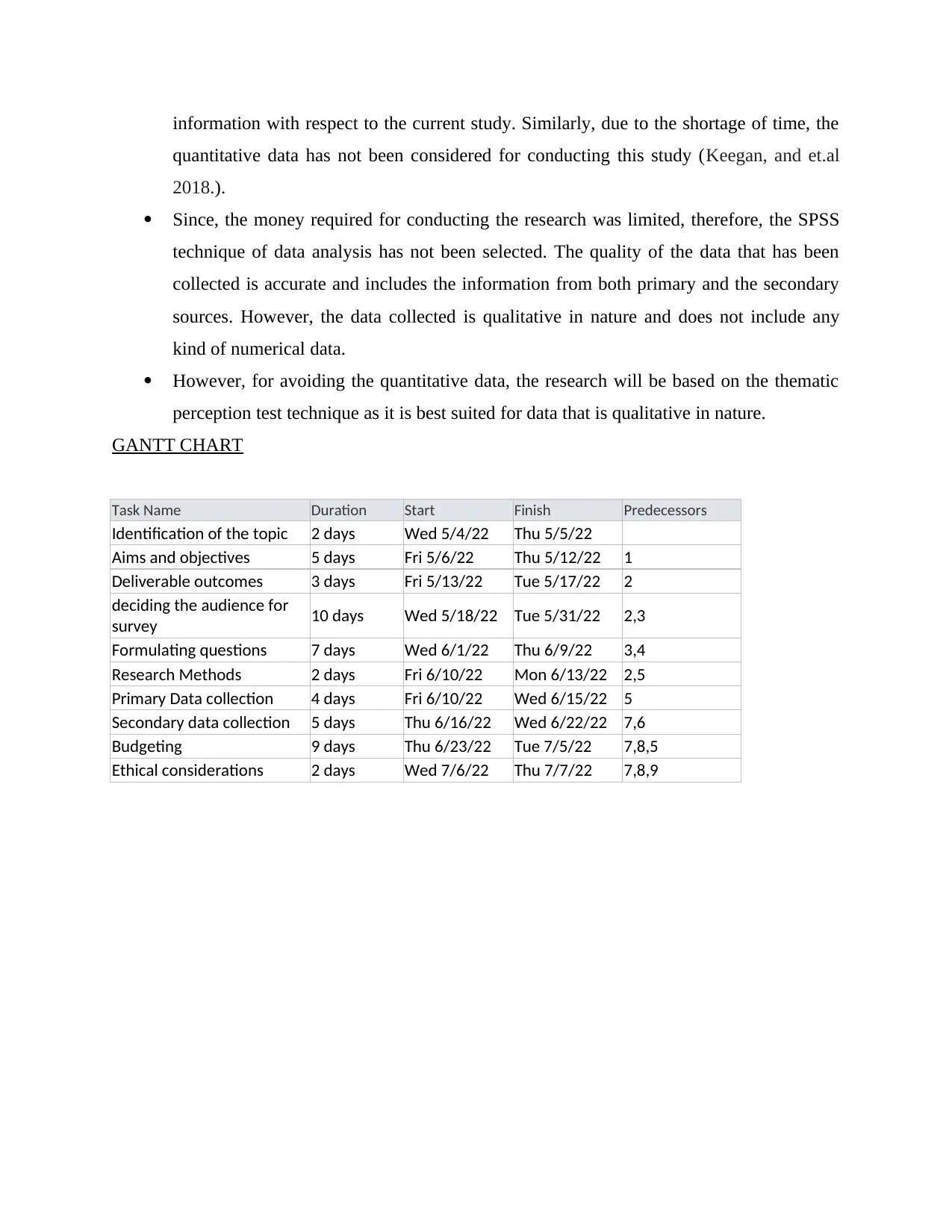
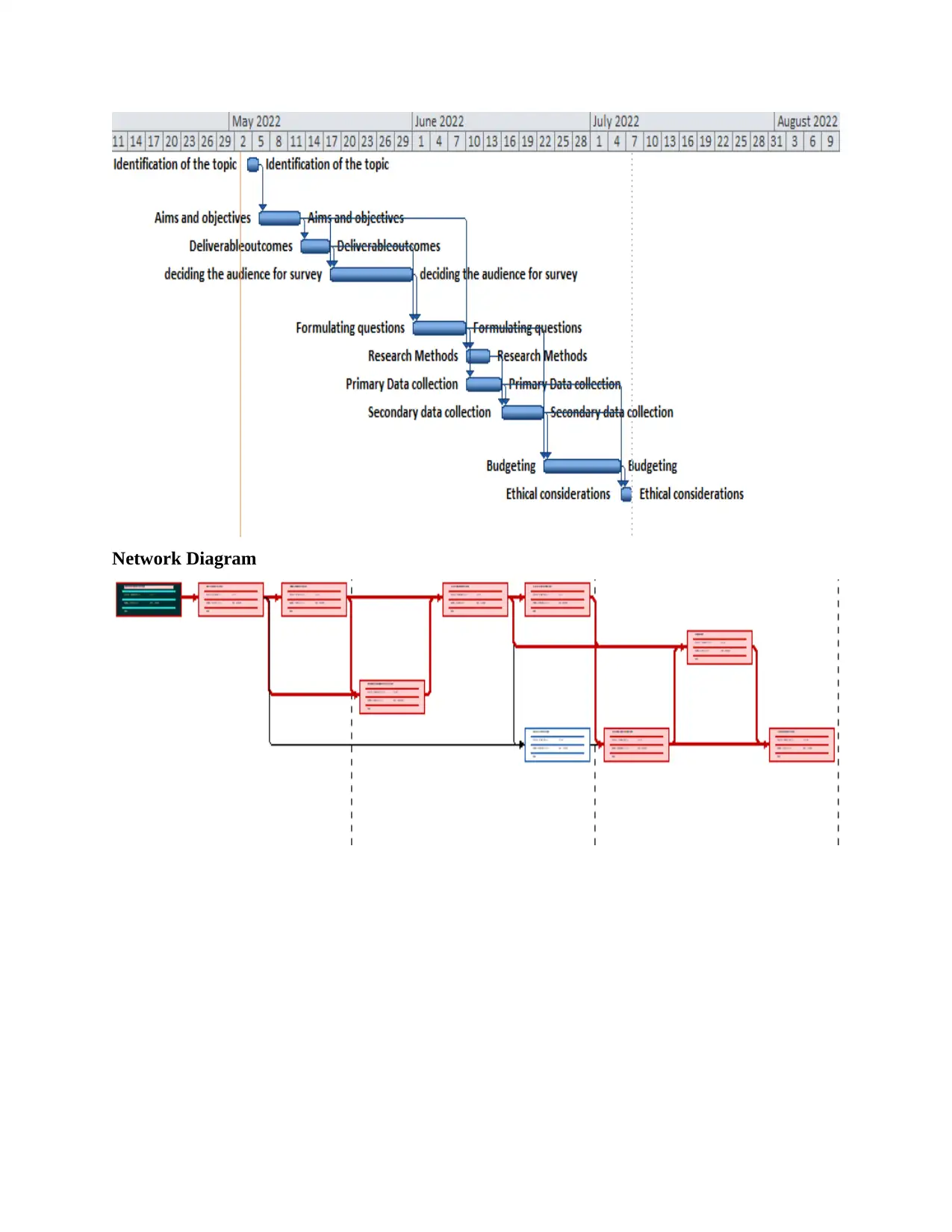
GANTT CHART
Task Name Duration Start Finish Predecessors
Identification of the topic 2 days Wed 5/4/22 Thu 5/5/22
Aims and objectives 5 days Fri 5/6/22 Thu 5/12/22 1
Deliverable outcomes 3 days Fri 5/13/22 Tue 5/17/22 2
deciding the audience for
survey 10 days Wed 5/18/22 Tue 5/31/22 2,3
Formulating questions 7 days Wed 6/1/22 Thu 6/9/22 3,4
Research Methods 2 days Fri 6/10/22 Mon 6/13/22 2,5
Primary Data collection 4 days Fri 6/10/22 Wed 6/15/22 5
Secondary data collection 5 days Thu 6/16/22 Wed 6/22/22 7,6
Budgeting 9 days Thu 6/23/22 Tue 7/5/22 7,8,5
Ethical considerations 2 days Wed 7/6/22 Thu 7/7/22 7,8,9
quantitative data has not been considered for conducting this study (Keegan, and et.al
2018.).
Since, the money required for conducting the research was limited, therefore, the SPSS
technique of data analysis has not been selected. The quality of the data that has been
collected is accurate and includes the information from both primary and the secondary
sources. However, the data collected is qualitative in nature and does not include any
kind of numerical data.
However, for avoiding the quantitative data, the research will be based on the thematic
perception test technique as it is best suited for data that is qualitative in nature.
GANTT CHART
Task Name Duration Start Finish Predecessors
Identification of the topic 2 days Wed 5/4/22 Thu 5/5/22
Aims and objectives 5 days Fri 5/6/22 Thu 5/12/22 1
Deliverable outcomes 3 days Fri 5/13/22 Tue 5/17/22 2
deciding the audience for
survey 10 days Wed 5/18/22 Tue 5/31/22 2,3
Formulating questions 7 days Wed 6/1/22 Thu 6/9/22 3,4
Research Methods 2 days Fri 6/10/22 Mon 6/13/22 2,5
Primary Data collection 4 days Fri 6/10/22 Wed 6/15/22 5
Secondary data collection 5 days Thu 6/16/22 Wed 6/22/22 7,6
Budgeting 9 days Thu 6/23/22 Tue 7/5/22 7,8,5
Ethical considerations 2 days Wed 7/6/22 Thu 7/7/22 7,8,9
⊘ This is a preview!⊘
Do you want full access?
Subscribe today to unlock all pages.
Trusted by 1+ million students worldwide
Network Diagram
Paraphrase This Document
Need a fresh take? Get an instant paraphrase of this document with our AI Paraphraser
REFERENCES
Books and journals
Stone, R.J., Cox, A. and Gavin, M., 2020. Human resource management. John Wiley & Sons.
Boon, C., Den Hartog, D.N. and Lepak, D.P., 2019. A systematic review of human resource
management systems and their measurement. Journal of management, 45(6), pp.2498-
2537.
Strohmeier, S., 2020. Digital human resource management: A conceptual clarification. German
Journal of Human Resource Management, 34(3), pp.345-365.
Anwar, G. and Abdullah, N.N., 2021. The impact of Human resource management practice on
Organizational performance. International journal of Engineering, Business and
Management (IJEBM), 5.
Otoo, F.N.K., 2019. Human resource management (HRM) practices and organizational
performance: The mediating role of employee competencies. Employee Relations: The
International Journal.
Riana, I.G., and et.al 2020. Human resource management in promoting innovation and
organizational performance. Problems and Perspectives in Management, 18(1), p.107.
Ho, H. and Kuvaas, B., 2020. Human resource management systems, employee well‐being, and
firm performance from the mutual gains and critical perspectives: The well‐being
paradox. Human Resource Management, 59(3), pp.235-253.
Zaim, H., and et.al 2018. The effects of knowledge management processes on human resource
management: Mediating role of knowledge utilization. Journal of Science and
Technology Policy Management.
Zeebaree, S.R., Shukur, H.M. and Hussan, B.K., 2019. Human resource management systems for
enterprise organizations: A review. Periodicals of Engineering and Natural
Sciences, 7(2), pp.660-669.
Ozkeser, B., 2019. Impact of training on employee motivation in human resources
management. Procedia Computer Science, 158, pp.802-810.
Keegan, A., and et.al 2018. Organizing the HRM function: Responses to paradoxes, variety, and
dynamism. Human Resource Management, 57(5), pp.1111-1126.
Berber, N., Đorđević, B. and Milanović, S., 2018. Electronic Human Resource Management (e-
HRM): А New Concept for Digital Age. Strategic Management-International Journal
1
Books and journals
Stone, R.J., Cox, A. and Gavin, M., 2020. Human resource management. John Wiley & Sons.
Boon, C., Den Hartog, D.N. and Lepak, D.P., 2019. A systematic review of human resource
management systems and their measurement. Journal of management, 45(6), pp.2498-
2537.
Strohmeier, S., 2020. Digital human resource management: A conceptual clarification. German
Journal of Human Resource Management, 34(3), pp.345-365.
Anwar, G. and Abdullah, N.N., 2021. The impact of Human resource management practice on
Organizational performance. International journal of Engineering, Business and
Management (IJEBM), 5.
Otoo, F.N.K., 2019. Human resource management (HRM) practices and organizational
performance: The mediating role of employee competencies. Employee Relations: The
International Journal.
Riana, I.G., and et.al 2020. Human resource management in promoting innovation and
organizational performance. Problems and Perspectives in Management, 18(1), p.107.
Ho, H. and Kuvaas, B., 2020. Human resource management systems, employee well‐being, and
firm performance from the mutual gains and critical perspectives: The well‐being
paradox. Human Resource Management, 59(3), pp.235-253.
Zaim, H., and et.al 2018. The effects of knowledge management processes on human resource
management: Mediating role of knowledge utilization. Journal of Science and
Technology Policy Management.
Zeebaree, S.R., Shukur, H.M. and Hussan, B.K., 2019. Human resource management systems for
enterprise organizations: A review. Periodicals of Engineering and Natural
Sciences, 7(2), pp.660-669.
Ozkeser, B., 2019. Impact of training on employee motivation in human resources
management. Procedia Computer Science, 158, pp.802-810.
Keegan, A., and et.al 2018. Organizing the HRM function: Responses to paradoxes, variety, and
dynamism. Human Resource Management, 57(5), pp.1111-1126.
Berber, N., Đorđević, B. and Milanović, S., 2018. Electronic Human Resource Management (e-
HRM): А New Concept for Digital Age. Strategic Management-International Journal
1

of Strategic Management and Decision Support Systems in Strategic
Management, 23(2).
Sivapragasam, P. and Raya, R.P., 2018. HRM and employee engagement link: Mediating role of
employee well-being. Global Business Review, 19(1), pp.147-161.
Michael, A., 2019. A handbook of human resource management practice. bookboon. com.
2
Management, 23(2).
Sivapragasam, P. and Raya, R.P., 2018. HRM and employee engagement link: Mediating role of
employee well-being. Global Business Review, 19(1), pp.147-161.
Michael, A., 2019. A handbook of human resource management practice. bookboon. com.
2
⊘ This is a preview!⊘
Do you want full access?
Subscribe today to unlock all pages.
Trusted by 1+ million students worldwide

1 out of 12


Related Documents


Your All-in-One AI-Powered Toolkit for Academic Success.
+13062052269
info@desklib.com
Available 24*7 on WhatsApp / Email
![[object Object]](/_next/static/media/star-bottom.7253800d.svg)
Unlock your academic potential
Copyright © 2020–2026 A2Z Services. All Rights Reserved. Developed and managed by ZUCOL.