Human Resource Management Report: Business Strategy and COE
VerifiedAdded on 2022/12/28
|14
|4043
|35
Report
AI Summary
This report provides a comprehensive analysis of human resource management (HRM) within the context of the Centre of Expertise (COE). It delves into the crucial relationship between business strategy and HRM strategy, emphasizing the significance of vertical alignment and horizontal integration within the COE. The report explores various Strategic Human Resource Management (SHRM) models, including the Michigan and Harvard models, and examines the resource-based view of SHRM. Furthermore, it evaluates performance management and reward systems, highlighting their impact on employee motivation and organizational success. The report concludes with recommendations for enhancing HRM practices within the COE, aiming to improve efficiency, productivity, and overall market share. The report also discusses employment relations, the roles of actors, and main theories.

Human resource
management
management

Paraphrase This Document
Need a fresh take? Get an instant paraphrase of this document with our AI Paraphraser
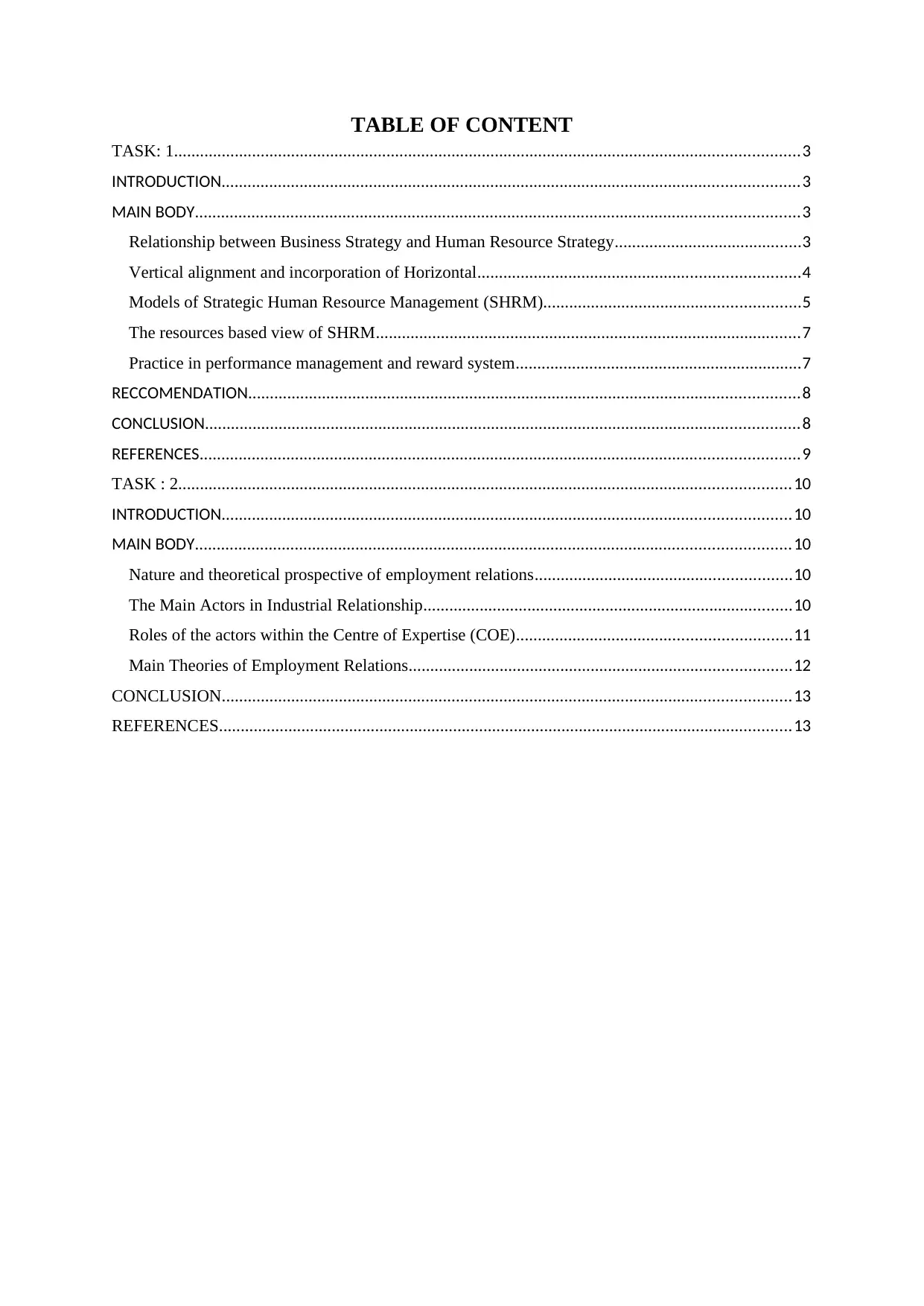
TABLE OF CONTENT
TASK: 1................................................................................................................................................3
INTRODUCTION.....................................................................................................................................3
MAIN BODY...........................................................................................................................................3
Relationship between Business Strategy and Human Resource Strategy...........................................3
Vertical alignment and incorporation of Horizontal..........................................................................4
Models of Strategic Human Resource Management (SHRM)...........................................................5
The resources based view of SHRM..................................................................................................7
Practice in performance management and reward system..................................................................7
RECCOMENDATION...............................................................................................................................8
CONCLUSION.........................................................................................................................................8
REFERENCES..........................................................................................................................................9
TASK : 2.............................................................................................................................................10
INTRODUCTION...................................................................................................................................10
MAIN BODY.........................................................................................................................................10
Nature and theoretical prospective of employment relations...........................................................10
The Main Actors in Industrial Relationship.....................................................................................10
Roles of the actors within the Centre of Expertise (COE)...............................................................11
Main Theories of Employment Relations........................................................................................12
CONCLUSION...................................................................................................................................13
REFERENCES....................................................................................................................................13
TASK: 1................................................................................................................................................3
INTRODUCTION.....................................................................................................................................3
MAIN BODY...........................................................................................................................................3
Relationship between Business Strategy and Human Resource Strategy...........................................3
Vertical alignment and incorporation of Horizontal..........................................................................4
Models of Strategic Human Resource Management (SHRM)...........................................................5
The resources based view of SHRM..................................................................................................7
Practice in performance management and reward system..................................................................7
RECCOMENDATION...............................................................................................................................8
CONCLUSION.........................................................................................................................................8
REFERENCES..........................................................................................................................................9
TASK : 2.............................................................................................................................................10
INTRODUCTION...................................................................................................................................10
MAIN BODY.........................................................................................................................................10
Nature and theoretical prospective of employment relations...........................................................10
The Main Actors in Industrial Relationship.....................................................................................10
Roles of the actors within the Centre of Expertise (COE)...............................................................11
Main Theories of Employment Relations........................................................................................12
CONCLUSION...................................................................................................................................13
REFERENCES....................................................................................................................................13
TASK: 1
INTRODUCTION
HRM is a feature of a company that focuses mainly on the recruitment, management
and direction of a corporation's employees, and SHRM is concerned with the actions and
concerns of individuals that affect the organization's strategy or are influenced by it. Human
issues, such as ensuring the accessibility, preservation, motivation, and development of these
resources for people (Brewster, 2017). This case study is about the "Centre of Expertise
(COE)" organization, a team, a common capacity, or an association that focuses on best
practices, leadership, science, support and/or training. As this study examines the relationship
between business strategies and human resource policy, vertical alignment and horizontal
integration are discussed throughout the enterprise. And also evaluate the SHRM models and
analyze the resource-based view of HR management and determine performance
management and incentive system HR activities to create organizational changes.
MAIN BODY
Relationship between Business Strategy and Human Resource Strategy
The centre of expertise relates the business strategy and human relation strategy. So,
that the employees can understand the workflow of the firm and also the superior can
recognize a good business plan. The development of human resources is vital to the
sustainability and growth of a company. In the past, workforce management was basically
the handling of payroll and wages. In order to establish compatible human resources and
overall company objectives, the human resources approach involves organizational leadership
teams conferring with human resources experts. The continuity of the relationship between
human resources managers and other managers of the Centre-of-expertise is the true indicator
of a human resources partnership and general business strategy. Sometimes, Executives of
human resources who are refused access to the meeting room claim that the significance of
human capital is not recognized by the Center of Expertise (Delery and Roumpi, 2017).As a
corporate strategy, management's strategic efforts to improve the market position of COE and
overall results are a combination of responses to unexpected developments and new market
circumstances.
The human element of the COE approach refers to members and business
relationships as a critical topic. This asset refers to the anticipated worker estimate for
INTRODUCTION
HRM is a feature of a company that focuses mainly on the recruitment, management
and direction of a corporation's employees, and SHRM is concerned with the actions and
concerns of individuals that affect the organization's strategy or are influenced by it. Human
issues, such as ensuring the accessibility, preservation, motivation, and development of these
resources for people (Brewster, 2017). This case study is about the "Centre of Expertise
(COE)" organization, a team, a common capacity, or an association that focuses on best
practices, leadership, science, support and/or training. As this study examines the relationship
between business strategies and human resource policy, vertical alignment and horizontal
integration are discussed throughout the enterprise. And also evaluate the SHRM models and
analyze the resource-based view of HR management and determine performance
management and incentive system HR activities to create organizational changes.
MAIN BODY
Relationship between Business Strategy and Human Resource Strategy
The centre of expertise relates the business strategy and human relation strategy. So,
that the employees can understand the workflow of the firm and also the superior can
recognize a good business plan. The development of human resources is vital to the
sustainability and growth of a company. In the past, workforce management was basically
the handling of payroll and wages. In order to establish compatible human resources and
overall company objectives, the human resources approach involves organizational leadership
teams conferring with human resources experts. The continuity of the relationship between
human resources managers and other managers of the Centre-of-expertise is the true indicator
of a human resources partnership and general business strategy. Sometimes, Executives of
human resources who are refused access to the meeting room claim that the significance of
human capital is not recognized by the Center of Expertise (Delery and Roumpi, 2017).As a
corporate strategy, management's strategic efforts to improve the market position of COE and
overall results are a combination of responses to unexpected developments and new market
circumstances.
The human element of the COE approach refers to members and business
relationships as a critical topic. This asset refers to the anticipated worker estimate for
⊘ This is a preview!⊘
Do you want full access?
Subscribe today to unlock all pages.

Trusted by 1+ million students worldwide
achieving targets and gaining authoritative accomplishment. In order to achieve the
authoritative targets, the executives of this include complex, use and making steps based on
staff mentalities and activities. A culture of consistent communication and trust within an
association is an integral part of linking business procedures to HRM. It generates more
significant levels of confidence and decency among members and the supervisory community
at the moment when employees are urged to interact with various components of the
company technique. This faith is focused on the exchange of knowledge that encourages
members to engage in the association's vision and goals as well.
As certain business strategies and human resource management are designed by the
Centre of Expertise, proper leadership is carried out so that effective, efficiency is achieved
and the COE can increase market share and also enhance the company's workflow and
productivity and produce good results with proper workflow maintenance. The Centre of
Excellence is a business that provides workplace creativity and also provides employees with
the opportunity to increase their knowledge and skills, and the COE will get benefit from
such training while achieving the efficient productivity of the employees and the company
can achieve its goal in particular time to move towards the growth.
Vertical alignment and incorporation of Horizontal
Vertical alignment is a process in which an individual assumes full responsibility for
the creation of an item in at least one stage. It may also use vertical integration to take
ownership of the products' reins of circulation. Another serious strategy that companies use is
horizontal integration. A scholastic concept is that flat coordination is the assurance of
business practices in comparative or multiple projects that are at a comparable stage of the
value chain (Iqbal, 2019). In simpler terms, the securing of a related enterprise is also
reconciliation: a drive-through eatery chain converging with a comparable corporation in
another nation to gain traction in unknown business sectors. The Centre of Excellence of U.S
adopt a new approach to international trade processing is being announced by Customs and
Border Protection (CBP), which will help foreign-made goods enter the country faster, better
identify dangerous and counterfeit items and use more advanced and efficient processing
methods. The new approaches would begin to process trade through an account-based
approach rather than a transaction-by-transaction strategy. This will help the COE to manage
the resources and produce a suitable product for it.
authoritative targets, the executives of this include complex, use and making steps based on
staff mentalities and activities. A culture of consistent communication and trust within an
association is an integral part of linking business procedures to HRM. It generates more
significant levels of confidence and decency among members and the supervisory community
at the moment when employees are urged to interact with various components of the
company technique. This faith is focused on the exchange of knowledge that encourages
members to engage in the association's vision and goals as well.
As certain business strategies and human resource management are designed by the
Centre of Expertise, proper leadership is carried out so that effective, efficiency is achieved
and the COE can increase market share and also enhance the company's workflow and
productivity and produce good results with proper workflow maintenance. The Centre of
Excellence is a business that provides workplace creativity and also provides employees with
the opportunity to increase their knowledge and skills, and the COE will get benefit from
such training while achieving the efficient productivity of the employees and the company
can achieve its goal in particular time to move towards the growth.
Vertical alignment and incorporation of Horizontal
Vertical alignment is a process in which an individual assumes full responsibility for
the creation of an item in at least one stage. It may also use vertical integration to take
ownership of the products' reins of circulation. Another serious strategy that companies use is
horizontal integration. A scholastic concept is that flat coordination is the assurance of
business practices in comparative or multiple projects that are at a comparable stage of the
value chain (Iqbal, 2019). In simpler terms, the securing of a related enterprise is also
reconciliation: a drive-through eatery chain converging with a comparable corporation in
another nation to gain traction in unknown business sectors. The Centre of Excellence of U.S
adopt a new approach to international trade processing is being announced by Customs and
Border Protection (CBP), which will help foreign-made goods enter the country faster, better
identify dangerous and counterfeit items and use more advanced and efficient processing
methods. The new approaches would begin to process trade through an account-based
approach rather than a transaction-by-transaction strategy. This will help the COE to manage
the resources and produce a suitable product for it.
Paraphrase This Document
Need a fresh take? Get an instant paraphrase of this document with our AI Paraphraser
Models of Strategic Human Resource Management (SHRM)
In order to promote innovation and increase morale, satisfaction, efficacy, and eventually
overall performance, SHRM is defined as alignment with human resources with the Centre of
Expertise Strategic Business Objectives. A relatively recent term that differentiates itself
from traditional HRM, which was merely a function of the COE, is Strategic HRM (Agolla,
2018).The SHRM Competency Model recognizes the stuff to be a fruitful HR proficient—
across the presentation continuum; around the world; and across all vocation levels, work
jobs and occupation capacities. SHRM worked with HR experts around the planet to make
the model, which:
Characterizes the capabilities and information vital for successful practice as a HR
proficient.
Supports HR experts in their vocation and expert turn of events.
Causes associations assemble ways to deal with recognize and develop top HR
pioneers, singular benefactors and groups.
The SHRM Competency Model provides the institution the opportunity to motivate the
board over the HR lifecycle and helps collaborations to ensure that HR practitioners are
capable of addressing the current most pressing issues and methodologies of the individual in
the basic practices and knowledge that are crucial (Kaur, 2017). There are a few models of
SHRM. Two speaking to models, which are unique, are talked about beneath in a nutshell to
show the cycle of SHRM.
1. Michigan Model-The system as indicated by this model and not the other way around
HRM effect. The model illustrates how HRM activities can be brought together and
configured to assist the procedure of the Centre of expertise. In the HR cycle, the
model shows four nonexclusive cycles or capacities that are performed by the HR
framework in all associations’ determination, examination prizes, and improvement.
2. Harvard Model-The model burdens the 'human' side of the HR through stressing
mental destinations, remembering spurring individuals by including them for
dynamic; and building up a culture dependent on trust and collaboration.
Inside the model's 'map' four key strategy zones are tended to:
HR streams: into, though, and out of the association.
Prize frameworks: intended to draw in, inspire and keep workers.
Business impact: controlling degrees of power, force, and dynamic.
In order to promote innovation and increase morale, satisfaction, efficacy, and eventually
overall performance, SHRM is defined as alignment with human resources with the Centre of
Expertise Strategic Business Objectives. A relatively recent term that differentiates itself
from traditional HRM, which was merely a function of the COE, is Strategic HRM (Agolla,
2018).The SHRM Competency Model recognizes the stuff to be a fruitful HR proficient—
across the presentation continuum; around the world; and across all vocation levels, work
jobs and occupation capacities. SHRM worked with HR experts around the planet to make
the model, which:
Characterizes the capabilities and information vital for successful practice as a HR
proficient.
Supports HR experts in their vocation and expert turn of events.
Causes associations assemble ways to deal with recognize and develop top HR
pioneers, singular benefactors and groups.
The SHRM Competency Model provides the institution the opportunity to motivate the
board over the HR lifecycle and helps collaborations to ensure that HR practitioners are
capable of addressing the current most pressing issues and methodologies of the individual in
the basic practices and knowledge that are crucial (Kaur, 2017). There are a few models of
SHRM. Two speaking to models, which are unique, are talked about beneath in a nutshell to
show the cycle of SHRM.
1. Michigan Model-The system as indicated by this model and not the other way around
HRM effect. The model illustrates how HRM activities can be brought together and
configured to assist the procedure of the Centre of expertise. In the HR cycle, the
model shows four nonexclusive cycles or capacities that are performed by the HR
framework in all associations’ determination, examination prizes, and improvement.
2. Harvard Model-The model burdens the 'human' side of the HR through stressing
mental destinations, remembering spurring individuals by including them for
dynamic; and building up a culture dependent on trust and collaboration.
Inside the model's 'map' four key strategy zones are tended to:
HR streams: into, though, and out of the association.
Prize frameworks: intended to draw in, inspire and keep workers.
Business impact: controlling degrees of power, force, and dynamic.
Work frameworks: characterizing and planning tasks to get the most beneficial
outcome.
These four approaches bring about the 'four Cs', in particular, responsibility,
compatibility, skill, and cost-adequacy. This model is implemented by the COE to
controls the power or any derivative that affects the organization and frames the plan
so that the company can accomplish the mission and get profit from the completion of
the target (Al-Ayed, 2019).
3. Separation of employees- This approach is a key strategic problem for separation,
employees leave the company smoothly, but operations do not suffer or substantial
professional relationships do not hamper this.
4. Employee regulatory laws- Often the regulatory authority imposes an embargo on the
advancement of recruiting, the organizations' pay scale, etc. SHRM operations are
thus affected.
5. Training- This is the model of SHRM after productive staffing. Training is a method
of growing awareness, productivity of expertise and improving employee behaviors to
accomplish objectives properly (Collins, 2020). This training will increase the
productivity of the firm and also build the image in the marketplace towards the
customers as the employees are working systematically and the company will
accomplished their objective on specific time.
As the Centre of expertise organization adopt the model of SHRM so that the company
can develop the value of productivity and the effectiveness of the workers towards their work
performance and use HR practices for the workflow of the enterprise and ultimately achieve
the best result. The company can deal with causes or any derivatives occurred at the time or
workflow. The strategy management helps the firm to control and improve the techniques
followed by the firm and develop the skills and knowledge of the employees by providing
proper training to them and aware the employees towards the adoption of new technologies
so that the employees can improve the performance and accomplish the objective of the firm
and this will benefited to the company as they can increase their market share and compete
with other competitors.
outcome.
These four approaches bring about the 'four Cs', in particular, responsibility,
compatibility, skill, and cost-adequacy. This model is implemented by the COE to
controls the power or any derivative that affects the organization and frames the plan
so that the company can accomplish the mission and get profit from the completion of
the target (Al-Ayed, 2019).
3. Separation of employees- This approach is a key strategic problem for separation,
employees leave the company smoothly, but operations do not suffer or substantial
professional relationships do not hamper this.
4. Employee regulatory laws- Often the regulatory authority imposes an embargo on the
advancement of recruiting, the organizations' pay scale, etc. SHRM operations are
thus affected.
5. Training- This is the model of SHRM after productive staffing. Training is a method
of growing awareness, productivity of expertise and improving employee behaviors to
accomplish objectives properly (Collins, 2020). This training will increase the
productivity of the firm and also build the image in the marketplace towards the
customers as the employees are working systematically and the company will
accomplished their objective on specific time.
As the Centre of expertise organization adopt the model of SHRM so that the company
can develop the value of productivity and the effectiveness of the workers towards their work
performance and use HR practices for the workflow of the enterprise and ultimately achieve
the best result. The company can deal with causes or any derivatives occurred at the time or
workflow. The strategy management helps the firm to control and improve the techniques
followed by the firm and develop the skills and knowledge of the employees by providing
proper training to them and aware the employees towards the adoption of new technologies
so that the employees can improve the performance and accomplish the objective of the firm
and this will benefited to the company as they can increase their market share and compete
with other competitors.
⊘ This is a preview!⊘
Do you want full access?
Subscribe today to unlock all pages.
Trusted by 1+ million students worldwide
The resources based view of SHRM
The Centre of Expertise reflects a paradigm change in SHRM thought by focusing on
the internal capital of COE, rather than analyzing outcomes with regard to the external
context. The resource-based perspective advocates of SHRM enable us to understand the
circumstances under which human resources become a finite, relevant, organizational,
difficult-to-imitate resource, i.e. critical 'strategic assets' (Schleicher and et.al ., 2018).
Practice in performance management and reward system
The Centre of Expertise now demonstrates a strong degree of commitment to
developing compensation policies that are compliant with other HR activities and
recruitment, retention and empowerment objectives. Successful reward policies help to retain
results-driven professionals who can excel and succeed in performance-based settings.
Therefore, it is a crucial motivator and can lead to an improvement in employee efficiency if
implemented correctly. For instance the Centre of Expertise provides employees some
facilities and makes a policy of providing incentives when achieving the goal they are
assigned and they will earn rewards according to their success, so the employees will be
encouraged and motivated to accomplish the target of COE and they will increase the market
share and profitability (Papa and et.al., 2018). The COE will provide reward to the best
employee of their firm this will encourage other employees of the company. The Centre of
Expertise's performance management process insists on production and offers appropriate
learning opportunities along with a healthy working atmosphere, and should be related to an
effective compensation scheme. Instead of fixed executive pay, variable pay could play a
vital role in enhancing employee performance. There may be few such bonus activities for
the forms of benefit sharing, promotions, team-based incentives, profit sharing and equity-
based incentive awards. Effective management of the incentive system can have a positive
effect on efficiency in many ways - instilling a sense of employee ownership, promoting
long-term focus through quality improvement, reducing operating costs, promoting team
work, reducing employee dissatisfaction, and increasing employee interest in the financial
performance of the COE (Michael, 2019).
The Centre of Expertise reflects a paradigm change in SHRM thought by focusing on
the internal capital of COE, rather than analyzing outcomes with regard to the external
context. The resource-based perspective advocates of SHRM enable us to understand the
circumstances under which human resources become a finite, relevant, organizational,
difficult-to-imitate resource, i.e. critical 'strategic assets' (Schleicher and et.al ., 2018).
Practice in performance management and reward system
The Centre of Expertise now demonstrates a strong degree of commitment to
developing compensation policies that are compliant with other HR activities and
recruitment, retention and empowerment objectives. Successful reward policies help to retain
results-driven professionals who can excel and succeed in performance-based settings.
Therefore, it is a crucial motivator and can lead to an improvement in employee efficiency if
implemented correctly. For instance the Centre of Expertise provides employees some
facilities and makes a policy of providing incentives when achieving the goal they are
assigned and they will earn rewards according to their success, so the employees will be
encouraged and motivated to accomplish the target of COE and they will increase the market
share and profitability (Papa and et.al., 2018). The COE will provide reward to the best
employee of their firm this will encourage other employees of the company. The Centre of
Expertise's performance management process insists on production and offers appropriate
learning opportunities along with a healthy working atmosphere, and should be related to an
effective compensation scheme. Instead of fixed executive pay, variable pay could play a
vital role in enhancing employee performance. There may be few such bonus activities for
the forms of benefit sharing, promotions, team-based incentives, profit sharing and equity-
based incentive awards. Effective management of the incentive system can have a positive
effect on efficiency in many ways - instilling a sense of employee ownership, promoting
long-term focus through quality improvement, reducing operating costs, promoting team
work, reducing employee dissatisfaction, and increasing employee interest in the financial
performance of the COE (Michael, 2019).
Paraphrase This Document
Need a fresh take? Get an instant paraphrase of this document with our AI Paraphraser
RECCOMENDATION
The performance management and incentive management practices are followed in
the Centre of Expertise. They provide incentives to the employees based on their performance
so that the company can accomplish their objective and maximize market share and
profitability for the COE.
CONCLUSION
From the above details, it can be concluded that the management of human resources
focuses on recruiting, providing feedback to employees so that they can enhance their
performance by planning human resources management plans to monitor the workflow and
improve the outcome of the employees' work performance. This study explores the
relationship between business and human strategy, as well as vertical alignment and
horizontal integration, and examines the SHRM models for organization growth and SHRM's
resource-based view of performance management and incentive system HR activities.
The performance management and incentive management practices are followed in
the Centre of Expertise. They provide incentives to the employees based on their performance
so that the company can accomplish their objective and maximize market share and
profitability for the COE.
CONCLUSION
From the above details, it can be concluded that the management of human resources
focuses on recruiting, providing feedback to employees so that they can enhance their
performance by planning human resources management plans to monitor the workflow and
improve the outcome of the employees' work performance. This study explores the
relationship between business and human strategy, as well as vertical alignment and
horizontal integration, and examines the SHRM models for organization growth and SHRM's
resource-based view of performance management and incentive system HR activities.
REFERENCES
Books and journals-
Agolla, J.E., 2018. Modelling the relationship between innovation, strategy, strategic human
resource management and organisation competitiveness. African Journal of
Business Management.12(14) pp.428-438.
Al-Ayed, S.I., 2019. The impact of strategic human resource management on organizational
resilience: an empirical study on hospitals. Verslas: teorijair praktika.20(1).
pp.179-186.
Brewster, C., 2017. The integration of human resource management and corporate
strategy. Policy and practice in European human resource management,
pp.22-35.
Collins, C.J., 2020. Expanding the resource based view model of strategic human resource
management. The International Journal of Human Resource Management,
pp.1-28.
Delery, J.E. and Roumpi, D., 2017. Strategic human resource management, human capital
and competitive advantage: is the field going in circles?. Human Resource
Management Journal.27(1). pp.1-21.
Iqbal, A., 2019. The strategic human resource management approaches and organisational
performance. Journal of Advances in Management Research.
Kaur, A., 2017. Strategic Human Resource Management (SHRM)-A Model of Achieving
Competitive Advantage. JNNCE Journal of Engineering & Management
(JJEM), 1(2), p.59.
Michael, A., 2019. A handbook of human resource management practice
Papa, A and et.al., 2018. Improving innovation performance through knowledge acquisition:
the moderating role of employee retention and human resource management
practices. Journal of Knowledge Management.
Schleicher, D.J and et.al ., 2018. Putting the system into performance management systems:
A review and agenda for performance management research. Journal of
Management.44(6). pp.2209-2245.
Books and journals-
Agolla, J.E., 2018. Modelling the relationship between innovation, strategy, strategic human
resource management and organisation competitiveness. African Journal of
Business Management.12(14) pp.428-438.
Al-Ayed, S.I., 2019. The impact of strategic human resource management on organizational
resilience: an empirical study on hospitals. Verslas: teorijair praktika.20(1).
pp.179-186.
Brewster, C., 2017. The integration of human resource management and corporate
strategy. Policy and practice in European human resource management,
pp.22-35.
Collins, C.J., 2020. Expanding the resource based view model of strategic human resource
management. The International Journal of Human Resource Management,
pp.1-28.
Delery, J.E. and Roumpi, D., 2017. Strategic human resource management, human capital
and competitive advantage: is the field going in circles?. Human Resource
Management Journal.27(1). pp.1-21.
Iqbal, A., 2019. The strategic human resource management approaches and organisational
performance. Journal of Advances in Management Research.
Kaur, A., 2017. Strategic Human Resource Management (SHRM)-A Model of Achieving
Competitive Advantage. JNNCE Journal of Engineering & Management
(JJEM), 1(2), p.59.
Michael, A., 2019. A handbook of human resource management practice
Papa, A and et.al., 2018. Improving innovation performance through knowledge acquisition:
the moderating role of employee retention and human resource management
practices. Journal of Knowledge Management.
Schleicher, D.J and et.al ., 2018. Putting the system into performance management systems:
A review and agenda for performance management research. Journal of
Management.44(6). pp.2209-2245.
⊘ This is a preview!⊘
Do you want full access?
Subscribe today to unlock all pages.
Trusted by 1+ million students worldwide
TASK : 2
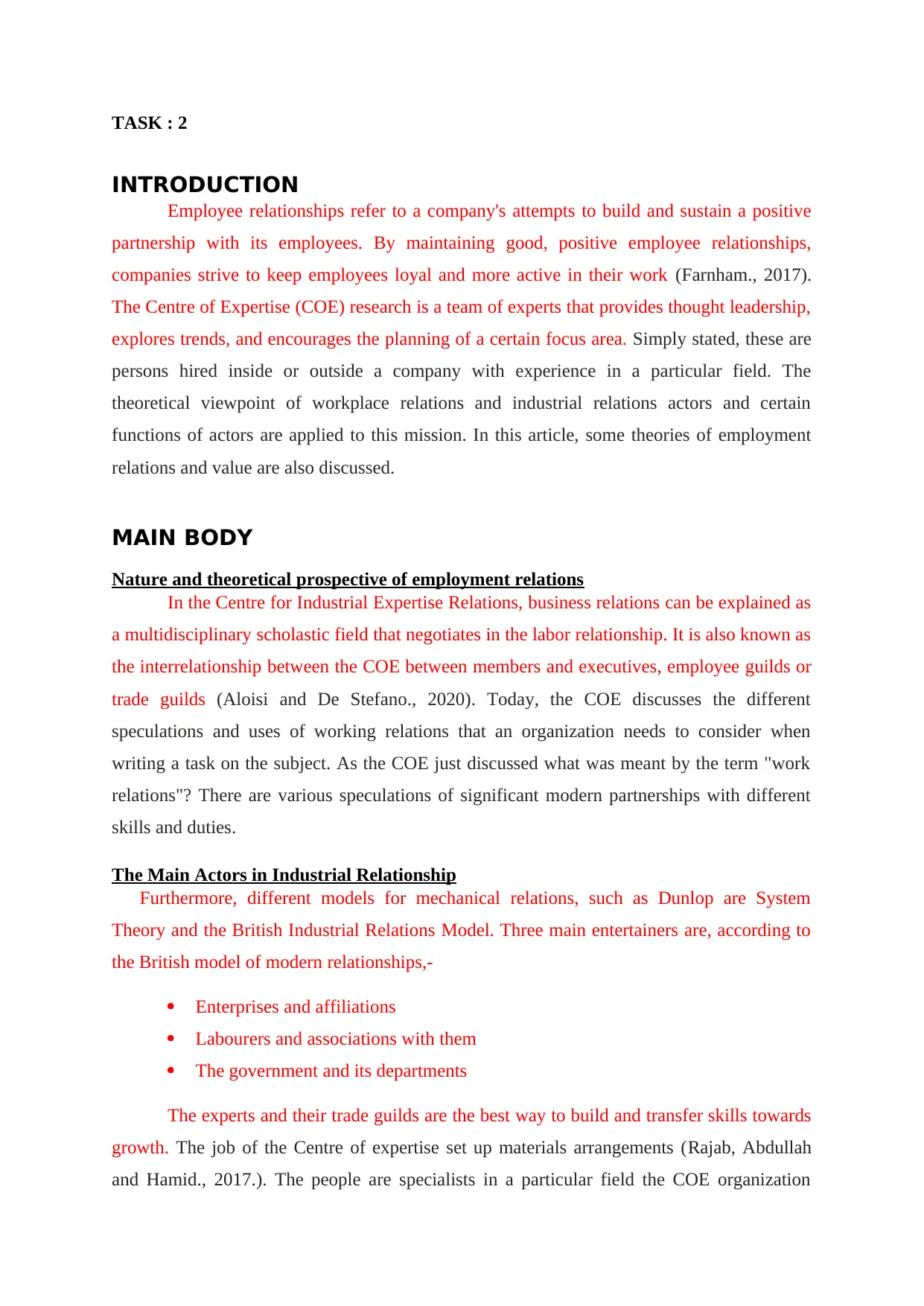
INTRODUCTION
Employee relationships refer to a company's attempts to build and sustain a positive
partnership with its employees. By maintaining good, positive employee relationships,
companies strive to keep employees loyal and more active in their work (Farnham., 2017).
The Centre of Expertise (COE) research is a team of experts that provides thought leadership,
explores trends, and encourages the planning of a certain focus area. Simply stated, these are
persons hired inside or outside a company with experience in a particular field. The
theoretical viewpoint of workplace relations and industrial relations actors and certain
functions of actors are applied to this mission. In this article, some theories of employment
relations and value are also discussed.
MAIN BODY
Nature and theoretical prospective of employment relations
In the Centre for Industrial Expertise Relations, business relations can be explained as
a multidisciplinary scholastic field that negotiates in the labor relationship. It is also known as
the interrelationship between the COE between members and executives, employee guilds or
trade guilds (Aloisi and De Stefano., 2020). Today, the COE discusses the different
speculations and uses of working relations that an organization needs to consider when
writing a task on the subject. As the COE just discussed what was meant by the term "work
relations"? There are various speculations of significant modern partnerships with different
skills and duties.
The Main Actors in Industrial Relationship
Furthermore, different models for mechanical relations, such as Dunlop are System
Theory and the British Industrial Relations Model. Three main entertainers are, according to
the British model of modern relationships,-
Enterprises and affiliations
Labourers and associations with them
The government and its departments
The experts and their trade guilds are the best way to build and transfer skills towards
growth. The job of the Centre of expertise set up materials arrangements (Rajab, Abdullah
and Hamid., 2017.). The people are specialists in a particular field the COE organization
INTRODUCTION
Employee relationships refer to a company's attempts to build and sustain a positive
partnership with its employees. By maintaining good, positive employee relationships,
companies strive to keep employees loyal and more active in their work (Farnham., 2017).
The Centre of Expertise (COE) research is a team of experts that provides thought leadership,
explores trends, and encourages the planning of a certain focus area. Simply stated, these are
persons hired inside or outside a company with experience in a particular field. The
theoretical viewpoint of workplace relations and industrial relations actors and certain
functions of actors are applied to this mission. In this article, some theories of employment
relations and value are also discussed.
MAIN BODY
Nature and theoretical prospective of employment relations
In the Centre for Industrial Expertise Relations, business relations can be explained as
a multidisciplinary scholastic field that negotiates in the labor relationship. It is also known as
the interrelationship between the COE between members and executives, employee guilds or
trade guilds (Aloisi and De Stefano., 2020). Today, the COE discusses the different
speculations and uses of working relations that an organization needs to consider when
writing a task on the subject. As the COE just discussed what was meant by the term "work
relations"? There are various speculations of significant modern partnerships with different
skills and duties.
The Main Actors in Industrial Relationship
Furthermore, different models for mechanical relations, such as Dunlop are System
Theory and the British Industrial Relations Model. Three main entertainers are, according to
the British model of modern relationships,-
Enterprises and affiliations
Labourers and associations with them
The government and its departments
The experts and their trade guilds are the best way to build and transfer skills towards
growth. The job of the Centre of expertise set up materials arrangements (Rajab, Abdullah
and Hamid., 2017.). The people are specialists in a particular field the COE organization
Paraphrase This Document
Need a fresh take? Get an instant paraphrase of this document with our AI Paraphraser
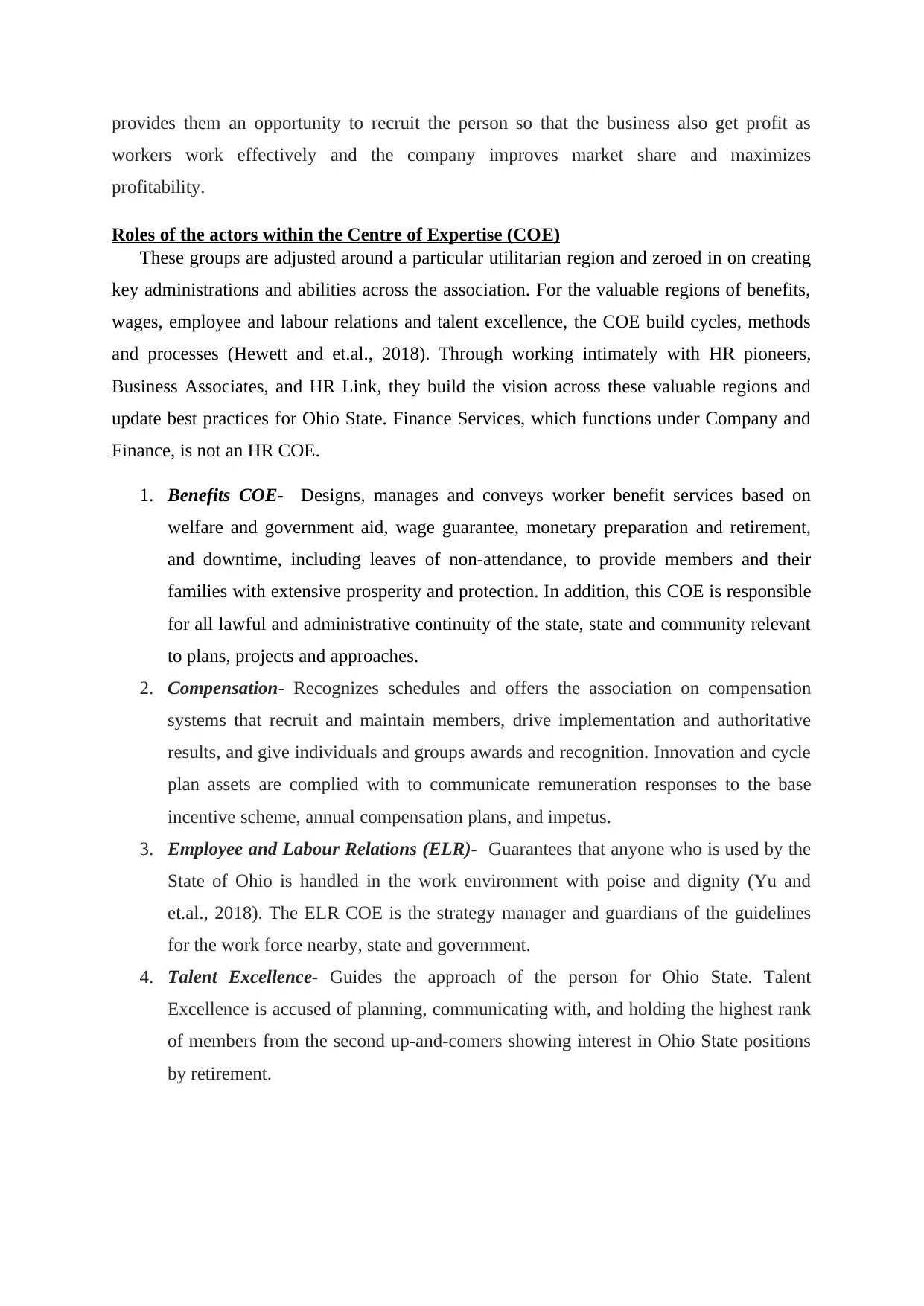
provides them an opportunity to recruit the person so that the business also get profit as
workers work effectively and the company improves market share and maximizes
profitability.
Roles of the actors within the Centre of Expertise (COE)
These groups are adjusted around a particular utilitarian region and zeroed in on creating
key administrations and abilities across the association. For the valuable regions of benefits,
wages, employee and labour relations and talent excellence, the COE build cycles, methods
and processes (Hewett and et.al., 2018). Through working intimately with HR pioneers,
Business Associates, and HR Link, they build the vision across these valuable regions and
update best practices for Ohio State. Finance Services, which functions under Company and
Finance, is not an HR COE.
1. Benefits COE- Designs, manages and conveys worker benefit services based on
welfare and government aid, wage guarantee, monetary preparation and retirement,
and downtime, including leaves of non-attendance, to provide members and their
families with extensive prosperity and protection. In addition, this COE is responsible
for all lawful and administrative continuity of the state, state and community relevant
to plans, projects and approaches.
2. Compensation- Recognizes schedules and offers the association on compensation
systems that recruit and maintain members, drive implementation and authoritative
results, and give individuals and groups awards and recognition. Innovation and cycle
plan assets are complied with to communicate remuneration responses to the base
incentive scheme, annual compensation plans, and impetus.
3. Employee and Labour Relations (ELR)- Guarantees that anyone who is used by the
State of Ohio is handled in the work environment with poise and dignity (Yu and
et.al., 2018). The ELR COE is the strategy manager and guardians of the guidelines
for the work force nearby, state and government.
4. Talent Excellence- Guides the approach of the person for Ohio State. Talent
Excellence is accused of planning, communicating with, and holding the highest rank
of members from the second up-and-comers showing interest in Ohio State positions
by retirement.
workers work effectively and the company improves market share and maximizes
profitability.
Roles of the actors within the Centre of Expertise (COE)
These groups are adjusted around a particular utilitarian region and zeroed in on creating
key administrations and abilities across the association. For the valuable regions of benefits,
wages, employee and labour relations and talent excellence, the COE build cycles, methods
and processes (Hewett and et.al., 2018). Through working intimately with HR pioneers,
Business Associates, and HR Link, they build the vision across these valuable regions and
update best practices for Ohio State. Finance Services, which functions under Company and
Finance, is not an HR COE.
1. Benefits COE- Designs, manages and conveys worker benefit services based on
welfare and government aid, wage guarantee, monetary preparation and retirement,
and downtime, including leaves of non-attendance, to provide members and their
families with extensive prosperity and protection. In addition, this COE is responsible
for all lawful and administrative continuity of the state, state and community relevant
to plans, projects and approaches.
2. Compensation- Recognizes schedules and offers the association on compensation
systems that recruit and maintain members, drive implementation and authoritative
results, and give individuals and groups awards and recognition. Innovation and cycle
plan assets are complied with to communicate remuneration responses to the base
incentive scheme, annual compensation plans, and impetus.
3. Employee and Labour Relations (ELR)- Guarantees that anyone who is used by the
State of Ohio is handled in the work environment with poise and dignity (Yu and
et.al., 2018). The ELR COE is the strategy manager and guardians of the guidelines
for the work force nearby, state and government.
4. Talent Excellence- Guides the approach of the person for Ohio State. Talent
Excellence is accused of planning, communicating with, and holding the highest rank
of members from the second up-and-comers showing interest in Ohio State positions
by retirement.
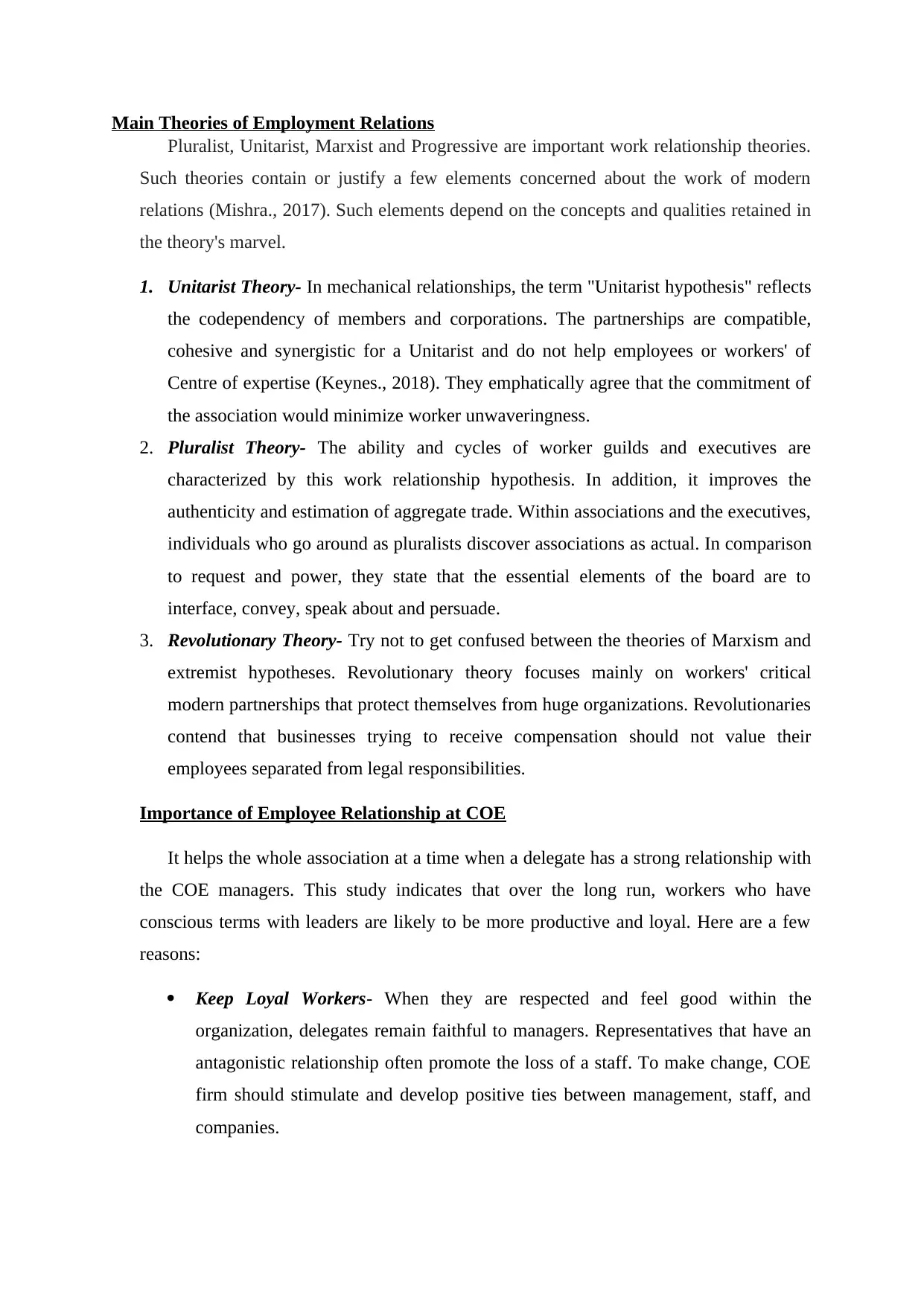
Main Theories of Employment Relations
Pluralist, Unitarist, Marxist and Progressive are important work relationship theories.
Such theories contain or justify a few elements concerned about the work of modern
relations (Mishra., 2017). Such elements depend on the concepts and qualities retained in
the theory's marvel.
1. Unitarist Theory- In mechanical relationships, the term "Unitarist hypothesis" reflects
the codependency of members and corporations. The partnerships are compatible,
cohesive and synergistic for a Unitarist and do not help employees or workers' of
Centre of expertise (Keynes., 2018). They emphatically agree that the commitment of
the association would minimize worker unwaveringness.
2. Pluralist Theory- The ability and cycles of worker guilds and executives are
characterized by this work relationship hypothesis. In addition, it improves the
authenticity and estimation of aggregate trade. Within associations and the executives,
individuals who go around as pluralists discover associations as actual. In comparison
to request and power, they state that the essential elements of the board are to
interface, convey, speak about and persuade.
3. Revolutionary Theory- Try not to get confused between the theories of Marxism and
extremist hypotheses. Revolutionary theory focuses mainly on workers' critical
modern partnerships that protect themselves from huge organizations. Revolutionaries
contend that businesses trying to receive compensation should not value their
employees separated from legal responsibilities.
Importance of Employee Relationship at COE
It helps the whole association at a time when a delegate has a strong relationship with
the COE managers. This study indicates that over the long run, workers who have
conscious terms with leaders are likely to be more productive and loyal. Here are a few
reasons:
Keep Loyal Workers- When they are respected and feel good within the
organization, delegates remain faithful to managers. Representatives that have an
antagonistic relationship often promote the loss of a staff. To make change, COE
firm should stimulate and develop positive ties between management, staff, and
companies.
Pluralist, Unitarist, Marxist and Progressive are important work relationship theories.
Such theories contain or justify a few elements concerned about the work of modern
relations (Mishra., 2017). Such elements depend on the concepts and qualities retained in
the theory's marvel.
1. Unitarist Theory- In mechanical relationships, the term "Unitarist hypothesis" reflects
the codependency of members and corporations. The partnerships are compatible,
cohesive and synergistic for a Unitarist and do not help employees or workers' of
Centre of expertise (Keynes., 2018). They emphatically agree that the commitment of
the association would minimize worker unwaveringness.
2. Pluralist Theory- The ability and cycles of worker guilds and executives are
characterized by this work relationship hypothesis. In addition, it improves the
authenticity and estimation of aggregate trade. Within associations and the executives,
individuals who go around as pluralists discover associations as actual. In comparison
to request and power, they state that the essential elements of the board are to
interface, convey, speak about and persuade.
3. Revolutionary Theory- Try not to get confused between the theories of Marxism and
extremist hypotheses. Revolutionary theory focuses mainly on workers' critical
modern partnerships that protect themselves from huge organizations. Revolutionaries
contend that businesses trying to receive compensation should not value their
employees separated from legal responsibilities.
Importance of Employee Relationship at COE
It helps the whole association at a time when a delegate has a strong relationship with
the COE managers. This study indicates that over the long run, workers who have
conscious terms with leaders are likely to be more productive and loyal. Here are a few
reasons:
Keep Loyal Workers- When they are respected and feel good within the
organization, delegates remain faithful to managers. Representatives that have an
antagonistic relationship often promote the loss of a staff. To make change, COE
firm should stimulate and develop positive ties between management, staff, and
companies.
⊘ This is a preview!⊘
Do you want full access?
Subscribe today to unlock all pages.
Trusted by 1+ million students worldwide

1 out of 14


Related Documents


Your All-in-One AI-Powered Toolkit for Academic Success.
+13062052269
info@desklib.com
Available 24*7 on WhatsApp / Email
![[object Object]](/_next/static/media/star-bottom.7253800d.svg)
Unlock your academic potential
Copyright © 2020–2026 A2Z Services. All Rights Reserved. Developed and managed by ZUCOL.