HRM Challenges & Career Development in Accommodation & Food Services
VerifiedAdded on 2023/06/12
|10
|2537
|442
Case Study
AI Summary
This case study report examines the human resource management (HRM) challenges within the accommodation and food service industry, focusing on how organizations manage workforce career development from a human capital perspective. It identifies key issues such as employee coordination, adapting to changing workplace dynamics, and fostering a training culture. The report further explores HRM practices like selective staffing, training assessment, equitable incentives, and performance appraisal as strategies for improving human capital. It reflects on the importance of attracting and retaining talent through career development programs, mentoring, job rotations, and work-shadowing. The conclusion emphasizes the need for organizations to address employee satisfaction through competitive compensation and a positive work environment to overcome staffing challenges and enhance overall performance. The report recommends focusing on employee training and development to improve the overall quality of human capital.

Human Resource Management

Paraphrase This Document
Need a fresh take? Get an instant paraphrase of this document with our AI Paraphraser
EXECUTIVE SUMMARY
Human resource management can be referred as a strategic approach for managing workers of an
organization in an effective manner so that same could assist in attaining competitive advantage.
Present report revolves around the discussion relating to changes faced by food and
accommodation organization. Further, the management manages the career of workers through
the application of appropriate strategy along with the development of personal appraisal.
Human resource management can be referred as a strategic approach for managing workers of an
organization in an effective manner so that same could assist in attaining competitive advantage.
Present report revolves around the discussion relating to changes faced by food and
accommodation organization. Further, the management manages the career of workers through
the application of appropriate strategy along with the development of personal appraisal.
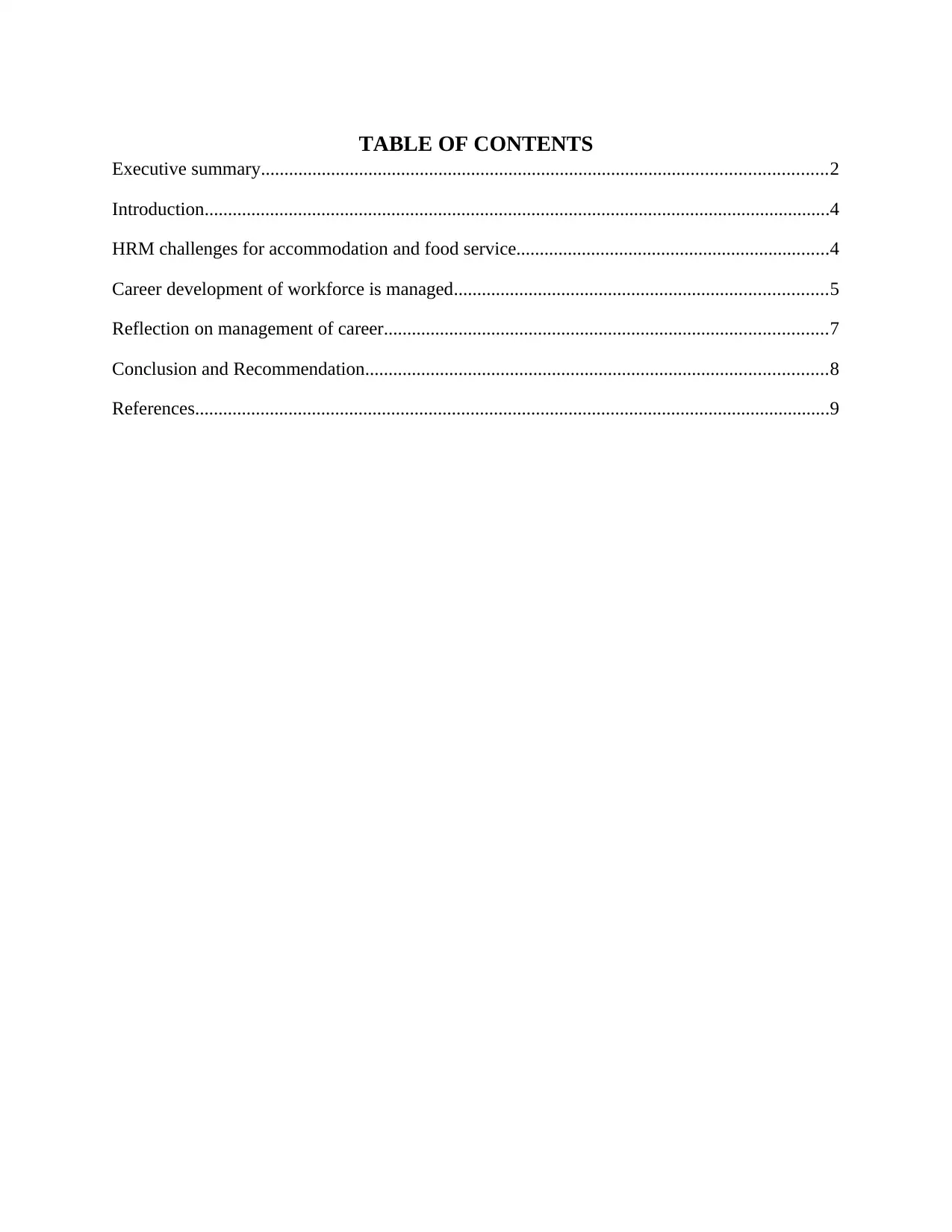
TABLE OF CONTENTS
Executive summary.........................................................................................................................2
Introduction......................................................................................................................................4
HRM challenges for accommodation and food service...................................................................4
Career development of workforce is managed................................................................................5
Reflection on management of career...............................................................................................7
Conclusion and Recommendation...................................................................................................8
References........................................................................................................................................9
Executive summary.........................................................................................................................2
Introduction......................................................................................................................................4
HRM challenges for accommodation and food service...................................................................4
Career development of workforce is managed................................................................................5
Reflection on management of career...............................................................................................7
Conclusion and Recommendation...................................................................................................8
References........................................................................................................................................9
⊘ This is a preview!⊘
Do you want full access?
Subscribe today to unlock all pages.

Trusted by 1+ million students worldwide
INTRODUCTION
Human resource professionals play a significant role in developing the career of workers in every
organization. They are responsible for recruiting, training and other development of the
employees which have been recruited by them (Purce, 2014). Present report emphasizes the
discussion relating to human resource management challenges relating to accommodation and
food service. Further, the manner in which organization develops the career of the worker in
order to enhance their personality as well as the existing level of skills. The report ends up with
focusing on the variants which I have been focusing on the development of my career.
HRM CHALLENGES FOR ACCOMMODATION AND FOOD SERVICE
HR is facing many problems specifically in the hospitality industry, as workers are moving from
one job to another due to the unsatisfied environment as well as payments made to them.
Although job opportunities are available in the hospitality industry but workers are left jobless.
The main challenges faced by accommodation and food service are as follows:
Coordination between employees
In spite of online rebellion, the hospitality sector is the industry under which direct
communication between customer and staff takes place. The discussion will keep on continue
that whether human interface will ultimately be overtaken, but in heart, retail is an association
which pays attention to business, yet for pure-play online who still wants to connect customer
service legislature to communicate with customers through online or phone (Reiche, Stahl,
Mendenhall and Oddou, 2016). Thus, employees are not ready to compromise in every situation
and adjust to the available environment. Due to the same reason, they are not able to coordinate
with each other and thus not able to perform in the best way. This compels the requirement to
consider, plan that how the business will stimulate the culture which is chosen by the company.
Changing the place of work
Giving the stress on things which is recognized above, under traditional places, there is an urgent
need to reorganize the manner in which they use to perform, the manner in which relations takes
place under place of work and also the rule or law that brunt’s it. This can be explained by taking
an example of supply and delivery cuffs since there is need of changing the manner of providing
service to a customer with a change in time (Kramar, 2014). In the present scenario, it is
Human resource professionals play a significant role in developing the career of workers in every
organization. They are responsible for recruiting, training and other development of the
employees which have been recruited by them (Purce, 2014). Present report emphasizes the
discussion relating to human resource management challenges relating to accommodation and
food service. Further, the manner in which organization develops the career of the worker in
order to enhance their personality as well as the existing level of skills. The report ends up with
focusing on the variants which I have been focusing on the development of my career.
HRM CHALLENGES FOR ACCOMMODATION AND FOOD SERVICE
HR is facing many problems specifically in the hospitality industry, as workers are moving from
one job to another due to the unsatisfied environment as well as payments made to them.
Although job opportunities are available in the hospitality industry but workers are left jobless.
The main challenges faced by accommodation and food service are as follows:
Coordination between employees
In spite of online rebellion, the hospitality sector is the industry under which direct
communication between customer and staff takes place. The discussion will keep on continue
that whether human interface will ultimately be overtaken, but in heart, retail is an association
which pays attention to business, yet for pure-play online who still wants to connect customer
service legislature to communicate with customers through online or phone (Reiche, Stahl,
Mendenhall and Oddou, 2016). Thus, employees are not ready to compromise in every situation
and adjust to the available environment. Due to the same reason, they are not able to coordinate
with each other and thus not able to perform in the best way. This compels the requirement to
consider, plan that how the business will stimulate the culture which is chosen by the company.
Changing the place of work
Giving the stress on things which is recognized above, under traditional places, there is an urgent
need to reorganize the manner in which they use to perform, the manner in which relations takes
place under place of work and also the rule or law that brunt’s it. This can be explained by taking
an example of supply and delivery cuffs since there is need of changing the manner of providing
service to a customer with a change in time (Kramar, 2014). In the present scenario, it is
Paraphrase This Document
Need a fresh take? Get an instant paraphrase of this document with our AI Paraphraser
necessary that management should be cautious about maintaining the good relation among who
delivers purchases to customers (Sheehan, 2014). Attaining this revolution in united negotiate
environment is a major challenge in most of the workplaces that model which is created about a
conventional adversarial connection among employer and employee. Flourishing companies
nowadays implementing a complicated approach which includes guarantees employees are not
only input for the business but are united through the business planned direction.
Training culture of the organization
To fulfil the consequence of globalization and to harness the advantages of latest technical
modifications it is important to make sure that the company has elasticity especially related to
labours. A business which is elastic and adaptable needs equal HR support in order to make and
apply modifications efficiently. Hence, we’ve stated above that to reduce the obstacles like
preventive terms under enterprise harmony, efficient working is vital (Stone, Deadrick,
Lukaszewski and Johnson, 2015). Similar to many employers, the hospitality industry has a
record of agreements that fix the terms and conditions which might be crooked among market
situations and requirements of the contemporary business. There are lots of methods the network,
but after that also it is vital for the business to plan and organize care for the outlook to maximize
the scenario for constructive change (Knies, Boselie, Gould-Williams and Vandenabeele, 2015).
Thus, appropriate culture should exist in the Accommodation and Foodservice organization so
that employees are able to provide to the best extent possible for them.
CAREER DEVELOPMENT OF WORKFORCE IS MANAGED FROM
HUMAN CAPITAL PERSPECTIVE
Under hospital industry, there are some HR practices which will be analytical of elevated
executing companies. Human resource management practices are the prime ways through which
company can spend for their staff. In order to improve human capital, there are certain ways
which are stated by the Snell and Dean they are Selective staffing, training assessment and
equitable incentives (Brewster, Mayrhofer and Morley, 2016). The same HRM practices
comprise: Selective Staffing, Training, Equitable pay, Performance Appraisal. The specified
practices will be followed by Accommodation and Food Service organization in order to develop
existing workforce:
delivers purchases to customers (Sheehan, 2014). Attaining this revolution in united negotiate
environment is a major challenge in most of the workplaces that model which is created about a
conventional adversarial connection among employer and employee. Flourishing companies
nowadays implementing a complicated approach which includes guarantees employees are not
only input for the business but are united through the business planned direction.
Training culture of the organization
To fulfil the consequence of globalization and to harness the advantages of latest technical
modifications it is important to make sure that the company has elasticity especially related to
labours. A business which is elastic and adaptable needs equal HR support in order to make and
apply modifications efficiently. Hence, we’ve stated above that to reduce the obstacles like
preventive terms under enterprise harmony, efficient working is vital (Stone, Deadrick,
Lukaszewski and Johnson, 2015). Similar to many employers, the hospitality industry has a
record of agreements that fix the terms and conditions which might be crooked among market
situations and requirements of the contemporary business. There are lots of methods the network,
but after that also it is vital for the business to plan and organize care for the outlook to maximize
the scenario for constructive change (Knies, Boselie, Gould-Williams and Vandenabeele, 2015).
Thus, appropriate culture should exist in the Accommodation and Foodservice organization so
that employees are able to provide to the best extent possible for them.
CAREER DEVELOPMENT OF WORKFORCE IS MANAGED FROM
HUMAN CAPITAL PERSPECTIVE
Under hospital industry, there are some HR practices which will be analytical of elevated
executing companies. Human resource management practices are the prime ways through which
company can spend for their staff. In order to improve human capital, there are certain ways
which are stated by the Snell and Dean they are Selective staffing, training assessment and
equitable incentives (Brewster, Mayrhofer and Morley, 2016). The same HRM practices
comprise: Selective Staffing, Training, Equitable pay, Performance Appraisal. The specified
practices will be followed by Accommodation and Food Service organization in order to develop
existing workforce:
Selective Staffing
Understaffing one of most apparent means for firms to develop their human capital is by
employing the individuals. In an ideal world, each and every employee includes regularly high
levels of job performance (Brewster, Chung and Sparrow, 2016). From the time, humans cannot
work as robots so there will be a significant disparity in productivity of every employee. Hull
had established that in comparison to poor employees good employees perform twice work.
Hence, benefits of utilizing a good selection technique look apparent. Selective staffing is
imagined to be linked to alleged organizational performance into hospital industry.
Assessment Training
Another way of through which company can develop human capital is training. In case if
employees are not accessible “on the market” an organization can enhance the ability of
employees in the house (Brewster, 2017). Through this increased level of ability would improve
the level of human capital in the company and enhance effectiveness thus comprehensive
training must result in increases in apparent performance.
Expansion of performance appraisal
For managerial or development function conventionally performance appraisals are carried out.
Under hospital industry development element is considered as the one the most significant
towards the human capital (Bratton and Gold, 2017). It is considered that administrator who
allocates his time in giving a response, converse with their staff about the difficulties that they
are facing and also recognizing the parts which need enhancement will boost employees target
setting and future-oriented approach towards execution (Cascio, 2018). So speculations into
performance appraisal are probably to raise the apparent executive performance.
Equitable Rewards
As organization do savings for employees’ development even after that also they are not
accomplishing the own the resultant human capital, it is suggested that hospitality industry
device manner in order to make sure employees must perform in the company’s best concern
(Armstrong and Taylor, 2014). For this wisdom company must keep in mind theories of
management while employing compensation. Theory of Equity states how employees view
Understaffing one of most apparent means for firms to develop their human capital is by
employing the individuals. In an ideal world, each and every employee includes regularly high
levels of job performance (Brewster, Chung and Sparrow, 2016). From the time, humans cannot
work as robots so there will be a significant disparity in productivity of every employee. Hull
had established that in comparison to poor employees good employees perform twice work.
Hence, benefits of utilizing a good selection technique look apparent. Selective staffing is
imagined to be linked to alleged organizational performance into hospital industry.
Assessment Training
Another way of through which company can develop human capital is training. In case if
employees are not accessible “on the market” an organization can enhance the ability of
employees in the house (Brewster, 2017). Through this increased level of ability would improve
the level of human capital in the company and enhance effectiveness thus comprehensive
training must result in increases in apparent performance.
Expansion of performance appraisal
For managerial or development function conventionally performance appraisals are carried out.
Under hospital industry development element is considered as the one the most significant
towards the human capital (Bratton and Gold, 2017). It is considered that administrator who
allocates his time in giving a response, converse with their staff about the difficulties that they
are facing and also recognizing the parts which need enhancement will boost employees target
setting and future-oriented approach towards execution (Cascio, 2018). So speculations into
performance appraisal are probably to raise the apparent executive performance.
Equitable Rewards
As organization do savings for employees’ development even after that also they are not
accomplishing the own the resultant human capital, it is suggested that hospitality industry
device manner in order to make sure employees must perform in the company’s best concern
(Armstrong and Taylor, 2014). For this wisdom company must keep in mind theories of
management while employing compensation. Theory of Equity states how employees view
⊘ This is a preview!⊘
Do you want full access?
Subscribe today to unlock all pages.
Trusted by 1+ million students worldwide
causes of equity for joining the company, continue and generate output for the company
(Brewster, Houldsworth, Sparrow and Vernon, 2016). There are two types of equity that are
internal equity and external equity. External equity refers to level to which workforce of the
company is compensated in contrast to the outer labour market. On the other hand, individual
equity can be defined as the level to which staff of the company is remunerated according to
their work. Hence outcome of equitable rewards are expected to superficial company
performance
REFLECTION ON MANAGEMENT OF CAREER
The hospitality industries are facing difficulty in the relation to creating attention and preserving
talent. According to me, skilled and trained workforce is essential in order to make sure the
survival of company which can be received only if the company gets success for long period of
time. This might be done by paying concentration towards how they can attract, retain and
improves the career of capable individuals. However, I accessed that accurate employee’s result
in superior customer services, and also lead to cost effectiveness where profits of the company
are condensed. During my training period, I emphasized the changes which have been adopted
by the organization and the manner in which management accepts the same. This assertion will
assist me in future to encourage my workforce to accept the required changes. I focus on my
personality development along with enhancement of knowledge required for various operation of
the organization. As personality development is the main variant which can be excelled in best
way during the training period. The reason behind same is that one gets information about the
obstacles which senior executives face while managing as well as motivating other employees to
provide the best they could. The execution of career development practices has been analyzed by
me on continuing basis as a technique forward. For instance, I focus on policies through which
staff can be encouraged are by job design and compensation and those that improve the skills of
the market with a sense of importance towards the company. Some of the policies which
company can use to attract and preserve skill for career development from company’s point of
view consist of:
Development program within the organization
Providing mentoring opportunity
Changing of Jobs
(Brewster, Houldsworth, Sparrow and Vernon, 2016). There are two types of equity that are
internal equity and external equity. External equity refers to level to which workforce of the
company is compensated in contrast to the outer labour market. On the other hand, individual
equity can be defined as the level to which staff of the company is remunerated according to
their work. Hence outcome of equitable rewards are expected to superficial company
performance
REFLECTION ON MANAGEMENT OF CAREER
The hospitality industries are facing difficulty in the relation to creating attention and preserving
talent. According to me, skilled and trained workforce is essential in order to make sure the
survival of company which can be received only if the company gets success for long period of
time. This might be done by paying concentration towards how they can attract, retain and
improves the career of capable individuals. However, I accessed that accurate employee’s result
in superior customer services, and also lead to cost effectiveness where profits of the company
are condensed. During my training period, I emphasized the changes which have been adopted
by the organization and the manner in which management accepts the same. This assertion will
assist me in future to encourage my workforce to accept the required changes. I focus on my
personality development along with enhancement of knowledge required for various operation of
the organization. As personality development is the main variant which can be excelled in best
way during the training period. The reason behind same is that one gets information about the
obstacles which senior executives face while managing as well as motivating other employees to
provide the best they could. The execution of career development practices has been analyzed by
me on continuing basis as a technique forward. For instance, I focus on policies through which
staff can be encouraged are by job design and compensation and those that improve the skills of
the market with a sense of importance towards the company. Some of the policies which
company can use to attract and preserve skill for career development from company’s point of
view consist of:
Development program within the organization
Providing mentoring opportunity
Changing of Jobs
Paraphrase This Document
Need a fresh take? Get an instant paraphrase of this document with our AI Paraphraser
Work –Shadowing
Hence, frequently the high labour return rates act as an obstacle for the company to spend in
employees, simply to drop them afterwards. I had recognized that human resource
management must focus on three areas: people performance, flair services and work replica.
CONCLUSION AND RECOMMENDATION
The above study concludes human resource management comprises clear progress prospects
during staffing, offering training to old employees from outside the state. The same is done
through outlining instructive institutions to align ability requirements and to obtain best from
instruction. However, as a result, the lack of ability and difficulties of staffing and preserving
skill individual for the hospitality industry looks not likely to be resolved in the future. Hence
it is recommended to focus on optimistic gains that skilled employees fetch under place of
work; any means to promote the procedure has to think about. The same can be done through
providing appropriate training to the employees and providing them satisfied return along
with the environment.
The main variants which is considered by each employee in order to sustain in an
organization is payment and environment of the organization. Thus, Accommodation and
Foodservice organization are recommended to focus on both of these variants in order to
resolve the challenges relating to human resource management. Appropriate returns are
necessary in order to bring out the best from employees or to motivate them to perform in the
best manner (Al-Refaie, 2015). Further, organizations are required to focus on training
provided to employees. As the more focus on the availability of expert will be provided the
more appropriate results will be attained by the organization (Chelladurai and Kerwin, 2017).
They are responsible primarily for the results which they get from their management. Thus,
the prior focus should be made that they have not left any absence of any facility which
might have resulted in enhancement of skills of employees.
Hence, frequently the high labour return rates act as an obstacle for the company to spend in
employees, simply to drop them afterwards. I had recognized that human resource
management must focus on three areas: people performance, flair services and work replica.
CONCLUSION AND RECOMMENDATION
The above study concludes human resource management comprises clear progress prospects
during staffing, offering training to old employees from outside the state. The same is done
through outlining instructive institutions to align ability requirements and to obtain best from
instruction. However, as a result, the lack of ability and difficulties of staffing and preserving
skill individual for the hospitality industry looks not likely to be resolved in the future. Hence
it is recommended to focus on optimistic gains that skilled employees fetch under place of
work; any means to promote the procedure has to think about. The same can be done through
providing appropriate training to the employees and providing them satisfied return along
with the environment.
The main variants which is considered by each employee in order to sustain in an
organization is payment and environment of the organization. Thus, Accommodation and
Foodservice organization are recommended to focus on both of these variants in order to
resolve the challenges relating to human resource management. Appropriate returns are
necessary in order to bring out the best from employees or to motivate them to perform in the
best manner (Al-Refaie, 2015). Further, organizations are required to focus on training
provided to employees. As the more focus on the availability of expert will be provided the
more appropriate results will be attained by the organization (Chelladurai and Kerwin, 2017).
They are responsible primarily for the results which they get from their management. Thus,
the prior focus should be made that they have not left any absence of any facility which
might have resulted in enhancement of skills of employees.

⊘ This is a preview!⊘
Do you want full access?
Subscribe today to unlock all pages.
Trusted by 1+ million students worldwide
REFERENCES
Al-Refaie, A. (2015). Effects of human resource management on hotel performance using
structural equation modeling. Computers in Human Behavior, 43, 293-303.
Armstrong, M., & Taylor, S. (2014). Armstrong's handbook of human resource management
practice. Kogan Page Publishers.
Bratton, J., & Gold, J. (2017). Human resource management: theory and practice. Palgrave.
Brewster, C. (2017). The integration of human resource management and corporate strategy.
In Policy and practice in European human resource management (pp. 22-35). Routledge.
Brewster, C., Chung, C., & Sparrow, P. (2016). Globalizing human resource management.
Routledge.
Brewster, C., Houldsworth, E., Sparrow, P., & Vernon, G. (2016). International human resource
management. Kogan Page Publishers.
Brewster, C., Mayrhofer, W., & Morley, M. (Eds.). (2016). New challenges for European
resource management. Springer.
Cascio, W. (2018). Managing human resources. McGraw-Hill Education.
Chelladurai, P., & Kerwin, S. (2017). Human resource management in sport and recreation.
Human Kinetics.
Knies, E., Boselie, P., Gould-Williams, J., & Vandenabeele, W. (2015). Special issue of
International Journal of Human Resource Management: Strategic human resource
management and public sector performance.
Kramar, R. (2014). Beyond strategic human resource management: is sustainable human
resource management the next approach?. The International Journal of Human Resource
Management, 25(8), 1069-1089.
Purce, J. (2014). The impact of corporate strategy on human resource management. New
Perspectives on Human Resource Management (Routledge Revivals), 67.
Reiche, B. S., Stahl, G. K., Mendenhall, M. E., & Oddou, G. R. (Eds.). (2016). Readings and
cases in international human resource management. Taylor & Francis.
Sheehan, M. (2014). Human resource management and performance: Evidence from small and
medium-sized firms. International Small Business Journal, 32(5), 545-570.
Stone, D. L., Deadrick, D. L., Lukaszewski, K. M., & Johnson, R. (2015). The influence of
technology on the future of human resource management. Human Resource Management
Review, 25(2), 216-231.
Al-Refaie, A. (2015). Effects of human resource management on hotel performance using
structural equation modeling. Computers in Human Behavior, 43, 293-303.
Armstrong, M., & Taylor, S. (2014). Armstrong's handbook of human resource management
practice. Kogan Page Publishers.
Bratton, J., & Gold, J. (2017). Human resource management: theory and practice. Palgrave.
Brewster, C. (2017). The integration of human resource management and corporate strategy.
In Policy and practice in European human resource management (pp. 22-35). Routledge.
Brewster, C., Chung, C., & Sparrow, P. (2016). Globalizing human resource management.
Routledge.
Brewster, C., Houldsworth, E., Sparrow, P., & Vernon, G. (2016). International human resource
management. Kogan Page Publishers.
Brewster, C., Mayrhofer, W., & Morley, M. (Eds.). (2016). New challenges for European
resource management. Springer.
Cascio, W. (2018). Managing human resources. McGraw-Hill Education.
Chelladurai, P., & Kerwin, S. (2017). Human resource management in sport and recreation.
Human Kinetics.
Knies, E., Boselie, P., Gould-Williams, J., & Vandenabeele, W. (2015). Special issue of
International Journal of Human Resource Management: Strategic human resource
management and public sector performance.
Kramar, R. (2014). Beyond strategic human resource management: is sustainable human
resource management the next approach?. The International Journal of Human Resource
Management, 25(8), 1069-1089.
Purce, J. (2014). The impact of corporate strategy on human resource management. New
Perspectives on Human Resource Management (Routledge Revivals), 67.
Reiche, B. S., Stahl, G. K., Mendenhall, M. E., & Oddou, G. R. (Eds.). (2016). Readings and
cases in international human resource management. Taylor & Francis.
Sheehan, M. (2014). Human resource management and performance: Evidence from small and
medium-sized firms. International Small Business Journal, 32(5), 545-570.
Stone, D. L., Deadrick, D. L., Lukaszewski, K. M., & Johnson, R. (2015). The influence of
technology on the future of human resource management. Human Resource Management
Review, 25(2), 216-231.

1 out of 10


Related Documents


Your All-in-One AI-Powered Toolkit for Academic Success.
+13062052269
info@desklib.com
Available 24*7 on WhatsApp / Email
![[object Object]](/_next/static/media/star-bottom.7253800d.svg)
Unlock your academic potential
Copyright © 2020–2026 A2Z Services. All Rights Reserved. Developed and managed by ZUCOL.