HRMT20024 - Construction HRM Literature Review Report
VerifiedAdded on 2022/09/11
|12
|3194
|20
Report
AI Summary
This report presents a literature review focusing on Human Resource Management (HRM) within the construction industry, specifically in the Australian context. The review analyzes five peer-reviewed articles published since 2014, each addressing different facets of HRM. The articles explore factors influencing labor productivity, barriers to knowledge management, the link between corporate social responsibility (CSR) and organizational performance, and critical factors in managing stress among construction workers. The review summarizes each article's objective, research question, methodology, findings, discussion, and conclusion, along with a brief explanation of how each article contributes to a larger essay. The analysis reveals crucial insights into productivity challenges, the importance of knowledge management, the role of CSR, and the impact of stress on the construction workforce, providing a comprehensive overview of key HRM issues within the sector.
Running head: ANNOTATED BIBLIOGRAPHY
HUMAN RESOURCE MANAGEMENT IN CONSTRUCTION INDUSTRY
Name of the Student
Name of the University
Author’s note
HUMAN RESOURCE MANAGEMENT IN CONSTRUCTION INDUSTRY
Name of the Student
Name of the University
Author’s note

Paraphrase This Document
Need a fresh take? Get an instant paraphrase of this document with our AI Paraphraser
1HUMAN RESOURCE MANAGEMNT IN CONSTRUCTION INDUSTRY
Article 1
Naoum, S. G. (2016). Factors influencing labor productivity on construction sites: A state-of-the-
art literature review and a survey. International Journal of Productivity and Performance
Management, 65(3), 401-421.
Objective and research question: Every organisation requires optimum productivity from
their employees in order to run smoothly. However, there is a problem regarding productivity
especially in the construction sector. Low productivity signifies low development in the industry.
There is always reason that can help to understand the fall in the productivity level. Therefore the
primary objective of this journal is to understand the problems related to the low productivity
level in construction sites. The various issues related with managerial and leadership problems,
employee motivation, activities prior and during construction and lastly it understand the
organisational factors that deter the productivity level. The research question is to explore the
various factors that influence the productivity on site.
Method: The following research uses qualitative research methodology to understand the issues
related to low productivity at construction sites. The research methodology covers in depth
analysis of the issues pertaining to low productivity rate at the construction site. The method uses
secondary data analysis through thorough review of literature which discussed various sectors
within and outside of the organisational setup. The research also uses primary data through
survey and interview. A total of five factors were assessed and a total of 46 issues were
discovered which were then reviewed by 36 contractors.
Findings and discussion: The secondary research through various literature review revealed
that there has been a significant advancement in development of various techniques and tool for
Article 1
Naoum, S. G. (2016). Factors influencing labor productivity on construction sites: A state-of-the-
art literature review and a survey. International Journal of Productivity and Performance
Management, 65(3), 401-421.
Objective and research question: Every organisation requires optimum productivity from
their employees in order to run smoothly. However, there is a problem regarding productivity
especially in the construction sector. Low productivity signifies low development in the industry.
There is always reason that can help to understand the fall in the productivity level. Therefore the
primary objective of this journal is to understand the problems related to the low productivity
level in construction sites. The various issues related with managerial and leadership problems,
employee motivation, activities prior and during construction and lastly it understand the
organisational factors that deter the productivity level. The research question is to explore the
various factors that influence the productivity on site.
Method: The following research uses qualitative research methodology to understand the issues
related to low productivity at construction sites. The research methodology covers in depth
analysis of the issues pertaining to low productivity rate at the construction site. The method uses
secondary data analysis through thorough review of literature which discussed various sectors
within and outside of the organisational setup. The research also uses primary data through
survey and interview. A total of five factors were assessed and a total of 46 issues were
discovered which were then reviewed by 36 contractors.
Findings and discussion: The secondary research through various literature review revealed
that there has been a significant advancement in development of various techniques and tool for
2HUMAN RESOURCE MANAGEMNT IN CONSTRUCTION INDUSTRY
that aid to the productivity, there is a dearth and urgent need for technology and innovation in
this sector. Productivity can be defined as a measurement of efficiency in production. Businesses
to deliver higher productivity to ensure the return of higher profit margins that can be helpful in
the growth and development of the entire organisation. The primary research performed through
survey interview revealed that factors such as experience of the project managers of the selected
site influenced the productive development. The design of the project is another important
parameter that needs to resonate with the people who are working on the construction site. When
the other employees do not resonate with the ideologies of the upper management it immediately
lowers the working motivation of the employees. Additionally, the reason for low productivity as
pointed out by the journal is the influence of the leadership style. Furthermore, the project
planning, the raw material procurement details are some of the factors that lead to low
productivity.
Conclusion: The final outcome of the research was to provide understanding to future
contractors about the issues that affect productivity. The issues are interrelated and can affect the
final outcome in a major way. Poor build design, lack of communication among the
management, lack of moral among the employee are all interrelated issues that effects the growth
of the business. In order to ensure there is proper business it is important that these issues are
resolved.
How this article will contribute to my Essay 3: This article is an important source of
literature that is essential in understanding the issue relating to productivity. Hence this journal
can be a helpful source of information for the construction business.
that aid to the productivity, there is a dearth and urgent need for technology and innovation in
this sector. Productivity can be defined as a measurement of efficiency in production. Businesses
to deliver higher productivity to ensure the return of higher profit margins that can be helpful in
the growth and development of the entire organisation. The primary research performed through
survey interview revealed that factors such as experience of the project managers of the selected
site influenced the productive development. The design of the project is another important
parameter that needs to resonate with the people who are working on the construction site. When
the other employees do not resonate with the ideologies of the upper management it immediately
lowers the working motivation of the employees. Additionally, the reason for low productivity as
pointed out by the journal is the influence of the leadership style. Furthermore, the project
planning, the raw material procurement details are some of the factors that lead to low
productivity.
Conclusion: The final outcome of the research was to provide understanding to future
contractors about the issues that affect productivity. The issues are interrelated and can affect the
final outcome in a major way. Poor build design, lack of communication among the
management, lack of moral among the employee are all interrelated issues that effects the growth
of the business. In order to ensure there is proper business it is important that these issues are
resolved.
How this article will contribute to my Essay 3: This article is an important source of
literature that is essential in understanding the issue relating to productivity. Hence this journal
can be a helpful source of information for the construction business.
⊘ This is a preview!⊘
Do you want full access?
Subscribe today to unlock all pages.

Trusted by 1+ million students worldwide
3HUMAN RESOURCE MANAGEMNT IN CONSTRUCTION INDUSTRY
Article 2
Shokri-Ghasabeh, M., & Chileshe, N. (2014). Knowledge management: Barriers to capturing
lessons learned from Australian construction contractors perspective. Construction
Innovation, 14(1), 108-134.
Objective and research question: The management of an organisation’s knowledge
systematically so that they can meet the strategic requirements is known as knowledge
management. In construction business much like any other industry require to have a knowledge
management to ensure they can strategize, create better system, which enhances and sustains
storages and it improving knowledge. It is noticed that there are several barriers that are
counterproductive to the growth of contractor business if the knowledge is not applied
successfully. Therefore the primary objective of the journal is to identify and locate the barriers
in the knowledge management system in the construction contractors in South Australia. The
research question is therefore the barriers for knowledge management in construction business.
Method: the following report analyses the research question through qualitative and
quantitative research methodology. The authors have used secondary data through reviewing and
analysing several literature both methodologically and interdisciplinary. This extensive research
also uses primary research where the authors have documented procedures extensively
understanding the responses of over 450 organisations out of which 81 responses were useable.
That helped to form inferential statistical data as the quantitative procedure to understand the
relation between the strength of relationship among the barriers.
Findings and discussion: There is a need for capturing lessons learned, it allows for growth
within the organisation and helps it to grow and also allows the employee and management to
Article 2
Shokri-Ghasabeh, M., & Chileshe, N. (2014). Knowledge management: Barriers to capturing
lessons learned from Australian construction contractors perspective. Construction
Innovation, 14(1), 108-134.
Objective and research question: The management of an organisation’s knowledge
systematically so that they can meet the strategic requirements is known as knowledge
management. In construction business much like any other industry require to have a knowledge
management to ensure they can strategize, create better system, which enhances and sustains
storages and it improving knowledge. It is noticed that there are several barriers that are
counterproductive to the growth of contractor business if the knowledge is not applied
successfully. Therefore the primary objective of the journal is to identify and locate the barriers
in the knowledge management system in the construction contractors in South Australia. The
research question is therefore the barriers for knowledge management in construction business.
Method: the following report analyses the research question through qualitative and
quantitative research methodology. The authors have used secondary data through reviewing and
analysing several literature both methodologically and interdisciplinary. This extensive research
also uses primary research where the authors have documented procedures extensively
understanding the responses of over 450 organisations out of which 81 responses were useable.
That helped to form inferential statistical data as the quantitative procedure to understand the
relation between the strength of relationship among the barriers.
Findings and discussion: There is a need for capturing lessons learned, it allows for growth
within the organisation and helps it to grow and also allows the employee and management to
Paraphrase This Document
Need a fresh take? Get an instant paraphrase of this document with our AI Paraphraser
4HUMAN RESOURCE MANAGEMNT IN CONSTRUCTION INDUSTRY
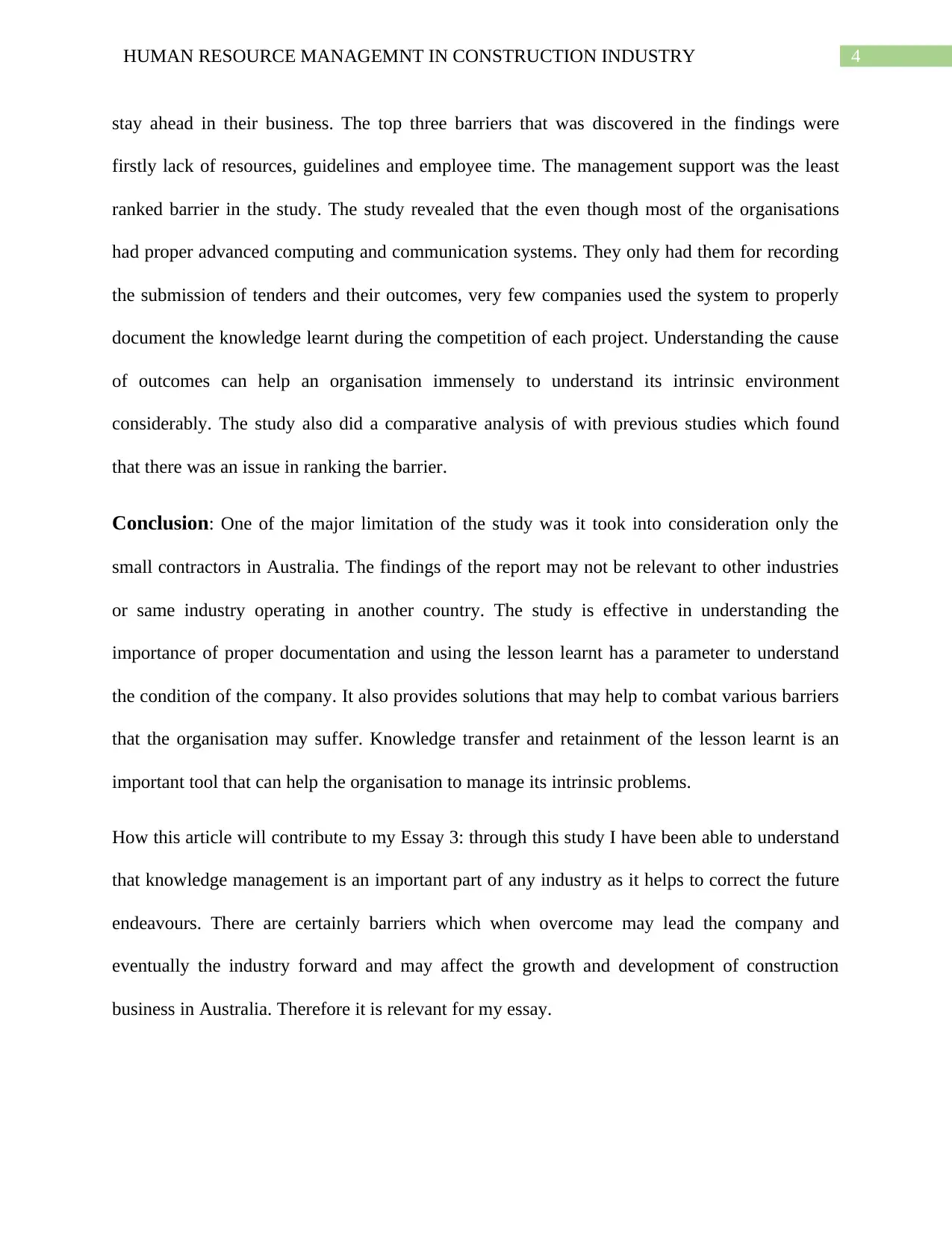
stay ahead in their business. The top three barriers that was discovered in the findings were
firstly lack of resources, guidelines and employee time. The management support was the least
ranked barrier in the study. The study revealed that the even though most of the organisations
had proper advanced computing and communication systems. They only had them for recording
the submission of tenders and their outcomes, very few companies used the system to properly
document the knowledge learnt during the competition of each project. Understanding the cause
of outcomes can help an organisation immensely to understand its intrinsic environment
considerably. The study also did a comparative analysis of with previous studies which found
that there was an issue in ranking the barrier.
Conclusion: One of the major limitation of the study was it took into consideration only the
small contractors in Australia. The findings of the report may not be relevant to other industries
or same industry operating in another country. The study is effective in understanding the
importance of proper documentation and using the lesson learnt has a parameter to understand
the condition of the company. It also provides solutions that may help to combat various barriers
that the organisation may suffer. Knowledge transfer and retainment of the lesson learnt is an
important tool that can help the organisation to manage its intrinsic problems.
How this article will contribute to my Essay 3: through this study I have been able to understand
that knowledge management is an important part of any industry as it helps to correct the future
endeavours. There are certainly barriers which when overcome may lead the company and
eventually the industry forward and may affect the growth and development of construction
business in Australia. Therefore it is relevant for my essay.
stay ahead in their business. The top three barriers that was discovered in the findings were
firstly lack of resources, guidelines and employee time. The management support was the least
ranked barrier in the study. The study revealed that the even though most of the organisations
had proper advanced computing and communication systems. They only had them for recording
the submission of tenders and their outcomes, very few companies used the system to properly
document the knowledge learnt during the competition of each project. Understanding the cause
of outcomes can help an organisation immensely to understand its intrinsic environment
considerably. The study also did a comparative analysis of with previous studies which found
that there was an issue in ranking the barrier.
Conclusion: One of the major limitation of the study was it took into consideration only the
small contractors in Australia. The findings of the report may not be relevant to other industries
or same industry operating in another country. The study is effective in understanding the
importance of proper documentation and using the lesson learnt has a parameter to understand
the condition of the company. It also provides solutions that may help to combat various barriers
that the organisation may suffer. Knowledge transfer and retainment of the lesson learnt is an
important tool that can help the organisation to manage its intrinsic problems.
How this article will contribute to my Essay 3: through this study I have been able to understand
that knowledge management is an important part of any industry as it helps to correct the future
endeavours. There are certainly barriers which when overcome may lead the company and
eventually the industry forward and may affect the growth and development of construction
business in Australia. Therefore it is relevant for my essay.
5HUMAN RESOURCE MANAGEMNT IN CONSTRUCTION INDUSTRY
Article 3
Loosemore, M., & Lim, B. T. H. (2017). Linking corporate social responsibility and
organizational performance in the construction industry. Construction management and
economics, 35(3), 90-105.
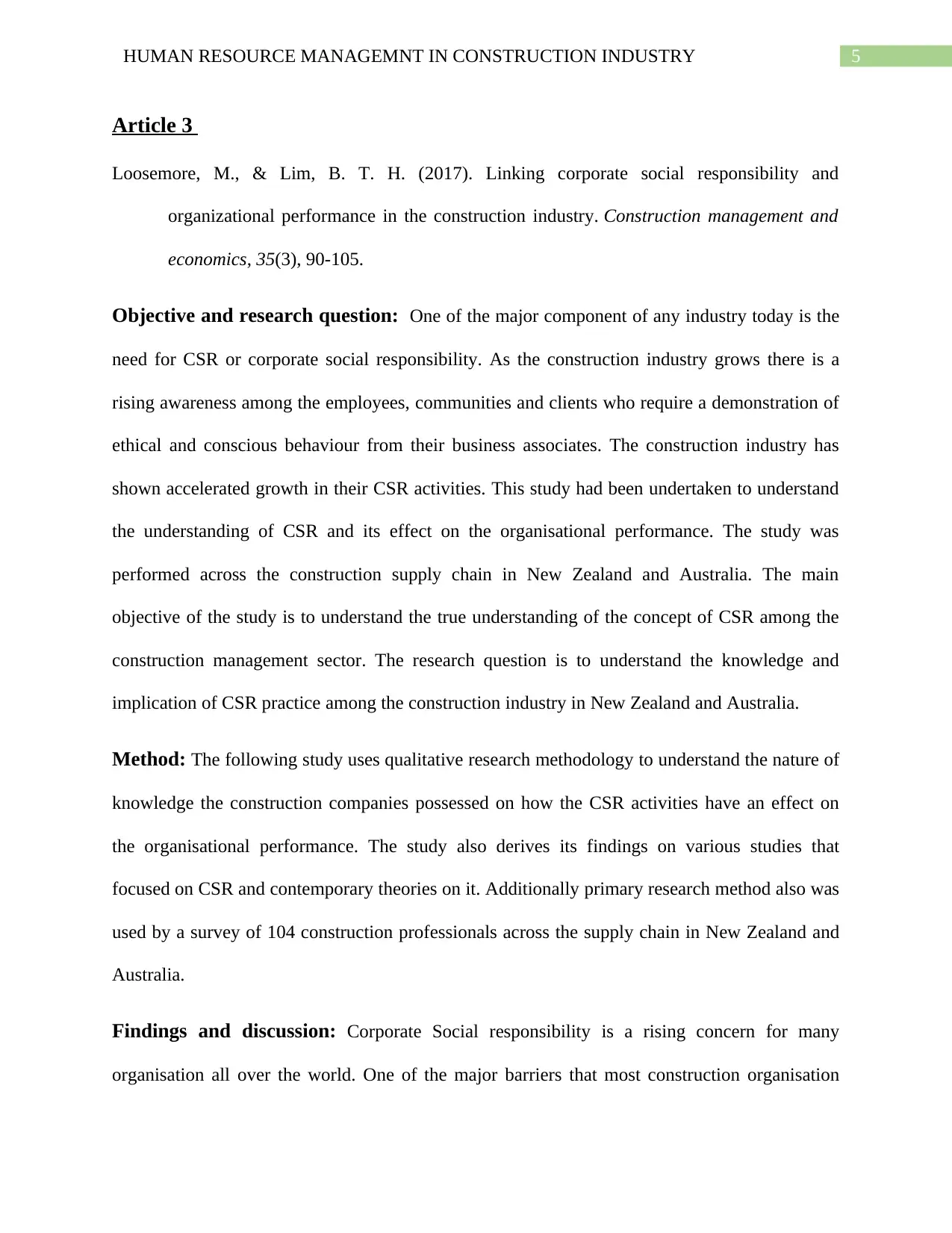
Objective and research question: One of the major component of any industry today is the
need for CSR or corporate social responsibility. As the construction industry grows there is a
rising awareness among the employees, communities and clients who require a demonstration of
ethical and conscious behaviour from their business associates. The construction industry has
shown accelerated growth in their CSR activities. This study had been undertaken to understand
the understanding of CSR and its effect on the organisational performance. The study was
performed across the construction supply chain in New Zealand and Australia. The main
objective of the study is to understand the true understanding of the concept of CSR among the
construction management sector. The research question is to understand the knowledge and
implication of CSR practice among the construction industry in New Zealand and Australia.
Method: The following study uses qualitative research methodology to understand the nature of
knowledge the construction companies possessed on how the CSR activities have an effect on
the organisational performance. The study also derives its findings on various studies that
focused on CSR and contemporary theories on it. Additionally primary research method also was
used by a survey of 104 construction professionals across the supply chain in New Zealand and
Australia.
Findings and discussion: Corporate Social responsibility is a rising concern for many
organisation all over the world. One of the major barriers that most construction organisation
Article 3
Loosemore, M., & Lim, B. T. H. (2017). Linking corporate social responsibility and
organizational performance in the construction industry. Construction management and
economics, 35(3), 90-105.
Objective and research question: One of the major component of any industry today is the
need for CSR or corporate social responsibility. As the construction industry grows there is a
rising awareness among the employees, communities and clients who require a demonstration of
ethical and conscious behaviour from their business associates. The construction industry has
shown accelerated growth in their CSR activities. This study had been undertaken to understand
the understanding of CSR and its effect on the organisational performance. The study was
performed across the construction supply chain in New Zealand and Australia. The main
objective of the study is to understand the true understanding of the concept of CSR among the
construction management sector. The research question is to understand the knowledge and
implication of CSR practice among the construction industry in New Zealand and Australia.
Method: The following study uses qualitative research methodology to understand the nature of
knowledge the construction companies possessed on how the CSR activities have an effect on
the organisational performance. The study also derives its findings on various studies that
focused on CSR and contemporary theories on it. Additionally primary research method also was
used by a survey of 104 construction professionals across the supply chain in New Zealand and
Australia.
Findings and discussion: Corporate Social responsibility is a rising concern for many
organisation all over the world. One of the major barriers that most construction organisation
⊘ This is a preview!⊘
Do you want full access?
Subscribe today to unlock all pages.
Trusted by 1+ million students worldwide
6HUMAN RESOURCE MANAGEMNT IN CONSTRUCTION INDUSTRY
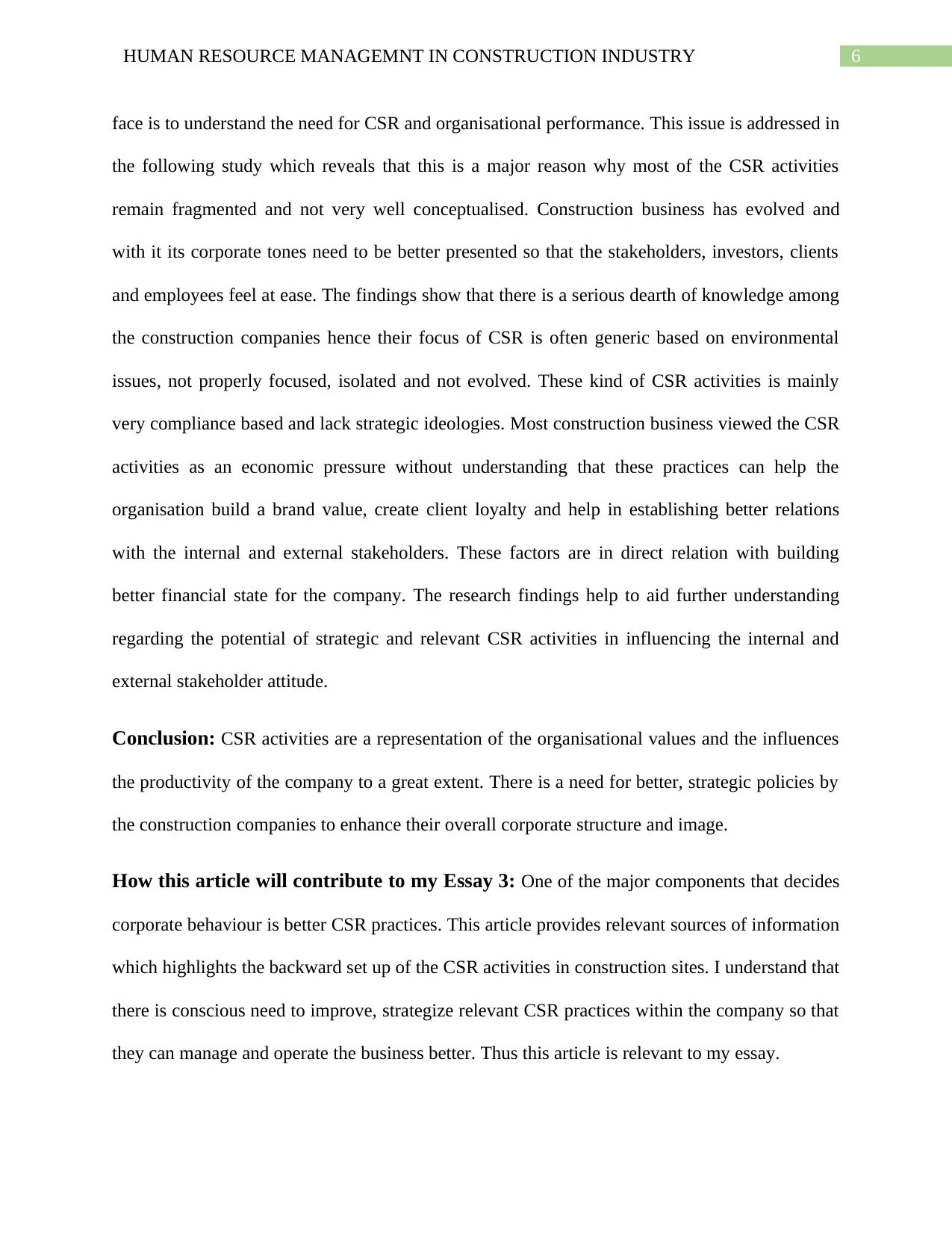
face is to understand the need for CSR and organisational performance. This issue is addressed in
the following study which reveals that this is a major reason why most of the CSR activities
remain fragmented and not very well conceptualised. Construction business has evolved and
with it its corporate tones need to be better presented so that the stakeholders, investors, clients
and employees feel at ease. The findings show that there is a serious dearth of knowledge among
the construction companies hence their focus of CSR is often generic based on environmental
issues, not properly focused, isolated and not evolved. These kind of CSR activities is mainly
very compliance based and lack strategic ideologies. Most construction business viewed the CSR
activities as an economic pressure without understanding that these practices can help the
organisation build a brand value, create client loyalty and help in establishing better relations
with the internal and external stakeholders. These factors are in direct relation with building
better financial state for the company. The research findings help to aid further understanding
regarding the potential of strategic and relevant CSR activities in influencing the internal and
external stakeholder attitude.
Conclusion: CSR activities are a representation of the organisational values and the influences
the productivity of the company to a great extent. There is a need for better, strategic policies by
the construction companies to enhance their overall corporate structure and image.
How this article will contribute to my Essay 3: One of the major components that decides
corporate behaviour is better CSR practices. This article provides relevant sources of information
which highlights the backward set up of the CSR activities in construction sites. I understand that
there is conscious need to improve, strategize relevant CSR practices within the company so that
they can manage and operate the business better. Thus this article is relevant to my essay.
face is to understand the need for CSR and organisational performance. This issue is addressed in
the following study which reveals that this is a major reason why most of the CSR activities
remain fragmented and not very well conceptualised. Construction business has evolved and
with it its corporate tones need to be better presented so that the stakeholders, investors, clients
and employees feel at ease. The findings show that there is a serious dearth of knowledge among
the construction companies hence their focus of CSR is often generic based on environmental
issues, not properly focused, isolated and not evolved. These kind of CSR activities is mainly
very compliance based and lack strategic ideologies. Most construction business viewed the CSR
activities as an economic pressure without understanding that these practices can help the
organisation build a brand value, create client loyalty and help in establishing better relations
with the internal and external stakeholders. These factors are in direct relation with building
better financial state for the company. The research findings help to aid further understanding
regarding the potential of strategic and relevant CSR activities in influencing the internal and
external stakeholder attitude.
Conclusion: CSR activities are a representation of the organisational values and the influences
the productivity of the company to a great extent. There is a need for better, strategic policies by
the construction companies to enhance their overall corporate structure and image.
How this article will contribute to my Essay 3: One of the major components that decides
corporate behaviour is better CSR practices. This article provides relevant sources of information
which highlights the backward set up of the CSR activities in construction sites. I understand that
there is conscious need to improve, strategize relevant CSR practices within the company so that
they can manage and operate the business better. Thus this article is relevant to my essay.
Paraphrase This Document
Need a fresh take? Get an instant paraphrase of this document with our AI Paraphraser
7HUMAN RESOURCE MANAGEMNT IN CONSTRUCTION INDUSTRY
Article 4
Liang, Q., Leung, M. Y., & Cooper, C. (2018). Focus group study to explore critical factors for
managing stress of construction workers. Journal of Construction Engineering and
Management, 144(5), 04018023.
Objective and research question: Stress is a leading cause for a lot disease, other than that
there is always serious mental health implication that is slowly becoming a rising concern. The
following journal is based on stress management in the construction industry. The authors point
that employees in the construction industry of the have to work under duress of stressful
environment, difficult timings and other factors which led to severe work related anxiety among
the employees. The objective of this article to understand various factors that lead to stress and
the effect it may have on the employee and organisation. The research question is to understand
the need for stress management in construction industry.
Method: The article uses the qualitative method of research practice as it discusses in details the
importance of occupational safety and health (OSH). The article has both primary research in
form of short questionnaire survey and secondary research. The journal investigates focus group
studies 15 coping behaviours that explored factors that lead to stress, the nature of their stress,
the coping mechanisms they develop and lastly, the effect of stress on their job performance.
Findings and discussion: The construction industry is one of the largest industries all over the
world and have both skilled and unskilled labour. Employee’s health and well-being is an
important responsibility of an organisation as they are the backbone of the company. There are
various factors that triggers the stress in construction industry which has been pointed out by the
journal. One of the primary reason that the journal mentions may lead to stress is the tight
Article 4
Liang, Q., Leung, M. Y., & Cooper, C. (2018). Focus group study to explore critical factors for
managing stress of construction workers. Journal of Construction Engineering and
Management, 144(5), 04018023.
Objective and research question: Stress is a leading cause for a lot disease, other than that
there is always serious mental health implication that is slowly becoming a rising concern. The
following journal is based on stress management in the construction industry. The authors point
that employees in the construction industry of the have to work under duress of stressful
environment, difficult timings and other factors which led to severe work related anxiety among
the employees. The objective of this article to understand various factors that lead to stress and
the effect it may have on the employee and organisation. The research question is to understand
the need for stress management in construction industry.
Method: The article uses the qualitative method of research practice as it discusses in details the
importance of occupational safety and health (OSH). The article has both primary research in
form of short questionnaire survey and secondary research. The journal investigates focus group
studies 15 coping behaviours that explored factors that lead to stress, the nature of their stress,
the coping mechanisms they develop and lastly, the effect of stress on their job performance.
Findings and discussion: The construction industry is one of the largest industries all over the
world and have both skilled and unskilled labour. Employee’s health and well-being is an
important responsibility of an organisation as they are the backbone of the company. There are
various factors that triggers the stress in construction industry which has been pointed out by the
journal. One of the primary reason that the journal mentions may lead to stress is the tight
8HUMAN RESOURCE MANAGEMNT IN CONSTRUCTION INDUSTRY
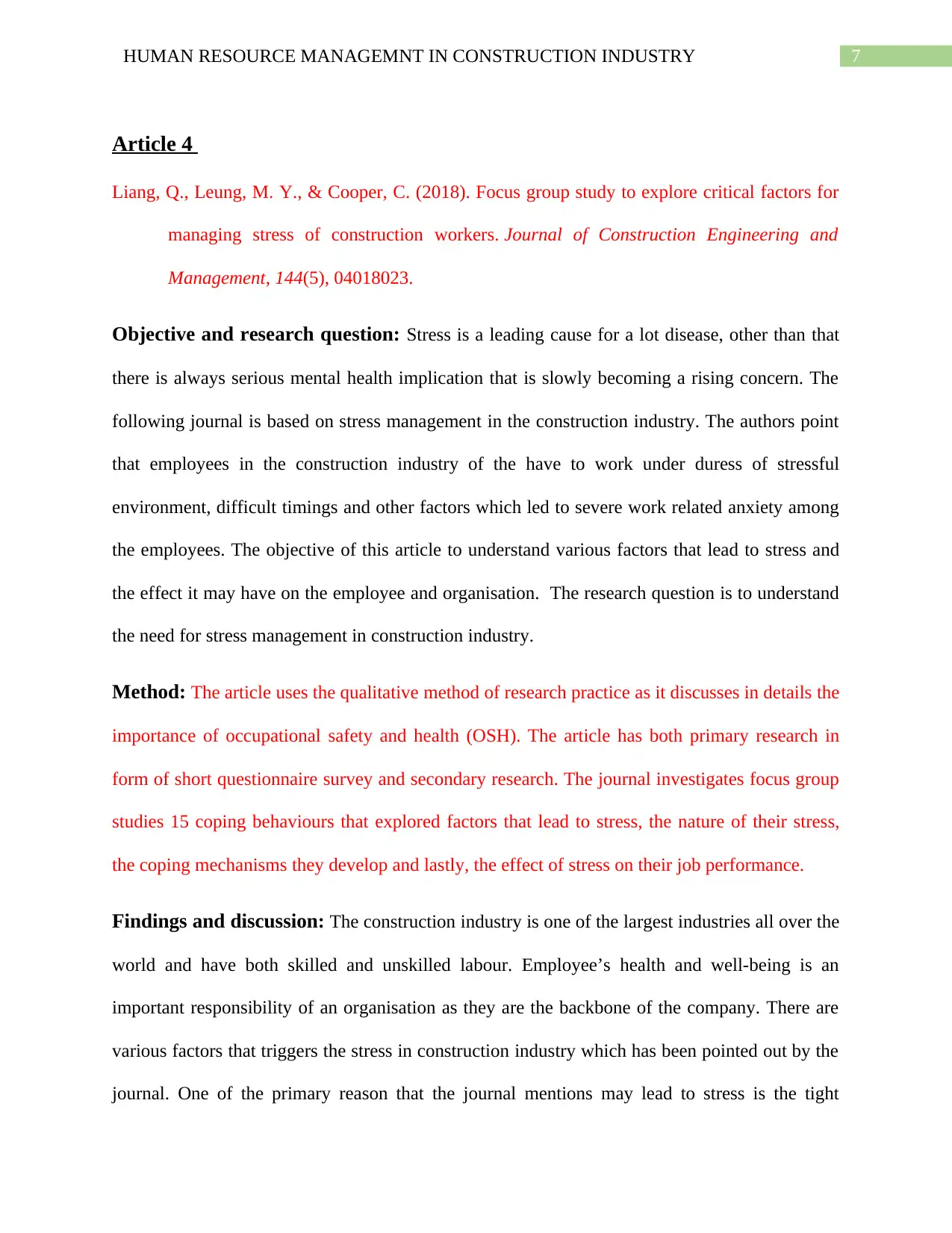
constraint of time that most construction company employees need to comply with. This equates
to long hours of work maybe with very less breaks that increases their duress considerably. The
high noise in construction site may follow a neurological issues such as loss of hearing, heart
ailments, raised blood pressure and others. The findings also show that there is an ethical and
legal obligation of employers towards their employee to ensure they have proper training and
equipment in the construction site. The journal mentions that construction companies must plan
and organise various therapeutical group sessions or individual session with therapists to help
their employees cope with the stress. Job design is also another sector that plays an important
role in stress control and overall productivity of the employees. The journal provides
recommendation on how to deal with individual, task related and organisational stress. There are
certainly positive organisational behaviours that will help to solve their employee issues.
Conclusion: Construction industry needs manpower to develop and thrive. However, the harsh
working conditions may increase stress level among the employees which in turn will have a
negative effect on the employee performance. The low performance issue effects the productivity
of the overall company. Therefore, there is a need to have proper stress management procedure
in construction business.
How this article will contribute to my Essay 3: Stress management is an important factor
that influences employee performance and can have a negative effect on the company’s
development and growth. The following article is a relevant source of literature to my essay.
constraint of time that most construction company employees need to comply with. This equates
to long hours of work maybe with very less breaks that increases their duress considerably. The
high noise in construction site may follow a neurological issues such as loss of hearing, heart
ailments, raised blood pressure and others. The findings also show that there is an ethical and
legal obligation of employers towards their employee to ensure they have proper training and
equipment in the construction site. The journal mentions that construction companies must plan
and organise various therapeutical group sessions or individual session with therapists to help
their employees cope with the stress. Job design is also another sector that plays an important
role in stress control and overall productivity of the employees. The journal provides
recommendation on how to deal with individual, task related and organisational stress. There are
certainly positive organisational behaviours that will help to solve their employee issues.
Conclusion: Construction industry needs manpower to develop and thrive. However, the harsh
working conditions may increase stress level among the employees which in turn will have a
negative effect on the employee performance. The low performance issue effects the productivity
of the overall company. Therefore, there is a need to have proper stress management procedure
in construction business.
How this article will contribute to my Essay 3: Stress management is an important factor
that influences employee performance and can have a negative effect on the company’s
development and growth. The following article is a relevant source of literature to my essay.
⊘ This is a preview!⊘
Do you want full access?
Subscribe today to unlock all pages.
Trusted by 1+ million students worldwide
9HUMAN RESOURCE MANAGEMNT IN CONSTRUCTION INDUSTRY
Article 5
Chileshe, N., Rameezdeen, R., & Hosseini, M. R. (2016). Drivers for adopting reverse logistics
in the construction industry: a qualitative study. Engineering, Construction and
Architectural Management, 23(2), 134-157.
Objective and research question: The primary objective of the paper is to investigate and
analyse the factors that influence the implementation of reverse logistics in South Australian
construction businesses. Construction industry are one of the largest consumers in the world and
the projects also lead to massive pollution therefore there are drivers for promoting reverse
logistics. The reverse logistics refers to the transfer of goods from their final destination to
ensure reuse or recycle or proper disposal. The research question is to analyse the perception of
reverse logistics among the Australian construction practitioners.
Method: The following article uses quantitative method and primary research method by
collecting data through interviewing eight South Australian construction practitioners. The data
collected was then analysed using the software NVivo (version 10). The primary research also
contained a survey report using cluster analysis. Cluster analysis helped to form a cross
validation the interviews and helped to develop an in-depth understanding of the findings.
Findings and discussion: Construction industry is a major contributor to deforestation, soil
erosion and loss in biodiversity. The industry also contributes to air and water pollution through
its activities. With an increased rate of consumption all over the world, there is a need for
development of this huge population which has led to numerous environmental issues.
Construction business need to be aware of the implications they have on the environment and
need to take responsibility and action through method such as reverse logistics to reduces its
Article 5
Chileshe, N., Rameezdeen, R., & Hosseini, M. R. (2016). Drivers for adopting reverse logistics
in the construction industry: a qualitative study. Engineering, Construction and
Architectural Management, 23(2), 134-157.
Objective and research question: The primary objective of the paper is to investigate and
analyse the factors that influence the implementation of reverse logistics in South Australian
construction businesses. Construction industry are one of the largest consumers in the world and
the projects also lead to massive pollution therefore there are drivers for promoting reverse
logistics. The reverse logistics refers to the transfer of goods from their final destination to
ensure reuse or recycle or proper disposal. The research question is to analyse the perception of
reverse logistics among the Australian construction practitioners.
Method: The following article uses quantitative method and primary research method by
collecting data through interviewing eight South Australian construction practitioners. The data
collected was then analysed using the software NVivo (version 10). The primary research also
contained a survey report using cluster analysis. Cluster analysis helped to form a cross
validation the interviews and helped to develop an in-depth understanding of the findings.
Findings and discussion: Construction industry is a major contributor to deforestation, soil
erosion and loss in biodiversity. The industry also contributes to air and water pollution through
its activities. With an increased rate of consumption all over the world, there is a need for
development of this huge population which has led to numerous environmental issues.
Construction business need to be aware of the implications they have on the environment and
need to take responsibility and action through method such as reverse logistics to reduces its
Paraphrase This Document
Need a fresh take? Get an instant paraphrase of this document with our AI Paraphraser
10HUMAN RESOURCE MANAGEMNT IN CONSTRUCTION INDUSTRY
harmful impact. The findings show that a large portion of the clientele demand better reverse
logistics to ensure that the construction company is ethically and environmentally aware. The
findings of the study also show that RL has a deep economic advantage to the company that was
previously ignored, the analysis from the interview reveals that RL is influenced by the attitude
of the client and the type of project.
Conclusion: the major limitation of the study is the small size of the survey sample and the
study only focused on South Australia and therefore may not be valid in other geographical area.
However, it provides explanation regarding the multiple usefulness of the RL and can be useful
in future research regarding the same matter.
How this article will contribute to my Essay 3: The following article is relevant to my
essay because it provides information about the implication the construction industry has on the
environment. While it is responsible to provide multiple job opportunities it is also responsible
in multiple environmental issues. I also feel that a proper RL can help to create a good company
brand value which can help the company grow in the future.
harmful impact. The findings show that a large portion of the clientele demand better reverse
logistics to ensure that the construction company is ethically and environmentally aware. The
findings of the study also show that RL has a deep economic advantage to the company that was
previously ignored, the analysis from the interview reveals that RL is influenced by the attitude
of the client and the type of project.
Conclusion: the major limitation of the study is the small size of the survey sample and the
study only focused on South Australia and therefore may not be valid in other geographical area.
However, it provides explanation regarding the multiple usefulness of the RL and can be useful
in future research regarding the same matter.
How this article will contribute to my Essay 3: The following article is relevant to my
essay because it provides information about the implication the construction industry has on the
environment. While it is responsible to provide multiple job opportunities it is also responsible
in multiple environmental issues. I also feel that a proper RL can help to create a good company
brand value which can help the company grow in the future.
11HUMAN RESOURCE MANAGEMNT IN CONSTRUCTION INDUSTRY
Reference
Chileshe, N., Rameezdeen, R., & Hosseini, M. R. (2016). Drivers for adopting reverse logistics
in the construction industry: a qualitative study. Engineering, Construction and
Architectural Management, 23(2), 134-157.
Liang, Q., Leung, M. Y., & Cooper, C. (2018). Focus group study to explore critical factors for
managing stress of construction workers. Journal of Construction Engineering and
Management, 144(5), 04018023.
Loosemore, M., & Lim, B. T. H. (2017). Linking corporate social responsibility and
organizational performance in the construction industry. Construction management and
economics, 35(3), 90-105.
Naoum, S. G. (2016). Factors influencing labor productivity on construction sites: A state-of-the-
art literature review and a survey. International Journal of Productivity and Performance
Management, 65(3), 401-421.
Shokri-Ghasabeh, M., & Chileshe, N. (2014). Knowledge management: Barriers to capturing
lessons learned from Australian construction contractors perspective. Construction
Innovation, 14(1), 108-134.
Reference
Chileshe, N., Rameezdeen, R., & Hosseini, M. R. (2016). Drivers for adopting reverse logistics
in the construction industry: a qualitative study. Engineering, Construction and
Architectural Management, 23(2), 134-157.
Liang, Q., Leung, M. Y., & Cooper, C. (2018). Focus group study to explore critical factors for
managing stress of construction workers. Journal of Construction Engineering and
Management, 144(5), 04018023.
Loosemore, M., & Lim, B. T. H. (2017). Linking corporate social responsibility and
organizational performance in the construction industry. Construction management and
economics, 35(3), 90-105.
Naoum, S. G. (2016). Factors influencing labor productivity on construction sites: A state-of-the-
art literature review and a survey. International Journal of Productivity and Performance
Management, 65(3), 401-421.
Shokri-Ghasabeh, M., & Chileshe, N. (2014). Knowledge management: Barriers to capturing
lessons learned from Australian construction contractors perspective. Construction
Innovation, 14(1), 108-134.
⊘ This is a preview!⊘
Do you want full access?
Subscribe today to unlock all pages.
Trusted by 1+ million students worldwide

1 out of 12


Related Documents


Your All-in-One AI-Powered Toolkit for Academic Success.
+13062052269
info@desklib.com
Available 24*7 on WhatsApp / Email
![[object Object]](/_next/static/media/star-bottom.7253800d.svg)
Unlock your academic potential
Copyright © 2020–2025 A2Z Services. All Rights Reserved. Developed and managed by ZUCOL.