Human Resource Management Report: Employment Laws and Trade Unions

Verified

Added on  2023/01/11

|6
|1313
|96
Report
AI Summary
This report delves into the core functions of Human Resource Management (HRM), specifically addressing the implementation and adherence to employment laws designed to protect employees. It examines the impact of various legislations, including the Health and Safety Act 1974, Minimum Wage Act 1998, and Employment Rights Act 1996, on HRM decision-making. The report highlights the legal, social, and ethical responsibilities of HRM in ensuring a safe, fair, and non-discriminatory workplace. Furthermore, it explores the role of trade unions in workplace representation, negotiation, and safeguarding employee rights, emphasizing the importance of collaboration between HRM and trade unions. The conclusion underscores the significance of employee laws in maintaining a healthy and productive work environment.
Document Page
Human Resources
Management
tabler-icon-diamond-filled.svg

Paraphrase This Document

Need a fresh take? Get an instant paraphrase of this document with our AI Paraphraser
Document Page
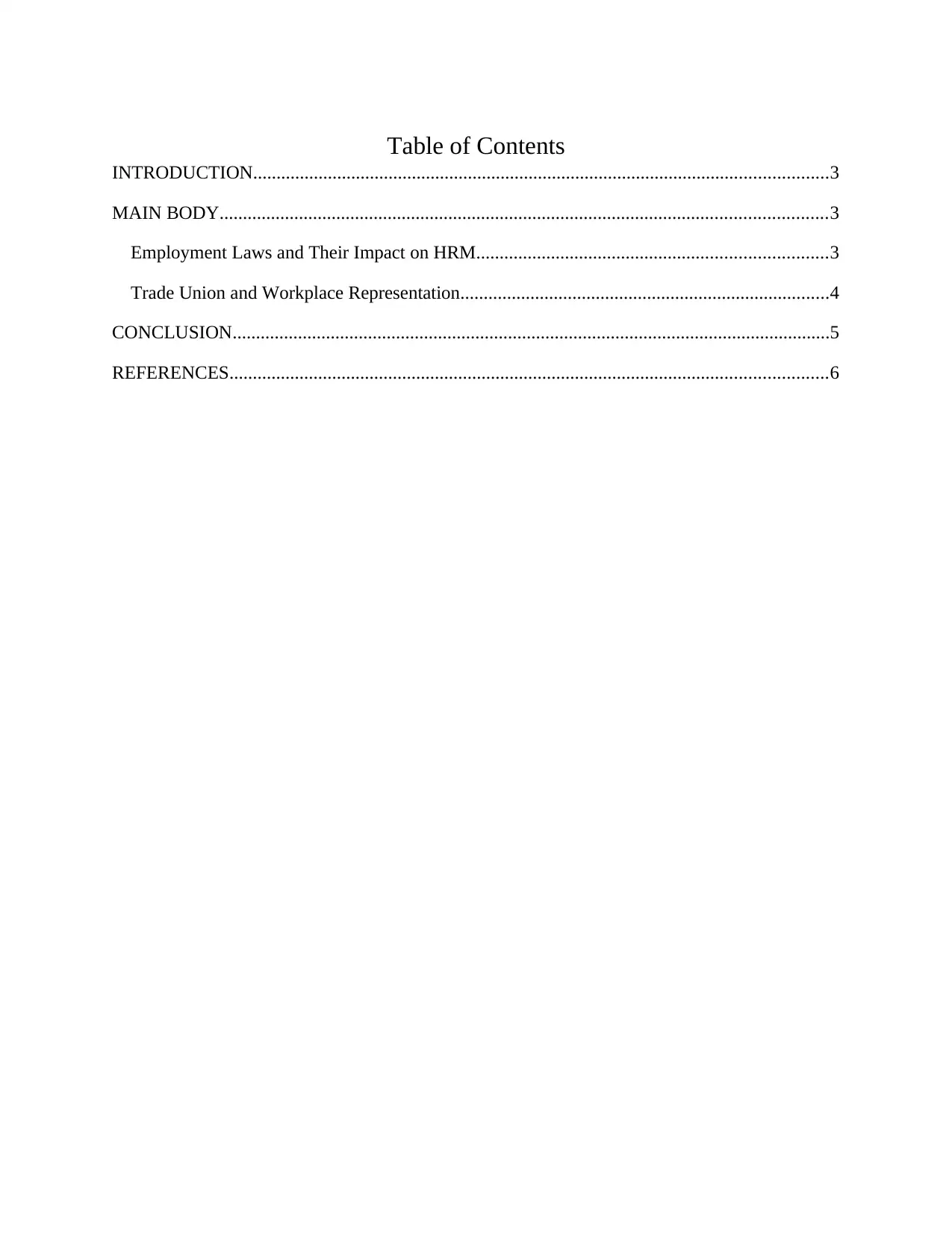
Table of Contents
INTRODUCTION...........................................................................................................................3
MAIN BODY..................................................................................................................................3
Employment Laws and Their Impact on HRM...........................................................................3
Trade Union and Workplace Representation...............................................................................4
CONCLUSION................................................................................................................................5
REFERENCES................................................................................................................................6
Document Page
INTRODUCTION
One of the primary functions of the Human Resource Management (HRM) department of
any business organisation relates to the implementation and adherence of the business
organisation to the numerous employee laws that are mandated by local and national authorities
with the intention to safeguarding the employees of these business organisations from threats,
harassment, discrimination and abuse at workplace (Guerin and Barreiro, 2016). This report
evaluates the key elements of employee legislations and their impact on decision making of
HRM.
MAIN BODY
Employment Laws and Their Impact on HRM
There are various legally mandated employee laws which the HRM of a business
organisation needs to ensure and implement within the workplace in order to operate legally in
the industries and possess a motivated and satisfied workforce capable of operating at optimum
performance and efficiency, such as:
Health and Safety Act 1974: This legally mandated employee law ensures that employees of a
business organisation are provided with a safe and healthy working environment that does not
endanger their health or safety in any possible way. Through this act, it is the duty of a business’s
HRM to ensure that they provide the business’s employees with a safe and healthy working
environment and also provide them will all necessary safety tools required for their operations
(Subramanian and Megginson, 2018). In case lapses are found in the HRM’s ability to
implement the Health and Safety Act 1974, which result in harm caused to any employee of the
business, then the business has to pay the employee significant reimbursements and also enables
the employee to drag the business to legislative courts for justice, which is immensely bad for the
business’s operations and brand value and reputation. This is why this employee law has a
significant impact on the operations of HRM, as they have to effectively train and educate their
workforce on the safe operational methods which guarantee the safety of all employees.
Document Page
Minimum Wage Act 1998: This legally mandated employee law ensures that all employees and
workers of a business organisation are at least paid the minimum amount of wages set by the
national authorities so that no worker gets taken advantage of by the business organisation. It is a
legal duty of a business’s HRM to ensure that all workers of the business are being paid their
minimum wages as is mandated by the national authorities (Goldberg and Wilkinson, 2019).
Failure to ensure such can result in legal lawsuits against the business organisation which hamper
its operational performance and decrease its brand value and reputation in the markets.
Employment Rights Act 1996: This legally mandated act ensures that no employees are
discriminated against or abused by the business organisation and also sets out guidelines in
relation to how the employee contracts have to be created. Through this act, the HRM of a
business needs to ensure that there takes place no abuse or discrimination of their employees and
workers while at work in order to legally continue the operations of the business. The HRM also
needs to take this act into account when drafting up the employee contracts to further ensure that
they are not being discriminated against by the business organisation (Hodges, 2018). Failure to
adhere to this act can also result in legal lawsuits, penalties, fines against the business
organisation which decreases their operational productivity and profitability while also
decreasing their brand value and reputation in the consumer markets.
Ethical and Social Responsibility of HRM:
Not only is the HRM of a business organisation legally mandated through employee laws
to safeguarding the employees of a business organisation, they also have social and ethical
responsibilities towards looking after the health and safety of their fellow workers, protect their
dignity and privacy while at work, ensure that no discrimination or abuse takes place in
workplace against employees, mandate a fair and equal wage structure in business and ensure
fair and equal implementation of organisational policies towards all employees making sure there
exist no prejudices or biases in the organisational culture within the business organisation
(Sappideen, O'Grady and Riley, 2016).
Trade Union and Workplace Representation
A trade union is an organised association of employees and workers of a business
organisation which is formed by them with the intention to further their own interests, to improve
tabler-icon-diamond-filled.svg

Paraphrase This Document

Need a fresh take? Get an instant paraphrase of this document with our AI Paraphraser
Document Page
their workplace environment and the business’s adherence to legal laws to safeguard employee
rights (Morrison, 2019). Trade unions perform a plethora of roles in a business organisation such
as bargaining and negotiation with the business’s HRM on various operational attributes which
cause grievance or endanger the operations of workers within the organisation, recommend
methods to the business’s HRM on how their adherence to employee laws can be further
improved, represent all of the business’s employee while negotiations with HRM, safeguard the
worker’s rights and safety, protect workers from wage discriminations and provide job security
to all the workers operating within a business organisation. The roles of a trade union are directly
linked with the roles of HRM of the business and any disputes and resulting negotiations
between the workers and business organisation are done through trade unions and HRM of the
business (Saba, 2019). This is why it is immensely important for a business’s HRM to work
together collectively with its trade unions towards the same objectives while in agreement with
each other. The HRM of a business must also ensure that all grievances and issues faced by the
workers of a trade union are addressed effectively, efficiently in a timely manner, so that the
operational performance and efficiency of the workers is not impacted upon.
CONCLUSION
Based on the findings of the report, it can be effectively concluded that employee laws
are immensely important to safeguarding the employee’s safety and health and to protect them
against harassment, discrimination and abuse while at workplace at a business organisation. This
report assesses the key elements, importance and the legal issues and constraints, social and
ethical responsibilities that HRM of a business faces while implementing the various employee
laws into their organisation and managing relations with various local and national trade unions.
Document Page
REFERENCES
Books and Journals
Goldberg, J. and Wilkinson, G., 2019. 2019: the year that was in labour law: employment law.
Without Prejudice. 19(10). pp.48-49.
Guerin, L. and Barreiro, S., 2016. Essential Guide to Federal Employment Laws. Nolo.
Hodges, A.C., 2018. Principles of employment law.
Morrison, K., 2019. HR Theory and Employment Law. Mellor, R.(Ed.) Management for
Scientists, Emerald Publishing Limited, pp.129-145.
Saba, C., 2019. Employment Law Violations. Am. Crim. L. Rev.. 56. p.759.
Sappideen, C., O'Grady, P. and Riley, J., 2016. Macken's Law of Employment.
Subramanian, K. and Megginson, W., 2018. Employment protection laws and privatization. The
Journal of Law and Economics. 61(1). pp.97-123.
chevron_up_icon
1 out of 6
circle_padding
hide_on_mobile
zoom_out_icon
[object Object]