Developing an Effective Training Plan: Human Resource Management

Verified

Added on  2023/06/06

|7
|1724
|97
Report
AI Summary
This report outlines the critical need for training and development in human resource management, emphasizing its role in personal and organizational success. It presents a detailed training plan, highlighting the importance of identifying training needs, setting objectives, and choosing appropriate training methods such as mentoring, on-the-job training, and internships. The plan addresses common issues like lack of leadership, confidence, and communication skills, offering solutions through personalized training and role-playing. The report underscores the significance of timely training delivery, performance evaluation, and continuous improvement. Ultimately, the personalized development and training plan aims to enhance employee abilities, knowledge, and productivity, leading to overall organizational success by bridging performance gaps and fostering innovation.

Document Page
qwertyuiopasdfghjklzxcvbnmq
wertyuiopasdfghjklzxcvbnmqwe
rtyuiopasdfghjklzxcvbnmqwerty
uiopasdfghjklzxcvbnmqwertyuio
pasdfghjklzxcvbnmqwertyuiopas
dfghjklzxcvbnmqwertyuiopasdfg
hjklzxcvbnmqwertyuiopasdfghjk
lzxcvbnmqwertyuiopasdfghjklzx
cvbnmqwertyuiopasdfghjklzxcvb
nmqwertyuiopasdfghjklzxcvbnm
qwertyuiopasdfghjklzxcvbnmqw
ertyuiopasdfghjklzxcvbnmqwert
yuiopasdfghjklzxcvbnmqwertyui
Human Resource Management
The training plan
[Pick the date]
Student’s Name
tabler-icon-diamond-filled.svg

Paraphrase This Document

Need a fresh take? Get an instant paraphrase of this document with our AI Paraphraser
Document Page
Human resource management 1
Introduction
This report highlights about the training and development need by the employees for
the personal development and organisation overall success. Other than this, this report also
comprises of training plans table and five major drawbacks in individual and their training
methods for the overall development of the individual and organisation. Lastly, it concludes
with the overall outcome and the effect of training and development over an individual to
generate success in terms of fulfilling the set objectives by the organisation.
Detail of the training and development need
Human resources training and development helps in improving current and future
employees’ performance by increasing an employee’s ability to perform through learning
which is usually by changing the employee’s attitude and by increasing his or her skills and
knowledge.
Training and development of employees is a costly activity, as it requires many
quality inputs of trainers as well as employees such as setting up the benchmark for
improvements so that it lead to the further improvement in the performance of employees.
Certain skills like communication management and team management are taken into
considerations.
However, by the performance of such activities it will help employees to develop
new skills and will helps in increasing their knowledge. Moreover, it also helps in improving
efficiency and productivity in individuals and in teams. Lastly, it also helps in keeping
employees motivated and refreshes their goals and contribution levels (Conceição, & Altman,
2011).
The particular training planning helps in building confidence, and creativity and
innovation of new strategies and products. This will ultimately help to develop employer
brand and make the company a prime considerations for changes. Lastly, training also makes
an organisation more attractive to generate ideas and helps in monitoring and evaluating the
overall performance as see again if more training is required or not (Cekada, 2011).
Document Page
Human resource management 2
The training plan
Employee training is the most important as it helps in improving employee
engagement and increases employee retention. Hence, it has positive effect or impact on
overall efficiency, innovation and productivity and ultimately helps in generating success for
both employees as well as organisation in long run.
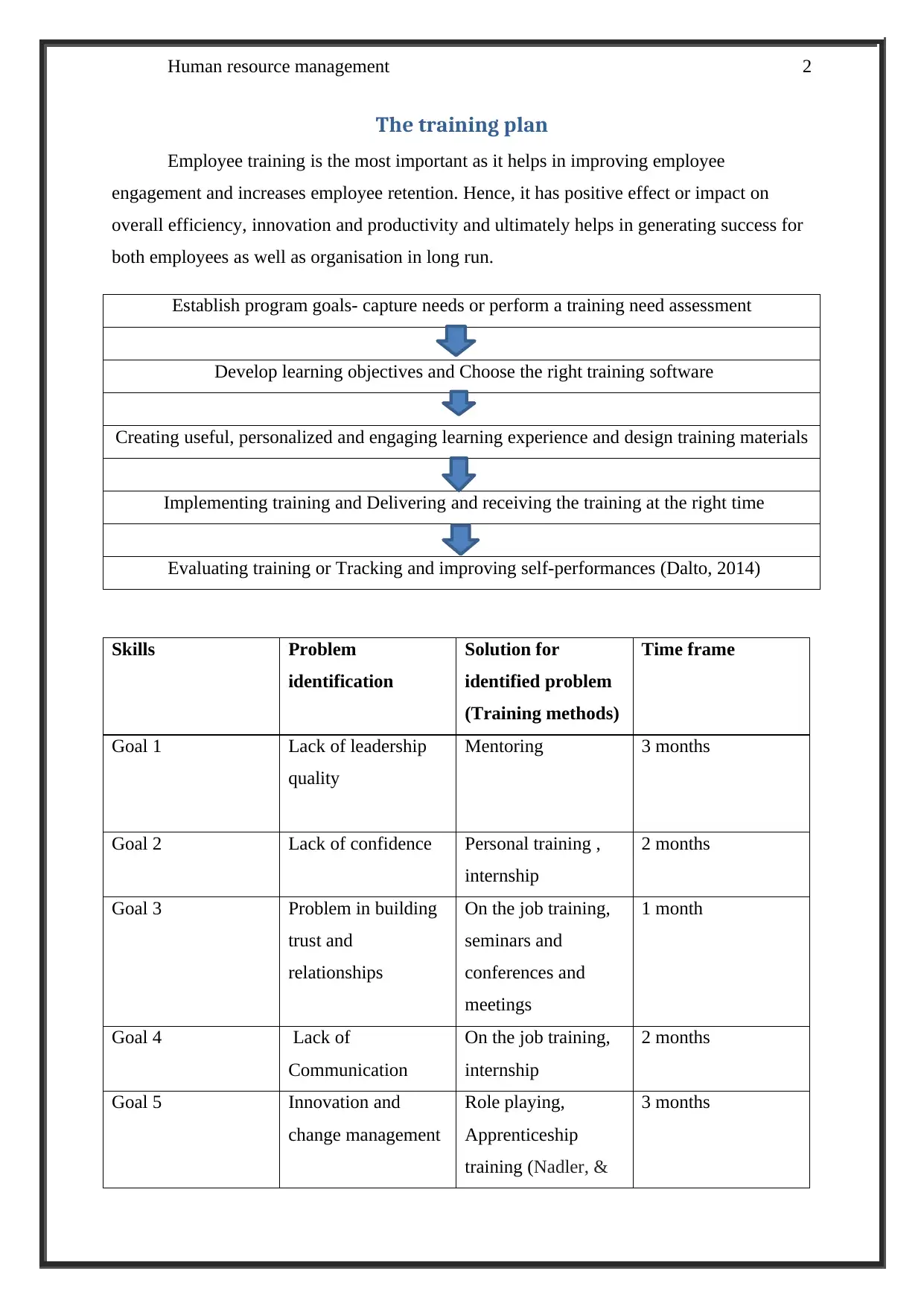
Establish program goals- capture needs or perform a training need assessment
Develop learning objectives and Choose the right training software
Creating useful, personalized and engaging learning experience and design training materials
Implementing training and Delivering and receiving the training at the right time
Evaluating training or Tracking and improving self-performances (Dalto, 2014)
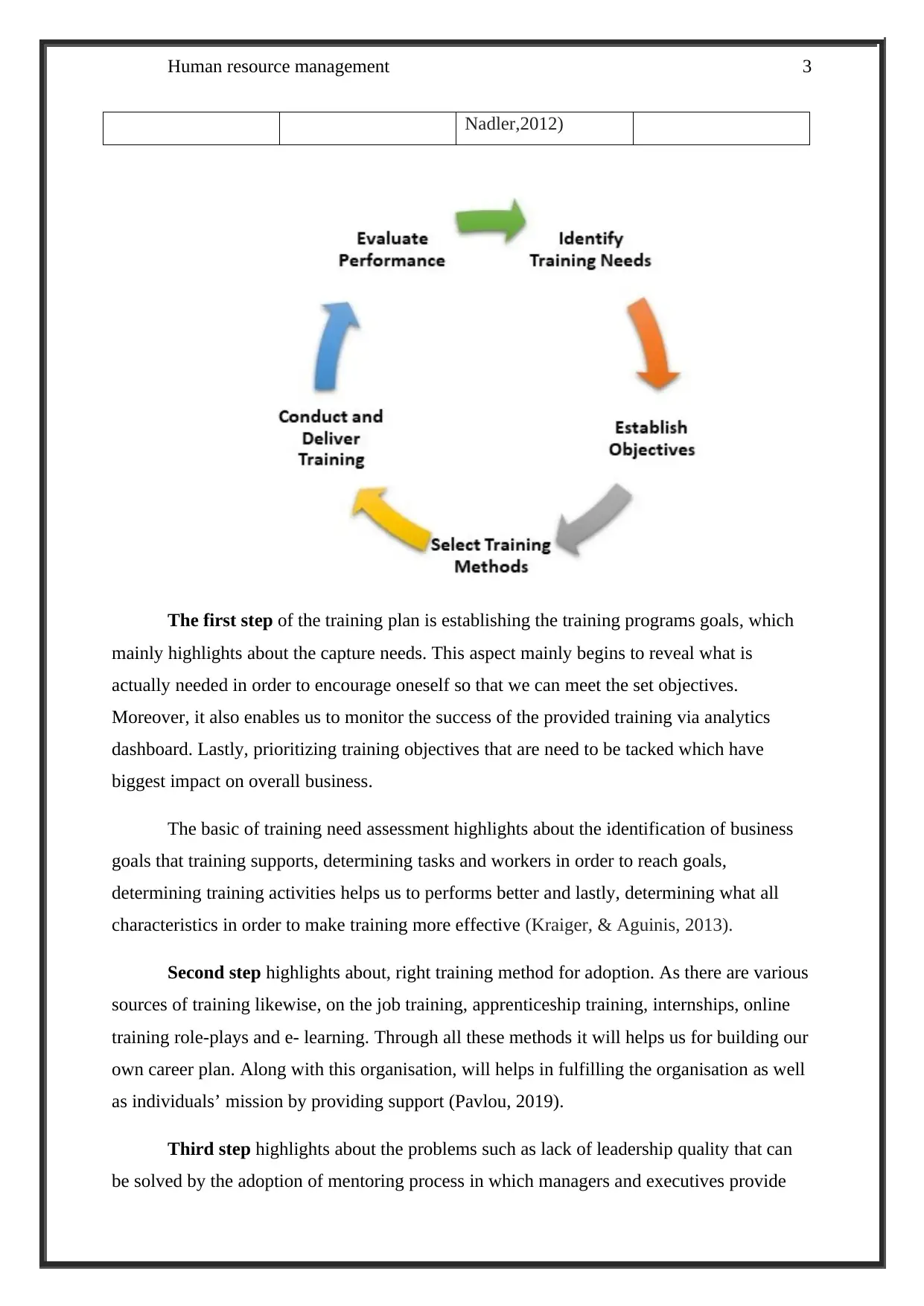
Skills Problem
identification
Solution for
identified problem
(Training methods)
Time frame
Goal 1 Lack of leadership
quality
Mentoring 3 months
Goal 2 Lack of confidence Personal training ,
internship
2 months
Goal 3 Problem in building
trust and
relationships
On the job training,
seminars and
conferences and
meetings
1 month
Goal 4 Lack of
Communication
On the job training,
internship
2 months
Goal 5 Innovation and
change management
Role playing,
Apprenticeship
training (Nadler, &
3 months
Document Page
Human resource management 3
Nadler,2012)
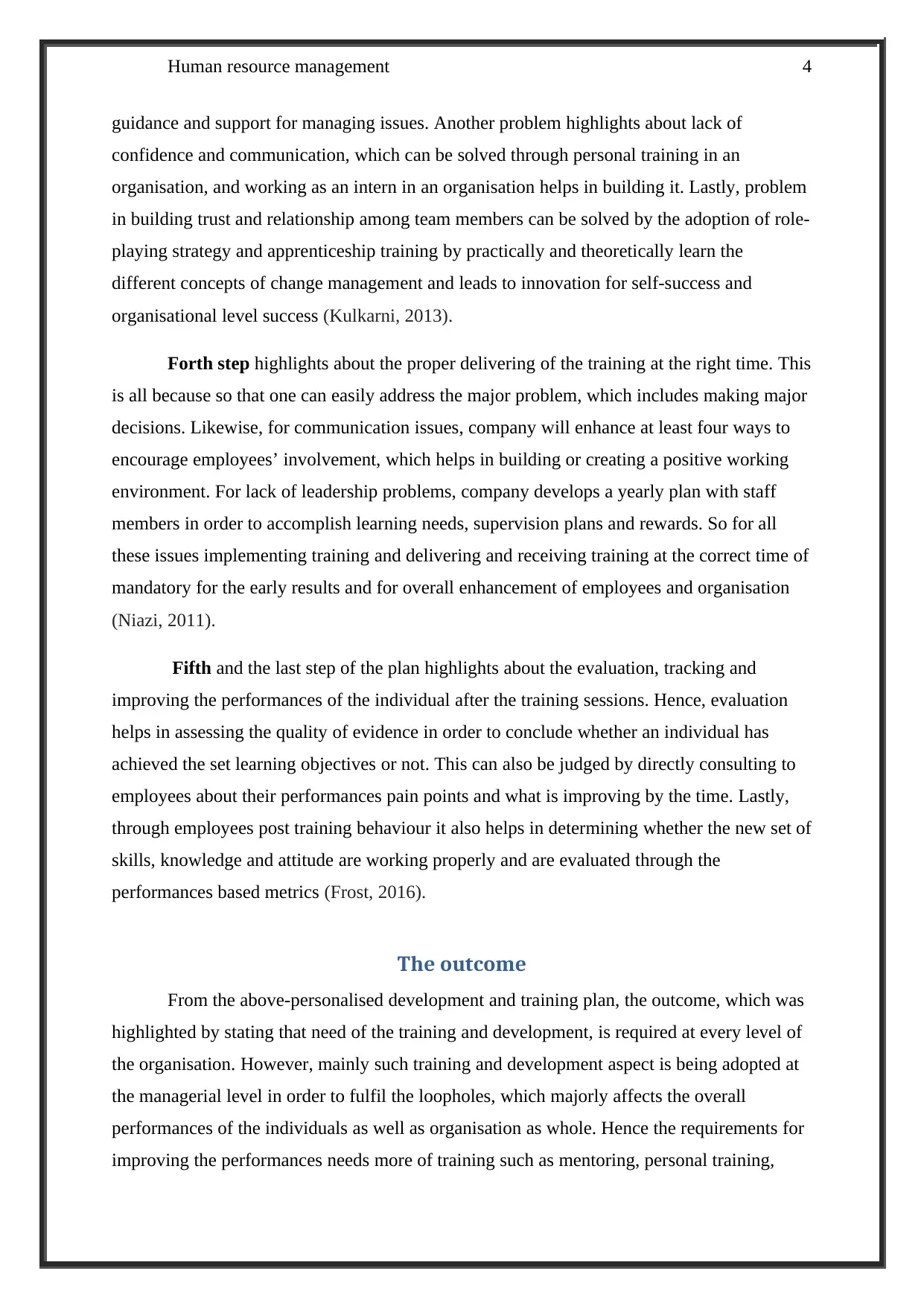
The first step of the training plan is establishing the training programs goals, which
mainly highlights about the capture needs. This aspect mainly begins to reveal what is
actually needed in order to encourage oneself so that we can meet the set objectives.
Moreover, it also enables us to monitor the success of the provided training via analytics
dashboard. Lastly, prioritizing training objectives that are need to be tacked which have
biggest impact on overall business.
The basic of training need assessment highlights about the identification of business
goals that training supports, determining tasks and workers in order to reach goals,
determining training activities helps us to performs better and lastly, determining what all
characteristics in order to make training more effective (Kraiger, & Aguinis, 2013).
Second step highlights about, right training method for adoption. As there are various
sources of training likewise, on the job training, apprenticeship training, internships, online
training role-plays and e- learning. Through all these methods it will helps us for building our
own career plan. Along with this organisation, will helps in fulfilling the organisation as well
as individuals’ mission by providing support (Pavlou, 2019).
Third step highlights about the problems such as lack of leadership quality that can
be solved by the adoption of mentoring process in which managers and executives provide
tabler-icon-diamond-filled.svg

Paraphrase This Document

Need a fresh take? Get an instant paraphrase of this document with our AI Paraphraser
Document Page
Human resource management 4
guidance and support for managing issues. Another problem highlights about lack of
confidence and communication, which can be solved through personal training in an
organisation, and working as an intern in an organisation helps in building it. Lastly, problem
in building trust and relationship among team members can be solved by the adoption of role-
playing strategy and apprenticeship training by practically and theoretically learn the
different concepts of change management and leads to innovation for self-success and
organisational level success (Kulkarni, 2013).
Forth step highlights about the proper delivering of the training at the right time. This
is all because so that one can easily address the major problem, which includes making major
decisions. Likewise, for communication issues, company will enhance at least four ways to
encourage employees’ involvement, which helps in building or creating a positive working
environment. For lack of leadership problems, company develops a yearly plan with staff
members in order to accomplish learning needs, supervision plans and rewards. So for all
these issues implementing training and delivering and receiving training at the correct time of
mandatory for the early results and for overall enhancement of employees and organisation
(Niazi, 2011).
Fifth and the last step of the plan highlights about the evaluation, tracking and
improving the performances of the individual after the training sessions. Hence, evaluation
helps in assessing the quality of evidence in order to conclude whether an individual has
achieved the set learning objectives or not. This can also be judged by directly consulting to
employees about their performances pain points and what is improving by the time. Lastly,
through employees post training behaviour it also helps in determining whether the new set of
skills, knowledge and attitude are working properly and are evaluated through the
performances based metrics (Frost, 2016).
The outcome
From the above-personalised development and training plan, the outcome, which was
highlighted by stating that need of the training and development, is required at every level of
the organisation. However, mainly such training and development aspect is being adopted at
the managerial level in order to fulfil the loopholes, which majorly affects the overall
performances of the individuals as well as organisation as whole. Hence the requirements for
improving the performances needs more of training such as mentoring, personal training,
Document Page
Human resource management 5
apprenticeship training, on the job and off the job training, seminars, and roles plays helps in
improving the employees performances and productivity and finally leads to the organisation
success.
The above mentioned key components of training helps in increasing the employees
abilities and knowledge and also strengthen the relationship that exist in between the
workforce and the members of leadership within the company. Training always begins when
it is determined that there is a particular need of it. In addition, according to need, type of
training and development sessions through plans are designed and implemented (Penfold,
2018).
Hence, above mentioned report highlights about the proper individual or personalized
planning process in terms of training for those which are considered as hurdles of the
individuals as well as organisation success. Therefore, proper planning includes who needs
the training, types of trainings, the problem with the best-suited solutions in terms of training
as well as taking follow up through evaluating performances after training sessions are
measured and on those basis employees knowledge and skills are increased as a results of the
training.
References
Cekada, T. L. (2011). Need training? Conducting an effective needs assessment. Professional
Safety, 56(12), 28.
Conceição, S. C., & Altman, B. A. (2011). Training and development process and
organizational culture change. Organization Development Journal, 29(1)
Dalto, J.(2014). How to create an effective training program: 8 step to success Retrieved
from: https://www.elucidat.com/blog/employee-training-program/
Frost, S. (2016). The importance of training & development in the workplace. Small
Business, http://smallbusiness. Chron. com/importance-trainingdevelopment-
workplace-10321.
Document Page
Human resource management 6
Kraiger, K., & Aguinis, H. (2013). Training effectiveness: Assessing training needs,
motivation, and accomplishments. In how people evaluate others in
organizations (pp. 229-246). Psychology Press.
Kulkarni, P. P. (2013). A literature review on training & development and quality of work
life. Researchers World, 4(2), 136
Nadler, Z., & Nadler, L. (2012). Designing training programs. Oxon: Routledge
Niazi, A. S. (2011). Training and development strategy and its role in organizational
performance. Journal of public Administration and Governance, 1(2).
Pavlou, C.(2019). How to build your first employee training program. Retrieved from:
https://www.elucidat.com/blog/employee-training-program/
Penfold, S.(2018). How to implement an effective employee-training program Retrieved
from: https://www.elucidat.com/blog/employee-training-program/
chevron_up_icon
1 out of 7
circle_padding
hide_on_mobile
zoom_out_icon
[object Object]