Human Resource Management Report: Australia vs. Canada HRM Practices
VerifiedAdded on 2022/10/14
|13
|2722
|458
Report
AI Summary
This report provides a comparative analysis of human resource management practices in Australia and Canada, focusing on three key areas: human rights legislation, job advertisements, and legal interviewing questions. It begins by examining the Australian Human Rights Commission Act of 1986 and the Canadian Human Rights Act, highlighting similarities in the principle of non-discrimination while noting differences in the scope and remedies provided. The report then explores job advertising practices, comparing the use of online platforms and the types of jobs in demand in each country, with a particular emphasis on the IT sector in Canada and the wage differences between the two countries. Finally, the report investigates legal interviewing questions, emphasizing the importance of avoiding discriminatory inquiries in both countries, while also noting the differing interview styles and hiring processes. The report concludes by summarizing the key findings and emphasizing the importance of understanding these differences for effective human resource management in a global context.
Running head: HRM
Human Resource Management
Name of the Student:
Name of the University:
Author Note:
Human Resource Management
Name of the Student:
Name of the University:
Author Note:

Paraphrase This Document
Need a fresh take? Get an instant paraphrase of this document with our AI Paraphraser
1
HRM
Executive Summary:
The objective of the report is to provide an insight into three aspects of human resource namely
human rights legislation, job ads and legal interviewing questions. Each of the aspects is
described with respect to the home country and Canada thereby focusing on the similarities and
the differences.
HRM
Executive Summary:
The objective of the report is to provide an insight into three aspects of human resource namely
human rights legislation, job ads and legal interviewing questions. Each of the aspects is
described with respect to the home country and Canada thereby focusing on the similarities and
the differences.
2
HRM
Table of Contents
Introduction:....................................................................................................................................3
Discussion:.......................................................................................................................................3
Human Rights Legislation...............................................................................................................3
Home Country: Australia.............................................................................................................3
Canada:.........................................................................................................................................3
Similarities:..................................................................................................................................4
Differences:..................................................................................................................................4
Job Ads............................................................................................................................................5
Canada:.........................................................................................................................................5
Similarities:..................................................................................................................................5
Differences...................................................................................................................................6
Legal Interviewing Question...........................................................................................................7
Home country: Australia..............................................................................................................7
Canada:.........................................................................................................................................7
Similarities:..................................................................................................................................7
Differences:..................................................................................................................................8
Conclusion:......................................................................................................................................9
References:....................................................................................................................................11
HRM
Table of Contents
Introduction:....................................................................................................................................3
Discussion:.......................................................................................................................................3
Human Rights Legislation...............................................................................................................3
Home Country: Australia.............................................................................................................3
Canada:.........................................................................................................................................3
Similarities:..................................................................................................................................4
Differences:..................................................................................................................................4
Job Ads............................................................................................................................................5
Canada:.........................................................................................................................................5
Similarities:..................................................................................................................................5
Differences...................................................................................................................................6
Legal Interviewing Question...........................................................................................................7
Home country: Australia..............................................................................................................7
Canada:.........................................................................................................................................7
Similarities:..................................................................................................................................7
Differences:..................................................................................................................................8
Conclusion:......................................................................................................................................9
References:....................................................................................................................................11
⊘ This is a preview!⊘
Do you want full access?
Subscribe today to unlock all pages.

Trusted by 1+ million students worldwide
3
HRM
Introduction:
The report aims at providing an overview on the three human resource aspects which
includes human rights legislation, job ads and the legal interviewing questions in the context of
home country Australia and that of Canada. The reports puts forward a description of the topic in
context of each of the countries and also highlights the differences and similarities through using
specific examples.
Discussion:
Human Rights Legislation
Home Country: Australia
In Australia, the Human Rights Legislations refers to the Australian Human Rights
Commission Act of 1986 that provides a detailed overview of the functions and power of
Australian Human Rights Commission as a commonwealth agency accountable for promoting
and monitoring human rights (Newman, 2013). The Commission also held the responsibilities
under Sex Discrimination Act 1984, Disability Discrimination Act 1992 and Age Discrimination
Act 1996.
Canada:
In Canada, the Human Rights Legislation refers to the Canadian Human Rights Act. It is
is passed by the Canadian Parliament in the year 1977 with the goal of ensuring equal
opportunities of the individuals who might be the victims of the discriminatory practice
depending on the various prohibited grounds that included sexual orientation, race, sex ,
HRM
Introduction:
The report aims at providing an overview on the three human resource aspects which
includes human rights legislation, job ads and the legal interviewing questions in the context of
home country Australia and that of Canada. The reports puts forward a description of the topic in
context of each of the countries and also highlights the differences and similarities through using
specific examples.
Discussion:
Human Rights Legislation
Home Country: Australia
In Australia, the Human Rights Legislations refers to the Australian Human Rights
Commission Act of 1986 that provides a detailed overview of the functions and power of
Australian Human Rights Commission as a commonwealth agency accountable for promoting
and monitoring human rights (Newman, 2013). The Commission also held the responsibilities
under Sex Discrimination Act 1984, Disability Discrimination Act 1992 and Age Discrimination
Act 1996.
Canada:
In Canada, the Human Rights Legislation refers to the Canadian Human Rights Act. It is
is passed by the Canadian Parliament in the year 1977 with the goal of ensuring equal
opportunities of the individuals who might be the victims of the discriminatory practice
depending on the various prohibited grounds that included sexual orientation, race, sex ,
Paraphrase This Document
Need a fresh take? Get an instant paraphrase of this document with our AI Paraphraser
4
HRM
expression or gender identity, marital status, age, creed, disability, color, religious and political
beliefs (Hammell, 2015).
Similarities:
A fundamental aspect of human rights law in both the countries is based on the idea of
non-discrimination which implied that all the human rights must be enjoyed by all irrespective of
race, disability or sex (Gerards, 2013). For example, in Australia the Sex Discrimination Act of
1984 is meant for protecting the people from the various unfair treatments based on the sexual
orientation, sex, intersex status, gender identity, relationship or marital status, breastfeeding and
pregnancy. It further provides protection to worker having family responsibilities and considers
sexual harassment against law.
Besides, interpretation of the legislation takes place in the courts of both the countries in
order to determine that they have been infringed.
Differences:
There are certain differences that seem to exist between the between the Human Rights
Legislation of Canada and that of Australia. For example, in Canada, a charter is designed by
adopting thirty four rights from Universal Declaration of the Human Rights. The list is designed
to specifically and extensively protect rights of Canadian people. Australia on the other hand has
only five express rights that do not adequately ensure the safeguarding of rights.
In Canada, when an individual right is infringed, the court determines the damage
through monetary compensation. Besides, in Canada when the evidence is considered illegal it is
not used in trial. The Supreme Court might even declare it as unacceptable thereby allowing the
parliament an opportunity of amending the legislation. In Australia there lie no such remedies for
HRM
expression or gender identity, marital status, age, creed, disability, color, religious and political
beliefs (Hammell, 2015).
Similarities:
A fundamental aspect of human rights law in both the countries is based on the idea of
non-discrimination which implied that all the human rights must be enjoyed by all irrespective of
race, disability or sex (Gerards, 2013). For example, in Australia the Sex Discrimination Act of
1984 is meant for protecting the people from the various unfair treatments based on the sexual
orientation, sex, intersex status, gender identity, relationship or marital status, breastfeeding and
pregnancy. It further provides protection to worker having family responsibilities and considers
sexual harassment against law.
Besides, interpretation of the legislation takes place in the courts of both the countries in
order to determine that they have been infringed.
Differences:
There are certain differences that seem to exist between the between the Human Rights
Legislation of Canada and that of Australia. For example, in Canada, a charter is designed by
adopting thirty four rights from Universal Declaration of the Human Rights. The list is designed
to specifically and extensively protect rights of Canadian people. Australia on the other hand has
only five express rights that do not adequately ensure the safeguarding of rights.
In Canada, when an individual right is infringed, the court determines the damage
through monetary compensation. Besides, in Canada when the evidence is considered illegal it is
not used in trial. The Supreme Court might even declare it as unacceptable thereby allowing the
parliament an opportunity of amending the legislation. In Australia there lie no such remedies for
5
HRM
the parties. Once it is declared by the High Court that the amendments or the legislation infringes
the rights then it is declared as invalid with no remedies offered to the parties.
Job Ads
Home Country: Australia
The job advertisements in Australia are available in Newspapers as well as on the
internet. Understanding the job requirement is crucial while searching for job (Ahsan & Khan,
2013). It is to be noted that the stronger job prospects are put forward to the young professionals
by the construction, health care and the technology industry of Australia. Applicants must apply
for a job before closing date as Australian employers does not entertain late applications.
Canada:
Job advertisements in Canada are primarily done online since the employers consider it
the most viable option for attracting clients (Kim, Warga & Moen, 2013). Some of the sites
where the job advertisements are posted are WOW Jobs and Indeed Canada. The present job
market of Canada seems to be very competitive.
Similarities:
The elements of the job ads remain similar for both the countries. For example, some of
the elements include (Henricks & Henricks-Lepp, 2014):
The description of the job role
Mentioning whether the offered job is part time, full time, fixed term or casual as per the
contract.
The necessary skills and qualifications
The necessary work experience required
HRM
the parties. Once it is declared by the High Court that the amendments or the legislation infringes
the rights then it is declared as invalid with no remedies offered to the parties.
Job Ads
Home Country: Australia
The job advertisements in Australia are available in Newspapers as well as on the
internet. Understanding the job requirement is crucial while searching for job (Ahsan & Khan,
2013). It is to be noted that the stronger job prospects are put forward to the young professionals
by the construction, health care and the technology industry of Australia. Applicants must apply
for a job before closing date as Australian employers does not entertain late applications.
Canada:
Job advertisements in Canada are primarily done online since the employers consider it
the most viable option for attracting clients (Kim, Warga & Moen, 2013). Some of the sites
where the job advertisements are posted are WOW Jobs and Indeed Canada. The present job
market of Canada seems to be very competitive.
Similarities:
The elements of the job ads remain similar for both the countries. For example, some of
the elements include (Henricks & Henricks-Lepp, 2014):
The description of the job role
Mentioning whether the offered job is part time, full time, fixed term or casual as per the
contract.
The necessary skills and qualifications
The necessary work experience required
⊘ This is a preview!⊘
Do you want full access?
Subscribe today to unlock all pages.
Trusted by 1+ million students worldwide
6
HRM
Description about the employer
The ways of application and addresses to whom the job application needed to be sent
Point of contact for additional information
Closure date for the applications.
There is another similarity between the job advertisements in both the countries. They both
are available online through various websites. For example, in Australia the online job
advertisements include a downloadable link that includes a detailed description of the position.
Some of the job advertisement site of Australia includes APS Jobs, Australian job search and
Career one, Career Jet, Glassdoor and LinkedIn. On the other hand, some of the online job
posting sites of Canada includes Working.com, Jobs.ca, Indeed Canada, Hot Jobs in Canada and
Career Jet.
It is also to be noted that both Canada and Australia have a higher demand of jobs within the
trade industry. Therefore job profiles related to plumber, electrician, laborer or carpenter are able
to find job easily. In both the countries, the hospitality industry also acts as a good place for
beginning the job hunt.
Differences
As far as the differences are concerned, Canada has a larger market for Information
Technology (IT) in comparison to Australia which has a smaller IT market (Luftman et al.,
2013). Therefore, job advertisements various in both countries. For example, Canada is more
inclined towards the IT related jobs. Besides, Canada has a huge base for manufacturing in
comparison to Australia and hence it has better wages for blue collar jobs in comparison to
HRM
Description about the employer
The ways of application and addresses to whom the job application needed to be sent
Point of contact for additional information
Closure date for the applications.
There is another similarity between the job advertisements in both the countries. They both
are available online through various websites. For example, in Australia the online job
advertisements include a downloadable link that includes a detailed description of the position.
Some of the job advertisement site of Australia includes APS Jobs, Australian job search and
Career one, Career Jet, Glassdoor and LinkedIn. On the other hand, some of the online job
posting sites of Canada includes Working.com, Jobs.ca, Indeed Canada, Hot Jobs in Canada and
Career Jet.
It is also to be noted that both Canada and Australia have a higher demand of jobs within the
trade industry. Therefore job profiles related to plumber, electrician, laborer or carpenter are able
to find job easily. In both the countries, the hospitality industry also acts as a good place for
beginning the job hunt.
Differences
As far as the differences are concerned, Canada has a larger market for Information
Technology (IT) in comparison to Australia which has a smaller IT market (Luftman et al.,
2013). Therefore, job advertisements various in both countries. For example, Canada is more
inclined towards the IT related jobs. Besides, Canada has a huge base for manufacturing in
comparison to Australia and hence it has better wages for blue collar jobs in comparison to
Paraphrase This Document
Need a fresh take? Get an instant paraphrase of this document with our AI Paraphraser
7
HRM
Australia that pays higher for the white collar jobs. Nevertheless, the general wage in Canada is
CAD$14.00 on a per hourly basis while that in Australia is AUD$17.70 per hour.
Legal Interviewing Question
Home country: Australia
In Australia applicants are asked question that does not disadvantage people and leads to
discrimination. Hence, for an interview in an Australian firm the candidate should highlight their
success, become knowledgeable about their whereabouts, frame their experience, have the ability
to sell the soft skills and dress up formally (Considine, O'Sullivan & Nguyen, 2014).
Canada:
In Canada, applicants are never asked any kind of questions that leads to discrimination.
However, for a job interview in Canadian firm applicants must undertake practice of non verbal
communication and accordingly dress for the company or job. They should ensure that they are
good listeners without talking much. The applicants must not be too familiar and should make
use of appropriate language.
Similarities:
In both the countries employers does not try to extract discriminatory and unnecessary
information from the applicants while preparing the interview questions (Kerekes et a., 2013).
Otherwise, it might result in discrimination if the employers have to rely on such information in
denying a job to a candidate. For example when employers needed to derive information from
disable candidates then it is done in a manner to ensure whether he/she would be able to fulfill
the requirements of the job, assess the safety and the health risk and identify the adjustments to
workplace.
HRM
Australia that pays higher for the white collar jobs. Nevertheless, the general wage in Canada is
CAD$14.00 on a per hourly basis while that in Australia is AUD$17.70 per hour.
Legal Interviewing Question
Home country: Australia
In Australia applicants are asked question that does not disadvantage people and leads to
discrimination. Hence, for an interview in an Australian firm the candidate should highlight their
success, become knowledgeable about their whereabouts, frame their experience, have the ability
to sell the soft skills and dress up formally (Considine, O'Sullivan & Nguyen, 2014).
Canada:
In Canada, applicants are never asked any kind of questions that leads to discrimination.
However, for a job interview in Canadian firm applicants must undertake practice of non verbal
communication and accordingly dress for the company or job. They should ensure that they are
good listeners without talking much. The applicants must not be too familiar and should make
use of appropriate language.
Similarities:
In both the countries employers does not try to extract discriminatory and unnecessary
information from the applicants while preparing the interview questions (Kerekes et a., 2013).
Otherwise, it might result in discrimination if the employers have to rely on such information in
denying a job to a candidate. For example when employers needed to derive information from
disable candidates then it is done in a manner to ensure whether he/she would be able to fulfill
the requirements of the job, assess the safety and the health risk and identify the adjustments to
workplace.
8
HRM
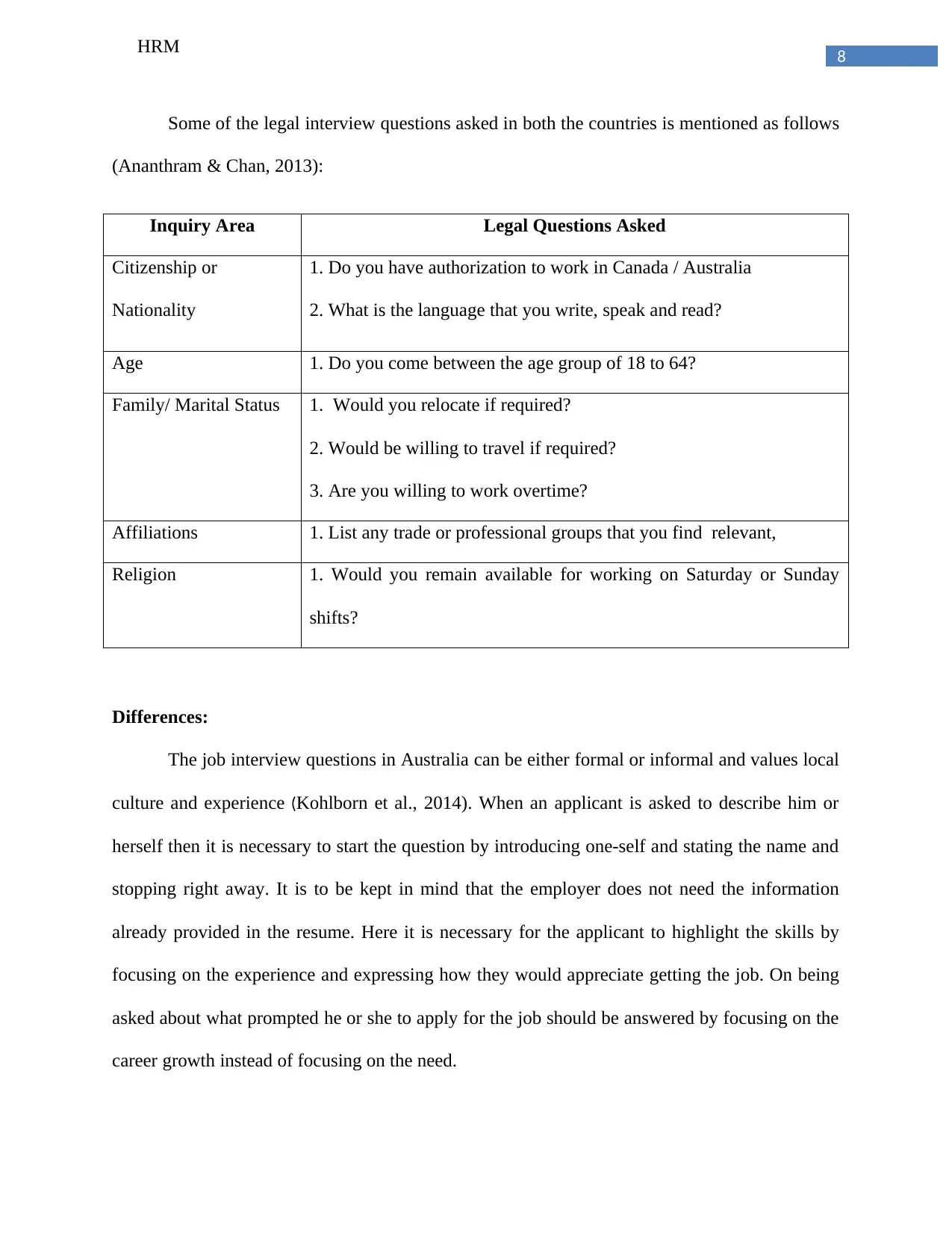
Some of the legal interview questions asked in both the countries is mentioned as follows
(Ananthram & Chan, 2013):
Inquiry Area Legal Questions Asked
Citizenship or
Nationality
1. Do you have authorization to work in Canada / Australia
2. What is the language that you write, speak and read?
Age 1. Do you come between the age group of 18 to 64?
Family/ Marital Status 1. Would you relocate if required?
2. Would be willing to travel if required?
3. Are you willing to work overtime?
Affiliations 1. List any trade or professional groups that you find relevant,
Religion 1. Would you remain available for working on Saturday or Sunday
shifts?
Differences:
The job interview questions in Australia can be either formal or informal and values local
culture and experience (Kohlborn et al., 2014). When an applicant is asked to describe him or
herself then it is necessary to start the question by introducing one-self and stating the name and
stopping right away. It is to be kept in mind that the employer does not need the information
already provided in the resume. Here it is necessary for the applicant to highlight the skills by
focusing on the experience and expressing how they would appreciate getting the job. On being
asked about what prompted he or she to apply for the job should be answered by focusing on the
career growth instead of focusing on the need.
HRM
Some of the legal interview questions asked in both the countries is mentioned as follows
(Ananthram & Chan, 2013):
Inquiry Area Legal Questions Asked
Citizenship or
Nationality
1. Do you have authorization to work in Canada / Australia
2. What is the language that you write, speak and read?
Age 1. Do you come between the age group of 18 to 64?
Family/ Marital Status 1. Would you relocate if required?
2. Would be willing to travel if required?
3. Are you willing to work overtime?
Affiliations 1. List any trade or professional groups that you find relevant,
Religion 1. Would you remain available for working on Saturday or Sunday
shifts?
Differences:
The job interview questions in Australia can be either formal or informal and values local
culture and experience (Kohlborn et al., 2014). When an applicant is asked to describe him or
herself then it is necessary to start the question by introducing one-self and stating the name and
stopping right away. It is to be kept in mind that the employer does not need the information
already provided in the resume. Here it is necessary for the applicant to highlight the skills by
focusing on the experience and expressing how they would appreciate getting the job. On being
asked about what prompted he or she to apply for the job should be answered by focusing on the
career growth instead of focusing on the need.
⊘ This is a preview!⊘
Do you want full access?
Subscribe today to unlock all pages.
Trusted by 1+ million students worldwide
9
HRM
On the other hand, the interview questions in Canada are more stressful and nerve
racking (Budworth, Latham & Manroop, 2015). It is necessary to be thoughtful before
answering a question. It is also necessary to make it personal and back up the answers with
personal examples and attributes. When asked to describe oneself then the candidate should
answer it by focusing on the key attributes, qualification, past career history and the skills that
are most relevant for the job. Besides, on being asked about the achievements, the applicant
should choose an achievement that is recent and work related. The applicant should also include
the skills that he/she used for reaching the achievement and to what extent the company gained
from accomplishing the achievement. For example one could say, “I managed and implemented
a new channel of communication for the client base that helped in improving the sales figures
and the companies grade of service”.
Organizations in Australia have a slower hiring process which makes them loose the top
candidates compared to that of Canada. Close to 57 percent of the Australian human resource
manager lost eligible and qualified candidate due to the lengthy process of hiring (Connolly &
Gustafsson, 2013). It has been found that the duration of hiring process rose to 66 percent in
larger organization. The key risk of a lengthier recruitment process lay in losing eligible
candidates the competitors. Six to ten percent of the HR managers are of the opinion that they
lost a qualified candidate during the process of hiring (Carroll & Tani, 2015). Losing candidates
during hiring process have been a common aspect in larger organizations. On the other hand, the
hiring process of Canada is more systematic.
HRM
On the other hand, the interview questions in Canada are more stressful and nerve
racking (Budworth, Latham & Manroop, 2015). It is necessary to be thoughtful before
answering a question. It is also necessary to make it personal and back up the answers with
personal examples and attributes. When asked to describe oneself then the candidate should
answer it by focusing on the key attributes, qualification, past career history and the skills that
are most relevant for the job. Besides, on being asked about the achievements, the applicant
should choose an achievement that is recent and work related. The applicant should also include
the skills that he/she used for reaching the achievement and to what extent the company gained
from accomplishing the achievement. For example one could say, “I managed and implemented
a new channel of communication for the client base that helped in improving the sales figures
and the companies grade of service”.
Organizations in Australia have a slower hiring process which makes them loose the top
candidates compared to that of Canada. Close to 57 percent of the Australian human resource
manager lost eligible and qualified candidate due to the lengthy process of hiring (Connolly &
Gustafsson, 2013). It has been found that the duration of hiring process rose to 66 percent in
larger organization. The key risk of a lengthier recruitment process lay in losing eligible
candidates the competitors. Six to ten percent of the HR managers are of the opinion that they
lost a qualified candidate during the process of hiring (Carroll & Tani, 2015). Losing candidates
during hiring process have been a common aspect in larger organizations. On the other hand, the
hiring process of Canada is more systematic.
Paraphrase This Document
Need a fresh take? Get an instant paraphrase of this document with our AI Paraphraser
10
HRM
Conclusion:
On a concluding note, it can be said that, human rights legislations is a crucial aspect of
human resource. The report discusses about the aspect of the human rights legislation in
Australia and Canada and also focuses on the similarities and the differences. The report also
portrays how job ads are different in Australia and Canada and how in Canada employers prefer
the online medium for attracting the applicants. As far as the interviewing questions are
concerned both the countries focus on asking the applicants questions that are not offensive and
does not lead to any kind of discrimination. However, the approaches of interview and ways of
answering the same set of questions are different in both the countries.
HRM
Conclusion:
On a concluding note, it can be said that, human rights legislations is a crucial aspect of
human resource. The report discusses about the aspect of the human rights legislation in
Australia and Canada and also focuses on the similarities and the differences. The report also
portrays how job ads are different in Australia and Canada and how in Canada employers prefer
the online medium for attracting the applicants. As far as the interviewing questions are
concerned both the countries focus on asking the applicants questions that are not offensive and
does not lead to any kind of discrimination. However, the approaches of interview and ways of
answering the same set of questions are different in both the countries.
11
HRM
References:
Ahsan, K., Ho, M., & Khan, S. (2013). Recruiting project managers: A comparative analysis of
competencies and recruitment signals from job advertisements. Project Management
Journal, 44(5), 36-54.
Ananthram, S., & Chan, C. (2013). Challenges and strategies for global human resource
executives: Perspectives from Canada and the United States. European Management
Journal, 31(3), 223-233.
Budworth, M. H., Latham, G. P., & Manroop, L. (2015). Looking forward to performance
improvement: A field test of the feedforward interview for performance
management. Human Resource Management, 54(1), 45-54.
Carroll, D., & Tani, M. (2015). Job search as a determinant of graduate over-education: evidence
from Australia. Education Economics, 23(5), 631-644.
Connolly, E., & Gustafsson, L. (2013). Australian productivity growth: trends and
determinants. Australian Economic Review, 46(4), 473-482.
Considine, M., O'Sullivan, S., & Nguyen, P. (2014). New public management and welfare-to-
work in Australia: Comparing the reform agendas of the ALP and the
Coalition. Australian Journal of Political Science, 49(3), 469-485.
Gerards, J. (2013). The discrimination grounds of article 14 of the European convention on
Human Rights. Human Rights Law Review, 13(1), 99-124.
Hammell, K. W. (2015). Participation and occupation: The need for a human rights perspective.
HRM
References:
Ahsan, K., Ho, M., & Khan, S. (2013). Recruiting project managers: A comparative analysis of
competencies and recruitment signals from job advertisements. Project Management
Journal, 44(5), 36-54.
Ananthram, S., & Chan, C. (2013). Challenges and strategies for global human resource
executives: Perspectives from Canada and the United States. European Management
Journal, 31(3), 223-233.
Budworth, M. H., Latham, G. P., & Manroop, L. (2015). Looking forward to performance
improvement: A field test of the feedforward interview for performance
management. Human Resource Management, 54(1), 45-54.
Carroll, D., & Tani, M. (2015). Job search as a determinant of graduate over-education: evidence
from Australia. Education Economics, 23(5), 631-644.
Connolly, E., & Gustafsson, L. (2013). Australian productivity growth: trends and
determinants. Australian Economic Review, 46(4), 473-482.
Considine, M., O'Sullivan, S., & Nguyen, P. (2014). New public management and welfare-to-
work in Australia: Comparing the reform agendas of the ALP and the
Coalition. Australian Journal of Political Science, 49(3), 469-485.
Gerards, J. (2013). The discrimination grounds of article 14 of the European convention on
Human Rights. Human Rights Law Review, 13(1), 99-124.
Hammell, K. W. (2015). Participation and occupation: The need for a human rights perspective.
⊘ This is a preview!⊘
Do you want full access?
Subscribe today to unlock all pages.
Trusted by 1+ million students worldwide

1 out of 13


Related Documents


Your All-in-One AI-Powered Toolkit for Academic Success.
+13062052269
info@desklib.com
Available 24*7 on WhatsApp / Email
![[object Object]](/_next/static/media/star-bottom.7253800d.svg)
Unlock your academic potential
Copyright © 2020–2026 A2Z Services. All Rights Reserved. Developed and managed by ZUCOL.