Evaluating HRM's Impact on Business Performance: Key Concepts

Verified

Added on  2022/08/25

|4
|756
|30
Essay
AI Summary
This essay delves into the strategic link between Human Resource Management (HRM) and business performance, addressing the challenge of understanding this complex relationship. It examines three perspectives—universalistic, contingency, and configurational—proposed by Bamberger, Biron, and Meshoulam (2014) for studying HR strategies, policies, and practices. The universalistic approach suggests adopting best practices to improve financial performance, while the contingency theory emphasizes customizing practices to suit individual organizational needs. The configurational approach seeks to merge both, measuring and addressing the shortcomings of each. The essay argues that a combination of all three perspectives is crucial for validating the concept and achieving organizational success, particularly highlighting the configurational approach as the most precise due to its ability to employ best practices while customizing others to meet specific business needs, ultimately validating the link between HRM and business performance. Desklib provides students access to similar essays and solved assignments.
Document Page
Running head: HUMAN RESOURCE MANAGEMENT
HUMAN RESOURCE MANAGEMENT
Name of the Student
Name of the University
Authors note
tabler-icon-diamond-filled.svg

Paraphrase This Document

Need a fresh take? Get an instant paraphrase of this document with our AI Paraphraser
Document Page
1
HUMAN RESOURCE MANAGEMENT
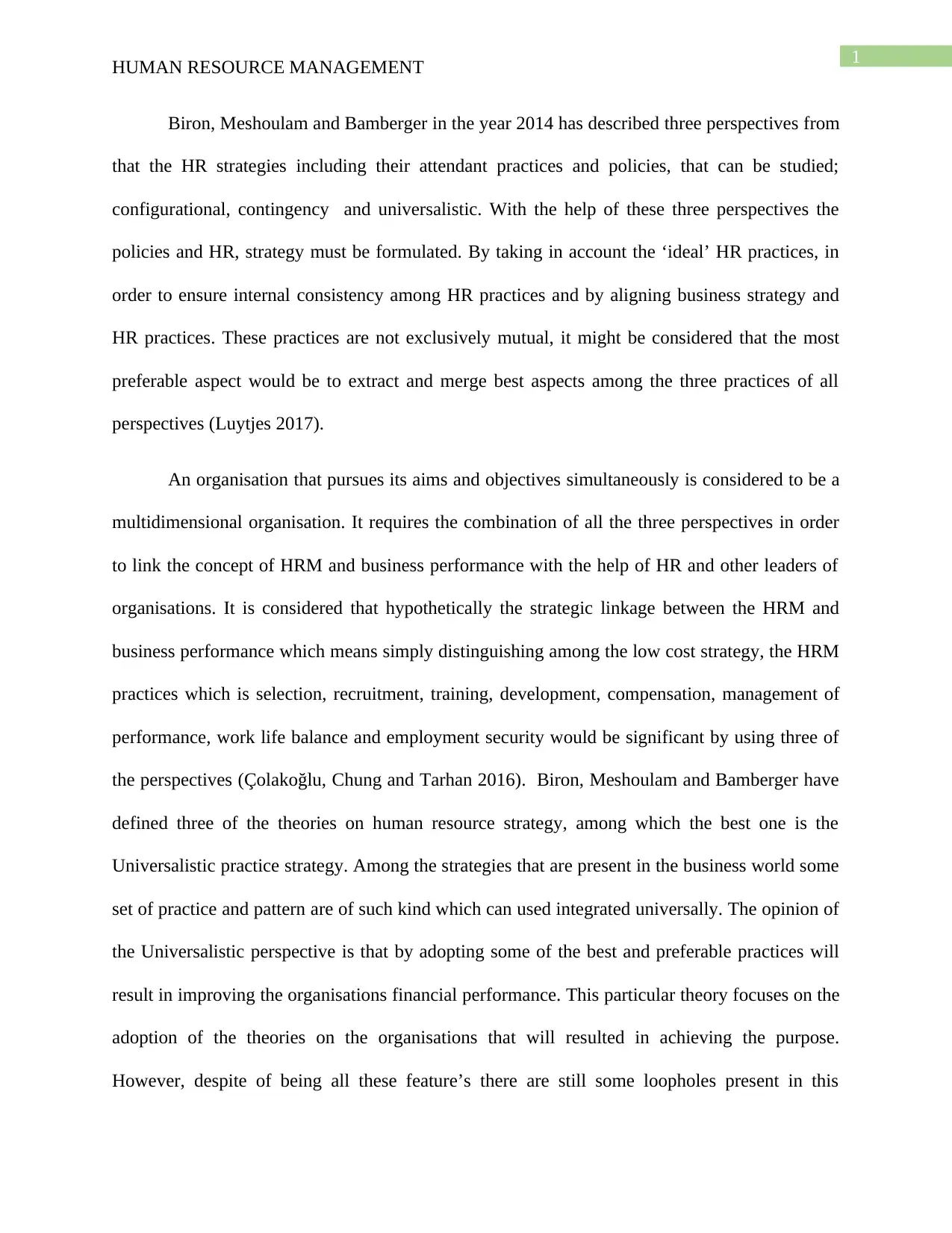
Biron, Meshoulam and Bamberger in the year 2014 has described three perspectives from
that the HR strategies including their attendant practices and policies, that can be studied;
configurational, contingency and universalistic. With the help of these three perspectives the
policies and HR, strategy must be formulated. By taking in account the ‘ideal’ HR practices, in
order to ensure internal consistency among HR practices and by aligning business strategy and
HR practices. These practices are not exclusively mutual, it might be considered that the most
preferable aspect would be to extract and merge best aspects among the three practices of all
perspectives (Luytjes 2017).
An organisation that pursues its aims and objectives simultaneously is considered to be a
multidimensional organisation. It requires the combination of all the three perspectives in order
to link the concept of HRM and business performance with the help of HR and other leaders of
organisations. It is considered that hypothetically the strategic linkage between the HRM and
business performance which means simply distinguishing among the low cost strategy, the HRM
practices which is selection, recruitment, training, development, compensation, management of
performance, work life balance and employment security would be significant by using three of
the perspectives (Çolakoğlu, Chung and Tarhan 2016). Biron, Meshoulam and Bamberger have
defined three of the theories on human resource strategy, among which the best one is the
Universalistic practice strategy. Among the strategies that are present in the business world some
set of practice and pattern are of such kind which can used integrated universally. The opinion of
the Universalistic perspective is that by adopting some of the best and preferable practices will
result in improving the organisations financial performance. This particular theory focuses on the
adoption of the theories on the organisations that will resulted in achieving the purpose.
However, despite of being all these feature’s there are still some loopholes present in this
Document Page
2
HUMAN RESOURCE MANAGEMENT
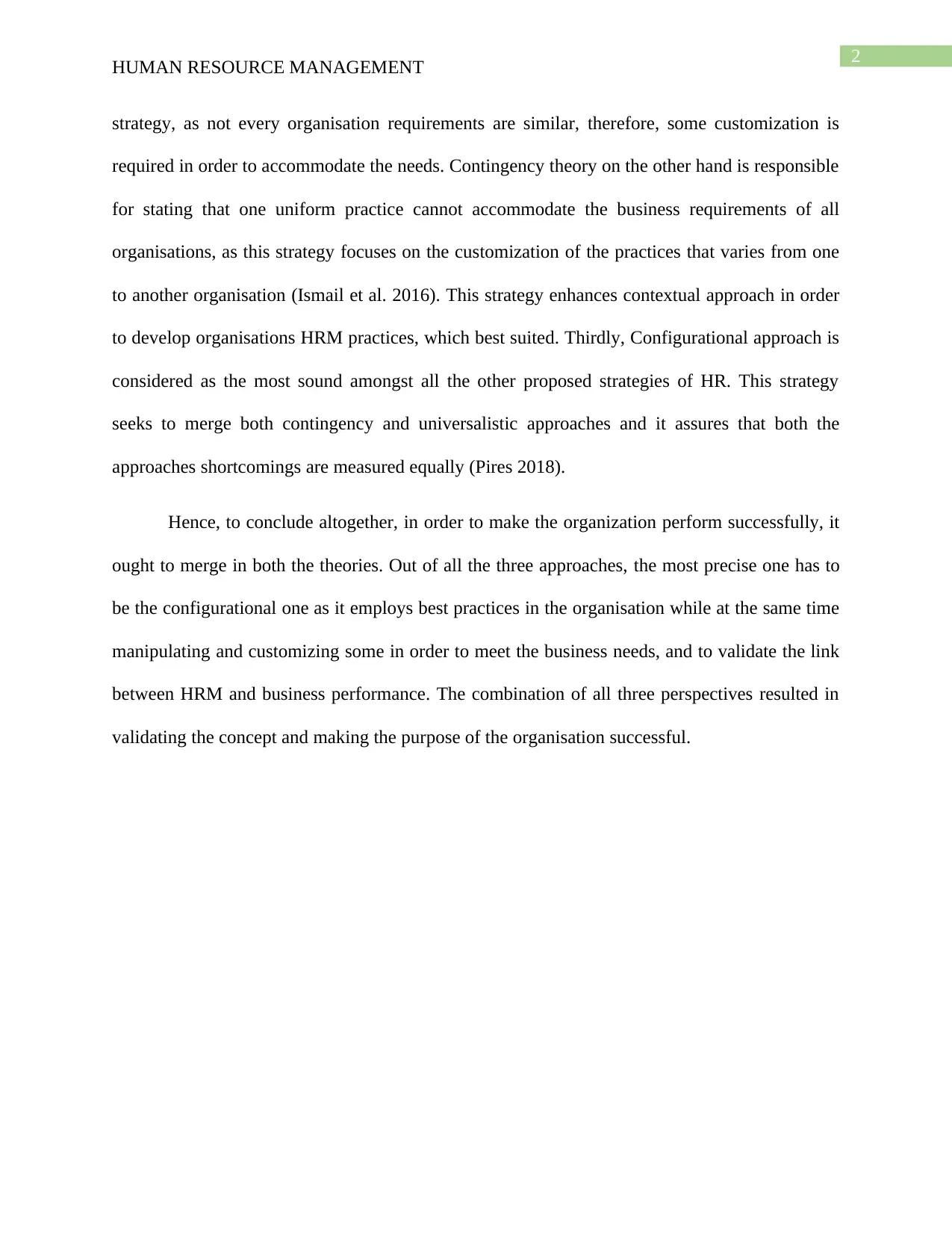
strategy, as not every organisation requirements are similar, therefore, some customization is
required in order to accommodate the needs. Contingency theory on the other hand is responsible
for stating that one uniform practice cannot accommodate the business requirements of all
organisations, as this strategy focuses on the customization of the practices that varies from one
to another organisation (Ismail et al. 2016). This strategy enhances contextual approach in order
to develop organisations HRM practices, which best suited. Thirdly, Configurational approach is
considered as the most sound amongst all the other proposed strategies of HR. This strategy
seeks to merge both contingency and universalistic approaches and it assures that both the
approaches shortcomings are measured equally (Pires 2018).
Hence, to conclude altogether, in order to make the organization perform successfully, it
ought to merge in both the theories. Out of all the three approaches, the most precise one has to
be the configurational one as it employs best practices in the organisation while at the same time
manipulating and customizing some in order to meet the business needs, and to validate the link
between HRM and business performance. The combination of all three perspectives resulted in
validating the concept and making the purpose of the organisation successful.
Document Page
3
HUMAN RESOURCE MANAGEMENT
References:
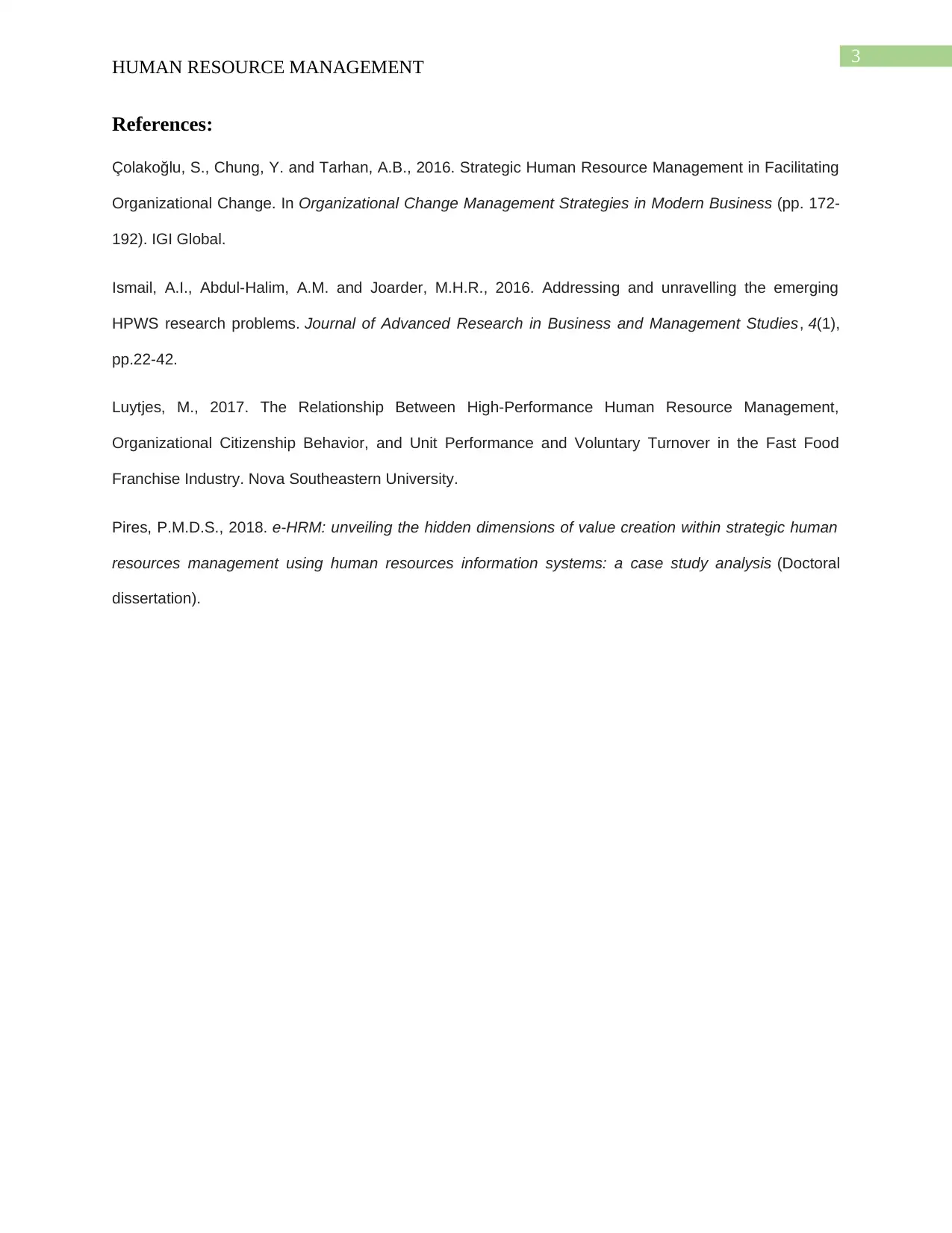
Çolakoğlu, S., Chung, Y. and Tarhan, A.B., 2016. Strategic Human Resource Management in Facilitating
Organizational Change. In Organizational Change Management Strategies in Modern Business (pp. 172-
192). IGI Global.
Ismail, A.I., Abdul-Halim, A.M. and Joarder, M.H.R., 2016. Addressing and unravelling the emerging
HPWS research problems. Journal of Advanced Research in Business and Management Studies, 4(1),
pp.22-42.
Luytjes, M., 2017. The Relationship Between High-Performance Human Resource Management,
Organizational Citizenship Behavior, and Unit Performance and Voluntary Turnover in the Fast Food
Franchise Industry. Nova Southeastern University.
Pires, P.M.D.S., 2018. e-HRM: unveiling the hidden dimensions of value creation within strategic human
resources management using human resources information systems: a case study analysis (Doctoral
dissertation).
chevron_up_icon
1 out of 4
circle_padding
hide_on_mobile
zoom_out_icon
[object Object]