HRM3014: Short Answer Questions - HRM and Leadership at Rio Tinto
VerifiedAdded on 2021/02/20
|13
|3892
|66
Homework Assignment
AI Summary
This assignment provides detailed answers to six short answer questions from the HRM3014 course, focusing on key aspects of human resource management and leadership within the context of Rio Tinto. The questions cover a range of topics including stereotype threat and how managers can reduce it, the ways in which biases and stereotypes about women manifest in the workplace, the meaning of stigma and its influence on the acceptance of employees with disabilities, the effectiveness of gender quotas for boards of directors, the impact of fault lines on diverse work groups, and the use of diversity initiatives in recruitment advertising. The answers draw upon academic research and provide practical insights into managing diversity, promoting inclusivity, and fostering effective leadership practices within organizations. The assignment offers a comprehensive overview of critical HRM challenges and solutions, making it a valuable resource for students studying human resource management.

HRM3014 Short Answer
Questions (you must
answer 6 from the 8
questions)
Questions (you must
answer 6 from the 8
questions)

Paraphrase This Document
Need a fresh take? Get an instant paraphrase of this document with our AI Paraphraser
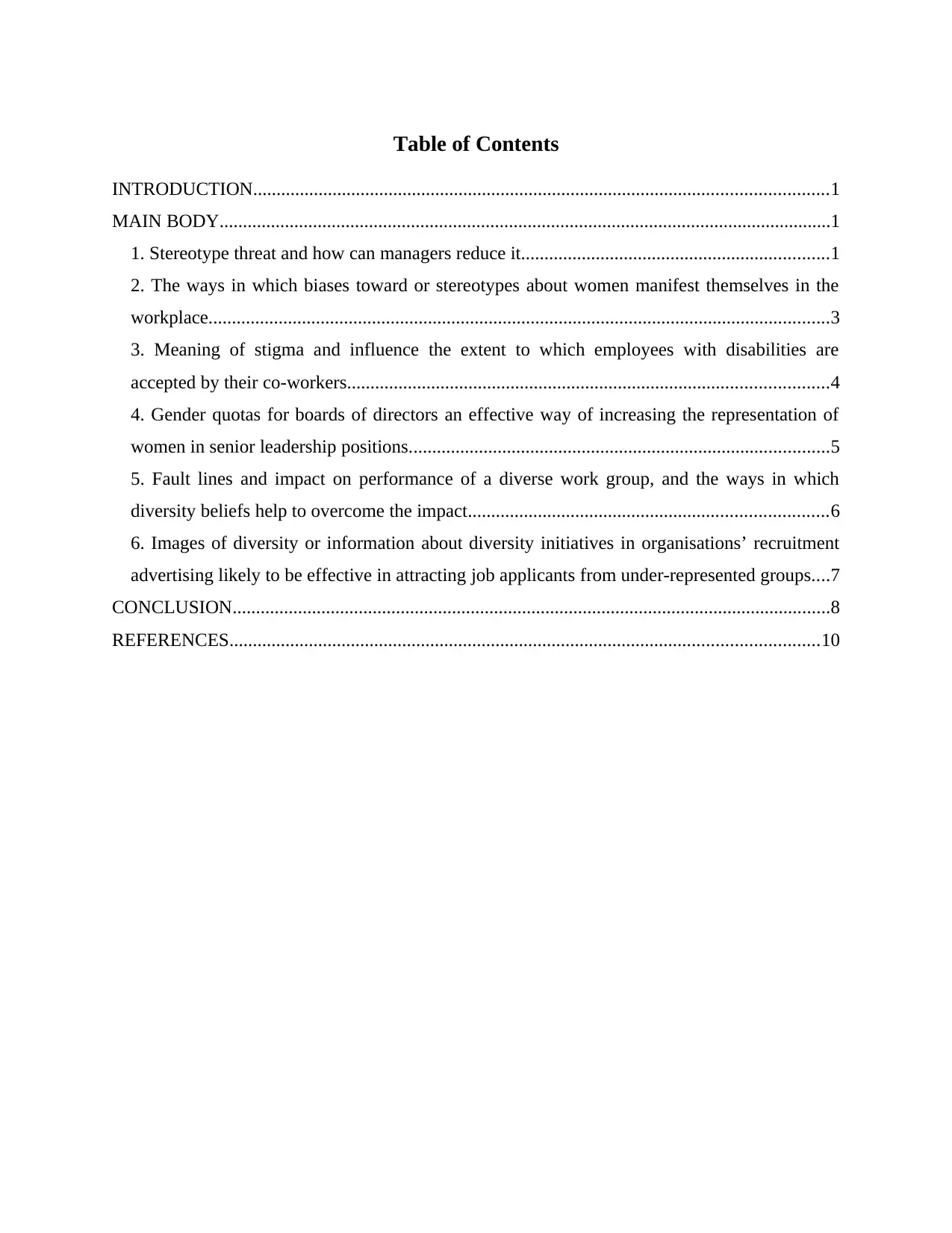
Table of Contents
INTRODUCTION...........................................................................................................................1
MAIN BODY...................................................................................................................................1
1. Stereotype threat and how can managers reduce it..................................................................1
2. The ways in which biases toward or stereotypes about women manifest themselves in the
workplace.....................................................................................................................................3
3. Meaning of stigma and influence the extent to which employees with disabilities are
accepted by their co-workers.......................................................................................................4
4. Gender quotas for boards of directors an effective way of increasing the representation of
women in senior leadership positions..........................................................................................5
5. Fault lines and impact on performance of a diverse work group, and the ways in which
diversity beliefs help to overcome the impact.............................................................................6
6. Images of diversity or information about diversity initiatives in organisations’ recruitment
advertising likely to be effective in attracting job applicants from under-represented groups....7
CONCLUSION................................................................................................................................8
REFERENCES..............................................................................................................................10
INTRODUCTION...........................................................................................................................1
MAIN BODY...................................................................................................................................1
1. Stereotype threat and how can managers reduce it..................................................................1
2. The ways in which biases toward or stereotypes about women manifest themselves in the
workplace.....................................................................................................................................3
3. Meaning of stigma and influence the extent to which employees with disabilities are
accepted by their co-workers.......................................................................................................4
4. Gender quotas for boards of directors an effective way of increasing the representation of
women in senior leadership positions..........................................................................................5
5. Fault lines and impact on performance of a diverse work group, and the ways in which
diversity beliefs help to overcome the impact.............................................................................6
6. Images of diversity or information about diversity initiatives in organisations’ recruitment
advertising likely to be effective in attracting job applicants from under-represented groups....7
CONCLUSION................................................................................................................................8
REFERENCES..............................................................................................................................10

⊘ This is a preview!⊘
Do you want full access?
Subscribe today to unlock all pages.

Trusted by 1+ million students worldwide
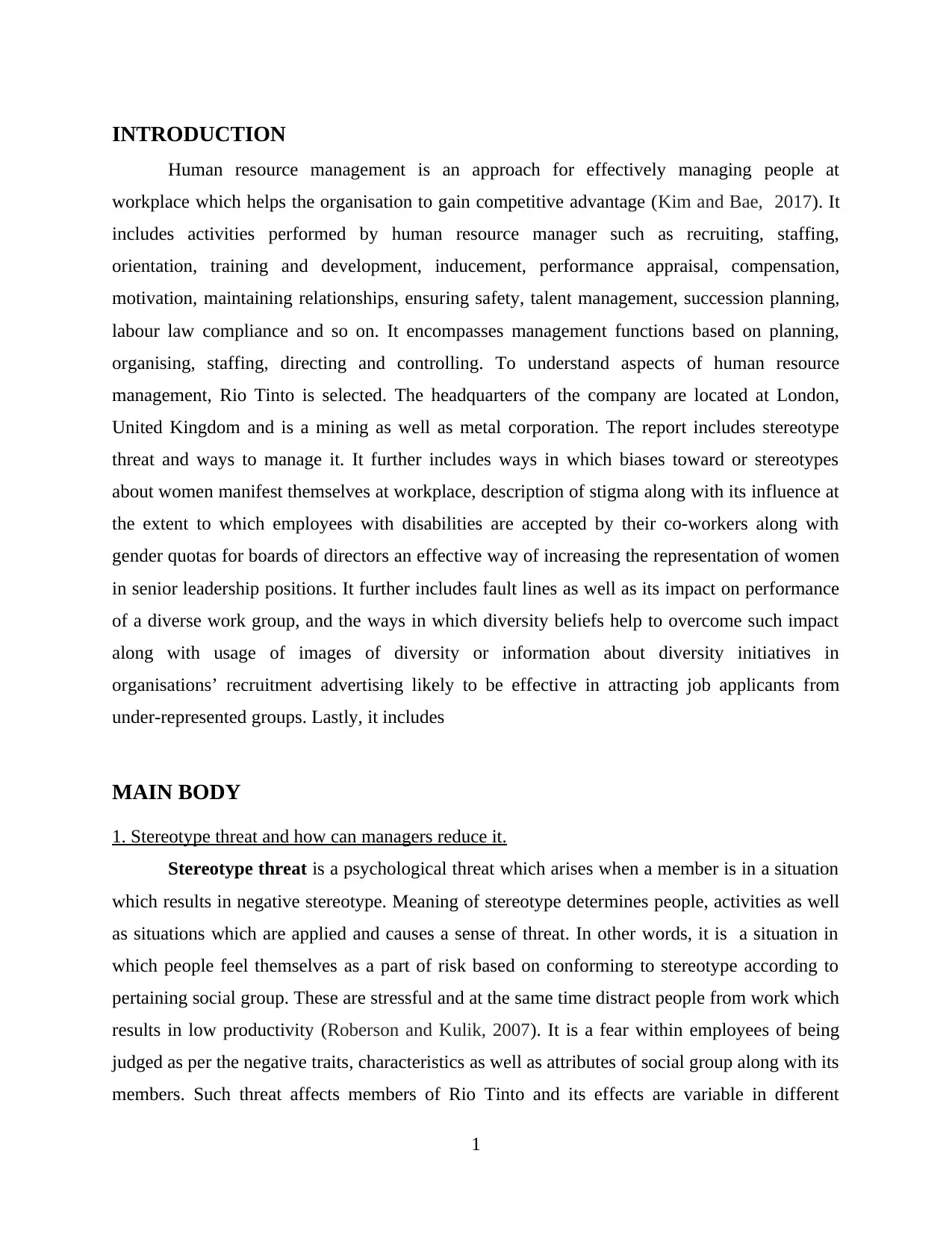
INTRODUCTION
Human resource management is an approach for effectively managing people at
workplace which helps the organisation to gain competitive advantage (Kim and Bae, 2017). It
includes activities performed by human resource manager such as recruiting, staffing,
orientation, training and development, inducement, performance appraisal, compensation,
motivation, maintaining relationships, ensuring safety, talent management, succession planning,
labour law compliance and so on. It encompasses management functions based on planning,
organising, staffing, directing and controlling. To understand aspects of human resource
management, Rio Tinto is selected. The headquarters of the company are located at London,
United Kingdom and is a mining as well as metal corporation. The report includes stereotype
threat and ways to manage it. It further includes ways in which biases toward or stereotypes
about women manifest themselves at workplace, description of stigma along with its influence at
the extent to which employees with disabilities are accepted by their co-workers along with
gender quotas for boards of directors an effective way of increasing the representation of women
in senior leadership positions. It further includes fault lines as well as its impact on performance
of a diverse work group, and the ways in which diversity beliefs help to overcome such impact
along with usage of images of diversity or information about diversity initiatives in
organisations’ recruitment advertising likely to be effective in attracting job applicants from
under-represented groups. Lastly, it includes
MAIN BODY
1. Stereotype threat and how can managers reduce it.
Stereotype threat is a psychological threat which arises when a member is in a situation
which results in negative stereotype. Meaning of stereotype determines people, activities as well
as situations which are applied and causes a sense of threat. In other words, it is a situation in
which people feel themselves as a part of risk based on conforming to stereotype according to
pertaining social group. These are stressful and at the same time distract people from work which
results in low productivity (Roberson and Kulik, 2007). It is a fear within employees of being
judged as per the negative traits, characteristics as well as attributes of social group along with its
members. Such threat affects members of Rio Tinto and its effects are variable in different
1
Human resource management is an approach for effectively managing people at
workplace which helps the organisation to gain competitive advantage (Kim and Bae, 2017). It
includes activities performed by human resource manager such as recruiting, staffing,
orientation, training and development, inducement, performance appraisal, compensation,
motivation, maintaining relationships, ensuring safety, talent management, succession planning,
labour law compliance and so on. It encompasses management functions based on planning,
organising, staffing, directing and controlling. To understand aspects of human resource
management, Rio Tinto is selected. The headquarters of the company are located at London,
United Kingdom and is a mining as well as metal corporation. The report includes stereotype
threat and ways to manage it. It further includes ways in which biases toward or stereotypes
about women manifest themselves at workplace, description of stigma along with its influence at
the extent to which employees with disabilities are accepted by their co-workers along with
gender quotas for boards of directors an effective way of increasing the representation of women
in senior leadership positions. It further includes fault lines as well as its impact on performance
of a diverse work group, and the ways in which diversity beliefs help to overcome such impact
along with usage of images of diversity or information about diversity initiatives in
organisations’ recruitment advertising likely to be effective in attracting job applicants from
under-represented groups. Lastly, it includes
MAIN BODY
1. Stereotype threat and how can managers reduce it.
Stereotype threat is a psychological threat which arises when a member is in a situation
which results in negative stereotype. Meaning of stereotype determines people, activities as well
as situations which are applied and causes a sense of threat. In other words, it is a situation in
which people feel themselves as a part of risk based on conforming to stereotype according to
pertaining social group. These are stressful and at the same time distract people from work which
results in low productivity (Roberson and Kulik, 2007). It is a fear within employees of being
judged as per the negative traits, characteristics as well as attributes of social group along with its
members. Such threat affects members of Rio Tinto and its effects are variable in different
1
Paraphrase This Document
Need a fresh take? Get an instant paraphrase of this document with our AI Paraphraser
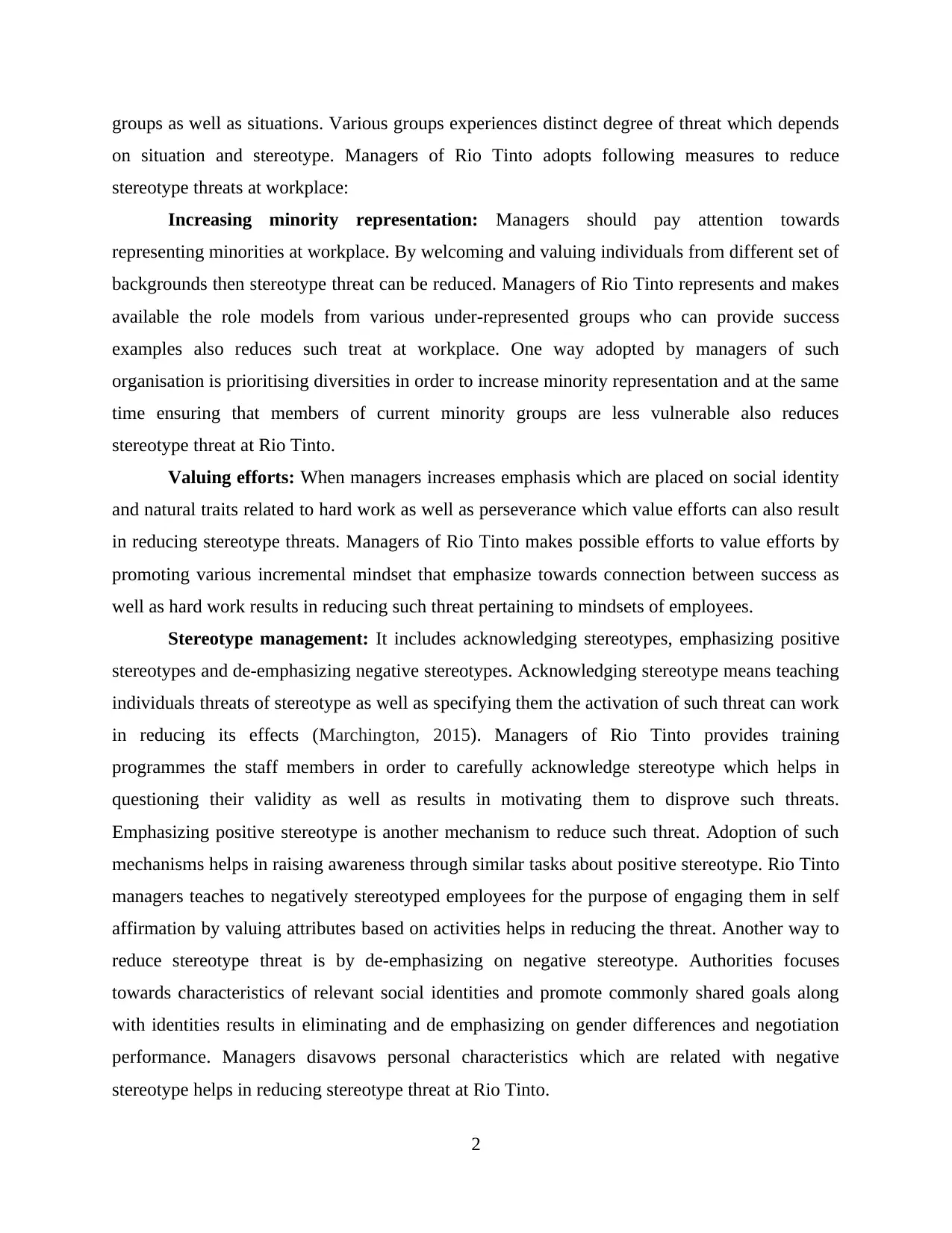
groups as well as situations. Various groups experiences distinct degree of threat which depends
on situation and stereotype. Managers of Rio Tinto adopts following measures to reduce
stereotype threats at workplace:
Increasing minority representation: Managers should pay attention towards
representing minorities at workplace. By welcoming and valuing individuals from different set of
backgrounds then stereotype threat can be reduced. Managers of Rio Tinto represents and makes
available the role models from various under-represented groups who can provide success
examples also reduces such treat at workplace. One way adopted by managers of such
organisation is prioritising diversities in order to increase minority representation and at the same
time ensuring that members of current minority groups are less vulnerable also reduces
stereotype threat at Rio Tinto.
Valuing efforts: When managers increases emphasis which are placed on social identity
and natural traits related to hard work as well as perseverance which value efforts can also result
in reducing stereotype threats. Managers of Rio Tinto makes possible efforts to value efforts by
promoting various incremental mindset that emphasize towards connection between success as
well as hard work results in reducing such threat pertaining to mindsets of employees.
Stereotype management: It includes acknowledging stereotypes, emphasizing positive
stereotypes and de-emphasizing negative stereotypes. Acknowledging stereotype means teaching
individuals threats of stereotype as well as specifying them the activation of such threat can work
in reducing its effects (Marchington, 2015). Managers of Rio Tinto provides training
programmes the staff members in order to carefully acknowledge stereotype which helps in
questioning their validity as well as results in motivating them to disprove such threats.
Emphasizing positive stereotype is another mechanism to reduce such threat. Adoption of such
mechanisms helps in raising awareness through similar tasks about positive stereotype. Rio Tinto
managers teaches to negatively stereotyped employees for the purpose of engaging them in self
affirmation by valuing attributes based on activities helps in reducing the threat. Another way to
reduce stereotype threat is by de-emphasizing on negative stereotype. Authorities focuses
towards characteristics of relevant social identities and promote commonly shared goals along
with identities results in eliminating and de emphasizing on gender differences and negotiation
performance. Managers disavows personal characteristics which are related with negative
stereotype helps in reducing stereotype threat at Rio Tinto.
2
on situation and stereotype. Managers of Rio Tinto adopts following measures to reduce
stereotype threats at workplace:
Increasing minority representation: Managers should pay attention towards
representing minorities at workplace. By welcoming and valuing individuals from different set of
backgrounds then stereotype threat can be reduced. Managers of Rio Tinto represents and makes
available the role models from various under-represented groups who can provide success
examples also reduces such treat at workplace. One way adopted by managers of such
organisation is prioritising diversities in order to increase minority representation and at the same
time ensuring that members of current minority groups are less vulnerable also reduces
stereotype threat at Rio Tinto.
Valuing efforts: When managers increases emphasis which are placed on social identity
and natural traits related to hard work as well as perseverance which value efforts can also result
in reducing stereotype threats. Managers of Rio Tinto makes possible efforts to value efforts by
promoting various incremental mindset that emphasize towards connection between success as
well as hard work results in reducing such threat pertaining to mindsets of employees.
Stereotype management: It includes acknowledging stereotypes, emphasizing positive
stereotypes and de-emphasizing negative stereotypes. Acknowledging stereotype means teaching
individuals threats of stereotype as well as specifying them the activation of such threat can work
in reducing its effects (Marchington, 2015). Managers of Rio Tinto provides training
programmes the staff members in order to carefully acknowledge stereotype which helps in
questioning their validity as well as results in motivating them to disprove such threats.
Emphasizing positive stereotype is another mechanism to reduce such threat. Adoption of such
mechanisms helps in raising awareness through similar tasks about positive stereotype. Rio Tinto
managers teaches to negatively stereotyped employees for the purpose of engaging them in self
affirmation by valuing attributes based on activities helps in reducing the threat. Another way to
reduce stereotype threat is by de-emphasizing on negative stereotype. Authorities focuses
towards characteristics of relevant social identities and promote commonly shared goals along
with identities results in eliminating and de emphasizing on gender differences and negotiation
performance. Managers disavows personal characteristics which are related with negative
stereotype helps in reducing stereotype threat at Rio Tinto.
2
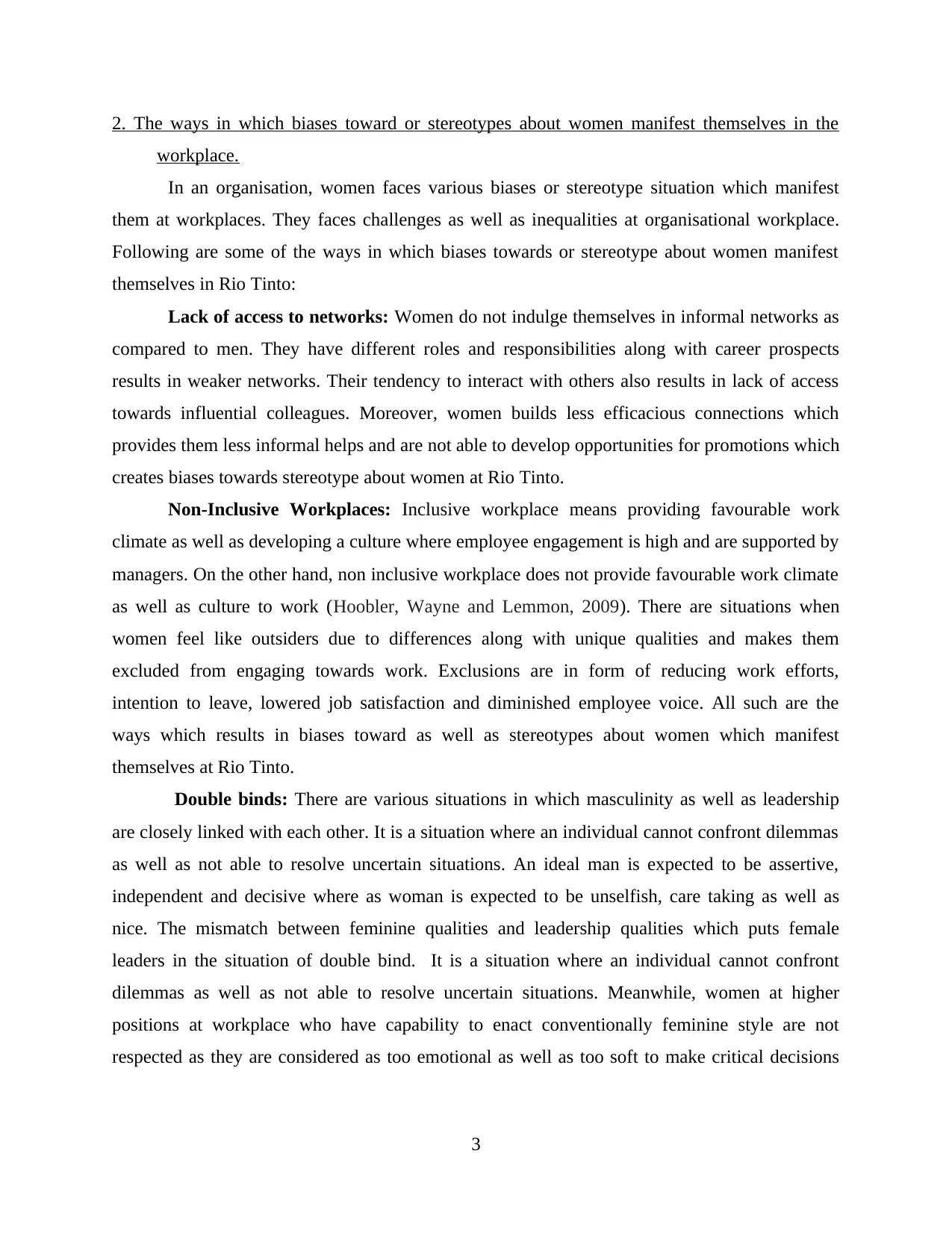
2. The ways in which biases toward or stereotypes about women manifest themselves in the
workplace.
In an organisation, women faces various biases or stereotype situation which manifest
them at workplaces. They faces challenges as well as inequalities at organisational workplace.
Following are some of the ways in which biases towards or stereotype about women manifest
themselves in Rio Tinto:
Lack of access to networks: Women do not indulge themselves in informal networks as
compared to men. They have different roles and responsibilities along with career prospects
results in weaker networks. Their tendency to interact with others also results in lack of access
towards influential colleagues. Moreover, women builds less efficacious connections which
provides them less informal helps and are not able to develop opportunities for promotions which
creates biases towards stereotype about women at Rio Tinto.
Non-Inclusive Workplaces: Inclusive workplace means providing favourable work
climate as well as developing a culture where employee engagement is high and are supported by
managers. On the other hand, non inclusive workplace does not provide favourable work climate
as well as culture to work (Hoobler, Wayne and Lemmon, 2009). There are situations when
women feel like outsiders due to differences along with unique qualities and makes them
excluded from engaging towards work. Exclusions are in form of reducing work efforts,
intention to leave, lowered job satisfaction and diminished employee voice. All such are the
ways which results in biases toward as well as stereotypes about women which manifest
themselves at Rio Tinto.
Double binds: There are various situations in which masculinity as well as leadership
are closely linked with each other. It is a situation where an individual cannot confront dilemmas
as well as not able to resolve uncertain situations. An ideal man is expected to be assertive,
independent and decisive where as woman is expected to be unselfish, care taking as well as
nice. The mismatch between feminine qualities and leadership qualities which puts female
leaders in the situation of double bind. It is a situation where an individual cannot confront
dilemmas as well as not able to resolve uncertain situations. Meanwhile, women at higher
positions at workplace who have capability to enact conventionally feminine style are not
respected as they are considered as too emotional as well as too soft to make critical decisions
3
workplace.
In an organisation, women faces various biases or stereotype situation which manifest
them at workplaces. They faces challenges as well as inequalities at organisational workplace.
Following are some of the ways in which biases towards or stereotype about women manifest
themselves in Rio Tinto:
Lack of access to networks: Women do not indulge themselves in informal networks as
compared to men. They have different roles and responsibilities along with career prospects
results in weaker networks. Their tendency to interact with others also results in lack of access
towards influential colleagues. Moreover, women builds less efficacious connections which
provides them less informal helps and are not able to develop opportunities for promotions which
creates biases towards stereotype about women at Rio Tinto.
Non-Inclusive Workplaces: Inclusive workplace means providing favourable work
climate as well as developing a culture where employee engagement is high and are supported by
managers. On the other hand, non inclusive workplace does not provide favourable work climate
as well as culture to work (Hoobler, Wayne and Lemmon, 2009). There are situations when
women feel like outsiders due to differences along with unique qualities and makes them
excluded from engaging towards work. Exclusions are in form of reducing work efforts,
intention to leave, lowered job satisfaction and diminished employee voice. All such are the
ways which results in biases toward as well as stereotypes about women which manifest
themselves at Rio Tinto.
Double binds: There are various situations in which masculinity as well as leadership
are closely linked with each other. It is a situation where an individual cannot confront dilemmas
as well as not able to resolve uncertain situations. An ideal man is expected to be assertive,
independent and decisive where as woman is expected to be unselfish, care taking as well as
nice. The mismatch between feminine qualities and leadership qualities which puts female
leaders in the situation of double bind. It is a situation where an individual cannot confront
dilemmas as well as not able to resolve uncertain situations. Meanwhile, women at higher
positions at workplace who have capability to enact conventionally feminine style are not
respected as they are considered as too emotional as well as too soft to make critical decisions
3
⊘ This is a preview!⊘
Do you want full access?
Subscribe today to unlock all pages.
Trusted by 1+ million students worldwide
and to become strong leaders. Thus, double bind is another way in which biases toward or
stereotypes about women manifest themselves at workplace of Rio Tinto.
3. Meaning of stigma and influence the extent to which employees with disabilities are accepted
by their co-workers.
Stigma is a situation in which a individual receives unfair alienation whose effects results
in detrimental of the person. Stigma is a disapproval as well as discrimination against any
individual due to perceivable social characteristics which distinguish them from others in a
society. In any organisation, various people faces such situations due to differences in culture,
race, health, gender as well as intelligence. It is a reaction which spoils others identity because of
differences. Such aspect rejects deeply discredited person and results in discouraging efficiency.
Disability status or stigma does not affect much at workplace but affects social support.
Employees at some extent accepts disable co workers as with the changing scenarios, thinking
capability of employees is also changing which helps in recognising people with disabilities as
key or valuable resources. It is categorised into visible as well as invisible stigma. Visible stigma
is related with race, gender, deformities and so on where as invisible stigma is based on sexual
orientation, certain diseases, gender identity, mental illnesses and hence forth. When an
employee is facing from such stigmas than they are not able to decide that either they should or
not revel their associations to others at work place. The individual who possess such stigmas
adopts compensatory strategies that leads towards reduction in interpersonal discrimination and
it requires remedial actions dependent on situational factors. Such decisions are important to be
taken as they influences perception of other employees and at the same time they results in
positive as well as negative circumstances as other people may not be ready to accept working
with such stigma people or there are chances when professionals appreciate to work with
affected people. Consequences determines motivation or dis motivational levels between normal
employees and stigma employees. The stigma influences interaction of employees with disable
people at work place and results in building healthy relationship between them. People with
disabilities encompasses growing portion of workers at the time compared with different aspects
of diversity. Stigma influences performances as well as perceive implications on co workers
performance (McLaughlin, Bell and Stringer, 2004). Co workers aligns practices and
understands the situation in order to improve quality of work at Rio Tinto. Managers of the
company provides various flexible schedules to co workers in order to promote the performance
4
stereotypes about women manifest themselves at workplace of Rio Tinto.
3. Meaning of stigma and influence the extent to which employees with disabilities are accepted
by their co-workers.
Stigma is a situation in which a individual receives unfair alienation whose effects results
in detrimental of the person. Stigma is a disapproval as well as discrimination against any
individual due to perceivable social characteristics which distinguish them from others in a
society. In any organisation, various people faces such situations due to differences in culture,
race, health, gender as well as intelligence. It is a reaction which spoils others identity because of
differences. Such aspect rejects deeply discredited person and results in discouraging efficiency.
Disability status or stigma does not affect much at workplace but affects social support.
Employees at some extent accepts disable co workers as with the changing scenarios, thinking
capability of employees is also changing which helps in recognising people with disabilities as
key or valuable resources. It is categorised into visible as well as invisible stigma. Visible stigma
is related with race, gender, deformities and so on where as invisible stigma is based on sexual
orientation, certain diseases, gender identity, mental illnesses and hence forth. When an
employee is facing from such stigmas than they are not able to decide that either they should or
not revel their associations to others at work place. The individual who possess such stigmas
adopts compensatory strategies that leads towards reduction in interpersonal discrimination and
it requires remedial actions dependent on situational factors. Such decisions are important to be
taken as they influences perception of other employees and at the same time they results in
positive as well as negative circumstances as other people may not be ready to accept working
with such stigma people or there are chances when professionals appreciate to work with
affected people. Consequences determines motivation or dis motivational levels between normal
employees and stigma employees. The stigma influences interaction of employees with disable
people at work place and results in building healthy relationship between them. People with
disabilities encompasses growing portion of workers at the time compared with different aspects
of diversity. Stigma influences performances as well as perceive implications on co workers
performance (McLaughlin, Bell and Stringer, 2004). Co workers aligns practices and
understands the situation in order to improve quality of work at Rio Tinto. Managers of the
company provides various flexible schedules to co workers in order to promote the performance
4
Paraphrase This Document
Need a fresh take? Get an instant paraphrase of this document with our AI Paraphraser
of disable people. Secured as well as sustainable employment helps in bringing co workers along
with disable workers into mainstream places which results in high quality work and helps in
employment growth.
4. Gender quotas for boards of directors an effective way of increasing the representation of
women in senior leadership positions.
Gender quotas are referred to gender representation that is a step which is taken by
government as to enhance female representation in board of directors. Such system symbolize
approach of equality of outcome that emphasises towards attaining results that benefit to women
along with organisations. There are several countries such as Belgium, Iceland, Italy and hence
forth that has governed legislative quotas for females in corporate boards that are related with
public listed companies. Yes, gender quotas for board of directors are effective way of increasing
representation of women in senior leadership positions as gender quotas for women for board of
directors helps in improving female shares which provides equal opportunities in order to
improve efficiency of a women. In general, board members are appointed through internal
methods or external methods of recruitment. Under internal process, firms appoints women
along with other members to those who are part of the organisation but in external method
appointments are done by appointing members or females from outside sources. In various
countries, women are at top executive position with the help of such quotas. The quota system
has significantly increased number of women in organisation who are in the list of Board of
Directors. After the enactment of gender quotas for directors positions it benefits various women
by changing the mentalities as well as practices at workplace. Gender quotas for directors builds
enthusiasm as well as motivates females to work with more responsibility as well as efficiency
which at the same time encourages other women at workplace to apply for senior leadership
positions. Adoption of gender quotas acts as rectifying disproportionate representation of gender
at different board of corporates. These quotas ensures that women can represent herself in all
fields and at the same time can tackle situations based on economic, social as well as political
inequalities. Executives of Rio Tinto are making policies to implement gender quotas at board
directors level in order to attain gender parity which helps in increasing women representation at
senior leadership positions which can provide expected benefits (Seierstad and Opsahl, 2011). At
Rio Tinto, internal sources as well as external sources are used to recruit women at Board of
directors so that effective decisions are taken and it shows reducing discrimination gaps between
5
with disable workers into mainstream places which results in high quality work and helps in
employment growth.
4. Gender quotas for boards of directors an effective way of increasing the representation of
women in senior leadership positions.
Gender quotas are referred to gender representation that is a step which is taken by
government as to enhance female representation in board of directors. Such system symbolize
approach of equality of outcome that emphasises towards attaining results that benefit to women
along with organisations. There are several countries such as Belgium, Iceland, Italy and hence
forth that has governed legislative quotas for females in corporate boards that are related with
public listed companies. Yes, gender quotas for board of directors are effective way of increasing
representation of women in senior leadership positions as gender quotas for women for board of
directors helps in improving female shares which provides equal opportunities in order to
improve efficiency of a women. In general, board members are appointed through internal
methods or external methods of recruitment. Under internal process, firms appoints women
along with other members to those who are part of the organisation but in external method
appointments are done by appointing members or females from outside sources. In various
countries, women are at top executive position with the help of such quotas. The quota system
has significantly increased number of women in organisation who are in the list of Board of
Directors. After the enactment of gender quotas for directors positions it benefits various women
by changing the mentalities as well as practices at workplace. Gender quotas for directors builds
enthusiasm as well as motivates females to work with more responsibility as well as efficiency
which at the same time encourages other women at workplace to apply for senior leadership
positions. Adoption of gender quotas acts as rectifying disproportionate representation of gender
at different board of corporates. These quotas ensures that women can represent herself in all
fields and at the same time can tackle situations based on economic, social as well as political
inequalities. Executives of Rio Tinto are making policies to implement gender quotas at board
directors level in order to attain gender parity which helps in increasing women representation at
senior leadership positions which can provide expected benefits (Seierstad and Opsahl, 2011). At
Rio Tinto, internal sources as well as external sources are used to recruit women at Board of
directors so that effective decisions are taken and it shows reducing discrimination gaps between
5
males as well as females. Thus, it can be said that gender quotas for boards of directors an
effective way of increasing the representation of women in senior leadership positions.
5. Fault lines and impact on performance of a diverse work group, and the ways in which
diversity beliefs help to overcome the impact
Fault line are the situations where misunderstandings take place at work culture. It is
basically a weak spot which is drawn between departments, work units and formal functions.
This creates situation of troubling employees with another. Thy define sensitive ground which
results in interdependence as well as influences relationships at Rio Tinto. Fault line divides the
team members as well as splits the group into subgroups. For example, when members identifies
differences within team which are based on ethnicity, disabilities and so on is the time they start
creating differences from the members. It also results in frustration within an employee because
of misunderstandings as well as work place injustice.
Fault lines impacts on performance of diverse work group as more misunderstanding
results in dissatisfaction from work as well as psychological distress. Such distress results in
unpleasant feeling, disengagement, irritability and so on that impacts functioning level.
Misunderstanding between work groups impact on efficiency of each group members which
results in decreasing profits and at the same time suspension of various employees from work.
Such aspects also leads to conflicts between diversified groups which creates unfavourable
environment for other members along with dropping morale of workforce (Gratton, Voigt and
Erickson, 2007). When misunderstanding takes employees in wrong direction it impacts on
overall work culture. The another impact of fault line is that it creates legal issues between
formal functional authorities and monitoring the problems is very difficult task. It results in
incompletion of work as well as disputes between departments and due to this relevant
information is not communicated properly between various diverse work groups.
The ways through which diversity beliefs are helpful in overcoming from the impacts of
fault lines are as follows:
Understanding: Employees at workplace disagrees at some situations when they are not
able to understand others. Diverse beliefs helps in understanding situations and eliminates
misunderstanding by evaluation of circumstances. This results in building relationships with
other employees in different departments as well as improving efficiencies by coordinating with
6
effective way of increasing the representation of women in senior leadership positions.
5. Fault lines and impact on performance of a diverse work group, and the ways in which
diversity beliefs help to overcome the impact
Fault line are the situations where misunderstandings take place at work culture. It is
basically a weak spot which is drawn between departments, work units and formal functions.
This creates situation of troubling employees with another. Thy define sensitive ground which
results in interdependence as well as influences relationships at Rio Tinto. Fault line divides the
team members as well as splits the group into subgroups. For example, when members identifies
differences within team which are based on ethnicity, disabilities and so on is the time they start
creating differences from the members. It also results in frustration within an employee because
of misunderstandings as well as work place injustice.
Fault lines impacts on performance of diverse work group as more misunderstanding
results in dissatisfaction from work as well as psychological distress. Such distress results in
unpleasant feeling, disengagement, irritability and so on that impacts functioning level.
Misunderstanding between work groups impact on efficiency of each group members which
results in decreasing profits and at the same time suspension of various employees from work.
Such aspects also leads to conflicts between diversified groups which creates unfavourable
environment for other members along with dropping morale of workforce (Gratton, Voigt and
Erickson, 2007). When misunderstanding takes employees in wrong direction it impacts on
overall work culture. The another impact of fault line is that it creates legal issues between
formal functional authorities and monitoring the problems is very difficult task. It results in
incompletion of work as well as disputes between departments and due to this relevant
information is not communicated properly between various diverse work groups.
The ways through which diversity beliefs are helpful in overcoming from the impacts of
fault lines are as follows:
Understanding: Employees at workplace disagrees at some situations when they are not
able to understand others. Diverse beliefs helps in understanding situations and eliminates
misunderstanding by evaluation of circumstances. This results in building relationships with
other employees in different departments as well as improving efficiencies by coordinating with
6
⊘ This is a preview!⊘
Do you want full access?
Subscribe today to unlock all pages.
Trusted by 1+ million students worldwide
diverse work groups in order to communicate necessary information which can help in
improving profits of Rio Tinto.
Looking into similarities: Diverse beliefs are effective in order to look at similar
characteristics or traits between two or more individuals. Such beliefs motivates an employee to
look at similarities rather con differences. When employees work by eliminating differences they
resolves disagreements in better manner which eliminates gap between misunderstanding and
helps in overcoming from fault line situations.
Taking responsibilities: When an employee faces the situation of fault line then they
does not concentrate on taking responsibilities in effective manner. Diverse beliefs is an effective
way which helps in taking responsibilities by eliminating misunderstanding and conflicts
between group members. Taking responsibilities improves morale of employees and at the same
time improves productivity by overcoming from such issue. Responsibilities helps in working
with honesty as well as without excuses which reduces the fault lines between various
departments as well as formal functions.
6. Images of diversity or information about diversity initiatives in organisations’ recruitment
advertising likely to be effective in attracting job applicants from under-represented groups
Organisations uses diversity images or diversity initiatives to attract job applicant from
under-represented groups. In the changing scenario, corporates uses recruitment advertisements
to attract large segment of applicants which impacts on increasing organisational image in the
dynamic competition. Yes, attractive images along with information about diversity which are
initiated while organisation's recruitment advertising are effective for attracting job applicants
from under represented groups. Here, diversity is used as cultural diversity, corporate diversity
and so on in which information is collected and analysed as to determine the needs of under
represented groups. Further, effective strategies are formulated as to increase the awareness
related to attracting job applicants from such groups. As the world is fostering towards
globalisation which helps in attracting various people with the help of diverse images as well as
initiative diverse information about organisation. Rio Tinto applies such concept in order to
attract job applicants from under-represented groups which helps in getting applications at large
scale. They adopts diverse techniques such as blind resume screening in which under represented
demographics are preferred and provided more options to such demographics that helps in
improving career growth. They also ensures inclusive wordings and emphasis on value based
7
improving profits of Rio Tinto.
Looking into similarities: Diverse beliefs are effective in order to look at similar
characteristics or traits between two or more individuals. Such beliefs motivates an employee to
look at similarities rather con differences. When employees work by eliminating differences they
resolves disagreements in better manner which eliminates gap between misunderstanding and
helps in overcoming from fault line situations.
Taking responsibilities: When an employee faces the situation of fault line then they
does not concentrate on taking responsibilities in effective manner. Diverse beliefs is an effective
way which helps in taking responsibilities by eliminating misunderstanding and conflicts
between group members. Taking responsibilities improves morale of employees and at the same
time improves productivity by overcoming from such issue. Responsibilities helps in working
with honesty as well as without excuses which reduces the fault lines between various
departments as well as formal functions.
6. Images of diversity or information about diversity initiatives in organisations’ recruitment
advertising likely to be effective in attracting job applicants from under-represented groups
Organisations uses diversity images or diversity initiatives to attract job applicant from
under-represented groups. In the changing scenario, corporates uses recruitment advertisements
to attract large segment of applicants which impacts on increasing organisational image in the
dynamic competition. Yes, attractive images along with information about diversity which are
initiated while organisation's recruitment advertising are effective for attracting job applicants
from under represented groups. Here, diversity is used as cultural diversity, corporate diversity
and so on in which information is collected and analysed as to determine the needs of under
represented groups. Further, effective strategies are formulated as to increase the awareness
related to attracting job applicants from such groups. As the world is fostering towards
globalisation which helps in attracting various people with the help of diverse images as well as
initiative diverse information about organisation. Rio Tinto applies such concept in order to
attract job applicants from under-represented groups which helps in getting applications at large
scale. They adopts diverse techniques such as blind resume screening in which under represented
demographics are preferred and provided more options to such demographics that helps in
improving career growth. They also ensures inclusive wordings and emphasis on value based
7
Paraphrase This Document
Need a fresh take? Get an instant paraphrase of this document with our AI Paraphraser
recruitment in which under represented groups are values more to provide greater satisfaction
with the organisational environment. The managers of such organisation eliminates biasness at
the time of attracting applicants. Diverse information provides a detailed knowledge about any
organisation and at the same attract various people. It encourages job applicants to participate in
recruitment process by analysing the working environment through images of the workplace.
Diversity brings more innovative skills along with services which improves image in the
competitive market place. Getting more applications helps in understanding perception of diverse
workforce or candidates as well as provides content that fits to all size approaches (Avery, 2003).
Diverse images as well as information acts as benefit approach to acquire diverse candidate and a
effective medium to scrutinise the applications as per the requirements of skills or capabilities at
workplace and increases candidates availability for the purpose of meeting organisational goals
as well as targets. Diverse images attracts wider talent pool and managers of selected business do
not make any type of discrimination between under represented grouped workers or over
represented grouped workers. Thus, it can be said that images of diversity along with information
associated with diversity initiatives in organisations’ recruitment advertising results in effective
manner to attract job applicants from demographic as well as under-represented groups.
CONCLUSION
From the above report it can be concluded that human resource management is used for
managing employees at work place. Stereotype is stressful and distracts people from work.
Managers adopts measures such as increasing minority representation, valuing efforts and
stereotype management to reduce stereotype threats at workplace. The ways in which biases
toward or stereotypes about women manifest themselves in the workplace are lack of access to
networks, non-inclusive workplaces and double binds. Stigma is a discrimination against any
individual due to perceivable social characteristics which distinguish them from others in a
society. It influence at large extent to which employees with disabilities are accepted by their co-
workers. Gender quotas for board of directors are effective way of increasing representation of
women in senior leadership positions as gender quotas for women for board of directors helps in
improving female shares which provides equal opportunities in order to improve efficiency of a
women. Fault line are situations which results in misunderstandings at work culture. They
impacts on performance of diverse work group as more misunderstanding results in
dissatisfaction from work as well as psychological distress. The ways through which diversity
8
with the organisational environment. The managers of such organisation eliminates biasness at
the time of attracting applicants. Diverse information provides a detailed knowledge about any
organisation and at the same attract various people. It encourages job applicants to participate in
recruitment process by analysing the working environment through images of the workplace.
Diversity brings more innovative skills along with services which improves image in the
competitive market place. Getting more applications helps in understanding perception of diverse
workforce or candidates as well as provides content that fits to all size approaches (Avery, 2003).
Diverse images as well as information acts as benefit approach to acquire diverse candidate and a
effective medium to scrutinise the applications as per the requirements of skills or capabilities at
workplace and increases candidates availability for the purpose of meeting organisational goals
as well as targets. Diverse images attracts wider talent pool and managers of selected business do
not make any type of discrimination between under represented grouped workers or over
represented grouped workers. Thus, it can be said that images of diversity along with information
associated with diversity initiatives in organisations’ recruitment advertising results in effective
manner to attract job applicants from demographic as well as under-represented groups.
CONCLUSION
From the above report it can be concluded that human resource management is used for
managing employees at work place. Stereotype is stressful and distracts people from work.
Managers adopts measures such as increasing minority representation, valuing efforts and
stereotype management to reduce stereotype threats at workplace. The ways in which biases
toward or stereotypes about women manifest themselves in the workplace are lack of access to
networks, non-inclusive workplaces and double binds. Stigma is a discrimination against any
individual due to perceivable social characteristics which distinguish them from others in a
society. It influence at large extent to which employees with disabilities are accepted by their co-
workers. Gender quotas for board of directors are effective way of increasing representation of
women in senior leadership positions as gender quotas for women for board of directors helps in
improving female shares which provides equal opportunities in order to improve efficiency of a
women. Fault line are situations which results in misunderstandings at work culture. They
impacts on performance of diverse work group as more misunderstanding results in
dissatisfaction from work as well as psychological distress. The ways through which diversity
8

beliefs are helpful in overcoming from the impacts of fault lines are understanding, looking into
similarities ans taking responsibilities. Images of diversity helps in attracting job applicants from
under-represented groups.
9
similarities ans taking responsibilities. Images of diversity helps in attracting job applicants from
under-represented groups.
9
⊘ This is a preview!⊘
Do you want full access?
Subscribe today to unlock all pages.
Trusted by 1+ million students worldwide

1 out of 13


Related Documents


Your All-in-One AI-Powered Toolkit for Academic Success.
+13062052269
info@desklib.com
Available 24*7 on WhatsApp / Email
![[object Object]](/_next/static/media/star-bottom.7253800d.svg)
Unlock your academic potential
Copyright © 2020–2026 A2Z Services. All Rights Reserved. Developed and managed by ZUCOL.