Human Resource Management Report: Merrill Lynch Case Study
VerifiedAdded on 2021/02/20
|8
|1411
|42
Report
AI Summary
This report provides a comprehensive analysis of Human Resource Management (HRM) principles, practices, and functions at Merrill Lynch, an investment and wealth management division of Bank of America. It explores the core characteristics and scope of HRM, including recruitment, compensation, employee motivation, and industrial relations. The report delves into the 'Best Fit' vs 'Best Practice' approaches, hard and soft models of HRM, and workforce planning strategies. It also examines the recruitment and selection processes, including internal and external recruitment sources, job analysis, job descriptions, and selection methods like interviewing and assessment centers. Furthermore, the report addresses issues related to induction and socialization, and the importance of effective HRM in establishing a robust human resource department. The report concludes with a discussion of key concepts such as internal labor markets, turnover, stability, and retention, along with relevant references.

Human resource management
Paraphrase This Document
Need a fresh take? Get an instant paraphrase of this document with our AI Paraphraser

Table of Contents
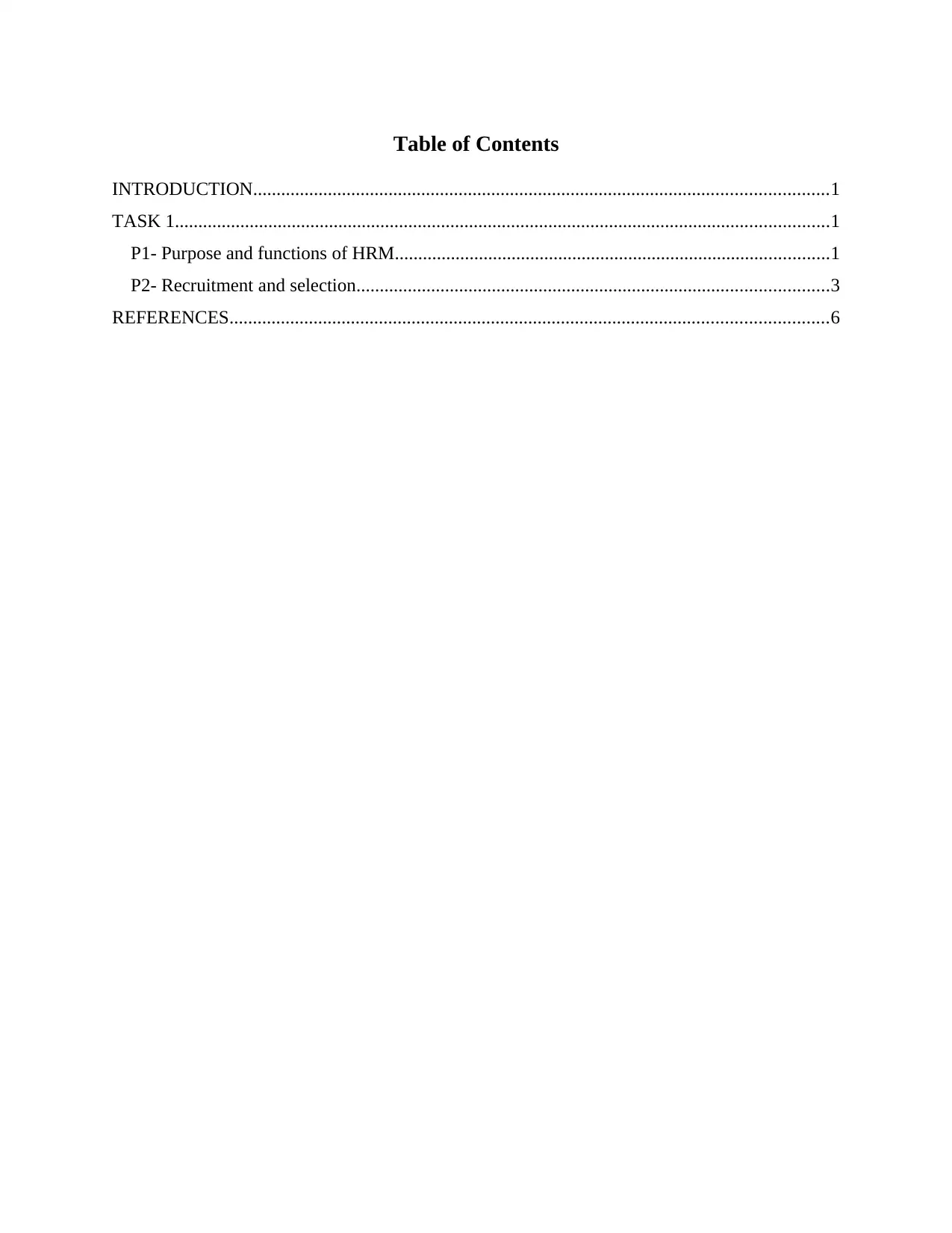
INTRODUCTION...........................................................................................................................1
TASK 1............................................................................................................................................1
P1- Purpose and functions of HRM.............................................................................................1
P2- Recruitment and selection.....................................................................................................3
REFERENCES................................................................................................................................6
INTRODUCTION...........................................................................................................................1
TASK 1............................................................................................................................................1
P1- Purpose and functions of HRM.............................................................................................1
P2- Recruitment and selection.....................................................................................................3
REFERENCES................................................................................................................................6

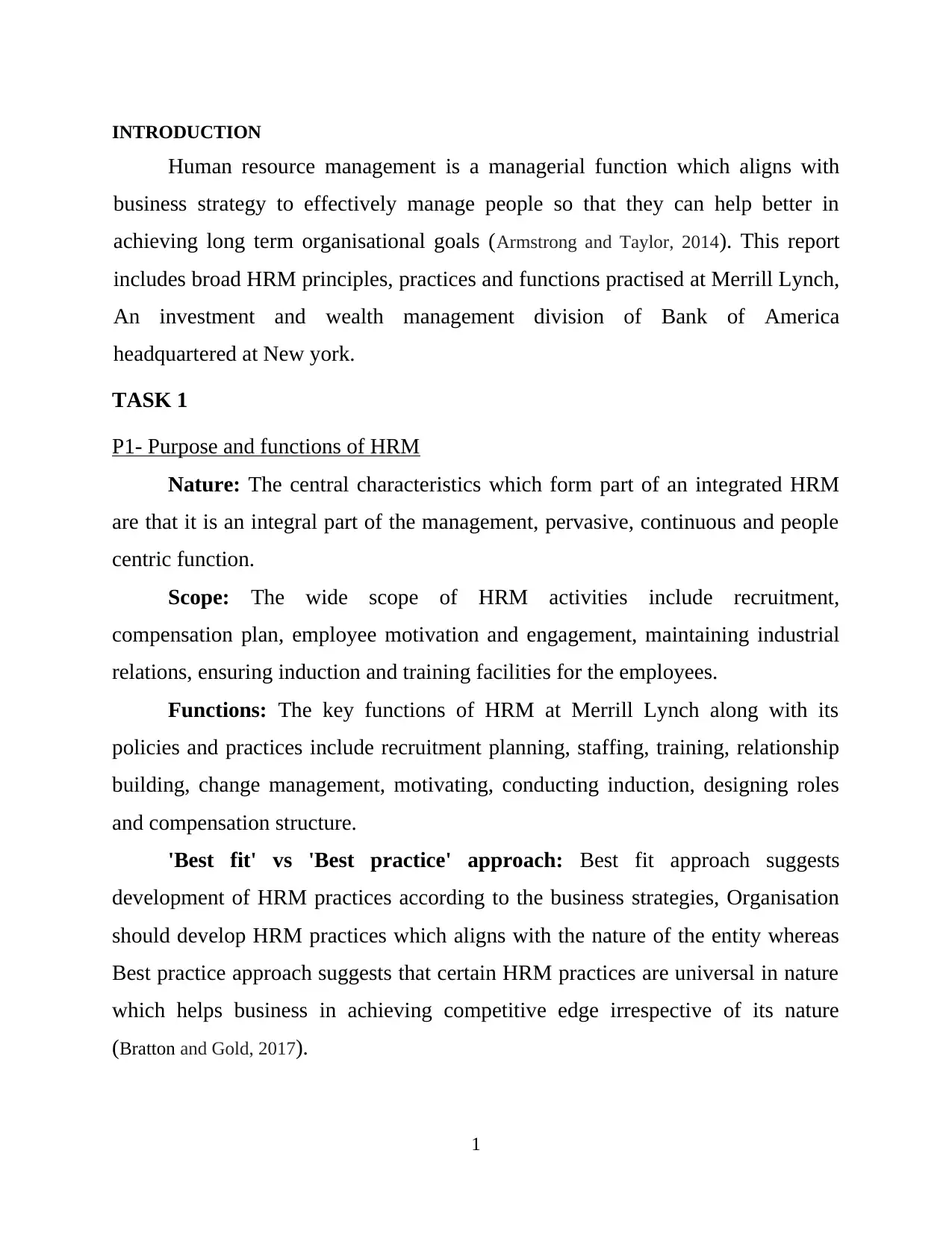
INTRODUCTION
Human resource management is a managerial function which aligns with
business strategy to effectively manage people so that they can help better in
achieving long term organisational goals (Armstrong and Taylor, 2014). This report
includes broad HRM principles, practices and functions practised at Merrill Lynch,
An investment and wealth management division of Bank of America
headquartered at New york.
TASK 1
P1- Purpose and functions of HRM
Nature: The central characteristics which form part of an integrated HRM
are that it is an integral part of the management, pervasive, continuous and people
centric function.
Scope: The wide scope of HRM activities include recruitment,
compensation plan, employee motivation and engagement, maintaining industrial
relations, ensuring induction and training facilities for the employees.
Functions: The key functions of HRM at Merrill Lynch along with its
policies and practices include recruitment planning, staffing, training, relationship
building, change management, motivating, conducting induction, designing roles
and compensation structure.
'Best fit' vs 'Best practice' approach: Best fit approach suggests
development of HRM practices according to the business strategies, Organisation
should develop HRM practices which aligns with the nature of the entity whereas
Best practice approach suggests that certain HRM practices are universal in nature
which helps business in achieving competitive edge irrespective of its nature
(Bratton and Gold, 2017).
1
Human resource management is a managerial function which aligns with
business strategy to effectively manage people so that they can help better in
achieving long term organisational goals (Armstrong and Taylor, 2014). This report
includes broad HRM principles, practices and functions practised at Merrill Lynch,
An investment and wealth management division of Bank of America
headquartered at New york.
TASK 1
P1- Purpose and functions of HRM
Nature: The central characteristics which form part of an integrated HRM
are that it is an integral part of the management, pervasive, continuous and people
centric function.
Scope: The wide scope of HRM activities include recruitment,
compensation plan, employee motivation and engagement, maintaining industrial
relations, ensuring induction and training facilities for the employees.
Functions: The key functions of HRM at Merrill Lynch along with its
policies and practices include recruitment planning, staffing, training, relationship
building, change management, motivating, conducting induction, designing roles
and compensation structure.
'Best fit' vs 'Best practice' approach: Best fit approach suggests
development of HRM practices according to the business strategies, Organisation
should develop HRM practices which aligns with the nature of the entity whereas
Best practice approach suggests that certain HRM practices are universal in nature
which helps business in achieving competitive edge irrespective of its nature
(Bratton and Gold, 2017).
1
⊘ This is a preview!⊘
Do you want full access?
Subscribe today to unlock all pages.

Trusted by 1+ million students worldwide

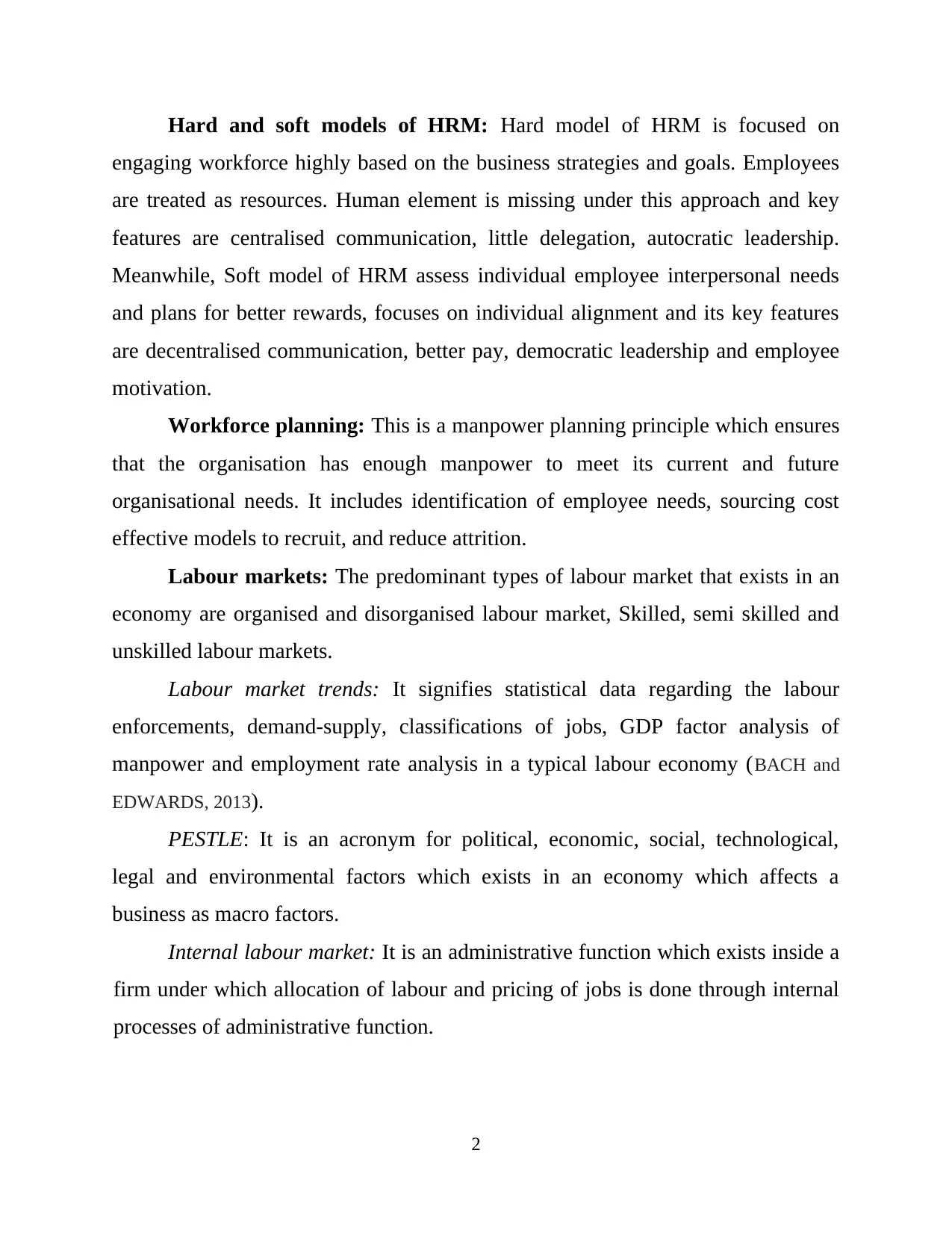
Hard and soft models of HRM: Hard model of HRM is focused on
engaging workforce highly based on the business strategies and goals. Employees
are treated as resources. Human element is missing under this approach and key
features are centralised communication, little delegation, autocratic leadership.
Meanwhile, Soft model of HRM assess individual employee interpersonal needs
and plans for better rewards, focuses on individual alignment and its key features
are decentralised communication, better pay, democratic leadership and employee
motivation.
Workforce planning: This is a manpower planning principle which ensures
that the organisation has enough manpower to meet its current and future
organisational needs. It includes identification of employee needs, sourcing cost
effective models to recruit, and reduce attrition.
Labour markets: The predominant types of labour market that exists in an
economy are organised and disorganised labour market, Skilled, semi skilled and
unskilled labour markets.
Labour market trends: It signifies statistical data regarding the labour
enforcements, demand-supply, classifications of jobs, GDP factor analysis of
manpower and employment rate analysis in a typical labour economy (BACH and
EDWARDS, 2013).
PESTLE: It is an acronym for political, economic, social, technological,
legal and environmental factors which exists in an economy which affects a
business as macro factors.
Internal labour market: It is an administrative function which exists inside a
firm under which allocation of labour and pricing of jobs is done through internal
processes of administrative function.
2
engaging workforce highly based on the business strategies and goals. Employees
are treated as resources. Human element is missing under this approach and key
features are centralised communication, little delegation, autocratic leadership.
Meanwhile, Soft model of HRM assess individual employee interpersonal needs
and plans for better rewards, focuses on individual alignment and its key features
are decentralised communication, better pay, democratic leadership and employee
motivation.
Workforce planning: This is a manpower planning principle which ensures
that the organisation has enough manpower to meet its current and future
organisational needs. It includes identification of employee needs, sourcing cost
effective models to recruit, and reduce attrition.
Labour markets: The predominant types of labour market that exists in an
economy are organised and disorganised labour market, Skilled, semi skilled and
unskilled labour markets.
Labour market trends: It signifies statistical data regarding the labour
enforcements, demand-supply, classifications of jobs, GDP factor analysis of
manpower and employment rate analysis in a typical labour economy (BACH and
EDWARDS, 2013).
PESTLE: It is an acronym for political, economic, social, technological,
legal and environmental factors which exists in an economy which affects a
business as macro factors.
Internal labour market: It is an administrative function which exists inside a
firm under which allocation of labour and pricing of jobs is done through internal
processes of administrative function.
2
Paraphrase This Document
Need a fresh take? Get an instant paraphrase of this document with our AI Paraphraser

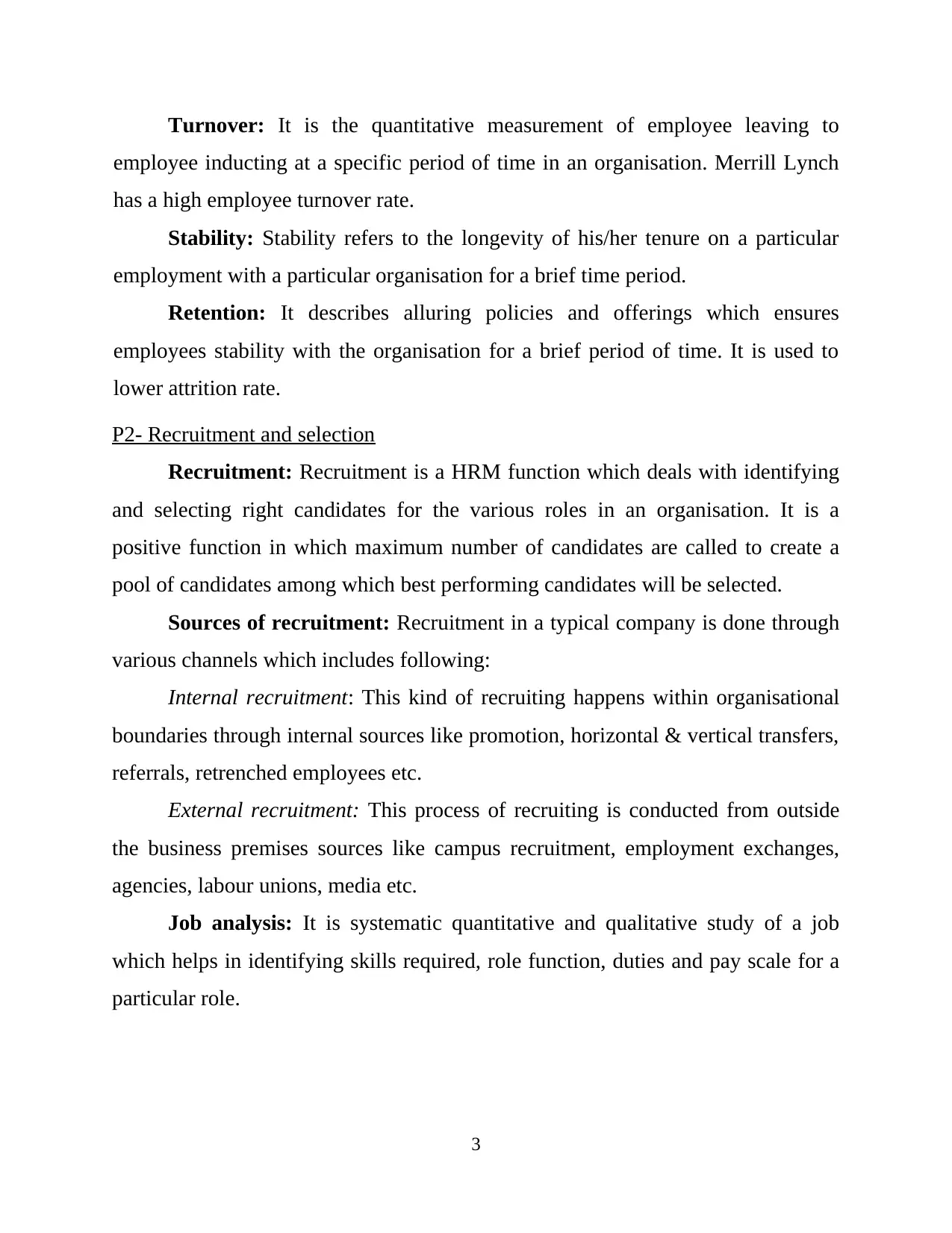
Turnover: It is the quantitative measurement of employee leaving to
employee inducting at a specific period of time in an organisation. Merrill Lynch
has a high employee turnover rate.
Stability: Stability refers to the longevity of his/her tenure on a particular
employment with a particular organisation for a brief time period.
Retention: It describes alluring policies and offerings which ensures
employees stability with the organisation for a brief period of time. It is used to
lower attrition rate.
P2- Recruitment and selection
Recruitment: Recruitment is a HRM function which deals with identifying
and selecting right candidates for the various roles in an organisation. It is a
positive function in which maximum number of candidates are called to create a
pool of candidates among which best performing candidates will be selected.
Sources of recruitment: Recruitment in a typical company is done through
various channels which includes following:
Internal recruitment: This kind of recruiting happens within organisational
boundaries through internal sources like promotion, horizontal & vertical transfers,
referrals, retrenched employees etc.
External recruitment: This process of recruiting is conducted from outside
the business premises sources like campus recruitment, employment exchanges,
agencies, labour unions, media etc.
Job analysis: It is systematic quantitative and qualitative study of a job
which helps in identifying skills required, role function, duties and pay scale for a
particular role.
3
employee inducting at a specific period of time in an organisation. Merrill Lynch
has a high employee turnover rate.
Stability: Stability refers to the longevity of his/her tenure on a particular
employment with a particular organisation for a brief time period.
Retention: It describes alluring policies and offerings which ensures
employees stability with the organisation for a brief period of time. It is used to
lower attrition rate.
P2- Recruitment and selection
Recruitment: Recruitment is a HRM function which deals with identifying
and selecting right candidates for the various roles in an organisation. It is a
positive function in which maximum number of candidates are called to create a
pool of candidates among which best performing candidates will be selected.
Sources of recruitment: Recruitment in a typical company is done through
various channels which includes following:
Internal recruitment: This kind of recruiting happens within organisational
boundaries through internal sources like promotion, horizontal & vertical transfers,
referrals, retrenched employees etc.
External recruitment: This process of recruiting is conducted from outside
the business premises sources like campus recruitment, employment exchanges,
agencies, labour unions, media etc.
Job analysis: It is systematic quantitative and qualitative study of a job
which helps in identifying skills required, role function, duties and pay scale for a
particular role.
3

Job description: It is a detailed document formed on the basis of job
analysis which contains details about the job, role, functions, duties and
responsibilities, skills required and the scope of the job.
Person specification: It is a set of key attributes which includes skills,
knowledge, education, experience and key characteristics which an individual must
possess in order to secure a specific job (CIPD UK, 2018).
Competency framework: It is a strategic model which signifies the
structure of processes to help HRM function at Merrill Lynch in developing with
time and increase efficiency in aligning with business goals.
Selection: It is the next process in recruitment under which selection of right
candidate who possess all the requirements of job description is selected. It is a
negative concept as opposed to recruitment.
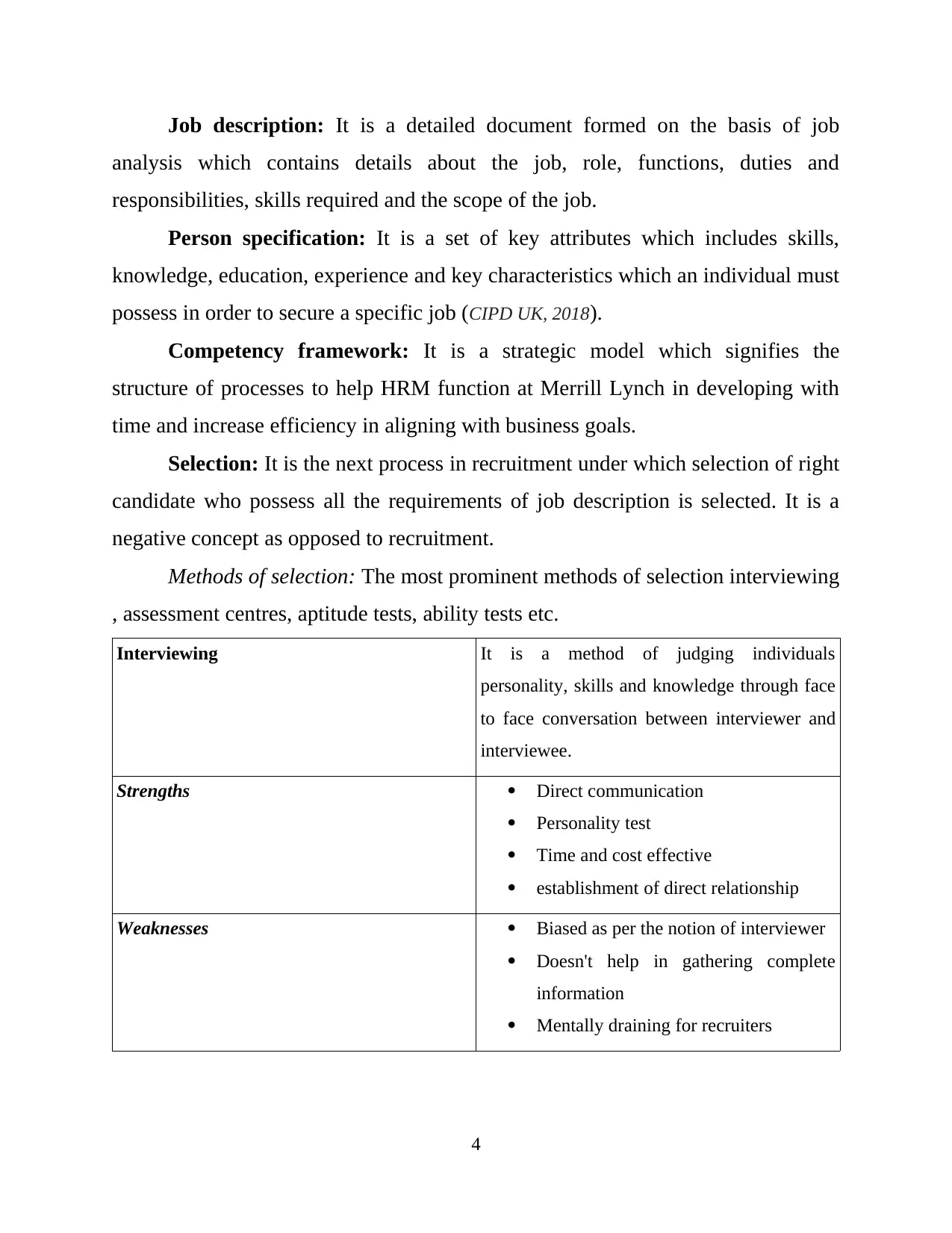
Methods of selection: The most prominent methods of selection interviewing
, assessment centres, aptitude tests, ability tests etc.
Interviewing It is a method of judging individuals
personality, skills and knowledge through face
to face conversation between interviewer and
interviewee.
Strengths Direct communication
Personality test
Time and cost effective
establishment of direct relationship
Weaknesses Biased as per the notion of interviewer
Doesn't help in gathering complete
information
Mentally draining for recruiters
4
analysis which contains details about the job, role, functions, duties and
responsibilities, skills required and the scope of the job.
Person specification: It is a set of key attributes which includes skills,
knowledge, education, experience and key characteristics which an individual must
possess in order to secure a specific job (CIPD UK, 2018).
Competency framework: It is a strategic model which signifies the
structure of processes to help HRM function at Merrill Lynch in developing with
time and increase efficiency in aligning with business goals.
Selection: It is the next process in recruitment under which selection of right
candidate who possess all the requirements of job description is selected. It is a
negative concept as opposed to recruitment.
Methods of selection: The most prominent methods of selection interviewing
, assessment centres, aptitude tests, ability tests etc.
Interviewing It is a method of judging individuals
personality, skills and knowledge through face
to face conversation between interviewer and
interviewee.
Strengths Direct communication
Personality test
Time and cost effective
establishment of direct relationship
Weaknesses Biased as per the notion of interviewer
Doesn't help in gathering complete
information
Mentally draining for recruiters
4
⊘ This is a preview!⊘
Do you want full access?
Subscribe today to unlock all pages.

Trusted by 1+ million students worldwide

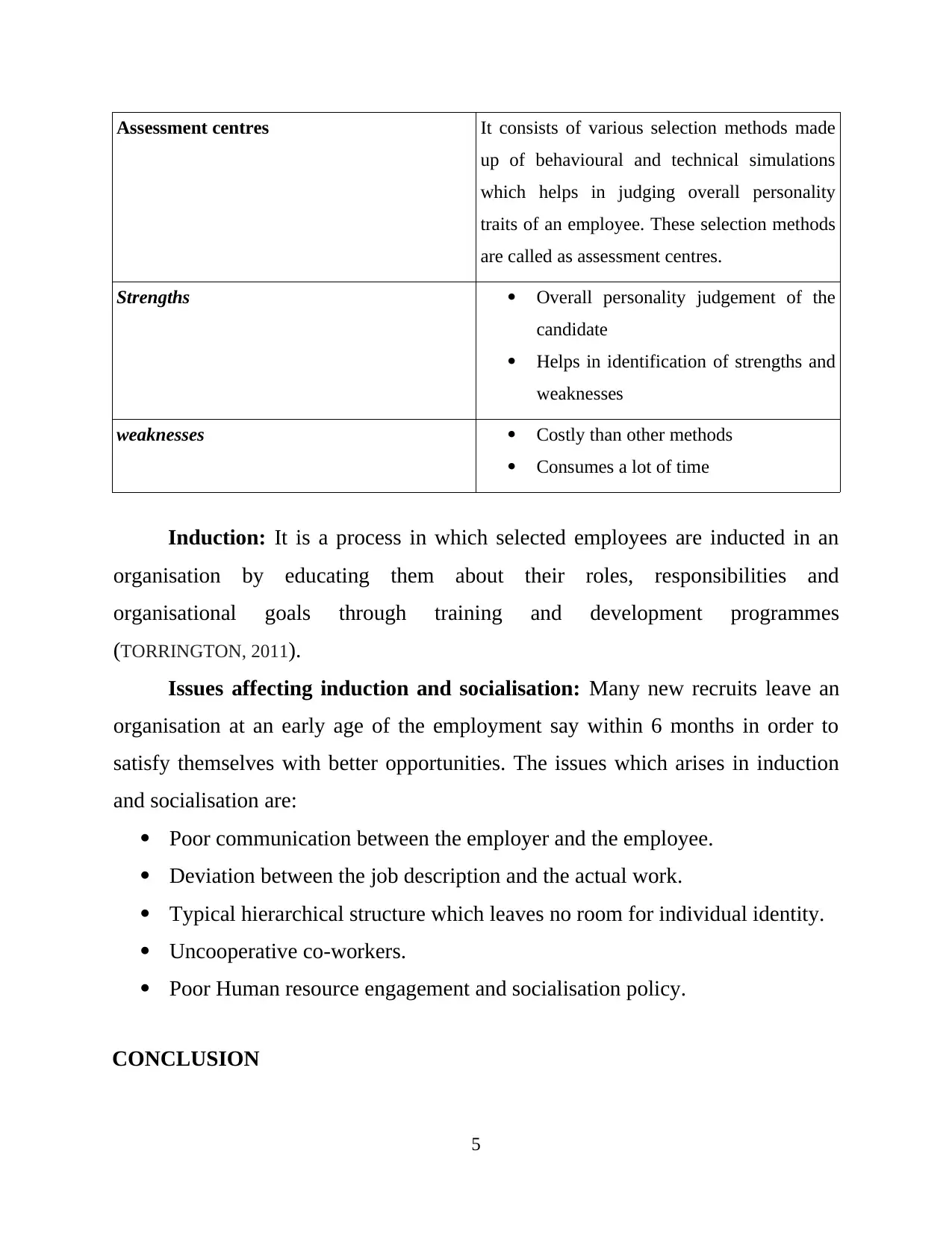
Assessment centres It consists of various selection methods made
up of behavioural and technical simulations
which helps in judging overall personality
traits of an employee. These selection methods
are called as assessment centres.
Strengths Overall personality judgement of the
candidate
Helps in identification of strengths and
weaknesses
weaknesses Costly than other methods
Consumes a lot of time
Induction: It is a process in which selected employees are inducted in an
organisation by educating them about their roles, responsibilities and
organisational goals through training and development programmes
(TORRINGTON, 2011).
Issues affecting induction and socialisation: Many new recruits leave an
organisation at an early age of the employment say within 6 months in order to
satisfy themselves with better opportunities. The issues which arises in induction
and socialisation are:
Poor communication between the employer and the employee.
Deviation between the job description and the actual work.
Typical hierarchical structure which leaves no room for individual identity.
Uncooperative co-workers.
Poor Human resource engagement and socialisation policy.
CONCLUSION
5
up of behavioural and technical simulations
which helps in judging overall personality
traits of an employee. These selection methods
are called as assessment centres.
Strengths Overall personality judgement of the
candidate
Helps in identification of strengths and
weaknesses
weaknesses Costly than other methods
Consumes a lot of time
Induction: It is a process in which selected employees are inducted in an
organisation by educating them about their roles, responsibilities and
organisational goals through training and development programmes
(TORRINGTON, 2011).
Issues affecting induction and socialisation: Many new recruits leave an
organisation at an early age of the employment say within 6 months in order to
satisfy themselves with better opportunities. The issues which arises in induction
and socialisation are:
Poor communication between the employer and the employee.
Deviation between the job description and the actual work.
Typical hierarchical structure which leaves no room for individual identity.
Uncooperative co-workers.
Poor Human resource engagement and socialisation policy.
CONCLUSION
5
Paraphrase This Document
Need a fresh take? Get an instant paraphrase of this document with our AI Paraphraser

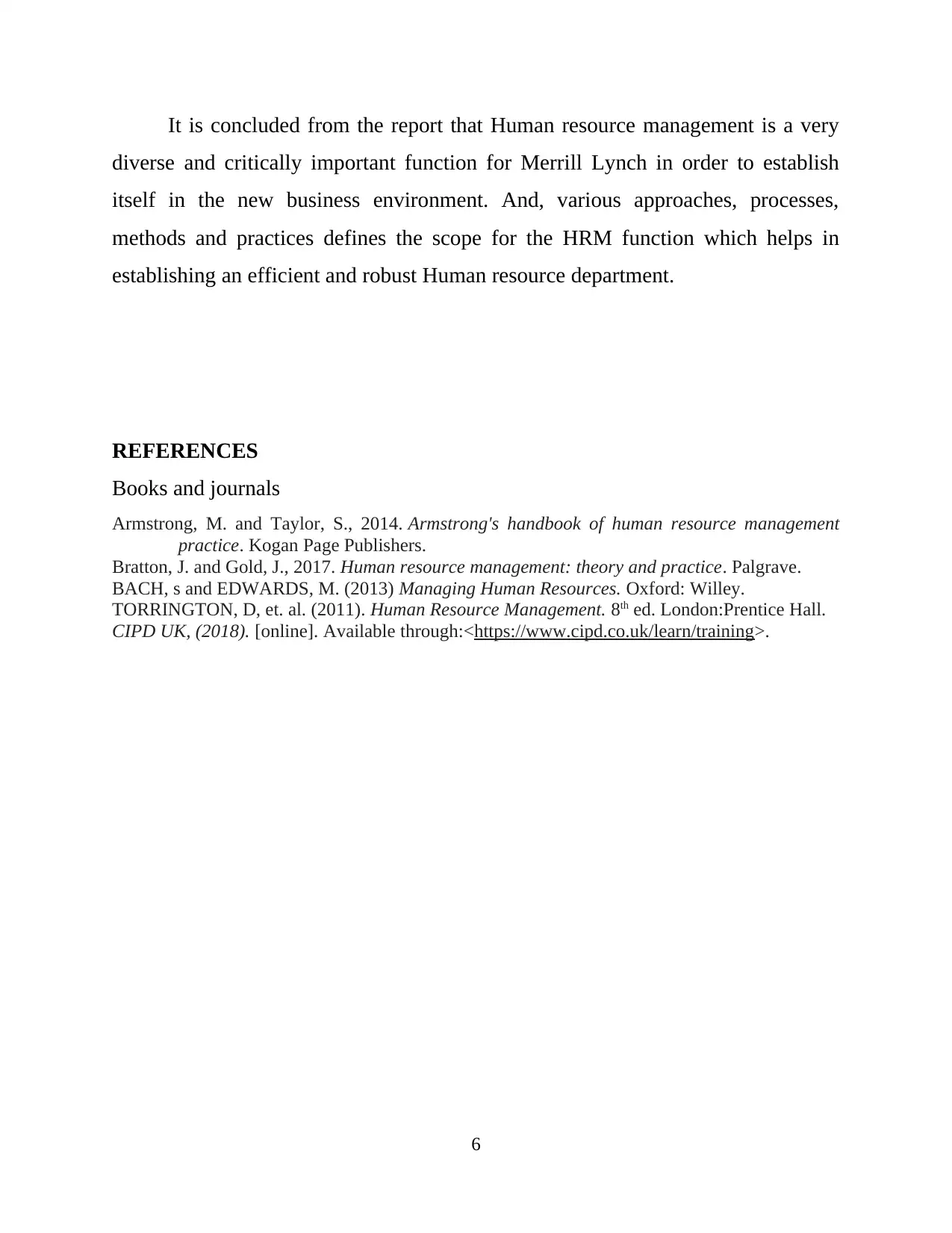
It is concluded from the report that Human resource management is a very
diverse and critically important function for Merrill Lynch in order to establish
itself in the new business environment. And, various approaches, processes,
methods and practices defines the scope for the HRM function which helps in
establishing an efficient and robust Human resource department.
REFERENCES
Books and journals
Armstrong, M. and Taylor, S., 2014. Armstrong's handbook of human resource management
practice. Kogan Page Publishers.
Bratton, J. and Gold, J., 2017. Human resource management: theory and practice. Palgrave.
BACH, s and EDWARDS, M. (2013) Managing Human Resources. Oxford: Willey.
TORRINGTON, D, et. al. (2011). Human Resource Management. 8th ed. London:Prentice Hall.
CIPD UK, (2018). [online]. Available through:<https://www.cipd.co.uk/learn/training>.
6
diverse and critically important function for Merrill Lynch in order to establish
itself in the new business environment. And, various approaches, processes,
methods and practices defines the scope for the HRM function which helps in
establishing an efficient and robust Human resource department.
REFERENCES
Books and journals
Armstrong, M. and Taylor, S., 2014. Armstrong's handbook of human resource management
practice. Kogan Page Publishers.
Bratton, J. and Gold, J., 2017. Human resource management: theory and practice. Palgrave.
BACH, s and EDWARDS, M. (2013) Managing Human Resources. Oxford: Willey.
TORRINGTON, D, et. al. (2011). Human Resource Management. 8th ed. London:Prentice Hall.
CIPD UK, (2018). [online]. Available through:<https://www.cipd.co.uk/learn/training>.
6
1 out of 8
Related Documents
Your All-in-One AI-Powered Toolkit for Academic Success.
+13062052269
info@desklib.com
Available 24*7 on WhatsApp / Email
Unlock your academic potential
Copyright © 2020–2026 A2Z Services. All Rights Reserved. Developed and managed by ZUCOL.