HRM Analysis: Ideal Worker Concepts, Policies & Parental Leave Impact

Verified

Added on  2023/06/11

|9
|1753
|255
Report
AI Summary
This report analyzes Human Resource Management (HRM) practices, focusing on the evolving notion of an ideal worker, the implementation of sustainable part-time work policies, and the impact of recent Australian government initiatives like paid parental leave and dad and partner pay schemes. It addresses issues faced by part-time employees, such as workload imbalances and unequal opportunities, and proposes solutions like reduced working hours and part-time-on-call practices. The report also examines how paid parental leave policies affect employee retention and reduce discrimination, emphasizing the importance of aligning HRM policies with employee needs for a comfortable and equitable working environment. This document is a valuable resource for students; find more solved assignments and past papers on Desklib.
Document Page
Running head: HRM
Human Resource Management
Name of the Student:
Name of the University:
Author’s Note:
tabler-icon-diamond-filled.svg

Paraphrase This Document

Need a fresh take? Get an instant paraphrase of this document with our AI Paraphraser
Document Page
2HRM
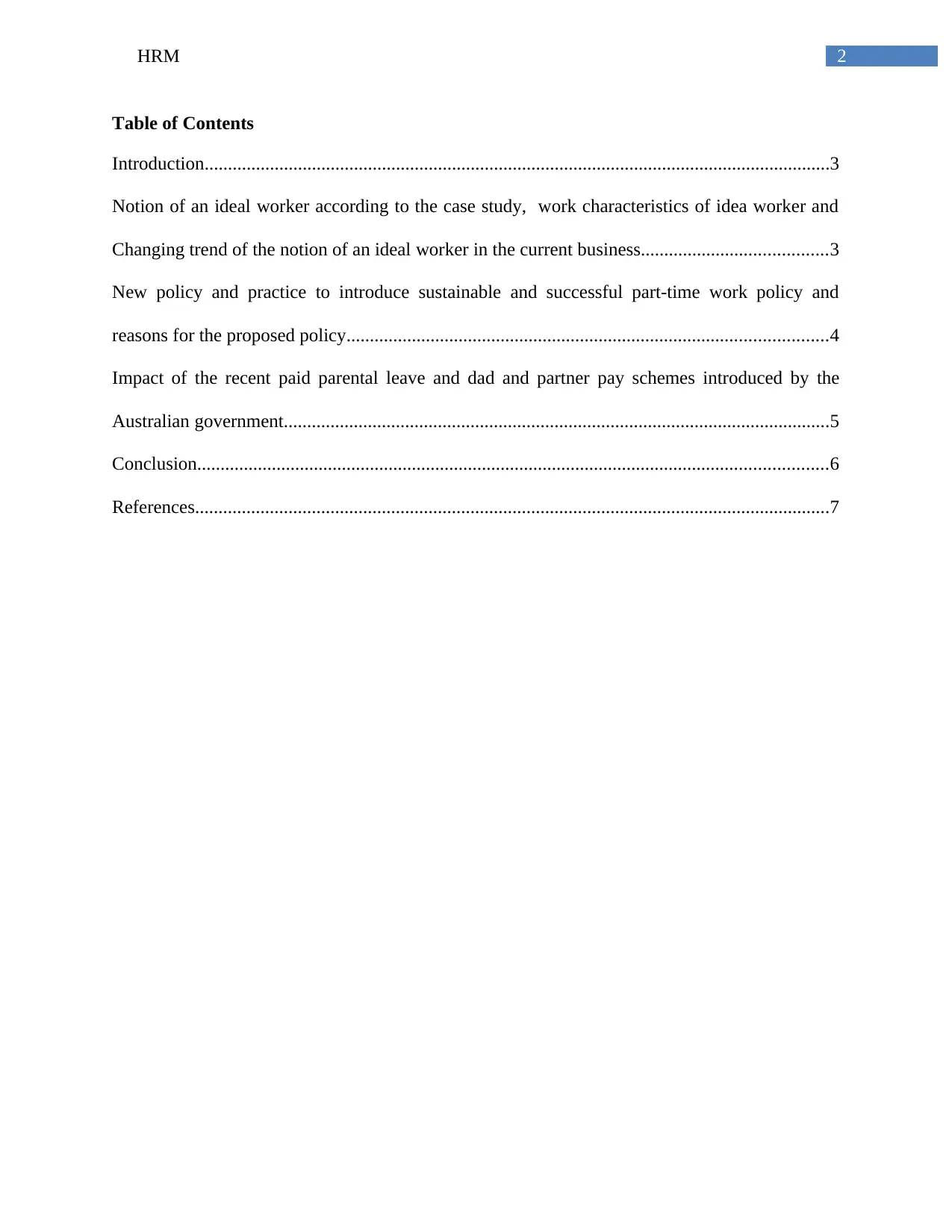
Table of Contents
Introduction......................................................................................................................................3
Notion of an ideal worker according to the case study, work characteristics of idea worker and
Changing trend of the notion of an ideal worker in the current business........................................3
New policy and practice to introduce sustainable and successful part-time work policy and
reasons for the proposed policy.......................................................................................................4
Impact of the recent paid parental leave and dad and partner pay schemes introduced by the
Australian government.....................................................................................................................5
Conclusion.......................................................................................................................................6
References........................................................................................................................................7
Document Page
3HRM
Introduction
Workforce management is a vital part of the human resource management department.
HRM is responsible for creating a particular work design for the employees. Different employees
have different designations and they need a specific type of job design (Malhotra et al. 2013).
This study deals with the job design of the part-time and full-time employees and related issues
and solutions regarding these. Therefore, the responsibilities of human resource management in
job designing will be evaluated in this section.
Notion of an ideal worker according to the case study, work characteristics of idea worker
and changing trend of the notion of an ideal worker in the current business
According to the given scenario, an ideal worker refers to the worker who is available to
work full time. Therefore, the ideal workers need to work for long hours and to do overtime.
However, it is important for an ideal worker to show their job responsibility as like an individual
shows their responsibility for their family. An ideal worker needs to treat their organization as
like their family (Jasri and Rahim 2017). In the operational area, the ideal workers are the male
as they are reliable and more responsible. A male is able to take the entire responsibility of his
family thus; he can carry out his responsibility properly in the operational area. On the other
hand, in white collar group, both male and female employees are present as they need to have
attitude and to provide long hour duty for their organization.
The ideal worker has a relation to the gender, ability of the person and other work
characteristics. Often the HRM department believes that a male employee is able to carry out the
job responsibility properly rather than female employees (Sungur et al. 2017). In the given
Document Page
4HRM
scenario, it has been seen that the public security utility organization has total 3000 employees.
80% employees are male out of total employees. This ensures that this organization is a male-
dominated organization. Therefore, in the operational area, entire employees are female, which
highlights that ideal employees are related to the gender. On the other hand, in a managerial
position both male and female employees are recruited and in this section, the attitude and the
duty hours are considered as the characteristics of ideal employees.
In the recent years, the concept of ideal worker has been changed. At present, the HRM
focuses on implementing the family-friendly policy to make the employees more comfortable in
the workplace (Malhotra et al. 2013). However, the gender discrimination is reduced in the
recent years and both male and female are able to get promotion and equal right in the
workplace. Accountability is the main factor of ideal employees. However, if an employee is
highly accountable and has muck skill then they are considered as the ideal employee. Business
focuses on the skill, knowledge and hard work to identify an ideal employee rather than the
gender.
New policy and practice to introduce sustainable and successful part-time work policy and
reasons for the proposed policy
As per the given scenario, it has been received that the part-time employees of a public
utility sector have been facing issues due to the poor management and work design. However,
the female employees those worked full-time before the birth of their children became the part-
time work when returned to their work. On the other hand, the part-time employees have to take
full-time workload along with pay cut. Therefore, the female employees are forced to accept
part-time job with lower pay when they returned from maternity leave. Therefore, there are
tabler-icon-diamond-filled.svg

Paraphrase This Document

Need a fresh take? Get an instant paraphrase of this document with our AI Paraphraser
Document Page
5HRM
consequences, which affect the rules of anti-discrimination law. In order to deal with this issue
reduction of working hour policy would be helpful. Reduction of working hour policy will allow
the employees to get limited job responsibility based on their pay (Gascoigne and Kelliher 2018).
In the context of this proposed utility sector reduction of working hour would be beneficial as it
could reduce the workload of the part-time employees and to gain the sustainable part-time job in
this organization. Introduction of Part-Time-On-Call or PTOC practice will be effective to
implement the part-time employment successfully. However, based on the given organization
PTOC practice would allow the old as well as the young workers to involve in the short time
project and to share the technical skill. This could bring the sustainability in the part-time work.
Therefore, implementation of the equality policy would be effective for the part-time employees
to get the same value as the full-time employees (Haines et al. 2018). However, in the given
scenario, it has been seen that part-time employees did not get equal training and development
opportunity as the full-time employees. Hence, by the implementation of this policy, they would
get equal opportunity in the workplace.
The main purpose of the proposed work time reduction policy is to give a comfortable
working environment to the part-time workers. Work time reduction is crucial to gain a
sustainable part-time work (Nieuwenhuis and Kossek 2018). Therefore, by introducing PTOC
and equality practice the organization would be able to influence the part-time workers in their
work along with getting equal opportunity.
Document Page
6HRM
Impact of the recent paid parental leave and dad and partner pay schemes introduced by
the Australian government
In the recent years Australian government has introduced paid parental leave and dad and
partner pat scheme to give benefits to the employees. According to this scheme the parents and
the partners will get paid leave to take care to their newly born child (Danzer and Lavy 2018).
However, based on the given scenario, it has found that individuals especially the women face
difficulties regarding the parental leave. Often the employees are unpaid while they take parental
leave and their job patterns are changed by the organization. Hence, this paid parental leave and
partner pay scheme of Australian government will be effective for the employees to reduce their
parental leave related issues. However, the organizations are bounded to implement this policy
and give benefits to the employees. This policy will maximize the employee retention policy in
an organization. Partner pay scheme allows the individuals to take paid leave to support their
partners during the birth of a baby. Any type of discrimination with the employees can be
reduced by implementing this policy. Therefore, this policy also strengthens the work of HRM
by managing the workforce in a proper way. All categories employees such as full time, part
time and contractual employees are eligible for this scheme (Malhotra et al. 2013). Hence, this
policy also gives facility to the part-time employees besides the full time employees.
Conclusion
The above piece of work deals with the issues of the part-time employees and
effectiveness of the paid parental scheme in an organization. It has been found that part-time
employee is often discriminated in the organization and do not get equal opportunity. Therefore,
many employees face issues during the maternal leave. Hence, implementation of paid parental
policy and partner scheme are effective to give comfort to the employees during their work. By
Document Page
7HRM
implementing this policy the HRM department of an organization can retain their employees and
meet their needs. HRM policy should be oriented to employee need. Hence, this policy is
effective to meet the needs of the employees.
tabler-icon-diamond-filled.svg

Paraphrase This Document

Need a fresh take? Get an instant paraphrase of this document with our AI Paraphraser
Document Page
8HRM
References
Bártová, A. and Emery, T., 2018. Measuring policy entitlements at the micro-level: maternity
and parental leave in Europe. Community, Work & Family, 21(1), pp.33-52.
Danzer, N. and Lavy, V., 2018. Paid parental leave and children's schooling outcomes. The
Economic Journal, 128(608), pp.81-117.
Gascoigne, C. and Kelliher, C., 2018. The transition to part-time: How professionals negotiate
‘reduced time and workload’i-deals and craft their jobs. Human Relations, 71(1), pp.103-125.
Haines III, V.Y., Doray-Demers, P. and Martin, V., 2018. Good, bad, and not so sad part-time
employment. Journal of Vocational Behavior, 104, pp.128-140.
Jasri, D.S. and Rahim, R., 2017. Decision Support System Best Employee Assessments with
Technique for Order of Preference by Similarity to Ideal Solution. Int. J. Recent TRENDS Eng.
Res, 3(3), pp.6-17.
Malhotra, N., Mavondo, F., Mukherjee, A. and Hooley, G., 2013. Service quality of frontline
employees: A profile deviation analysis. Journal of Business Research, 66(9), pp.1338-1344.
Nieuwenhuis, R. and Kossek, E.E., 2018. Work-life balance in times of recession, austerity and
beyond.
Sungur, B., Özgüven, C. and Kariper, Y., 2017. Shift scheduling with break windows, ideal
break periods, and ideal waiting times. Flexible Services and Manufacturing Journal, 29(2),
pp.203-222.
Document Page
9HRM
chevron_up_icon
1 out of 9
circle_padding
hide_on_mobile
zoom_out_icon
[object Object]