Introduction to HRM: Functions, Requirements and Contribution Analysis
VerifiedAdded on 2022/10/08
|10
|2855
|25
Report
AI Summary
This report provides a comprehensive analysis of Human Resource Management (HRM) and its significant contributions to organizational performance, focusing on the New Zealand context. It explores five key ways HRM enhances firm performance, including training and development, performance appraisal plans, team culture, talent management, and motivation. The report further examines the interrelation of various HRM functions such as HR planning, induction, talent management, performance management, and remuneration, highlighting their impact on overall organizational effectiveness. Additionally, the report details the human resource requirements for recruitment and selection processes, emphasizing the importance of job role design, recruitment sources, recruitment procedure design, and test mechanisms. The report uses examples from companies like Fletcher Building Ltd, Air New Zealand, Alliance Group, 2degrees, and Arora Energy to illustrate these concepts, providing a practical understanding of HRM practices.
Human Resource Management
INTRODUCTION
TO
HUMAN RESOURCE
MANAGEMENT
INTRODUCTION
TO
HUMAN RESOURCE
MANAGEMENT

Paraphrase This Document
Need a fresh take? Get an instant paraphrase of this document with our AI Paraphraser
1
Human Resource Management
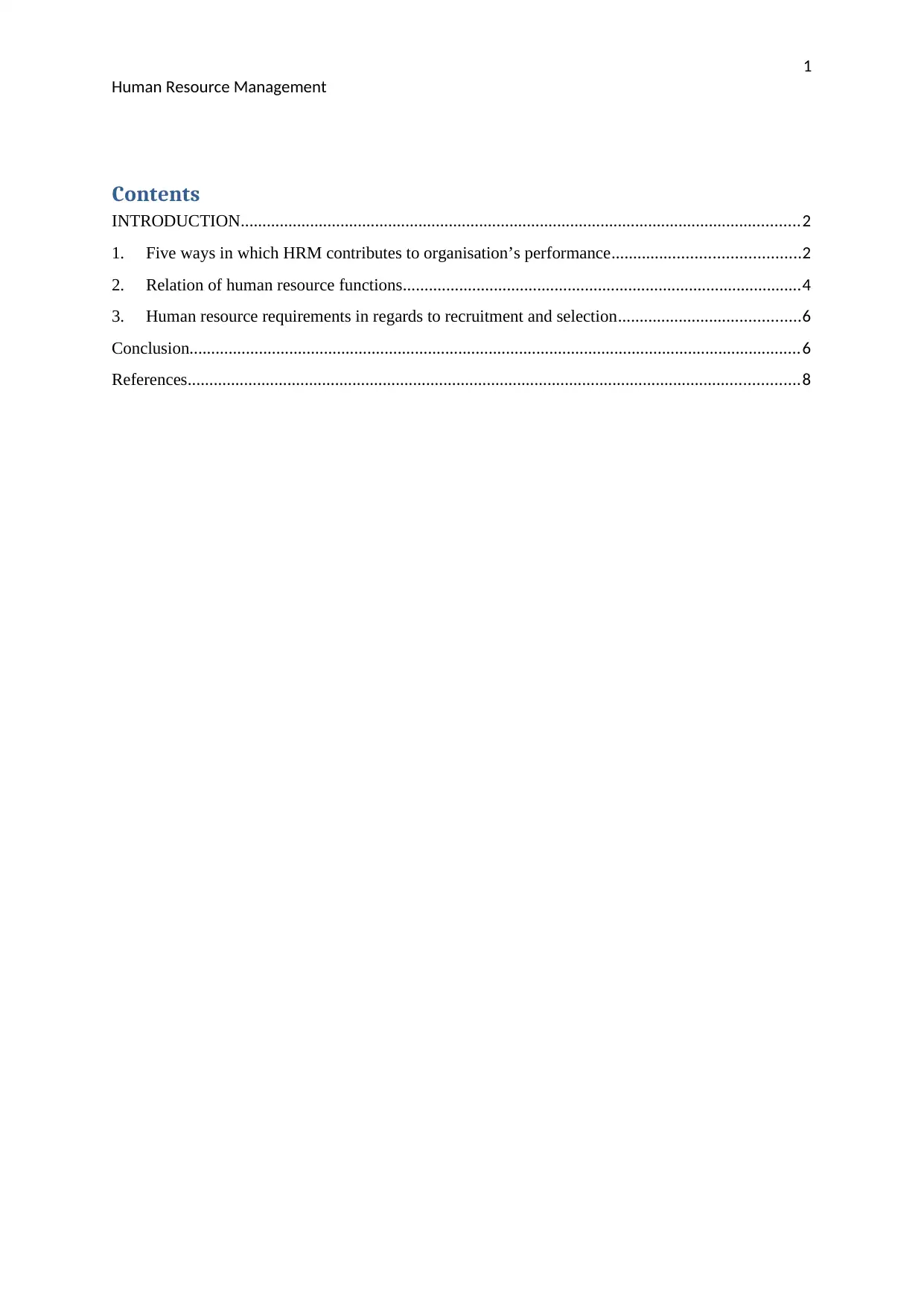
Contents
INTRODUCTION.................................................................................................................................2
1. Five ways in which HRM contributes to organisation’s performance...........................................2
2. Relation of human resource functions............................................................................................4
3. Human resource requirements in regards to recruitment and selection..........................................6
Conclusion.............................................................................................................................................6
References.............................................................................................................................................8
Human Resource Management
Contents
INTRODUCTION.................................................................................................................................2
1. Five ways in which HRM contributes to organisation’s performance...........................................2
2. Relation of human resource functions............................................................................................4
3. Human resource requirements in regards to recruitment and selection..........................................6
Conclusion.............................................................................................................................................6
References.............................................................................................................................................8
2
Human Resource Management
INTRODUCTION
Human Resource Management in today’s time plays a critical role in the success of the
organisation. This is because they have a very major role to play in the performance of the
organisation. This can be illustrated by the fact that human resource is the most effective
resource that a firm has and the effective utilisation of these resources depends on the skills
of the individuals. There are different functions of human resource management which
includes HR planning, Induction, Talent management, performance management and
Remuneration. These functions are inter-related and they have impact on the overall
effectiveness of the organisation (Noe, Hollenbeck, Gerhart & Wright, 2017). In New
Zealand where the competition has gone to higher side, it has become critical for the HR
managers to understand the challenges that they might face in the management of skills and
the way it enhances the overall performance of the organisation. This report illustrates the
five ways in which Human Resource Management contributes to the performance of the firm.
It also shows the relation between human resource management functions. In the last section
of the report illustration about the human resource requirements in regards to recruitment and
selection.
1. Five ways in which HRM contributes to organisation’s performance
There are different ways in which HRM can contribute to organisation’s performance. These
are:
Training and development: New Zealand is facing challenges related to the talent
scarcity and in this regards organisations must be able to have a training and
development program that must be able to make sure that they meet the talent
requirement within the firm and all the employees within the firm must be able to
achieve better performance (Wright & McMahan, 2011). For example in the Fletcher
Building Ltd is a heavy construction company where they have made changes in their
training intensity where it was seen that overall employees performance got enhanced
which has increased the performance of the organisation. Training also allows
companies to make sure that employees do not lose focus from the objective that they
have given by the company. Continuous training is required within the firm as it will
allow the company to make sure that they have a plan for the knowledge and skill
development within the firm. Fletcher Building Ltd. understands the technology
Human Resource Management
INTRODUCTION
Human Resource Management in today’s time plays a critical role in the success of the
organisation. This is because they have a very major role to play in the performance of the
organisation. This can be illustrated by the fact that human resource is the most effective
resource that a firm has and the effective utilisation of these resources depends on the skills
of the individuals. There are different functions of human resource management which
includes HR planning, Induction, Talent management, performance management and
Remuneration. These functions are inter-related and they have impact on the overall
effectiveness of the organisation (Noe, Hollenbeck, Gerhart & Wright, 2017). In New
Zealand where the competition has gone to higher side, it has become critical for the HR
managers to understand the challenges that they might face in the management of skills and
the way it enhances the overall performance of the organisation. This report illustrates the
five ways in which Human Resource Management contributes to the performance of the firm.
It also shows the relation between human resource management functions. In the last section
of the report illustration about the human resource requirements in regards to recruitment and
selection.
1. Five ways in which HRM contributes to organisation’s performance
There are different ways in which HRM can contribute to organisation’s performance. These
are:
Training and development: New Zealand is facing challenges related to the talent
scarcity and in this regards organisations must be able to have a training and
development program that must be able to make sure that they meet the talent
requirement within the firm and all the employees within the firm must be able to
achieve better performance (Wright & McMahan, 2011). For example in the Fletcher
Building Ltd is a heavy construction company where they have made changes in their
training intensity where it was seen that overall employees performance got enhanced
which has increased the performance of the organisation. Training also allows
companies to make sure that employees do not lose focus from the objective that they
have given by the company. Continuous training is required within the firm as it will
allow the company to make sure that they have a plan for the knowledge and skill
development within the firm. Fletcher Building Ltd. understands the technology
⊘ This is a preview!⊘
Do you want full access?
Subscribe today to unlock all pages.

Trusted by 1+ million students worldwide
3
Human Resource Management
requirements and hence they also upgrade their training at regular intervals so as to
ensure that organisational performance remains on the higher side.
Performance appraisal plan: It is essential for the management to have an
understanding about the fact that higher motivation takes out better performance from
the employees and in this regards it is critical for the management to make sure that
they develop a performance appraisal plan that takes out maximum from the
organisations (Armstrong & Taylor, 2014). For example Air New Zealand has
developed a performance appraisal plan that motivated employees to take out
maximum from them. This allowed them to achieve higher organisational
performance. Appraisals plans need to be designed according to the employees and
for this company needs to have a plan in which they involve employees. This is
necessary for the companies as it enhance the will of the people and also enhances
their loyalty. This is critical for the management of skills (Boxall & Purcell, 2011).
Team culture: HRM has the role to make teams within the organisation that will be
able to take out maximum from the employees. This is necessary for improving the
effectiveness of the individuals and at the same time it will also allow the company to
create a better workplace where everyone supports everyone else (Guest, 2011). For
example Alliance Group is one of the best examples where the change in the culture
to team culture has allowed them to enhance the overall performance of the
organisation.
Talent management: One of the critical aspects of the modern day business is that
talent requirement within the firm is increasing and this enhancement in the
requirement of talent has allowed the company to make progress at the speed that they
wanted. Better the talent within the firm better is the chance that they can perform. In
this regards most important role is played by recruitment and selection done by HRM
(Hoque, 2013). For example in 2degrees the company changed its recruitment and
selection procedure which allowed them to hire best of talent which ultimately
enhanced the overall performance of the organisation.
Motivation: Performance of the individuals depends on the level to which they are
motivated. In this regards it is highly critical role is played by the HRM as they can
motivate their employees (Daley, 2012). This employee motivation will have a direct
impact on the overall performance of the company. For example the company like
Arora Energy has empowered their employees by enhancing their employee
engagement in the decision making which again has impact on the way an
Human Resource Management
requirements and hence they also upgrade their training at regular intervals so as to
ensure that organisational performance remains on the higher side.
Performance appraisal plan: It is essential for the management to have an
understanding about the fact that higher motivation takes out better performance from
the employees and in this regards it is critical for the management to make sure that
they develop a performance appraisal plan that takes out maximum from the
organisations (Armstrong & Taylor, 2014). For example Air New Zealand has
developed a performance appraisal plan that motivated employees to take out
maximum from them. This allowed them to achieve higher organisational
performance. Appraisals plans need to be designed according to the employees and
for this company needs to have a plan in which they involve employees. This is
necessary for the companies as it enhance the will of the people and also enhances
their loyalty. This is critical for the management of skills (Boxall & Purcell, 2011).
Team culture: HRM has the role to make teams within the organisation that will be
able to take out maximum from the employees. This is necessary for improving the
effectiveness of the individuals and at the same time it will also allow the company to
create a better workplace where everyone supports everyone else (Guest, 2011). For
example Alliance Group is one of the best examples where the change in the culture
to team culture has allowed them to enhance the overall performance of the
organisation.
Talent management: One of the critical aspects of the modern day business is that
talent requirement within the firm is increasing and this enhancement in the
requirement of talent has allowed the company to make progress at the speed that they
wanted. Better the talent within the firm better is the chance that they can perform. In
this regards most important role is played by recruitment and selection done by HRM
(Hoque, 2013). For example in 2degrees the company changed its recruitment and
selection procedure which allowed them to hire best of talent which ultimately
enhanced the overall performance of the organisation.
Motivation: Performance of the individuals depends on the level to which they are
motivated. In this regards it is highly critical role is played by the HRM as they can
motivate their employees (Daley, 2012). This employee motivation will have a direct
impact on the overall performance of the company. For example the company like
Arora Energy has empowered their employees by enhancing their employee
engagement in the decision making which again has impact on the way an
Paraphrase This Document
Need a fresh take? Get an instant paraphrase of this document with our AI Paraphraser
4
Human Resource Management
organisation is performing. The management at this organisation provides both
monetary and non-monetary rewards so as to ensure that their performance remains
on the other side.
2. Relation of human resource functions
There are different human resource functionalities and it has become critical for the
management to have an understanding about different functionalities and the relation between
them. Every organisational function has a deep relation with each other.
HR Planning: Organisational HR planning is done with the help of best fit approach
by management. In this a company needs to have an understanding about the job roles
for which recruitment has to be done and the employees that will be selected. For
instance the forecasting of the employee demands in the future along with finding the
sustainability in the management. This has relation with the Talent management
within the firm (Briscoe, Tarique & Schuler, 2012). This can be understood in the
term of fact that there are people from different parts of the world and it is necessary
for the management to have an understanding that they manage the skills in an
appropriate manner. HR planning also needs to be done about the remuneration. This
is because in future the HR requirements are changing and in this environment, it is
critical for the company to control their cost related to the HR management.
According to the HR planning a company needs to design their induction program and
accordingly they need to motivate their employees. HR planning also has relation
with the performance management as it allows a company to make sure that they have
a mechanism for development performance for which need to have skills development
(Jackson, Schuler & Jiang, 2014).
Induction: This HR function also has critical role in the success of the organisation.
This can be understood in terms of the fact that it is the induction that helps the
employees to get friendly with the challenges faced by the company. Induction has a
relation with HR planning as it allowed the firms to ensure that employees will remain
in the organisation for longer period of time. Induction also allows in performance
management as in the induction all the details about what companies expect from
them is conveyed along with the policies and skills of the individuals (Bratton &
Gold, 2017). This is critical for the performance improvement.
Human Resource Management
organisation is performing. The management at this organisation provides both
monetary and non-monetary rewards so as to ensure that their performance remains
on the other side.
2. Relation of human resource functions
There are different human resource functionalities and it has become critical for the
management to have an understanding about different functionalities and the relation between
them. Every organisational function has a deep relation with each other.
HR Planning: Organisational HR planning is done with the help of best fit approach
by management. In this a company needs to have an understanding about the job roles
for which recruitment has to be done and the employees that will be selected. For
instance the forecasting of the employee demands in the future along with finding the
sustainability in the management. This has relation with the Talent management
within the firm (Briscoe, Tarique & Schuler, 2012). This can be understood in the
term of fact that there are people from different parts of the world and it is necessary
for the management to have an understanding that they manage the skills in an
appropriate manner. HR planning also needs to be done about the remuneration. This
is because in future the HR requirements are changing and in this environment, it is
critical for the company to control their cost related to the HR management.
According to the HR planning a company needs to design their induction program and
accordingly they need to motivate their employees. HR planning also has relation
with the performance management as it allows a company to make sure that they have
a mechanism for development performance for which need to have skills development
(Jackson, Schuler & Jiang, 2014).
Induction: This HR function also has critical role in the success of the organisation.
This can be understood in terms of the fact that it is the induction that helps the
employees to get friendly with the challenges faced by the company. Induction has a
relation with HR planning as it allowed the firms to ensure that employees will remain
in the organisation for longer period of time. Induction also allows in performance
management as in the induction all the details about what companies expect from
them is conveyed along with the policies and skills of the individuals (Bratton &
Gold, 2017). This is critical for the performance improvement.
5
Human Resource Management
Talent Management: Talent management initiatives need to be design in a manner that
it is not only able to meet the present workforce requirement but it carters the future
need of the company. Talent management starts from the day any person is recruited
within the firm and it is essential that HR manager manages the induction program in
such a manner that they are able to meet the expectation of the company (Stahl,
Björkman & Morris, 2012). Having cultural understanding about the company is
critical and at the time of induction this needs to be done in an appropriate manner.
Talent management also has deeper impacts with the remuneration done by the
company. This is because the amount of money that will be paid for any particular job
will have impact on the fact that whether an employee will stay in the organisation for
the longer period of time or not as it is critical for the motivation.
Performance management: In the time when the competition is touching new heights,
performance management is critical for the company as it allows them to achieve the
desired benefits from the employees and at the same time ensure that company is able
to achieve their decided goals. It is critical for the management to make sure that they
train the employees. With the enhancement in the skill requirements, it is critical for
the management to have training that is design for improving the skills of the people
(Jiang, Lepak, Han, Hong, Kim & Winkler, 2012). This training also has impact on
the way an organisation is dealing with the current and future talent requirement. For
example in the Bank of New Zealand there was a serious need of the improving the
talent skill in terms of the new technology that was installed within the Bank and due
to this they need to have skills related to the way in which technology can be used. In
New Zealand the internet infrastructure is highly developed hence bank wanted to put
most of their operations on the automated technologies. This kind of HR planning
cannot be possible without the help of training and development initiatives.
Remuneration: This has a deeper impact on all the HR function. This is because it is
the Remuneration that allows the firm to make sure that they have employees for their
future. This enables them to manage the operations of the HR in the future
(Chandrasekar, 2011). Remuneration allows the company to have a better relation will
the employees which help in the function such as talent management and performance
management. It also has relation with induction in which people are told about the
ways in which they will be benefited from working with this organisation.
Human Resource Management
Talent Management: Talent management initiatives need to be design in a manner that
it is not only able to meet the present workforce requirement but it carters the future
need of the company. Talent management starts from the day any person is recruited
within the firm and it is essential that HR manager manages the induction program in
such a manner that they are able to meet the expectation of the company (Stahl,
Björkman & Morris, 2012). Having cultural understanding about the company is
critical and at the time of induction this needs to be done in an appropriate manner.
Talent management also has deeper impacts with the remuneration done by the
company. This is because the amount of money that will be paid for any particular job
will have impact on the fact that whether an employee will stay in the organisation for
the longer period of time or not as it is critical for the motivation.
Performance management: In the time when the competition is touching new heights,
performance management is critical for the company as it allows them to achieve the
desired benefits from the employees and at the same time ensure that company is able
to achieve their decided goals. It is critical for the management to make sure that they
train the employees. With the enhancement in the skill requirements, it is critical for
the management to have training that is design for improving the skills of the people
(Jiang, Lepak, Han, Hong, Kim & Winkler, 2012). This training also has impact on
the way an organisation is dealing with the current and future talent requirement. For
example in the Bank of New Zealand there was a serious need of the improving the
talent skill in terms of the new technology that was installed within the Bank and due
to this they need to have skills related to the way in which technology can be used. In
New Zealand the internet infrastructure is highly developed hence bank wanted to put
most of their operations on the automated technologies. This kind of HR planning
cannot be possible without the help of training and development initiatives.
Remuneration: This has a deeper impact on all the HR function. This is because it is
the Remuneration that allows the firm to make sure that they have employees for their
future. This enables them to manage the operations of the HR in the future
(Chandrasekar, 2011). Remuneration allows the company to have a better relation will
the employees which help in the function such as talent management and performance
management. It also has relation with induction in which people are told about the
ways in which they will be benefited from working with this organisation.
⊘ This is a preview!⊘
Do you want full access?
Subscribe today to unlock all pages.
Trusted by 1+ million students worldwide
6
Human Resource Management
3. Human resource requirements in regards to recruitment and selection
Recruitment and Selection is a continuous process of finding out the best candidates for any
specific positions. These vacant positions are filled with the best of talents from best of
sources so as to achieve the desired objectives of the organisation. Some of the requirements
are:
Job role design: It is critical to design effective job roles as it is necessary for ensuring
that management have an understanding about what is the actual requirement of the
company. In this the description about the company’s demand for the employees must
be illustrated.
Source of recruitment: There are many sources through which recruitment is done.
First is that in today’s time it is critical to utilise technology that can help the
company to hire talents from the global locations (Iles, Preece & Chuai, 2010). Source
of recruitment could be online sites such as LinkedIn, Universities and on-site job
post. Companies in New Zealand can also hire people with the help of third party
recruiters.
Recruitment procedure design: It is critical for the companies in New Zealand to
make sure that they have a proper recruitment procedure design that would help the
firm to hire the best of talents (Elnaga & Imran, 2013). This needs to be done with the
help of technology as it would help the firm in improving the effectiveness of the
whole process and at the same time it would also assist the firms from New Zealand
to hire people from all across the globe.
Test mechanism: It is necessary for the organisations to make sure that a firm chooses
the best candidate among all others. This can be done through rigorous tests and
capacity analysis test (Brewster, Vernon, Sparrow & Houldsworth, 2016). It is always
better to put individuals under virtual conditions so as to ensure that best candidates
get selected.
Conclusion
From the above based report it can be concluded that Human Resource Management plays a
major role in the performance of the company. This also goes true with the fact that it is the
human resource whose efficiency decides the way in which other resources will be utilised
within the firm. Training and development, Performance appraisal plan, Team culture, Talent
management and Motivation are the five ways in which HRM can enhance the organisational
Human Resource Management
3. Human resource requirements in regards to recruitment and selection
Recruitment and Selection is a continuous process of finding out the best candidates for any
specific positions. These vacant positions are filled with the best of talents from best of
sources so as to achieve the desired objectives of the organisation. Some of the requirements
are:
Job role design: It is critical to design effective job roles as it is necessary for ensuring
that management have an understanding about what is the actual requirement of the
company. In this the description about the company’s demand for the employees must
be illustrated.
Source of recruitment: There are many sources through which recruitment is done.
First is that in today’s time it is critical to utilise technology that can help the
company to hire talents from the global locations (Iles, Preece & Chuai, 2010). Source
of recruitment could be online sites such as LinkedIn, Universities and on-site job
post. Companies in New Zealand can also hire people with the help of third party
recruiters.
Recruitment procedure design: It is critical for the companies in New Zealand to
make sure that they have a proper recruitment procedure design that would help the
firm to hire the best of talents (Elnaga & Imran, 2013). This needs to be done with the
help of technology as it would help the firm in improving the effectiveness of the
whole process and at the same time it would also assist the firms from New Zealand
to hire people from all across the globe.
Test mechanism: It is necessary for the organisations to make sure that a firm chooses
the best candidate among all others. This can be done through rigorous tests and
capacity analysis test (Brewster, Vernon, Sparrow & Houldsworth, 2016). It is always
better to put individuals under virtual conditions so as to ensure that best candidates
get selected.
Conclusion
From the above based report it can be concluded that Human Resource Management plays a
major role in the performance of the company. This also goes true with the fact that it is the
human resource whose efficiency decides the way in which other resources will be utilised
within the firm. Training and development, Performance appraisal plan, Team culture, Talent
management and Motivation are the five ways in which HRM can enhance the organisational
Paraphrase This Document
Need a fresh take? Get an instant paraphrase of this document with our AI Paraphraser
7
Human Resource Management
performance. All the HR functional is related with each other and contributes to the overall
effectiveness of the firm. Job role design, Source of recruitment, Recruitment procedure
design and selecting the best candidate are some of the major requirement for recruitment and
selection procedure.
Human Resource Management
performance. All the HR functional is related with each other and contributes to the overall
effectiveness of the firm. Job role design, Source of recruitment, Recruitment procedure
design and selecting the best candidate are some of the major requirement for recruitment and
selection procedure.
8
Human Resource Management
References
Armstrong, M., & Taylor, S. (2014). Armstrong's handbook of human resource management
practice. Kogan Page Publishers.
Boxall, P., & Purcell, J. (2011). Strategy and human resource management. Macmillan
International Higher Education.
Bratton, J., & Gold, J. (2017). Human resource management: theory and practice. Palgrave.
Brewster, C., Vernon, G., Sparrow, P., & Houldsworth, E. (2016). International human
resource management. Kogan Page Publishers.
Briscoe, D., Tarique, I., & Schuler, R. (2012). International human resource management:
Policies and practices for multinational enterprises. Routledge.
Chandrasekar, K. (2011). Workplace environment and its impact on organisational
performance in public sector organisations. International journal of enterprise
computing and business systems, 1(1), 1-19.
Daley, D. M. (2012). Strategic human resources management. Public Personnel
Management, 120-125.
Elnaga, A., & Imran, A. (2013). The effect of training on employee performance. European
Journal of Business and Management, 5(4), 137-147.
Guest, D. E. (2011). Human resource management and performance: still searching for some
answers. Human resource management journal, 21(1), 3-13.
Hoque, K. (2013). Human resource management in the hotel industry: Strategy, innovation
and performance. Routledge.
Iles, P., Preece, D., & Chuai, X. (2010). Talent management as a management fashion in
HRD: Towards a research agenda. Human Resource Development
International, 13(2), 125-145.
Jackson, S. E., Schuler, R. S., & Jiang, K. (2014). An aspirational framework for strategic
human resource management. The Academy of Management Annals, 8(1), 1-56.
Human Resource Management
References
Armstrong, M., & Taylor, S. (2014). Armstrong's handbook of human resource management
practice. Kogan Page Publishers.
Boxall, P., & Purcell, J. (2011). Strategy and human resource management. Macmillan
International Higher Education.
Bratton, J., & Gold, J. (2017). Human resource management: theory and practice. Palgrave.
Brewster, C., Vernon, G., Sparrow, P., & Houldsworth, E. (2016). International human
resource management. Kogan Page Publishers.
Briscoe, D., Tarique, I., & Schuler, R. (2012). International human resource management:
Policies and practices for multinational enterprises. Routledge.
Chandrasekar, K. (2011). Workplace environment and its impact on organisational
performance in public sector organisations. International journal of enterprise
computing and business systems, 1(1), 1-19.
Daley, D. M. (2012). Strategic human resources management. Public Personnel
Management, 120-125.
Elnaga, A., & Imran, A. (2013). The effect of training on employee performance. European
Journal of Business and Management, 5(4), 137-147.
Guest, D. E. (2011). Human resource management and performance: still searching for some
answers. Human resource management journal, 21(1), 3-13.
Hoque, K. (2013). Human resource management in the hotel industry: Strategy, innovation
and performance. Routledge.
Iles, P., Preece, D., & Chuai, X. (2010). Talent management as a management fashion in
HRD: Towards a research agenda. Human Resource Development
International, 13(2), 125-145.
Jackson, S. E., Schuler, R. S., & Jiang, K. (2014). An aspirational framework for strategic
human resource management. The Academy of Management Annals, 8(1), 1-56.
⊘ This is a preview!⊘
Do you want full access?
Subscribe today to unlock all pages.
Trusted by 1+ million students worldwide
9
Human Resource Management
Jiang, K., Lepak, D. P., Han, K., Hong, Y., Kim, A., & Winkler, A. L. (2012). Clarifying the
construct of human resource systems: Relating human resource management to
employee performance. Human Resource Management Review, 22(2), 73-85.
Noe, R. A., Hollenbeck, J. R., Gerhart, B., & Wright, P. M. (2017). Human resource
management: Gaining a competitive advantage. New York, NY: McGraw-Hill
Education.
Stahl, G. K., Björkman, I., & Morris, S. (Eds.). (2012). Handbook of research in
international human resource management. Edward Elgar Publishing.
Wright, P. M., & McMahan, G. C. (2011). Exploring human capital: putting ‘human’back
into strategic human resource management. Human resource management
journal, 21(2), 93-104.
Human Resource Management
Jiang, K., Lepak, D. P., Han, K., Hong, Y., Kim, A., & Winkler, A. L. (2012). Clarifying the
construct of human resource systems: Relating human resource management to
employee performance. Human Resource Management Review, 22(2), 73-85.
Noe, R. A., Hollenbeck, J. R., Gerhart, B., & Wright, P. M. (2017). Human resource
management: Gaining a competitive advantage. New York, NY: McGraw-Hill
Education.
Stahl, G. K., Björkman, I., & Morris, S. (Eds.). (2012). Handbook of research in
international human resource management. Edward Elgar Publishing.
Wright, P. M., & McMahan, G. C. (2011). Exploring human capital: putting ‘human’back
into strategic human resource management. Human resource management
journal, 21(2), 93-104.

1 out of 10


Related Documents


Your All-in-One AI-Powered Toolkit for Academic Success.
+13062052269
info@desklib.com
Available 24*7 on WhatsApp / Email
![[object Object]](/_next/static/media/star-bottom.7253800d.svg)
Unlock your academic potential
Copyright © 2020–2026 A2Z Services. All Rights Reserved. Developed and managed by ZUCOL.