Human Resource Management Plan for Sporting Goods Inc. - BUSI2103
VerifiedAdded on 2022/09/07
|9
|2484
|32
Report
AI Summary
This report presents a comprehensive human resource management plan, addressing the challenges faced by Sporting Goods Incorporated due to shifting customer preferences and declining in-store sales. The plan analyzes the forecasted demand for labor, considering factors like sales revenue and employee turnover, and identifies potential labor shortages. It proposes strategies to mitigate these shortages, including staff reductions, revisions of exit policies, and employee training programs. The report emphasizes the importance of strategic workforce planning, including cross-functional training and the adoption of change management models. Furthermore, it delves into the significance of labor forecasting, analyzing various factors such as absenteeism, resignations, and machine breakdowns. Recommendations are provided to address labor surpluses, optimize resource allocation, and align the workforce with the changing business needs, ensuring the franchise owner's success.

Running head: HUMAN RESOURCE MANAGEMENT
Human Resource Management Plan
Name of the Student:
Name of the university:
Author Note:
Human Resource Management Plan
Name of the Student:
Name of the university:
Author Note:

Paraphrase This Document
Need a fresh take? Get an instant paraphrase of this document with our AI Paraphraser
1
HUMAN RESOURCE MANAGEMENT
Part 2
1.
a. Labour shortage is predicted, as the demand exceeds the supply. One of the striking facts is
that it results in internal movements like transfer, promotion, performance management and
training. Labour shortages contradicts the aspect of performance management and training.
This shortage contributes to the delays in completing the orders as per the requirements of the
customers (Dessler & Chhinze, 2018). This issue is detected at the early stage of entry level
vacancies, aggravating the complexities in the recruitment and selection process. One of the
striking facts is the disproportionate relationship between skill inventories of the employees
and the managers. Replacement charts was not proper, which added an interrogative
parameter to the filling up of the vacant positions. Succession plans lacked alignment to the
identified and specified job requirements. According to the arguments of Dessler and
Chhinze, (2018), there was an absence of incapability towards identification of the skills and
its development. Consideration of the potential successors and their competencies was
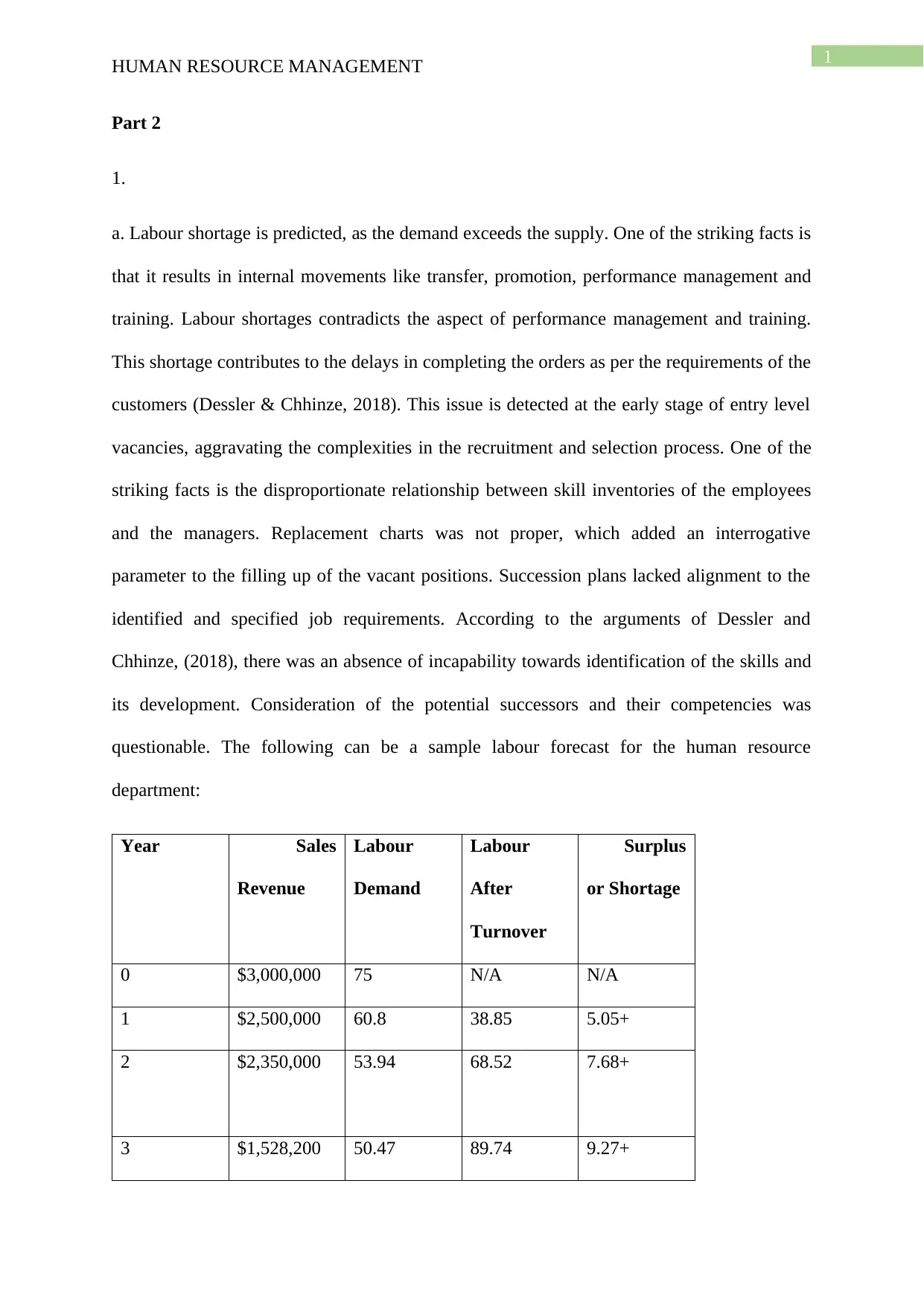
questionable. The following can be a sample labour forecast for the human resource
department:
Year Sales
Revenue
Labour
Demand
Labour
After
Turnover
Surplus
or Shortage
0 $3,000,000 75 N/A N/A
1 $2,500,000 60.8 38.85 5.05+
2 $2,350,000 53.94 68.52 7.68+
3 $1,528,200 50.47 89.74 9.27+
HUMAN RESOURCE MANAGEMENT
Part 2
1.
a. Labour shortage is predicted, as the demand exceeds the supply. One of the striking facts is
that it results in internal movements like transfer, promotion, performance management and
training. Labour shortages contradicts the aspect of performance management and training.
This shortage contributes to the delays in completing the orders as per the requirements of the
customers (Dessler & Chhinze, 2018). This issue is detected at the early stage of entry level
vacancies, aggravating the complexities in the recruitment and selection process. One of the
striking facts is the disproportionate relationship between skill inventories of the employees
and the managers. Replacement charts was not proper, which added an interrogative
parameter to the filling up of the vacant positions. Succession plans lacked alignment to the
identified and specified job requirements. According to the arguments of Dessler and
Chhinze, (2018), there was an absence of incapability towards identification of the skills and
its development. Consideration of the potential successors and their competencies was
questionable. The following can be a sample labour forecast for the human resource
department:
Year Sales
Revenue
Labour
Demand
Labour
After
Turnover
Surplus
or Shortage
0 $3,000,000 75 N/A N/A
1 $2,500,000 60.8 38.85 5.05+
2 $2,350,000 53.94 68.52 7.68+
3 $1,528,200 50.47 89.74 9.27+
2
HUMAN RESOURCE MANAGEMENT
b. The in-store staffs need to be aware of the labour force downsizing. Staff reductions can
aggravate the complexities for the existing employees regarding the execution of assigned
duties and responsibilities. Massive terminations need to be controlled through revision of the
parameters of the exit policies, terms and conditions. In this context, mention can be made of
the one to one sessions, which would enhance the awareness about the reasons behind switch
over. Dessler and Chhinze, (2018) opines that participative management style from the
Operational Manager and Human Resource Manager would be assistance for empowering the
employees towards their individualism. These sessions are effective for averting the instances
of conflicts, discrimination and harassments. Unexpected turnovers are obstacles in the
process of delivering the orders as per the requirements.
Meetings can be conducted for planning alternative means of labour and resource
allocation. In case of absence of any effective plans and solutions, in-store resource
termination can be adopted for hiring the rightful employees. The termination costs is to be
aligned with the budget for ensuring that there are no discrepancies. Employee turnover and
restructuring can be costly, therefore, surveys can be conducted for planning the steps
towards averting the instances of layoffs (Dessler & Chhinze, 2018). Training for the in-store
staffs can be assistance for the staffs towards enhancing the preconceived skills, knowledge
and expertise regarding the human resource management trends, skills, competencies.
In the first financial year, the aim would be reducing the employees with the
application of the criterions of labour pool. The second year would focus on the alignment of
the labour pool with the reduction techniques, which would developed consistency in the
recruitment and selection process. Cross functional training is to be levied to the in-store
managers for enhancing their awareness about the operational differences. Taking post
training tests would be effective in terms of assuring whether the employees are capable of
HUMAN RESOURCE MANAGEMENT
b. The in-store staffs need to be aware of the labour force downsizing. Staff reductions can
aggravate the complexities for the existing employees regarding the execution of assigned
duties and responsibilities. Massive terminations need to be controlled through revision of the
parameters of the exit policies, terms and conditions. In this context, mention can be made of
the one to one sessions, which would enhance the awareness about the reasons behind switch
over. Dessler and Chhinze, (2018) opines that participative management style from the
Operational Manager and Human Resource Manager would be assistance for empowering the
employees towards their individualism. These sessions are effective for averting the instances
of conflicts, discrimination and harassments. Unexpected turnovers are obstacles in the
process of delivering the orders as per the requirements.
Meetings can be conducted for planning alternative means of labour and resource
allocation. In case of absence of any effective plans and solutions, in-store resource
termination can be adopted for hiring the rightful employees. The termination costs is to be
aligned with the budget for ensuring that there are no discrepancies. Employee turnover and
restructuring can be costly, therefore, surveys can be conducted for planning the steps
towards averting the instances of layoffs (Dessler & Chhinze, 2018). Training for the in-store
staffs can be assistance for the staffs towards enhancing the preconceived skills, knowledge
and expertise regarding the human resource management trends, skills, competencies.
In the first financial year, the aim would be reducing the employees with the
application of the criterions of labour pool. The second year would focus on the alignment of
the labour pool with the reduction techniques, which would developed consistency in the
recruitment and selection process. Cross functional training is to be levied to the in-store
managers for enhancing their awareness about the operational differences. Taking post
training tests would be effective in terms of assuring whether the employees are capable of
⊘ This is a preview!⊘
Do you want full access?
Subscribe today to unlock all pages.

Trusted by 1+ million students worldwide

3
HUMAN RESOURCE MANAGEMENT
applying the learnt skills into the execution of the assigned duties and responsibilities
(Dessler & Chhinze, 2018).
Restructuring would be one of the complex processes, which would need additional
resources. This approach can be effective in terms of altering the business outlook. However,
the HR managers need to be conscious about maintaining the traditionalism in the processes.
Adoption of Kotter’s change management model can be effective for maintaining the balance
between the urgency of changing the conditions for recruitment and selection and actually
achieving the change. Strategic approach in this context would be arranging for online
advertisement of the application forms, which would help in increasing the trafficking of the
audience towards the brand image. Career enhancement programs would also be fruitful in
terms of ensuring that the employees get proper placement for enhancing their
professionalism.
2. (Refer to the attached PPT)
HUMAN RESOURCE MANAGEMENT
applying the learnt skills into the execution of the assigned duties and responsibilities
(Dessler & Chhinze, 2018).
Restructuring would be one of the complex processes, which would need additional
resources. This approach can be effective in terms of altering the business outlook. However,
the HR managers need to be conscious about maintaining the traditionalism in the processes.
Adoption of Kotter’s change management model can be effective for maintaining the balance
between the urgency of changing the conditions for recruitment and selection and actually
achieving the change. Strategic approach in this context would be arranging for online
advertisement of the application forms, which would help in increasing the trafficking of the
audience towards the brand image. Career enhancement programs would also be fruitful in
terms of ensuring that the employees get proper placement for enhancing their
professionalism.
2. (Refer to the attached PPT)
Paraphrase This Document
Need a fresh take? Get an instant paraphrase of this document with our AI Paraphraser
4
HUMAN RESOURCE MANAGEMENT
Part 3
This section will include the analysis on the labour cost that has been done in the
earlier sections of this paper, which will include the labour forecast as well as the turnover
which will be required by the franchise owner, who is going to open a new store. It can be
stated in this context that proper plans need to be designed by this franchise owner so that any
kind of labour shortages in the market place where the owner is going to open the franchise
outlet to cope up with the situations. Revision of the plans, polices, terms and conditions
along with other parameters need to be kept ready so that the flow of the business operations
for that franchise can be maintained. Leadership along with the management style need to be
changed according to the situation and market alterations.
Importance of Labour Forecast
In this context, it can be said that labour forecasting is the identification of the exact
number of people who will world as the employees for a particular organization or a group of
organizations, with the right amount of skills at the exact time. Forecasting of labour can be
made at any moment of time, according to the situations of the market and requirement in
those business houses in order to maintain the flow of the business operations. There should
not be any excess in the number of employees for a particular company along with shortage
of employees, which will put pressure on other employees. Productivity along with the
performance of the existing employees as well as to that business entity may hamper in any
kind of excess and shortage of employees, and as a result, the overall productivity of that
organization will also hamper (Singh et al 2013). This will lead to lose the competitive
advantage in the market places where the firm is operating their businesses. It this one of the
important part of the job role of a human resource employee, and proper labour forecasting is
identified as one of the parameters which is evaluated at the time of the performance analysis
HUMAN RESOURCE MANAGEMENT
Part 3
This section will include the analysis on the labour cost that has been done in the
earlier sections of this paper, which will include the labour forecast as well as the turnover
which will be required by the franchise owner, who is going to open a new store. It can be
stated in this context that proper plans need to be designed by this franchise owner so that any
kind of labour shortages in the market place where the owner is going to open the franchise
outlet to cope up with the situations. Revision of the plans, polices, terms and conditions
along with other parameters need to be kept ready so that the flow of the business operations
for that franchise can be maintained. Leadership along with the management style need to be
changed according to the situation and market alterations.
Importance of Labour Forecast
In this context, it can be said that labour forecasting is the identification of the exact
number of people who will world as the employees for a particular organization or a group of
organizations, with the right amount of skills at the exact time. Forecasting of labour can be
made at any moment of time, according to the situations of the market and requirement in
those business houses in order to maintain the flow of the business operations. There should
not be any excess in the number of employees for a particular company along with shortage
of employees, which will put pressure on other employees. Productivity along with the
performance of the existing employees as well as to that business entity may hamper in any
kind of excess and shortage of employees, and as a result, the overall productivity of that
organization will also hamper (Singh et al 2013). This will lead to lose the competitive
advantage in the market places where the firm is operating their businesses. It this one of the
important part of the job role of a human resource employee, and proper labour forecasting is
identified as one of the parameters which is evaluated at the time of the performance analysis
5
HUMAN RESOURCE MANAGEMENT
of an human resource representative of a business houses. Labour shortages contradicts the
aspect of performance management and training. This shortage contributes to the delays in
completing the orders as per the requirements of the customers, so it is essential to fill up the
space where there is labour shortage in the respective organizations (Raza & Khosravi 2015).
In this context, it can be said that proper labour forecasting will help to allow the
workforce or human resource planner to get the exact projections related to the overall
demand requirement of that particular organization, which involves total sales, overall items
sold, overall transactions and foot traffic. Accurate schedules can be built if accurate labour
forecast can be made by the human resource department of an organization. In this case, it
can be seen from the analysis part that has been provided earlier in this paper, there is the
sign of labour surplus, which will help the franchise owner to accommodate the excess labour
in other job role of the franchise, so that all the employees can possess different kinds of job
role, which will help to divide the overall job role among all the employees. It can be said in
this context that advancement or improvement in the area of technology has changed the
overall business operations of the business houses which are operating in different market
conditions and overall all the business sectors that are present in the business environment
around the world. So, the importance of labour or demand forecasting has increased in this
modern competitive business environment to gain the competitive edge over others and
sustain in this modern competitive world (Nenni, Giustiniano & Pirolo 2013).
The algorithm of labour demand forecasting need to be followed by the franchise
owner, so that any kind of alterations in the business operations can be faced with strategic
options that need to be made with appropriate decision making processes by the management
of the organization. But the human resource managers need to be alert about maintaining the
traditionalism in the overall processes related to labour forecasting. Adoption or following
the management models like of the change management model of Kotler can become
HUMAN RESOURCE MANAGEMENT
of an human resource representative of a business houses. Labour shortages contradicts the
aspect of performance management and training. This shortage contributes to the delays in
completing the orders as per the requirements of the customers, so it is essential to fill up the
space where there is labour shortage in the respective organizations (Raza & Khosravi 2015).
In this context, it can be said that proper labour forecasting will help to allow the
workforce or human resource planner to get the exact projections related to the overall
demand requirement of that particular organization, which involves total sales, overall items
sold, overall transactions and foot traffic. Accurate schedules can be built if accurate labour
forecast can be made by the human resource department of an organization. In this case, it
can be seen from the analysis part that has been provided earlier in this paper, there is the
sign of labour surplus, which will help the franchise owner to accommodate the excess labour
in other job role of the franchise, so that all the employees can possess different kinds of job
role, which will help to divide the overall job role among all the employees. It can be said in
this context that advancement or improvement in the area of technology has changed the
overall business operations of the business houses which are operating in different market
conditions and overall all the business sectors that are present in the business environment
around the world. So, the importance of labour or demand forecasting has increased in this
modern competitive business environment to gain the competitive edge over others and
sustain in this modern competitive world (Nenni, Giustiniano & Pirolo 2013).
The algorithm of labour demand forecasting need to be followed by the franchise
owner, so that any kind of alterations in the business operations can be faced with strategic
options that need to be made with appropriate decision making processes by the management
of the organization. But the human resource managers need to be alert about maintaining the
traditionalism in the overall processes related to labour forecasting. Adoption or following
the management models like of the change management model of Kotler can become
⊘ This is a preview!⊘
Do you want full access?
Subscribe today to unlock all pages.
Trusted by 1+ million students worldwide
6
HUMAN RESOURCE MANAGEMENT
effective for maintaining the balance between the urgency of changing the conditions for
recruitment and selection and actually achieving the change. Strategic approach will become
helpful in this context, as it will help in arranging for online advertisement of the application
forms, which will, in turn, help in increasing the trafficking of the audience towards the brand
image of that particular organization that will increase the effectiveness the human resource
management in the overall business operations of that firm (Mirowski et al 2014).
Analysis
It has been discussed earlier that labour or demand forecasting plays an integral part
in the overall business operations of a particular business firm, and helps to evaluate the exact
requirement of the number of employees in a particular company. Forecasting labour or
demand, in other words, is termed as an important information which gives the power to a
company to strategically plan for the future purposes, and according to the requirement in the
marketing conditions. In addition to revenue and factors related to employees, other factors
like absenteeism rate, rate of labour turnover, resignations, deaths, machine break-down,
strikes, power-failure and others need to be taken into consideration while estimating future
demand of human resources (Mahbub, Paul & Azeem 2013). From the analysis of the sample
labour forecast that has been performed earlier, it can be seen that there is excess labour
supply in the analysis, so the franchise owner need to divide the overall work that will occur
after set-up of the franchise by the owner. In-store labour forecast need to be done effectively
and efficiently by the franchise owner so that the overall job role that will be existing in the
market place will segregated according to the requirement of the skills and requirements in
the respective job role that will exist after opening of that franchise (Hernandez et al 2014).
HUMAN RESOURCE MANAGEMENT
effective for maintaining the balance between the urgency of changing the conditions for
recruitment and selection and actually achieving the change. Strategic approach will become
helpful in this context, as it will help in arranging for online advertisement of the application
forms, which will, in turn, help in increasing the trafficking of the audience towards the brand
image of that particular organization that will increase the effectiveness the human resource
management in the overall business operations of that firm (Mirowski et al 2014).
Analysis
It has been discussed earlier that labour or demand forecasting plays an integral part
in the overall business operations of a particular business firm, and helps to evaluate the exact
requirement of the number of employees in a particular company. Forecasting labour or
demand, in other words, is termed as an important information which gives the power to a
company to strategically plan for the future purposes, and according to the requirement in the
marketing conditions. In addition to revenue and factors related to employees, other factors
like absenteeism rate, rate of labour turnover, resignations, deaths, machine break-down,
strikes, power-failure and others need to be taken into consideration while estimating future
demand of human resources (Mahbub, Paul & Azeem 2013). From the analysis of the sample
labour forecast that has been performed earlier, it can be seen that there is excess labour
supply in the analysis, so the franchise owner need to divide the overall work that will occur
after set-up of the franchise by the owner. In-store labour forecast need to be done effectively
and efficiently by the franchise owner so that the overall job role that will be existing in the
market place will segregated according to the requirement of the skills and requirements in
the respective job role that will exist after opening of that franchise (Hernandez et al 2014).
Paraphrase This Document
Need a fresh take? Get an instant paraphrase of this document with our AI Paraphraser
7
HUMAN RESOURCE MANAGEMENT
Recommendations
In this context, it can be stated that meetings need to be conducted for planning
alternative means of labour as well as resource allocation. If there is any kind of absence of
any kind of effective plans and solutions, the in-store resource termination can be adopted for
hiring the rightful number of employees. Employee turnover and restructuring can be costly
affairs. So, surveys can be conducted for planning the steps towards preventing the instances
of layoffs. Apart from this, it can be said that training for the in-store employees can be
fruitful towards enhancing the preconceived skills along with the knowledge and expertise
regarding the human resource management trends, skills, competencies. In other words, it can
be said that proper labour or demand forecasting will help to involve the employees
according to the requirement of the franchise owner and exact training programs can be
designed and given to those employees to maintain the flow of operations in the business that
will be performed by the franchise owner.
In the first financial year of the franchise business, the aim should be reducing the
employees with the application of the criterions of the total labour pool. In the second year,
the aim should be to align the labour pool with the help of reduction techniques, which will
help to develop the consistency in the recruitment as well as selection process that will be
unperformed by the human resource department of that franchise. Cross functional training
and performing post training tests need to be performed, which will possess an effective flow
of business operations in terms of assuring whether the employees will be capable of
application of the learnt skills into executing them in order to assign the duties and
responsibilities to the forecasted demand or labour from the market place.
HUMAN RESOURCE MANAGEMENT
Recommendations
In this context, it can be stated that meetings need to be conducted for planning
alternative means of labour as well as resource allocation. If there is any kind of absence of
any kind of effective plans and solutions, the in-store resource termination can be adopted for
hiring the rightful number of employees. Employee turnover and restructuring can be costly
affairs. So, surveys can be conducted for planning the steps towards preventing the instances
of layoffs. Apart from this, it can be said that training for the in-store employees can be
fruitful towards enhancing the preconceived skills along with the knowledge and expertise
regarding the human resource management trends, skills, competencies. In other words, it can
be said that proper labour or demand forecasting will help to involve the employees
according to the requirement of the franchise owner and exact training programs can be
designed and given to those employees to maintain the flow of operations in the business that
will be performed by the franchise owner.
In the first financial year of the franchise business, the aim should be reducing the
employees with the application of the criterions of the total labour pool. In the second year,
the aim should be to align the labour pool with the help of reduction techniques, which will
help to develop the consistency in the recruitment as well as selection process that will be
unperformed by the human resource department of that franchise. Cross functional training
and performing post training tests need to be performed, which will possess an effective flow
of business operations in terms of assuring whether the employees will be capable of
application of the learnt skills into executing them in order to assign the duties and
responsibilities to the forecasted demand or labour from the market place.
8
HUMAN RESOURCE MANAGEMENT
References
Dessler. G & Chhinze. N (2018). Human Resources Management in Canada - 13th Canadian
Edition. Pearson
Hernandez, L., Baladron, C., Aguiar, J. M., Carro, B., Sanchez-Esguevillas, A. J., Lloret, J.,
& Massana, J. (2014). A survey on electric power demand forecasting: future trends
in smart grids, microgrids and smart buildings. IEEE Communications Surveys &
Tutorials, 16(3), 1460-1495.
Mahbub, N., Paul, S. K., & Azeem, A. (2013). A neural approach to product demand
forecasting. International Journal of Industrial and systems engineering, 15(1), 1-18.
Mirowski, P., Chen, S., Ho, T. K., & Yu, C. N. (2014). Demand forecasting in smart
grids. Bell Labs technical journal, 18(4), 135-158.
Nenni, M. E., Giustiniano, L., & Pirolo, L. (2013). Demand forecasting in the fashion
industry: a review. International Journal of Engineering Business Management, 5, 37.
Raza, M. Q., & Khosravi, A. (2015). A review on artificial intelligence based load demand
forecasting techniques for smart grid and buildings. Renewable and Sustainable
Energy Reviews, 50, 1352-1372.
Singh, A. K., Ibraheem, S. K., Muazzam, M., & Chaturvedi, D. K. (2013). An overview of
electricity demand forecasting techniques. Network and Complex Systems, 3(3), 38-
48.
HUMAN RESOURCE MANAGEMENT
References
Dessler. G & Chhinze. N (2018). Human Resources Management in Canada - 13th Canadian
Edition. Pearson
Hernandez, L., Baladron, C., Aguiar, J. M., Carro, B., Sanchez-Esguevillas, A. J., Lloret, J.,
& Massana, J. (2014). A survey on electric power demand forecasting: future trends
in smart grids, microgrids and smart buildings. IEEE Communications Surveys &
Tutorials, 16(3), 1460-1495.
Mahbub, N., Paul, S. K., & Azeem, A. (2013). A neural approach to product demand
forecasting. International Journal of Industrial and systems engineering, 15(1), 1-18.
Mirowski, P., Chen, S., Ho, T. K., & Yu, C. N. (2014). Demand forecasting in smart
grids. Bell Labs technical journal, 18(4), 135-158.
Nenni, M. E., Giustiniano, L., & Pirolo, L. (2013). Demand forecasting in the fashion
industry: a review. International Journal of Engineering Business Management, 5, 37.
Raza, M. Q., & Khosravi, A. (2015). A review on artificial intelligence based load demand
forecasting techniques for smart grid and buildings. Renewable and Sustainable
Energy Reviews, 50, 1352-1372.
Singh, A. K., Ibraheem, S. K., Muazzam, M., & Chaturvedi, D. K. (2013). An overview of
electricity demand forecasting techniques. Network and Complex Systems, 3(3), 38-
48.
⊘ This is a preview!⊘
Do you want full access?
Subscribe today to unlock all pages.
Trusted by 1+ million students worldwide

1 out of 9


Related Documents


Your All-in-One AI-Powered Toolkit for Academic Success.
+13062052269
info@desklib.com
Available 24*7 on WhatsApp / Email
![[object Object]](/_next/static/media/star-bottom.7253800d.svg)
Unlock your academic potential
Copyright © 2020–2026 A2Z Services. All Rights Reserved. Developed and managed by ZUCOL.