HRM Practices: Recruitment, Selection, and Benefits at JP Morgan
VerifiedAdded on 2024/07/12
|21
|4694
|479
Report
AI Summary
This report provides a comprehensive analysis of Human Resources Management (HRM) practices within organizations, focusing on workforce planning, recruitment, and their impact on both employers and employees. It evaluates the functions and scope of HRM, highlighting the roles of HR managers in employee relations, legal compliance, and strategic planning. The report also examines the strengths and weaknesses of internal and external recruitment approaches, along with various recruitment methods. Furthermore, it discusses the benefits of different HRM practices, such as hiring, training, performance management, and reward systems, for both employers and employees, and assesses their effectiveness in raising organizational profits and productivity. This document provides a detailed overview of HRM principles and their practical applications in a corporate setting.

Human Resources Management
1
1

Paraphrase This Document
Need a fresh take? Get an instant paraphrase of this document with our AI Paraphraser

Table of Contents
Introduction......................................................................................................................................3
Task 1...............................................................................................................................................4
P1..................................................................................................................................................... 4
P2..................................................................................................................................................... 5
Task 2...............................................................................................................................................8
P3..................................................................................................................................................... 8
P4..................................................................................................................................................... 9
Task 3.............................................................................................................................................11
P5................................................................................................................................................... 11
P6................................................................................................................................................... 11
Conclusion..................................................................................................................................... 19
Reference List................................................................................................................................ 20
2
Introduction......................................................................................................................................3
Task 1...............................................................................................................................................4
P1..................................................................................................................................................... 4
P2..................................................................................................................................................... 5
Task 2...............................................................................................................................................8
P3..................................................................................................................................................... 8
P4..................................................................................................................................................... 9
Task 3.............................................................................................................................................11
P5................................................................................................................................................... 11
P6................................................................................................................................................... 11
Conclusion..................................................................................................................................... 19
Reference List................................................................................................................................ 20
2
Introduction
Human resource department is responsible for carrying out management of human resources in
every organization. There practices are aimed towards the well-being of employees, their
improvement, providing support and guidance to every department of the organization. In this
assignment, primary focus has been on evaluating the functions, scope and workforce planning
of HR managers is mentioned. Impact of HRM practices on the employees of the organization
as well as employer is illustrated. Ways that are used for recruitment of best candidates is also
explained. In the end, the report consists of CV of three candidates for the application of human
resource assistant is provided, along with the person specifications and job description of the
required designation is included in the assignment. The assignment also provides profound
information about key elements of external forces have on the HRM department.
3
Human resource department is responsible for carrying out management of human resources in
every organization. There practices are aimed towards the well-being of employees, their
improvement, providing support and guidance to every department of the organization. In this
assignment, primary focus has been on evaluating the functions, scope and workforce planning
of HR managers is mentioned. Impact of HRM practices on the employees of the organization
as well as employer is illustrated. Ways that are used for recruitment of best candidates is also
explained. In the end, the report consists of CV of three candidates for the application of human
resource assistant is provided, along with the person specifications and job description of the
required designation is included in the assignment. The assignment also provides profound
information about key elements of external forces have on the HRM department.
3
⊘ This is a preview!⊘
Do you want full access?
Subscribe today to unlock all pages.

Trusted by 1+ million students worldwide
Task 1
P1 Explain the purpose and the functions of HRM, applicable to workforce planning and
resourcing an organization
Human resources management can be defined as an approach that involves coherent as well as
strategic view to the management of an organization. This includes managing the most valued
assets of the employees that are human resources or working force, who individually and
collectively work hard to contribute to the organizational success (Bratton, and Gold, 2017).
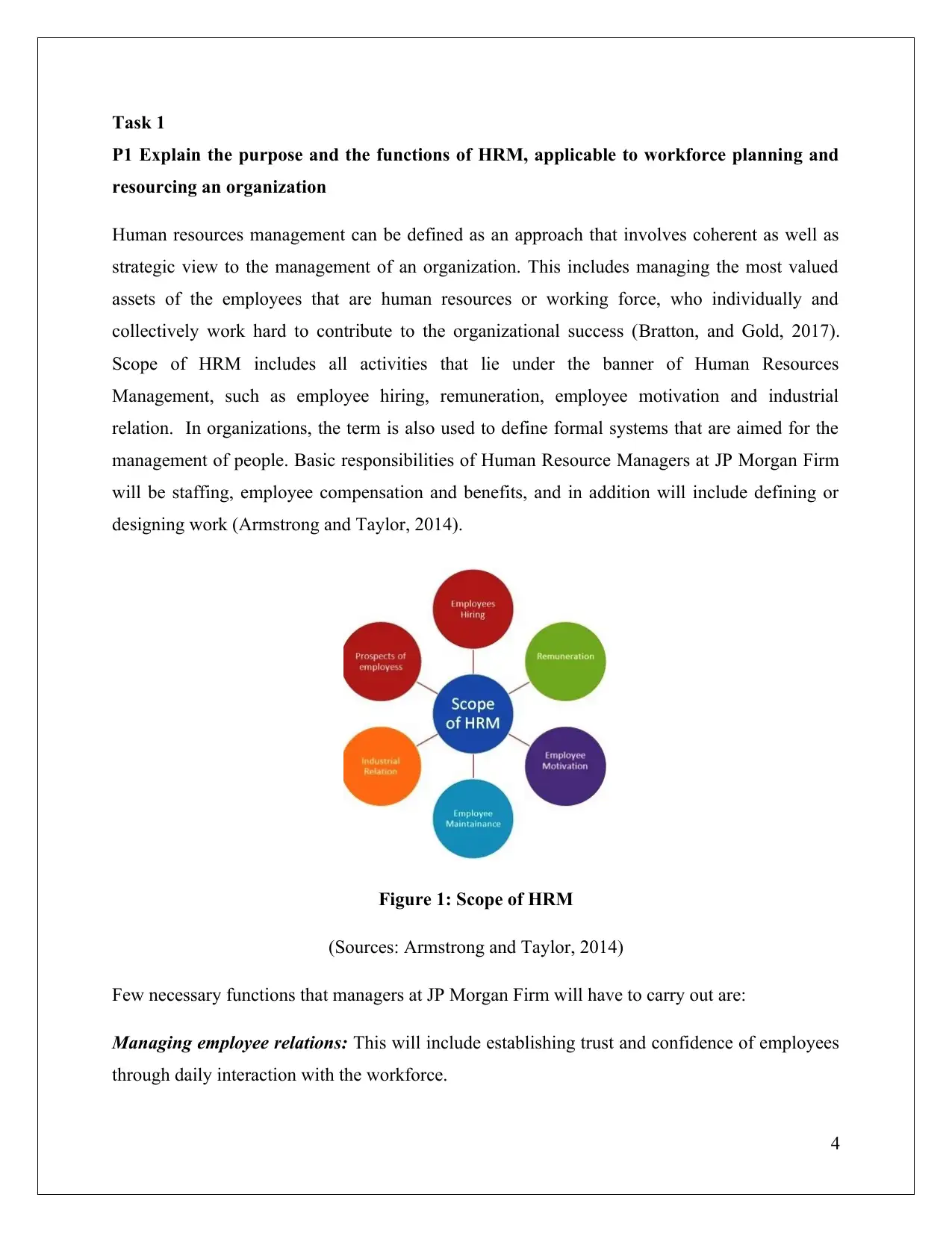
Scope of HRM includes all activities that lie under the banner of Human Resources
Management, such as employee hiring, remuneration, employee motivation and industrial
relation. In organizations, the term is also used to define formal systems that are aimed for the
management of people. Basic responsibilities of Human Resource Managers at JP Morgan Firm
will be staffing, employee compensation and benefits, and in addition will include defining or
designing work (Armstrong and Taylor, 2014).
Figure 1: Scope of HRM
(Sources: Armstrong and Taylor, 2014)
Few necessary functions that managers at JP Morgan Firm will have to carry out are:
Managing employee relations: This will include establishing trust and confidence of employees
through daily interaction with the workforce.
4
P1 Explain the purpose and the functions of HRM, applicable to workforce planning and
resourcing an organization
Human resources management can be defined as an approach that involves coherent as well as
strategic view to the management of an organization. This includes managing the most valued
assets of the employees that are human resources or working force, who individually and
collectively work hard to contribute to the organizational success (Bratton, and Gold, 2017).
Scope of HRM includes all activities that lie under the banner of Human Resources
Management, such as employee hiring, remuneration, employee motivation and industrial
relation. In organizations, the term is also used to define formal systems that are aimed for the
management of people. Basic responsibilities of Human Resource Managers at JP Morgan Firm
will be staffing, employee compensation and benefits, and in addition will include defining or
designing work (Armstrong and Taylor, 2014).
Figure 1: Scope of HRM
(Sources: Armstrong and Taylor, 2014)
Few necessary functions that managers at JP Morgan Firm will have to carry out are:
Managing employee relations: This will include establishing trust and confidence of employees
through daily interaction with the workforce.
4
Paraphrase This Document
Need a fresh take? Get an instant paraphrase of this document with our AI Paraphraser
Strong leadership with interaction: Human resource department is not considered for generating
revenue for the company, however, managers are considerate about the return of investment
from human resource activities on the organization’s bottom line (Bailey et al., 2018).
Compliance with laws: Managers at JP Morgan Firm will be required to take care of all required
federal and state laws and regulations that apply to the human resources professionals.
Hard HRM management practices can be understood HRM managers that focus on treating
employees as a resource of the company, just like machinery and buildings. Managers are
strongly linked with the corporate business planning that includes resources that are required, the
methods of attaining those resources and determining the cost of resources. Primary focus of
hard HRM is to identify necessary needs of the business, recruit, and manage as per the
requirements. Soft HRM management practices include treating employees as a highly important
resource that is considered as a part of the organization that aids to lead the company in
competitive environment. Managers focus on treating individuals with high regard and
concentrating on fulfilling their needs. Key features include competitive pay structure and in
addition incentive and rewards for high performing employees (Moore and Jennings, 2017).
Managers empower employees to improve themselves and increase their productivity.
Managers at JP Morgan Firm will be in charge of workforce planning that includes processes for
determining future needs of human resource in respect to the strategic planning of the
organization and taking care of those needs so that they are met in a timely manner. They are
required to make efficient use of information systems that allow to track and monitor economic
activities and legislations that might have an impact on the planning. Job analysis and evaluation,
providing necessary benefits to current and retired employees will be part of workforce planning
of HRM managers
P2 Explain the strengths and weaknesses of different approaches to recruitment and
selection
Recruitment process in an organization, in a broader view, can be explained as the process that
involves entering of new labour or employees, communicating job responsibilities and roles and
encouraging them to achieve organizational goals (Olson et al., 2018). The primary aim of
recruitment process is to include right number of individuals required in the organization along
5
revenue for the company, however, managers are considerate about the return of investment
from human resource activities on the organization’s bottom line (Bailey et al., 2018).
Compliance with laws: Managers at JP Morgan Firm will be required to take care of all required
federal and state laws and regulations that apply to the human resources professionals.
Hard HRM management practices can be understood HRM managers that focus on treating
employees as a resource of the company, just like machinery and buildings. Managers are
strongly linked with the corporate business planning that includes resources that are required, the
methods of attaining those resources and determining the cost of resources. Primary focus of
hard HRM is to identify necessary needs of the business, recruit, and manage as per the
requirements. Soft HRM management practices include treating employees as a highly important
resource that is considered as a part of the organization that aids to lead the company in
competitive environment. Managers focus on treating individuals with high regard and
concentrating on fulfilling their needs. Key features include competitive pay structure and in
addition incentive and rewards for high performing employees (Moore and Jennings, 2017).
Managers empower employees to improve themselves and increase their productivity.
Managers at JP Morgan Firm will be in charge of workforce planning that includes processes for
determining future needs of human resource in respect to the strategic planning of the
organization and taking care of those needs so that they are met in a timely manner. They are
required to make efficient use of information systems that allow to track and monitor economic
activities and legislations that might have an impact on the planning. Job analysis and evaluation,
providing necessary benefits to current and retired employees will be part of workforce planning
of HRM managers
P2 Explain the strengths and weaknesses of different approaches to recruitment and
selection
Recruitment process in an organization, in a broader view, can be explained as the process that
involves entering of new labour or employees, communicating job responsibilities and roles and
encouraging them to achieve organizational goals (Olson et al., 2018). The primary aim of
recruitment process is to include right number of individuals required in the organization along
5
with those individuals that poses right set of skills. Two different ways in which JP Morgan Firm
can recruit employees are
Internal recruitment process involves looking for ways to fill the vacancy of business through its
existing workforce. External recruitment process involves looking for opportunities outside the
business through attracting suitable applicants. In most organizations, both these methods are
widely used simultaneously.
Advantages of internal recruitment
This method is cheaper, therefore cost-effective
This method ensures people that are familiar with the system and organization are
recruited to fill the vacancy.
Managers and executives are already well aware about the strengths and weaknesses of
the candidates
Drawbacks of internal recruitment
Using this process limits the number of potential candidates
Candidates that are not selected may resent the process and management
The method fills vacancy in one field, however, creates vacancy in another department as
well
Advantages of external recruitment
This allows to bring new individuals from outside, which lest new ideas and opinions to
follow within the organization
This method ensures that the best candidates are selected from a large pool of applicants
People with different experiences can join the organization.
Drawbacks of external recruitment
This recruitment process takes longer time to be completed
In order to attract right candidates with appropriate skills requires expenditure on
advertising and interviews
6
can recruit employees are
Internal recruitment process involves looking for ways to fill the vacancy of business through its
existing workforce. External recruitment process involves looking for opportunities outside the
business through attracting suitable applicants. In most organizations, both these methods are
widely used simultaneously.
Advantages of internal recruitment
This method is cheaper, therefore cost-effective
This method ensures people that are familiar with the system and organization are
recruited to fill the vacancy.
Managers and executives are already well aware about the strengths and weaknesses of
the candidates
Drawbacks of internal recruitment
Using this process limits the number of potential candidates
Candidates that are not selected may resent the process and management
The method fills vacancy in one field, however, creates vacancy in another department as
well
Advantages of external recruitment
This allows to bring new individuals from outside, which lest new ideas and opinions to
follow within the organization
This method ensures that the best candidates are selected from a large pool of applicants
People with different experiences can join the organization.
Drawbacks of external recruitment
This recruitment process takes longer time to be completed
In order to attract right candidates with appropriate skills requires expenditure on
advertising and interviews
6
⊘ This is a preview!⊘
Do you want full access?
Subscribe today to unlock all pages.
Trusted by 1+ million students worldwide
In some cases, it has been noticed that the process could not aid in finding the right
candidates
After proper analysis and evaluation of different advantage and drawbacks of each internal and
external recruitment process, it can be concluded that For JP Morgan Firm, both the above
mentioned processes are appropriate to be implemented.
Different methods that are used for recruiting appropriate candidates in JP Morgan Firm are:
Direct method
According to this method, the mangers at JP Morgan Firm can visit institutes and other training
centres to hire the right candidates. These way managers get to interact and communicate with
potential employees that are seeking job (Brewster et al., 2016). Several companies also choose
to conduct seminars, exhibitions and conferences to attract candidates. They review their
qualifications as per the job requirements and hire the best ones. They conduct face to face
interview and try to evaluate the necessary skills and knowledge that the candidate poses and
take decisions based on their evaluation, whether to hire or not. This process takes a lot of time
and investment as well.
E-recruitment
This process involves recruiting employees using web and software’s. This helps them to attract
employees and hire individuals. This process involves using social media to get large number of
candidates (Lane et al., 2015). Applicant tracking system allows HR managers to track the
applicants and then interview candidates via video interviewing software. Advantage of this
process is that it is cost effective and much reliable then face to face interviews.
7
candidates
After proper analysis and evaluation of different advantage and drawbacks of each internal and
external recruitment process, it can be concluded that For JP Morgan Firm, both the above
mentioned processes are appropriate to be implemented.
Different methods that are used for recruiting appropriate candidates in JP Morgan Firm are:
Direct method
According to this method, the mangers at JP Morgan Firm can visit institutes and other training
centres to hire the right candidates. These way managers get to interact and communicate with
potential employees that are seeking job (Brewster et al., 2016). Several companies also choose
to conduct seminars, exhibitions and conferences to attract candidates. They review their
qualifications as per the job requirements and hire the best ones. They conduct face to face
interview and try to evaluate the necessary skills and knowledge that the candidate poses and
take decisions based on their evaluation, whether to hire or not. This process takes a lot of time
and investment as well.
E-recruitment
This process involves recruiting employees using web and software’s. This helps them to attract
employees and hire individuals. This process involves using social media to get large number of
candidates (Lane et al., 2015). Applicant tracking system allows HR managers to track the
applicants and then interview candidates via video interviewing software. Advantage of this
process is that it is cost effective and much reliable then face to face interviews.
7
Paraphrase This Document
Need a fresh take? Get an instant paraphrase of this document with our AI Paraphraser
Task 2
P3 Explain the benefits of different HRM practices within an organization for both the
employer and employee
Different HRM practices that are usually executed within the organization are:
Hiring and recruitment
This is the most essential responsibility of HRM managers as they are responsible for hiring and
recruiting individuals in the organization. They are responsible for identifying the needs and then
hiring the candidates that fulfil the requirements completely (Guan et al., 2016). The benefit of
this process in context to employer is that the process allows flow of new individuals with varied
experiences, learning and background to enter the organization. This facilitates development of
new ideas in the business leading to development of the organization. Employees can benefit
from this step as well, as they can share information and experiences with everyone and learn
from each other.
Training practices and development
HRM managers at organizations also deal with the responsibility of providing appropriate
methods for learning and development to all employees. They take necessary measures and
organize activities in order to provide the best trainers and mentors for employees. The benefit of
this method for the employees is that they are able to enhance their competencies, knowledge
bank and improve effectiveness at workplace. Employers can benefit from this activity as well,
as enhancement of employee skills they can have better command on activities, they are able to
retain talented candidates and win their trust.
Payment and reward management
HRM managers are responsible for managing record of all employees in the organization. They
keep track of salaries and payment methods of all employees (Nadiv et al., 2017). Providing
rewards and incentives to talented employees is the part of HRM practices. Benefit of this
process is that employees feel more valued and appreciated at workplace. This boosts their
confidence and morale and therefore they try to put in more effort and dedication. Employers are
8
P3 Explain the benefits of different HRM practices within an organization for both the
employer and employee
Different HRM practices that are usually executed within the organization are:
Hiring and recruitment
This is the most essential responsibility of HRM managers as they are responsible for hiring and
recruiting individuals in the organization. They are responsible for identifying the needs and then
hiring the candidates that fulfil the requirements completely (Guan et al., 2016). The benefit of
this process in context to employer is that the process allows flow of new individuals with varied
experiences, learning and background to enter the organization. This facilitates development of
new ideas in the business leading to development of the organization. Employees can benefit
from this step as well, as they can share information and experiences with everyone and learn
from each other.
Training practices and development
HRM managers at organizations also deal with the responsibility of providing appropriate
methods for learning and development to all employees. They take necessary measures and
organize activities in order to provide the best trainers and mentors for employees. The benefit of
this method for the employees is that they are able to enhance their competencies, knowledge
bank and improve effectiveness at workplace. Employers can benefit from this activity as well,
as enhancement of employee skills they can have better command on activities, they are able to
retain talented candidates and win their trust.
Payment and reward management
HRM managers are responsible for managing record of all employees in the organization. They
keep track of salaries and payment methods of all employees (Nadiv et al., 2017). Providing
rewards and incentives to talented employees is the part of HRM practices. Benefit of this
process is that employees feel more valued and appreciated at workplace. This boosts their
confidence and morale and therefore they try to put in more effort and dedication. Employers are
8
able to benefit from this exercise as employees and employer relationship can be enhanced using
this activity (Albrecht et al., 2015).
Employee performance management and monitoring
HRM managers are responsible for tracking and monitoring the performance of each employee
in order to identify their strengths and weaknesses. This enables them to evaluate the quality of
work that each individual is doing at workplace. The benefits of this process on employees are
that talented employees are rewarded for their dedication and commitment. Benefit of the
activity on the employers is that they are able to identify the ones that are more capable and
talented in the organization (Liu et al., 2017). Employers can select them for higher positions and
responsibilities.
P4 Evaluate the effectiveness of different HRM practices in terms of raising organisational
profits and productivity
The effectiveness of different HRM practices on the organizational profits and productivity are
elaborated below:
Hiring and recruitment
This aspect of hiring and recruitment of HRM department has diverse impact on the
organizational profits and productivity. This is so because hiring talented and experienced
workers lead the company to better results (Rajani et al., 2015). The quality of products and
services can be improved only when the employees that are hired have the right set of skills and
knowledge for producing and developing unique products. High performing products and
services lead to improved reputation and customer loyalty.
Training practices and development
Organizations that invest on providing training and development opportunities to their
employees experience increased effectiveness and efficiency in all their activities and operations.
Employees are able to add new characteristics in their attitude and behaviour. The main
advantage is that employees feel more confident at work and are able to produce better quality
9
this activity (Albrecht et al., 2015).
Employee performance management and monitoring
HRM managers are responsible for tracking and monitoring the performance of each employee
in order to identify their strengths and weaknesses. This enables them to evaluate the quality of
work that each individual is doing at workplace. The benefits of this process on employees are
that talented employees are rewarded for their dedication and commitment. Benefit of the
activity on the employers is that they are able to identify the ones that are more capable and
talented in the organization (Liu et al., 2017). Employers can select them for higher positions and
responsibilities.
P4 Evaluate the effectiveness of different HRM practices in terms of raising organisational
profits and productivity
The effectiveness of different HRM practices on the organizational profits and productivity are
elaborated below:
Hiring and recruitment
This aspect of hiring and recruitment of HRM department has diverse impact on the
organizational profits and productivity. This is so because hiring talented and experienced
workers lead the company to better results (Rajani et al., 2015). The quality of products and
services can be improved only when the employees that are hired have the right set of skills and
knowledge for producing and developing unique products. High performing products and
services lead to improved reputation and customer loyalty.
Training practices and development
Organizations that invest on providing training and development opportunities to their
employees experience increased effectiveness and efficiency in all their activities and operations.
Employees are able to add new characteristics in their attitude and behaviour. The main
advantage is that employees feel more confident at work and are able to produce better quality
9
⊘ This is a preview!⊘
Do you want full access?
Subscribe today to unlock all pages.
Trusted by 1+ million students worldwide
work and decisions. This is, in turn, leads to an increased competitive edge over the rivals, higher
productivity, reduced costs on overhead and operational costs.
Payment and reward management
Evaluating the performance of employees and assessing their performance periodically, helps to
identify high performing candidates and individuals that are little lagging behind the appropriate
standards. This way the HR department can appoint high performing candidates to higher
positions to help lead the company to greater heights. Providing rewards and bonuses
Employee performance management and monitoring
This exercise of HR managers enables to keep track of employees work and activities in order to
find the needs and requirements of training. This enables the managers to take care of the
knowledge and efficiency of employees and provide them with the necessary help and support.
Managing performance of employees leads to maintain the competencies of employees and up to
date with the right set of skills and talent. When employees have the right set of skill and
knowledge to carry out their activities, the performance of the organizations will automatically
improve (Paillé et al., 2014).
10
productivity, reduced costs on overhead and operational costs.
Payment and reward management
Evaluating the performance of employees and assessing their performance periodically, helps to
identify high performing candidates and individuals that are little lagging behind the appropriate
standards. This way the HR department can appoint high performing candidates to higher
positions to help lead the company to greater heights. Providing rewards and bonuses
Employee performance management and monitoring
This exercise of HR managers enables to keep track of employees work and activities in order to
find the needs and requirements of training. This enables the managers to take care of the
knowledge and efficiency of employees and provide them with the necessary help and support.
Managing performance of employees leads to maintain the competencies of employees and up to
date with the right set of skills and talent. When employees have the right set of skill and
knowledge to carry out their activities, the performance of the organizations will automatically
improve (Paillé et al., 2014).
10
Paraphrase This Document
Need a fresh take? Get an instant paraphrase of this document with our AI Paraphraser
Task 3
P5 Analyse the importance of employee relations in respect to influencing HRM decision-
making
Strong employee relations with HR department are necessary for better understanding and
coherence between the two. Friendly and open relations among HR department and staff workers
of the company can facilitate new employees to get comfortable with the daily routine and in
addition with the new environment (Bamberger et al., 2014). Better relations assist in building
better teams and working together, the most important activity from the perspective of an
organization. The importance of good relations with employees can be understood from the fact
that having good relations is a vital element that enables to build a proper line of communication
within the organization. This also has an impact on the ability of all teams, individuals and
different departments of the organization to work together towards a common goal. Fostering
good relations assists the HR department to unite the entire organization into one big entity.
Proper contact among the employees and HR managers has a direct impact on the satisfaction
level of the employees. However, implementing any change or altering the structure of the
organization, good employee relations aid in this process, as employees welcome and understand
the change.
When number of employees at the workplace is satisfied with their jobs, the conduct of seniors
and organization culture within the organization, employees are observed to put in more effort in
all their actions (Shields et al., 2015). This will improve their performance and help them
achieve a higher professional position in the JP Morgan Firm. They will also like to refer to their
close families and friends in order to join the company. This will build a better reputation and
goodwill of JP Morgan Firm in the market (Marchington et al., 2016).
P6 Identify the key elements of employment legislation and the impact of it has on HRM
decision-making
The key elements of employment legislation that have been introduced by the UK government
and other trade unions are to protect the employees and for their welfare. The government has
introduced strict legislations so that no unfair practices occur against the interest of the
employees within an organization (Belloc, 2016). These legislations introduced by the authorities
11
P5 Analyse the importance of employee relations in respect to influencing HRM decision-
making
Strong employee relations with HR department are necessary for better understanding and
coherence between the two. Friendly and open relations among HR department and staff workers
of the company can facilitate new employees to get comfortable with the daily routine and in
addition with the new environment (Bamberger et al., 2014). Better relations assist in building
better teams and working together, the most important activity from the perspective of an
organization. The importance of good relations with employees can be understood from the fact
that having good relations is a vital element that enables to build a proper line of communication
within the organization. This also has an impact on the ability of all teams, individuals and
different departments of the organization to work together towards a common goal. Fostering
good relations assists the HR department to unite the entire organization into one big entity.
Proper contact among the employees and HR managers has a direct impact on the satisfaction
level of the employees. However, implementing any change or altering the structure of the
organization, good employee relations aid in this process, as employees welcome and understand
the change.
When number of employees at the workplace is satisfied with their jobs, the conduct of seniors
and organization culture within the organization, employees are observed to put in more effort in
all their actions (Shields et al., 2015). This will improve their performance and help them
achieve a higher professional position in the JP Morgan Firm. They will also like to refer to their
close families and friends in order to join the company. This will build a better reputation and
goodwill of JP Morgan Firm in the market (Marchington et al., 2016).
P6 Identify the key elements of employment legislation and the impact of it has on HRM
decision-making
The key elements of employment legislation that have been introduced by the UK government
and other trade unions are to protect the employees and for their welfare. The government has
introduced strict legislations so that no unfair practices occur against the interest of the
employees within an organization (Belloc, 2016). These legislations introduced by the authorities
11
enable employees to rise against large corporations during any discrimination and illegal
happenings. The rules and regulations that have an impact on the human resource management
are as follows:
Equality Act, 2010 – Stipulations introduced in this act, state that all organizations and their
human resource department should take care of all their employees with equality. Any
discrimination done within the organization based on caste, creed, and colour, gender should be
avoided at any cost. Any sort of abuse or harm towards employees should not be followed within
the organization (Karpuz et al., 2017). These practices have an impact on the morale and
confidence level of employees. Senior managers and executives of the human resource
department are greatly accountable for nurturing a pleasant atmosphere within the organization,
this way they can win the faith of staff workers and have better relationships with them.
Human Rights Act, 1998 – Stipulations introduced in this act state that management of human
resource in all organizations has to abide by is that staff members be given an equal opportunity
to participate in the conversation and administrative sessions (Countouris, 2016). Practising these
actions within the organization will make employees feel more valued and take better initiation
in all their activities and actions (Conley, 2014). Employees will have higher job happiness while
the human resource department will be able to improve communication channel with them.
12
happenings. The rules and regulations that have an impact on the human resource management
are as follows:
Equality Act, 2010 – Stipulations introduced in this act, state that all organizations and their
human resource department should take care of all their employees with equality. Any
discrimination done within the organization based on caste, creed, and colour, gender should be
avoided at any cost. Any sort of abuse or harm towards employees should not be followed within
the organization (Karpuz et al., 2017). These practices have an impact on the morale and
confidence level of employees. Senior managers and executives of the human resource
department are greatly accountable for nurturing a pleasant atmosphere within the organization,
this way they can win the faith of staff workers and have better relationships with them.
Human Rights Act, 1998 – Stipulations introduced in this act state that management of human
resource in all organizations has to abide by is that staff members be given an equal opportunity
to participate in the conversation and administrative sessions (Countouris, 2016). Practising these
actions within the organization will make employees feel more valued and take better initiation
in all their activities and actions (Conley, 2014). Employees will have higher job happiness while
the human resource department will be able to improve communication channel with them.
12
⊘ This is a preview!⊘
Do you want full access?
Subscribe today to unlock all pages.
Trusted by 1+ million students worldwide

1 out of 21


Related Documents


Your All-in-One AI-Powered Toolkit for Academic Success.
+13062052269
info@desklib.com
Available 24*7 on WhatsApp / Email
![[object Object]](/_next/static/media/star-bottom.7253800d.svg)
Unlock your academic potential
Copyright © 2020–2026 A2Z Services. All Rights Reserved. Developed and managed by ZUCOL.