Report: HRM, Resource Based View, UK Labour Market Analysis
VerifiedAdded on 2020/10/23
|10
|3613
|468
Report
AI Summary
This report delves into the intricacies of Human Resource Management (HRM), examining how the 'Resource Based View' can be adapted to achieve competitive advantage and organizational success. It provides examples of 'good practice' by organizations to support its arguments. The report also critically analyzes two major threats currently facing organizations operating within the United Kingdom labour market, providing evidenced examples to support its assessment. The analysis covers key HR practices, the importance of resource-based view in HRM, the impact of Brexit, and other factors influencing the UK labor market. This comprehensive report provides valuable insights into effective HRM strategies and the challenges faced by organizations in the current economic climate.

Managing Human
Resources
Resources

Paraphrase This Document
Need a fresh take? Get an instant paraphrase of this document with our AI Paraphraser
Table of Contents
INTRODUCTION...........................................................................................................................1
Main Body.......................................................................................................................................1
Explain how the ‘Resource Based View’ can be adapted to Human Resource Management to
help deliver competitive advantage and organisational success, using examples of ‘good
practice’ by organisations to support your argument..................................................................1
Analyse two major threats currently facing organisations operating within the United
Kingdom labour market, using evidenced examples as part of your critical assessment...........4
CONCLUSION ...............................................................................................................................7
REFERENCES................................................................................................................................8
INTRODUCTION...........................................................................................................................1
Main Body.......................................................................................................................................1
Explain how the ‘Resource Based View’ can be adapted to Human Resource Management to
help deliver competitive advantage and organisational success, using examples of ‘good
practice’ by organisations to support your argument..................................................................1
Analyse two major threats currently facing organisations operating within the United
Kingdom labour market, using evidenced examples as part of your critical assessment...........4
CONCLUSION ...............................................................................................................................7
REFERENCES................................................................................................................................8
INTRODUCTION
Managing human resources can be defined as the process that is carried out by the
manager to manage the employees of an organisation in effective manner. It can be also stated as
the act of providing management actions to the employees of HRM department (Huxham and
Vangen, 2013). It includes different aspects of planning and allocating of resources, providing
direction, vision and goals, helps in developing an environment in which the employees choose
motivation and contribution, providing opportunities for formal as well as informal development,
works to eradicate the obstacles that affects the progress of the workforce. The present report
will explain the resource based view, it will analyse major threats faced by the organisations in
the current time within the UK labour market.
Main Body
Explain how the ‘Resource Based View’ can be adapted to Human Resource Management to
help deliver competitive advantage and organisational success, using examples of ‘good
practice’ by organisations to support your argument
Human resources is a essential part for every business organisation that assist an business
to accomplish its required goals and objectives within limited time period (Ployhart and et. al.,
2014). For this, the HR management is supposed to be responsible to carry out the requirements
of the skilled and well-informed employees within the organisation and supervising with the help
of adopting a range of HR practices such as recruitment, training and development programs,
rewards and compensation etc. The present essay will describe the roles of the HR practices in
supporting and developing an organisation to attain competitive advantage.
Human resources can be defined as the process in which individuals work for the
business organisation using their skills and knowledge with the purpose of driving the business
operations to accomplish its required goals and objectives within the determined time. To
enhance their efforts and contribution, the HR manager is entirely liable to carry out several HR
practices such as recruitment and selection, training and development programs, rewards and
incentives etc. (Messersmith and Wales, 2013). HR managers is required to forecast the future
needs after examining the working environment, mission, objectives and then required to make
suitable HR strategies and policies accordingly, in order to make their workforce more
competent to deal with different complexities of business environment and accomplish
1
Managing human resources can be defined as the process that is carried out by the
manager to manage the employees of an organisation in effective manner. It can be also stated as
the act of providing management actions to the employees of HRM department (Huxham and
Vangen, 2013). It includes different aspects of planning and allocating of resources, providing
direction, vision and goals, helps in developing an environment in which the employees choose
motivation and contribution, providing opportunities for formal as well as informal development,
works to eradicate the obstacles that affects the progress of the workforce. The present report
will explain the resource based view, it will analyse major threats faced by the organisations in
the current time within the UK labour market.
Main Body
Explain how the ‘Resource Based View’ can be adapted to Human Resource Management to
help deliver competitive advantage and organisational success, using examples of ‘good
practice’ by organisations to support your argument
Human resources is a essential part for every business organisation that assist an business
to accomplish its required goals and objectives within limited time period (Ployhart and et. al.,
2014). For this, the HR management is supposed to be responsible to carry out the requirements
of the skilled and well-informed employees within the organisation and supervising with the help
of adopting a range of HR practices such as recruitment, training and development programs,
rewards and compensation etc. The present essay will describe the roles of the HR practices in
supporting and developing an organisation to attain competitive advantage.
Human resources can be defined as the process in which individuals work for the
business organisation using their skills and knowledge with the purpose of driving the business
operations to accomplish its required goals and objectives within the determined time. To
enhance their efforts and contribution, the HR manager is entirely liable to carry out several HR
practices such as recruitment and selection, training and development programs, rewards and
incentives etc. (Messersmith and Wales, 2013). HR managers is required to forecast the future
needs after examining the working environment, mission, objectives and then required to make
suitable HR strategies and policies accordingly, in order to make their workforce more
competent to deal with different complexities of business environment and accomplish
1
⊘ This is a preview!⊘
Do you want full access?
Subscribe today to unlock all pages.

Trusted by 1+ million students worldwide
competitive advantage. Here are some HR practices that can be used and implement by an
organisation for the betterment of human resources so as to achieve competitiveness among their
rivals exists in market.
Resource based view can be defined as the device which is used to assess the available
amount of the business strategic assets. Resource based view is a very essential theory that helps
in enhancing the knowledge of outsourcing decision. The resource based view helps in analysing
the organisational capabilities that will link the outsourcing to the organisation performance and
in turn competitive advantage. In the highly competitive economic context, defined by such
phenomena of globalisation in the market, change in the demands of the customers and increased
competition in the market (Stone and Stone, 2013). The way people are managed requires greater
importance because many other sources of competitive success are less powerful. But, to gain the
competitive success by the help of people it is needed to change the thinking process in relation
to the employment relations. To maintain the good relations will require successfully working
with people and considering the HR activities as a source of competitive advantage rather merely
a cost. Resource based view approach can help in considering that organisation investing in the
human resource has the great potential to generate superior performances. It helps in pointing out
that the business organisation can only develop the sustainable competitive advantage by
creating the specific values which should be impossible for the competitors to imitate. The
resources and the capabilities are considered to be valuable as they allow an business
organisation to enhane the possibility of the market and to counter threats as well. These
resources are liable to enable the organisation to meet the required factors which are essential to
success in the business environment.
Where competitors in the market possess high resource then it is unlikely to be a source
of the competitive advantage and thus becomes the suitable candidate for outsourcing. This
approach requires that the business organisation should not be seen by their activities in the
product market but on the basis of special bundle of the resources which are complex, dynamic
and intangible in nature. The human resources in the business organisation can be defined as the
stocks of the available factors which are owned by the business organisations (Renwick, Redman
and Maguire, 2013). The resources are converted into the final services or products by using the
wide variety of the organisation's assets and the bonding mechanisms like management
information system, technology, incentive systems, trust between the management and labour
2
organisation for the betterment of human resources so as to achieve competitiveness among their
rivals exists in market.
Resource based view can be defined as the device which is used to assess the available
amount of the business strategic assets. Resource based view is a very essential theory that helps
in enhancing the knowledge of outsourcing decision. The resource based view helps in analysing
the organisational capabilities that will link the outsourcing to the organisation performance and
in turn competitive advantage. In the highly competitive economic context, defined by such
phenomena of globalisation in the market, change in the demands of the customers and increased
competition in the market (Stone and Stone, 2013). The way people are managed requires greater
importance because many other sources of competitive success are less powerful. But, to gain the
competitive success by the help of people it is needed to change the thinking process in relation
to the employment relations. To maintain the good relations will require successfully working
with people and considering the HR activities as a source of competitive advantage rather merely
a cost. Resource based view approach can help in considering that organisation investing in the
human resource has the great potential to generate superior performances. It helps in pointing out
that the business organisation can only develop the sustainable competitive advantage by
creating the specific values which should be impossible for the competitors to imitate. The
resources and the capabilities are considered to be valuable as they allow an business
organisation to enhane the possibility of the market and to counter threats as well. These
resources are liable to enable the organisation to meet the required factors which are essential to
success in the business environment.
Where competitors in the market possess high resource then it is unlikely to be a source
of the competitive advantage and thus becomes the suitable candidate for outsourcing. This
approach requires that the business organisation should not be seen by their activities in the
product market but on the basis of special bundle of the resources which are complex, dynamic
and intangible in nature. The human resources in the business organisation can be defined as the
stocks of the available factors which are owned by the business organisations (Renwick, Redman
and Maguire, 2013). The resources are converted into the final services or products by using the
wide variety of the organisation's assets and the bonding mechanisms like management
information system, technology, incentive systems, trust between the management and labour
2
Paraphrase This Document
Need a fresh take? Get an instant paraphrase of this document with our AI Paraphraser
and so on. The capabilities are the capacity of an organisation to deploy the resources, usually in
combination, applying the organisation process to achieve the desired outcome.
The business organisation consists of several resources and capabilities which are not
enough to assure the success in the market. Competitive advantage emerges from the distinctive
resources or the capabilities that is controlled by the business organisation and in accordance
with the competitors. The supporters of resource-based view have argued that competitive
advantage is constructed from the resources and capabilities that are closely-held and possessed
in a single organisation. Consequently, resources those are internal to the business organisation
campaign competitive advantage in effective manner (Turner, Swart and Maylor, 2013).
Nevertheless, some scholars have prolonged the extent of the resource-based perspective to
concentrate on the resources that distance the limit of the organisation. Sometimes it is referred
as the ‘extended resource-based view’. The counsellors of this approach describe it as a means of
knowing how business organisation can gain and uphold competitive advantage in the market.
For instance, it is manageable for an organisation to combine resources in specific ways across
the organisational boundaries to acquire benefit over their rival already existing in the market.
The business organisation can create valuable resources by cautiously managing the relations
with the external elements including suppliers, customers, government agencies, etc. Thus, a
organisation can gain competitive advantage by accessing the key resources in a manner that will
expand the organisation boundaries. Investigation has recommended that there is a possibility of
productivity improvements in the value chain when organisations are inclined to make relation-
specific investments in unique ways. Organisations that make relation-specific investments are
competent to combine the resources in a specific manner to create relative rents and gain
competitive advantage over other organisations that are unable to do this.
The managers of business organisation can use the different HR practices to attract and
retain the high quality workforce. The reward systems, communication system, training
programs and the socialization systems that encourage the workforce to work in the best interest
of the organisation to gain the competitive advantage in the market (Chan, 2012). Therefore, the
HR practices has a great influence on the skills acquired by the employees with the help of
developing the organisation human capital. The organisations that creates an impactful HR
systems compounding the HR practices to accomplish the prospective for natural process among
these practices has the ability to acknowledge the inherent value of HR in processing new
3
combination, applying the organisation process to achieve the desired outcome.
The business organisation consists of several resources and capabilities which are not
enough to assure the success in the market. Competitive advantage emerges from the distinctive
resources or the capabilities that is controlled by the business organisation and in accordance
with the competitors. The supporters of resource-based view have argued that competitive
advantage is constructed from the resources and capabilities that are closely-held and possessed
in a single organisation. Consequently, resources those are internal to the business organisation
campaign competitive advantage in effective manner (Turner, Swart and Maylor, 2013).
Nevertheless, some scholars have prolonged the extent of the resource-based perspective to
concentrate on the resources that distance the limit of the organisation. Sometimes it is referred
as the ‘extended resource-based view’. The counsellors of this approach describe it as a means of
knowing how business organisation can gain and uphold competitive advantage in the market.
For instance, it is manageable for an organisation to combine resources in specific ways across
the organisational boundaries to acquire benefit over their rival already existing in the market.
The business organisation can create valuable resources by cautiously managing the relations
with the external elements including suppliers, customers, government agencies, etc. Thus, a
organisation can gain competitive advantage by accessing the key resources in a manner that will
expand the organisation boundaries. Investigation has recommended that there is a possibility of
productivity improvements in the value chain when organisations are inclined to make relation-
specific investments in unique ways. Organisations that make relation-specific investments are
competent to combine the resources in a specific manner to create relative rents and gain
competitive advantage over other organisations that are unable to do this.
The managers of business organisation can use the different HR practices to attract and
retain the high quality workforce. The reward systems, communication system, training
programs and the socialization systems that encourage the workforce to work in the best interest
of the organisation to gain the competitive advantage in the market (Chan, 2012). Therefore, the
HR practices has a great influence on the skills acquired by the employees with the help of
developing the organisation human capital. The organisations that creates an impactful HR
systems compounding the HR practices to accomplish the prospective for natural process among
these practices has the ability to acknowledge the inherent value of HR in processing new
3
strategies for the competitors in the market in effective manner. It is very essential to apply the
resource based view to manage the human resources in effective manner. This will lead in
gaining competitive advantage and will allow to sustain in the market for a longer period of time.
Analyse two major threats currently facing organisations operating within the United Kingdom
labour market, using evidenced examples as part of your critical assessment
Labour market can be referred to as the market where individuals look for and compete in
order to get employment and the owners (employers) look forward to and compete for the
workers. Within labour market, the three major groups of participants are ascertained to be
individuals, government and companies. There are a number of factors which strive to have a
significant impact upon the participants within labour market of a nation with regards to UK
also. The elements which affect the participants of UK labour market with regards to individuals
are the timing of making entry into labour force, type of job, hours of employment, allocation of
salary, employment rates, qualification of job and retirement. In regards with firms, the elements
affecting the decision making power of this group of participants are found to be working time
requirement, quantum as well as nature of workers to be hired, qualifications of prospect
candidates, risk of lay-off personnel, salaries and benefits allocation, pension, retirement policies
and procedures, nature of work that can easily be sub-contracted etc. In relation to government of
the specific country (UK here), this group is the most significant as they are the ones who are
responsible for enforcing various laws, policies, regulations that have a significant impact upon
the labour market decisions of individuals and organisations. These policies can be termed as
human rights, anti discriminatory laws, employment laws and standards associated with aspects
such as paternity or maternity leaves, minimum wages, working hours, worker compensation,
overtime, health and safety laws (Carley and Christie, 2017). Also the policies include employee
relations laws supervising income maintenance, insurance policies, public pensions, collective
bargaining procedures, provision of jobs within public sector etc.
The economics of labour market is associated with analysis and evaluation of
determinants of the several dimensions related to labour demand as well as supply. Moreover,
these dimensions interact with each other to ascertain aspects like wages, employment,
unemployment etc. In this regard, the dimensions of labour supply consist of a number of aspects
such as emigration and immigration policies, demographics, disincentive impacts of income
maintenance, education and training, labour force participation decisions and unemployment
4
resource based view to manage the human resources in effective manner. This will lead in
gaining competitive advantage and will allow to sustain in the market for a longer period of time.
Analyse two major threats currently facing organisations operating within the United Kingdom
labour market, using evidenced examples as part of your critical assessment
Labour market can be referred to as the market where individuals look for and compete in
order to get employment and the owners (employers) look forward to and compete for the
workers. Within labour market, the three major groups of participants are ascertained to be
individuals, government and companies. There are a number of factors which strive to have a
significant impact upon the participants within labour market of a nation with regards to UK
also. The elements which affect the participants of UK labour market with regards to individuals
are the timing of making entry into labour force, type of job, hours of employment, allocation of
salary, employment rates, qualification of job and retirement. In regards with firms, the elements
affecting the decision making power of this group of participants are found to be working time
requirement, quantum as well as nature of workers to be hired, qualifications of prospect
candidates, risk of lay-off personnel, salaries and benefits allocation, pension, retirement policies
and procedures, nature of work that can easily be sub-contracted etc. In relation to government of
the specific country (UK here), this group is the most significant as they are the ones who are
responsible for enforcing various laws, policies, regulations that have a significant impact upon
the labour market decisions of individuals and organisations. These policies can be termed as
human rights, anti discriminatory laws, employment laws and standards associated with aspects
such as paternity or maternity leaves, minimum wages, working hours, worker compensation,
overtime, health and safety laws (Carley and Christie, 2017). Also the policies include employee
relations laws supervising income maintenance, insurance policies, public pensions, collective
bargaining procedures, provision of jobs within public sector etc.
The economics of labour market is associated with analysis and evaluation of
determinants of the several dimensions related to labour demand as well as supply. Moreover,
these dimensions interact with each other to ascertain aspects like wages, employment,
unemployment etc. In this regard, the dimensions of labour supply consist of a number of aspects
such as emigration and immigration policies, demographics, disincentive impacts of income
maintenance, education and training, labour force participation decisions and unemployment
4
⊘ This is a preview!⊘
Do you want full access?
Subscribe today to unlock all pages.
Trusted by 1+ million students worldwide
insurance policies. On the contrary, dimensions of labour demand are largely focussed on the
manner in which organisations tend to change their demands for labour in answer to changes in
wage rates and other associated costs inclusive of quasi-fixed costs linked to hiring and training
of workers, fringe benefits etc. Labour market of United Kingdom is largely impacted by a
number of factors such as free trade, global rivalry and technological changes (Bailey and et. al.,
2018).
One of the most significant changes that pose a threat to the companies operating within
the labour market of UK is the outcome of Brexit. Membership of UK in European Union (EU)
directly impacts upon UK labour market through fiscal budget, contribution of immigration to
GDP and free movement of labour. Brexit also pose some indirect impacts by way of effects of
FDI and trade flows on overall economic activity. But post the effect of the votes asking UK to
leave EU, the first class labour market effects have caused uncertainties in relation to economic
as well as political scenarios in future. Post the referendum, it was observed that there were clear
signs of a hiring freeze. Some weeks later, the job ads posted online significantly reduced by
around a half- from 1.5 million to approximately around 800,000 as per the reports of CE Global
(Ahmed, 2013). This decline is far from the normal fluctuations that keep taking place in the
field of online job ads, the normal range here is around 5-10%. As per CBI (Confederation of
British Industry), the confidence of businesses shook post the peak of financial crisis that took
place in UK during 2009. The very first survey taking into account the private sector of United
Kingdom (Markit/CIPS Purchasing Managers’ Index) conducted post the referendum revealed
the sharpest downfall in the business economic activities since the year 2009, particularly the
service sector being found to be affected the most. In medium run, the impact of Brexit was
noticed upon wages and jobs influenced by the deal negotiated amidst UK and other nations in
relation to movement of labour and global trade. If United Kingdom still wishes to remain as a
member of the EEA (European Economic Area) and retain the access to single market, then it
clearly seems that it would have to accept the free flow of labour to and from within European
Union just like the other nations within European Free Trade Association do. European Union is
ascertained to be the largest trade partner of United Kingdom and losing the access to Single
Market indicates a massive damage to the economy of UK. In case UK remains as a member of
EEA, it would suffer from a 1.3% reduction in GDP per head majorly emerging out of the impact
of non-tariff trade barriers upon trade flows (Bonache, Trullen and Sanchez, 2012). Till date, the
5
manner in which organisations tend to change their demands for labour in answer to changes in
wage rates and other associated costs inclusive of quasi-fixed costs linked to hiring and training
of workers, fringe benefits etc. Labour market of United Kingdom is largely impacted by a
number of factors such as free trade, global rivalry and technological changes (Bailey and et. al.,
2018).
One of the most significant changes that pose a threat to the companies operating within
the labour market of UK is the outcome of Brexit. Membership of UK in European Union (EU)
directly impacts upon UK labour market through fiscal budget, contribution of immigration to
GDP and free movement of labour. Brexit also pose some indirect impacts by way of effects of
FDI and trade flows on overall economic activity. But post the effect of the votes asking UK to
leave EU, the first class labour market effects have caused uncertainties in relation to economic
as well as political scenarios in future. Post the referendum, it was observed that there were clear
signs of a hiring freeze. Some weeks later, the job ads posted online significantly reduced by
around a half- from 1.5 million to approximately around 800,000 as per the reports of CE Global
(Ahmed, 2013). This decline is far from the normal fluctuations that keep taking place in the
field of online job ads, the normal range here is around 5-10%. As per CBI (Confederation of
British Industry), the confidence of businesses shook post the peak of financial crisis that took
place in UK during 2009. The very first survey taking into account the private sector of United
Kingdom (Markit/CIPS Purchasing Managers’ Index) conducted post the referendum revealed
the sharpest downfall in the business economic activities since the year 2009, particularly the
service sector being found to be affected the most. In medium run, the impact of Brexit was
noticed upon wages and jobs influenced by the deal negotiated amidst UK and other nations in
relation to movement of labour and global trade. If United Kingdom still wishes to remain as a
member of the EEA (European Economic Area) and retain the access to single market, then it
clearly seems that it would have to accept the free flow of labour to and from within European
Union just like the other nations within European Free Trade Association do. European Union is
ascertained to be the largest trade partner of United Kingdom and losing the access to Single
Market indicates a massive damage to the economy of UK. In case UK remains as a member of
EEA, it would suffer from a 1.3% reduction in GDP per head majorly emerging out of the impact
of non-tariff trade barriers upon trade flows (Bonache, Trullen and Sanchez, 2012). Till date, the
5
Paraphrase This Document
Need a fresh take? Get an instant paraphrase of this document with our AI Paraphraser
economy of UK, especially the UK labour market is largely getting affected by the outcomes of
Brexit. In this regard, some of the companies have left UK while some have cut or downsized the
jobs post Brexit. The names of such organisations are Jaguar Land Rover, Nissan, Airbus, Aviva,
Barclays, Dyson, Bank of America Merrill Lynch who have been undertaking steps to deal with
the threats posed to UK economy post the Brexit Referendum.
It can be seen that there are many companies who faces various kind of issues on a
regular basis and among them labour market is one of the major one because it creates threat for
the organisation. It is important for any organisation that they read the situation which has been
raised in front of them that how it can control the situation of threat when it arises in front of
them. In context of TESCO PLC, it is one the leading retail sector industry within United
Kingdom but currently they are facing various kinds of issues which need to be solved on short
period of time. The problems that have been raised against the company are related with labour
market. Here, workers are demanding of some of the rights and wages which they need while
working with the company.Cowling and Mailer, 2013). The main problem which organisation is
facing at the moment is related with wages and remuneration rate and polluted working
environment. The workers who are working in the company want their salary to be increased
because they are unable to work with company with wages rate which they are getting at the
moment. But, it might create problem for organisation because it will increase the overall
expenses of a company. Even it will not allow the company to work as per their requirement
because it can develop the mindset of employee that if company won't fulfil their need that they
can go against the policies which have been implemented by company.
Talking about the second problem or threat which is related with the polluted working
environment, here employees are demanding with the company that they require such technology
through which pollution will not be created. Also, they want the cleanliness in the company so
that it will be easy for them to work freely. As, working environment is not that suitable for
company because there is lack of number of employee's in the department of cleanliness. Here, if
they appoint more number of employees then it will not be easy for them to pay the amount of
wages because it will increase the expenses of a company (Heraty, Michailova and Morley,
2016). Even, workers are demanding for technology as per the part of healthy working
environment because as paper work creates lots of pollution and other related equipment creates
pollution within the premises of a company so in this case employees are willing for new
6
Brexit. In this regard, some of the companies have left UK while some have cut or downsized the
jobs post Brexit. The names of such organisations are Jaguar Land Rover, Nissan, Airbus, Aviva,
Barclays, Dyson, Bank of America Merrill Lynch who have been undertaking steps to deal with
the threats posed to UK economy post the Brexit Referendum.
It can be seen that there are many companies who faces various kind of issues on a
regular basis and among them labour market is one of the major one because it creates threat for
the organisation. It is important for any organisation that they read the situation which has been
raised in front of them that how it can control the situation of threat when it arises in front of
them. In context of TESCO PLC, it is one the leading retail sector industry within United
Kingdom but currently they are facing various kinds of issues which need to be solved on short
period of time. The problems that have been raised against the company are related with labour
market. Here, workers are demanding of some of the rights and wages which they need while
working with the company.Cowling and Mailer, 2013). The main problem which organisation is
facing at the moment is related with wages and remuneration rate and polluted working
environment. The workers who are working in the company want their salary to be increased
because they are unable to work with company with wages rate which they are getting at the
moment. But, it might create problem for organisation because it will increase the overall
expenses of a company. Even it will not allow the company to work as per their requirement
because it can develop the mindset of employee that if company won't fulfil their need that they
can go against the policies which have been implemented by company.
Talking about the second problem or threat which is related with the polluted working
environment, here employees are demanding with the company that they require such technology
through which pollution will not be created. Also, they want the cleanliness in the company so
that it will be easy for them to work freely. As, working environment is not that suitable for
company because there is lack of number of employee's in the department of cleanliness. Here, if
they appoint more number of employees then it will not be easy for them to pay the amount of
wages because it will increase the expenses of a company (Heraty, Michailova and Morley,
2016). Even, workers are demanding for technology as per the part of healthy working
environment because as paper work creates lots of pollution and other related equipment creates
pollution within the premises of a company so in this case employees are willing for new
6
technology to be used in the company i.e. modern software which can reduce the paper work. It
is one of the major cons from TESCO PLC point of view because they will not be able to
generate maximum revenue if they fulfil the demands of worker. Even it will required to change
their Article of Association where guidelines are written regarding how company will work and
how they will manage their business activities in future. In simple words, it can be said that it
will increase day to day expenses of the company which will not allow them to work as per their
requirement in future. (Decker, Riley and Siemer, 2012).
CONCLUSION
Form the above given report it can be concluded that the human resource management
has a great role in developing the organisational capabilities and the impact of these activities on
the performance of the organisation from a resource based view. It can be evaluated that the HR
practices and policies have important and positive impact on the development of the
organisational capabilities. The output based capabilities are influenced by the HR practices
which improves the personnel internal development. It defined the current problems faced by the
organisation operating in the market of UK labour market.
7
is one of the major cons from TESCO PLC point of view because they will not be able to
generate maximum revenue if they fulfil the demands of worker. Even it will required to change
their Article of Association where guidelines are written regarding how company will work and
how they will manage their business activities in future. In simple words, it can be said that it
will increase day to day expenses of the company which will not allow them to work as per their
requirement in future. (Decker, Riley and Siemer, 2012).
CONCLUSION
Form the above given report it can be concluded that the human resource management
has a great role in developing the organisational capabilities and the impact of these activities on
the performance of the organisation from a resource based view. It can be evaluated that the HR
practices and policies have important and positive impact on the development of the
organisational capabilities. The output based capabilities are influenced by the HR practices
which improves the personnel internal development. It defined the current problems faced by the
organisation operating in the market of UK labour market.
7
⊘ This is a preview!⊘
Do you want full access?
Subscribe today to unlock all pages.
Trusted by 1+ million students worldwide
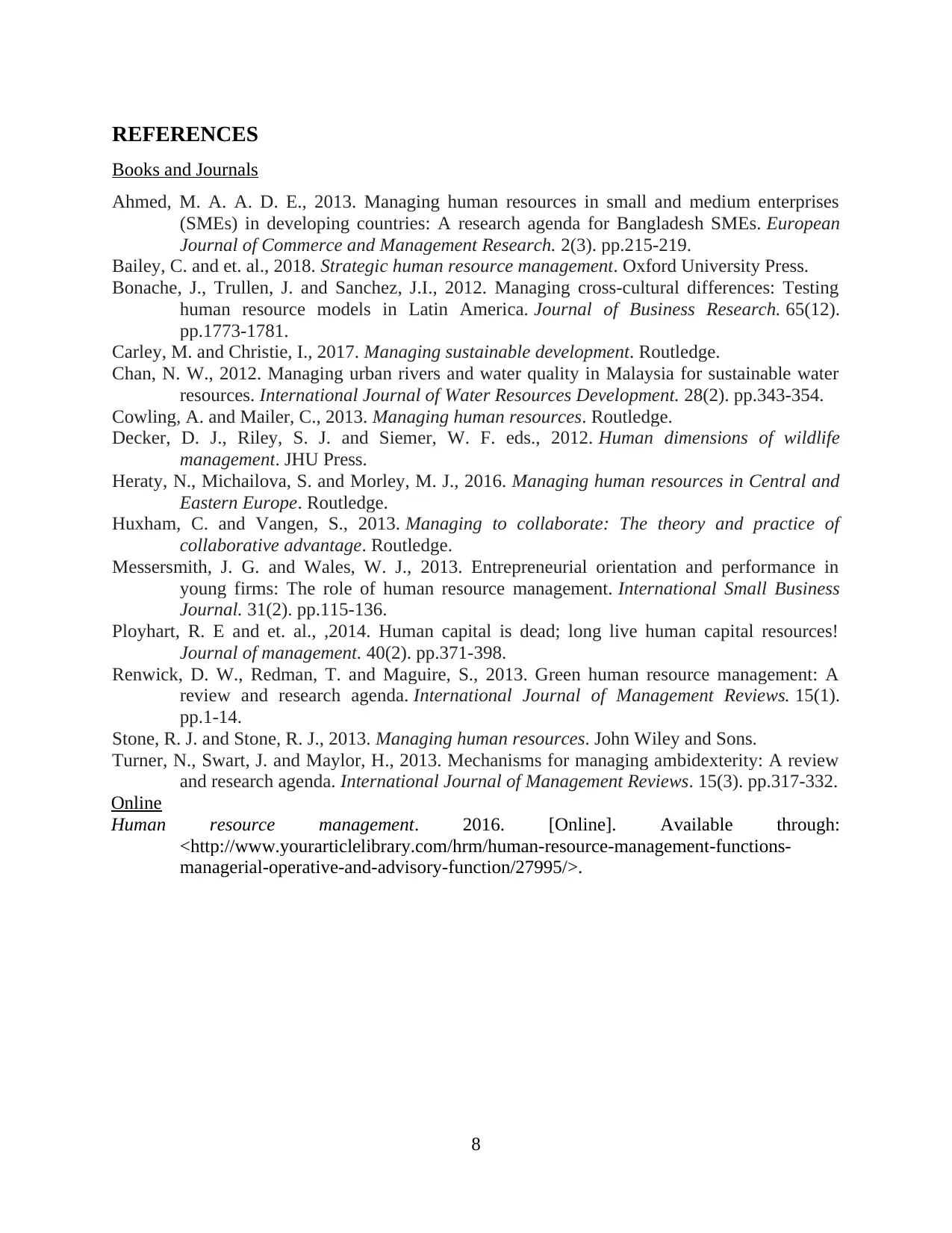
REFERENCES
Books and Journals
Ahmed, M. A. A. D. E., 2013. Managing human resources in small and medium enterprises
(SMEs) in developing countries: A research agenda for Bangladesh SMEs. European
Journal of Commerce and Management Research. 2(3). pp.215-219.
Bailey, C. and et. al., 2018. Strategic human resource management. Oxford University Press.
Bonache, J., Trullen, J. and Sanchez, J.I., 2012. Managing cross-cultural differences: Testing
human resource models in Latin America. Journal of Business Research. 65(12).
pp.1773-1781.
Carley, M. and Christie, I., 2017. Managing sustainable development. Routledge.
Chan, N. W., 2012. Managing urban rivers and water quality in Malaysia for sustainable water
resources. International Journal of Water Resources Development. 28(2). pp.343-354.
Cowling, A. and Mailer, C., 2013. Managing human resources. Routledge.
Decker, D. J., Riley, S. J. and Siemer, W. F. eds., 2012. Human dimensions of wildlife
management. JHU Press.
Heraty, N., Michailova, S. and Morley, M. J., 2016. Managing human resources in Central and
Eastern Europe. Routledge.
Huxham, C. and Vangen, S., 2013. Managing to collaborate: The theory and practice of
collaborative advantage. Routledge.
Messersmith, J. G. and Wales, W. J., 2013. Entrepreneurial orientation and performance in
young firms: The role of human resource management. International Small Business
Journal. 31(2). pp.115-136.
Ployhart, R. E and et. al., ,2014. Human capital is dead; long live human capital resources!
Journal of management. 40(2). pp.371-398.
Renwick, D. W., Redman, T. and Maguire, S., 2013. Green human resource management: A
review and research agenda. International Journal of Management Reviews. 15(1).
pp.1-14.
Stone, R. J. and Stone, R. J., 2013. Managing human resources. John Wiley and Sons.
Turner, N., Swart, J. and Maylor, H., 2013. Mechanisms for managing ambidexterity: A review
and research agenda. International Journal of Management Reviews. 15(3). pp.317-332.
Online
Human resource management. 2016. [Online]. Available through:
<http://www.yourarticlelibrary.com/hrm/human-resource-management-functions-
managerial-operative-and-advisory-function/27995/>.
8
Books and Journals
Ahmed, M. A. A. D. E., 2013. Managing human resources in small and medium enterprises
(SMEs) in developing countries: A research agenda for Bangladesh SMEs. European
Journal of Commerce and Management Research. 2(3). pp.215-219.
Bailey, C. and et. al., 2018. Strategic human resource management. Oxford University Press.
Bonache, J., Trullen, J. and Sanchez, J.I., 2012. Managing cross-cultural differences: Testing
human resource models in Latin America. Journal of Business Research. 65(12).
pp.1773-1781.
Carley, M. and Christie, I., 2017. Managing sustainable development. Routledge.
Chan, N. W., 2012. Managing urban rivers and water quality in Malaysia for sustainable water
resources. International Journal of Water Resources Development. 28(2). pp.343-354.
Cowling, A. and Mailer, C., 2013. Managing human resources. Routledge.
Decker, D. J., Riley, S. J. and Siemer, W. F. eds., 2012. Human dimensions of wildlife
management. JHU Press.
Heraty, N., Michailova, S. and Morley, M. J., 2016. Managing human resources in Central and
Eastern Europe. Routledge.
Huxham, C. and Vangen, S., 2013. Managing to collaborate: The theory and practice of
collaborative advantage. Routledge.
Messersmith, J. G. and Wales, W. J., 2013. Entrepreneurial orientation and performance in
young firms: The role of human resource management. International Small Business
Journal. 31(2). pp.115-136.
Ployhart, R. E and et. al., ,2014. Human capital is dead; long live human capital resources!
Journal of management. 40(2). pp.371-398.
Renwick, D. W., Redman, T. and Maguire, S., 2013. Green human resource management: A
review and research agenda. International Journal of Management Reviews. 15(1).
pp.1-14.
Stone, R. J. and Stone, R. J., 2013. Managing human resources. John Wiley and Sons.
Turner, N., Swart, J. and Maylor, H., 2013. Mechanisms for managing ambidexterity: A review
and research agenda. International Journal of Management Reviews. 15(3). pp.317-332.
Online
Human resource management. 2016. [Online]. Available through:
<http://www.yourarticlelibrary.com/hrm/human-resource-management-functions-
managerial-operative-and-advisory-function/27995/>.
8

1 out of 10


Related Documents


Your All-in-One AI-Powered Toolkit for Academic Success.
+13062052269
info@desklib.com
Available 24*7 on WhatsApp / Email
![[object Object]](/_next/static/media/star-bottom.7253800d.svg)
Unlock your academic potential
Copyright © 2020–2026 A2Z Services. All Rights Reserved. Developed and managed by ZUCOL.