Strategic HR Skill Development for Enhanced Business Effectiveness
VerifiedAdded on 2020/10/22
|11
|2998
|445
AI Summary
The document explores essential skills needed by HR managers to enhance organizational effectiveness through strategic learning. It highlights areas like ethical practices, dual-focus strategies, and problem-solving within human resource functions such as recruitment and staffing. The paper also outlines various learning methodologies to address challenges faced in HR roles, utilizing insights from key literature in the field.
PROJECT/PLACEMENT
DESIGN AND
IMPLEMENTATION
DESIGN AND
IMPLEMENTATION

Paraphrase This Document
Need a fresh take? Get an instant paraphrase of this document with our AI Paraphraser
Table of Contents
PROJECT PORTFOLIO 2...............................................................................................................1
1. Background and context to the project ..............................................................................1
2. Theories and Models to support the analysis ....................................................................1
3. Development and Implementation of Effective plan to become an HR manager .............3
4. Skills needs to be developed for solving work based problems ........................................5
5. Analysis and Evaluation of the Action...............................................................................6
6. What learning you took from the project by giving a portfolio of evidence. ....................6
Conclusion ......................................................................................................................................7
REFERENCES................................................................................................................................8
PROJECT PORTFOLIO 2...............................................................................................................1
1. Background and context to the project ..............................................................................1
2. Theories and Models to support the analysis ....................................................................1
3. Development and Implementation of Effective plan to become an HR manager .............3
4. Skills needs to be developed for solving work based problems ........................................5
5. Analysis and Evaluation of the Action...............................................................................6
6. What learning you took from the project by giving a portfolio of evidence. ....................6
Conclusion ......................................................................................................................................7
REFERENCES................................................................................................................................8
PROJECT PORTFOLIO 2
1. Background and context to the project
Human resources refer to the employees or staff working within an organization or
company. These resources are one of the most essential elements within each and every business
which helps in achievement of goals or objectives easily and efficiently. In order to manage and
use these resources in most appropriate manner every company has a team of hr professional
known as human resource management team.
Human resource management plays a vital role in recruiting skills and talented employees
in a company so that it can improve its performance and profitability within the business
operations. The present report is in context to the brief concept of Human resource management
and its technical aspects such as recruiting, evaluating, training and compensating etc. There are
various parts of this project which is essential in order to analyse and identify the topic. The
project was prepared and developed by considering all the factors that can affect human
resources and its management in an organisation or company. Furthermore, the project also
focuses on future challenges or changes which can affect the HRM practices performed by a
human resource manager. The project can help in identifying various theories or approaches that
can be applied by an organization to motivate and retain their employees as well as to improve
their performance in a company(Garavan, Carbery and Rock, 2017).
2. Theories and Models to support the analysis
In order to understand and support the examination related to the project on human
resource management and its theories there are various theories or models which can be applied.
Various theories with regards to HRM can be described as below -
1. The Universalistic theory – According to this theory an organization or company should
select the best series of human resource practices which can be used in order to manage
and maintain the staff properly. This particular theory aims at explaining structural
similarities among the business environment all around the world on the basis of
assumptions that each and every human is characterized by an innate ability to simply the
language. Therefore, this theory states that structural similarities are the outcomes of
universal strategies for simplification of the language(Anderson and Anderson, 2017).
2. Harvard analytical framework – This model was developed at Harvard school in 1980,
the model is based on six basic elements such as -
1
1. Background and context to the project
Human resources refer to the employees or staff working within an organization or
company. These resources are one of the most essential elements within each and every business
which helps in achievement of goals or objectives easily and efficiently. In order to manage and
use these resources in most appropriate manner every company has a team of hr professional
known as human resource management team.
Human resource management plays a vital role in recruiting skills and talented employees
in a company so that it can improve its performance and profitability within the business
operations. The present report is in context to the brief concept of Human resource management
and its technical aspects such as recruiting, evaluating, training and compensating etc. There are
various parts of this project which is essential in order to analyse and identify the topic. The
project was prepared and developed by considering all the factors that can affect human
resources and its management in an organisation or company. Furthermore, the project also
focuses on future challenges or changes which can affect the HRM practices performed by a
human resource manager. The project can help in identifying various theories or approaches that
can be applied by an organization to motivate and retain their employees as well as to improve
their performance in a company(Garavan, Carbery and Rock, 2017).
2. Theories and Models to support the analysis
In order to understand and support the examination related to the project on human
resource management and its theories there are various theories or models which can be applied.
Various theories with regards to HRM can be described as below -
1. The Universalistic theory – According to this theory an organization or company should
select the best series of human resource practices which can be used in order to manage
and maintain the staff properly. This particular theory aims at explaining structural
similarities among the business environment all around the world on the basis of
assumptions that each and every human is characterized by an innate ability to simply the
language. Therefore, this theory states that structural similarities are the outcomes of
universal strategies for simplification of the language(Anderson and Anderson, 2017).
2. Harvard analytical framework – This model was developed at Harvard school in 1980,
the model is based on six basic elements such as -
1
⊘ This is a preview!⊘
Do you want full access?
Subscribe today to unlock all pages.

Trusted by 1+ million students worldwide
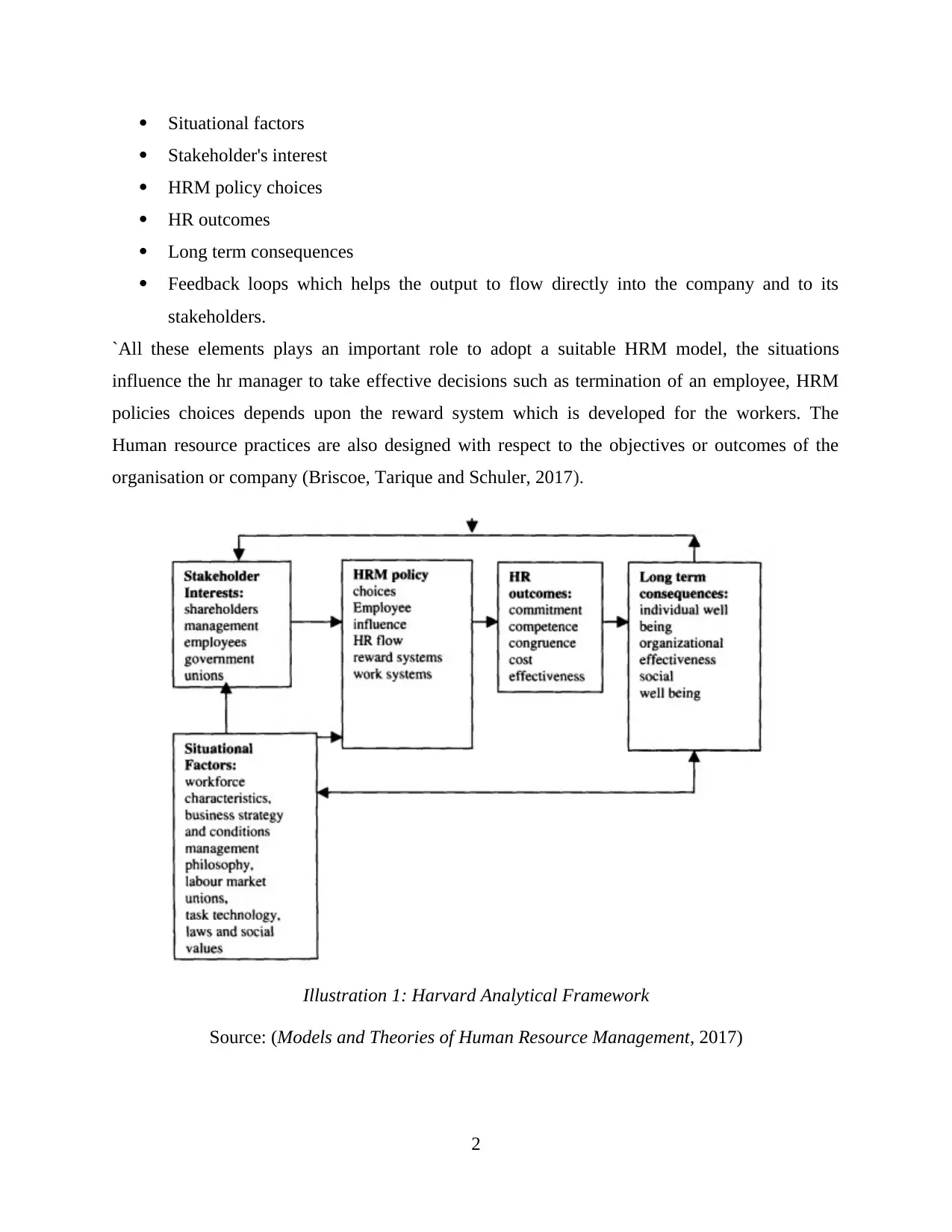
Situational factors
Stakeholder's interest
HRM policy choices
HR outcomes
Long term consequences
Feedback loops which helps the output to flow directly into the company and to its
stakeholders.
`All these elements plays an important role to adopt a suitable HRM model, the situations
influence the hr manager to take effective decisions such as termination of an employee, HRM
policies choices depends upon the reward system which is developed for the workers. The
Human resource practices are also designed with respect to the objectives or outcomes of the
organisation or company (Briscoe, Tarique and Schuler, 2017).
2
Illustration 1: Harvard Analytical Framework
Source: (Models and Theories of Human Resource Management, 2017)
Stakeholder's interest
HRM policy choices
HR outcomes
Long term consequences
Feedback loops which helps the output to flow directly into the company and to its
stakeholders.
`All these elements plays an important role to adopt a suitable HRM model, the situations
influence the hr manager to take effective decisions such as termination of an employee, HRM
policies choices depends upon the reward system which is developed for the workers. The
Human resource practices are also designed with respect to the objectives or outcomes of the
organisation or company (Briscoe, Tarique and Schuler, 2017).
2
Illustration 1: Harvard Analytical Framework
Source: (Models and Theories of Human Resource Management, 2017)
Paraphrase This Document
Need a fresh take? Get an instant paraphrase of this document with our AI Paraphraser
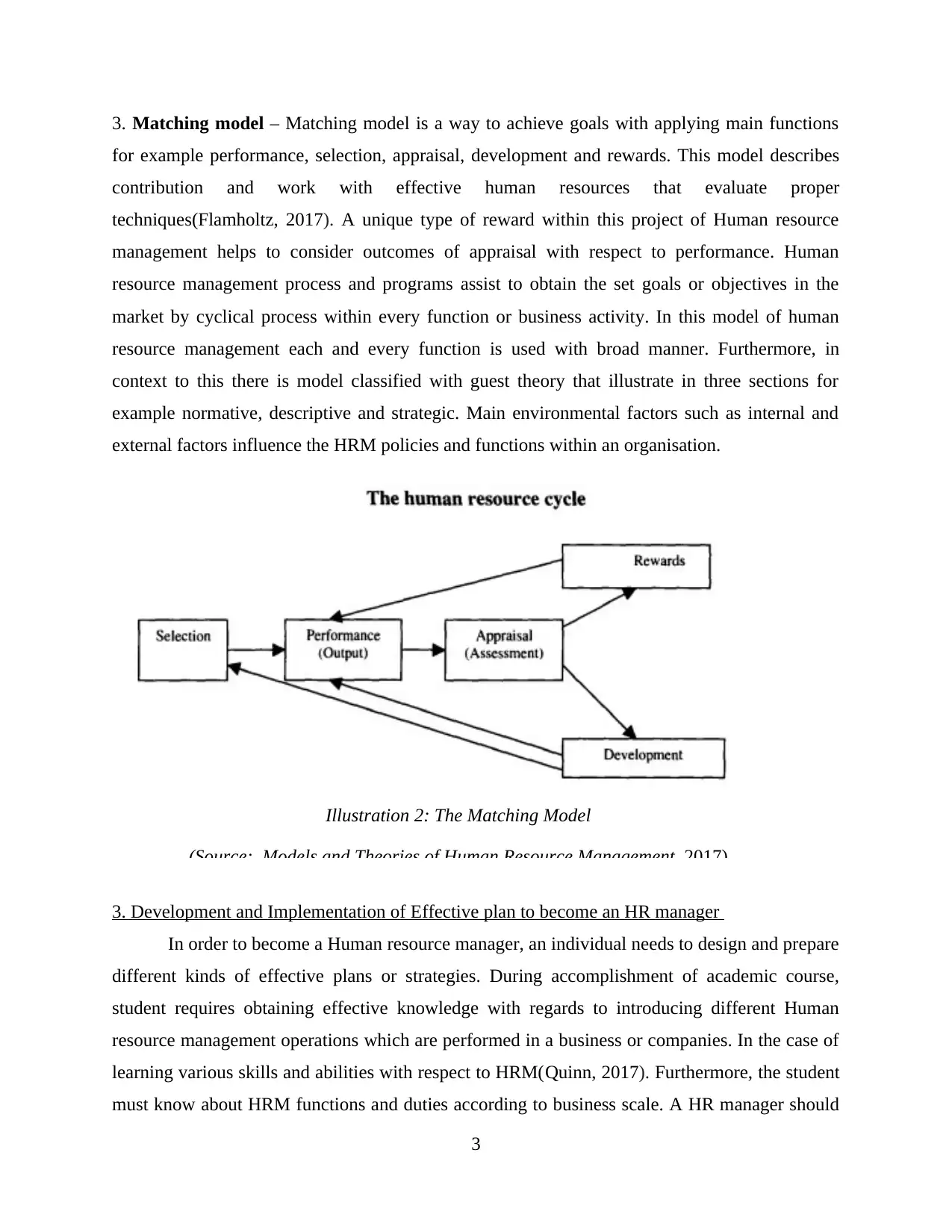
3. Matching model – Matching model is a way to achieve goals with applying main functions
for example performance, selection, appraisal, development and rewards. This model describes
contribution and work with effective human resources that evaluate proper
techniques(Flamholtz, 2017). A unique type of reward within this project of Human resource
management helps to consider outcomes of appraisal with respect to performance. Human
resource management process and programs assist to obtain the set goals or objectives in the
market by cyclical process within every function or business activity. In this model of human
resource management each and every function is used with broad manner. Furthermore, in
context to this there is model classified with guest theory that illustrate in three sections for
example normative, descriptive and strategic. Main environmental factors such as internal and
external factors influence the HRM policies and functions within an organisation.
Illustration 2: The Matching Model
(Source: Models and Theories of Human Resource Management, 2017)
3. Development and Implementation of Effective plan to become an HR manager
In order to become a Human resource manager, an individual needs to design and prepare
different kinds of effective plans or strategies. During accomplishment of academic course,
student requires obtaining effective knowledge with regards to introducing different Human
resource management operations which are performed in a business or companies. In the case of
learning various skills and abilities with respect to HRM(Quinn, 2017). Furthermore, the student
must know about HRM functions and duties according to business scale. A HR manager should
3
for example performance, selection, appraisal, development and rewards. This model describes
contribution and work with effective human resources that evaluate proper
techniques(Flamholtz, 2017). A unique type of reward within this project of Human resource
management helps to consider outcomes of appraisal with respect to performance. Human
resource management process and programs assist to obtain the set goals or objectives in the
market by cyclical process within every function or business activity. In this model of human
resource management each and every function is used with broad manner. Furthermore, in
context to this there is model classified with guest theory that illustrate in three sections for
example normative, descriptive and strategic. Main environmental factors such as internal and
external factors influence the HRM policies and functions within an organisation.
Illustration 2: The Matching Model
(Source: Models and Theories of Human Resource Management, 2017)
3. Development and Implementation of Effective plan to become an HR manager
In order to become a Human resource manager, an individual needs to design and prepare
different kinds of effective plans or strategies. During accomplishment of academic course,
student requires obtaining effective knowledge with regards to introducing different Human
resource management operations which are performed in a business or companies. In the case of
learning various skills and abilities with respect to HRM(Quinn, 2017). Furthermore, the student
must know about HRM functions and duties according to business scale. A HR manager should
3
have an effective knowledge of human resource management, policies and the lawful issues
around enlisting and staffing within an organization. In addition to this the student needs to
comprehend the hierarchical technique which can help them to comprehend the vision and
mission of organization. The individual must require learning relationship administration
strategies and building powerful association with individuals crosswise over at all levels, which
can help its employees to effectively trust on them and furthermore manage individual data, for
example, pay rates and grievances which cause at working environment(Hendry, 2017). Aside
from it, the individual additionally needs to comprehend the all ideas of getting to be successful
HR chief throughout everyday life. The individual needs to gain different type of understandings
and learning related to HRM roles and duties in business, so it will help them to achieve their
objectives of becoming a HR manager in and association. For becoming a human resource
manager an individual must have a little education background in the same field, while human
resource manager qualifications are not fast and hard, it is important to follow a general path as
mentioned below - -
1. Education – Individual must have atleast an associate in Human resource or other related
field.
2. Experience – The next step is to begin working in human resource field, it is important
for an individual to have at least one year of work experience to qualify for certifications.
3. Certification – The another main step is to pass the certification examination and
maintain it by earning continuing education credits of online HR courses(Marchington,
Donnelly and Kynighou, 2017).
There are various bachelor's and master's degrees which are required to be a successful
human resource manager as it increases the knowledge and information related to the human
resources and concept of human resource management. It is further important for an individual to
develop certain skills as mentioned below -
Interpersonal skills – These skills includes group speaking, clear communication and
team leadership that allows an individual to work with many random people that come
across daily in an organization.
Outstanding organisation skills – These are also essential skills required by a successful
Human resource manager. Human resource manager needs to look after various activities
4
around enlisting and staffing within an organization. In addition to this the student needs to
comprehend the hierarchical technique which can help them to comprehend the vision and
mission of organization. The individual must require learning relationship administration
strategies and building powerful association with individuals crosswise over at all levels, which
can help its employees to effectively trust on them and furthermore manage individual data, for
example, pay rates and grievances which cause at working environment(Hendry, 2017). Aside
from it, the individual additionally needs to comprehend the all ideas of getting to be successful
HR chief throughout everyday life. The individual needs to gain different type of understandings
and learning related to HRM roles and duties in business, so it will help them to achieve their
objectives of becoming a HR manager in and association. For becoming a human resource
manager an individual must have a little education background in the same field, while human
resource manager qualifications are not fast and hard, it is important to follow a general path as
mentioned below - -
1. Education – Individual must have atleast an associate in Human resource or other related
field.
2. Experience – The next step is to begin working in human resource field, it is important
for an individual to have at least one year of work experience to qualify for certifications.
3. Certification – The another main step is to pass the certification examination and
maintain it by earning continuing education credits of online HR courses(Marchington,
Donnelly and Kynighou, 2017).
There are various bachelor's and master's degrees which are required to be a successful
human resource manager as it increases the knowledge and information related to the human
resources and concept of human resource management. It is further important for an individual to
develop certain skills as mentioned below -
Interpersonal skills – These skills includes group speaking, clear communication and
team leadership that allows an individual to work with many random people that come
across daily in an organization.
Outstanding organisation skills – These are also essential skills required by a successful
Human resource manager. Human resource manager needs to look after various activities
4
⊘ This is a preview!⊘
Do you want full access?
Subscribe today to unlock all pages.
Trusted by 1+ million students worldwide
such as hiring, requiring dozens or even hundreds of candidates to be interviewed within
a short period of time.
4. Skills needs to be developed for solving work based problems
A HR manager needs to be successful and effective in solving work based problems, this
is essential because one of the main role of a human resource manager is to manage human
resource properly by avoiding any conflict situation within the organization. As a Human
resource manager I need to develop various kinds of skills in myself which can help me solve
various work based problems and issue in the organisation. The various skills which are required
to be develop are discussed below - Communication skills – The main skill needed by an HR to solve a particular problem or
issue is communication technique. Communication helps in listening, speaking and
understanding individuals point of view. This assist in taking effective decisions and
solving the issue(Kippers and Visscher, 2017). Logical and analytical thinking – This includes various skills such as comparing,
ordering, evaluating, contrasting and selecting. It gives a logical framework which helps
in solving a particular problem or issue and helps to choose the best alternative solution
for the same.
Creative thinking – It can be referred to a divergent procedure that uses the imagination
to develop a wide range of ideas for a certain solution(Kavanagh and Johnson, 2017). As
a HR manager I need to look for creative ideas, the creative skills can be divided in to
three major elements -
1. Flexibility – Producing a wide range of effective ideas, producing unique ideas.
2. Fluency – Producing many ideas
3. Elaboration – Developing ideas.
Employee engagement – It is important for me to get engage or connected with the
employees working in an organisation. This helps in identifying and understanding the
needs, behaviour and nature of the employees, they feel free to share their ideas and
views with regards to any issue they are facing while working in an organisation. The HR
can solve this identified issue properly later.
5
a short period of time.
4. Skills needs to be developed for solving work based problems
A HR manager needs to be successful and effective in solving work based problems, this
is essential because one of the main role of a human resource manager is to manage human
resource properly by avoiding any conflict situation within the organization. As a Human
resource manager I need to develop various kinds of skills in myself which can help me solve
various work based problems and issue in the organisation. The various skills which are required
to be develop are discussed below - Communication skills – The main skill needed by an HR to solve a particular problem or
issue is communication technique. Communication helps in listening, speaking and
understanding individuals point of view. This assist in taking effective decisions and
solving the issue(Kippers and Visscher, 2017). Logical and analytical thinking – This includes various skills such as comparing,
ordering, evaluating, contrasting and selecting. It gives a logical framework which helps
in solving a particular problem or issue and helps to choose the best alternative solution
for the same.
Creative thinking – It can be referred to a divergent procedure that uses the imagination
to develop a wide range of ideas for a certain solution(Kavanagh and Johnson, 2017). As
a HR manager I need to look for creative ideas, the creative skills can be divided in to
three major elements -
1. Flexibility – Producing a wide range of effective ideas, producing unique ideas.
2. Fluency – Producing many ideas
3. Elaboration – Developing ideas.
Employee engagement – It is important for me to get engage or connected with the
employees working in an organisation. This helps in identifying and understanding the
needs, behaviour and nature of the employees, they feel free to share their ideas and
views with regards to any issue they are facing while working in an organisation. The HR
can solve this identified issue properly later.
5
Paraphrase This Document
Need a fresh take? Get an instant paraphrase of this document with our AI Paraphraser
5. Analysis and Evaluation of the Action
For gaining effective development and growth in solving work base problems or issues, I
required to improve certain areas of my personal skills. I needed to develop engagement or
connection with the employees for understanding their behaviors at the workplace. I failed to
take appropriate actions or step to create this engagement which also affected my process of
understanding the employees(Lunenberg, 2017). The main reason for this failure was lack of
time, I consume a lot of time in making reports, managing employee attendance, leaves etc
which creates a barrier in getting connected with the employees. I also failed to apply my logical
thinking for solving work based issues and problems due to specific policies related to the
organization and Human resource practices. The policies bounded me to take any action with
regards to my creative and logical thinking. Multiple activities and functions are being performed
in an organisation and human resource manager has a major responsibility to develop or maintain
a good working environment for the employees. Furthermore, I also needed to improve my
communication skills, I developed my written communication skills by sending emails, letters
etc. But I failed to learn oral communication skills which was also essential for me. The reason
behind this failure was lack of opportunities. I was looking forward to improving my
communication skills by conducting meetings, events and activities for the employees but to
work load there was no event scheduled in the company(Bratton and Gold, 2017).
Planning – In order to overcome all these issues it is important to make strategies for time
management, it can be done by managing time and setting time limits for various activities and
functions I need to perform in an organization or company, this can help in providing enough
time for getting connected with the employees. Furthermore, I will also develop and conduct
training and events for the employees which would help me to develop my own skills and
implement new methods to overcome work based problems as well as developing good
workplace environment.
6. What learning you took from the project by giving a portfolio of evidence.
Log book: This is the condensed book which includes record identified with different occasions
or some other information like entire event or a trip. This is particularly useful particularly on
part of student as they could incorporate their day by day learning or advance of their working
that to on day by day bases. This at that point is been checked by their managers or the person
6
For gaining effective development and growth in solving work base problems or issues, I
required to improve certain areas of my personal skills. I needed to develop engagement or
connection with the employees for understanding their behaviors at the workplace. I failed to
take appropriate actions or step to create this engagement which also affected my process of
understanding the employees(Lunenberg, 2017). The main reason for this failure was lack of
time, I consume a lot of time in making reports, managing employee attendance, leaves etc
which creates a barrier in getting connected with the employees. I also failed to apply my logical
thinking for solving work based issues and problems due to specific policies related to the
organization and Human resource practices. The policies bounded me to take any action with
regards to my creative and logical thinking. Multiple activities and functions are being performed
in an organisation and human resource manager has a major responsibility to develop or maintain
a good working environment for the employees. Furthermore, I also needed to improve my
communication skills, I developed my written communication skills by sending emails, letters
etc. But I failed to learn oral communication skills which was also essential for me. The reason
behind this failure was lack of opportunities. I was looking forward to improving my
communication skills by conducting meetings, events and activities for the employees but to
work load there was no event scheduled in the company(Bratton and Gold, 2017).
Planning – In order to overcome all these issues it is important to make strategies for time
management, it can be done by managing time and setting time limits for various activities and
functions I need to perform in an organization or company, this can help in providing enough
time for getting connected with the employees. Furthermore, I will also develop and conduct
training and events for the employees which would help me to develop my own skills and
implement new methods to overcome work based problems as well as developing good
workplace environment.
6. What learning you took from the project by giving a portfolio of evidence.
Log book: This is the condensed book which includes record identified with different occasions
or some other information like entire event or a trip. This is particularly useful particularly on
part of student as they could incorporate their day by day learning or advance of their working
that to on day by day bases. This at that point is been checked by their managers or the person
6
who is controlling them with their work. In same sense laborers and understudies are
additionally included who are setting up this logbook and they have to review their day by day
discoveries and learning into that and this is additionally checked by their educates or chiefs
giving them inputs on that (Knowles, Holton and Swanson, 2017).
Critical incidents' diary: This sort of work would incorporate a wide range of surprising
occasions identified with all staff and employees of organization and this would be kept by their
director of every worker. This is particularly improved the situation and evaluation time of that
worker as this will incorporate the exceptional notes and basic episodes which are identified
with how could they performed. This is additionally including the conduct of those workers and
afterward positioning them on bases of all these specified criteria extending from best to the
most noticeably bad employees. This basic occurrences' journal is telling and letting know
directors what their each staff individuals is doing and how could the assistance them in
improvement of their employees execution and conduct both.
Feedback: This is the most particular part which is including offering criticisms to their
youngsters which is chiefly done by the directors everything being equal. This journal will
reveal to them how employees are performing and how better they have to perform. This is
especially for the workers or student know their best and most exceedingly terrible part which
they have to enhance and which they have to revise. Criticism is useful for future improvement
and development of the student that must be taken by them for their own particular
advancement as it were.
Conclusion
The report concluded that there are different set of skills which are required to be
developed within an individual. It develops a method to promote effectiveness of the business in
very systematic manner. It consists employment cycle, staffing, recruiting etc. There are many
issues or problems which arises in an organisation which are important to be resolved for
developing effectiveness and efficiency in a business. Ethical and Discrete, duel focus, problem
solving, conflict management and so on. The report also identified various skills which are
required to be a successful Human resource manager, In addition to this there are various
7
additionally included who are setting up this logbook and they have to review their day by day
discoveries and learning into that and this is additionally checked by their educates or chiefs
giving them inputs on that (Knowles, Holton and Swanson, 2017).
Critical incidents' diary: This sort of work would incorporate a wide range of surprising
occasions identified with all staff and employees of organization and this would be kept by their
director of every worker. This is particularly improved the situation and evaluation time of that
worker as this will incorporate the exceptional notes and basic episodes which are identified
with how could they performed. This is additionally including the conduct of those workers and
afterward positioning them on bases of all these specified criteria extending from best to the
most noticeably bad employees. This basic occurrences' journal is telling and letting know
directors what their each staff individuals is doing and how could the assistance them in
improvement of their employees execution and conduct both.
Feedback: This is the most particular part which is including offering criticisms to their
youngsters which is chiefly done by the directors everything being equal. This journal will
reveal to them how employees are performing and how better they have to perform. This is
especially for the workers or student know their best and most exceedingly terrible part which
they have to enhance and which they have to revise. Criticism is useful for future improvement
and development of the student that must be taken by them for their own particular
advancement as it were.
Conclusion
The report concluded that there are different set of skills which are required to be
developed within an individual. It develops a method to promote effectiveness of the business in
very systematic manner. It consists employment cycle, staffing, recruiting etc. There are many
issues or problems which arises in an organisation which are important to be resolved for
developing effectiveness and efficiency in a business. Ethical and Discrete, duel focus, problem
solving, conflict management and so on. The report also identified various skills which are
required to be a successful Human resource manager, In addition to this there are various
7
⊘ This is a preview!⊘
Do you want full access?
Subscribe today to unlock all pages.
Trusted by 1+ million students worldwide
methods of learning which are essential for overcoming the challenges and issues raised in
performing the roles or duties of a HR.
REFERENCES
Books and Journals
Knowles, M.S., Holton III, E.F. and Swanson, R.A., 2017. The adult learner: The definitive
classic in adult education and human resource development. Routledge.
Bratton, J. and Gold, J., 2017. Human resource management: theory and practice. Palgrave.
Kavanagh, M.J. and Johnson, R.D. eds., 2017. Human resource information systems: Basics,
applications, and future directions. Sage Publications.
Marchington, M., Donnelly, R. and Kynighou, A., 2017. Human resource management at work.
Kogan Page Publisher.
Quinn, R., 2017. Guns, Germs & Steel: The Fate of Human Societies. Macat Library.
Flamholtz, E. G., 2017. Human resource accounting: Advances in concepts, methods and
applications. Springer Science & Business Media.
Briscoe, D., Tarique, I. and Schuler, R., 2017. International human resource management:
Policies and practices for multinational enterprises. Routledge.
Anderson, D. and Anderson, L. A., 2017. Beyond change management: How to achieve
breakthrough results through conscious change leadership (Vol. 36). John Wiley &
Sons.
Garavan, T. N., Carbery, R. and Rock, A., 2017. Mapping talent development: definition, scope
and architecture. European Journal of Training and Development. 36. 1. pp. 5-24.
Hendry, C., 2017. Human resource management. Routledge.
Kippers, W.B.. and Visscher, A.J., 2017. Data literacy: What do educators learn and struggle
with during a data use intervention?. Studies in Educational Evaluation, 56, pp.21-31.
Lunenberg, M., 2017. Teaching and Learning Self-Study Research: Tracing the Map.
In Teaching, Learning, and Enacting of Self-Study Methodology (pp. 101-110). Springer,
Singapore.
Online
Models and Theories of Human Resource Management, 2017. [Online] Available through:
<http://shodhganga.inflibnet.ac.in/bitstream/10603/155771/16/13_chapter%203.pdf>
8
performing the roles or duties of a HR.
REFERENCES
Books and Journals
Knowles, M.S., Holton III, E.F. and Swanson, R.A., 2017. The adult learner: The definitive
classic in adult education and human resource development. Routledge.
Bratton, J. and Gold, J., 2017. Human resource management: theory and practice. Palgrave.
Kavanagh, M.J. and Johnson, R.D. eds., 2017. Human resource information systems: Basics,
applications, and future directions. Sage Publications.
Marchington, M., Donnelly, R. and Kynighou, A., 2017. Human resource management at work.
Kogan Page Publisher.
Quinn, R., 2017. Guns, Germs & Steel: The Fate of Human Societies. Macat Library.
Flamholtz, E. G., 2017. Human resource accounting: Advances in concepts, methods and
applications. Springer Science & Business Media.
Briscoe, D., Tarique, I. and Schuler, R., 2017. International human resource management:
Policies and practices for multinational enterprises. Routledge.
Anderson, D. and Anderson, L. A., 2017. Beyond change management: How to achieve
breakthrough results through conscious change leadership (Vol. 36). John Wiley &
Sons.
Garavan, T. N., Carbery, R. and Rock, A., 2017. Mapping talent development: definition, scope
and architecture. European Journal of Training and Development. 36. 1. pp. 5-24.
Hendry, C., 2017. Human resource management. Routledge.
Kippers, W.B.. and Visscher, A.J., 2017. Data literacy: What do educators learn and struggle
with during a data use intervention?. Studies in Educational Evaluation, 56, pp.21-31.
Lunenberg, M., 2017. Teaching and Learning Self-Study Research: Tracing the Map.
In Teaching, Learning, and Enacting of Self-Study Methodology (pp. 101-110). Springer,
Singapore.
Online
Models and Theories of Human Resource Management, 2017. [Online] Available through:
<http://shodhganga.inflibnet.ac.in/bitstream/10603/155771/16/13_chapter%203.pdf>
8
Paraphrase This Document
Need a fresh take? Get an instant paraphrase of this document with our AI Paraphraser

9

1 out of 11


Related Documents


Your All-in-One AI-Powered Toolkit for Academic Success.
+13062052269
info@desklib.com
Available 24*7 on WhatsApp / Email
![[object Object]](/_next/static/media/star-bottom.7253800d.svg)
Unlock your academic potential
Copyright © 2020–2026 A2Z Services. All Rights Reserved. Developed and managed by ZUCOL.