Human Resource Management and Training Report: Training Methods

Verified

Added on  2022/11/19

|5
|830
|360
Report
AI Summary
This report delves into the critical role of training objectives in effective human resource management and course design. It explores the relevance of objectives for instructors, learners, and course designers, emphasizing their function in guiding the training process and ensuring successful outcomes. The report provides examples of both good and poor learning objectives, offering rationales for each selection based on their adherence to SMART criteria. Furthermore, it compares and contrasts the advantages and disadvantages of web-based or multimedia training with face-to-face training, examining factors such as flexibility, engagement, and cost. The analysis also considers learner/audience factors, such as resource availability and physical impairments, in selecting the optimal delivery method. The report concludes by providing a comprehensive overview of HRM training methodologies.
Document Page
Running head: HUMAN RESOURCE MANAGEMENT AND TRAINING 1
Human Resource Management and Training
Name
Professor
Course
Date
tabler-icon-diamond-filled.svg

Paraphrase This Document

Need a fresh take? Get an instant paraphrase of this document with our AI Paraphraser
Document Page
HUMAN RESOURCE MANAGEMENT AND TRAINING 2
Human Resource Management and Training
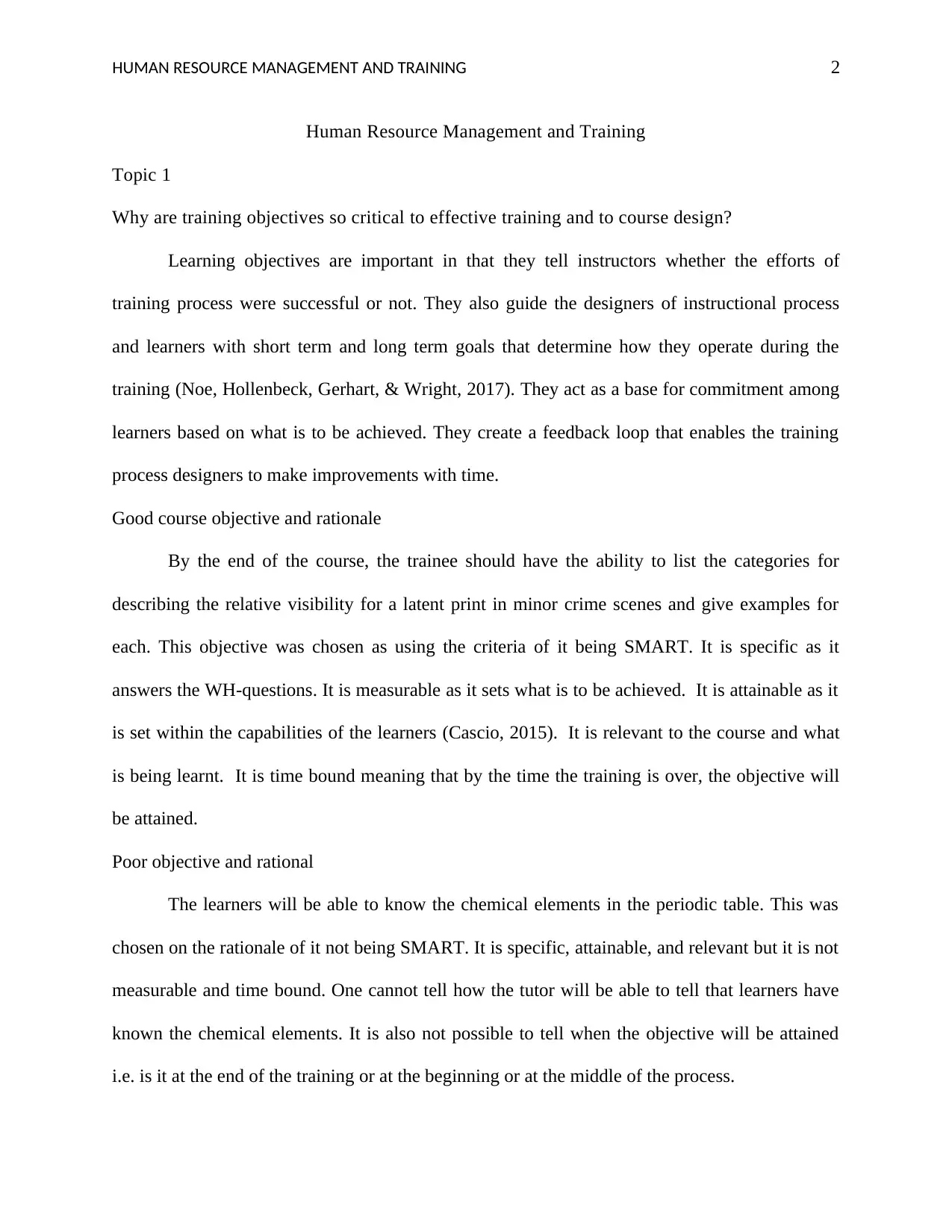
Topic 1
Why are training objectives so critical to effective training and to course design?
Learning objectives are important in that they tell instructors whether the efforts of
training process were successful or not. They also guide the designers of instructional process
and learners with short term and long term goals that determine how they operate during the
training (Noe, Hollenbeck, Gerhart, & Wright, 2017). They act as a base for commitment among
learners based on what is to be achieved. They create a feedback loop that enables the training
process designers to make improvements with time.
Good course objective and rationale
By the end of the course, the trainee should have the ability to list the categories for
describing the relative visibility for a latent print in minor crime scenes and give examples for
each. This objective was chosen as using the criteria of it being SMART. It is specific as it
answers the WH-questions. It is measurable as it sets what is to be achieved. It is attainable as it
is set within the capabilities of the learners (Cascio, 2015). It is relevant to the course and what
is being learnt. It is time bound meaning that by the time the training is over, the objective will
be attained.
Poor objective and rational
The learners will be able to know the chemical elements in the periodic table. This was
chosen on the rationale of it not being SMART. It is specific, attainable, and relevant but it is not
measurable and time bound. One cannot tell how the tutor will be able to tell that learners have
known the chemical elements. It is also not possible to tell when the objective will be attained
i.e. is it at the end of the training or at the beginning or at the middle of the process.
Document Page
HUMAN RESOURCE MANAGEMENT AND TRAINING 3
Topic 2
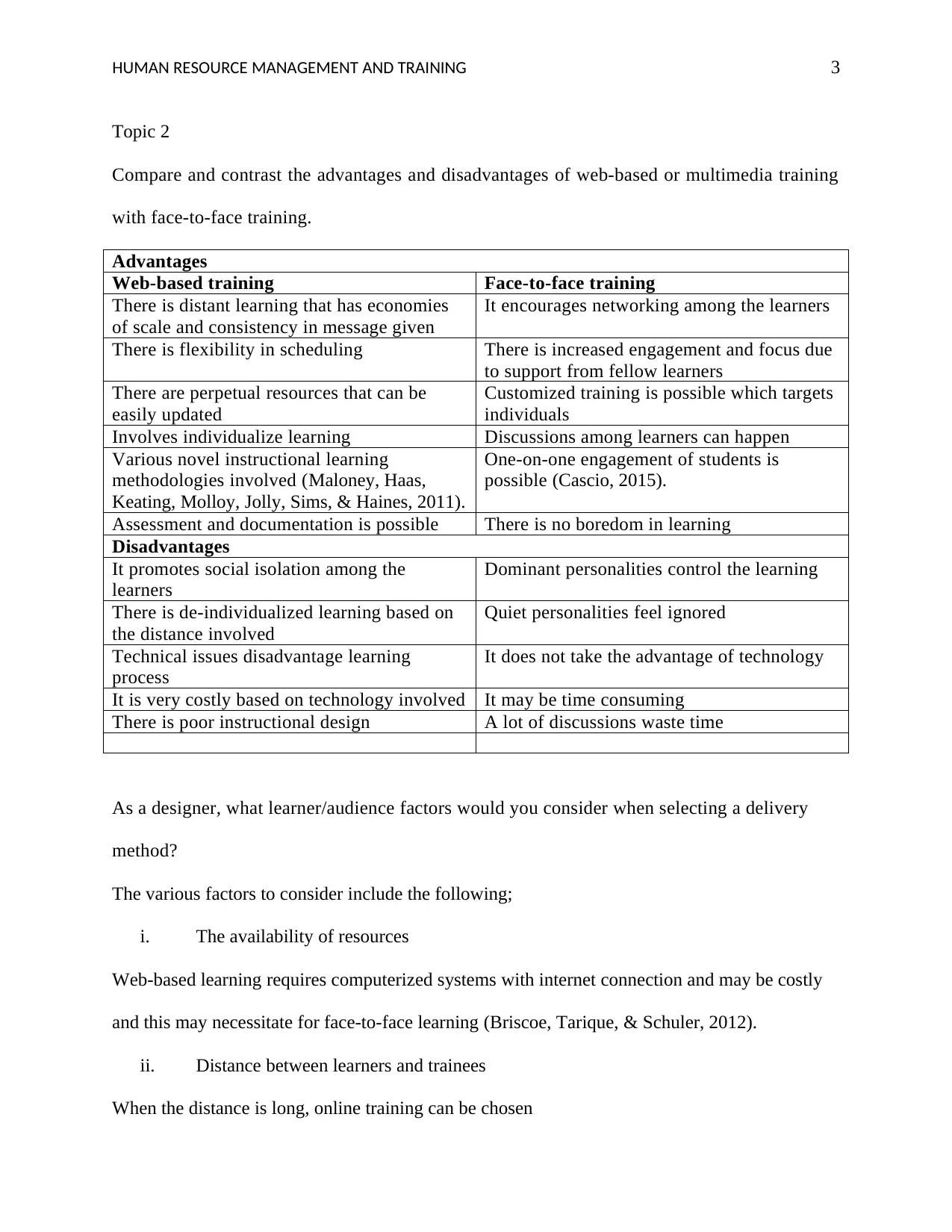
Compare and contrast the advantages and disadvantages of web-based or multimedia training
with face-to-face training.
Advantages
Web-based training Face-to-face training
There is distant learning that has economies
of scale and consistency in message given
It encourages networking among the learners
There is flexibility in scheduling There is increased engagement and focus due
to support from fellow learners
There are perpetual resources that can be
easily updated
Customized training is possible which targets
individuals
Involves individualize learning Discussions among learners can happen
Various novel instructional learning
methodologies involved (Maloney, Haas,
Keating, Molloy, Jolly, Sims, & Haines, 2011).
One-on-one engagement of students is
possible (Cascio, 2015).
Assessment and documentation is possible There is no boredom in learning
Disadvantages
It promotes social isolation among the
learners
Dominant personalities control the learning
There is de-individualized learning based on
the distance involved
Quiet personalities feel ignored
Technical issues disadvantage learning
process
It does not take the advantage of technology
It is very costly based on technology involved It may be time consuming
There is poor instructional design A lot of discussions waste time
As a designer, what learner/audience factors would you consider when selecting a delivery
method?
The various factors to consider include the following;
i. The availability of resources
Web-based learning requires computerized systems with internet connection and may be costly
and this may necessitate for face-to-face learning (Briscoe, Tarique, & Schuler, 2012).
ii. Distance between learners and trainees
When the distance is long, online training can be chosen
Document Page
HUMAN RESOURCE MANAGEMENT AND TRAINING 4
iii. The number of learners
Few learners may not require face-to-face training as online can do
iv. Status of learners
Physically impaired learners may require face-to-face learning to identify their problems and
solve them
v. Time
Short time may require the use of online teaching
References
tabler-icon-diamond-filled.svg

Paraphrase This Document

Need a fresh take? Get an instant paraphrase of this document with our AI Paraphraser
Document Page
HUMAN RESOURCE MANAGEMENT AND TRAINING 5
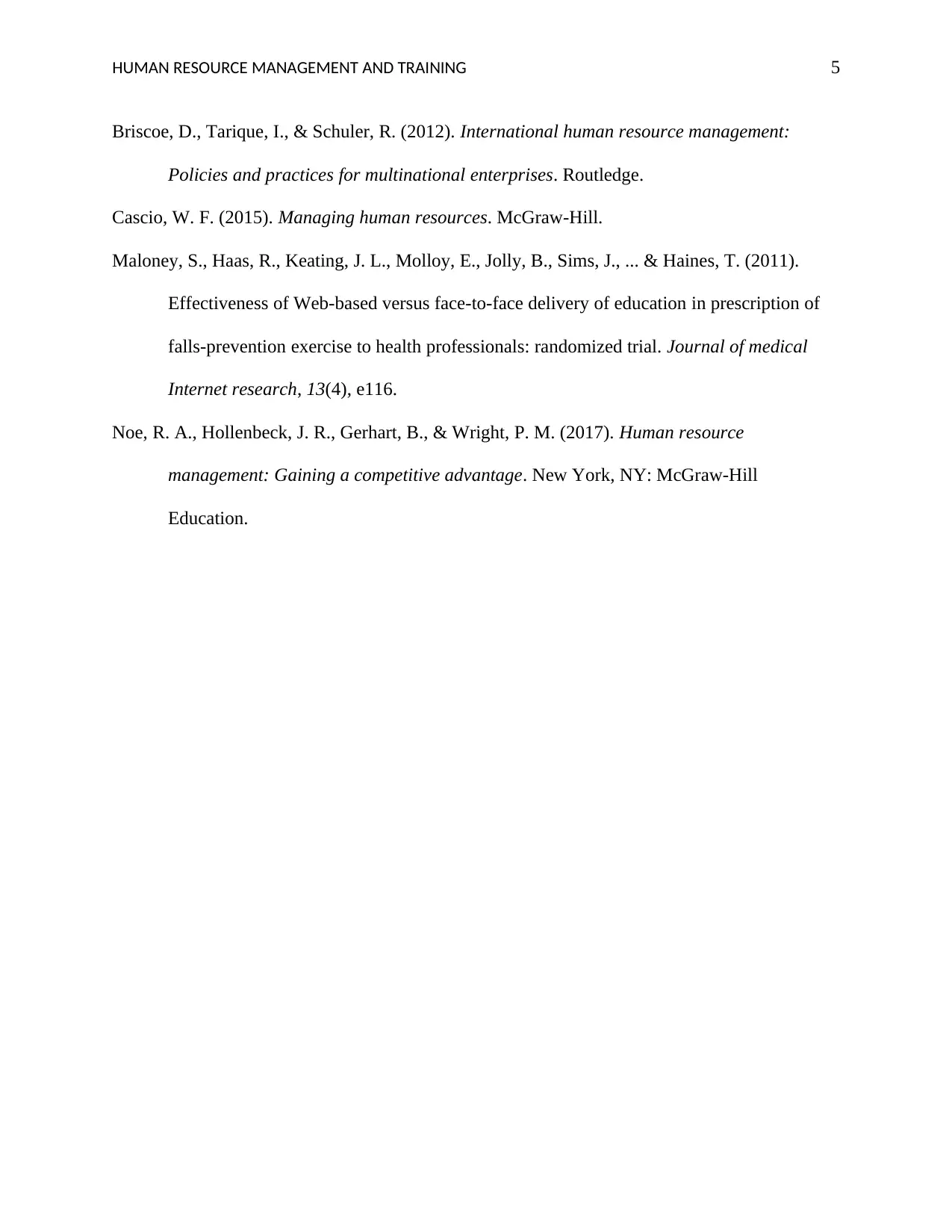
Briscoe, D., Tarique, I., & Schuler, R. (2012). International human resource management:
Policies and practices for multinational enterprises. Routledge.
Cascio, W. F. (2015). Managing human resources. McGraw-Hill.
Maloney, S., Haas, R., Keating, J. L., Molloy, E., Jolly, B., Sims, J., ... & Haines, T. (2011).
Effectiveness of Web-based versus face-to-face delivery of education in prescription of
falls-prevention exercise to health professionals: randomized trial. Journal of medical
Internet research, 13(4), e116.
Noe, R. A., Hollenbeck, J. R., Gerhart, B., & Wright, P. M. (2017). Human resource
management: Gaining a competitive advantage. New York, NY: McGraw-Hill
Education.
chevron_up_icon
1 out of 5
circle_padding
hide_on_mobile
zoom_out_icon
[object Object]