HRM2039- Report on UK Employment Law: Employing Overseas Workers
VerifiedAdded on 2023/06/12
|12
|3273
|284
Report
AI Summary
This report provides an analysis of UK employment law concerning the employment of overseas workers. It outlines key legislation and regulatory provisions, explaining their implications for employment practices. The report recommends specific employment practices employers should adopt to ensure legal compliance and follow good practices that exceed legal requirements. It justifies these recommendations, considering cost, resource implications, and potential barriers to implementation. The report emphasizes the importance of equal pay and non-discrimination, suggesting measures such as fair recruitment processes, equitable bonus distribution, and performance-based promotions. Additionally, it recommends leveraging online recruiting, fostering positive workplace behavior, and involving team members in decision-making to promote a fair and inclusive work environment. The ultimate goal is to ensure organizational growth and development while adhering to legal standards and ethical employment practices.

Employing overseas
workers in the UK
workers in the UK

Paraphrase This Document
Need a fresh take? Get an instant paraphrase of this document with our AI Paraphraser
Executive Summary
The overall report is about employment law and its significance at the organisational level. The
report basically consist of outline of regulation provisions and also about their implication when
applied to employment. The report also consist of recommendation for employment practices
which employers have to adopt it with the consideration of ensure they comply with the law and
also follow good practice as well. It is also required to give recommendation to the employers for
taking these steps. It also includes consideration to cost and resource implications and also any
other implementation barriers.
The overall report is about employment law and its significance at the organisational level. The
report basically consist of outline of regulation provisions and also about their implication when
applied to employment. The report also consist of recommendation for employment practices
which employers have to adopt it with the consideration of ensure they comply with the law and
also follow good practice as well. It is also required to give recommendation to the employers for
taking these steps. It also includes consideration to cost and resource implications and also any
other implementation barriers.
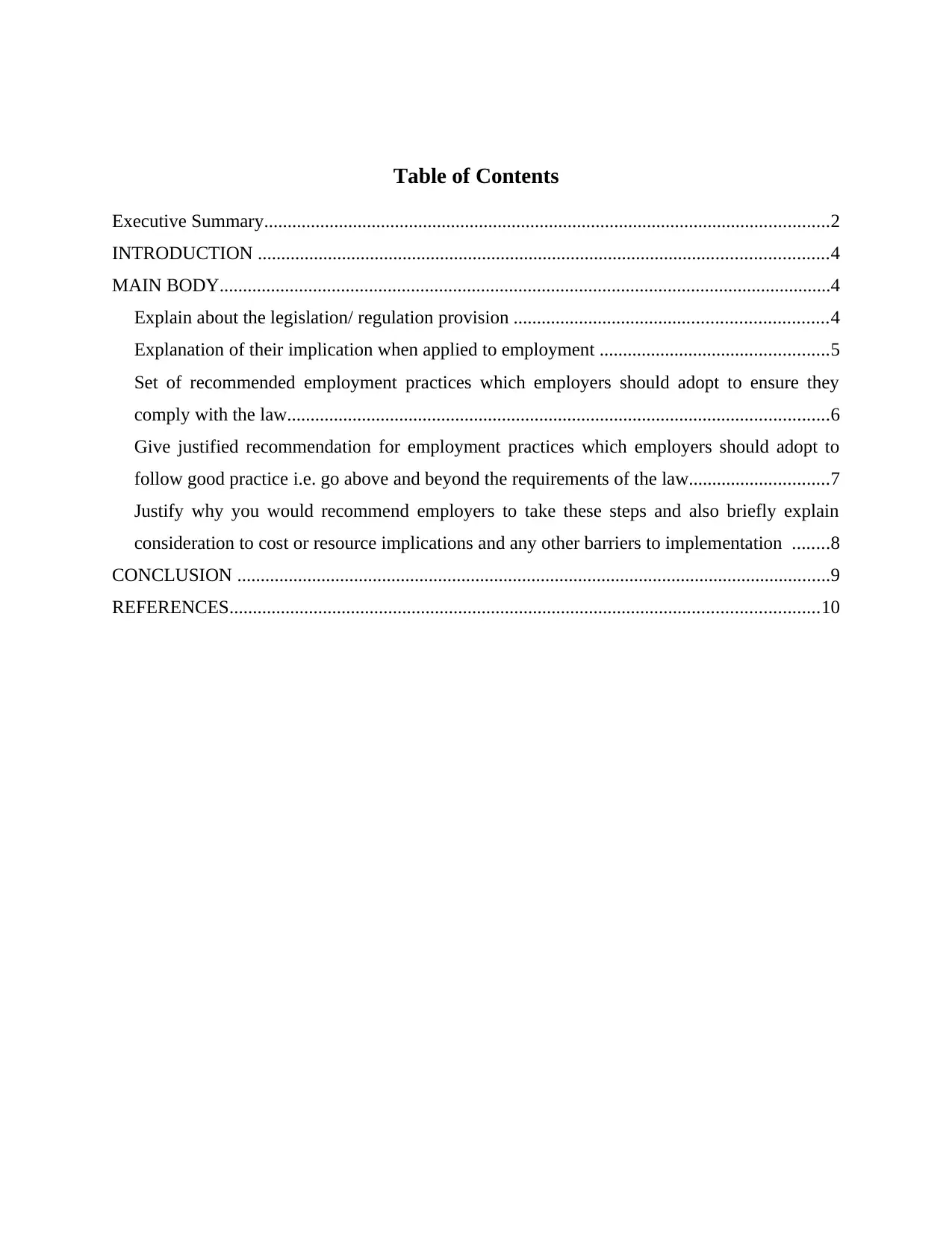
Table of Contents
Executive Summary.........................................................................................................................2
INTRODUCTION ..........................................................................................................................4
MAIN BODY...................................................................................................................................4
Explain about the legislation/ regulation provision ...................................................................4
Explanation of their implication when applied to employment .................................................5
Set of recommended employment practices which employers should adopt to ensure they
comply with the law....................................................................................................................6
Give justified recommendation for employment practices which employers should adopt to
follow good practice i.e. go above and beyond the requirements of the law..............................7
Justify why you would recommend employers to take these steps and also briefly explain
consideration to cost or resource implications and any other barriers to implementation ........8
CONCLUSION ...............................................................................................................................9
REFERENCES..............................................................................................................................10
Executive Summary.........................................................................................................................2
INTRODUCTION ..........................................................................................................................4
MAIN BODY...................................................................................................................................4
Explain about the legislation/ regulation provision ...................................................................4
Explanation of their implication when applied to employment .................................................5
Set of recommended employment practices which employers should adopt to ensure they
comply with the law....................................................................................................................6
Give justified recommendation for employment practices which employers should adopt to
follow good practice i.e. go above and beyond the requirements of the law..............................7
Justify why you would recommend employers to take these steps and also briefly explain
consideration to cost or resource implications and any other barriers to implementation ........8
CONCLUSION ...............................................................................................................................9
REFERENCES..............................................................................................................................10
⊘ This is a preview!⊘
Do you want full access?
Subscribe today to unlock all pages.

Trusted by 1+ million students worldwide
INTRODUCTION
Employment law refers to the law which governs basically about employee-employer
relationship. It is basically the set of laws which deals with rights of employees and
responsibilities of employers as well(Brummer.,2018). This law basically covers the wide range
of issues from retirement and pension plan, to discrimination into the workplace and to the
occupational safety as well. This law act as the tool in order to promote worker protection and
worker empowerment as well. The present report will cover discussion about the legislation and
also about their implications when applied to employment. In addition to this, the report will
cover analysis about set of recommended employment practices which employers have to adopt
it.
MAIN BODY
Explain about the legislation/ regulation provision
It is an equal right for both men and women to get paid for same work they do. Since
1970 it has been a part of UK and now it is also a part of Equality Act 2010. Whether employees
work full time, temporary or part time they are entitled to equal pay. According to law women
and men must be paid equally for doing equal work such as work in a same organisation at
different posts etc. It applies to different work positioning such as a written or verbal contract of
employment with employees, public or personal office holders, employees who agree to do work
personally (Bertrand, 2020). It should not be any discrimination in pay just because of their sex
unless the employer show a material factor. Material factor must be relevant, significant or
genuine reason for the difference in pay. It is the law that every employer need to follow it and
must apply to all the lawful terms such as non discretionary bonuses, overtime rates and
allowances, basic pay, performance related benefits, hours of work, sick pays, benefits under
pension schemes, severance and overabundance pay, travel allowances, benefits in kind etc. as it
does not refers to salaries only. The difference in pay must be allowed in the condition when they
are better educated in comparison if their skills are critical to the job and difficult to recruit. If
they are located at different place where cost of living is higher such as London and night shifts
where employer need to pay more as they get the work done by covering nights. It must be
applied to agency workers, employees, workers, employees who work on temporary contracts,
full time or part time, self employed persons which are hired to personally do the work. Equal
Employment law refers to the law which governs basically about employee-employer
relationship. It is basically the set of laws which deals with rights of employees and
responsibilities of employers as well(Brummer.,2018). This law basically covers the wide range
of issues from retirement and pension plan, to discrimination into the workplace and to the
occupational safety as well. This law act as the tool in order to promote worker protection and
worker empowerment as well. The present report will cover discussion about the legislation and
also about their implications when applied to employment. In addition to this, the report will
cover analysis about set of recommended employment practices which employers have to adopt
it.
MAIN BODY
Explain about the legislation/ regulation provision
It is an equal right for both men and women to get paid for same work they do. Since
1970 it has been a part of UK and now it is also a part of Equality Act 2010. Whether employees
work full time, temporary or part time they are entitled to equal pay. According to law women
and men must be paid equally for doing equal work such as work in a same organisation at
different posts etc. It applies to different work positioning such as a written or verbal contract of
employment with employees, public or personal office holders, employees who agree to do work
personally (Bertrand, 2020). It should not be any discrimination in pay just because of their sex
unless the employer show a material factor. Material factor must be relevant, significant or
genuine reason for the difference in pay. It is the law that every employer need to follow it and
must apply to all the lawful terms such as non discretionary bonuses, overtime rates and
allowances, basic pay, performance related benefits, hours of work, sick pays, benefits under
pension schemes, severance and overabundance pay, travel allowances, benefits in kind etc. as it
does not refers to salaries only. The difference in pay must be allowed in the condition when they
are better educated in comparison if their skills are critical to the job and difficult to recruit. If
they are located at different place where cost of living is higher such as London and night shifts
where employer need to pay more as they get the work done by covering nights. It must be
applied to agency workers, employees, workers, employees who work on temporary contracts,
full time or part time, self employed persons which are hired to personally do the work. Equal
Paraphrase This Document
Need a fresh take? Get an instant paraphrase of this document with our AI Paraphraser
pay is needed to rebuild trust with women in company and improved to increase transparency
among employees. People are enabled for equal pay if they are doing similar job or job of equal
value. Employees can find out if they are equally paid or not by asking your colleagues,
organizing an equal pay questionnaire, researching job evaluation studies or by checking job ads.
In an employment contract there is a pay secrecy clause which prevent from asking how much
they earn from its co-workers (Duffy and Schwartz, 2018). If an employee got to know that
they are not getting equally pay than employer is breaking law and can claim for lost earning
which allows to claim up to 6 years maximum. It was replaced with previous anti discrimination
laws with single act as it make more easier to understand and in some situation it strengthening
protection. It is important for employers and employees to know their rights and to whom you
can contact for advice and help if there is any discrimination and disadvantage. It is explained
broadly under European Union law which includes pensions and this act is applied to all in
contractual terms as not only to those who are directly related to compensation.
Explanation of their implication when applied to employment
Equal pay is a law which considers under the equality act 2010 where men and women
who are performing equal work must receive equal pay unless any difference in pay can be
justified. This is a law which employer has to follow otherwise the individual is at the risk of an
expensive tribunal case and also have the reputational damage if the individual do not provide
equal pay. This is a law which is necessary at the organisational level so that equality can be
maintained among employees into positive manner and there is no discrimination in terms of
paying employees(Dube.,2017). When this law implied to the employment then it not only
applies to just pay but on the contractual terms as well. It basically includes basic pay, non-
discretionary bonuses, performance related benefits, access to pension schemes, hours of work,
sick pay, company cars, fringe benefits. In addition to this, it includes overtime rates and
allowances, redundancy pay and severance and benefits in kind etc. The right of equal pay
basically applies to many working arrangements which includes workers who agree to do work
personally, apprentices, public and personal office holders.
When equal pay has applied on the employment then it has been observed that it gives
motivation to the employees to work with their full potential so that it can result into positive
outcome. When equal pay has been provided then employees feel privileged specially women
where they feel satisfied from their job and working environment as well.
among employees. People are enabled for equal pay if they are doing similar job or job of equal
value. Employees can find out if they are equally paid or not by asking your colleagues,
organizing an equal pay questionnaire, researching job evaluation studies or by checking job ads.
In an employment contract there is a pay secrecy clause which prevent from asking how much
they earn from its co-workers (Duffy and Schwartz, 2018). If an employee got to know that
they are not getting equally pay than employer is breaking law and can claim for lost earning
which allows to claim up to 6 years maximum. It was replaced with previous anti discrimination
laws with single act as it make more easier to understand and in some situation it strengthening
protection. It is important for employers and employees to know their rights and to whom you
can contact for advice and help if there is any discrimination and disadvantage. It is explained
broadly under European Union law which includes pensions and this act is applied to all in
contractual terms as not only to those who are directly related to compensation.
Explanation of their implication when applied to employment
Equal pay is a law which considers under the equality act 2010 where men and women
who are performing equal work must receive equal pay unless any difference in pay can be
justified. This is a law which employer has to follow otherwise the individual is at the risk of an
expensive tribunal case and also have the reputational damage if the individual do not provide
equal pay. This is a law which is necessary at the organisational level so that equality can be
maintained among employees into positive manner and there is no discrimination in terms of
paying employees(Dube.,2017). When this law implied to the employment then it not only
applies to just pay but on the contractual terms as well. It basically includes basic pay, non-
discretionary bonuses, performance related benefits, access to pension schemes, hours of work,
sick pay, company cars, fringe benefits. In addition to this, it includes overtime rates and
allowances, redundancy pay and severance and benefits in kind etc. The right of equal pay
basically applies to many working arrangements which includes workers who agree to do work
personally, apprentices, public and personal office holders.
When equal pay has applied on the employment then it has been observed that it gives
motivation to the employees to work with their full potential so that it can result into positive
outcome. When equal pay has been provided then employees feel privileged specially women
where they feel satisfied from their job and working environment as well.
From the perspective of future, the implication of this law gives inspiration to upcoming
generation to respect each other and also about giving equal opportunities in terms of growth and
development of an employee. This equal pay also implied that when it has been implemented at
the organisational level then it shows that there is no biasness on the basis of gender or religion
etc(Ebrahim., 2017). When equal pay has their implication on employment law it sends a
positive message about the values of organisation. It also increases productivity and efficiency
through attracting best employees and reduces staff absence and turnover as well. This law
basically act as key part the corporate social responsibility of organisation. It is also important
from the perspective of stakeholders as well. In this manner, when equal pay has been
implemented on employment law then it is not only beneficial for employees but is also
beneficial for organisational growth and development as well.
Set of recommended employment practices which employers should adopt to ensure they comply
with the law
It has been recommended for employers where certain employment practices needs to be
followed at the organisational level. It has been recommended that while recruiting a candidate it
is necessary that there should be not any kind of sexual harassment which lead towards negative
situation at the organisational level. According to this law of equal pay, it is important that to not
discriminate among employees on the basis of gender, religion, culture or any other factor. In
order to ensure that the organisation is properly following the law then it has been recommended
that bonuses provided by the employer should be distributed into equal manner(Erne and
Imboden., 2015).As a result it ensures that employees are properly following the law of equal
pay and there is no biasness at the organisational level whether the individual is male or female.
It has also been recommended that on the basis of performance an organisation has to
properly follow increment parameter so that it can be considered under equal pay law where
there is no biasness on the basis of performance. At the organisational level, when employees get
promoted then it is necessary that they should be promoted on the basis of their potential so that
it can be observed that they have been awarded on the basis of their calibre rather than not any
kind of biasness. The promotion factor also shows that employee gets hike according to equal
pay law where it has been observed that this law has been followed into very positive manner.
generation to respect each other and also about giving equal opportunities in terms of growth and
development of an employee. This equal pay also implied that when it has been implemented at
the organisational level then it shows that there is no biasness on the basis of gender or religion
etc(Ebrahim., 2017). When equal pay has their implication on employment law it sends a
positive message about the values of organisation. It also increases productivity and efficiency
through attracting best employees and reduces staff absence and turnover as well. This law
basically act as key part the corporate social responsibility of organisation. It is also important
from the perspective of stakeholders as well. In this manner, when equal pay has been
implemented on employment law then it is not only beneficial for employees but is also
beneficial for organisational growth and development as well.
Set of recommended employment practices which employers should adopt to ensure they comply
with the law
It has been recommended for employers where certain employment practices needs to be
followed at the organisational level. It has been recommended that while recruiting a candidate it
is necessary that there should be not any kind of sexual harassment which lead towards negative
situation at the organisational level. According to this law of equal pay, it is important that to not
discriminate among employees on the basis of gender, religion, culture or any other factor. In
order to ensure that the organisation is properly following the law then it has been recommended
that bonuses provided by the employer should be distributed into equal manner(Erne and
Imboden., 2015).As a result it ensures that employees are properly following the law of equal
pay and there is no biasness at the organisational level whether the individual is male or female.
It has also been recommended that on the basis of performance an organisation has to
properly follow increment parameter so that it can be considered under equal pay law where
there is no biasness on the basis of performance. At the organisational level, when employees get
promoted then it is necessary that they should be promoted on the basis of their potential so that
it can be observed that they have been awarded on the basis of their calibre rather than not any
kind of biasness. The promotion factor also shows that employee gets hike according to equal
pay law where it has been observed that this law has been followed into very positive manner.
⊘ This is a preview!⊘
Do you want full access?
Subscribe today to unlock all pages.
Trusted by 1+ million students worldwide
It has been recommended for organisation at the time of appraisal it is important that the
employee get appraisal according to equal pay law on the basis of their performance or their
performance is in out of box manner according to expectations of employer. These are the set of
employment practices which needs to be followed by employer which ensures that it complies
according to the law into positive manner (Kambayashi and Kiyota., 2015). These practices not
only beneficial for employer but it is also beneficial for employees working at the organisational
level within this positive environment. This kind of approach creates a positive environment at
the organisational level and also gives motivation to employees to perform into out of box
manner. When employees perform out of box manner then they also get their desired payment
according to laws and regulations of the organisation.
Give justified recommendation for employment practices which employers should adopt to
follow good practice i.e. go above and beyond the requirements of the law
There are certain employment practices which can be adopted by employer in order to
follow good practice into positive manner and it has been defined into following manner:
It has been recommended that they should use online recruiting and interviewing
procedure without violation anti discrimination law. It is a practice which is beyond the equal
pay law and also considers under good practice as well. Within the corporate environment, it is
necessary that to encourage for appropriate behaviour of work place due to which it creates a
positive environment where employees can work without any kind of hesitation and interference
as well (Mueller and et.al., 2017).It has been recommended that when organisation is preparing
for a new plan or a new target then they should involve every team members point of view so
that everybody's contribution can be justified within the plan. So on the basis of performance of
every individual, the increment and proper pay can be given to every employee into positive
manner.
It has also been recommended that while organising any kind of activity it is necessary to
divide the responsibilities according to potential of different employees so it shows that
organisation is giving equal opportunity to every kind of employee into result oriented manner.
In order to follow good practice, it is necessary for an organisation to be very effective in terms
of following these practices.
employee get appraisal according to equal pay law on the basis of their performance or their
performance is in out of box manner according to expectations of employer. These are the set of
employment practices which needs to be followed by employer which ensures that it complies
according to the law into positive manner (Kambayashi and Kiyota., 2015). These practices not
only beneficial for employer but it is also beneficial for employees working at the organisational
level within this positive environment. This kind of approach creates a positive environment at
the organisational level and also gives motivation to employees to perform into out of box
manner. When employees perform out of box manner then they also get their desired payment
according to laws and regulations of the organisation.
Give justified recommendation for employment practices which employers should adopt to
follow good practice i.e. go above and beyond the requirements of the law
There are certain employment practices which can be adopted by employer in order to
follow good practice into positive manner and it has been defined into following manner:
It has been recommended that they should use online recruiting and interviewing
procedure without violation anti discrimination law. It is a practice which is beyond the equal
pay law and also considers under good practice as well. Within the corporate environment, it is
necessary that to encourage for appropriate behaviour of work place due to which it creates a
positive environment where employees can work without any kind of hesitation and interference
as well (Mueller and et.al., 2017).It has been recommended that when organisation is preparing
for a new plan or a new target then they should involve every team members point of view so
that everybody's contribution can be justified within the plan. So on the basis of performance of
every individual, the increment and proper pay can be given to every employee into positive
manner.
It has also been recommended that while organising any kind of activity it is necessary to
divide the responsibilities according to potential of different employees so it shows that
organisation is giving equal opportunity to every kind of employee into result oriented manner.
In order to follow good practice, it is necessary for an organisation to be very effective in terms
of following these practices.
Paraphrase This Document
Need a fresh take? Get an instant paraphrase of this document with our AI Paraphraser
An organisation can also give opportunities for growth from perspective of employees
benefit where they can plan a task for a selected period of time and whoever achieve it on the
priority basis then that employee will be rewarded with equal pay according to organisational
policies and terms as well.
Justify why you would recommend employers to take these steps and also briefly explain
consideration to cost or resource implications and any other barriers to implementation
There are certain reasons behind which employers have to take these steps and it is
necessary for the growth and development of an organisation which is defined into the following
manner:
It has been recommended that employers have to take these steps because it is necessary
for the employees positive growth and development as well. These steps are necessary for
purpose of creating positive environment at the organisational level so that employees can work
with their full potential into result oriented manner (O’Reilly and et.al., 2015). It has also been
recommended that these steps has been followed with the reason that a strong brand image can
be created at the organisational level in terms of equality and respect as well. These steps shows
that organisation cares about this parameter that equality should be maintained at the
organisational level. These steps should be taken by the employer in terms of creating new
change into positive manner so that employees inspire others as well in order to perform into
well mannered way.
It is required that to positively consider the cost parameter so that employer properly
analyse about pay given to employees so that proper calculation can be done into positive
manner. When cost has been taken into consideration into proper manner then proper budget can
be prepared for purpose of effective performance of an organisation. It is necessary to consider
cost into positive manner because the changes in cost directly influences dynamics performance.
It is also necessary to implicate resources into result oriented manner so that employees can use
it for the purpose of plan and daily tasks as well (Roberts., 2017). Resource implication is also
very important at the organisational level because when resources has been used into effective
manner then organisation can provide effective results within market at international level. There
are certain barriers to implementation because sometimes organisational people don't understand
the value of change implementation and their related aspects as well.
benefit where they can plan a task for a selected period of time and whoever achieve it on the
priority basis then that employee will be rewarded with equal pay according to organisational
policies and terms as well.
Justify why you would recommend employers to take these steps and also briefly explain
consideration to cost or resource implications and any other barriers to implementation
There are certain reasons behind which employers have to take these steps and it is
necessary for the growth and development of an organisation which is defined into the following
manner:
It has been recommended that employers have to take these steps because it is necessary
for the employees positive growth and development as well. These steps are necessary for
purpose of creating positive environment at the organisational level so that employees can work
with their full potential into result oriented manner (O’Reilly and et.al., 2015). It has also been
recommended that these steps has been followed with the reason that a strong brand image can
be created at the organisational level in terms of equality and respect as well. These steps shows
that organisation cares about this parameter that equality should be maintained at the
organisational level. These steps should be taken by the employer in terms of creating new
change into positive manner so that employees inspire others as well in order to perform into
well mannered way.
It is required that to positively consider the cost parameter so that employer properly
analyse about pay given to employees so that proper calculation can be done into positive
manner. When cost has been taken into consideration into proper manner then proper budget can
be prepared for purpose of effective performance of an organisation. It is necessary to consider
cost into positive manner because the changes in cost directly influences dynamics performance.
It is also necessary to implicate resources into result oriented manner so that employees can use
it for the purpose of plan and daily tasks as well (Roberts., 2017). Resource implication is also
very important at the organisational level because when resources has been used into effective
manner then organisation can provide effective results within market at international level. There
are certain barriers to implementation because sometimes organisational people don't understand
the value of change implementation and their related aspects as well.
It has been observed at the organisational level that there is lack of proper planning and
also have low employee morale due to which it create barrier in terms of implementation
parameter(Zosky and et.al., 2016).That's why its very important to consider barriers of
implementation into positive manner so that there can be no hindrance in terms of achieving
goals and objectives of an organisation.
CONCLUSION
The above stated report concludes that at the organisational level laws needs to be
followed into appropriate manner. It has been concluded that at the employment level it is
necessary to imply equal pay law into proper manner. It has been determined that there are
certain employment practices which employer should adopt in order to comply the law into
positive manner. It has been observed that there are certain recommendations for employment
practices where employees has to follow certain good practices which is beneficial for
employees growth and development as well. At the organisational level, it is necessary that
employers should take certain steps which is beneficial for maintaining equality at the
organisational level and the cost parameter which needs to be taken into consideration into
serious manner. It has been observed that there are certain implementation barriers which creates
problems in terms of bringing positive results at the organisational level. So employment laws
are very important from the perspective of legalised manner.
also have low employee morale due to which it create barrier in terms of implementation
parameter(Zosky and et.al., 2016).That's why its very important to consider barriers of
implementation into positive manner so that there can be no hindrance in terms of achieving
goals and objectives of an organisation.
CONCLUSION
The above stated report concludes that at the organisational level laws needs to be
followed into appropriate manner. It has been concluded that at the employment level it is
necessary to imply equal pay law into proper manner. It has been determined that there are
certain employment practices which employer should adopt in order to comply the law into
positive manner. It has been observed that there are certain recommendations for employment
practices where employees has to follow certain good practices which is beneficial for
employees growth and development as well. At the organisational level, it is necessary that
employers should take certain steps which is beneficial for maintaining equality at the
organisational level and the cost parameter which needs to be taken into consideration into
serious manner. It has been observed that there are certain implementation barriers which creates
problems in terms of bringing positive results at the organisational level. So employment laws
are very important from the perspective of legalised manner.
⊘ This is a preview!⊘
Do you want full access?
Subscribe today to unlock all pages.
Trusted by 1+ million students worldwide
REFERENCES
Books and Journals
Anderson, B., 2015. Migrant domestic workers: Good workers, poor slaves, new
connections. Social Politics: International Studies in Gender, State & Society, 22(4),
pp.636-652.
Bertrand, M., 2020, May. Gender in the twenty-first century. In AEA Papers and
proceedings (Vol. 110, pp. 1-24).
Brummer, V., 2018. Community energy–benefits and barriers: A comparative literature review
of Community Energy in the UK, Germany and the USA, the benefits it provides for
society and the barriers it faces. Renewable and Sustainable Energy Reviews, 94,
pp.187-196.
Dube, T., 2017. A critical analysis of the'equal pay for equal work or work of equal
value'provision as it relates to the South African labour market (Doctoral dissertation).
Duffy, B. E. and Schwartz, B., 2018. Digital “women’s work?”: Job recruitment ads and the
feminization of social media employment. New media & society, 20(8). pp.2972-2989.
Ebrahim, S., 2017. Equal Pay in Terms of the Employment Equity Act: The Role of Seniority,
Collective Agreements and Good Industrial Relations: Pioneer Foods (Pty) Ltd v
Workers against Regression 2016 ZALCCT 14. Potchefstroom Elec. LJ, 20, p.iii.
Erne, R. and Imboden, N., 2015. Equal pay by gender and by nationality: a comparative analysis
of Switzerland’s unequal equal pay policy regimes across time. Cambridge Journal of
Economics, 39(2), pp.655-674.
Kambayashi, R. and Kiyota, K., 2015. Disemployment caused by foreign direct investment?
Multinationals and Japanese employment. Review of World Economics, 151(3), pp.433-
460.
Mueller and et.al., 2017. Within-firm pay inequality. The Review of Financial Studies, 30(10),
pp.3605-3635.
O’Reilly and et.al., 2015. Equal pay as a moving target: International perspectives on forty-years
of addressing the gender pay gap. Cambridge Journal of Economics, 39(2), pp.299-317.
Roberts, A., 2017. Is international law international?. Oxford University Press.
Schwiter, K., Strauss, K. and England, K., 2018. At home with the boss: Migrant live‐in
caregivers, social reproduction and constrained agency in the UK, Canada, Austria and
Switzerland. Transactions of the Institute of British Geographers, 43(3), pp.462-476.
Sukarieh, M. and Tannock, S., 2019. Subcontracting academia: alienation, exploitation and
disillusionment in the UK overseas Syrian refugee research industry. Antipode, 51(2),
pp.664-680.
Walani, S.R., 2015. Global migration of internationally educated nurses: Experiences of
employment discrimination. International Journal of Africa Nursing Sciences, 3, pp.65-
70.
Zosky and et.al., 2016. Coal workers’ pneumoconiosis: an Australian perspective. The Medical
Journal of Australia, 204(11), pp.414-418.
Books and Journals
Anderson, B., 2015. Migrant domestic workers: Good workers, poor slaves, new
connections. Social Politics: International Studies in Gender, State & Society, 22(4),
pp.636-652.
Bertrand, M., 2020, May. Gender in the twenty-first century. In AEA Papers and
proceedings (Vol. 110, pp. 1-24).
Brummer, V., 2018. Community energy–benefits and barriers: A comparative literature review
of Community Energy in the UK, Germany and the USA, the benefits it provides for
society and the barriers it faces. Renewable and Sustainable Energy Reviews, 94,
pp.187-196.
Dube, T., 2017. A critical analysis of the'equal pay for equal work or work of equal
value'provision as it relates to the South African labour market (Doctoral dissertation).
Duffy, B. E. and Schwartz, B., 2018. Digital “women’s work?”: Job recruitment ads and the
feminization of social media employment. New media & society, 20(8). pp.2972-2989.
Ebrahim, S., 2017. Equal Pay in Terms of the Employment Equity Act: The Role of Seniority,
Collective Agreements and Good Industrial Relations: Pioneer Foods (Pty) Ltd v
Workers against Regression 2016 ZALCCT 14. Potchefstroom Elec. LJ, 20, p.iii.
Erne, R. and Imboden, N., 2015. Equal pay by gender and by nationality: a comparative analysis
of Switzerland’s unequal equal pay policy regimes across time. Cambridge Journal of
Economics, 39(2), pp.655-674.
Kambayashi, R. and Kiyota, K., 2015. Disemployment caused by foreign direct investment?
Multinationals and Japanese employment. Review of World Economics, 151(3), pp.433-
460.
Mueller and et.al., 2017. Within-firm pay inequality. The Review of Financial Studies, 30(10),
pp.3605-3635.
O’Reilly and et.al., 2015. Equal pay as a moving target: International perspectives on forty-years
of addressing the gender pay gap. Cambridge Journal of Economics, 39(2), pp.299-317.
Roberts, A., 2017. Is international law international?. Oxford University Press.
Schwiter, K., Strauss, K. and England, K., 2018. At home with the boss: Migrant live‐in
caregivers, social reproduction and constrained agency in the UK, Canada, Austria and
Switzerland. Transactions of the Institute of British Geographers, 43(3), pp.462-476.
Sukarieh, M. and Tannock, S., 2019. Subcontracting academia: alienation, exploitation and
disillusionment in the UK overseas Syrian refugee research industry. Antipode, 51(2),
pp.664-680.
Walani, S.R., 2015. Global migration of internationally educated nurses: Experiences of
employment discrimination. International Journal of Africa Nursing Sciences, 3, pp.65-
70.
Zosky and et.al., 2016. Coal workers’ pneumoconiosis: an Australian perspective. The Medical
Journal of Australia, 204(11), pp.414-418.
Paraphrase This Document
Need a fresh take? Get an instant paraphrase of this document with our AI Paraphraser


⊘ This is a preview!⊘
Do you want full access?
Subscribe today to unlock all pages.
Trusted by 1+ million students worldwide

1 out of 12


Related Documents


Your All-in-One AI-Powered Toolkit for Academic Success.
+13062052269
info@desklib.com
Available 24*7 on WhatsApp / Email
![[object Object]](/_next/static/media/star-bottom.7253800d.svg)
Unlock your academic potential
Copyright © 2020–2026 A2Z Services. All Rights Reserved. Developed and managed by ZUCOL.