HRM3007: HR and Training for Internationalizing Organizations
VerifiedAdded on 2023/06/04
|12
|3780
|260
Essay
AI Summary
This essay explores the strategies and approaches a newly internationalizing organization can use to prepare and train employees for overseas assignments lasting a year or more. It discusses various approaches, including home country nationals, host country nationals, and third-country nationals, and examines the advantages of using local workers. The essay also highlights the importance of selection, technical training, cross-cultural training, motivation, and remuneration in ensuring the success of international projects. Furthermore, it addresses the challenges employees often face when working abroad, such as language barriers, cultural differences, lack of support, learning curves, and financial constraints, and suggests how management and HR practices can assist them in coping with these challenges. Desklib provides access to similar essays and study resources for students.
Running Head: HR AND TRAINING FOR A NEWLY INTERNATIONALISING
ORGANIZATION 1
Human Resource and Training for a Newly Internationalising Organization
Student’s name
Course name and number
Instructor’s name
Date submitted
ORGANIZATION 1
Human Resource and Training for a Newly Internationalising Organization
Student’s name
Course name and number
Instructor’s name
Date submitted

Paraphrase This Document
Need a fresh take? Get an instant paraphrase of this document with our AI Paraphraser
HR AND TRAINING FOR A NEWLY INTERNATIONALISING ORGANIZATION 2
Human Resource and Training for a Newly Internationalising Organization
Part A: Approaches and Strategies of Training Employees Abroad
Internationalisation is the process where an organization extends its operations across the
borders of the home country. An internationalised organization is able to operate in more than
one country and be in a position to serve many customers in provision of goods and services.
Organizations in the modern times have been active in internationalising their business
activities to reach a big market across the world (Aguinis, and Kraiger, 2009, p.463). With
the swift growth in globalization, many business organizations are expanding their business
activities as it has become easy to internationalise using modern technology. However, there
are challenges which are faced by internationalising organizations in the early stages of
expanding the business operations. Human resource management ensure employees get
recruited and given required training of their duties.
It is therefore crucial to ensure human resource management of the internationalising
organizations is well equipped with the knowledge and understanding of the new
environment the organization will operate. This will help in training the employees and
giving necessary assistance to the employees going abroad either temporary or permanent
basis. This will make the employees be more comfortable in performing their duties in the
countries they will be travelling and help them adapt to the new environment. The
internationalising organization is supposed to train and give the employees the support
necessary in the foreign countries for the success of the business activities which will
promote growth of the institution (Ambos et al. 2009, p.644)
There are various strategies and approaches which can be used by a newly
internationalising organization in training their employees who will work overseas in
accomplishing their projects lasting a year or more. This will the employees adapt to the new
working environment and encourage them perform their duties well for the success of the
Human Resource and Training for a Newly Internationalising Organization
Part A: Approaches and Strategies of Training Employees Abroad
Internationalisation is the process where an organization extends its operations across the
borders of the home country. An internationalised organization is able to operate in more than
one country and be in a position to serve many customers in provision of goods and services.
Organizations in the modern times have been active in internationalising their business
activities to reach a big market across the world (Aguinis, and Kraiger, 2009, p.463). With
the swift growth in globalization, many business organizations are expanding their business
activities as it has become easy to internationalise using modern technology. However, there
are challenges which are faced by internationalising organizations in the early stages of
expanding the business operations. Human resource management ensure employees get
recruited and given required training of their duties.
It is therefore crucial to ensure human resource management of the internationalising
organizations is well equipped with the knowledge and understanding of the new
environment the organization will operate. This will help in training the employees and
giving necessary assistance to the employees going abroad either temporary or permanent
basis. This will make the employees be more comfortable in performing their duties in the
countries they will be travelling and help them adapt to the new environment. The
internationalising organization is supposed to train and give the employees the support
necessary in the foreign countries for the success of the business activities which will
promote growth of the institution (Ambos et al. 2009, p.644)
There are various strategies and approaches which can be used by a newly
internationalising organization in training their employees who will work overseas in
accomplishing their projects lasting a year or more. This will the employees adapt to the new
working environment and encourage them perform their duties well for the success of the
HR AND TRAINING FOR A NEWLY INTERNATIONALISING ORGANIZATION 3
project. Different strategies and approaches have been used in training their employees to
ensure rapid growth and development of the organization in the oversee countries.
International human resource established by the newly internationalising organization helps
the employees to adapt the new environment in oversees, ideas and resources required to
promote maximum output of the services delivered (Barkema et al. p.460). International
human resource management is given the mandate by the organization to employ, consult and
manage services to ensure the best skilled employees are given the job positions.
There are different approaches used in training and managing employees in the
subsidiaries of the organization for effective and maximum productivity. The employees are
trained depending on their place of work which depends on the origins of the workers. There
is home country where the organization sends employees abroad to work on the established
branches. Most of the important positions of the job are taken by the home country
employees because they already know what the employees requires and can help in making
decisions. The subsidiaries are the second to follow home country in managing the resources.
Secondly, there is nationals form the host country where the organization employs people of
the same nationality as the subsidiary’s location (Bol, and Van de Werfhorst, 2011, p.124).
The organization can also set training initiatives to impart more knowledge to the host
country employees to promote them in learning and understanding what the institution
requires. The third approach is nationals from third country which involves recruiting
workers from different nations who are not citizens of the home or host country. This is
advantageous to the organization as it increases the employment pool and diversifies job
opportunities. It encourages hiring qualified people to the organization and promotes growth
and success of the project (De Clercq et al. 2012, p.148).
There are several advantages of using local workers to staff subsidiaries of the
organization abroad. The local employees are familiar with the political, legal and
project. Different strategies and approaches have been used in training their employees to
ensure rapid growth and development of the organization in the oversee countries.
International human resource established by the newly internationalising organization helps
the employees to adapt the new environment in oversees, ideas and resources required to
promote maximum output of the services delivered (Barkema et al. p.460). International
human resource management is given the mandate by the organization to employ, consult and
manage services to ensure the best skilled employees are given the job positions.
There are different approaches used in training and managing employees in the
subsidiaries of the organization for effective and maximum productivity. The employees are
trained depending on their place of work which depends on the origins of the workers. There
is home country where the organization sends employees abroad to work on the established
branches. Most of the important positions of the job are taken by the home country
employees because they already know what the employees requires and can help in making
decisions. The subsidiaries are the second to follow home country in managing the resources.
Secondly, there is nationals form the host country where the organization employs people of
the same nationality as the subsidiary’s location (Bol, and Van de Werfhorst, 2011, p.124).
The organization can also set training initiatives to impart more knowledge to the host
country employees to promote them in learning and understanding what the institution
requires. The third approach is nationals from third country which involves recruiting
workers from different nations who are not citizens of the home or host country. This is
advantageous to the organization as it increases the employment pool and diversifies job
opportunities. It encourages hiring qualified people to the organization and promotes growth
and success of the project (De Clercq et al. 2012, p.148).
There are several advantages of using local workers to staff subsidiaries of the
organization abroad. The local employees are familiar with the political, legal and
⊘ This is a preview!⊘
Do you want full access?
Subscribe today to unlock all pages.

Trusted by 1+ million students worldwide
HR AND TRAINING FOR A NEWLY INTERNATIONALISING ORGANIZATION 4
socioeconomic requirements in that host country. This makes it easy for the subsidiary to
adhere and cope with the working environment with help of the local workers. Another
benefit of using local employees is that the local society feels recognized by the organization
and promotes acceptance (De Wit, and Merkx, 2012, p.48).
Another approach used by newly internationalising organization is training and selection
of the employees. The organization should equally treat the employees going to work in the
foreign countries and ensure their family needs are considered. The family may accompany
the employee going abroad and therefore the organization must help in ensuring good
relationship in that new country to encourage good working conditions. The employees
should be well trained and oriented to ensure understanding of the new environment. The best
employees should be selected for oversees project of the company to ensure it is done to
completion (de Wit, 2011, p.77).
The best expatriates selected for the foreign project of the organization have to be decided
by considering certain factors. These factors include language skills, job and family situations
as well as motivation and relational aspects of the individuals. All these factors will help the
company in selection of the best expatriates suitable for the overseas project undertaken by
the organization (Ernst, Hoyer, and Rübsaamen, 2010, p.84).
Training of the employees and expatriates is a significant factor which determines the
success of the project in terms of performance and quality. Firstly, the training should be
cross cultural which helps in acknowledging and appreciating the culture of the host nation
where the expatriates will be working. This helps the employees to feel encouraged to work
more in the project they are working on once the culture is understood. Secondly, the
organization also needs to train the employees about the knowledge of the host nation
(Fletcher, Harris, and Richey, 2013, p.64). Thirdly, the organization must offer technical and
detailed job training to the employees to promote understanding of the job requirements. The
socioeconomic requirements in that host country. This makes it easy for the subsidiary to
adhere and cope with the working environment with help of the local workers. Another
benefit of using local employees is that the local society feels recognized by the organization
and promotes acceptance (De Wit, and Merkx, 2012, p.48).
Another approach used by newly internationalising organization is training and selection
of the employees. The organization should equally treat the employees going to work in the
foreign countries and ensure their family needs are considered. The family may accompany
the employee going abroad and therefore the organization must help in ensuring good
relationship in that new country to encourage good working conditions. The employees
should be well trained and oriented to ensure understanding of the new environment. The best
employees should be selected for oversees project of the company to ensure it is done to
completion (de Wit, 2011, p.77).
The best expatriates selected for the foreign project of the organization have to be decided
by considering certain factors. These factors include language skills, job and family situations
as well as motivation and relational aspects of the individuals. All these factors will help the
company in selection of the best expatriates suitable for the overseas project undertaken by
the organization (Ernst, Hoyer, and Rübsaamen, 2010, p.84).
Training of the employees and expatriates is a significant factor which determines the
success of the project in terms of performance and quality. Firstly, the training should be
cross cultural which helps in acknowledging and appreciating the culture of the host nation
where the expatriates will be working. This helps the employees to feel encouraged to work
more in the project they are working on once the culture is understood. Secondly, the
organization also needs to train the employees about the knowledge of the host nation
(Fletcher, Harris, and Richey, 2013, p.64). Thirdly, the organization must offer technical and
detailed job training to the employees to promote understanding of the job requirements. The
Paraphrase This Document
Need a fresh take? Get an instant paraphrase of this document with our AI Paraphraser
HR AND TRAINING FOR A NEWLY INTERNATIONALISING ORGANIZATION 5
employees need knowledge and understanding of the necessities of the project in the overseas
for effective operation. Technical training helps the employees equip themselves with
materials and tools for the project during the time in the foreign nation (Jensen, Poulfelt, and
Kraus, 2010, p.2052).
Another strategy and approach used by newly internationalised organization is
remuneration of the employees and expatriates. The institution is supposed to ensure wages
and other benefits are considered to ensure minimization of expenses. The organization
should offer wages and benefits to the employees depending on the level of production and
market level. Top wages should be awarded to those employees participating in development
and research departments and then offer average salaries to employees in the manufacturing
industry of the organization (Khavul, Pérez-Nordtvedt, and Wood, 2010, p.112).
Motivation is another strategy used newly internationalised organization to the employees
in the overseas. The employees should be allowed to participate in making decisions affecting
the project and organization at large. Initiatives aimed at providing development of careers of
the employees should be implemented. This will motivate the employees to perform their
level best to get those opportunities (Kwon et al. 2012, p.168).
The best strategies and approaches to be used by a newly internationalised organization in
training their employees are selection, technical, training, motivation and remuneration. All
these strategies are aimed at ensuring the expatriates and employees involved in the project
are well equipped and carry it to completion without many complications. Good
remuneration and motivation will encourage the employees to perform better for the success
of the project (Lee, et al. 2012, p.14).
There are many problems encountered by workers and expatriates in carrying their job
requirements which human resource management can help them to ensure success of the
project or business activities. The human resource of the organization is mandated to ensure
employees need knowledge and understanding of the necessities of the project in the overseas
for effective operation. Technical training helps the employees equip themselves with
materials and tools for the project during the time in the foreign nation (Jensen, Poulfelt, and
Kraus, 2010, p.2052).
Another strategy and approach used by newly internationalised organization is
remuneration of the employees and expatriates. The institution is supposed to ensure wages
and other benefits are considered to ensure minimization of expenses. The organization
should offer wages and benefits to the employees depending on the level of production and
market level. Top wages should be awarded to those employees participating in development
and research departments and then offer average salaries to employees in the manufacturing
industry of the organization (Khavul, Pérez-Nordtvedt, and Wood, 2010, p.112).
Motivation is another strategy used newly internationalised organization to the employees
in the overseas. The employees should be allowed to participate in making decisions affecting
the project and organization at large. Initiatives aimed at providing development of careers of
the employees should be implemented. This will motivate the employees to perform their
level best to get those opportunities (Kwon et al. 2012, p.168).
The best strategies and approaches to be used by a newly internationalised organization in
training their employees are selection, technical, training, motivation and remuneration. All
these strategies are aimed at ensuring the expatriates and employees involved in the project
are well equipped and carry it to completion without many complications. Good
remuneration and motivation will encourage the employees to perform better for the success
of the project (Lee, et al. 2012, p.14).
There are many problems encountered by workers and expatriates in carrying their job
requirements which human resource management can help them to ensure success of the
project or business activities. The human resource of the organization is mandated to ensure
HR AND TRAINING FOR A NEWLY INTERNATIONALISING ORGANIZATION 6
employees are assisted in settling overseas and given support required for the success of their
satay and the organization at large. The following are some of the challenges employees face
in overseas:
Firstly, it is a challenge for the employees to adapt and learn foreign languages in the host
nation. This is a great problem which employees face in the overseas as language barrier
hinders effective communication with the locals of the state (Paul, Parthasarathy, and Gupta,
2017, p.335). It therefore makes difficult to conduct business activities without understanding
their language. It is the responsibility of the organization to ensure the employees going
overseas are fully trained and equipped with understanding of the working environment and
language for effective communication.
Another challenge of employees working abroad is to understand the socioeconomic and
cultural practices of the foreign countries. The employees find the cultural, social and
economic practices of the people which are different from their home county. They need to
adapt and get used to what the people do in terms of culture and socioeconomic factors to
enable them meet their needs and according to the requirements. This becomes a challenge to
the employees who were not used to the new working environment and may negatively
influence the project or business activity (Peng, et al. 2009, p.72).
There is lack of support which employees face when working abroad as they are not in
touch with their family, relatives and close friends as they were used before. The employees
may feel lonely during their stay in the foreign countries because they cannot reach them in
an easy way. The only options they can contact them is through social media like Skype
where they can have calls and feel together. However, it does not feel the same and cannot
compare being together physically. This affects their working output and can lead to failures
of the project and organization at large. The human resource management can help
employees are assisted in settling overseas and given support required for the success of their
satay and the organization at large. The following are some of the challenges employees face
in overseas:
Firstly, it is a challenge for the employees to adapt and learn foreign languages in the host
nation. This is a great problem which employees face in the overseas as language barrier
hinders effective communication with the locals of the state (Paul, Parthasarathy, and Gupta,
2017, p.335). It therefore makes difficult to conduct business activities without understanding
their language. It is the responsibility of the organization to ensure the employees going
overseas are fully trained and equipped with understanding of the working environment and
language for effective communication.
Another challenge of employees working abroad is to understand the socioeconomic and
cultural practices of the foreign countries. The employees find the cultural, social and
economic practices of the people which are different from their home county. They need to
adapt and get used to what the people do in terms of culture and socioeconomic factors to
enable them meet their needs and according to the requirements. This becomes a challenge to
the employees who were not used to the new working environment and may negatively
influence the project or business activity (Peng, et al. 2009, p.72).
There is lack of support which employees face when working abroad as they are not in
touch with their family, relatives and close friends as they were used before. The employees
may feel lonely during their stay in the foreign countries because they cannot reach them in
an easy way. The only options they can contact them is through social media like Skype
where they can have calls and feel together. However, it does not feel the same and cannot
compare being together physically. This affects their working output and can lead to failures
of the project and organization at large. The human resource management can help
⊘ This is a preview!⊘
Do you want full access?
Subscribe today to unlock all pages.
Trusted by 1+ million students worldwide
HR AND TRAINING FOR A NEWLY INTERNATIONALISING ORGANIZATION 7
employees where possible to go together with their families abroad for effective production
and success of the business operations (Powell, and Solga, 2010, p.714).
Learning curve and overcoming it in abroad is a challenge for the employees to adapt to
the new experiences. This may take long time as the abroad curve becomes steeper compared
to the one in home country. Learning the new experiences may take even six months for the
employees to adopt the new working environment which may stress them in their job places.
The employees may feel depressed in the process but they should decide and be capable to
overcome all the challenges to ensure effective production in the job areas or even during the
project. The human resource management should help the employees in overcoming the
issues by assisting them where possible to adapt with the shortest time possible (Sun, and
Anderson, 2010, p.138).
Financial constraints and challenges in meeting their needs in abroad becomes a problem
to the employees. The workers had got used to plan according to the salary in the home
country and the needs which they encountered on daily basis. Once in a broad, there are
different problems which require money to be settled. This becomes a challenge especially
when the organization does not provide good salary and other benefits for them. The
employees will eventually be affected on how they work and general production of the
organization. It is therefore important for the human resource to ensure the employees are
given convenient and effective salaries which will cater for the foreign financial needs
(Teichler, 2009, p.98). The human resource should ensure the employees get benefits and
allowances which will allow them settle in the foreign county and perform to their duties in a
good manner.
There is also a challenge of looking a good home for the employees who are not
conversant with the foreign country. This may become a great challenge to many employees
in establishing a good residential area which will be convenient with the job area. The homes
employees where possible to go together with their families abroad for effective production
and success of the business operations (Powell, and Solga, 2010, p.714).
Learning curve and overcoming it in abroad is a challenge for the employees to adapt to
the new experiences. This may take long time as the abroad curve becomes steeper compared
to the one in home country. Learning the new experiences may take even six months for the
employees to adopt the new working environment which may stress them in their job places.
The employees may feel depressed in the process but they should decide and be capable to
overcome all the challenges to ensure effective production in the job areas or even during the
project. The human resource management should help the employees in overcoming the
issues by assisting them where possible to adapt with the shortest time possible (Sun, and
Anderson, 2010, p.138).
Financial constraints and challenges in meeting their needs in abroad becomes a problem
to the employees. The workers had got used to plan according to the salary in the home
country and the needs which they encountered on daily basis. Once in a broad, there are
different problems which require money to be settled. This becomes a challenge especially
when the organization does not provide good salary and other benefits for them. The
employees will eventually be affected on how they work and general production of the
organization. It is therefore important for the human resource to ensure the employees are
given convenient and effective salaries which will cater for the foreign financial needs
(Teichler, 2009, p.98). The human resource should ensure the employees get benefits and
allowances which will allow them settle in the foreign county and perform to their duties in a
good manner.
There is also a challenge of looking a good home for the employees who are not
conversant with the foreign country. This may become a great challenge to many employees
in establishing a good residential area which will be convenient with the job area. The homes
Paraphrase This Document
Need a fresh take? Get an instant paraphrase of this document with our AI Paraphraser
HR AND TRAINING FOR A NEWLY INTERNATIONALISING ORGANIZATION 8
may be expensive and unavailable to get at the moment the employees are going abroad. To
curb this challenge, the human resource should provide homes or a temporary residing place
for the employees to stay for some time. This will enable them become familiar and
understand areas where they can get good and secure place to reside during their stay
(Tolstoy, and Agndal, 2010, p.28).
Another challenge is finding good learning institutions and health care for employees who
go abroad with their families. Employees should ensure they acquire health insurance to
cater all their health issues which may arise due to the change in climate and affect their
family members. It is also becomes difficult to look for a good school for their children who
may find it hard to adapt and adjust the new environment. The human resource management
should ensure the organization covers some of these needs like health insurance. This reduces
the burden and challenges experienced by the employees working abroad. Employers should
provide higher benefits and cover the requirements to motivate and encourage the employees
to work more in their duties of the organization for its success (Zhao, et al. 2011, p.308).
Balance of the working time and the need to explore different places in the new country
may become a challenge to the employees. This affects most employees who have family and
are not able to go abroad together with family members as they become lonely and look for
ways to reach and make new friends. This becomes difficult due to the job schedule which
may not allow much free time to explore new places. The human resources should consider
employees going abroad and find ways how the family should accompany them to help them
be successful and cope with the difficulties. This helps the employees to concentrate and
focus on the project or business activities of the organization (Zou, and Ghauri, 2010, p.232).
The tax system and legal requirements in the foreign country is a challenge which
employees face when working abroad. Some countries have implemented high tax rates for
the foreign employees working in certain areas of production and tax heavily their salaries.
may be expensive and unavailable to get at the moment the employees are going abroad. To
curb this challenge, the human resource should provide homes or a temporary residing place
for the employees to stay for some time. This will enable them become familiar and
understand areas where they can get good and secure place to reside during their stay
(Tolstoy, and Agndal, 2010, p.28).
Another challenge is finding good learning institutions and health care for employees who
go abroad with their families. Employees should ensure they acquire health insurance to
cater all their health issues which may arise due to the change in climate and affect their
family members. It is also becomes difficult to look for a good school for their children who
may find it hard to adapt and adjust the new environment. The human resource management
should ensure the organization covers some of these needs like health insurance. This reduces
the burden and challenges experienced by the employees working abroad. Employers should
provide higher benefits and cover the requirements to motivate and encourage the employees
to work more in their duties of the organization for its success (Zhao, et al. 2011, p.308).
Balance of the working time and the need to explore different places in the new country
may become a challenge to the employees. This affects most employees who have family and
are not able to go abroad together with family members as they become lonely and look for
ways to reach and make new friends. This becomes difficult due to the job schedule which
may not allow much free time to explore new places. The human resources should consider
employees going abroad and find ways how the family should accompany them to help them
be successful and cope with the difficulties. This helps the employees to concentrate and
focus on the project or business activities of the organization (Zou, and Ghauri, 2010, p.232).
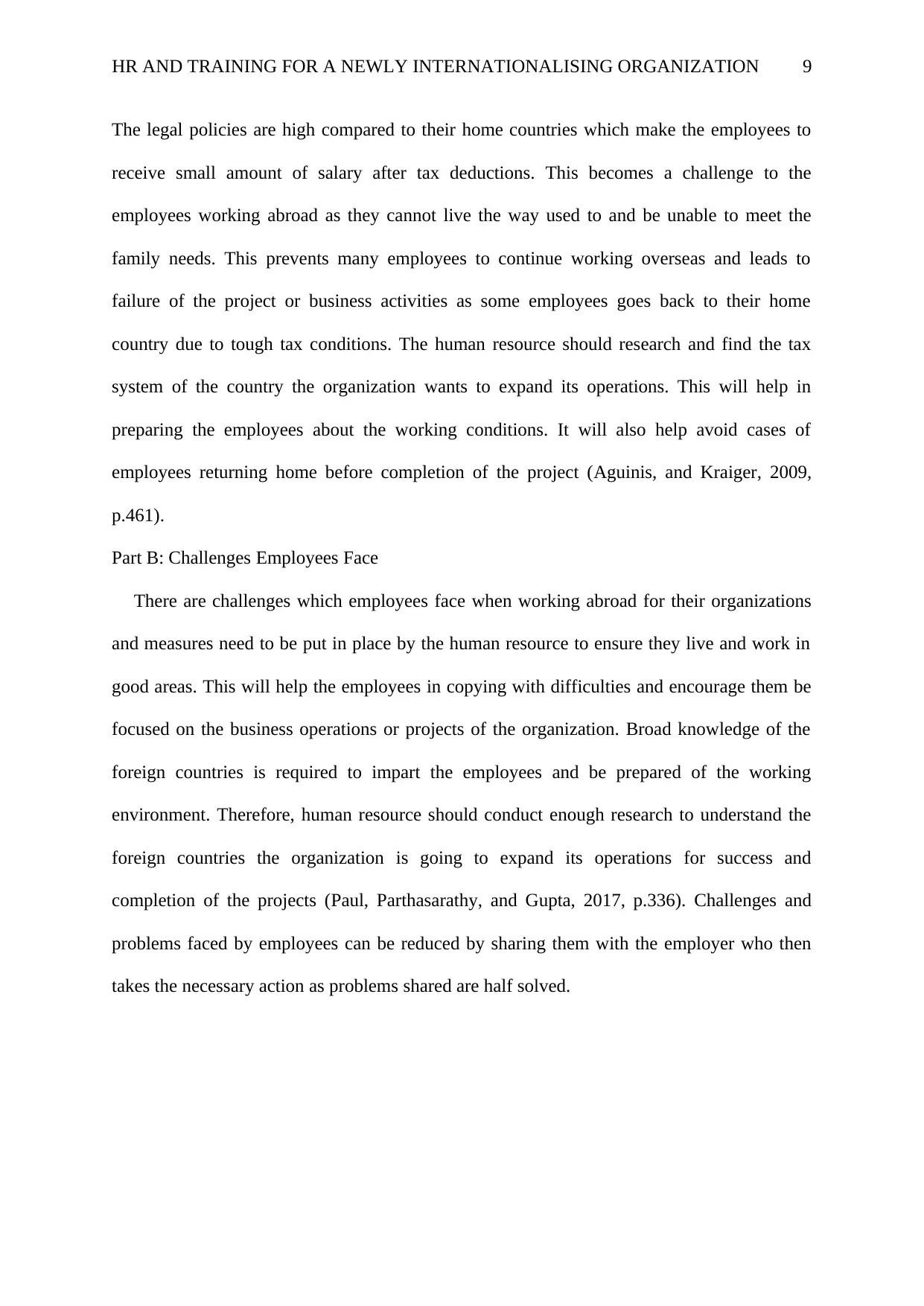
The tax system and legal requirements in the foreign country is a challenge which
employees face when working abroad. Some countries have implemented high tax rates for
the foreign employees working in certain areas of production and tax heavily their salaries.
HR AND TRAINING FOR A NEWLY INTERNATIONALISING ORGANIZATION 9
The legal policies are high compared to their home countries which make the employees to
receive small amount of salary after tax deductions. This becomes a challenge to the
employees working abroad as they cannot live the way used to and be unable to meet the
family needs. This prevents many employees to continue working overseas and leads to
failure of the project or business activities as some employees goes back to their home
country due to tough tax conditions. The human resource should research and find the tax
system of the country the organization wants to expand its operations. This will help in
preparing the employees about the working conditions. It will also help avoid cases of
employees returning home before completion of the project (Aguinis, and Kraiger, 2009,
p.461).
Part B: Challenges Employees Face
There are challenges which employees face when working abroad for their organizations
and measures need to be put in place by the human resource to ensure they live and work in
good areas. This will help the employees in copying with difficulties and encourage them be
focused on the business operations or projects of the organization. Broad knowledge of the
foreign countries is required to impart the employees and be prepared of the working
environment. Therefore, human resource should conduct enough research to understand the
foreign countries the organization is going to expand its operations for success and
completion of the projects (Paul, Parthasarathy, and Gupta, 2017, p.336). Challenges and
problems faced by employees can be reduced by sharing them with the employer who then
takes the necessary action as problems shared are half solved.
The legal policies are high compared to their home countries which make the employees to
receive small amount of salary after tax deductions. This becomes a challenge to the
employees working abroad as they cannot live the way used to and be unable to meet the
family needs. This prevents many employees to continue working overseas and leads to
failure of the project or business activities as some employees goes back to their home
country due to tough tax conditions. The human resource should research and find the tax
system of the country the organization wants to expand its operations. This will help in
preparing the employees about the working conditions. It will also help avoid cases of
employees returning home before completion of the project (Aguinis, and Kraiger, 2009,
p.461).
Part B: Challenges Employees Face
There are challenges which employees face when working abroad for their organizations
and measures need to be put in place by the human resource to ensure they live and work in
good areas. This will help the employees in copying with difficulties and encourage them be
focused on the business operations or projects of the organization. Broad knowledge of the
foreign countries is required to impart the employees and be prepared of the working
environment. Therefore, human resource should conduct enough research to understand the
foreign countries the organization is going to expand its operations for success and
completion of the projects (Paul, Parthasarathy, and Gupta, 2017, p.336). Challenges and
problems faced by employees can be reduced by sharing them with the employer who then
takes the necessary action as problems shared are half solved.
⊘ This is a preview!⊘
Do you want full access?
Subscribe today to unlock all pages.
Trusted by 1+ million students worldwide
HR AND TRAINING FOR A NEWLY INTERNATIONALISING ORGANIZATION 10
References
Aguinis, H. and Kraiger, K., 2009. Benefits of training and development for individuals
and teams, organizations, and society. Annual review of psychology, 60, pp.451-474.
Ambos, T.C., Schlegelmilch, B.B., Ambos, B. and Brenner, B., 2009. Evolution of
organisational structure and capabilities in internationalising banks: the CEE operations
of UniCredit's Vienna office. Long Range Planning, 42(5-6), pp.633-653.
Barkema, H.G., Chen, X.P., George, G., Luo, Y. and Tsui, A.S., 2015. West meets East:
New concepts and theories. Academy of Management Journal, 58(2), p.460.
Bol, T. and Van de Werfhorst, H.G., 2011. Signals and closure by degrees: The education
effect across 15 European countries. Research in Social Stratification and Mobility, 29(1),
pp.119-132.
De Clercq, D., Sapienza, H.J., Yavuz, R.I. and Zhou, L., 2012. Learning and knowledge
in early internationalization research: Past accomplishments and future
directions. Journal of Business Venturing, 27(1), pp.143-165.
De Wit, H. and Merkx, G., 2012. The history of internationalization of higher
education. The SAGE handbook of international higher education, pp.43-57.
de Wit, J.H., 2011. Globalization and internationalisation of higher education. RUSC.
Universities and Knowledge Society Journal, 8(2), pp.págs-77.
References
Aguinis, H. and Kraiger, K., 2009. Benefits of training and development for individuals
and teams, organizations, and society. Annual review of psychology, 60, pp.451-474.
Ambos, T.C., Schlegelmilch, B.B., Ambos, B. and Brenner, B., 2009. Evolution of
organisational structure and capabilities in internationalising banks: the CEE operations
of UniCredit's Vienna office. Long Range Planning, 42(5-6), pp.633-653.
Barkema, H.G., Chen, X.P., George, G., Luo, Y. and Tsui, A.S., 2015. West meets East:
New concepts and theories. Academy of Management Journal, 58(2), p.460.
Bol, T. and Van de Werfhorst, H.G., 2011. Signals and closure by degrees: The education
effect across 15 European countries. Research in Social Stratification and Mobility, 29(1),
pp.119-132.
De Clercq, D., Sapienza, H.J., Yavuz, R.I. and Zhou, L., 2012. Learning and knowledge
in early internationalization research: Past accomplishments and future
directions. Journal of Business Venturing, 27(1), pp.143-165.
De Wit, H. and Merkx, G., 2012. The history of internationalization of higher
education. The SAGE handbook of international higher education, pp.43-57.
de Wit, J.H., 2011. Globalization and internationalisation of higher education. RUSC.
Universities and Knowledge Society Journal, 8(2), pp.págs-77.
Paraphrase This Document
Need a fresh take? Get an instant paraphrase of this document with our AI Paraphraser
HR AND TRAINING FOR A NEWLY INTERNATIONALISING ORGANIZATION 11
Ernst, H., Hoyer, W.D. and Rübsaamen, C., 2010. Sales, marketing, and research-and-
development cooperation across new product development stages: implications for
success. Journal of Marketing, 74(5), pp.80-92.
Fletcher, M., Harris, S. and Richey Jr, R.G., 2013. Internationalization knowledge: What,
why, where, and when?. Journal of International Marketing, 21(3), pp.47-71.
Jensen, S.H., Poulfelt, F. and Kraus, S., 2010. Managerial routines in professional service
firms: transforming knowledge into competitive advantages. The Service Industries
Journal, 30(12), pp.2045-2062.
Khavul, S., Pérez-Nordtvedt, L. and Wood, E., 2010. Organizational entrainment and
international new ventures from emerging markets. Journal of Business Venturing, 25(1),
pp.104-119.
Kwon, K.S., Park, H.W., So, M. and Leydesdorff, L., 2012. Has globalization
strengthened South Korea’s national research system? National and international
dynamics of the Triple Helix of scientific co-authorship relationships in South
Korea. Scientometrics, 90(1), pp.163-176.
Lee, H., Kelley, D., Lee, J. and Lee, S., 2012. SME survival: The impact of
internationalization, technology resources, and alliances. Journal of small business
management, 50(1), pp.1-19.
Paul, J., Parthasarathy, S. and Gupta, P., 2017. Exporting challenges of SMEs: A review
and future research agenda. Journal of world business, 52(3), pp.327-342.
Peng, M.W., Sun, S.L., Pinkham, B. and Chen, H., 2009. The institution-based view as a
third leg for a strategy tripod. Academy of Management Perspectives, 23(3), pp.63-81.
Powell, J.J. and Solga, H., 2010. Analyzing the nexus of higher education and vocational
training in Europe: a comparative‐institutional framework. Studies in Higher
Education, 35(6), pp.705-721.
Ernst, H., Hoyer, W.D. and Rübsaamen, C., 2010. Sales, marketing, and research-and-
development cooperation across new product development stages: implications for
success. Journal of Marketing, 74(5), pp.80-92.
Fletcher, M., Harris, S. and Richey Jr, R.G., 2013. Internationalization knowledge: What,
why, where, and when?. Journal of International Marketing, 21(3), pp.47-71.
Jensen, S.H., Poulfelt, F. and Kraus, S., 2010. Managerial routines in professional service
firms: transforming knowledge into competitive advantages. The Service Industries
Journal, 30(12), pp.2045-2062.
Khavul, S., Pérez-Nordtvedt, L. and Wood, E., 2010. Organizational entrainment and
international new ventures from emerging markets. Journal of Business Venturing, 25(1),
pp.104-119.
Kwon, K.S., Park, H.W., So, M. and Leydesdorff, L., 2012. Has globalization
strengthened South Korea’s national research system? National and international
dynamics of the Triple Helix of scientific co-authorship relationships in South
Korea. Scientometrics, 90(1), pp.163-176.
Lee, H., Kelley, D., Lee, J. and Lee, S., 2012. SME survival: The impact of
internationalization, technology resources, and alliances. Journal of small business
management, 50(1), pp.1-19.
Paul, J., Parthasarathy, S. and Gupta, P., 2017. Exporting challenges of SMEs: A review
and future research agenda. Journal of world business, 52(3), pp.327-342.
Peng, M.W., Sun, S.L., Pinkham, B. and Chen, H., 2009. The institution-based view as a
third leg for a strategy tripod. Academy of Management Perspectives, 23(3), pp.63-81.
Powell, J.J. and Solga, H., 2010. Analyzing the nexus of higher education and vocational
training in Europe: a comparative‐institutional framework. Studies in Higher
Education, 35(6), pp.705-721.
HR AND TRAINING FOR A NEWLY INTERNATIONALISING ORGANIZATION 12
Sun, P.Y. and Anderson, M.H., 2010. An examination of the relationship between
absorptive capacity and organizational learning, and a proposed integration. International
Journal of Management Reviews, 12(2), pp.130-150.
Teichler, U., 2009. Internationalisation of higher education: European experiences. Asia
Pacific education review, 10(1), pp.93-106.
Tolstoy, D. and Agndal, H., 2010. Network resource combinations in the international
venturing of small biotech firms. Technovation, 30(1), pp.24-36.
Zhao, Y., Li, Y., Lee, S.H. and Bo Chen, L., 2011. Entrepreneurial orientation,
organizational learning, and performance: evidence from China. Entrepreneurship theory
and practice, 35(2), pp.293-317.
Zou, H. and Ghauri, P.N., 2010. Internationalizing by learning: the case of Chinese high-
tech new ventures. International Marketing Review, 27(2), pp.223-244.
Sun, P.Y. and Anderson, M.H., 2010. An examination of the relationship between
absorptive capacity and organizational learning, and a proposed integration. International
Journal of Management Reviews, 12(2), pp.130-150.
Teichler, U., 2009. Internationalisation of higher education: European experiences. Asia
Pacific education review, 10(1), pp.93-106.
Tolstoy, D. and Agndal, H., 2010. Network resource combinations in the international
venturing of small biotech firms. Technovation, 30(1), pp.24-36.
Zhao, Y., Li, Y., Lee, S.H. and Bo Chen, L., 2011. Entrepreneurial orientation,
organizational learning, and performance: evidence from China. Entrepreneurship theory
and practice, 35(2), pp.293-317.
Zou, H. and Ghauri, P.N., 2010. Internationalizing by learning: the case of Chinese high-
tech new ventures. International Marketing Review, 27(2), pp.223-244.
⊘ This is a preview!⊘
Do you want full access?
Subscribe today to unlock all pages.
Trusted by 1+ million students worldwide

1 out of 12


Related Documents


Your All-in-One AI-Powered Toolkit for Academic Success.
+13062052269
info@desklib.com
Available 24*7 on WhatsApp / Email
![[object Object]](/_next/static/media/star-bottom.7253800d.svg)
Unlock your academic potential
Copyright © 2020–2026 A2Z Services. All Rights Reserved. Developed and managed by ZUCOL.