Reflective Portfolio: HRM3008 Module on Power, Politics, and KM
VerifiedAdded on 2023/01/16
|10
|2621
|65
Report
AI Summary
This report presents a reflective portfolio based on a student's learning experience in the HRM3008 module, focusing on three key topics: power and politics, knowledge management, and learning organizations. The student explores the concepts of power dynamics, organizational politics, and their impact on business operations. The report defines knowledge management and its significance, differentiating between explicit and tacit knowledge. It also discusses the characteristics of a learning organization. The Gibbs reflective cycle is utilized to analyze the student's learning process, including descriptions of experiences, feelings, evaluations, and action plans for future modules. The portfolio emphasizes the practical application of theoretical knowledge and concludes with insights on the importance of power, politics, knowledge management, and learning within a company.
A Critical discussion on
3 HRM3008 topics / themes
3 HRM3008 topics / themes

Paraphrase This Document
Need a fresh take? Get an instant paraphrase of this document with our AI Paraphraser
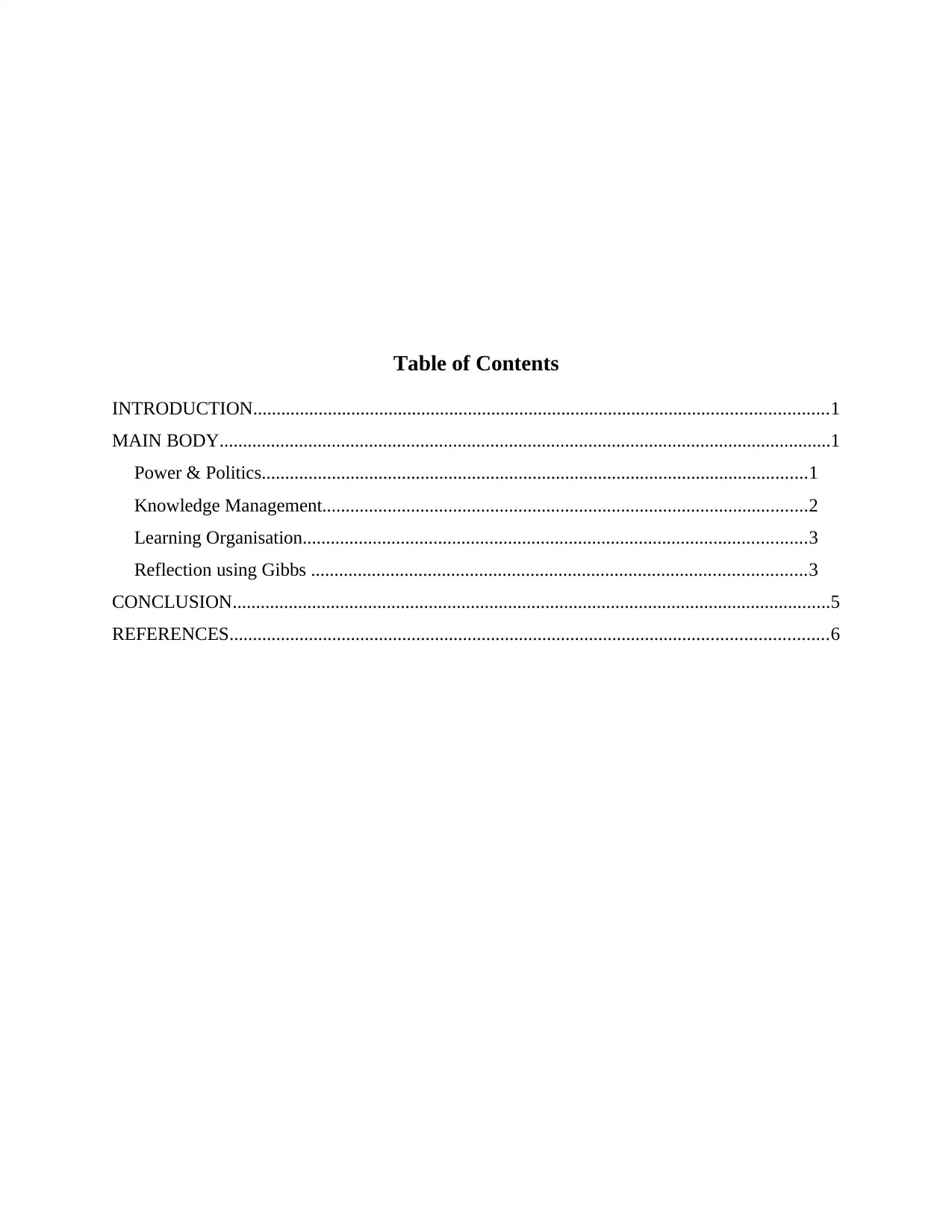
Table of Contents
INTRODUCTION...........................................................................................................................1
MAIN BODY...................................................................................................................................1
Power & Politics.....................................................................................................................1
Knowledge Management........................................................................................................2
Learning Organisation............................................................................................................3
Reflection using Gibbs ..........................................................................................................3
CONCLUSION................................................................................................................................5
REFERENCES................................................................................................................................6
INTRODUCTION...........................................................................................................................1
MAIN BODY...................................................................................................................................1
Power & Politics.....................................................................................................................1
Knowledge Management........................................................................................................2
Learning Organisation............................................................................................................3
Reflection using Gibbs ..........................................................................................................3
CONCLUSION................................................................................................................................5
REFERENCES................................................................................................................................6

⊘ This is a preview!⊘
Do you want full access?
Subscribe today to unlock all pages.

Trusted by 1+ million students worldwide
INTRODUCTION
A reflective portfolio can be deciphered as the integration of writing which provide an
overview of the experience as well as learning gained by students as a result of undergoing
modules or practical assignment work (Gerhardt, 2019). This provides assistance in ascertaining
the indulgence of students in a particular task or activity which was assigned to them to be
completed within due course of time. It is concerned with application of theoretical knowledge
base within the academic settings. The present project is based upon the individual reflective
portfolio based on learning gained by a student during the module in relation to 3 HRM topics or
themes. The topics that are considered are power & politics, organisational learning and
knowledge management.
MAIN BODY
During the course of module, I learned about a number of topics. Out of all the topics, the
ones that I considered to be the most important were acknowledged to be knowledge
management, organisational learning and power & politics. The experiences and learnings
gained as a result of undergoing the module based on these 3 topics are discussed in detailed
manner underneath.
Power & Politics
This was one of the most interesting as well as crucial topics of the present module. It
allowed me to make use of my analytical and practical skills to understand in depth about both
the concepts. In this regard, as a result of undergoing the module, I acknowledged that power as
well as politics form the core of an enterprise. Power is considered as a pervasive element within
an organisation that is undertaken by managers in order to fulfil organisational goals information
order to strengthen their own position (Mostafa and et. al., 2019). It has been identified by me
that managers duly manipulate power as to fulfil goals in order to strengthen position of their
own. In addition to this, it has also been identified that every interaction as well as social
relationship within an organisation can be taken as an exercise of power. Power mainly
represents capability while on the other hand politics is termed as self-serving behaviour that an
employee undertake as to make significant increase in positive outcomes. This has been duly
ascertained by me that with the use of politics within organisation employees serve their personal
interest without even considering organisation objectives. It has been further learned that with
1
A reflective portfolio can be deciphered as the integration of writing which provide an
overview of the experience as well as learning gained by students as a result of undergoing
modules or practical assignment work (Gerhardt, 2019). This provides assistance in ascertaining
the indulgence of students in a particular task or activity which was assigned to them to be
completed within due course of time. It is concerned with application of theoretical knowledge
base within the academic settings. The present project is based upon the individual reflective
portfolio based on learning gained by a student during the module in relation to 3 HRM topics or
themes. The topics that are considered are power & politics, organisational learning and
knowledge management.
MAIN BODY
During the course of module, I learned about a number of topics. Out of all the topics, the
ones that I considered to be the most important were acknowledged to be knowledge
management, organisational learning and power & politics. The experiences and learnings
gained as a result of undergoing the module based on these 3 topics are discussed in detailed
manner underneath.
Power & Politics
This was one of the most interesting as well as crucial topics of the present module. It
allowed me to make use of my analytical and practical skills to understand in depth about both
the concepts. In this regard, as a result of undergoing the module, I acknowledged that power as
well as politics form the core of an enterprise. Power is considered as a pervasive element within
an organisation that is undertaken by managers in order to fulfil organisational goals information
order to strengthen their own position (Mostafa and et. al., 2019). It has been identified by me
that managers duly manipulate power as to fulfil goals in order to strengthen position of their
own. In addition to this, it has also been identified that every interaction as well as social
relationship within an organisation can be taken as an exercise of power. Power mainly
represents capability while on the other hand politics is termed as self-serving behaviour that an
employee undertake as to make significant increase in positive outcomes. This has been duly
ascertained by me that with the use of politics within organisation employees serve their personal
interest without even considering organisation objectives. It has been further learned that with
1
Paraphrase This Document
Need a fresh take? Get an instant paraphrase of this document with our AI Paraphraser
obtaining, maintaining and using power, behaviour of power can be duly influenced. Thus, it has
been duly analysed that in every organisation there are some internal system which is duly
determined by some certain aspects like power and politics.
Both of these elements have formative control over organisational functionality
(Williams and et. al., 2019). This is also been evaluated by me that, there are different types of
power and all of them have distinguish motive and measures. In this it has been learned by me
that individuals within entity develop professional power differently as per according to the
factors like job positioning within organisation and the industry in which business operates.
Different types of power are legitimate, coercive, reward, referent and expert power (Justice and
et. al, 2019). By properly analysing all the types of power this has been significantly identified
by me that with the use of reward power organisation can effectively able to encourage
individual within entity towards effective accomplishment of organisational goals and objectives.
This has been learned by me that with the effective use of reward power entity can further able to
influence their employees with the help of bonuses and promotions.
While it has also been identified by me that within organisation every people tend to ave
their own set of benefit in order to effectively shape their image. This lead towards emerging
politics within business as, is an individual act towards their own interest without even having
concerned for company. With the effective evaluation I have learned that most of the experts
within business organisation such as leaders and manager says that politics within organisation is
harmful for business and further do worst damage for organisation as in this people only
concerned towards their own agendas. This further lead towards encouraging conflicts within
entity (Soriano, Mann and Friesen, 2019). Thus, I duly learned that with the presence of power
and politics within business organisation negative consequences can be faced by organisation
with individual and executives undertake use of negative power and politics. While with the help
of positive politics as well as power leaders and managers within entity can effectively able to
stimulate performance of individuals in best effect manner and can further ensure long term
sustainability of organisation for high profit and productivity.
Knowledge Management
During the module, I learned that knowledge management is an important part of a
corporation. It can be defined as the procedure of creation, exchange and management of data
and knowledge pertaining to an entity (Doeze Jager‐van Vliet, Born and van der Molen, 2019).
2
been duly analysed that in every organisation there are some internal system which is duly
determined by some certain aspects like power and politics.
Both of these elements have formative control over organisational functionality
(Williams and et. al., 2019). This is also been evaluated by me that, there are different types of
power and all of them have distinguish motive and measures. In this it has been learned by me
that individuals within entity develop professional power differently as per according to the
factors like job positioning within organisation and the industry in which business operates.
Different types of power are legitimate, coercive, reward, referent and expert power (Justice and
et. al, 2019). By properly analysing all the types of power this has been significantly identified
by me that with the use of reward power organisation can effectively able to encourage
individual within entity towards effective accomplishment of organisational goals and objectives.
This has been learned by me that with the effective use of reward power entity can further able to
influence their employees with the help of bonuses and promotions.
While it has also been identified by me that within organisation every people tend to ave
their own set of benefit in order to effectively shape their image. This lead towards emerging
politics within business as, is an individual act towards their own interest without even having
concerned for company. With the effective evaluation I have learned that most of the experts
within business organisation such as leaders and manager says that politics within organisation is
harmful for business and further do worst damage for organisation as in this people only
concerned towards their own agendas. This further lead towards encouraging conflicts within
entity (Soriano, Mann and Friesen, 2019). Thus, I duly learned that with the presence of power
and politics within business organisation negative consequences can be faced by organisation
with individual and executives undertake use of negative power and politics. While with the help
of positive politics as well as power leaders and managers within entity can effectively able to
stimulate performance of individuals in best effect manner and can further ensure long term
sustainability of organisation for high profit and productivity.
Knowledge Management
During the module, I learned that knowledge management is an important part of a
corporation. It can be defined as the procedure of creation, exchange and management of data
and knowledge pertaining to an entity (Doeze Jager‐van Vliet, Born and van der Molen, 2019).
2
In other words, it was acknowledged that KM is an approach through which an enterprise seeks
to attain its goals and objectives by capitalising upon knowledge. While undergoing the course of
module, it was taught that there are mainly 2 types of knowledge, namely, explicit and tacit
knowledge (Schippers and et. al., 2020). With this, I realised that it is important for every
company to effectively manage the data or knowledge in order to realise the goals in due course
of time. Furthermore, it was learnt by me that the types of knowledge that can be managed are
codified knowledge (know what and know why) and knowledge (know how and know who).
Thus, I interpreted that when I join an organisation in future, I need to take proper account of the
different types of knowledge and their usage to ensure growth and development of business
entity.
Learning Organisation
During the tenure of this HRM module, I gained comprehensibility of a new concept
named learning organisation. In this regard, I learnt that a learning organisation is the one which
allows learning process to take place in a way such that 4 outcomes can be gained as a result,
namely, efficiency, innovation, environmental alignment and competitive advantage. In addition
to this, I acknowledged that this concept has become excessively important over the passage of
time as several organisations have lost knowledgeable staff as a result of retirement and
delayering. Also, another reason behind its emerging significance is regarded to be knowledge
intensiveness of information technologies (Johannes and et. al., 2019). Further, I was taught that
there are 2 types of learning, namely, single loop and double loop learning. The latter of the 2
types is regarded to be more complex approach to facilitating learning within a corporation. In
this regard, I determined that it is important for the company that I become a part of in the future,
to create an atmosphere which presents opportunities for the employees to learn new things and
elaborate knowledge on a regular basis (Zubizarreta, 2019).
Reflection using Gibbs
Gibbs Reflective Cycle was coined by Graham Gibbs in the year 1988 as to duly provide
structure to learning from experiences (McLean and Price, 2019). In addition to this, this model
provide framework as to examine experiences. In this model there are mainly six stages that are
included in this model that are description, feelings, evaluation, analysis, conclusion and action
plan. This has been further identified that Gibb's reflective cycle is particularly undertake in
3
to attain its goals and objectives by capitalising upon knowledge. While undergoing the course of
module, it was taught that there are mainly 2 types of knowledge, namely, explicit and tacit
knowledge (Schippers and et. al., 2020). With this, I realised that it is important for every
company to effectively manage the data or knowledge in order to realise the goals in due course
of time. Furthermore, it was learnt by me that the types of knowledge that can be managed are
codified knowledge (know what and know why) and knowledge (know how and know who).
Thus, I interpreted that when I join an organisation in future, I need to take proper account of the
different types of knowledge and their usage to ensure growth and development of business
entity.
Learning Organisation
During the tenure of this HRM module, I gained comprehensibility of a new concept
named learning organisation. In this regard, I learnt that a learning organisation is the one which
allows learning process to take place in a way such that 4 outcomes can be gained as a result,
namely, efficiency, innovation, environmental alignment and competitive advantage. In addition
to this, I acknowledged that this concept has become excessively important over the passage of
time as several organisations have lost knowledgeable staff as a result of retirement and
delayering. Also, another reason behind its emerging significance is regarded to be knowledge
intensiveness of information technologies (Johannes and et. al., 2019). Further, I was taught that
there are 2 types of learning, namely, single loop and double loop learning. The latter of the 2
types is regarded to be more complex approach to facilitating learning within a corporation. In
this regard, I determined that it is important for the company that I become a part of in the future,
to create an atmosphere which presents opportunities for the employees to learn new things and
elaborate knowledge on a regular basis (Zubizarreta, 2019).
Reflection using Gibbs
Gibbs Reflective Cycle was coined by Graham Gibbs in the year 1988 as to duly provide
structure to learning from experiences (McLean and Price, 2019). In addition to this, this model
provide framework as to examine experiences. In this model there are mainly six stages that are
included in this model that are description, feelings, evaluation, analysis, conclusion and action
plan. This has been further identified that Gibb's reflective cycle is particularly undertake in
3
⊘ This is a preview!⊘
Do you want full access?
Subscribe today to unlock all pages.
Trusted by 1+ million students worldwide
order to make people learn from situation and further experience on regular basis when they
undergo with number of stages (Torres, Strong and Adesope, 2020).
Description:
As to initiate module learning it has been analysed by me that I decided to divide lessons
from module as per according to importance of each element. In addition to this enough amount
of time has been given by me to learn things from module as to gain formative knowledge
related power and politics, knowledge management and learning organisation. In addition to this,
it has been duly ensured by me that all the activities goes as per according to the time in order to
make sure that task completes as per accordance with accurate deadline (Lukitasari, Hasan and
Sukri, 2020).
Feelings:
At this stage, I was quite happy as I learnt things gradually in accordance with time
(O'Reilly and Milner, 2020). While this, has been duly identified by me that when things got
piled up I got quite frustrated.
Evaluation:
This has been duly determined that the thing that worked well is that each and every
activity went as per according to time and in qualitative manner within agreed deadline. While I
effectively contributed in a positive manner as to learn things in ethical manner. While, it has
been identified that certain things that did not went well that I assumed that I learned all the
activities and things in the module in best effective manner (Schedlitzki, 2019). But it has been
later identified that some activities were left.
Analysis
In this step it has been duly evaluated that the main thing that aid in accomplishing
learning process in best effective manner was that there are some self-identified strengths that aid
me to stay aligned towards my goal (McGarr and O’Gallchóir, 2020). In addition to this, with the
help of different types of skills and knowledge I understand things in well defined manner.
Conclusion:
By undergoing this module, I learnt the manner in which the theoretical learning can be
applied in practical work settings in order to gain favourable results in future prospect. Further, it
is inferred that power, politics, knowledge management and learning are crucial aspects for a
company (Bakar, 2020).
4
undergo with number of stages (Torres, Strong and Adesope, 2020).
Description:
As to initiate module learning it has been analysed by me that I decided to divide lessons
from module as per according to importance of each element. In addition to this enough amount
of time has been given by me to learn things from module as to gain formative knowledge
related power and politics, knowledge management and learning organisation. In addition to this,
it has been duly ensured by me that all the activities goes as per according to the time in order to
make sure that task completes as per accordance with accurate deadline (Lukitasari, Hasan and
Sukri, 2020).
Feelings:
At this stage, I was quite happy as I learnt things gradually in accordance with time
(O'Reilly and Milner, 2020). While this, has been duly identified by me that when things got
piled up I got quite frustrated.
Evaluation:
This has been duly determined that the thing that worked well is that each and every
activity went as per according to time and in qualitative manner within agreed deadline. While I
effectively contributed in a positive manner as to learn things in ethical manner. While, it has
been identified that certain things that did not went well that I assumed that I learned all the
activities and things in the module in best effective manner (Schedlitzki, 2019). But it has been
later identified that some activities were left.
Analysis
In this step it has been duly evaluated that the main thing that aid in accomplishing
learning process in best effective manner was that there are some self-identified strengths that aid
me to stay aligned towards my goal (McGarr and O’Gallchóir, 2020). In addition to this, with the
help of different types of skills and knowledge I understand things in well defined manner.
Conclusion:
By undergoing this module, I learnt the manner in which the theoretical learning can be
applied in practical work settings in order to gain favourable results in future prospect. Further, it
is inferred that power, politics, knowledge management and learning are crucial aspects for a
company (Bakar, 2020).
4
Paraphrase This Document
Need a fresh take? Get an instant paraphrase of this document with our AI Paraphraser
Action Plan:
It is decided by me that whenever I will undergo a module in future, I will utilise my
analytical skills in a better manner so as to derive positive results (Driscoll and et. al., 2020).
CONCLUSION
On the basis of above individual reflective portfolio, it can be analysed that a student
gains a number of experiences as well as learnings while undergoing a course or module. In
addition to this, it has been acknowledged that there are various topics that are essential for a
student to gain knowledge about in order to ensure that they do not face issues while gaining
entry into professional field of work. Apart from this, it is recognised that power and politics are
of various types whereby some of them imply betterment of organisation while the other
facilitate adversities in business operations. Besides this, it has been inferred that knowledge
management consists of 2 extensive concepts, namely, tacit and explicit knowledge.
5
It is decided by me that whenever I will undergo a module in future, I will utilise my
analytical skills in a better manner so as to derive positive results (Driscoll and et. al., 2020).
CONCLUSION
On the basis of above individual reflective portfolio, it can be analysed that a student
gains a number of experiences as well as learnings while undergoing a course or module. In
addition to this, it has been acknowledged that there are various topics that are essential for a
student to gain knowledge about in order to ensure that they do not face issues while gaining
entry into professional field of work. Apart from this, it is recognised that power and politics are
of various types whereby some of them imply betterment of organisation while the other
facilitate adversities in business operations. Besides this, it has been inferred that knowledge
management consists of 2 extensive concepts, namely, tacit and explicit knowledge.
5
REFERENCES
Books and Journals
Gerhardt, T., 2019. An analysis of the impact of a leadership intervention on an undergraduate
work-based learning project for human resource management students. Journal of Work-
Applied Management.
Justice, S.B. and et. al, 2019. Operationalizing reflection in experience-based workplace
learning: a hybrid approach. Human Resource Development International, pp.1-22.
Williams, J. and et. al., 2019. Instruments to measure the ability to self‐reflect: evidence from
work place and educational settings including healthcare. A systematic review. European
Journal of Dental Education.
Mostafa, A.M.S. and et. al., 2019. High‐commitment human resource practices and employee
outcomes: The contingent role of organisational identification. Human Resource
Management Journal, 29(4), pp.620-636.
Doeze Jager‐van Vliet, S.B., Born, M.P. and van der Molen, H.T., 2019. Using a portfolio‐based
process to develop agility among employees. Human Resource Development
Quarterly, 30(1), pp.39-60.
Soriano, L., Mann, D. and Friesen, M.R., 2019. ENHANCEMENT OF STUDENT LEARNING
THROUGH SELF-REFLECTION. Proceedings of the Canadian Engineering Education
Association (CEEA).
McLean, N. and Price, L., 2019. A longitudinal study of the impact of reflective coursework
writing on teacher development courses: a ‘legacy effect’of iterative writing tasks. Higher
Education, 77(5), pp.949-962.
Zubizarreta, J., 2019. Good practice: Improving and assessing honors student learning with
learning portfolios. Journal of the European Honors Council, 3(1), pp.1-9.
Johannes, H. and et. al., 2019. Exploring academic development programme evaluation at a
university: A systematic scholarly approach. South African Journal of Higher
Education, 33(1), pp.144-172.
Schippers, M.C. and et. al., 2020. Writing about personal goals and plans regardless of goal type
boosts academic performance. Contemporary Educational Psychology, 60, p.101823.
Lukitasari, M., Hasan, R. and Sukri, A., 2020. The Effect of e-portfolio on Biological Concepts
Understanding and Responses of Students with Different Academic Achievement
Levels. International Journal of Instruction, 13(1), pp.685-694.
Torres, J.T., Strong, Z.H. and Adesope, O.O., 2020. Reflection through assessment: A systematic
narrative review of teacher feedback and student self-perception. Studies in Educational
Evaluation, 64, p.100814.
Schedlitzki, D., 2019. Developing apprentice leaders through critical reflection. Higher
Education, Skills and Work-Based Learning, 9(2), pp.237-247.
McGarr, O. and O’Gallchóir, C., 2020. The futile quest for honesty in reflective writing:
recognising self-criticism as a form of self-enhancement. Teaching in Higher
Education, pp.1-7.
Driscoll, D.L. and et. al., 2020. Genre Knowledge and Writing Development: Results From the
Writing Transfer Project. Written Communication, 37(1), pp.69-103.
O'Reilly, S. and Milner, J., 2020. Impact of Technology-based Reflective Practice Tools on
Student Skill Development. International Journal of Technology and Human
Interaction (IJTHI), 16(1), pp.77-93.
6
Books and Journals
Gerhardt, T., 2019. An analysis of the impact of a leadership intervention on an undergraduate
work-based learning project for human resource management students. Journal of Work-
Applied Management.
Justice, S.B. and et. al, 2019. Operationalizing reflection in experience-based workplace
learning: a hybrid approach. Human Resource Development International, pp.1-22.
Williams, J. and et. al., 2019. Instruments to measure the ability to self‐reflect: evidence from
work place and educational settings including healthcare. A systematic review. European
Journal of Dental Education.
Mostafa, A.M.S. and et. al., 2019. High‐commitment human resource practices and employee
outcomes: The contingent role of organisational identification. Human Resource
Management Journal, 29(4), pp.620-636.
Doeze Jager‐van Vliet, S.B., Born, M.P. and van der Molen, H.T., 2019. Using a portfolio‐based
process to develop agility among employees. Human Resource Development
Quarterly, 30(1), pp.39-60.
Soriano, L., Mann, D. and Friesen, M.R., 2019. ENHANCEMENT OF STUDENT LEARNING
THROUGH SELF-REFLECTION. Proceedings of the Canadian Engineering Education
Association (CEEA).
McLean, N. and Price, L., 2019. A longitudinal study of the impact of reflective coursework
writing on teacher development courses: a ‘legacy effect’of iterative writing tasks. Higher
Education, 77(5), pp.949-962.
Zubizarreta, J., 2019. Good practice: Improving and assessing honors student learning with
learning portfolios. Journal of the European Honors Council, 3(1), pp.1-9.
Johannes, H. and et. al., 2019. Exploring academic development programme evaluation at a
university: A systematic scholarly approach. South African Journal of Higher
Education, 33(1), pp.144-172.
Schippers, M.C. and et. al., 2020. Writing about personal goals and plans regardless of goal type
boosts academic performance. Contemporary Educational Psychology, 60, p.101823.
Lukitasari, M., Hasan, R. and Sukri, A., 2020. The Effect of e-portfolio on Biological Concepts
Understanding and Responses of Students with Different Academic Achievement
Levels. International Journal of Instruction, 13(1), pp.685-694.
Torres, J.T., Strong, Z.H. and Adesope, O.O., 2020. Reflection through assessment: A systematic
narrative review of teacher feedback and student self-perception. Studies in Educational
Evaluation, 64, p.100814.
Schedlitzki, D., 2019. Developing apprentice leaders through critical reflection. Higher
Education, Skills and Work-Based Learning, 9(2), pp.237-247.
McGarr, O. and O’Gallchóir, C., 2020. The futile quest for honesty in reflective writing:
recognising self-criticism as a form of self-enhancement. Teaching in Higher
Education, pp.1-7.
Driscoll, D.L. and et. al., 2020. Genre Knowledge and Writing Development: Results From the
Writing Transfer Project. Written Communication, 37(1), pp.69-103.
O'Reilly, S. and Milner, J., 2020. Impact of Technology-based Reflective Practice Tools on
Student Skill Development. International Journal of Technology and Human
Interaction (IJTHI), 16(1), pp.77-93.
6
⊘ This is a preview!⊘
Do you want full access?
Subscribe today to unlock all pages.
Trusted by 1+ million students worldwide

Bakar, M.A.A., 2020. DOES REFLECTIVE PRACTICE AND PERSONALISED FEEDBACK
FOSTER LEARNING?. Asia Proceedings of Social Sciences, 5(1), pp.102-105.
7
FOSTER LEARNING?. Asia Proceedings of Social Sciences, 5(1), pp.102-105.
7

1 out of 10


Related Documents


Your All-in-One AI-Powered Toolkit for Academic Success.
+13062052269
info@desklib.com
Available 24*7 on WhatsApp / Email
![[object Object]](/_next/static/media/star-bottom.7253800d.svg)
Unlock your academic potential
Copyright © 2020–2026 A2Z Services. All Rights Reserved. Developed and managed by ZUCOL.