HRMT11011: Fair Work Commission and HRM Challenges in Horticulture
VerifiedAdded on 2023/03/30
|16
|2459
|241
Report
AI Summary
This report examines the human resource management challenges within the Australian horticulture industry following rulings by the Fair Work Commission (FWC). It highlights issues such as the impact of new policies on casual workers and working hours, exploitation concerns, and wage-related problems. The report reviews the FWC's role before and after 2012, detailing the introduction of overtime provisions and the difficulties faced by farmers in adapting to these changes. It also explores the potential of technological advancements and offers recommendations for managing casual workers, introducing HR policies, and fostering collaboration between industry stakeholders and policymakers. The analysis emphasizes the need for financial calculating systems, the integration of technology like AI and robots, and improved management of the casual workforce to ensure fair labor practices and sustainable horticultural development. Desklib provides this and other solved assignments to aid students.

Fair work commission and horticulture report on the human resources management
Paraphrase This Document
Need a fresh take? Get an instant paraphrase of this document with our AI Paraphraser

Running Head: Report
Executive Summary
In the latest news from Australia, it has been pointed out about the increase in the casual
workers. The main reasons being under-employed youth and low pay jobs.This came in during
the election times wherein it was proposed that there will be laws with respect to the permanent
jobs after spending 12 months as a casual worker. As per the timeline, the discussions started off
from the year of 2010 about various problems with respect to the status of the casual workers,
problems for the farmers, wages and overtime working hours.
It is, thus, in this light that the current study is trying to make an attempt to understand various
points of discussion with industry of Horticulture and associated issues, challenges and problems
from the perspective of the human resource management. There will be points discussing on the
role of casual workers, concept of overtime, productivity and assignment of the wages and future
of the horticulture with respect to advancements in the field of the technology.
1
Executive Summary
In the latest news from Australia, it has been pointed out about the increase in the casual
workers. The main reasons being under-employed youth and low pay jobs.This came in during
the election times wherein it was proposed that there will be laws with respect to the permanent
jobs after spending 12 months as a casual worker. As per the timeline, the discussions started off
from the year of 2010 about various problems with respect to the status of the casual workers,
problems for the farmers, wages and overtime working hours.
It is, thus, in this light that the current study is trying to make an attempt to understand various
points of discussion with industry of Horticulture and associated issues, challenges and problems
from the perspective of the human resource management. There will be points discussing on the
role of casual workers, concept of overtime, productivity and assignment of the wages and future
of the horticulture with respect to advancements in the field of the technology.
1

Running Head: Report
Contents
Executive Summary.........................................................................................................................1
Brief Summary.................................................................................................................................3
Identification of three key human resource management issues.....................................................4
Problem of New Policy For Casual Workers and Working Hours..............................................4
Problem Of Hiring Casual Workers, Exploitation of Children and Introduction of Robots......4
Problem With The Wages and Burdent of the Overtime Charges...............................................6
Fair Work Commission....................................................................................................................7
Before 2012..................................................................................................................................7
After 2012-2019...........................................................................................................................7
Recommendations for the future...................................................................................................11
Technological advancements and horticultural developments..................................................11
Management of the casual workers............................................................................................12
Introduction of the hr management & policies..........................................................................13
References......................................................................................................................................14
2
Contents
Executive Summary.........................................................................................................................1
Brief Summary.................................................................................................................................3
Identification of three key human resource management issues.....................................................4
Problem of New Policy For Casual Workers and Working Hours..............................................4
Problem Of Hiring Casual Workers, Exploitation of Children and Introduction of Robots......4
Problem With The Wages and Burdent of the Overtime Charges...............................................6
Fair Work Commission....................................................................................................................7
Before 2012..................................................................................................................................7
After 2012-2019...........................................................................................................................7
Recommendations for the future...................................................................................................11
Technological advancements and horticultural developments..................................................11
Management of the casual workers............................................................................................12
Introduction of the hr management & policies..........................................................................13
References......................................................................................................................................14
2
⊘ This is a preview!⊘
Do you want full access?
Subscribe today to unlock all pages.

Trusted by 1+ million students worldwide

Running Head: Report
Brief Summary
The News Story informs and shares about various problems and issues faced from the side of the
farmers in Australia due to the new policy that has been rolled out by the Fair Work Commision.
According to the FWC, there has to be some kind of justice to be shown against the casual
workers engaged in the horticulture sectors of farming and their empowerment may be done
through various measurements and steps taken towards their welfare.
However, the farmers feel that FWC has given them a short notice of 14 days and the new policy
will be rolled out after 14 days.they feel that it is too short notice for them to implement the new
policy and they are in bad situation for which they pin pointed to different reasons. One of them
being the planning for the work through casual workers and it needed some time. They felt that it
will be introducing a business loss at three levels for the country namely at the regional, State
and global levels. Thus, it is necessary to rethink about the new policy and implementing them in
Australia.
3
Brief Summary
The News Story informs and shares about various problems and issues faced from the side of the
farmers in Australia due to the new policy that has been rolled out by the Fair Work Commision.
According to the FWC, there has to be some kind of justice to be shown against the casual
workers engaged in the horticulture sectors of farming and their empowerment may be done
through various measurements and steps taken towards their welfare.
However, the farmers feel that FWC has given them a short notice of 14 days and the new policy
will be rolled out after 14 days.they feel that it is too short notice for them to implement the new
policy and they are in bad situation for which they pin pointed to different reasons. One of them
being the planning for the work through casual workers and it needed some time. They felt that it
will be introducing a business loss at three levels for the country namely at the regional, State
and global levels. Thus, it is necessary to rethink about the new policy and implementing them in
Australia.
3
Paraphrase This Document
Need a fresh take? Get an instant paraphrase of this document with our AI Paraphraser

Running Head: Report
Identification of three key human resource management issues
One may observe the following from the news report:
1. Role of Fair Work Commission
2. Farmers’ Problems, Challenges and Initiatives (Cattle, 2019)
3. Status of casual Workers (Lester, 2012)
4. Role of Policy makers and farmers
Problem of New Policy For Casual Workers and Working Hours
Apart from these main points, it is observed that there is a new policy being rolled out and going
to be implemented in two weeks time from the side of the Fair Work Commission. The farmers
were in difficult position and demanded the clarity and reality of working conditions of the new
policy for them. The farmers had to limit with the number of workers who will be working for
only 38 hours and they had to employ more workers in order to avoid the overtime charges.
Furthermore, the farmers had difficulty in making payments for overtime. There were problems
and issues with the new policy effecting the businesses (Gorman & Vemuri, 2012).
Problem Of Hiring Casual Workers, Exploitation of Children and Introduction of Robots
It was found that it is cheaper to employ children and get the work done during the vacation and
holiday seasons. The farmers were eager to introduce the robots and get the work completed in
their farms. Now they had a choice to get 10-15 employees and productivity was completed
through them with the rule that in less time the work must be completed in the farm. Thus, there
will be multiple picking of the fruits and vegetables from these farms and there is the need to
4
Identification of three key human resource management issues
One may observe the following from the news report:
1. Role of Fair Work Commission
2. Farmers’ Problems, Challenges and Initiatives (Cattle, 2019)
3. Status of casual Workers (Lester, 2012)
4. Role of Policy makers and farmers
Problem of New Policy For Casual Workers and Working Hours
Apart from these main points, it is observed that there is a new policy being rolled out and going
to be implemented in two weeks time from the side of the Fair Work Commission. The farmers
were in difficult position and demanded the clarity and reality of working conditions of the new
policy for them. The farmers had to limit with the number of workers who will be working for
only 38 hours and they had to employ more workers in order to avoid the overtime charges.
Furthermore, the farmers had difficulty in making payments for overtime. There were problems
and issues with the new policy effecting the businesses (Gorman & Vemuri, 2012).
Problem Of Hiring Casual Workers, Exploitation of Children and Introduction of Robots
It was found that it is cheaper to employ children and get the work done during the vacation and
holiday seasons. The farmers were eager to introduce the robots and get the work completed in
their farms. Now they had a choice to get 10-15 employees and productivity was completed
through them with the rule that in less time the work must be completed in the farm. Thus, there
will be multiple picking of the fruits and vegetables from these farms and there is the need to
4

Running Head: Report
work out plan with respect to the workers supply chain and the manner they had to work on the
farms (Gorman & Vemuri, 2012)..They were relying on the robotic technology and employing
kids during the school holidays instead of adults. They were thinking on the lines of paying in
lower wage rates for kids and avoid superannuation as done in the other employment scenarios..
As a result, the costs of the fruits and vegetables will rise and be difficult for the customers to
buy or purchase from the markets (Berg & Farbenblum, 2017).There are certain financial
impacts on the farmers and they need to prepare, manage and find ways to absorb financial
impacts and warrants for the lengthy, transition period for changes to come into effect for them
due to the new policy. Thus, the main and major concerns are:
1. Casual Workers
2. Problem with the wages
3. Loss of chances of earning extra due to technological innovations
4. Exploitation at the workplace due to hiring of the children
5. Improper Management of the Farmers and their Operations and Supply Chain
Management
6. Role of the government, policy makers and farmers
7. Missing Discussions with the casual workers
8. Mismanagement of Working Hours
9. No market research
10. No role of the Industry and Investors
5
work out plan with respect to the workers supply chain and the manner they had to work on the
farms (Gorman & Vemuri, 2012)..They were relying on the robotic technology and employing
kids during the school holidays instead of adults. They were thinking on the lines of paying in
lower wage rates for kids and avoid superannuation as done in the other employment scenarios..
As a result, the costs of the fruits and vegetables will rise and be difficult for the customers to
buy or purchase from the markets (Berg & Farbenblum, 2017).There are certain financial
impacts on the farmers and they need to prepare, manage and find ways to absorb financial
impacts and warrants for the lengthy, transition period for changes to come into effect for them
due to the new policy. Thus, the main and major concerns are:
1. Casual Workers
2. Problem with the wages
3. Loss of chances of earning extra due to technological innovations
4. Exploitation at the workplace due to hiring of the children
5. Improper Management of the Farmers and their Operations and Supply Chain
Management
6. Role of the government, policy makers and farmers
7. Missing Discussions with the casual workers
8. Mismanagement of Working Hours
9. No market research
10. No role of the Industry and Investors
5
⊘ This is a preview!⊘
Do you want full access?
Subscribe today to unlock all pages.

Trusted by 1+ million students worldwide

Running Head: Report
Problem With The Wages and Burdent of the Overtime Charges
Since the casual workers need to work during the peak seasons of the harvet time, it was difficult
to hire them and get the work done through them on the farms. There was good competition
amongst the farmers and casual workers had the choice to work for those farmers who were
willing to pay higher wages and paid the over time charges also. The farmers had to search for
the alternatives in the market.
As there is the problem with the wages and overtime charges, the farmers wanted to introduce
new ways of working and maintaining the financial competition and performance also.
6
Problem With The Wages and Burdent of the Overtime Charges
Since the casual workers need to work during the peak seasons of the harvet time, it was difficult
to hire them and get the work done through them on the farms. There was good competition
amongst the farmers and casual workers had the choice to work for those farmers who were
willing to pay higher wages and paid the over time charges also. The farmers had to search for
the alternatives in the market.
As there is the problem with the wages and overtime charges, the farmers wanted to introduce
new ways of working and maintaining the financial competition and performance also.
6
Paraphrase This Document
Need a fresh take? Get an instant paraphrase of this document with our AI Paraphraser

Running Head: Report
Fair Work Commission
Before 2012
It has been observed, according to Stewart, Fair Work Australia is a new institution and was
created in 2009. It performs in a range of functions , focuses on the labor development and pays
attention to the workplace authority and the Australian Fair Pay Commission. The four main
functions of the FWA like the approval of the enterprise agreements, the resolution of the unfair
dismissal claims, wage fixation and setting and existence of variation of minimum standards
(Stewart, 2011).
After 2012-2019
According to Wallace, FWC announced that in two weeks’ time, the farmers must introduce new
overtime provisions for the casual horticulture workers. In other words, the casual employees
working in this sector must receive overtime. There was a need for the development of the frame
works for the decision and minimize the impact on farmers. The growers need to pay a 15%
"night loading" where casual employees working overnight or overtime rates where the
employees works more than 12 hours per day or 304 hours over 8 weeks. It was difficult to
accommodate and was less problematic as compared to the other possible alternatives and
outcomes like giving the entitlements as it was given to the permanent employees. The FWC
gave only 14 days for implementation of the new policy and farmers demanded more time in
order to understand and enact upon the relevant changes. The wages were highest component of
horticulture's cash costs and farmers-need time, revisit their budgets, business strategy,
workforce planning, assess the impact of change and required time to modify their plans, indirect
changes and worker’s overtime had to base upon new system of calculations involving the
7
Fair Work Commission
Before 2012
It has been observed, according to Stewart, Fair Work Australia is a new institution and was
created in 2009. It performs in a range of functions , focuses on the labor development and pays
attention to the workplace authority and the Australian Fair Pay Commission. The four main
functions of the FWA like the approval of the enterprise agreements, the resolution of the unfair
dismissal claims, wage fixation and setting and existence of variation of minimum standards
(Stewart, 2011).
After 2012-2019
According to Wallace, FWC announced that in two weeks’ time, the farmers must introduce new
overtime provisions for the casual horticulture workers. In other words, the casual employees
working in this sector must receive overtime. There was a need for the development of the frame
works for the decision and minimize the impact on farmers. The growers need to pay a 15%
"night loading" where casual employees working overnight or overtime rates where the
employees works more than 12 hours per day or 304 hours over 8 weeks. It was difficult to
accommodate and was less problematic as compared to the other possible alternatives and
outcomes like giving the entitlements as it was given to the permanent employees. The FWC
gave only 14 days for implementation of the new policy and farmers demanded more time in
order to understand and enact upon the relevant changes. The wages were highest component of
horticulture's cash costs and farmers-need time, revisit their budgets, business strategy,
workforce planning, assess the impact of change and required time to modify their plans, indirect
changes and worker’s overtime had to base upon new system of calculations involving the
7

Running Head: Report
number of hours worked-when and over what time periods in a day, etc. This seems to be
workforce crisis especially with respect to the pick and pack and pruning of their trees (Wallace,
2019)
There was no direct access to workers and this certainly constrains farmer's productivity,
profitability and flow on benefits for region of Australia. Apart from this, there was a problem
with the no proper source of labor and this might hold back agriculture's goal $100 billion
industry by 2030. This was the main problem especially with the small businesses’ working style
and FWC policies to be rolled out in 2 weeks’ time for implementation (Underhill & Rimmer,
2016).
8
number of hours worked-when and over what time periods in a day, etc. This seems to be
workforce crisis especially with respect to the pick and pack and pruning of their trees (Wallace,
2019)
There was no direct access to workers and this certainly constrains farmer's productivity,
profitability and flow on benefits for region of Australia. Apart from this, there was a problem
with the no proper source of labor and this might hold back agriculture's goal $100 billion
industry by 2030. This was the main problem especially with the small businesses’ working style
and FWC policies to be rolled out in 2 weeks’ time for implementation (Underhill & Rimmer,
2016).
8
⊘ This is a preview!⊘
Do you want full access?
Subscribe today to unlock all pages.

Trusted by 1+ million students worldwide

Running Head: Report
9
9
Paraphrase This Document
Need a fresh take? Get an instant paraphrase of this document with our AI Paraphraser

Running Head: Report
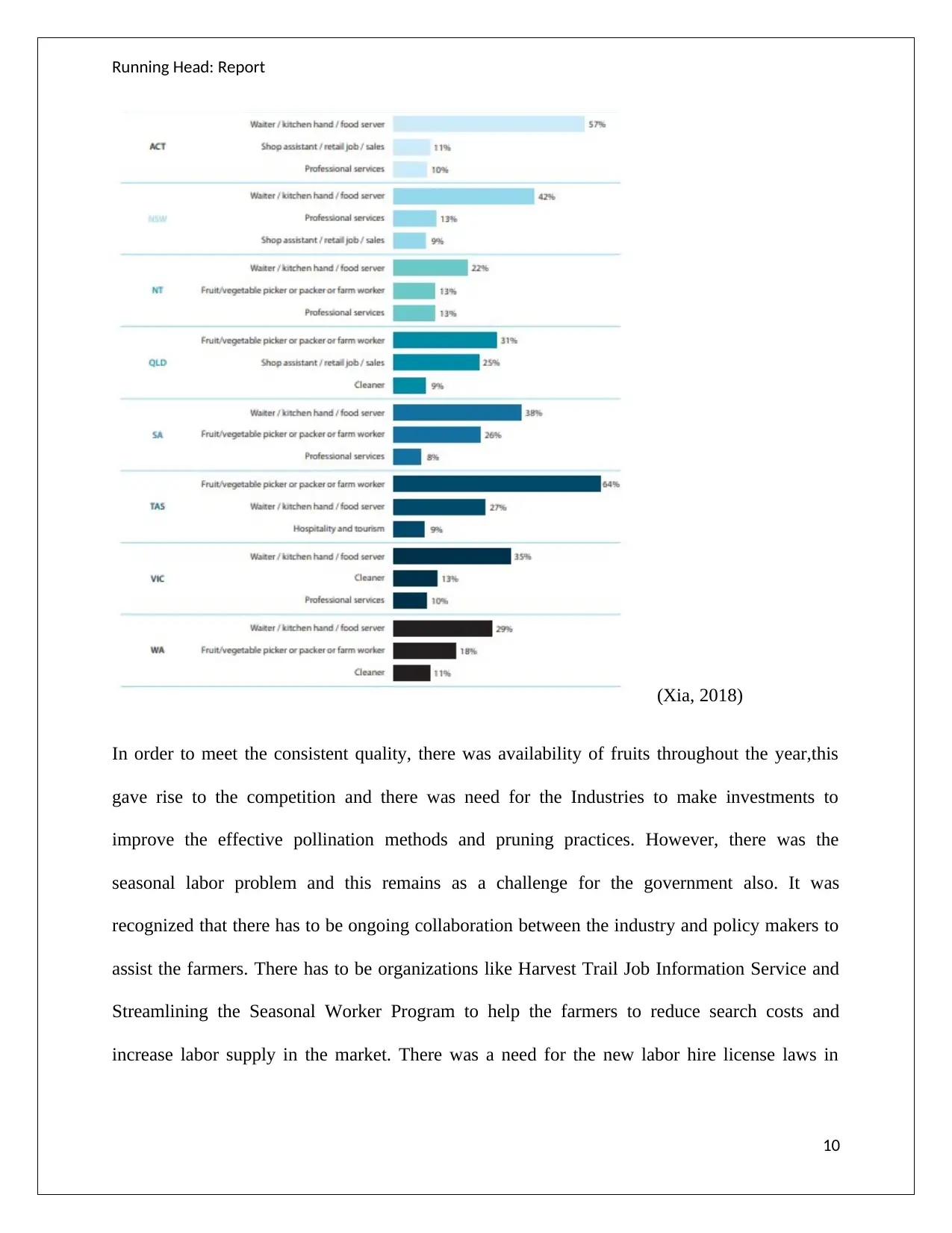
(Xia, 2018)
In order to meet the consistent quality, there was availability of fruits throughout the year,this
gave rise to the competition and there was need for the Industries to make investments to
improve the effective pollination methods and pruning practices. However, there was the
seasonal labor problem and this remains as a challenge for the government also. It was
recognized that there has to be ongoing collaboration between the industry and policy makers to
assist the farmers. There has to be organizations like Harvest Trail Job Information Service and
Streamlining the Seasonal Worker Program to help the farmers to reduce search costs and
increase labor supply in the market. There was a need for the new labor hire license laws in
10
(Xia, 2018)
In order to meet the consistent quality, there was availability of fruits throughout the year,this
gave rise to the competition and there was need for the Industries to make investments to
improve the effective pollination methods and pruning practices. However, there was the
seasonal labor problem and this remains as a challenge for the government also. It was
recognized that there has to be ongoing collaboration between the industry and policy makers to
assist the farmers. There has to be organizations like Harvest Trail Job Information Service and
Streamlining the Seasonal Worker Program to help the farmers to reduce search costs and
increase labor supply in the market. There was a need for the new labor hire license laws in
10

Running Head: Report
Queensland, South Australia and Victoria. Apart from these changes, there was an introduction
to the National schemes also (Xia, 2018).
It was also showcased that the International students, backpackers and other temporary migrants
also experienced exploitation and criminal forced labor. The statistics revealed that out of 91
participants, the passports were confiscated by their employer (3%) and 77 by their
Accommodation provider (2%) and most were in food services (28%) or horticulture (18%)
(Khadem, 2019). The question arises- What is the status of the casual workers in Australia?
Recommendations for the future.
Technological advancements and horticultural developments
1. There has to be new financial calculating systems specially designed or the casual
workers (Gibson & McKenzie, 2014)
2. With the help of the IoT and Artificial Intelligence, there may be support and
introduction of robots in the farms to help the farmers.Hiring Notifications may be
launched via the websites of the farmers to attract the casual workers (Wallace, 2019)
3. Encouraging new Start-Ups to develop automated systems for the farmers.
4. Increased awareness programs for the farmers to use the social networking platforms and
introduce at University and colleges.
11
Queensland, South Australia and Victoria. Apart from these changes, there was an introduction
to the National schemes also (Xia, 2018).
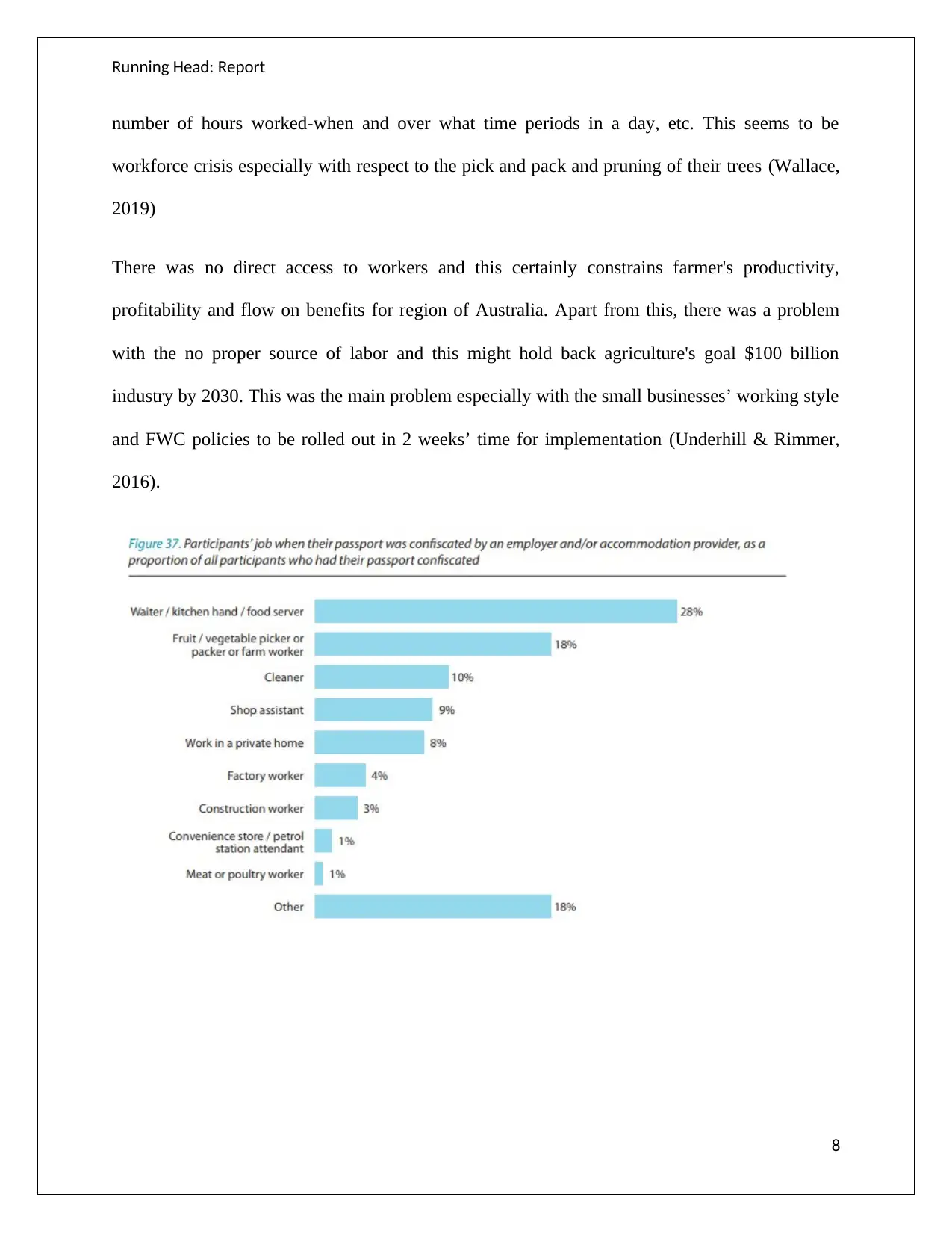
It was also showcased that the International students, backpackers and other temporary migrants
also experienced exploitation and criminal forced labor. The statistics revealed that out of 91
participants, the passports were confiscated by their employer (3%) and 77 by their
Accommodation provider (2%) and most were in food services (28%) or horticulture (18%)
(Khadem, 2019). The question arises- What is the status of the casual workers in Australia?
Recommendations for the future.
Technological advancements and horticultural developments
1. There has to be new financial calculating systems specially designed or the casual
workers (Gibson & McKenzie, 2014)
2. With the help of the IoT and Artificial Intelligence, there may be support and
introduction of robots in the farms to help the farmers.Hiring Notifications may be
launched via the websites of the farmers to attract the casual workers (Wallace, 2019)
3. Encouraging new Start-Ups to develop automated systems for the farmers.
4. Increased awareness programs for the farmers to use the social networking platforms and
introduce at University and colleges.
11
⊘ This is a preview!⊘
Do you want full access?
Subscribe today to unlock all pages.

Trusted by 1+ million students worldwide
1 out of 16
Related Documents
Your All-in-One AI-Powered Toolkit for Academic Success.
+13062052269
info@desklib.com
Available 24*7 on WhatsApp / Email
Unlock your academic potential
Copyright © 2020–2025 A2Z Services. All Rights Reserved. Developed and managed by ZUCOL.