Organizational Change and Restructuring: A Case Study of HSBC Bank
VerifiedAdded on 2023/06/05
|9
|1569
|136
Report
AI Summary
This report examines the organizational change at HSBC Bank, focusing on its restructuring efforts and transition towards digital banking. The analysis utilizes the change path model, detailing the steps taken by HSBC, including the closure of branches and staff reductions, driven by the increasing adoption of online banking and high operating costs of physical branches. The report outlines the 'awakening,' 'mobilization,' 'acceleration,' and 'institutionalization' phases, evaluating the stakeholders involved, successful and unsuccessful processes, and providing suggestions for future change management. Key findings include the successful expansion of digital banking and the challenges associated with staff redundancies and branch closures. The conclusion emphasizes the overall success of HSBC's restructuring, highlighting its ability to mobilize financial resources and adapt to the evolving banking landscape.

Running head: ORGANIZATIONAL CHANGE
Organisational Change
Name of the Student
Name of the University
Author note
Organisational Change
Name of the Student
Name of the University
Author note

Paraphrase This Document
Need a fresh take? Get an instant paraphrase of this document with our AI Paraphraser
1
ORGANIZATIONAL CHANGE
Table of Contents
Introduction:....................................................................................................................................1
Brief summary of the chosen organisation:.....................................................................................1
Reasons for the change:...................................................................................................................1
Steps taken to achieve the change:..................................................................................................2
Awakening:..................................................................................................................................2
Mobilisation:................................................................................................................................2
Acceleration:................................................................................................................................3
Institutionalisation:......................................................................................................................3
Discussion of the stakeholders included and their roles:.................................................................3
Key processes which were successful:............................................................................................4
Key processes which were not successful:......................................................................................4
Suggestions to the company to achieve successful change in the future:........................................4
Conclusion:......................................................................................................................................5
References:......................................................................................................................................6
ORGANIZATIONAL CHANGE
Table of Contents
Introduction:....................................................................................................................................1
Brief summary of the chosen organisation:.....................................................................................1
Reasons for the change:...................................................................................................................1
Steps taken to achieve the change:..................................................................................................2
Awakening:..................................................................................................................................2
Mobilisation:................................................................................................................................2
Acceleration:................................................................................................................................3
Institutionalisation:......................................................................................................................3
Discussion of the stakeholders included and their roles:.................................................................3
Key processes which were successful:............................................................................................4
Key processes which were not successful:......................................................................................4
Suggestions to the company to achieve successful change in the future:........................................4
Conclusion:......................................................................................................................................5
References:......................................................................................................................................6
2
ORGANIZATIONAL CHANGE
Introduction:
The aim of the paper is to delve into the process of organisational change using the
change path model. The organisation chosen for studying the model is HSBC Bank, the leading
British multinational banking chain.
Brief summary of the chosen organisation:
HSBC Bank is one of the world’s largest chain of international bank with its headquarters
in London, the United Kingdom. The bank is a wholly owned subsidiary of HSBC Holding and
functions under Stephen O’Connor in the capacity of its chairman. The services provided by the
bank consist of personal banking, commercial banking, investment bank and host of other
banking services. It is this wide range of finance services which enables the bank to serve both
individual and business customers. The main markets of HSBC Bank are Europe, Asia, Middle-
east and the Asia-Pacific Region. The British multinational bank around the beginning of 2017 in
order to restructure its British operations, announced closing of 117 branches in the country and
reduce its staff numbers by 380 (Reuters.com, 2018).
Reasons for the change:
The management of the HSBC announced closure of around a hundred and a seventeen
braches in order to restructure its British operations. The management reasoned that the bank has
experienced significant increase in the online banking transactions among customers. The main
customers who use braches were either aged or lower income group customers who do not have
access to internet banking (Theguardian.com, 2018). The second reason which the management
held significant for closing of more than a hundred branches was high operating cost of the brick
and mortar branches. The management quipped that with customers gradually shifting towards
ORGANIZATIONAL CHANGE
Introduction:
The aim of the paper is to delve into the process of organisational change using the
change path model. The organisation chosen for studying the model is HSBC Bank, the leading
British multinational banking chain.
Brief summary of the chosen organisation:
HSBC Bank is one of the world’s largest chain of international bank with its headquarters
in London, the United Kingdom. The bank is a wholly owned subsidiary of HSBC Holding and
functions under Stephen O’Connor in the capacity of its chairman. The services provided by the
bank consist of personal banking, commercial banking, investment bank and host of other
banking services. It is this wide range of finance services which enables the bank to serve both
individual and business customers. The main markets of HSBC Bank are Europe, Asia, Middle-
east and the Asia-Pacific Region. The British multinational bank around the beginning of 2017 in
order to restructure its British operations, announced closing of 117 branches in the country and
reduce its staff numbers by 380 (Reuters.com, 2018).
Reasons for the change:
The management of the HSBC announced closure of around a hundred and a seventeen
braches in order to restructure its British operations. The management reasoned that the bank has
experienced significant increase in the online banking transactions among customers. The main
customers who use braches were either aged or lower income group customers who do not have
access to internet banking (Theguardian.com, 2018). The second reason which the management
held significant for closing of more than a hundred branches was high operating cost of the brick
and mortar branches. The management quipped that with customers gradually shifting towards
⊘ This is a preview!⊘
Do you want full access?
Subscribe today to unlock all pages.

Trusted by 1+ million students worldwide
3
ORGANIZATIONAL CHANGE
online banking and customer footfall dwindling at the branches, branch operations ceased to
remain profitable. Moreover, financing the staff and assets of so many braches were adding rto
the operating costs of the bank. Thus, the decision to change from physical banking services to
embrace digital banking in a big way also aimed to curtail cost of operations at the bank
(Reuters.com, 2018). The outcome of this organisational restructuring at the HSBC Bank led to
staff reduction by 380 jobs.
Steps taken to achieve the change:
The steps which HSBC Bank took to embrace the change corresponded to the change
path model. HSBC Bank took the following steps to achieve the change which was
organisational restructuring and closing a hundred and seven branches in the United Kingdom.:
Awakening:
The first step which HSBC Bank took to embrace the change to embrace digital methods
of operations proactively was awakening. Graupner et al. (2015) mentioned in this respect that
the changing acceptance of digital banking among customers was one of the main reasons for the
bank to embrace digital banking more actively. Khrais (2015) contradicts this opinion and point
out that digital banking has made the customers susceptible to online frauds. It could be inferred
from the discussion of the two authors that though digital banking carry data theft risks, its
increasing future profitability awakened the management of HSBC Bank to restructure its home
operations to align it with digital banking.
Mobilisation:
The second step change path model is mobilisation which revolves around mobilising
resources to initiate the change process. Cameron and Green (2015) echoing Graupner et al.
ORGANIZATIONAL CHANGE
online banking and customer footfall dwindling at the branches, branch operations ceased to
remain profitable. Moreover, financing the staff and assets of so many braches were adding rto
the operating costs of the bank. Thus, the decision to change from physical banking services to
embrace digital banking in a big way also aimed to curtail cost of operations at the bank
(Reuters.com, 2018). The outcome of this organisational restructuring at the HSBC Bank led to
staff reduction by 380 jobs.
Steps taken to achieve the change:
The steps which HSBC Bank took to embrace the change corresponded to the change
path model. HSBC Bank took the following steps to achieve the change which was
organisational restructuring and closing a hundred and seven branches in the United Kingdom.:
Awakening:
The first step which HSBC Bank took to embrace the change to embrace digital methods
of operations proactively was awakening. Graupner et al. (2015) mentioned in this respect that
the changing acceptance of digital banking among customers was one of the main reasons for the
bank to embrace digital banking more actively. Khrais (2015) contradicts this opinion and point
out that digital banking has made the customers susceptible to online frauds. It could be inferred
from the discussion of the two authors that though digital banking carry data theft risks, its
increasing future profitability awakened the management of HSBC Bank to restructure its home
operations to align it with digital banking.
Mobilisation:
The second step change path model is mobilisation which revolves around mobilising
resources to initiate the change process. Cameron and Green (2015) echoing Graupner et al.
Paraphrase This Document
Need a fresh take? Get an instant paraphrase of this document with our AI Paraphraser
4
ORGANIZATIONAL CHANGE
(2015) mentioned that organisations in order to initiate the change process have to mobilise
resources to support the change. In this light it can be pointed out that the management of HSBC
Bank took two steps towards mobilising resources. First, it strengthened and promoted its digital
banking platforms to increase their market penetration. Thus digital banking services generated
sufficient revenue for the bank to drive its restricting and also provided base to diversify the loss
it would suffer due to closing of several branches. Secondly, the bank allowed the post offices to
play the roles of its branches, thus not depriving customers entire of physical banking services
(Hsbc.com, 2018).
Acceleration:
Heyden et al.(2017) mentioned that the stage of acceleration is the stage when
organisations eyeing to embrace changes actually implement the change. As far as HSBC Bank
was concerned, this stage comprised of actually closing around 117 branches and rendering more
than 300 employees redundant. The bank on the other hand opened branches in more profitable
locations so as to diversify the business loss it would incur by closing around a hundred and
seventeen branches (Theguardian.com, 2018).
Institutionalisation:
The last step of the change model is institutionalisation in which organisation adopt the
changed methods as a part of their organisational culture and modus operandi (Johnson &
Szamosi, 2018). This step is reflected the present business generations of HSBC Bank which is
largely dependent on digital banking. The restructuring and embracing of digital banking allows
the bank to serve billions of customers, both domestic and business customers using internet
banking.
ORGANIZATIONAL CHANGE
(2015) mentioned that organisations in order to initiate the change process have to mobilise
resources to support the change. In this light it can be pointed out that the management of HSBC
Bank took two steps towards mobilising resources. First, it strengthened and promoted its digital
banking platforms to increase their market penetration. Thus digital banking services generated
sufficient revenue for the bank to drive its restricting and also provided base to diversify the loss
it would suffer due to closing of several branches. Secondly, the bank allowed the post offices to
play the roles of its branches, thus not depriving customers entire of physical banking services
(Hsbc.com, 2018).
Acceleration:
Heyden et al.(2017) mentioned that the stage of acceleration is the stage when
organisations eyeing to embrace changes actually implement the change. As far as HSBC Bank
was concerned, this stage comprised of actually closing around 117 branches and rendering more
than 300 employees redundant. The bank on the other hand opened branches in more profitable
locations so as to diversify the business loss it would incur by closing around a hundred and
seventeen branches (Theguardian.com, 2018).
Institutionalisation:
The last step of the change model is institutionalisation in which organisation adopt the
changed methods as a part of their organisational culture and modus operandi (Johnson &
Szamosi, 2018). This step is reflected the present business generations of HSBC Bank which is
largely dependent on digital banking. The restructuring and embracing of digital banking allows
the bank to serve billions of customers, both domestic and business customers using internet
banking.
5
ORGANIZATIONAL CHANGE
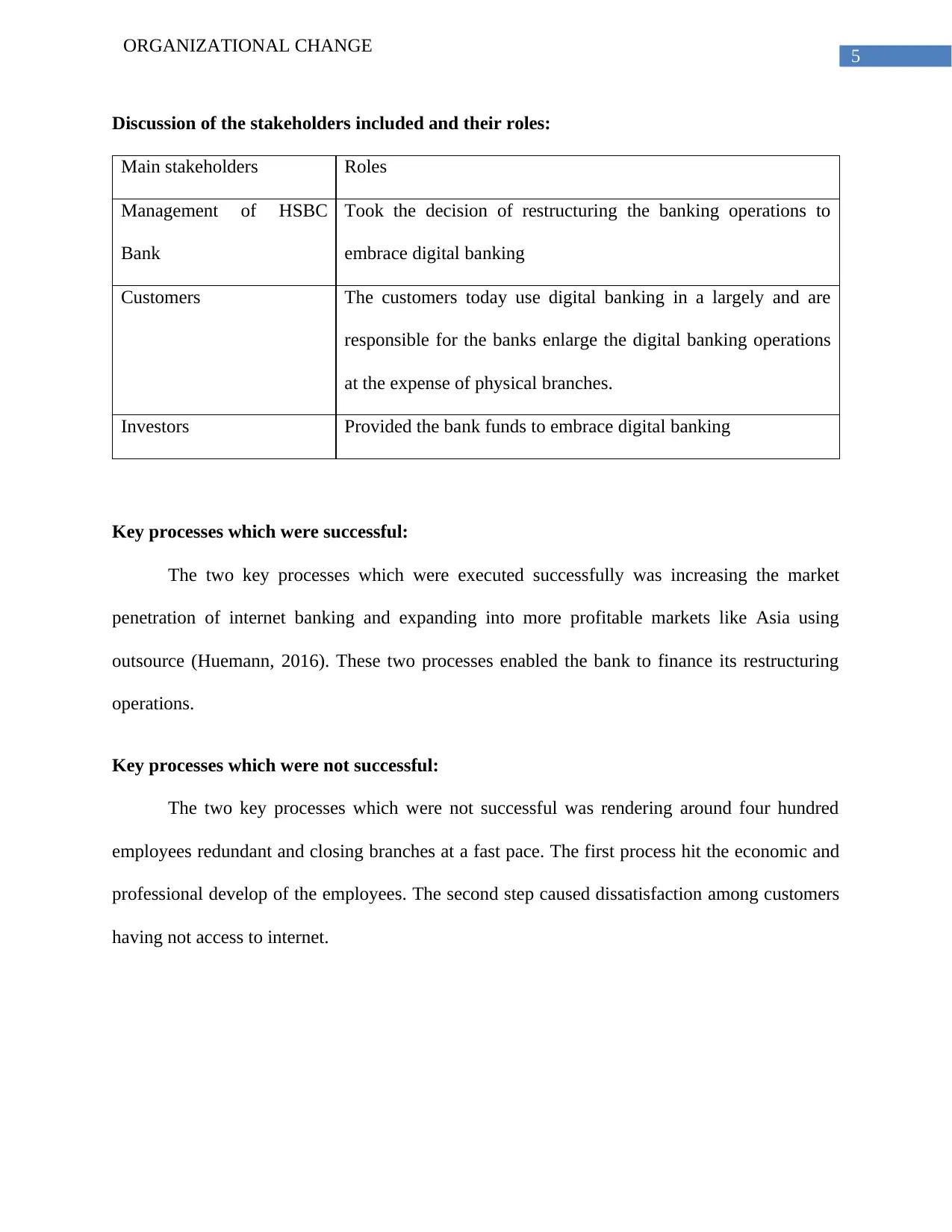
Discussion of the stakeholders included and their roles:
Main stakeholders Roles
Management of HSBC
Bank
Took the decision of restructuring the banking operations to
embrace digital banking
Customers The customers today use digital banking in a largely and are
responsible for the banks enlarge the digital banking operations
at the expense of physical branches.
Investors Provided the bank funds to embrace digital banking
Key processes which were successful:
The two key processes which were executed successfully was increasing the market
penetration of internet banking and expanding into more profitable markets like Asia using
outsource (Huemann, 2016). These two processes enabled the bank to finance its restructuring
operations.
Key processes which were not successful:
The two key processes which were not successful was rendering around four hundred
employees redundant and closing branches at a fast pace. The first process hit the economic and
professional develop of the employees. The second step caused dissatisfaction among customers
having not access to internet.
ORGANIZATIONAL CHANGE
Discussion of the stakeholders included and their roles:
Main stakeholders Roles
Management of HSBC
Bank
Took the decision of restructuring the banking operations to
embrace digital banking
Customers The customers today use digital banking in a largely and are
responsible for the banks enlarge the digital banking operations
at the expense of physical branches.
Investors Provided the bank funds to embrace digital banking
Key processes which were successful:
The two key processes which were executed successfully was increasing the market
penetration of internet banking and expanding into more profitable markets like Asia using
outsource (Huemann, 2016). These two processes enabled the bank to finance its restructuring
operations.
Key processes which were not successful:
The two key processes which were not successful was rendering around four hundred
employees redundant and closing branches at a fast pace. The first process hit the economic and
professional develop of the employees. The second step caused dissatisfaction among customers
having not access to internet.
⊘ This is a preview!⊘
Do you want full access?
Subscribe today to unlock all pages.
Trusted by 1+ million students worldwide
6
ORGANIZATIONAL CHANGE
Suggestions to the company to achieve successful change in the future:
It could be suggested to the management of HSBC Bank that they should reinstate the
redundant employees in the new branches. The second which could be offered to the bank is that
it should be responsible towards securing the accounts of its investors from data thefts.
Conclusion:
It could be concluded from the discussion that the restructuring of HSBC Bank is
successful. It is evident from the fact that the bank is able to mobilise financial resources worth
billions of pounds on real time basis.
ORGANIZATIONAL CHANGE
Suggestions to the company to achieve successful change in the future:
It could be suggested to the management of HSBC Bank that they should reinstate the
redundant employees in the new branches. The second which could be offered to the bank is that
it should be responsible towards securing the accounts of its investors from data thefts.
Conclusion:
It could be concluded from the discussion that the restructuring of HSBC Bank is
successful. It is evident from the fact that the bank is able to mobilise financial resources worth
billions of pounds on real time basis.
Paraphrase This Document
Need a fresh take? Get an instant paraphrase of this document with our AI Paraphraser
7
ORGANIZATIONAL CHANGE
References:
Cameron, E., & Green, M. (2015). Making sense of change management: A complete guide to
the models, tools and techniques of organizational change. Kogan Page Publishers.
Graupner, E., Melcher, F., Demers, D., & Maedche, A. (2015, May). Customers' Intention to Use
Digital Services in Retail Banking-An Information Processing Perspective. In ECIS.
Heyden, M. L., Fourné, S. P., Koene, B. A., Werkman, R., & Ansari, S. (2017). Rethinking ‘top‐
down’and ‘bottom‐up’roles of top and middle managers in organizational change:
Implications for employee support. Journal of Management Studies, 54(7), 961-985.
Hsbc.com | HSBC Holdings plc. (2018). Retrieved from https://www.hsbc.com/
Huemann, M. (2016). Human resource management in the project-oriented organization: towards
a viable system for project personnel. Routledge.
Johnson, P., & Szamosi, L. T. (2018). HRM in changing organizational contexts. In Human
resource management (pp. 27-48). Routledge.
Khrais, L. T. (2015). Highlighting the vulnerabilities of online banking system. The Journal of
Internet Banking and Commerce, 20(3).
Reuters.com. (2018). Retrieved from https://www.reuters.com/article/us-hsbc-jobs/hsbc-to-close-
117-branches-in-britain-cut-380-jobs-idUSKBN1581IC
Theguardian.com. (2018). Theguardian.com. Retrieved from
https://www.theguardian.com/business/2017/jan/24/hsbc-close-branches-online-banking-
unions-jobs
ORGANIZATIONAL CHANGE
References:
Cameron, E., & Green, M. (2015). Making sense of change management: A complete guide to
the models, tools and techniques of organizational change. Kogan Page Publishers.
Graupner, E., Melcher, F., Demers, D., & Maedche, A. (2015, May). Customers' Intention to Use
Digital Services in Retail Banking-An Information Processing Perspective. In ECIS.
Heyden, M. L., Fourné, S. P., Koene, B. A., Werkman, R., & Ansari, S. (2017). Rethinking ‘top‐
down’and ‘bottom‐up’roles of top and middle managers in organizational change:
Implications for employee support. Journal of Management Studies, 54(7), 961-985.
Hsbc.com | HSBC Holdings plc. (2018). Retrieved from https://www.hsbc.com/
Huemann, M. (2016). Human resource management in the project-oriented organization: towards
a viable system for project personnel. Routledge.
Johnson, P., & Szamosi, L. T. (2018). HRM in changing organizational contexts. In Human
resource management (pp. 27-48). Routledge.
Khrais, L. T. (2015). Highlighting the vulnerabilities of online banking system. The Journal of
Internet Banking and Commerce, 20(3).
Reuters.com. (2018). Retrieved from https://www.reuters.com/article/us-hsbc-jobs/hsbc-to-close-
117-branches-in-britain-cut-380-jobs-idUSKBN1581IC
Theguardian.com. (2018). Theguardian.com. Retrieved from
https://www.theguardian.com/business/2017/jan/24/hsbc-close-branches-online-banking-
unions-jobs

8
ORGANIZATIONAL CHANGE
ORGANIZATIONAL CHANGE
⊘ This is a preview!⊘
Do you want full access?
Subscribe today to unlock all pages.
Trusted by 1+ million students worldwide

1 out of 9


Your All-in-One AI-Powered Toolkit for Academic Success.
+13062052269
info@desklib.com
Available 24*7 on WhatsApp / Email
![[object Object]](/_next/static/media/star-bottom.7253800d.svg)
Unlock your academic potential
Copyright © 2020–2026 A2Z Services. All Rights Reserved. Developed and managed by ZUCOL.