Analysis of HSBC's Customer Engagement and Retention Strategies
VerifiedAdded on 2020/12/18
|50
|18341
|303
Report
AI Summary
This report analyzes the issue of decreasing customer engagement within the banking sector, using HSBC as a case study. The executive summary highlights the problem of declining client engagement due to factors such as lower interest rates and competition from alternative financial instruments. The report delves into the background of HSBC, the problem statement, and the conceptual framework, outlining research objectives and questions. The literature review examines customer engagement in banking, its benefits, and the impact of its absence, while also exploring the reasons behind the decline and potential solutions. The methodology section details the research design, philosophy, and data collection methods. The data analysis and findings section present the results of both primary and secondary research. Finally, the report concludes with recommendations for HSBC to improve customer engagement, including strategies like using innovative technology, analyzing the customer journey, and regular communication to address client issues and queries, aiming to enhance satisfaction and retention.

Finance and
Management
Management

Paraphrase This Document
Need a fresh take? Get an instant paraphrase of this document with our AI Paraphraser
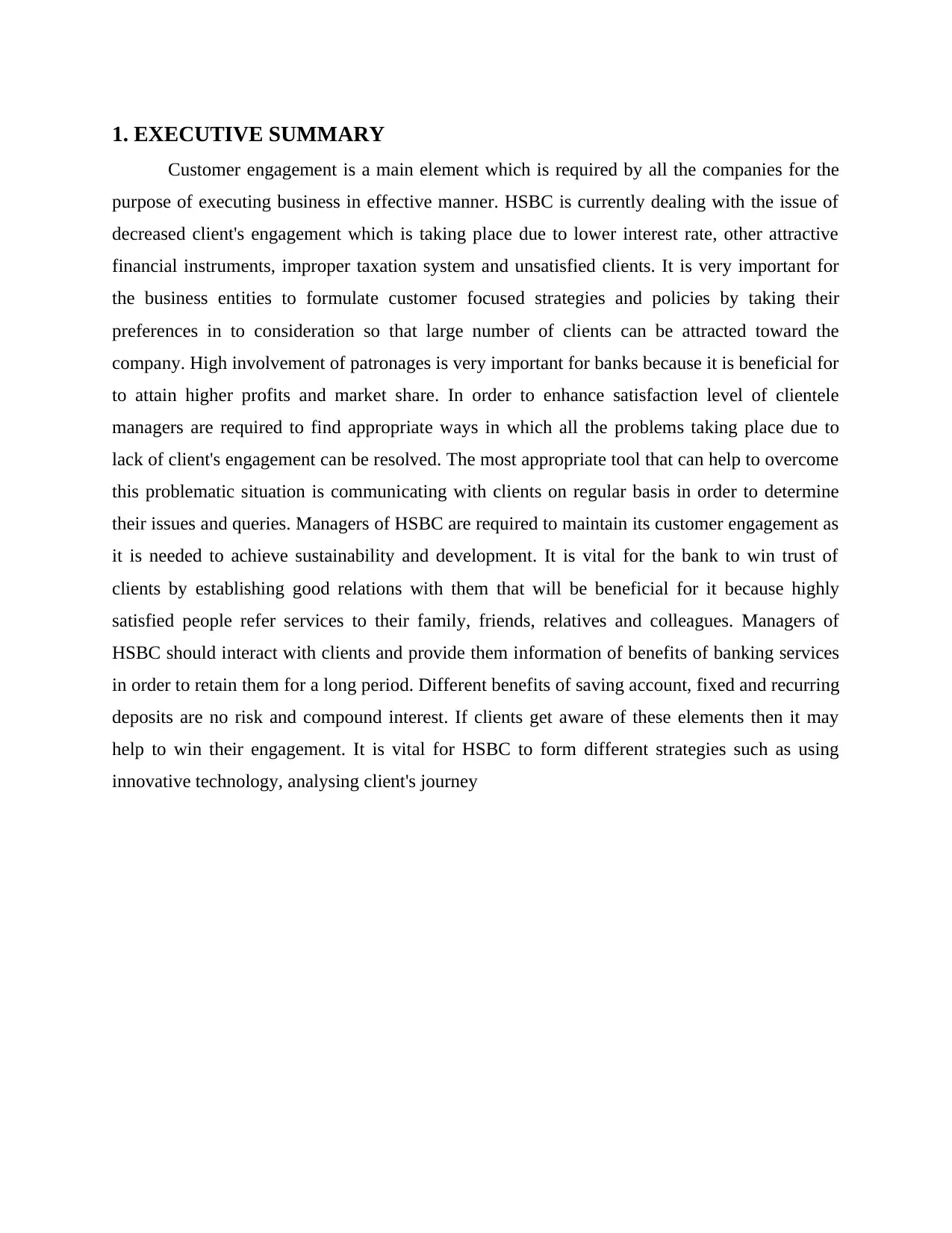
1. EXECUTIVE SUMMARY
Customer engagement is a main element which is required by all the companies for the
purpose of executing business in effective manner. HSBC is currently dealing with the issue of
decreased client's engagement which is taking place due to lower interest rate, other attractive
financial instruments, improper taxation system and unsatisfied clients. It is very important for
the business entities to formulate customer focused strategies and policies by taking their
preferences in to consideration so that large number of clients can be attracted toward the
company. High involvement of patronages is very important for banks because it is beneficial for
to attain higher profits and market share. In order to enhance satisfaction level of clientele
managers are required to find appropriate ways in which all the problems taking place due to
lack of client's engagement can be resolved. The most appropriate tool that can help to overcome
this problematic situation is communicating with clients on regular basis in order to determine
their issues and queries. Managers of HSBC are required to maintain its customer engagement as
it is needed to achieve sustainability and development. It is vital for the bank to win trust of
clients by establishing good relations with them that will be beneficial for it because highly
satisfied people refer services to their family, friends, relatives and colleagues. Managers of
HSBC should interact with clients and provide them information of benefits of banking services
in order to retain them for a long period. Different benefits of saving account, fixed and recurring
deposits are no risk and compound interest. If clients get aware of these elements then it may
help to win their engagement. It is vital for HSBC to form different strategies such as using
innovative technology, analysing client's journey
Customer engagement is a main element which is required by all the companies for the
purpose of executing business in effective manner. HSBC is currently dealing with the issue of
decreased client's engagement which is taking place due to lower interest rate, other attractive
financial instruments, improper taxation system and unsatisfied clients. It is very important for
the business entities to formulate customer focused strategies and policies by taking their
preferences in to consideration so that large number of clients can be attracted toward the
company. High involvement of patronages is very important for banks because it is beneficial for
to attain higher profits and market share. In order to enhance satisfaction level of clientele
managers are required to find appropriate ways in which all the problems taking place due to
lack of client's engagement can be resolved. The most appropriate tool that can help to overcome
this problematic situation is communicating with clients on regular basis in order to determine
their issues and queries. Managers of HSBC are required to maintain its customer engagement as
it is needed to achieve sustainability and development. It is vital for the bank to win trust of
clients by establishing good relations with them that will be beneficial for it because highly
satisfied people refer services to their family, friends, relatives and colleagues. Managers of
HSBC should interact with clients and provide them information of benefits of banking services
in order to retain them for a long period. Different benefits of saving account, fixed and recurring
deposits are no risk and compound interest. If clients get aware of these elements then it may
help to win their engagement. It is vital for HSBC to form different strategies such as using
innovative technology, analysing client's journey
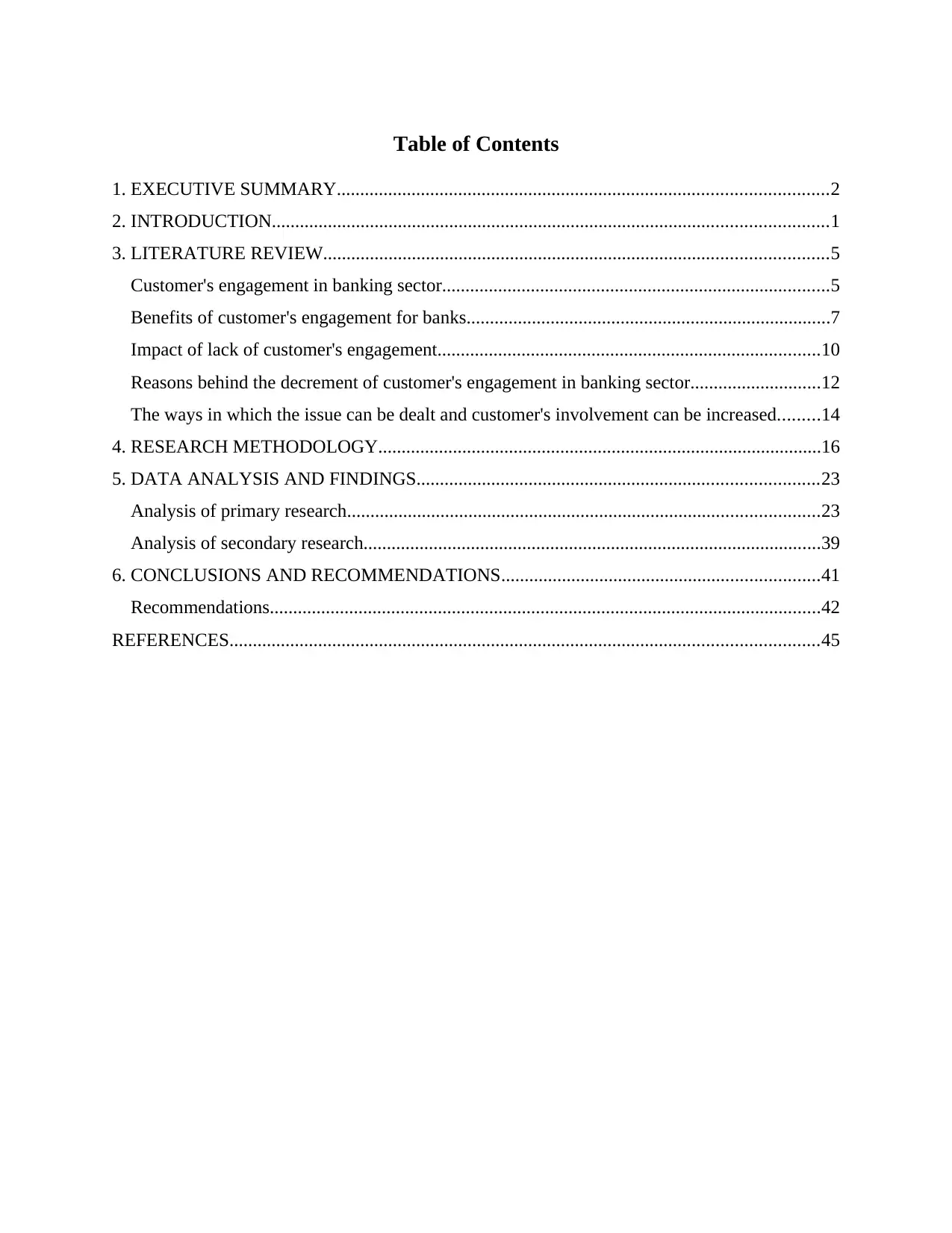
Table of Contents
1. EXECUTIVE SUMMARY.........................................................................................................2
2. INTRODUCTION.......................................................................................................................1
3. LITERATURE REVIEW............................................................................................................5
Customer's engagement in banking sector...................................................................................5
Benefits of customer's engagement for banks..............................................................................7
Impact of lack of customer's engagement..................................................................................10
Reasons behind the decrement of customer's engagement in banking sector............................12
The ways in which the issue can be dealt and customer's involvement can be increased.........14
4. RESEARCH METHODOLOGY...............................................................................................16
5. DATA ANALYSIS AND FINDINGS......................................................................................23
Analysis of primary research.....................................................................................................23
Analysis of secondary research..................................................................................................39
6. CONCLUSIONS AND RECOMMENDATIONS....................................................................41
Recommendations......................................................................................................................42
REFERENCES..............................................................................................................................45
1. EXECUTIVE SUMMARY.........................................................................................................2
2. INTRODUCTION.......................................................................................................................1
3. LITERATURE REVIEW............................................................................................................5
Customer's engagement in banking sector...................................................................................5
Benefits of customer's engagement for banks..............................................................................7
Impact of lack of customer's engagement..................................................................................10
Reasons behind the decrement of customer's engagement in banking sector............................12
The ways in which the issue can be dealt and customer's involvement can be increased.........14
4. RESEARCH METHODOLOGY...............................................................................................16
5. DATA ANALYSIS AND FINDINGS......................................................................................23
Analysis of primary research.....................................................................................................23
Analysis of secondary research..................................................................................................39
6. CONCLUSIONS AND RECOMMENDATIONS....................................................................41
Recommendations......................................................................................................................42
REFERENCES..............................................................................................................................45
⊘ This is a preview!⊘
Do you want full access?
Subscribe today to unlock all pages.

Trusted by 1+ million students worldwide
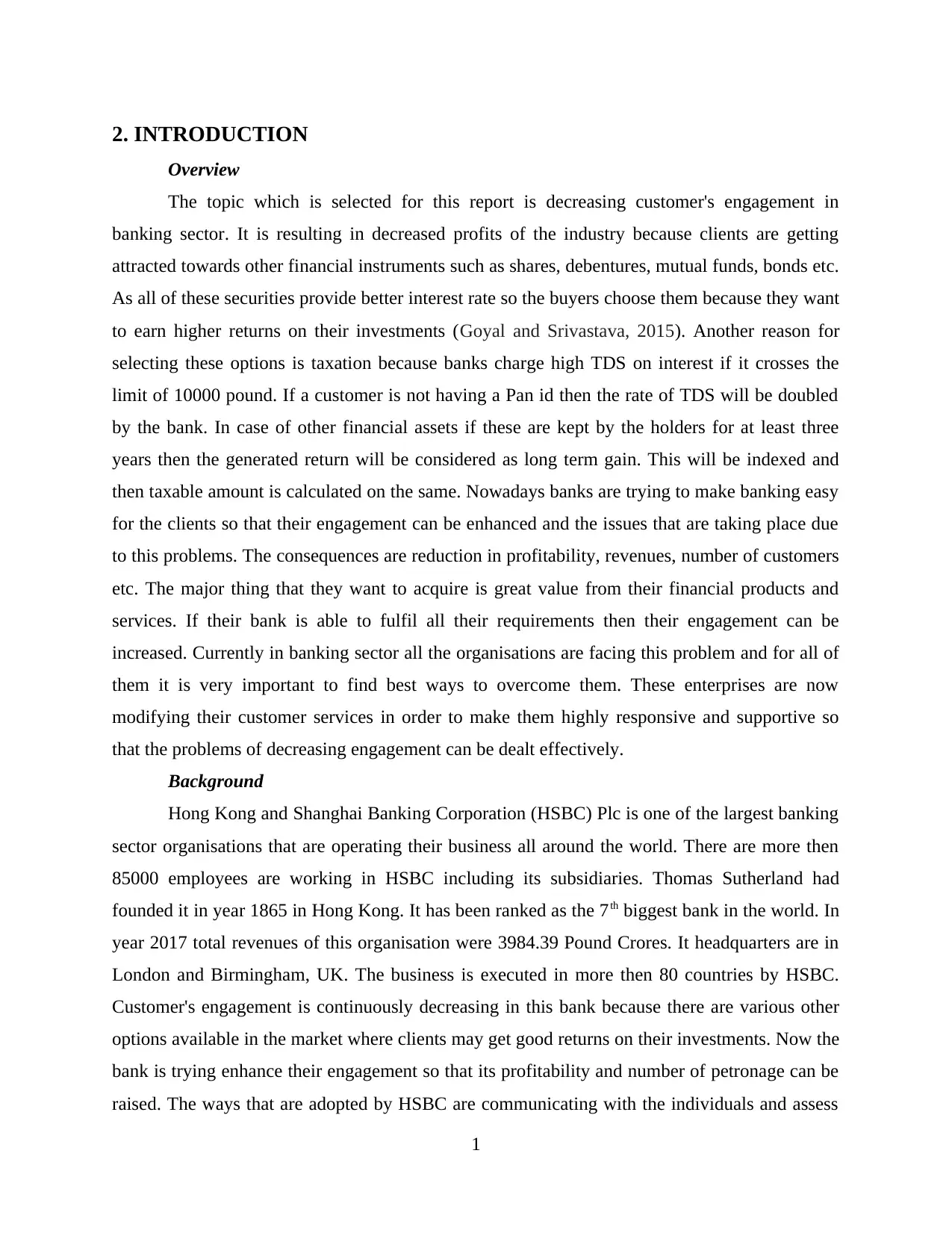
2. INTRODUCTION
Overview
The topic which is selected for this report is decreasing customer's engagement in
banking sector. It is resulting in decreased profits of the industry because clients are getting
attracted towards other financial instruments such as shares, debentures, mutual funds, bonds etc.
As all of these securities provide better interest rate so the buyers choose them because they want
to earn higher returns on their investments (Goyal and Srivastava, 2015). Another reason for
selecting these options is taxation because banks charge high TDS on interest if it crosses the
limit of 10000 pound. If a customer is not having a Pan id then the rate of TDS will be doubled
by the bank. In case of other financial assets if these are kept by the holders for at least three
years then the generated return will be considered as long term gain. This will be indexed and
then taxable amount is calculated on the same. Nowadays banks are trying to make banking easy
for the clients so that their engagement can be enhanced and the issues that are taking place due
to this problems. The consequences are reduction in profitability, revenues, number of customers
etc. The major thing that they want to acquire is great value from their financial products and
services. If their bank is able to fulfil all their requirements then their engagement can be
increased. Currently in banking sector all the organisations are facing this problem and for all of
them it is very important to find best ways to overcome them. These enterprises are now
modifying their customer services in order to make them highly responsive and supportive so
that the problems of decreasing engagement can be dealt effectively.
Background
Hong Kong and Shanghai Banking Corporation (HSBC) Plc is one of the largest banking
sector organisations that are operating their business all around the world. There are more then
85000 employees are working in HSBC including its subsidiaries. Thomas Sutherland had
founded it in year 1865 in Hong Kong. It has been ranked as the 7th biggest bank in the world. In
year 2017 total revenues of this organisation were 3984.39 Pound Crores. It headquarters are in
London and Birmingham, UK. The business is executed in more then 80 countries by HSBC.
Customer's engagement is continuously decreasing in this bank because there are various other
options available in the market where clients may get good returns on their investments. Now the
bank is trying enhance their engagement so that its profitability and number of petronage can be
raised. The ways that are adopted by HSBC are communicating with the individuals and assess
1
Overview
The topic which is selected for this report is decreasing customer's engagement in
banking sector. It is resulting in decreased profits of the industry because clients are getting
attracted towards other financial instruments such as shares, debentures, mutual funds, bonds etc.
As all of these securities provide better interest rate so the buyers choose them because they want
to earn higher returns on their investments (Goyal and Srivastava, 2015). Another reason for
selecting these options is taxation because banks charge high TDS on interest if it crosses the
limit of 10000 pound. If a customer is not having a Pan id then the rate of TDS will be doubled
by the bank. In case of other financial assets if these are kept by the holders for at least three
years then the generated return will be considered as long term gain. This will be indexed and
then taxable amount is calculated on the same. Nowadays banks are trying to make banking easy
for the clients so that their engagement can be enhanced and the issues that are taking place due
to this problems. The consequences are reduction in profitability, revenues, number of customers
etc. The major thing that they want to acquire is great value from their financial products and
services. If their bank is able to fulfil all their requirements then their engagement can be
increased. Currently in banking sector all the organisations are facing this problem and for all of
them it is very important to find best ways to overcome them. These enterprises are now
modifying their customer services in order to make them highly responsive and supportive so
that the problems of decreasing engagement can be dealt effectively.
Background
Hong Kong and Shanghai Banking Corporation (HSBC) Plc is one of the largest banking
sector organisations that are operating their business all around the world. There are more then
85000 employees are working in HSBC including its subsidiaries. Thomas Sutherland had
founded it in year 1865 in Hong Kong. It has been ranked as the 7th biggest bank in the world. In
year 2017 total revenues of this organisation were 3984.39 Pound Crores. It headquarters are in
London and Birmingham, UK. The business is executed in more then 80 countries by HSBC.
Customer's engagement is continuously decreasing in this bank because there are various other
options available in the market where clients may get good returns on their investments. Now the
bank is trying enhance their engagement so that its profitability and number of petronage can be
raised. The ways that are adopted by HSBC are communicating with the individuals and assess
1
Paraphrase This Document
Need a fresh take? Get an instant paraphrase of this document with our AI Paraphraser
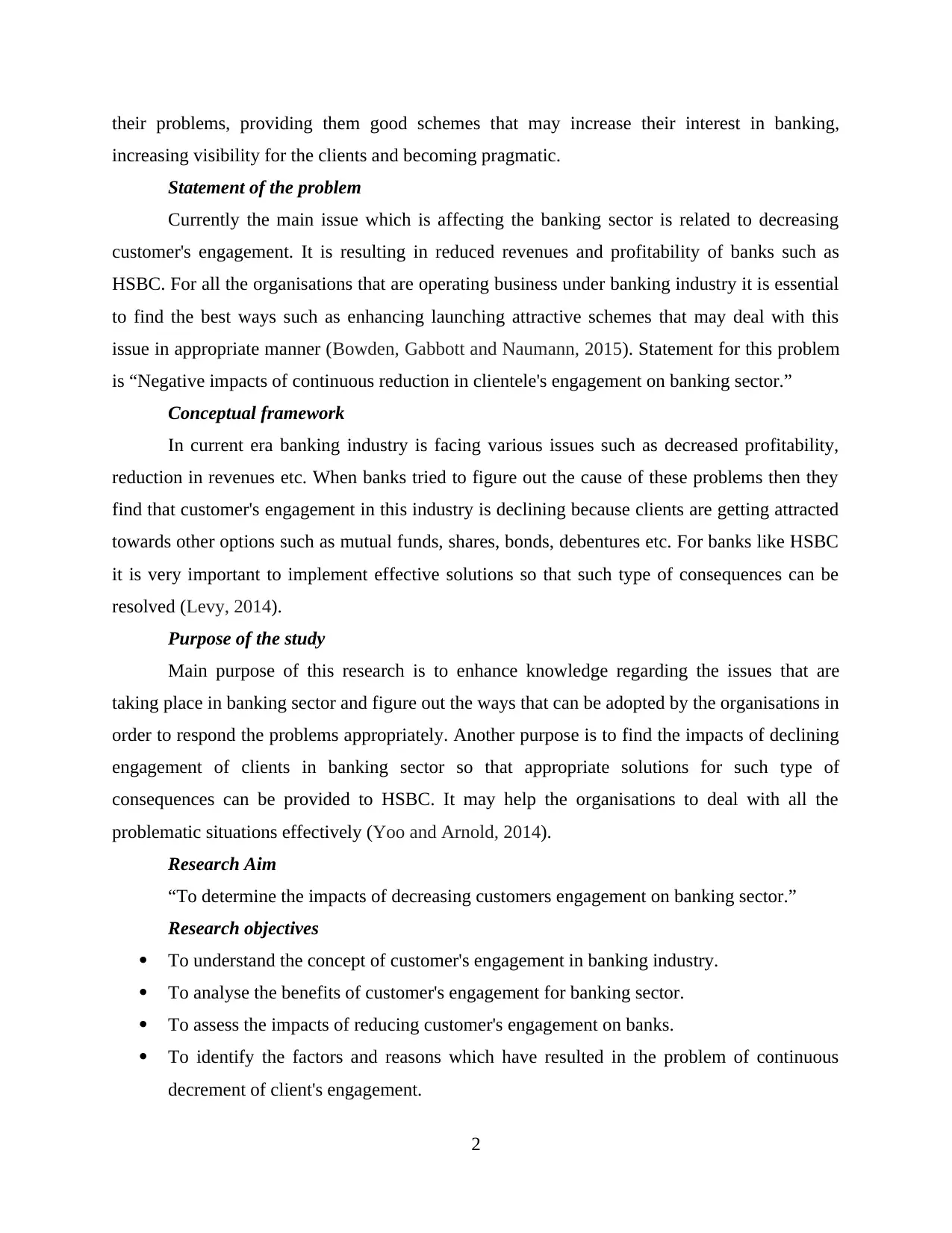
their problems, providing them good schemes that may increase their interest in banking,
increasing visibility for the clients and becoming pragmatic.
Statement of the problem
Currently the main issue which is affecting the banking sector is related to decreasing
customer's engagement. It is resulting in reduced revenues and profitability of banks such as
HSBC. For all the organisations that are operating business under banking industry it is essential
to find the best ways such as enhancing launching attractive schemes that may deal with this
issue in appropriate manner (Bowden, Gabbott and Naumann, 2015). Statement for this problem
is “Negative impacts of continuous reduction in clientele's engagement on banking sector.”
Conceptual framework
In current era banking industry is facing various issues such as decreased profitability,
reduction in revenues etc. When banks tried to figure out the cause of these problems then they
find that customer's engagement in this industry is declining because clients are getting attracted
towards other options such as mutual funds, shares, bonds, debentures etc. For banks like HSBC
it is very important to implement effective solutions so that such type of consequences can be
resolved (Levy, 2014).
Purpose of the study
Main purpose of this research is to enhance knowledge regarding the issues that are
taking place in banking sector and figure out the ways that can be adopted by the organisations in
order to respond the problems appropriately. Another purpose is to find the impacts of declining
engagement of clients in banking sector so that appropriate solutions for such type of
consequences can be provided to HSBC. It may help the organisations to deal with all the
problematic situations effectively (Yoo and Arnold, 2014).
Research Aim
“To determine the impacts of decreasing customers engagement on banking sector.”
Research objectives
To understand the concept of customer's engagement in banking industry.
To analyse the benefits of customer's engagement for banking sector.
To assess the impacts of reducing customer's engagement on banks.
To identify the factors and reasons which have resulted in the problem of continuous
decrement of client's engagement.
2
increasing visibility for the clients and becoming pragmatic.
Statement of the problem
Currently the main issue which is affecting the banking sector is related to decreasing
customer's engagement. It is resulting in reduced revenues and profitability of banks such as
HSBC. For all the organisations that are operating business under banking industry it is essential
to find the best ways such as enhancing launching attractive schemes that may deal with this
issue in appropriate manner (Bowden, Gabbott and Naumann, 2015). Statement for this problem
is “Negative impacts of continuous reduction in clientele's engagement on banking sector.”
Conceptual framework
In current era banking industry is facing various issues such as decreased profitability,
reduction in revenues etc. When banks tried to figure out the cause of these problems then they
find that customer's engagement in this industry is declining because clients are getting attracted
towards other options such as mutual funds, shares, bonds, debentures etc. For banks like HSBC
it is very important to implement effective solutions so that such type of consequences can be
resolved (Levy, 2014).
Purpose of the study
Main purpose of this research is to enhance knowledge regarding the issues that are
taking place in banking sector and figure out the ways that can be adopted by the organisations in
order to respond the problems appropriately. Another purpose is to find the impacts of declining
engagement of clients in banking sector so that appropriate solutions for such type of
consequences can be provided to HSBC. It may help the organisations to deal with all the
problematic situations effectively (Yoo and Arnold, 2014).
Research Aim
“To determine the impacts of decreasing customers engagement on banking sector.”
Research objectives
To understand the concept of customer's engagement in banking industry.
To analyse the benefits of customer's engagement for banking sector.
To assess the impacts of reducing customer's engagement on banks.
To identify the factors and reasons which have resulted in the problem of continuous
decrement of client's engagement.
2
To evaluate the ways that may help banks to overcome the issue and enhance customer's
engagement.
Research Questions
What is engagement of customer's in banking industry?
Is there any benefit of customer's engagement for banks?
Do lack of client's engagement leave impact on banks?
Why decrement of customer's engagement is taking place in banking industry?
What are the ways that may help banks to deal with the issue and increase involvement of
customers?
Key terms
There are various types of key terms that are going to be discussed by the researcher in
this research. All of them are as follows:
Customers: These are the individuals who buy goods or services from a particular
organisation. In this research customers are the buyers of bank's products such as fixed
deposit, saving accounts etc.
Customer's engagement: It is a communication connection between customer and an
organisation. For banks like HSBC and other financial institutions it is very important to
enhance patronage's engagement so that their long as well as short term goals can be
achieved (Thakur, 2016).
Banking sector: It is a part of the economy which is responsible for rendering financial
services to the individuals. Different types of assets such as CASA (Current and Saving
Accounts), Fixed deposits etc. HSBC is a part of banking industry which is facing issues
regarding lack of customer's engagement (Pick, 2014). Financial instruments: All the securities that are offered by finance and banking sector
are considered as financial instruments. These are shares, debentures, mutual funds,
bonds etc. All of them are bought by the customers in order to achieve higher returns on
their investments (Rezghi Rostami, Valmohammadi and Yousefpoor, 2014).
Procedure
In order to successfully complete the study different types of procedures and
methodologies are going to be used by the researcher. The research design which is used in this
report is descriptive. Research philosophy for this assignment is interpretivism and the approach
3
engagement.
Research Questions
What is engagement of customer's in banking industry?
Is there any benefit of customer's engagement for banks?
Do lack of client's engagement leave impact on banks?
Why decrement of customer's engagement is taking place in banking industry?
What are the ways that may help banks to deal with the issue and increase involvement of
customers?
Key terms
There are various types of key terms that are going to be discussed by the researcher in
this research. All of them are as follows:
Customers: These are the individuals who buy goods or services from a particular
organisation. In this research customers are the buyers of bank's products such as fixed
deposit, saving accounts etc.
Customer's engagement: It is a communication connection between customer and an
organisation. For banks like HSBC and other financial institutions it is very important to
enhance patronage's engagement so that their long as well as short term goals can be
achieved (Thakur, 2016).
Banking sector: It is a part of the economy which is responsible for rendering financial
services to the individuals. Different types of assets such as CASA (Current and Saving
Accounts), Fixed deposits etc. HSBC is a part of banking industry which is facing issues
regarding lack of customer's engagement (Pick, 2014). Financial instruments: All the securities that are offered by finance and banking sector
are considered as financial instruments. These are shares, debentures, mutual funds,
bonds etc. All of them are bought by the customers in order to achieve higher returns on
their investments (Rezghi Rostami, Valmohammadi and Yousefpoor, 2014).
Procedure
In order to successfully complete the study different types of procedures and
methodologies are going to be used by the researcher. The research design which is used in this
report is descriptive. Research philosophy for this assignment is interpretivism and the approach
3
⊘ This is a preview!⊘
Do you want full access?
Subscribe today to unlock all pages.
Trusted by 1+ million students worldwide

which is used is inductive. The researcher has used primary as well as secondary data for the
purpose of appropriate research. Questionnaires are used to collect primary data and different
types of websites are used to get secondary information (Mohan, Mathur and Reddy, 2015).
Significance
This research will help the readers to enhance their knowledge regarding the issue of
decreasing customer's engagement which is faced by banking sector in current era. It will
provide detailed information of the solutions that can be used by the banks such as HSBC to
overcome the situation.
Limitations
While collecting primary data the researcher have faced various limitations such as the
employees of HSBC were not ready to provide them information, the data which is collected can
be biased because the workers are not allowed to share private content or internal information.
Organisation of the study
This research is organised in different subsections and all of them are as follows:
Introduction: In this section the researcher has provided basic information regarding the
issue which is faced by HSBC Plc. The problem is lack of customer's engagement in banking
sector. It is also creating other issues such as reduction in profitability and liquidity of the
organisation.
Literature review: Point of views of different persons regarding the topics are
considered in this section. It helps the researcher to conduct an appropriate research and provide
effective information to the readers. The data which is recorded in literature review is based on
current knowledge that includes substantive findings (King, 2014).
Research methodology: In this section information regarding research approach, design,
philosophy and methods of data collection is recorded. In this report descriptive design,
inductive approach, primary and secondary sources of information are used by the researcher.
Data analysis: It is the process of inspecting, cleansing, modelling and transforming
appropriate information which is collected from different sources such as primary or secondary.
Primary data is collected from questionnaires, interviews, survey etc. and secondary is received
from online sources, websites, books and journals.
Conclusion and recommendations: It is the last section of the research in which
research add a summary of the report and the conclusion of the report. Recommendations
4
purpose of appropriate research. Questionnaires are used to collect primary data and different
types of websites are used to get secondary information (Mohan, Mathur and Reddy, 2015).
Significance
This research will help the readers to enhance their knowledge regarding the issue of
decreasing customer's engagement which is faced by banking sector in current era. It will
provide detailed information of the solutions that can be used by the banks such as HSBC to
overcome the situation.
Limitations
While collecting primary data the researcher have faced various limitations such as the
employees of HSBC were not ready to provide them information, the data which is collected can
be biased because the workers are not allowed to share private content or internal information.
Organisation of the study
This research is organised in different subsections and all of them are as follows:
Introduction: In this section the researcher has provided basic information regarding the
issue which is faced by HSBC Plc. The problem is lack of customer's engagement in banking
sector. It is also creating other issues such as reduction in profitability and liquidity of the
organisation.
Literature review: Point of views of different persons regarding the topics are
considered in this section. It helps the researcher to conduct an appropriate research and provide
effective information to the readers. The data which is recorded in literature review is based on
current knowledge that includes substantive findings (King, 2014).
Research methodology: In this section information regarding research approach, design,
philosophy and methods of data collection is recorded. In this report descriptive design,
inductive approach, primary and secondary sources of information are used by the researcher.
Data analysis: It is the process of inspecting, cleansing, modelling and transforming
appropriate information which is collected from different sources such as primary or secondary.
Primary data is collected from questionnaires, interviews, survey etc. and secondary is received
from online sources, websites, books and journals.
Conclusion and recommendations: It is the last section of the research in which
research add a summary of the report and the conclusion of the report. Recommendations
4
Paraphrase This Document
Need a fresh take? Get an instant paraphrase of this document with our AI Paraphraser
regarding the solution which should be selected by the organisation in order to deal with the
problems are also going to be provided at the end of the report. This section may guide the
observers to get brief information of the whole research and the conclusion which is provided by
the researcher after completing the report.
3. LITERATURE REVIEW
Literature review includes the current knowledge and findings that are analysed by the
researcher. It is the theoretical and methodological contributions to a particular topic chosen to
complete the research. In this section answers for the research questions are founded. The
answers are provided from the point of view of different authors who have already studied the
topic and provided their judgement. It is a method which helps to find out solutions for the
research problems. The researcher is going to find the appropriate answers for all the research
questions that are formed earlier (Indrianti, 2016).
Customer's engagement in banking sector
As per the views of Wang and Kim, (2017) Customer's engagement is a process of
keeping customers engaged in the organisational activities so that all the operational activities
can be conducted in appropriate manner. For all the banking sector companies it is vital to keep
all the clients engaged in order to generate high revenues. If the organisations which are
operating business under baking industry are not able to engage customers in their activities then
it is not possible for them to attain long term sustainability in the organisation (Kandampully,
Zhang and Bilgihan, 2015).
According to Pansari and Kumar, (2017) customer's engagement can be defined as the
way of communication and maintaining relations with the clients by providing them such
services that may garb their attention. For all the banks like HSBC it is very important to
enhance engagement of customers so that other problems such reduction in profits and liquidity
that are taking place due to this issue can be controlled. If an organisation which is operating its
business under banking sector is not able to manage the involvement of them then it is not
possible for that enterprise to sustain in the market. When there are no clients then it is
impossible to operate business without them. Customers that are highly engaged, helps to
increase revenues as they buy more and also promotes if they are satisfied with the services. In
banking sector client's involvement is very important because if there are no clientele then it will
5
problems are also going to be provided at the end of the report. This section may guide the
observers to get brief information of the whole research and the conclusion which is provided by
the researcher after completing the report.
3. LITERATURE REVIEW
Literature review includes the current knowledge and findings that are analysed by the
researcher. It is the theoretical and methodological contributions to a particular topic chosen to
complete the research. In this section answers for the research questions are founded. The
answers are provided from the point of view of different authors who have already studied the
topic and provided their judgement. It is a method which helps to find out solutions for the
research problems. The researcher is going to find the appropriate answers for all the research
questions that are formed earlier (Indrianti, 2016).
Customer's engagement in banking sector
As per the views of Wang and Kim, (2017) Customer's engagement is a process of
keeping customers engaged in the organisational activities so that all the operational activities
can be conducted in appropriate manner. For all the banking sector companies it is vital to keep
all the clients engaged in order to generate high revenues. If the organisations which are
operating business under baking industry are not able to engage customers in their activities then
it is not possible for them to attain long term sustainability in the organisation (Kandampully,
Zhang and Bilgihan, 2015).
According to Pansari and Kumar, (2017) customer's engagement can be defined as the
way of communication and maintaining relations with the clients by providing them such
services that may garb their attention. For all the banks like HSBC it is very important to
enhance engagement of customers so that other problems such reduction in profits and liquidity
that are taking place due to this issue can be controlled. If an organisation which is operating its
business under banking sector is not able to manage the involvement of them then it is not
possible for that enterprise to sustain in the market. When there are no clients then it is
impossible to operate business without them. Customers that are highly engaged, helps to
increase revenues as they buy more and also promotes if they are satisfied with the services. In
banking sector client's involvement is very important because if there are no clientele then it will
5
become difficult to execute operational activities and generate profits. Needs and demands
always changes with time and technology (Tojib and Khajehzadeh, 2017). Patronages always
look for something new and interesting and in service sector it is difficult to make changes and
launch a innovative services according to their needs. It directly affect their engagement as their
satisfaction level decreases. Currently competition in banking and finance sector is increasing
and creating challenges for the organisations. For banks like HSBC it is very important to form
customer focused strategies so that they can be retained and level of their involvement get
enhanced. It will be beneficial for the enterprise as it can help to achieve competitive advantage
and deal with competitors appropriately.
According to Hapsari, Clemes and Dean, (2017) Customer engagement in banking
industry can be defined as the interaction between customer and the organisations regarding the
services that are offered by it. Currently banks like HSBC are facing the issue of lack of
customer's engagement because of other financial instruments that provides them higher returns
on their investments. When clients are highly satisfied and get effective responses on their
queries by the banks then it results in their engagement in organisational schemes. It is essential
for banks to maintain involvement of customers so that operational activities can be executed
without any issue (Shukla, Banerjee and Singh, 2016). Higher engagement results in good
profitability and liquidity because clients will buy more and more services if the organisations
are offering them good deals. It describes the means which is used by enterprises to foster
relationship with their prospects and customers. As banking business runs on good relations so if
banks are willing to enhance customer's engagement then it is very important to maintain them.
When there is a positive bond between a client and the bank then it would be beneficial for the
entity as it may result in higher profitability. It can be established by interacting with them and
taking feedback on regular basis as it is beneficial while trying to know about the requirements
of clients. In banking industry maintaining good relations is required because in this sector
business runs on relationships.
According to Durkin, Mulholland and McCartan, (2015) in banking industry customer
engagement can be defined as an essential element which is required to operate business
successfully. It is all about encouraging interaction with client's and try to analyse their
experience with the services that are provided by the organisations that are executing business
under banking sector. Effective customer engagement fosters loyalty of clients and lead the
6
always changes with time and technology (Tojib and Khajehzadeh, 2017). Patronages always
look for something new and interesting and in service sector it is difficult to make changes and
launch a innovative services according to their needs. It directly affect their engagement as their
satisfaction level decreases. Currently competition in banking and finance sector is increasing
and creating challenges for the organisations. For banks like HSBC it is very important to form
customer focused strategies so that they can be retained and level of their involvement get
enhanced. It will be beneficial for the enterprise as it can help to achieve competitive advantage
and deal with competitors appropriately.
According to Hapsari, Clemes and Dean, (2017) Customer engagement in banking
industry can be defined as the interaction between customer and the organisations regarding the
services that are offered by it. Currently banks like HSBC are facing the issue of lack of
customer's engagement because of other financial instruments that provides them higher returns
on their investments. When clients are highly satisfied and get effective responses on their
queries by the banks then it results in their engagement in organisational schemes. It is essential
for banks to maintain involvement of customers so that operational activities can be executed
without any issue (Shukla, Banerjee and Singh, 2016). Higher engagement results in good
profitability and liquidity because clients will buy more and more services if the organisations
are offering them good deals. It describes the means which is used by enterprises to foster
relationship with their prospects and customers. As banking business runs on good relations so if
banks are willing to enhance customer's engagement then it is very important to maintain them.
When there is a positive bond between a client and the bank then it would be beneficial for the
entity as it may result in higher profitability. It can be established by interacting with them and
taking feedback on regular basis as it is beneficial while trying to know about the requirements
of clients. In banking industry maintaining good relations is required because in this sector
business runs on relationships.
According to Durkin, Mulholland and McCartan, (2015) in banking industry customer
engagement can be defined as an essential element which is required to operate business
successfully. It is all about encouraging interaction with client's and try to analyse their
experience with the services that are provided by the organisations that are executing business
under banking sector. Effective customer engagement fosters loyalty of clients and lead the
6
⊘ This is a preview!⊘
Do you want full access?
Subscribe today to unlock all pages.
Trusted by 1+ million students worldwide
enterprise towards growth. For banks like HSBC it is a vital substance because when there is no
involvement of clients then it will result in inappropriate business operations. Profitability and
liquidity will also get decreased because the number of customers will be reduced. To maintain
the engagement of them the bank should establish a good connection so that all the queries and
issues regarding the banking services can be resolved (Maslowska, Malthouse and Collinger,
2016). Development in emotional relations, sharing of appropriate information, creating
informational tour to provide content regarding new schemes, implementing latest technology
etc. are the steps that are very helpful while planning to engage customers. Sometimes online
engagement is also very important because it helps banks to be aware of activities of clients and
their choices. There are various ways that can be adopted by HSBC and other banks for better
customer experience which is important to engage them. One of them is being digital in which
new applications can be launch, online visibility can be enhanced. With the help of this solution
basic requirements and issues of clients can be analysed and identified.
According to Mozammel and Haan, (2016) Customer engagement is a tool which is
required for successful execution of a business which is a part of banking industry. If a company
is not having highly engaged clients then it is not possible to achieve business goals such as
customer satisfaction, profit maximisation and development. For all the banks it is vital to make
effective strategies that can help to identify requirements of patronage and then try to offer them
such services that they are willing to buy. It can help to enhance their engagement and resolve
the issues such as decreased profits and liquidity that are taking place due to this situation
(Abdolvand, Baradaran and Albadvi, 2015).
Benefits of customer's engagement for banks
For all the organisations customer's engagement is very important whether it is a part of
banking industry or not. But for banks it is essential because when there is a lack of engagement
of clients then it is not possible for it to operate business operations in appropriate manner.
According to Goyal and Srivastava, (2015) customer's engagement for banks is very
important because it can help to generate good revenues and conduct operation in appropriate
manner. It results in higher profits because clients will buy more and more products that are
offered by bank. When there are highly engaged patronages then brand loyalty of them will also
be high that may help to appropriately operate business and accomplish all the predetermined
goals that are formed previously. For large banks such as HSBC it is very beneficial as it can
7
involvement of clients then it will result in inappropriate business operations. Profitability and
liquidity will also get decreased because the number of customers will be reduced. To maintain
the engagement of them the bank should establish a good connection so that all the queries and
issues regarding the banking services can be resolved (Maslowska, Malthouse and Collinger,
2016). Development in emotional relations, sharing of appropriate information, creating
informational tour to provide content regarding new schemes, implementing latest technology
etc. are the steps that are very helpful while planning to engage customers. Sometimes online
engagement is also very important because it helps banks to be aware of activities of clients and
their choices. There are various ways that can be adopted by HSBC and other banks for better
customer experience which is important to engage them. One of them is being digital in which
new applications can be launch, online visibility can be enhanced. With the help of this solution
basic requirements and issues of clients can be analysed and identified.
According to Mozammel and Haan, (2016) Customer engagement is a tool which is
required for successful execution of a business which is a part of banking industry. If a company
is not having highly engaged clients then it is not possible to achieve business goals such as
customer satisfaction, profit maximisation and development. For all the banks it is vital to make
effective strategies that can help to identify requirements of patronage and then try to offer them
such services that they are willing to buy. It can help to enhance their engagement and resolve
the issues such as decreased profits and liquidity that are taking place due to this situation
(Abdolvand, Baradaran and Albadvi, 2015).
Benefits of customer's engagement for banks
For all the organisations customer's engagement is very important whether it is a part of
banking industry or not. But for banks it is essential because when there is a lack of engagement
of clients then it is not possible for it to operate business operations in appropriate manner.
According to Goyal and Srivastava, (2015) customer's engagement for banks is very
important because it can help to generate good revenues and conduct operation in appropriate
manner. It results in higher profits because clients will buy more and more products that are
offered by bank. When there are highly engaged patronages then brand loyalty of them will also
be high that may help to appropriately operate business and accomplish all the predetermined
goals that are formed previously. For large banks such as HSBC it is very beneficial as it can
7
Paraphrase This Document
Need a fresh take? Get an instant paraphrase of this document with our AI Paraphraser
help them to be position where it is willing to reach. If organisations provide good experience to
the clients then it results in higher satisfaction level of them which is important for customer's
engagement. Another benefits of it are good market image, high rate of employee retention, low
employee turnover, good profits, satisfied clients etc. Banks like HSBC should maintain
customer's engagement as it is required to operate business in appropriate manner. As profits get
declined when clients are not taking interest in banking so it is very important for all the banking
sector organisations to offer such financial products to the clientele that can increase their
satisfaction level. Brand loyal customers always help on mouth publicity because they refer the
services to their friends, family, collogues and other people they know (Dewnarain, Ramkissoon
and Mavondo, 2019). It helps to increase profits that can be used for successful business
execution.
According to Islam and Rahman, (2017) customer's engagement is advantageous for
banks as it enhances loyalty of clients, raise profits, liquidity etc. by increasing number of
customers. Improvement in experience of patronages is vital for all the organisations that are part
of banking industry because it is very difficult to retain customers by rendering them services as
these are intangible in nature. When an enterprise such as HSBC understands the needs and
expectations of clients, encourages their involvement, figure out issues that are resulting in
decreased engagement of them then it can help to successfully operate business. Other benefits
of it are good mouth marketing, bank's reputation, reduce churn, increase retention of patronages
and new development opportunity. Fully engaged customers can help to make huge increment in
revenues than average. If banks like HSBC does not have any a good strategy for client's
involvement then it is possible that the organisation may loose a chance to interact with clientele
and build a good relationship with them. It is a type of long term investment for an organisation
because it is helps to build relations with clients. Maintaining engagement of clients is a time
consuming process but it always results positively (Kumar and et.al., 2019). All the expenses that
are made by an organisation to enhance engagement of clientele are going to be recovered
because when it is increased then revenues get higher. The right steps that are taken to maintain
relationship with clients can mean long lasting ties that continue to be profitable even year down
the road.
According to Pick, (2014), customer's engagement is beneficial for the organisations that
are related to banking industry because it helps to make loyal clients, healthy relations and it also
8
the clients then it results in higher satisfaction level of them which is important for customer's
engagement. Another benefits of it are good market image, high rate of employee retention, low
employee turnover, good profits, satisfied clients etc. Banks like HSBC should maintain
customer's engagement as it is required to operate business in appropriate manner. As profits get
declined when clients are not taking interest in banking so it is very important for all the banking
sector organisations to offer such financial products to the clientele that can increase their
satisfaction level. Brand loyal customers always help on mouth publicity because they refer the
services to their friends, family, collogues and other people they know (Dewnarain, Ramkissoon
and Mavondo, 2019). It helps to increase profits that can be used for successful business
execution.
According to Islam and Rahman, (2017) customer's engagement is advantageous for
banks as it enhances loyalty of clients, raise profits, liquidity etc. by increasing number of
customers. Improvement in experience of patronages is vital for all the organisations that are part
of banking industry because it is very difficult to retain customers by rendering them services as
these are intangible in nature. When an enterprise such as HSBC understands the needs and
expectations of clients, encourages their involvement, figure out issues that are resulting in
decreased engagement of them then it can help to successfully operate business. Other benefits
of it are good mouth marketing, bank's reputation, reduce churn, increase retention of patronages
and new development opportunity. Fully engaged customers can help to make huge increment in
revenues than average. If banks like HSBC does not have any a good strategy for client's
involvement then it is possible that the organisation may loose a chance to interact with clientele
and build a good relationship with them. It is a type of long term investment for an organisation
because it is helps to build relations with clients. Maintaining engagement of clients is a time
consuming process but it always results positively (Kumar and et.al., 2019). All the expenses that
are made by an organisation to enhance engagement of clientele are going to be recovered
because when it is increased then revenues get higher. The right steps that are taken to maintain
relationship with clients can mean long lasting ties that continue to be profitable even year down
the road.
According to Pick, (2014), customer's engagement is beneficial for the organisations that
are related to banking industry because it helps to make loyal clients, healthy relations and it also
8
creates natural evangelists. All these elements can help to achieve higher profits and execute
business in appropriate manner. The main benefit of it is that it provides real and lasting returns
for the banks. Proper investment in an engagement program strengthen the market position,
increases organic referrals and ultimately life the bottom line. Highly engaged and satisfied
customers works as mouth marketers and refer the services to other individuals. Banks such as
HSBC should try to invest in involvement of clientele so that the problems that are affecting its
operational efficiency can be resolved in effective way (Skinner, 2014). Best solution for the
issue of lack of customer's engagement is bank is offering attractive deals with higher rate of
return on investment to them and grab their attention. Continuous modification in policies is
essential for HSBC because it can help to win trust of clients and retain them for a long period by
increasing their involvement. Two unexpected benefits of it are stronger brand image and mouth
publicity. When the image of the bank is good and powerful then it is to possible for competitors
and substitutes to capture the market share because customers will never switch to other services
or financial products if they are satisfied. In mouth publicity clientele promote banks because
they are highly satisfied with the services and the deals that are acquired by them from financial
institutions.
As per the views of Pérez and Rodríguez Del Bosque, (2015) for all the banking sector
organisations customer's engagement is beneficial because it can help them to increase their
profits, liquidity and brand loyalty. When there are highly satisfied clients then it will also result
in enhanced operational efficiency which is required to successfully conduct operational
activities. The managers of HSBC are required to pay attention on the issues that are taking place
due to low client's engagement because it is required for the betterment of the organisation. The
main benefit of customer's engagement is higher incomes because the engaged clients will buy
more and promote more because their satisfaction level is very high and they are happy with the
services that are rendered by bank to them. If a bank like HSBC achieve success in engaging
customers then it can help to attain long term business goals such as profit maximisation,
customer satisfaction etc. When there are end number of clients then it becomes easy to operate
business activities because in this situation the organisation have appropriate funds that can be
used to conduct all the operations. There are various benefits of customer's engagement for
banking industry (Beckers, Risselada and Verhoef, 2014). These are mouth publicity, satisfied
customers, high profitability, increased revenues as compare to average etc.
9
business in appropriate manner. The main benefit of it is that it provides real and lasting returns
for the banks. Proper investment in an engagement program strengthen the market position,
increases organic referrals and ultimately life the bottom line. Highly engaged and satisfied
customers works as mouth marketers and refer the services to other individuals. Banks such as
HSBC should try to invest in involvement of clientele so that the problems that are affecting its
operational efficiency can be resolved in effective way (Skinner, 2014). Best solution for the
issue of lack of customer's engagement is bank is offering attractive deals with higher rate of
return on investment to them and grab their attention. Continuous modification in policies is
essential for HSBC because it can help to win trust of clients and retain them for a long period by
increasing their involvement. Two unexpected benefits of it are stronger brand image and mouth
publicity. When the image of the bank is good and powerful then it is to possible for competitors
and substitutes to capture the market share because customers will never switch to other services
or financial products if they are satisfied. In mouth publicity clientele promote banks because
they are highly satisfied with the services and the deals that are acquired by them from financial
institutions.
As per the views of Pérez and Rodríguez Del Bosque, (2015) for all the banking sector
organisations customer's engagement is beneficial because it can help them to increase their
profits, liquidity and brand loyalty. When there are highly satisfied clients then it will also result
in enhanced operational efficiency which is required to successfully conduct operational
activities. The managers of HSBC are required to pay attention on the issues that are taking place
due to low client's engagement because it is required for the betterment of the organisation. The
main benefit of customer's engagement is higher incomes because the engaged clients will buy
more and promote more because their satisfaction level is very high and they are happy with the
services that are rendered by bank to them. If a bank like HSBC achieve success in engaging
customers then it can help to attain long term business goals such as profit maximisation,
customer satisfaction etc. When there are end number of clients then it becomes easy to operate
business activities because in this situation the organisation have appropriate funds that can be
used to conduct all the operations. There are various benefits of customer's engagement for
banking industry (Beckers, Risselada and Verhoef, 2014). These are mouth publicity, satisfied
customers, high profitability, increased revenues as compare to average etc.
9
⊘ This is a preview!⊘
Do you want full access?
Subscribe today to unlock all pages.
Trusted by 1+ million students worldwide

1 out of 50


Related Documents


Your All-in-One AI-Powered Toolkit for Academic Success.
+13062052269
info@desklib.com
Available 24*7 on WhatsApp / Email
![[object Object]](/_next/static/media/star-bottom.7253800d.svg)
Unlock your academic potential
Copyright © 2020–2026 A2Z Services. All Rights Reserved. Developed and managed by ZUCOL.