Organisational Behaviour Report: HSBC Bank Case Study Analysis

Verified

Added on  2023/01/20

|9
|436
|26
Report
AI Summary
This report provides an analysis of organisational behaviour, focusing on HSBC Bank. It begins with an introduction to organisational behaviour, discussing its importance in understanding employee behaviour and its impact on the workplace. The report then examines various organisational structures, specifically comparing flat and tall structures within the context of HSBC Bank. It evaluates the importance of organisational culture theory, highlighting its role in shaping employee interactions and fostering a positive work environment. The conclusion summarizes the key findings, emphasizing the significance of organisational behaviour in enhancing overall organisational effectiveness. The report references several academic sources to support its analysis.
Document Page
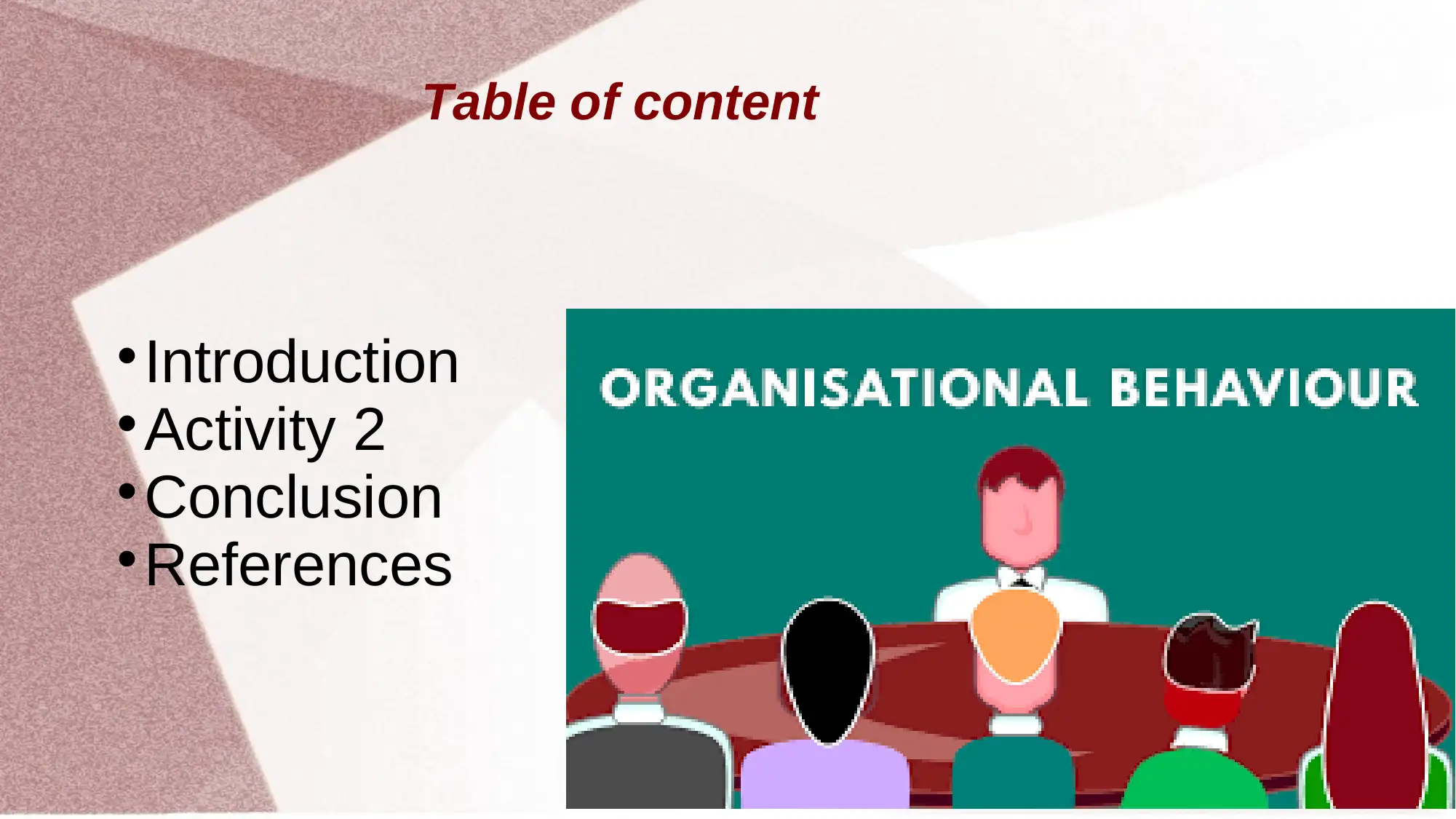
Organisational Behaviour
tabler-icon-diamond-filled.svg

Paraphrase This Document

Need a fresh take? Get an instant paraphrase of this document with our AI Paraphraser
Document Page
Table of content
Introduction
Activity 2
Conclusion
References
Document Page
Introduction
Organisational behaviour refers to the method where study of human resources, their
behaviour and attitude is being studied by the management team of an organisation. It is
the study area where managers examine the behaviour of an individual working within
the workplace as well as identify its influence on the performance, leadership, motivation
and many more. It refers to the study as well as knowledge of application in order to
know about the act of individual within the workplace
Document Page
Activity-2
Analysis of characteristics of different organisational structure
Each and every organisation have their own structure and each structure is different
from other. There are various organisational structure used by HSBC Bank Malta such as
flat, hierarchical, tall and centralised or decentralised.
Flat structure: In this type of organisational structure, there is very few level of
management.
Tall Structure: On the other hand, tall structure have various level of supervision and
management. In this, command run from the top authority and then go to the lower level.
tabler-icon-diamond-filled.svg

Paraphrase This Document

Need a fresh take? Get an instant paraphrase of this document with our AI Paraphraser
Document Page
Document Page
Evaluation of the importance of organisation's culture theory in
order to develop organisational effectiveness
Culture of an organisation decides in which manner an individual
need to interact with their colleagues, superiors and subordinates
Healthy and positive organisational culture motivates the employees
in order to stay loyal towards their company. Along with this, strong
organisational culture leads to create high brand image of an
organisation so that they gain competitive advantages at the
marketplace.
Document Page
Conclusion
As per the above mentioned report, it has been identified that
organisational behaviour is one of the most importation part in any
organisation. Organisational behaviour refers to the method where
every individual have their own attitude, style and perception so that
they can perform their task in an effective manner.
tabler-icon-diamond-filled.svg

Paraphrase This Document

Need a fresh take? Get an instant paraphrase of this document with our AI Paraphraser
Document Page
References
Kitchin, D., 2017. An introduction to organisational behaviour for managers and
engineers: A group and multicultural approach. Routledge.
Elsmore, P., 2017. Organisational Culture: Organisational Change?:
Organisational Change?. Routledge.
Katou, A.A., 2015. Transformational leadership and organisational performance:
Three serially mediating mechanisms. Employee Relations, 37(3), pp.329-
353.
Maitland, A., Hills, L.A. and Rhind, D.J., 2015. Organisational culture in sport–A
systematic review. Sport Management Review, 18(4), pp.501-516.
Document Page
Thank You
chevron_up_icon
1 out of 9
circle_padding
hide_on_mobile
zoom_out_icon
[object Object]