Initial Report: Human Activity Recognition Data from Wearable Sensors
VerifiedAdded on 2023/01/18
|8
|2540
|72
Report
AI Summary
This initial report, submitted for a University of Greenwich MSc program, focuses on human activity recognition using wearable sensors. It outlines the current situation, including the increasing pervasiveness of ubiquitous computing and the challenges in implicit interaction and data standardization. The report identifies objectives such as developing technologies for the elderly and preventing diseases, and highlights problem areas like the need for less supervision in machine learning and the exploration of high-level and long-term activities. The key work planned for the next period includes a literature review covering applications, sensors, activities, and modeling techniques, along with an analysis of the system involving dataset analysis, feature analysis, and recognition. The report also references key publications and provides an overview of the project's scope and objectives.
The initial report for a dissertation to be submitted in partial fulfilment of a
University of Greenwich Masters Degree
Human Activity Recognition Data from Wearable Sensor
Name:
Student ID:
Programme of Study:
Initial Report
Date Proposal Submitted:
Project Hand in Date:
Supervisor:
University of Greenwich Masters Degree
Human Activity Recognition Data from Wearable Sensor
Name:
Student ID:
Programme of Study:
Initial Report
Date Proposal Submitted:
Project Hand in Date:
Supervisor:

Paraphrase This Document
Need a fresh take? Get an instant paraphrase of this document with our AI Paraphraser
The Initial Report
1. Current situation
The pervasiveness of computers is growing and they are being integrated in cameras,
mobile phones, cars, buildings, music players, clothing and many other things that lack
the resemblance of the traditional desktop computers with a mouse, keyboard, and a
monitor. The debate revolving on how we should live and interact freely when there are
many small computer systems that can be hidden so that we cannot see them. Ubiquitous
computing has the vision that with time computers will be part of our lives such that we
cannot do anything without them (Baghiyan, 2011). Basically, the number of computers
will increase and will enhance our way of life. However, we may not be aware of them
as we will be concentrating more on the tasks that we are doing rather than technology
around us. As such, the ubiquitous computing has been challenged with the task to
identify new ways of how the users will interact and use the new generation of
computers.
By reducing the explicit interaction, the designers will be able to do away with the big
computers and increase the implicit interaction. A good example of implicit interaction
is a case like using motion sensors to turn on or off the lights rather than using a switch
(Bulling, Blanke and Schiele, 2014). Also motion sensors could be used to register
students as they walk into class rather than signing a manual register. Lack of standard
acceptable protocols to carry out experiments and present the outcomes is one of the
main concerns of carrying out study on human activity recognition data on wearable
sensors. Basically, many issues have not been addressed including evaluations metrics,
generating datasets from raw signals, and the datasets that are challenging by the
existing research work.
This paper will explore a section of context-wear technology. First, the focus will be on
context of the user which is a very crucial part. Secondly, we concentrate on combining
machine learning methods with the use of wearable sensors to learn, record, recognize,
and model the activities of the user. One primary advantage of wearable sensors is the
chance to view the world from the perspective of the first-person all the time without
having to setup external infrastructure. The existing applications can be improved by
wearable activity recognition abilities ranging from assisted living and personal
healthcare to arts, entertainment, and even industrial applications (Dunne et al., 2016).
The next session will describe the main challenges that the researchers often face when
handling the concept of human activity recognition data from wearable sensors.
MSc Initial Report Page 1
1. Current situation
The pervasiveness of computers is growing and they are being integrated in cameras,
mobile phones, cars, buildings, music players, clothing and many other things that lack
the resemblance of the traditional desktop computers with a mouse, keyboard, and a
monitor. The debate revolving on how we should live and interact freely when there are
many small computer systems that can be hidden so that we cannot see them. Ubiquitous
computing has the vision that with time computers will be part of our lives such that we
cannot do anything without them (Baghiyan, 2011). Basically, the number of computers
will increase and will enhance our way of life. However, we may not be aware of them
as we will be concentrating more on the tasks that we are doing rather than technology
around us. As such, the ubiquitous computing has been challenged with the task to
identify new ways of how the users will interact and use the new generation of
computers.
By reducing the explicit interaction, the designers will be able to do away with the big
computers and increase the implicit interaction. A good example of implicit interaction
is a case like using motion sensors to turn on or off the lights rather than using a switch
(Bulling, Blanke and Schiele, 2014). Also motion sensors could be used to register
students as they walk into class rather than signing a manual register. Lack of standard
acceptable protocols to carry out experiments and present the outcomes is one of the
main concerns of carrying out study on human activity recognition data on wearable
sensors. Basically, many issues have not been addressed including evaluations metrics,
generating datasets from raw signals, and the datasets that are challenging by the
existing research work.
This paper will explore a section of context-wear technology. First, the focus will be on
context of the user which is a very crucial part. Secondly, we concentrate on combining
machine learning methods with the use of wearable sensors to learn, record, recognize,
and model the activities of the user. One primary advantage of wearable sensors is the
chance to view the world from the perspective of the first-person all the time without
having to setup external infrastructure. The existing applications can be improved by
wearable activity recognition abilities ranging from assisted living and personal
healthcare to arts, entertainment, and even industrial applications (Dunne et al., 2016).
The next session will describe the main challenges that the researchers often face when
handling the concept of human activity recognition data from wearable sensors.
MSc Initial Report Page 1
Objectives
One of the main objectives in context-aware computing and activity recognition is to
facilitate development of new technologies and applications for the elderly and other
patients (Huynh et al., 2016). The declining rates of fertility and the extended life
expectancy are increasing the number of the aged population in our communities across
the world bring about numerous challenges to the current healthcare systems. Many
expect that the activity recognition and wearable sensors will address these challenges
by enabling the aged in the society to live independently without having the need of
caregivers around. One way of utilizing such technology in healthcare is designing a
sensory system that will have the ability to use human activity to identify any possible
dangerous situation in the life of an elderly person and automatically call for help.
Another objective of this technology is to prevent the occurrence of severe medical
conditions or age-related diseases before they occur because the wearable sensor
applications use long-term monitoring to discover any unusual patterns or changes in the
daily routine of a person as any changes may indicate early symptoms of a particular
disease (Junker et al., 2013). Applications that have shown the abilities to record and
monitor physiological parameters and daily activities of a person have proven to be very
valuable to care-givers and physicians to assess the physical wellness of a person.
Thirdly, the medical sector aims at employing context-information to foster for a
healthier and more active lifestyle, or to support the disabled or elderly people actively
in carrying out their everyday tasks. The fluctuating signals in mobile phones can be
used to summarize and approximate the levels of activities of a person to encourage and
motivate contemplation of everyday activities (Kunze and Lukowicz, 2014). Wearable
sensors can be used to discover particular activities and symbolize them as distinct types
of flowers in the display of a mobile phone. Location and activity data collected by
wearable sensors can be combined to imply impulsive exercises like recording that a
particular user walked to the next eat out instead of queuing in the current one (Kańtoch,
2018).
2. Problem Areas
This section will attempt to describe essential research challenges in human activity
recognition. They include:
Exploration of high-level and long-term activities
The need for less constant supervision
MSc Initial Report Page 2
One of the main objectives in context-aware computing and activity recognition is to
facilitate development of new technologies and applications for the elderly and other
patients (Huynh et al., 2016). The declining rates of fertility and the extended life
expectancy are increasing the number of the aged population in our communities across
the world bring about numerous challenges to the current healthcare systems. Many
expect that the activity recognition and wearable sensors will address these challenges
by enabling the aged in the society to live independently without having the need of
caregivers around. One way of utilizing such technology in healthcare is designing a
sensory system that will have the ability to use human activity to identify any possible
dangerous situation in the life of an elderly person and automatically call for help.
Another objective of this technology is to prevent the occurrence of severe medical
conditions or age-related diseases before they occur because the wearable sensor
applications use long-term monitoring to discover any unusual patterns or changes in the
daily routine of a person as any changes may indicate early symptoms of a particular
disease (Junker et al., 2013). Applications that have shown the abilities to record and
monitor physiological parameters and daily activities of a person have proven to be very
valuable to care-givers and physicians to assess the physical wellness of a person.
Thirdly, the medical sector aims at employing context-information to foster for a
healthier and more active lifestyle, or to support the disabled or elderly people actively
in carrying out their everyday tasks. The fluctuating signals in mobile phones can be
used to summarize and approximate the levels of activities of a person to encourage and
motivate contemplation of everyday activities (Kunze and Lukowicz, 2014). Wearable
sensors can be used to discover particular activities and symbolize them as distinct types
of flowers in the display of a mobile phone. Location and activity data collected by
wearable sensors can be combined to imply impulsive exercises like recording that a
particular user walked to the next eat out instead of queuing in the current one (Kańtoch,
2018).
2. Problem Areas
This section will attempt to describe essential research challenges in human activity
recognition. They include:
Exploration of high-level and long-term activities
The need for less constant supervision
MSc Initial Report Page 2
⊘ This is a preview!⊘
Do you want full access?
Subscribe today to unlock all pages.

Trusted by 1+ million students worldwide
These challenges are further described below in detail, and finally give a summary of
other challenged related to the topic.
The need for less supervision
To train a machine learning algorithm, nearly all approached in human activity
recognition depend on glossed or annotated records of the data associated with the
specific activity. It is quite difficult, erroneous, time-consuming, tedious, and sometimes
nearly impossible to acquire such data with ground truth or enough annotations and this
poses a serious challenge to the enhancement in this field. Most part of the work on
activity recognition has been carried out by individuals because of the challenges
associated with acquiring annotated data for training (Eagle and Pentland, 2016). This
has caused several issues including the fact that the available data is insufficient to make
reliable approximations of how better the approach will conclude to various users or
settings (how relevant is the approach).
It would be much easier to exploit sparsely, or no-annotated data since they can be
acquired more easily, and this will further reduce the problems and issues in the activity
recognition field. Furthermore, there exist several big databases which contains data that
is uncategorized such as location traces, activity diaries, or even cell phone logs. It is
quite expensive to carry out annotation on such big databases, and it can also introduce
unexpected data biasness.
High-level and Long-term activities:
Several of the tasks in activity recognition concentrates on quite shorter activities that
can be measured in seconds or minutes, rather than days or hours (Hamid et al., 2015).
Activity exploration on a bigger time scale is both challenging and interesting for
several reasons: high-levels time scale activity recognition has unclear understanding in
several aspects, and long-term activities have not been researched on extensively.
3. Key work during the next period
The next section will address the following:
Literature Review
o Introduction
o Applications
o Sensors
o Activities
MSc Initial Report Page 3
other challenged related to the topic.
The need for less supervision
To train a machine learning algorithm, nearly all approached in human activity
recognition depend on glossed or annotated records of the data associated with the
specific activity. It is quite difficult, erroneous, time-consuming, tedious, and sometimes
nearly impossible to acquire such data with ground truth or enough annotations and this
poses a serious challenge to the enhancement in this field. Most part of the work on
activity recognition has been carried out by individuals because of the challenges
associated with acquiring annotated data for training (Eagle and Pentland, 2016). This
has caused several issues including the fact that the available data is insufficient to make
reliable approximations of how better the approach will conclude to various users or
settings (how relevant is the approach).
It would be much easier to exploit sparsely, or no-annotated data since they can be
acquired more easily, and this will further reduce the problems and issues in the activity
recognition field. Furthermore, there exist several big databases which contains data that
is uncategorized such as location traces, activity diaries, or even cell phone logs. It is
quite expensive to carry out annotation on such big databases, and it can also introduce
unexpected data biasness.
High-level and Long-term activities:
Several of the tasks in activity recognition concentrates on quite shorter activities that
can be measured in seconds or minutes, rather than days or hours (Hamid et al., 2015).
Activity exploration on a bigger time scale is both challenging and interesting for
several reasons: high-levels time scale activity recognition has unclear understanding in
several aspects, and long-term activities have not been researched on extensively.
3. Key work during the next period
The next section will address the following:
Literature Review
o Introduction
o Applications
o Sensors
o Activities
MSc Initial Report Page 3
Paraphrase This Document
Need a fresh take? Get an instant paraphrase of this document with our AI Paraphraser
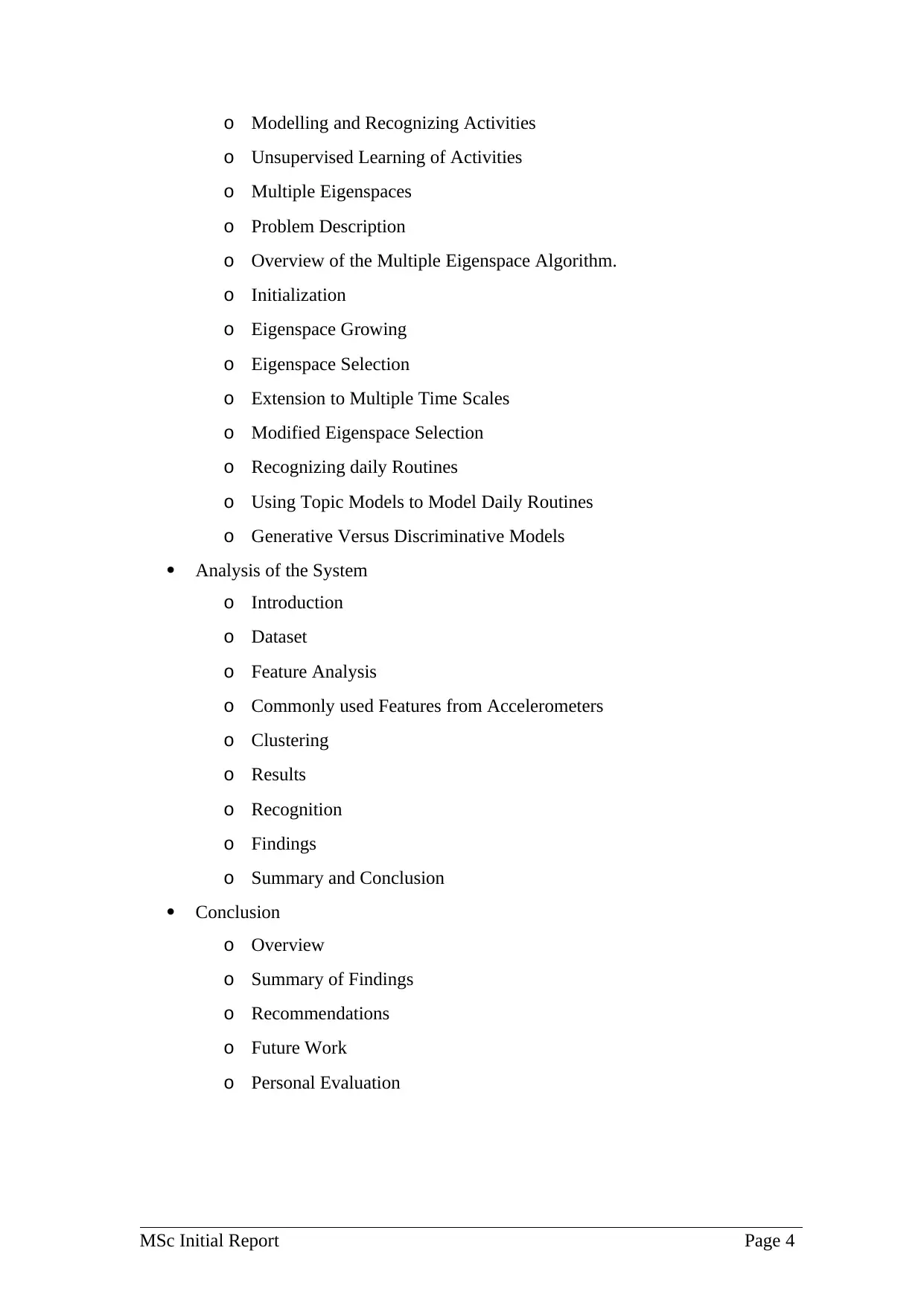
o Modelling and Recognizing Activities
o Unsupervised Learning of Activities
o Multiple Eigenspaces
o Problem Description
o Overview of the Multiple Eigenspace Algorithm.
o Initialization
o Eigenspace Growing
o Eigenspace Selection
o Extension to Multiple Time Scales
o Modified Eigenspace Selection
o Recognizing daily Routines
o Using Topic Models to Model Daily Routines
o Generative Versus Discriminative Models
Analysis of the System
o Introduction
o Dataset
o Feature Analysis
o Commonly used Features from Accelerometers
o Clustering
o Results
o Recognition
o Findings
o Summary and Conclusion
Conclusion
o Overview
o Summary of Findings
o Recommendations
o Future Work
o Personal Evaluation
MSc Initial Report Page 4
o Unsupervised Learning of Activities
o Multiple Eigenspaces
o Problem Description
o Overview of the Multiple Eigenspace Algorithm.
o Initialization
o Eigenspace Growing
o Eigenspace Selection
o Extension to Multiple Time Scales
o Modified Eigenspace Selection
o Recognizing daily Routines
o Using Topic Models to Model Daily Routines
o Generative Versus Discriminative Models
Analysis of the System
o Introduction
o Dataset
o Feature Analysis
o Commonly used Features from Accelerometers
o Clustering
o Results
o Recognition
o Findings
o Summary and Conclusion
Conclusion
o Overview
o Summary of Findings
o Recommendations
o Future Work
o Personal Evaluation
MSc Initial Report Page 4
Reference List
Adaskevicius, R. (2014). Method for Recognition of the Physical Activity of Human
Being Using a Wearable Accelerometer. Elektronika ir Elektrotechnika, 20(5).
Affanni, A. (2019). Dual channel electrodermal activity and an ECG wearable sensor to
measure mental stress from the hands. ACTA IMEKO, 8(1), p.56.
Baghiyan, R. (2011). Radiation in transition of charged particles through rough
interfaces. Physical Review E, 69(2).
Bulling, A., Blanke, U. and Schiele, B. (2014). A tutorial on human activity recognition
using body-worn inertial sensors. ACM Computing Surveys, 46(3), pp.1-33.
Chereshnev, R. and Kertész-Farkas, A. (2018). RapidHARe: A computationally
inexpensive method for real-time human activity recognition from wearable
sensors. Journal of Ambient Intelligence and Smart Environments, 10(5), pp.377-391.
Chung, S., Lim, J., Noh, K., Kim, G. and Jeong, H. (2019). Sensor Data Acquisition and
Multimodal Sensor Fusion for Human Activity Recognition Using Deep
Learning. Sensors, 19(7), p.1716.
Dávila, J. (2016). Iterative Learning for Human Activity Recognition from Wearable
Sensor Data. Proceedings, 1(2), p.7.
Dunne, L., Walsh, P., Hermann, S., Smyth, B. and Caulfield, B. (2016). Wearable
Monitoring of Seated Spinal Posture. IEEE Transactions on Biomedical Circuits and
Systems, 2(2), pp.97-105.
Eagle, N. and Pentland, A. (2016). Social Serendipity: Mobilizing Social
Software. IEEE Pervasive Computing, 4(2), pp.28-34.
Gu, T., Wang, L., Wu, Z., Tao, X. and Lu, J. (2011). A Pattern Mining Approach to
Sensor-Based Human Activity Recognition. IEEE Transactions on Knowledge and Data
Engineering, 23(9), pp.1359-1372.
Hamid, R., Maddi, S., Johnson, A., Bobick, A., Essa, I. and Isbell, C. (2015). A novel
sequence representation for unsupervised analysis of human activities. Artificial
Intelligence, 173(14), pp.1221-1244.
MSc Initial Report Page 5
Adaskevicius, R. (2014). Method for Recognition of the Physical Activity of Human
Being Using a Wearable Accelerometer. Elektronika ir Elektrotechnika, 20(5).
Affanni, A. (2019). Dual channel electrodermal activity and an ECG wearable sensor to
measure mental stress from the hands. ACTA IMEKO, 8(1), p.56.
Baghiyan, R. (2011). Radiation in transition of charged particles through rough
interfaces. Physical Review E, 69(2).
Bulling, A., Blanke, U. and Schiele, B. (2014). A tutorial on human activity recognition
using body-worn inertial sensors. ACM Computing Surveys, 46(3), pp.1-33.
Chereshnev, R. and Kertész-Farkas, A. (2018). RapidHARe: A computationally
inexpensive method for real-time human activity recognition from wearable
sensors. Journal of Ambient Intelligence and Smart Environments, 10(5), pp.377-391.
Chung, S., Lim, J., Noh, K., Kim, G. and Jeong, H. (2019). Sensor Data Acquisition and
Multimodal Sensor Fusion for Human Activity Recognition Using Deep
Learning. Sensors, 19(7), p.1716.
Dávila, J. (2016). Iterative Learning for Human Activity Recognition from Wearable
Sensor Data. Proceedings, 1(2), p.7.
Dunne, L., Walsh, P., Hermann, S., Smyth, B. and Caulfield, B. (2016). Wearable
Monitoring of Seated Spinal Posture. IEEE Transactions on Biomedical Circuits and
Systems, 2(2), pp.97-105.
Eagle, N. and Pentland, A. (2016). Social Serendipity: Mobilizing Social
Software. IEEE Pervasive Computing, 4(2), pp.28-34.
Gu, T., Wang, L., Wu, Z., Tao, X. and Lu, J. (2011). A Pattern Mining Approach to
Sensor-Based Human Activity Recognition. IEEE Transactions on Knowledge and Data
Engineering, 23(9), pp.1359-1372.
Hamid, R., Maddi, S., Johnson, A., Bobick, A., Essa, I. and Isbell, C. (2015). A novel
sequence representation for unsupervised analysis of human activities. Artificial
Intelligence, 173(14), pp.1221-1244.
MSc Initial Report Page 5
⊘ This is a preview!⊘
Do you want full access?
Subscribe today to unlock all pages.
Trusted by 1+ million students worldwide
Hastie, T., Tibshirani, R. and Friedman, J. (2011). The elements of statistical learning.
New York: Springer.
Huynh, G., Schiele, S., Welling, M. and Teh, Y. (2016). Unsupervised Discovery of
Nonlinear Structure Using Contrastive Backpropagation. Cognitive Science, 30(4),
pp.725-731.
Junker, H., Amft, O., Lukowicz, P. and Tröster, G. (2013). Gesture spotting with body-
worn inertial sensors to detect user activities. Pattern Recognition, 41(6), pp.2010-2024.
Kańtoch, E. (2018). Recognition of Sedentary Behavior by Machine Learning Analysis
of Wearable Sensors during Activities of Daily Living for Telemedical Assessment of
Cardiovascular Risk. Sensors, 18(10), p.3219.
Kunze, K. and Lukowicz, P. (2014). Sensor Placement Variations in Wearable Activity
Recognition. IEEE Pervasive Computing, 13(4), pp.32-41.
Kunze, K. and Lukowicz, P. (2014). Sensor Placement Variations in Wearable Activity
Recognition. IEEE Pervasive Computing, 13(4), pp.32-41.
Leonardis, A., Bischof, H. and Maver, J. (2012). Multiple eigenspaces. Pattern
Recognition, 35(11), pp.2613-2627.
Liang, G., Luo, Q. and Jia, Y. (2018). Automatic Labeling Framework for Wearable
Sensor-based Human Activity Recognition. Sensors and Materials, 30(9), p.2049.
Ponce, H., Martínez-Villaseñor, M. and Miralles-Pechuán, L. (2016). A Novel Wearable
Sensor-Based Human Activity Recognition Approach Using Artificial Hydrocarbon
Networks. Sensors, 16(7), p.1033.
Rosati, S., Balestra, G. and Knaflitz, M. (2018). Comparison of Different Sets of
Features for Human Activity Recognition by Wearable Sensors. Sensors, 18(12),
p.4189.
Stork, D., Yom-Tov, E. and Duda, R. (2014). Computer manual in MATLAB to
accompany Pattern classification, second edition. Hoboken, N.J.: John Wiley & Sons.
Vogel, J. and Schiele, B. (2016). Performance evaluation and optimization for content-
based image retrieval. Pattern Recognition, 39(5), pp.897-909.
MSc Initial Report Page 6
New York: Springer.
Huynh, G., Schiele, S., Welling, M. and Teh, Y. (2016). Unsupervised Discovery of
Nonlinear Structure Using Contrastive Backpropagation. Cognitive Science, 30(4),
pp.725-731.
Junker, H., Amft, O., Lukowicz, P. and Tröster, G. (2013). Gesture spotting with body-
worn inertial sensors to detect user activities. Pattern Recognition, 41(6), pp.2010-2024.
Kańtoch, E. (2018). Recognition of Sedentary Behavior by Machine Learning Analysis
of Wearable Sensors during Activities of Daily Living for Telemedical Assessment of
Cardiovascular Risk. Sensors, 18(10), p.3219.
Kunze, K. and Lukowicz, P. (2014). Sensor Placement Variations in Wearable Activity
Recognition. IEEE Pervasive Computing, 13(4), pp.32-41.
Kunze, K. and Lukowicz, P. (2014). Sensor Placement Variations in Wearable Activity
Recognition. IEEE Pervasive Computing, 13(4), pp.32-41.
Leonardis, A., Bischof, H. and Maver, J. (2012). Multiple eigenspaces. Pattern
Recognition, 35(11), pp.2613-2627.
Liang, G., Luo, Q. and Jia, Y. (2018). Automatic Labeling Framework for Wearable
Sensor-based Human Activity Recognition. Sensors and Materials, 30(9), p.2049.
Ponce, H., Martínez-Villaseñor, M. and Miralles-Pechuán, L. (2016). A Novel Wearable
Sensor-Based Human Activity Recognition Approach Using Artificial Hydrocarbon
Networks. Sensors, 16(7), p.1033.
Rosati, S., Balestra, G. and Knaflitz, M. (2018). Comparison of Different Sets of
Features for Human Activity Recognition by Wearable Sensors. Sensors, 18(12),
p.4189.
Stork, D., Yom-Tov, E. and Duda, R. (2014). Computer manual in MATLAB to
accompany Pattern classification, second edition. Hoboken, N.J.: John Wiley & Sons.
Vogel, J. and Schiele, B. (2016). Performance evaluation and optimization for content-
based image retrieval. Pattern Recognition, 39(5), pp.897-909.
MSc Initial Report Page 6
Paraphrase This Document
Need a fresh take? Get an instant paraphrase of this document with our AI Paraphraser
Wahle, F., Kowatsch, T., Fleisch, E., Rufer, M. and Weidt, S. (2016). Mobile Sensing
and Support for People With Depression: A Pilot Trial in the Wild. JMIR mHealth and
uHealth, 4(3), p.e111.
Xu, H., Liu, J., Hu, H. and Zhang, Y. (2016). Wearable Sensor-Based Human Activity
Recognition Method with Multi-Features Extracted from Hilbert-Huang
Transform. Sensors, 16(12), p.2048.
Yin, J., Zhu, C., Zhou, S., Yuan, L., Liu, Q. and Lu, M. (2016). A Highly Efficient
Human Activity Classification Method Using Mobile Data from Wearable
Sensors. International Journal of Sensor Networks, 1(1), p.1.
Yuan, L., Liu, Q., Lu, M., Zhou, S., Zhu, C. and Yin, J. (2017). A highly efficient
human activity classification method using mobile data from wearable
sensors. International Journal of Sensor Networks, 25(2), p.86.
Zahid, M., Mittal, A. and Joshi, R. (2017). A pattern recognition-based approach for
phylogenetic network construction with constrained recombination. Pattern
Recognition, 39(12), pp.2312-2322.
Zhan, Y. and Kuroda, T. (2012). Wearable sensor-based human activity recognition
from environmental background sounds. Journal of Ambient Intelligence and
Humanized Computing, 5(1), pp.77-89.
MSc Initial Report Page 7
and Support for People With Depression: A Pilot Trial in the Wild. JMIR mHealth and
uHealth, 4(3), p.e111.
Xu, H., Liu, J., Hu, H. and Zhang, Y. (2016). Wearable Sensor-Based Human Activity
Recognition Method with Multi-Features Extracted from Hilbert-Huang
Transform. Sensors, 16(12), p.2048.
Yin, J., Zhu, C., Zhou, S., Yuan, L., Liu, Q. and Lu, M. (2016). A Highly Efficient
Human Activity Classification Method Using Mobile Data from Wearable
Sensors. International Journal of Sensor Networks, 1(1), p.1.
Yuan, L., Liu, Q., Lu, M., Zhou, S., Zhu, C. and Yin, J. (2017). A highly efficient
human activity classification method using mobile data from wearable
sensors. International Journal of Sensor Networks, 25(2), p.86.
Zahid, M., Mittal, A. and Joshi, R. (2017). A pattern recognition-based approach for
phylogenetic network construction with constrained recombination. Pattern
Recognition, 39(12), pp.2312-2322.
Zhan, Y. and Kuroda, T. (2012). Wearable sensor-based human activity recognition
from environmental background sounds. Journal of Ambient Intelligence and
Humanized Computing, 5(1), pp.77-89.
MSc Initial Report Page 7

1 out of 8


Related Documents


Your All-in-One AI-Powered Toolkit for Academic Success.
+13062052269
info@desklib.com
Available 24*7 on WhatsApp / Email
![[object Object]](/_next/static/media/star-bottom.7253800d.svg)
Unlock your academic potential
Copyright © 2020–2026 A2Z Services. All Rights Reserved. Developed and managed by ZUCOL.