Analysis of Symbolic Thought and Human Cognition - PSYC105 Report
VerifiedAdded on 2022/11/14
|8
|2238
|497
Report
AI Summary
This report presents an experimental study investigating symbolic thought and human cognition, replicating a previous experiment by Marghetis, Landy, and Goldstone (2016) to examine syntax knowledge. The study involved 450 participants divided into syntax knowers and non-knowers, who completed tasks using the PsyToolkit software. Participants were subjected to three conditions: neutral spacing, consistent spacing, and inconsistent spacing, with the goal of assessing their perception of abstract mathematical and symbolic knowledge. The results revealed statistically significant differences between syntax knowers and non-knowers in the neutral and consistent spacing conditions, but not in the inconsistent spacing condition. The discussion highlights the influence of factors like working memory and the Hawthorne effect on cognitive processes, emphasizing the role of training in abstract notations and the connection between formal mathematics and human cognition. The study concludes that the quantification of abstractness in the human cognitive system is a complex matter, depending on an individual's ability to either possess symbolic thought or effectively interpret symbols and mathematical notions.
Running head: SYMBOLIC THOUGHT AND HUMAN COGNITION
SYMBOLIC THOUGHT AND HUMAN COGNITION
Name of the Student
Name of the University
Author note
SYMBOLIC THOUGHT AND HUMAN COGNITION
Name of the Student
Name of the University
Author note

Paraphrase This Document
Need a fresh take? Get an instant paraphrase of this document with our AI Paraphraser
1SYMBOLIC THOUGHT AND HUMAN COGNITION
Introduction
One of the main questions in the domain of cognitive sciences is the understanding of
the actual functioning of the human cognition system in regards to notions of abstractness and
symbolism. Historically, symbols have played a significant role in shaping the understanding
of the human evolutionary process. Starting from the ancient cave paintings where the
prehistoric people sketched out their daily encounters as a means of recording a journal to the
present to use of symbols in computation and digital technology, the aspect of symbolic
understanding has seen major developments. Drawing upon that concept, the current
discussions on cognition and symbolic thought diverges into multiple directions. Algebra and
mathematical notions have been identified by many researchers as dominant examples for
pure symbolic manipulation (Landy and Goldstone, 2007). Furthermore, specific instances
from cognitive and neurological studies have also highlighted that the representation of
abstractness and symbolic notations are categorically dependent on the functioning of the
brain and the specific brain regions that are biologically adapted to interpret and represent
those notions of abstractness (Goldstone et al., 2017).
In this current study, the notion of symbolic thought is looked at from an experimental
viewpoint. As research highlights, mathematics forms a significant base for the understanding
and formulation of symbolic notion in the brain. This study has attempted to replicate the
experiment conducted by Marghetis, Landy and Goldstone (2016) in order to understand
syntax knowledge. This experiment highlights the abstract conceptions regarding cognitive
functionality when it comes to mathematics and algebraic functions. More specifically the
study attempts to identify how individuals understand and interpret the notions of symbolism
and abstract thought based on the inputs provided as colours and differentiated mathematical
expressions.
Introduction
One of the main questions in the domain of cognitive sciences is the understanding of
the actual functioning of the human cognition system in regards to notions of abstractness and
symbolism. Historically, symbols have played a significant role in shaping the understanding
of the human evolutionary process. Starting from the ancient cave paintings where the
prehistoric people sketched out their daily encounters as a means of recording a journal to the
present to use of symbols in computation and digital technology, the aspect of symbolic
understanding has seen major developments. Drawing upon that concept, the current
discussions on cognition and symbolic thought diverges into multiple directions. Algebra and
mathematical notions have been identified by many researchers as dominant examples for
pure symbolic manipulation (Landy and Goldstone, 2007). Furthermore, specific instances
from cognitive and neurological studies have also highlighted that the representation of
abstractness and symbolic notations are categorically dependent on the functioning of the
brain and the specific brain regions that are biologically adapted to interpret and represent
those notions of abstractness (Goldstone et al., 2017).
In this current study, the notion of symbolic thought is looked at from an experimental
viewpoint. As research highlights, mathematics forms a significant base for the understanding
and formulation of symbolic notion in the brain. This study has attempted to replicate the
experiment conducted by Marghetis, Landy and Goldstone (2016) in order to understand
syntax knowledge. This experiment highlights the abstract conceptions regarding cognitive
functionality when it comes to mathematics and algebraic functions. More specifically the
study attempts to identify how individuals understand and interpret the notions of symbolism
and abstract thought based on the inputs provided as colours and differentiated mathematical
expressions.
2SYMBOLIC THOUGHT AND HUMAN COGNITION
H0 – there is no identifiable difference between the syntax knowers and syntax non
knower groups in their perception of abstract mathematical and symbolic knowledge
H1 – there is significant difference between syntax knowers and non-knowers in their
perception and cognition of abstract mathematical and symbolic knowledge.
Methods
Prior to the experiment, an initial survey was conducted to identify and recruit
participants for the study. The survey included general information questions regarding the
participants’ visual judgements regarding mathematical expressions. The survey also asked
the participants to perform simple mathematical calculations as well as gathered information
about the participants’ background in mathematics.
In order to effectively complete this study, the experiment has been divided into three
specific tasks, namely syntax knowledge measure with neutral spacing, consistent spacing
and inconsistent spacing. A total of 642 initial respondents were recorded for the experiment
with the final sample size coming to 450. 150 participants were allocated to each category of
spacing (neutral, consistent and inconsistent). In order to maintain equality of participants in
each of the three conditions, the participant size of 150 was further subdivided into 75
participants who knew the syntax and the remaining 75 who did not. The experiment was
programmed and presented using the PsyToolkit software (Stoet, 2010; 2017).
The preliminary testing allowed for the participants to be divided into ‘Syntax
knowers’ and ‘syntax non-knowers’ groups. In order to make that division, a new measure of
25 maths questions was used, as per the questions presented in Marghetis, Landy and
Goldstone (2016). A correct response to each of the questions resulted in a score of 1 with a
H0 – there is no identifiable difference between the syntax knowers and syntax non
knower groups in their perception of abstract mathematical and symbolic knowledge
H1 – there is significant difference between syntax knowers and non-knowers in their
perception and cognition of abstract mathematical and symbolic knowledge.
Methods
Prior to the experiment, an initial survey was conducted to identify and recruit
participants for the study. The survey included general information questions regarding the
participants’ visual judgements regarding mathematical expressions. The survey also asked
the participants to perform simple mathematical calculations as well as gathered information
about the participants’ background in mathematics.
In order to effectively complete this study, the experiment has been divided into three
specific tasks, namely syntax knowledge measure with neutral spacing, consistent spacing
and inconsistent spacing. A total of 642 initial respondents were recorded for the experiment
with the final sample size coming to 450. 150 participants were allocated to each category of
spacing (neutral, consistent and inconsistent). In order to maintain equality of participants in
each of the three conditions, the participant size of 150 was further subdivided into 75
participants who knew the syntax and the remaining 75 who did not. The experiment was
programmed and presented using the PsyToolkit software (Stoet, 2010; 2017).
The preliminary testing allowed for the participants to be divided into ‘Syntax
knowers’ and ‘syntax non-knowers’ groups. In order to make that division, a new measure of
25 maths questions was used, as per the questions presented in Marghetis, Landy and
Goldstone (2016). A correct response to each of the questions resulted in a score of 1 with a
⊘ This is a preview!⊘
Do you want full access?
Subscribe today to unlock all pages.

Trusted by 1+ million students worldwide
3SYMBOLIC THOUGHT AND HUMAN COGNITION
highest possible score of 25. The participants with a score of 85% and higher were allocated
into the former group and those with a lower score were allocated into the latter group.
The initial demographic questions asked about the participants’ age and sex before
moving to the main task. The participants were randomly allocated into the three
experimental conditions. All conditions were given the same set of instructions and tasks.
Each of the conditions had four blocks of 88 trials cumulating a total of 352 trials. Each trial
began with a black text presented for 3 seconds before changing the colour in two of the
letters (for the colour judgement task) or another equation was presented to the right of the =
sign (for the algebraic equivalence task). For the colour judgement task, each participant was
asked to respond as quickly and accurately as possible, responding if the two colour letters
were the same or different colours, whereas for the algebraic equivalence task, the same
response criteria was used for determining if the equations on both sides would output the
same results. The participants would have to input a response within 10 seconds otherwise a
‘too slow’ remark would be displayed for half a second before moving on to the next
question.
Results
For the demographic status of the participants in this experiment, a total of 450 participants
out of the 642 respondents were selected. The minimum age of the participants was recorded at 17
and the maximum age was recorded at 62 with a mean of 20.7 and a 5.71 standard deviation. 22.44 %
of the participants were male and 74 % were female, with the rest being divided into other and prefer
not to answer at 2.22 and 1.33 respectively.
For calculating the results of the main experiment, a two sample t-test was conducted which showed
the following results:
1. For the first hypothesis (Syntax knower vs non knower in neutral spacing condition):
highest possible score of 25. The participants with a score of 85% and higher were allocated
into the former group and those with a lower score were allocated into the latter group.
The initial demographic questions asked about the participants’ age and sex before
moving to the main task. The participants were randomly allocated into the three
experimental conditions. All conditions were given the same set of instructions and tasks.
Each of the conditions had four blocks of 88 trials cumulating a total of 352 trials. Each trial
began with a black text presented for 3 seconds before changing the colour in two of the
letters (for the colour judgement task) or another equation was presented to the right of the =
sign (for the algebraic equivalence task). For the colour judgement task, each participant was
asked to respond as quickly and accurately as possible, responding if the two colour letters
were the same or different colours, whereas for the algebraic equivalence task, the same
response criteria was used for determining if the equations on both sides would output the
same results. The participants would have to input a response within 10 seconds otherwise a
‘too slow’ remark would be displayed for half a second before moving on to the next
question.
Results
For the demographic status of the participants in this experiment, a total of 450 participants
out of the 642 respondents were selected. The minimum age of the participants was recorded at 17
and the maximum age was recorded at 62 with a mean of 20.7 and a 5.71 standard deviation. 22.44 %
of the participants were male and 74 % were female, with the rest being divided into other and prefer
not to answer at 2.22 and 1.33 respectively.
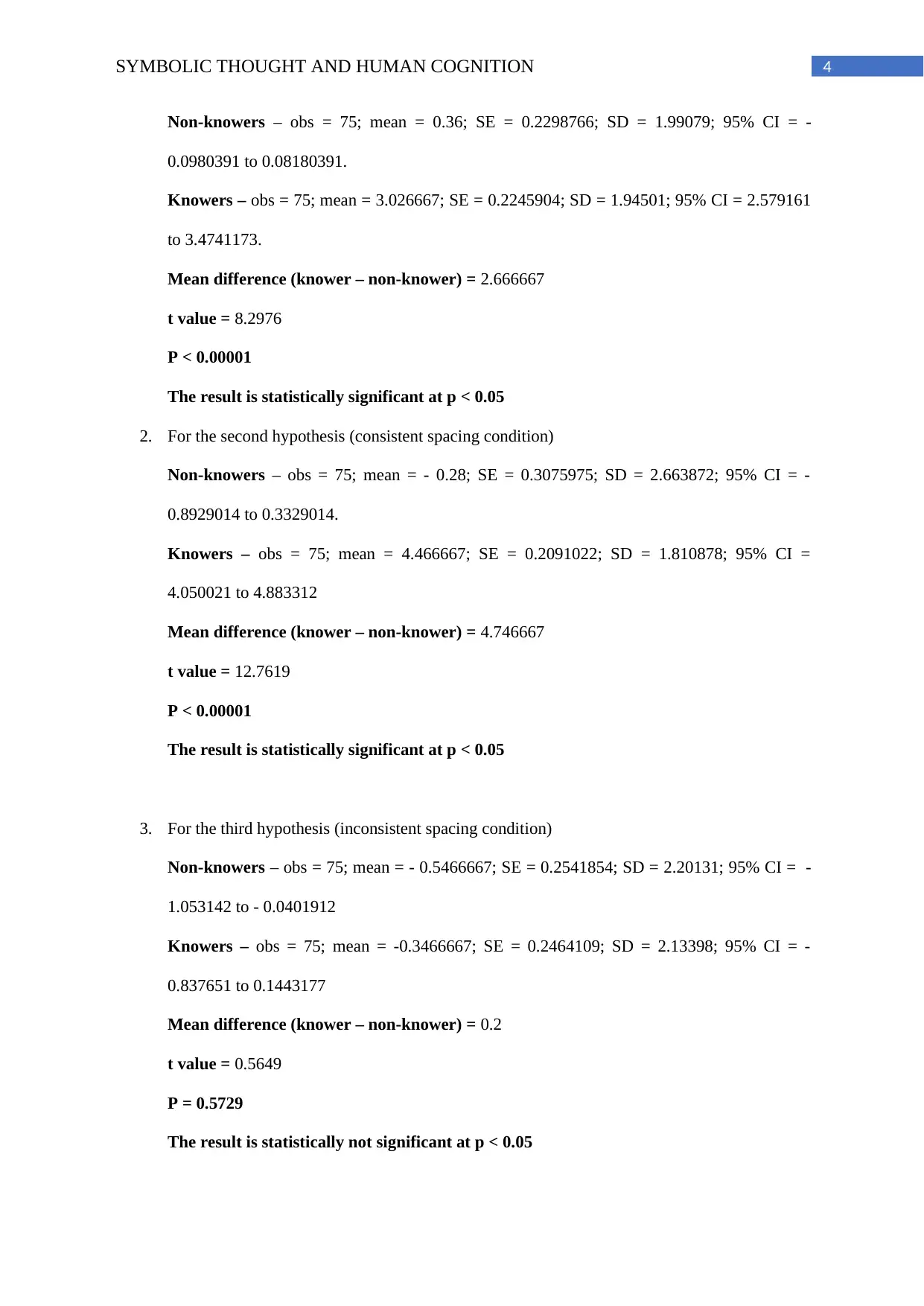
For calculating the results of the main experiment, a two sample t-test was conducted which showed
the following results:
1. For the first hypothesis (Syntax knower vs non knower in neutral spacing condition):
Paraphrase This Document
Need a fresh take? Get an instant paraphrase of this document with our AI Paraphraser
4SYMBOLIC THOUGHT AND HUMAN COGNITION
Non-knowers – obs = 75; mean = 0.36; SE = 0.2298766; SD = 1.99079; 95% CI = -
0.0980391 to 0.08180391.
Knowers – obs = 75; mean = 3.026667; SE = 0.2245904; SD = 1.94501; 95% CI = 2.579161
to 3.4741173.
Mean difference (knower – non-knower) = 2.666667
t value = 8.2976
P < 0.00001
The result is statistically significant at p < 0.05
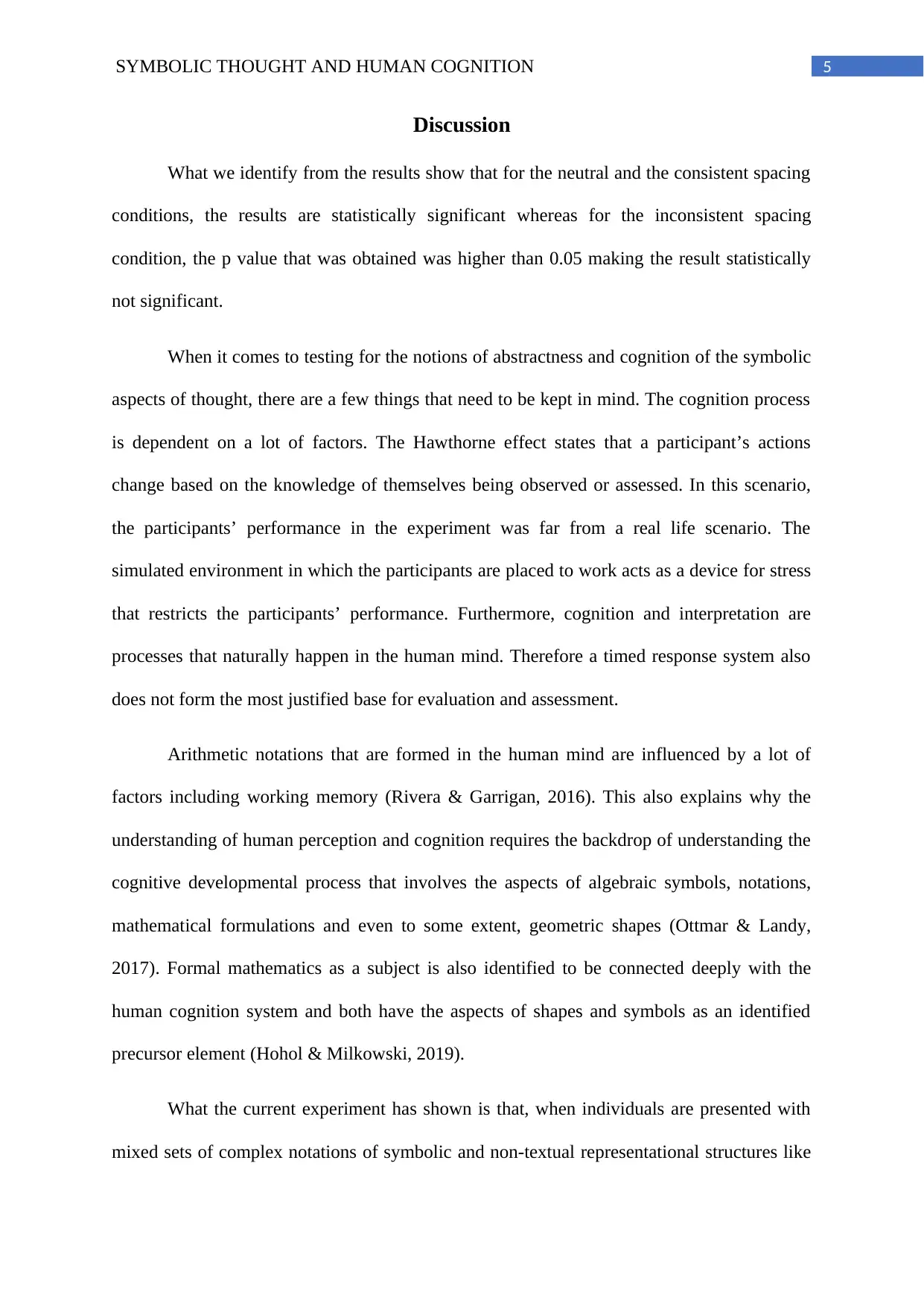
2. For the second hypothesis (consistent spacing condition)
Non-knowers – obs = 75; mean = - 0.28; SE = 0.3075975; SD = 2.663872; 95% CI = -
0.8929014 to 0.3329014.
Knowers – obs = 75; mean = 4.466667; SE = 0.2091022; SD = 1.810878; 95% CI =
4.050021 to 4.883312
Mean difference (knower – non-knower) = 4.746667
t value = 12.7619
P < 0.00001
The result is statistically significant at p < 0.05
3. For the third hypothesis (inconsistent spacing condition)
Non-knowers – obs = 75; mean = - 0.5466667; SE = 0.2541854; SD = 2.20131; 95% CI = -
1.053142 to - 0.0401912
Knowers – obs = 75; mean = -0.3466667; SE = 0.2464109; SD = 2.13398; 95% CI = -
0.837651 to 0.1443177
Mean difference (knower – non-knower) = 0.2
t value = 0.5649
P = 0.5729
The result is statistically not significant at p < 0.05
Non-knowers – obs = 75; mean = 0.36; SE = 0.2298766; SD = 1.99079; 95% CI = -
0.0980391 to 0.08180391.
Knowers – obs = 75; mean = 3.026667; SE = 0.2245904; SD = 1.94501; 95% CI = 2.579161
to 3.4741173.
Mean difference (knower – non-knower) = 2.666667
t value = 8.2976
P < 0.00001
The result is statistically significant at p < 0.05
2. For the second hypothesis (consistent spacing condition)
Non-knowers – obs = 75; mean = - 0.28; SE = 0.3075975; SD = 2.663872; 95% CI = -
0.8929014 to 0.3329014.
Knowers – obs = 75; mean = 4.466667; SE = 0.2091022; SD = 1.810878; 95% CI =
4.050021 to 4.883312
Mean difference (knower – non-knower) = 4.746667
t value = 12.7619
P < 0.00001
The result is statistically significant at p < 0.05
3. For the third hypothesis (inconsistent spacing condition)
Non-knowers – obs = 75; mean = - 0.5466667; SE = 0.2541854; SD = 2.20131; 95% CI = -
1.053142 to - 0.0401912
Knowers – obs = 75; mean = -0.3466667; SE = 0.2464109; SD = 2.13398; 95% CI = -
0.837651 to 0.1443177
Mean difference (knower – non-knower) = 0.2
t value = 0.5649
P = 0.5729
The result is statistically not significant at p < 0.05
5SYMBOLIC THOUGHT AND HUMAN COGNITION
Discussion
What we identify from the results show that for the neutral and the consistent spacing
conditions, the results are statistically significant whereas for the inconsistent spacing
condition, the p value that was obtained was higher than 0.05 making the result statistically
not significant.
When it comes to testing for the notions of abstractness and cognition of the symbolic
aspects of thought, there are a few things that need to be kept in mind. The cognition process
is dependent on a lot of factors. The Hawthorne effect states that a participant’s actions
change based on the knowledge of themselves being observed or assessed. In this scenario,
the participants’ performance in the experiment was far from a real life scenario. The
simulated environment in which the participants are placed to work acts as a device for stress
that restricts the participants’ performance. Furthermore, cognition and interpretation are
processes that naturally happen in the human mind. Therefore a timed response system also
does not form the most justified base for evaluation and assessment.
Arithmetic notations that are formed in the human mind are influenced by a lot of
factors including working memory (Rivera & Garrigan, 2016). This also explains why the
understanding of human perception and cognition requires the backdrop of understanding the
cognitive developmental process that involves the aspects of algebraic symbols, notations,
mathematical formulations and even to some extent, geometric shapes (Ottmar & Landy,
2017). Formal mathematics as a subject is also identified to be connected deeply with the
human cognition system and both have the aspects of shapes and symbols as an identified
precursor element (Hohol & Milkowski, 2019).
What the current experiment has shown is that, when individuals are presented with
mixed sets of complex notations of symbolic and non-textual representational structures like
Discussion
What we identify from the results show that for the neutral and the consistent spacing
conditions, the results are statistically significant whereas for the inconsistent spacing
condition, the p value that was obtained was higher than 0.05 making the result statistically
not significant.
When it comes to testing for the notions of abstractness and cognition of the symbolic
aspects of thought, there are a few things that need to be kept in mind. The cognition process
is dependent on a lot of factors. The Hawthorne effect states that a participant’s actions
change based on the knowledge of themselves being observed or assessed. In this scenario,
the participants’ performance in the experiment was far from a real life scenario. The
simulated environment in which the participants are placed to work acts as a device for stress
that restricts the participants’ performance. Furthermore, cognition and interpretation are
processes that naturally happen in the human mind. Therefore a timed response system also
does not form the most justified base for evaluation and assessment.
Arithmetic notations that are formed in the human mind are influenced by a lot of
factors including working memory (Rivera & Garrigan, 2016). This also explains why the
understanding of human perception and cognition requires the backdrop of understanding the
cognitive developmental process that involves the aspects of algebraic symbols, notations,
mathematical formulations and even to some extent, geometric shapes (Ottmar & Landy,
2017). Formal mathematics as a subject is also identified to be connected deeply with the
human cognition system and both have the aspects of shapes and symbols as an identified
precursor element (Hohol & Milkowski, 2019).
What the current experiment has shown is that, when individuals are presented with
mixed sets of complex notations of symbolic and non-textual representational structures like
⊘ This is a preview!⊘
Do you want full access?
Subscribe today to unlock all pages.
Trusted by 1+ million students worldwide
6SYMBOLIC THOUGHT AND HUMAN COGNITION
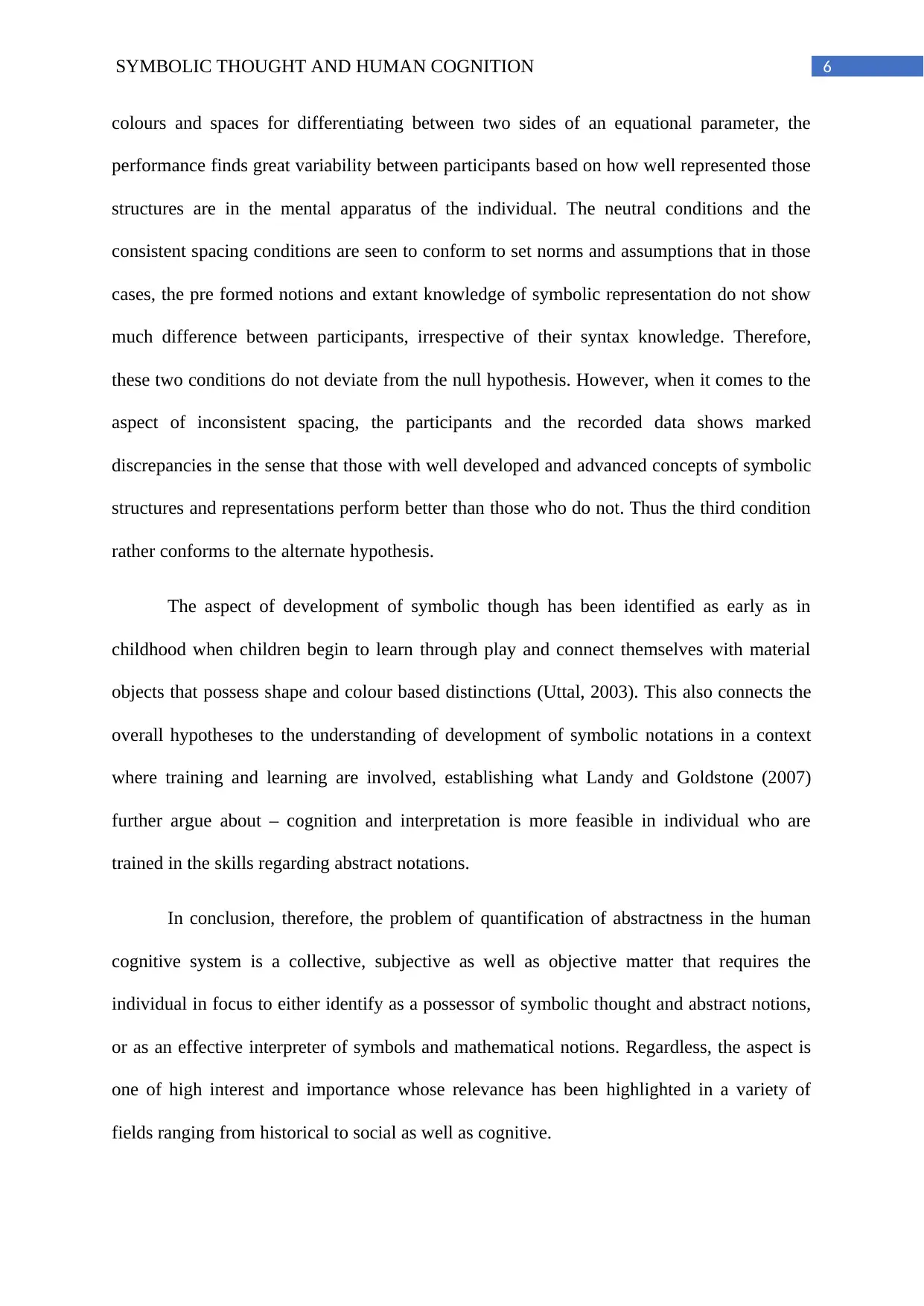
colours and spaces for differentiating between two sides of an equational parameter, the
performance finds great variability between participants based on how well represented those
structures are in the mental apparatus of the individual. The neutral conditions and the
consistent spacing conditions are seen to conform to set norms and assumptions that in those
cases, the pre formed notions and extant knowledge of symbolic representation do not show
much difference between participants, irrespective of their syntax knowledge. Therefore,
these two conditions do not deviate from the null hypothesis. However, when it comes to the
aspect of inconsistent spacing, the participants and the recorded data shows marked
discrepancies in the sense that those with well developed and advanced concepts of symbolic
structures and representations perform better than those who do not. Thus the third condition
rather conforms to the alternate hypothesis.
The aspect of development of symbolic though has been identified as early as in
childhood when children begin to learn through play and connect themselves with material
objects that possess shape and colour based distinctions (Uttal, 2003). This also connects the
overall hypotheses to the understanding of development of symbolic notations in a context
where training and learning are involved, establishing what Landy and Goldstone (2007)
further argue about – cognition and interpretation is more feasible in individual who are
trained in the skills regarding abstract notations.
In conclusion, therefore, the problem of quantification of abstractness in the human
cognitive system is a collective, subjective as well as objective matter that requires the
individual in focus to either identify as a possessor of symbolic thought and abstract notions,
or as an effective interpreter of symbols and mathematical notions. Regardless, the aspect is
one of high interest and importance whose relevance has been highlighted in a variety of
fields ranging from historical to social as well as cognitive.
colours and spaces for differentiating between two sides of an equational parameter, the
performance finds great variability between participants based on how well represented those
structures are in the mental apparatus of the individual. The neutral conditions and the
consistent spacing conditions are seen to conform to set norms and assumptions that in those
cases, the pre formed notions and extant knowledge of symbolic representation do not show
much difference between participants, irrespective of their syntax knowledge. Therefore,
these two conditions do not deviate from the null hypothesis. However, when it comes to the
aspect of inconsistent spacing, the participants and the recorded data shows marked
discrepancies in the sense that those with well developed and advanced concepts of symbolic
structures and representations perform better than those who do not. Thus the third condition
rather conforms to the alternate hypothesis.
The aspect of development of symbolic though has been identified as early as in
childhood when children begin to learn through play and connect themselves with material
objects that possess shape and colour based distinctions (Uttal, 2003). This also connects the
overall hypotheses to the understanding of development of symbolic notations in a context
where training and learning are involved, establishing what Landy and Goldstone (2007)
further argue about – cognition and interpretation is more feasible in individual who are
trained in the skills regarding abstract notations.
In conclusion, therefore, the problem of quantification of abstractness in the human
cognitive system is a collective, subjective as well as objective matter that requires the
individual in focus to either identify as a possessor of symbolic thought and abstract notions,
or as an effective interpreter of symbols and mathematical notions. Regardless, the aspect is
one of high interest and importance whose relevance has been highlighted in a variety of
fields ranging from historical to social as well as cognitive.
Paraphrase This Document
Need a fresh take? Get an instant paraphrase of this document with our AI Paraphraser
7SYMBOLIC THOUGHT AND HUMAN COGNITION
References
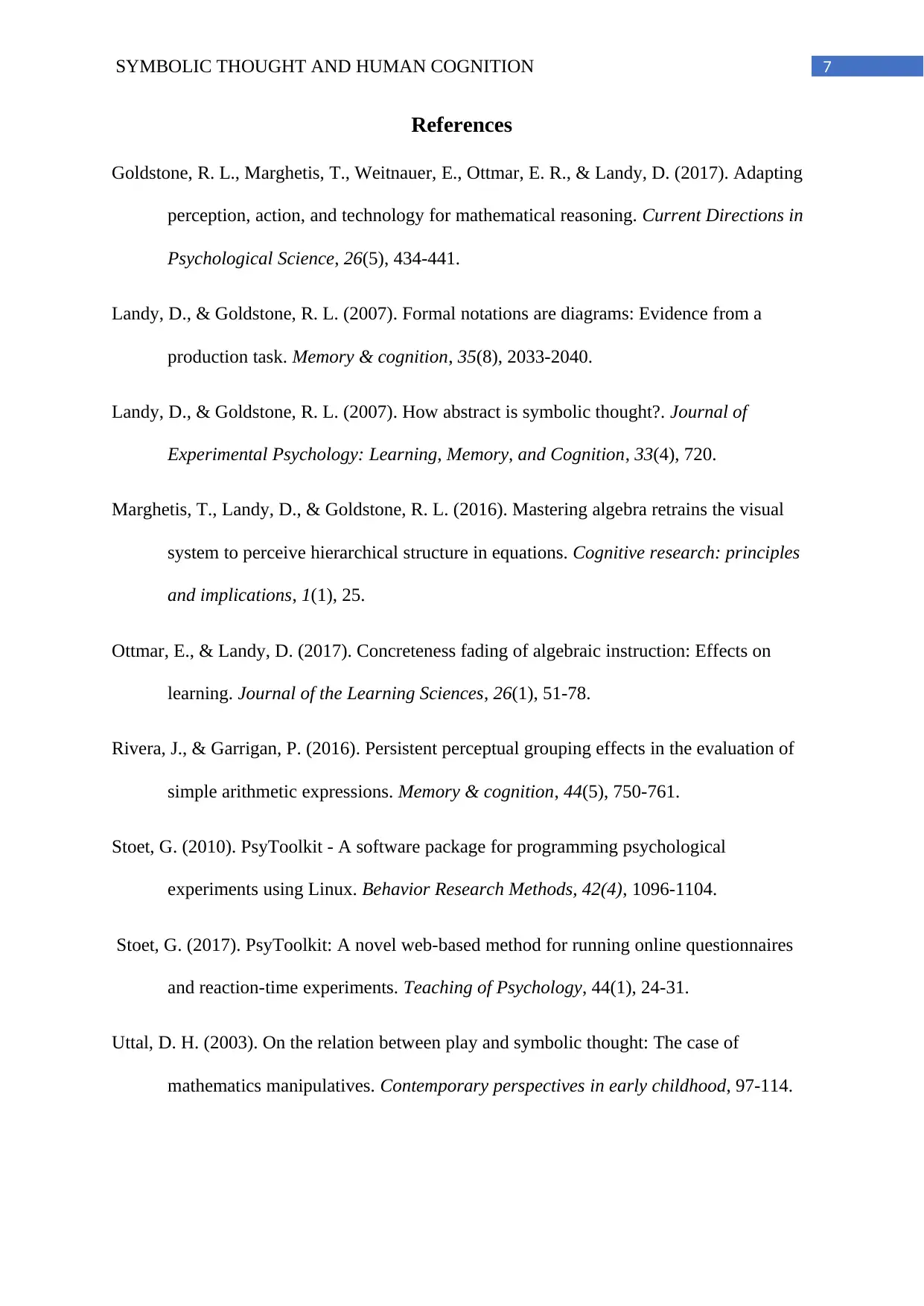
Goldstone, R. L., Marghetis, T., Weitnauer, E., Ottmar, E. R., & Landy, D. (2017). Adapting
perception, action, and technology for mathematical reasoning. Current Directions in
Psychological Science, 26(5), 434-441.
Landy, D., & Goldstone, R. L. (2007). Formal notations are diagrams: Evidence from a
production task. Memory & cognition, 35(8), 2033-2040.
Landy, D., & Goldstone, R. L. (2007). How abstract is symbolic thought?. Journal of
Experimental Psychology: Learning, Memory, and Cognition, 33(4), 720.
Marghetis, T., Landy, D., & Goldstone, R. L. (2016). Mastering algebra retrains the visual
system to perceive hierarchical structure in equations. Cognitive research: principles
and implications, 1(1), 25.
Ottmar, E., & Landy, D. (2017). Concreteness fading of algebraic instruction: Effects on
learning. Journal of the Learning Sciences, 26(1), 51-78.
Rivera, J., & Garrigan, P. (2016). Persistent perceptual grouping effects in the evaluation of
simple arithmetic expressions. Memory & cognition, 44(5), 750-761.
Stoet, G. (2010). PsyToolkit - A software package for programming psychological
experiments using Linux. Behavior Research Methods, 42(4), 1096-1104.
Stoet, G. (2017). PsyToolkit: A novel web-based method for running online questionnaires
and reaction-time experiments. Teaching of Psychology, 44(1), 24-31.
Uttal, D. H. (2003). On the relation between play and symbolic thought: The case of
mathematics manipulatives. Contemporary perspectives in early childhood, 97-114.
References
Goldstone, R. L., Marghetis, T., Weitnauer, E., Ottmar, E. R., & Landy, D. (2017). Adapting
perception, action, and technology for mathematical reasoning. Current Directions in
Psychological Science, 26(5), 434-441.
Landy, D., & Goldstone, R. L. (2007). Formal notations are diagrams: Evidence from a
production task. Memory & cognition, 35(8), 2033-2040.
Landy, D., & Goldstone, R. L. (2007). How abstract is symbolic thought?. Journal of
Experimental Psychology: Learning, Memory, and Cognition, 33(4), 720.
Marghetis, T., Landy, D., & Goldstone, R. L. (2016). Mastering algebra retrains the visual
system to perceive hierarchical structure in equations. Cognitive research: principles
and implications, 1(1), 25.
Ottmar, E., & Landy, D. (2017). Concreteness fading of algebraic instruction: Effects on
learning. Journal of the Learning Sciences, 26(1), 51-78.
Rivera, J., & Garrigan, P. (2016). Persistent perceptual grouping effects in the evaluation of
simple arithmetic expressions. Memory & cognition, 44(5), 750-761.
Stoet, G. (2010). PsyToolkit - A software package for programming psychological
experiments using Linux. Behavior Research Methods, 42(4), 1096-1104.
Stoet, G. (2017). PsyToolkit: A novel web-based method for running online questionnaires
and reaction-time experiments. Teaching of Psychology, 44(1), 24-31.
Uttal, D. H. (2003). On the relation between play and symbolic thought: The case of
mathematics manipulatives. Contemporary perspectives in early childhood, 97-114.

1 out of 8


Your All-in-One AI-Powered Toolkit for Academic Success.
+13062052269
info@desklib.com
Available 24*7 on WhatsApp / Email
![[object Object]](/_next/static/media/star-bottom.7253800d.svg)
Unlock your academic potential
Copyright © 2020–2026 A2Z Services. All Rights Reserved. Developed and managed by ZUCOL.