Understanding Human Development for Social and Community Work (2019)
VerifiedAdded on 2023/01/12
|12
|4238
|85
Report
AI Summary
This report delves into the application of human development theories within social and community work, using a case study of an eleven-year-old boy named Kenny to illustrate key concepts. It begins by exploring influential theories such as Piaget's stages of cognitive development and attachment theory, outlining their impact on social work practices. The report then analyzes the importance of biological and environmental factors in human development, specifically examining prenatal risk factors like maternal substance abuse and its effects on Kenny's development. It further investigates the impact of life events throughout childhood and adolescence, highlighting the role of prenatal care, birth weight, and other factors. Finally, the report discusses the impact of life events in adulthood and explores the range of social and community services that can support individuals experiencing different life stages and challenges, offering insights into practical applications for social workers.
Applying understanding of
human development in social
and community work
human development in social
and community work

Paraphrase This Document
Need a fresh take? Get an instant paraphrase of this document with our AI Paraphraser
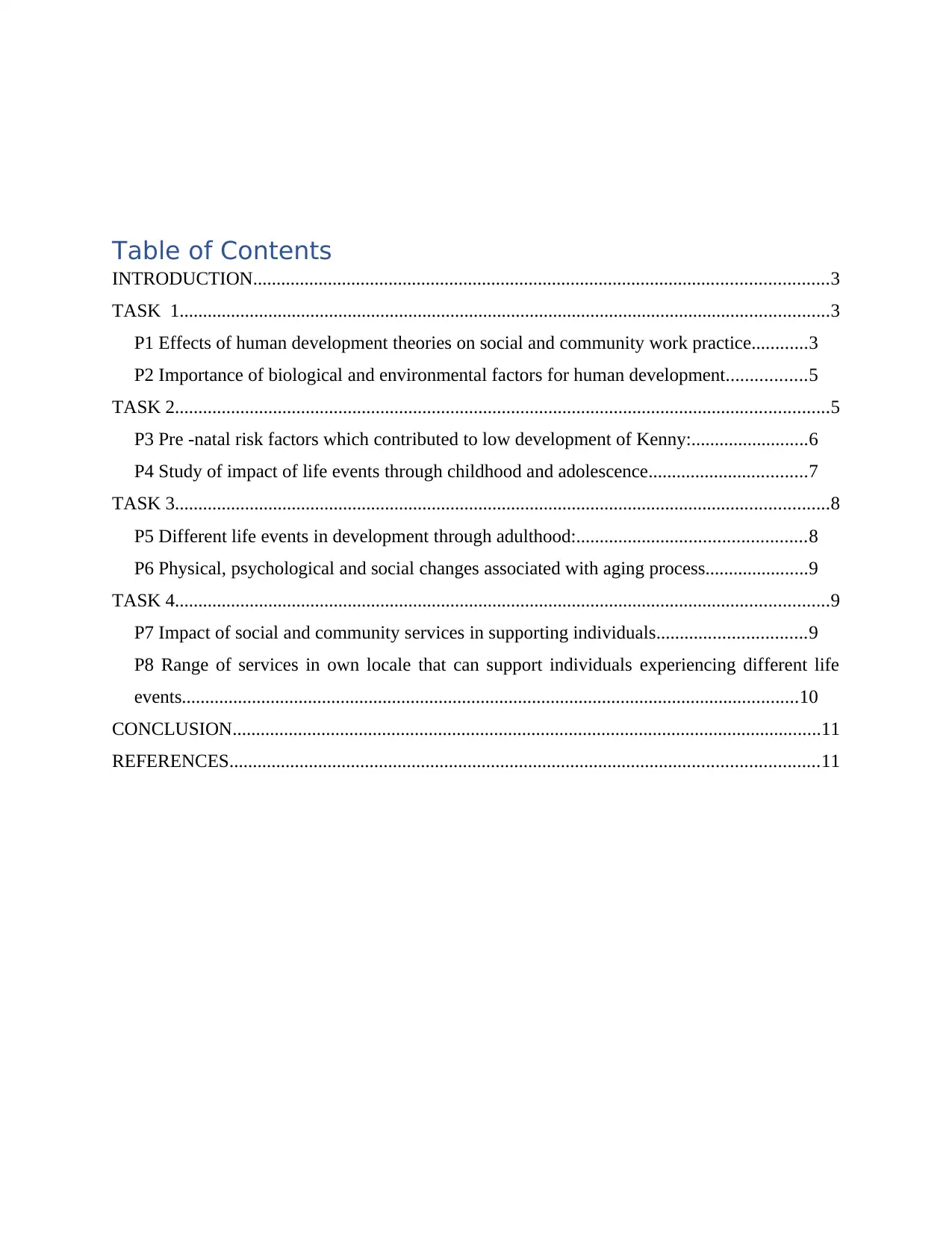
Table of Contents
INTRODUCTION...........................................................................................................................3
TASK 1...........................................................................................................................................3
P1 Effects of human development theories on social and community work practice............3
P2 Importance of biological and environmental factors for human development.................5
TASK 2............................................................................................................................................5
P3 Pre -natal risk factors which contributed to low development of Kenny:.........................6
P4 Study of impact of life events through childhood and adolescence..................................7
TASK 3............................................................................................................................................8
P5 Different life events in development through adulthood:.................................................8
P6 Physical, psychological and social changes associated with aging process......................9
TASK 4............................................................................................................................................9
P7 Impact of social and community services in supporting individuals................................9
P8 Range of services in own locale that can support individuals experiencing different life
events....................................................................................................................................10
CONCLUSION..............................................................................................................................11
REFERENCES..............................................................................................................................11
INTRODUCTION...........................................................................................................................3
TASK 1...........................................................................................................................................3
P1 Effects of human development theories on social and community work practice............3
P2 Importance of biological and environmental factors for human development.................5
TASK 2............................................................................................................................................5
P3 Pre -natal risk factors which contributed to low development of Kenny:.........................6
P4 Study of impact of life events through childhood and adolescence..................................7
TASK 3............................................................................................................................................8
P5 Different life events in development through adulthood:.................................................8
P6 Physical, psychological and social changes associated with aging process......................9
TASK 4............................................................................................................................................9
P7 Impact of social and community services in supporting individuals................................9
P8 Range of services in own locale that can support individuals experiencing different life
events....................................................................................................................................10
CONCLUSION..............................................................................................................................11
REFERENCES..............................................................................................................................11
INTRODUCTION
Human development refers to a process in which people’s freedom is enlarged along with
improving their well-being and creating opportunities for them to grow. In this ordinary people
need to decide who to be, what to do and how do they deserve to live. In today’s era social
workers are involved in development of individual’s as well as community at large. It is
responsibility of social workers to understand people and notice their development and their life
situations in the course of their development (Kail and Cavanaugh, 2018). The following report
discusses about an eleven-year-old boy Kenny who have had a troublesome childhood and due to
which his mother is worried about his adolescence. Being a social worker, it is my duty to learn
about his past and in order to know the effects they might have on his development. Various
theories are also described in relation to it. Also impact of social services in supporting
individuals as well as community is discussed.
TASK 1
P1 Effects of human development theories on social and community work practice
Various theories of human development have been discussed which might help in
development of Kenny. Below mentioned are two such theories namely Piaget’s stages of
cognitive development and attachment theory:
PIAGET’S STAGES OF COGNITIVE DEVELOPMENT
This theory of cognitive development states that there are four stages involved in
development of cognitive abilities. This is an effective theory for development of a child’s
knowledge as well as activity. This theory basically consists of four stages for brain development
in a child. Below mentioned are those four stages of development in this theory:
Sensorimotor: This occurs from birth to age of two years. It is said that a child uses seeing,
hearing, touching, smelling and tasting. They start hearing sounds playing, throwing objects et
cetera. It is said that a child develops object permanence and start developing existence of
material. At the end of the state child of fun starts imitation.
Pre-Operational stage: The pre-operational stage is from 2 to 7 years. In this child uses words,
ideas, images in order to represent their thoughts. In this stage they do not start logical reasoning.
However, they start showing an ability to pretend. It is often seen at this stage of development a
Human development refers to a process in which people’s freedom is enlarged along with
improving their well-being and creating opportunities for them to grow. In this ordinary people
need to decide who to be, what to do and how do they deserve to live. In today’s era social
workers are involved in development of individual’s as well as community at large. It is
responsibility of social workers to understand people and notice their development and their life
situations in the course of their development (Kail and Cavanaugh, 2018). The following report
discusses about an eleven-year-old boy Kenny who have had a troublesome childhood and due to
which his mother is worried about his adolescence. Being a social worker, it is my duty to learn
about his past and in order to know the effects they might have on his development. Various
theories are also described in relation to it. Also impact of social services in supporting
individuals as well as community is discussed.
TASK 1
P1 Effects of human development theories on social and community work practice
Various theories of human development have been discussed which might help in
development of Kenny. Below mentioned are two such theories namely Piaget’s stages of
cognitive development and attachment theory:
PIAGET’S STAGES OF COGNITIVE DEVELOPMENT
This theory of cognitive development states that there are four stages involved in
development of cognitive abilities. This is an effective theory for development of a child’s
knowledge as well as activity. This theory basically consists of four stages for brain development
in a child. Below mentioned are those four stages of development in this theory:
Sensorimotor: This occurs from birth to age of two years. It is said that a child uses seeing,
hearing, touching, smelling and tasting. They start hearing sounds playing, throwing objects et
cetera. It is said that a child develops object permanence and start developing existence of
material. At the end of the state child of fun starts imitation.
Pre-Operational stage: The pre-operational stage is from 2 to 7 years. In this child uses words,
ideas, images in order to represent their thoughts. In this stage they do not start logical reasoning.
However, they start showing an ability to pretend. It is often seen at this stage of development a
⊘ This is a preview!⊘
Do you want full access?
Subscribe today to unlock all pages.

Trusted by 1+ million students worldwide
child is very egocentric, all the focus on is how an action might impact them rather than others.
They disagree to take others perspective and think or do whatever they like (Weiss, 2017).
Concrete operational stage: This stage occurs from seven years of age to age of 11 years. it is
said that child start reasoning and thinking logically. They start focusing on key properties of
substance while their physical appearance keeps on altering. The quantity of liquid, the depth of
container, all these are various examples of logical thinking of a child in this stage (Goodway,
Ozmun and Gallahue, 2019).
Formal Operational: It considers age of 11 to the adulthood in this a child develops ability to
think in a number of abstract ways. Children often engage in problem-solving methods and also
develop reasoning as well as hypothesis to solve the problems. They combine various ideas and
thoughts to create new ideas. At the end of the state child have already developed systematic
thinking and they can easily create hypothesis to explain their concepts.
ATTACHMENT THEORY
According to this theory it is assumed that children are often developing attachment to
their caregivers. In this theory the idea of caregiver is introduced as being a secure base for a
child it is necessary to know that whether this is a secure base was created for a child or not there
are four stages of this theory mentioned below:
Pre-attachment: it happens from the birth of a child to 6 weeks. In this a child learns from the
signals, crying, queen, and bringing new-born baby in proximity with their caregiver. A child is
often comforted with voice and smell of things. Baby forms an attachment with caregiver at this
stage. However, this is not permanent as baby may also feel comfortable with unfamiliar people.
Attachment in the making: attachment usually gets stronger at this stage and an infant start
responding differently to different people. It can be seen as a baby might be happier and more
talkative with his parents rather than any relative, he meets in a month. Parents build attachment
with baby providing them food, shelter as well as comfort (Innis, 2016).
Clear cut attachment: this takes place from eight months to 18 months the caregivers attachment
goes on strengthening and a toddler starts getting anxious in absence of caregiver. They might
want to be around their caregivers all the time and at this stage parents strengthen this attachment
by meeting basic needs of the child and playing with them.
Formation of reciprocal attachment: This stage takes place during 18 months to 2 years. In this
language growth as well as new concepts are adopted by child. The anxiety faced by child in the
They disagree to take others perspective and think or do whatever they like (Weiss, 2017).
Concrete operational stage: This stage occurs from seven years of age to age of 11 years. it is
said that child start reasoning and thinking logically. They start focusing on key properties of
substance while their physical appearance keeps on altering. The quantity of liquid, the depth of
container, all these are various examples of logical thinking of a child in this stage (Goodway,
Ozmun and Gallahue, 2019).
Formal Operational: It considers age of 11 to the adulthood in this a child develops ability to
think in a number of abstract ways. Children often engage in problem-solving methods and also
develop reasoning as well as hypothesis to solve the problems. They combine various ideas and
thoughts to create new ideas. At the end of the state child have already developed systematic
thinking and they can easily create hypothesis to explain their concepts.
ATTACHMENT THEORY
According to this theory it is assumed that children are often developing attachment to
their caregivers. In this theory the idea of caregiver is introduced as being a secure base for a
child it is necessary to know that whether this is a secure base was created for a child or not there
are four stages of this theory mentioned below:
Pre-attachment: it happens from the birth of a child to 6 weeks. In this a child learns from the
signals, crying, queen, and bringing new-born baby in proximity with their caregiver. A child is
often comforted with voice and smell of things. Baby forms an attachment with caregiver at this
stage. However, this is not permanent as baby may also feel comfortable with unfamiliar people.
Attachment in the making: attachment usually gets stronger at this stage and an infant start
responding differently to different people. It can be seen as a baby might be happier and more
talkative with his parents rather than any relative, he meets in a month. Parents build attachment
with baby providing them food, shelter as well as comfort (Innis, 2016).
Clear cut attachment: this takes place from eight months to 18 months the caregivers attachment
goes on strengthening and a toddler starts getting anxious in absence of caregiver. They might
want to be around their caregivers all the time and at this stage parents strengthen this attachment
by meeting basic needs of the child and playing with them.
Formation of reciprocal attachment: This stage takes place during 18 months to 2 years. In this
language growth as well as new concepts are adopted by child. The anxiety faced by child in the
Paraphrase This Document
Need a fresh take? Get an instant paraphrase of this document with our AI Paraphraser
earlier stage starts to decrease as the child start understanding that the care giver has many other
works to do as well. Parents continue to secure attachment with children by making them
understand things and continuously meeting their basic needs.
Following are the major two theories of development in human which can be studied
while dealing with Kenny’s case. Whether this development happened at the right time in his life
or not will help in developing a program in order to help him.
P2 Importance of biological and environmental factors for human development
Biological factors: Biological factors hold an important role for development of a child. They
help in nutritional development of child, gender of a child is also decided through these, it is
often seen that biological factors require interactions they do not work in isolation. This is how
biological factors stays important for growth and development of a child.
Environmental Factors: It is important that an environment that a child grows in always stays
clean and hygienic for proper growth of child. It helps a child in development physically as well
as mentally. The environment in which a child grows have deep rooted effects on their behaviour
and actions as well. it is often said that a child learns what it sees. Therefore, environmental
factors are important for a child’s growth and development.
TASK 2
Prenatal care of a mother is very important in order to make sure that growth of the child
is done correctly physically as well as mentally. There are a number of disabilities which can
occur to a child due to improper prenatal care while the mother is pregnant.
Development disabilities may occur in a single person. These disabilities are including
sensory difficulties or cognitive difficulties, communications related problem, impairment of
motor skills, delay in adoption, or in combination of all of these. It is assumed that 10% to 20%
of individuals face some or the other kind of developmental disability (Walker and Fongwa,
2017). The prenatal factors which include maternal illness, infections, toxin exposures and
nutritional deficiencies lead to such disability. Major risk factors are complications in pregnancy,
premature birth and low birth weight due to this. Many times, this also happens due to lack of
quality care during pregnancy as well as delivery of child.
works to do as well. Parents continue to secure attachment with children by making them
understand things and continuously meeting their basic needs.
Following are the major two theories of development in human which can be studied
while dealing with Kenny’s case. Whether this development happened at the right time in his life
or not will help in developing a program in order to help him.
P2 Importance of biological and environmental factors for human development
Biological factors: Biological factors hold an important role for development of a child. They
help in nutritional development of child, gender of a child is also decided through these, it is
often seen that biological factors require interactions they do not work in isolation. This is how
biological factors stays important for growth and development of a child.
Environmental Factors: It is important that an environment that a child grows in always stays
clean and hygienic for proper growth of child. It helps a child in development physically as well
as mentally. The environment in which a child grows have deep rooted effects on their behaviour
and actions as well. it is often said that a child learns what it sees. Therefore, environmental
factors are important for a child’s growth and development.
TASK 2
Prenatal care of a mother is very important in order to make sure that growth of the child
is done correctly physically as well as mentally. There are a number of disabilities which can
occur to a child due to improper prenatal care while the mother is pregnant.
Development disabilities may occur in a single person. These disabilities are including
sensory difficulties or cognitive difficulties, communications related problem, impairment of
motor skills, delay in adoption, or in combination of all of these. It is assumed that 10% to 20%
of individuals face some or the other kind of developmental disability (Walker and Fongwa,
2017). The prenatal factors which include maternal illness, infections, toxin exposures and
nutritional deficiencies lead to such disability. Major risk factors are complications in pregnancy,
premature birth and low birth weight due to this. Many times, this also happens due to lack of
quality care during pregnancy as well as delivery of child.
P3 Pre -natal risk factors which contributed to low development of Kenny:
Prenatal Toxins: The development of a foetal brain is very vulnerable to an environment filled
with toxins. The blood brain barrier is immature to toxins. There is a rapid growth of rain while
mother is in second trimester. If toxins are in taken by the mother growing cells become more
vulnerable to toxins during this term. These toxins me include smoking, alcohol, other drugs as
well as in normal toxins. Smoking of a pregnant mother leads to placental abruption, preterm
labour and calls or adversely affect the foetal growth. Kenny’s mother was indulged into
smoking which might be a reason for her preterm labour. Consumption of alcohol during
pregnancy is lead to cognitive disability, learning disability and so on. It also leads to
behavioural changes in the child. Alcohol causes development of brain of a foetus to slow down.
Christine was indulged in alcohol you too much development of Kenny was affected a lot. Other
drugs during maternal pregnancy leads to developmental disabilities as well. Christine was
indulged in all kind of drugs which led to poor development of Kenny.
Maternal nutritional deficiencies: The nervous system of a fetus is directly linked to the
nutrition that is increasing by a mother during her pregnancy. It is estimated that more than 90%
of serious defects that occur in a child during birth is due to nutritional deficiencies of mother.
The development disability may also be combined with exposure to toxins including alcohol,
smoking, and other drugs (Ninio, 2018). My nutrition of a mother before as well as during the
pregnancy may have a negative impact on the birth weight of infant and his development as well.
When Kenny was born, he was underweight. Christine was highly dependent on drugs and never
took care of herself while pregnancy. This led to preterm labour and birth of Kenny. She also
earned through prostitution which opened the door for a number of infections.
Preterm Birth: Preterm birth is the major factor which might lead to developmental disabilities
in a child. It is necessary for a child or an infant to stay in mother’s womb for the required period
of time in order to gain all the required nutrition from them. Due to early birth the risk of preterm
delivery, multi foetal pregnancy, prenatal exposure to drugs, prolonged damage to membrane as
well as bacterial infections may occur in the child. Kenny was a pre term baby. He also stayed in
hospital for three months after delivery. He was exposed to a number of drugs during this day in
hospital. This is a major reason for developmental disabilities in him.
Prenatal infections: There are a number of prenatal infections which might affect developmental
disabilities of a child. This includes sexually transmitted diseases, bacterial infections, invasive
Prenatal Toxins: The development of a foetal brain is very vulnerable to an environment filled
with toxins. The blood brain barrier is immature to toxins. There is a rapid growth of rain while
mother is in second trimester. If toxins are in taken by the mother growing cells become more
vulnerable to toxins during this term. These toxins me include smoking, alcohol, other drugs as
well as in normal toxins. Smoking of a pregnant mother leads to placental abruption, preterm
labour and calls or adversely affect the foetal growth. Kenny’s mother was indulged into
smoking which might be a reason for her preterm labour. Consumption of alcohol during
pregnancy is lead to cognitive disability, learning disability and so on. It also leads to
behavioural changes in the child. Alcohol causes development of brain of a foetus to slow down.
Christine was indulged in alcohol you too much development of Kenny was affected a lot. Other
drugs during maternal pregnancy leads to developmental disabilities as well. Christine was
indulged in all kind of drugs which led to poor development of Kenny.
Maternal nutritional deficiencies: The nervous system of a fetus is directly linked to the
nutrition that is increasing by a mother during her pregnancy. It is estimated that more than 90%
of serious defects that occur in a child during birth is due to nutritional deficiencies of mother.
The development disability may also be combined with exposure to toxins including alcohol,
smoking, and other drugs (Ninio, 2018). My nutrition of a mother before as well as during the
pregnancy may have a negative impact on the birth weight of infant and his development as well.
When Kenny was born, he was underweight. Christine was highly dependent on drugs and never
took care of herself while pregnancy. This led to preterm labour and birth of Kenny. She also
earned through prostitution which opened the door for a number of infections.
Preterm Birth: Preterm birth is the major factor which might lead to developmental disabilities
in a child. It is necessary for a child or an infant to stay in mother’s womb for the required period
of time in order to gain all the required nutrition from them. Due to early birth the risk of preterm
delivery, multi foetal pregnancy, prenatal exposure to drugs, prolonged damage to membrane as
well as bacterial infections may occur in the child. Kenny was a pre term baby. He also stayed in
hospital for three months after delivery. He was exposed to a number of drugs during this day in
hospital. This is a major reason for developmental disabilities in him.
Prenatal infections: There are a number of prenatal infections which might affect developmental
disabilities of a child. This includes sexually transmitted diseases, bacterial infections, invasive
⊘ This is a preview!⊘
Do you want full access?
Subscribe today to unlock all pages.
Trusted by 1+ million students worldwide
group B Strep, listeria infection. Christine was a prostitution by profession. She was actively
working even after conceiving can you, this led to developmental disabilities in Kenny because
she never checked herself for any infection and it is very valid that she might have any of these
infections mentioned above.
P4 Study of impact of life events through childhood and adolescence
There are a range of life events affecting development through childhood and adolescents.
There are a number of such events in Kenny’s life which affected his growth and development.
These events occurred through his childhood as well as adolescent. Below are mentioned such
events which contributed to low development of Kenny.
Prenatal care: prenatal care is very important for a child. In this case Christine mentions Kenny
as a mistake or an accident. She was highly dependent on drugs and worked as a prostitute so
that she can support her addiction. The father of her child was also a drug dealer. She never took
care while her pregnancy and continued to work as a prostitute. This led to pre-term birth of
Kenny leading to deficiency in him while birth (Vondracek, Lerner and Schulenberg, 2019).
Birth weight: Kenny was underweight because he was prematurely born before eight weeks. His
weight during birth was very low. Due to this he had to spend three months in hospital. It is also
mentioned that he was left alone crying. Christine never took care of him. He had undergone a
number of caretakers as Christine was always switching jobs and was busy with it.
Violence: Kenny has to face a number of violent incidents while growing up. When he was of
two years his father continuously abused him, strike him, pushed him shouting at him and calling
him names. Christine’s mother Judy was very worried due to this. There was lack of furniture as
well as toys in house. She then took Kenny with her and lived with him for a year in order to
work on her routine. This violence which Kenny faced at such a small age had great effect on his
might which is also a major reason behind developmental disabilities faced by him.
Ignorance: After a year Christine took Kenny back with her. This was the time she was trying to
quit on her drugs. This led her to depression and no focus was paid on Kenny while this period.
He was often left ignored in his room busy in playing with his own toys. Due to this ignorance
Kenny could never develop the required qualities which children of his age generally do. He was
left behind from all other child of his age (Peters and Wolper, 2018). It is important to focus on
child and give him time. Ignoring them might lead to developmental disabilities in them. The
same is what happened with Kenny.
working even after conceiving can you, this led to developmental disabilities in Kenny because
she never checked herself for any infection and it is very valid that she might have any of these
infections mentioned above.
P4 Study of impact of life events through childhood and adolescence
There are a range of life events affecting development through childhood and adolescents.
There are a number of such events in Kenny’s life which affected his growth and development.
These events occurred through his childhood as well as adolescent. Below are mentioned such
events which contributed to low development of Kenny.
Prenatal care: prenatal care is very important for a child. In this case Christine mentions Kenny
as a mistake or an accident. She was highly dependent on drugs and worked as a prostitute so
that she can support her addiction. The father of her child was also a drug dealer. She never took
care while her pregnancy and continued to work as a prostitute. This led to pre-term birth of
Kenny leading to deficiency in him while birth (Vondracek, Lerner and Schulenberg, 2019).
Birth weight: Kenny was underweight because he was prematurely born before eight weeks. His
weight during birth was very low. Due to this he had to spend three months in hospital. It is also
mentioned that he was left alone crying. Christine never took care of him. He had undergone a
number of caretakers as Christine was always switching jobs and was busy with it.
Violence: Kenny has to face a number of violent incidents while growing up. When he was of
two years his father continuously abused him, strike him, pushed him shouting at him and calling
him names. Christine’s mother Judy was very worried due to this. There was lack of furniture as
well as toys in house. She then took Kenny with her and lived with him for a year in order to
work on her routine. This violence which Kenny faced at such a small age had great effect on his
might which is also a major reason behind developmental disabilities faced by him.
Ignorance: After a year Christine took Kenny back with her. This was the time she was trying to
quit on her drugs. This led her to depression and no focus was paid on Kenny while this period.
He was often left ignored in his room busy in playing with his own toys. Due to this ignorance
Kenny could never develop the required qualities which children of his age generally do. He was
left behind from all other child of his age (Peters and Wolper, 2018). It is important to focus on
child and give him time. Ignoring them might lead to developmental disabilities in them. The
same is what happened with Kenny.
Paraphrase This Document
Need a fresh take? Get an instant paraphrase of this document with our AI Paraphraser
TASK 3
P5 Different life events in development through adulthood:
Below mentioned are the various life events of Kenny which affected his development through
adulthood:
Difficulty to accept new relationships: Kenny’s mother Christine met Ray and got married to
him. Due to this Kenny had to live with them far from Judy’s house. Kenny often missed her
grandmother. He wasn’t ready to accept Ray and often ignored him. Due to this he also spent
most of his time outside the house. Christine could not do anything about it as she was caught up
in this. It is often seen in children that they need to be explained the need of new relationships in
their lives. They take things negatively and it often affects them and their development. They
start remaining sad and are drawn towards bad influences during this time. After that when other
two child of Christine were born with Ray, Kenny was more cut off with his family. It is
important to take care of old relations with the new ones. Christine was busy in forming her new
family with Ray due to which Kenny felt left out which influenced his development and
disabilities raised.
Peer pressure: By the age of 10 Kenny started mixing up with boys of older age. His peer group
was very unorganised. He had friends who wanted him to do bad things. They often forced him
to take drugs and smoke. When he refused to do that, they would call him names. He was
involved with a group in a nearby park of which all the local residents complained. They even
dared him to shoplift, hit others and abuse others (Payne and Isaacs, 2017). This led to bad
influence on Kenny indulging him in criminal activities as well. It is very important for a child to
have good friends around. The major affects on a child’s behaviour is due to his friends and
people he is brought up around. Child learns from his environment. It is important for parents to
make sure that their child is developing in good peers’ group so that they might not indulge in
any such practice which might harm them in future.
These were some of the life events of Kenny in adulthood which led to poor development
of his. All these factors will prove to be helpful in taking further steps in order to make sure that
proper development of child takes place.
P5 Different life events in development through adulthood:
Below mentioned are the various life events of Kenny which affected his development through
adulthood:
Difficulty to accept new relationships: Kenny’s mother Christine met Ray and got married to
him. Due to this Kenny had to live with them far from Judy’s house. Kenny often missed her
grandmother. He wasn’t ready to accept Ray and often ignored him. Due to this he also spent
most of his time outside the house. Christine could not do anything about it as she was caught up
in this. It is often seen in children that they need to be explained the need of new relationships in
their lives. They take things negatively and it often affects them and their development. They
start remaining sad and are drawn towards bad influences during this time. After that when other
two child of Christine were born with Ray, Kenny was more cut off with his family. It is
important to take care of old relations with the new ones. Christine was busy in forming her new
family with Ray due to which Kenny felt left out which influenced his development and
disabilities raised.
Peer pressure: By the age of 10 Kenny started mixing up with boys of older age. His peer group
was very unorganised. He had friends who wanted him to do bad things. They often forced him
to take drugs and smoke. When he refused to do that, they would call him names. He was
involved with a group in a nearby park of which all the local residents complained. They even
dared him to shoplift, hit others and abuse others (Payne and Isaacs, 2017). This led to bad
influence on Kenny indulging him in criminal activities as well. It is very important for a child to
have good friends around. The major affects on a child’s behaviour is due to his friends and
people he is brought up around. Child learns from his environment. It is important for parents to
make sure that their child is developing in good peers’ group so that they might not indulge in
any such practice which might harm them in future.
These were some of the life events of Kenny in adulthood which led to poor development
of his. All these factors will prove to be helpful in taking further steps in order to make sure that
proper development of child takes place.
P6 Physical, psychological and social changes associated with aging process
Physical Changes: There are a number of physical changes which come with aging in a human.
This includes changes in heart, shrinking of bones, slowing of digestive system, losing nervous
cells, loosing eyesight, weak hearing power and many more.
Psychological changes: It is often seen that due to aging the major psychological changes faced
by adults are depression which comes in teenage itself. They also face anxiety which may arise
due to peer pressure. Dementia is another psychological change which they might face.
Social changes: It is often seen that while aging there are a number of social changes taking
place. This includes need to be recognised, the changing of social partners, importance of social
gatherings. Social ties when discarded results in anger and distress. in order to stay positive it is
important to stay socially stable.
TASK 4
P7 Impact of social and community services in supporting individuals
Every time a strong community is established it helps in generating participatory energy which
makes the residents feel integrated as well as empowered. This feeling and sense of community
helps in bringing out the best in individuals and also empowers them to know themselves more.
It is also said that empowerment leads to as well as long lasting improvement in a community
(Slezáčková, 2016). People these days have lack of confidence due to which they are unable to
build their skill sets social workers come in handy here and help in community development
spending their careers perfecting individuals.
The basic idea behind development of a community is that collective actions are taken to
solve common problems. It includes improving quality of life, addressing social economic
barriers, dealing with poverty, poor health, underperforming schools and many more. It is the
duty of a social worker to generate various community improvement programs and projects they
many times also involve individuals to contribute in community development. Some social
workers work for individuals where as others work on a community at a larger scale.
As social worker helps the committee, they have a number of rules which vary from project to
project (Haywood and Getchell, 2019). They work for non-profits organisation, agencies and
grassroots. There are a number of titles dedicated to social workers and community development
which are mentioned below:
Physical Changes: There are a number of physical changes which come with aging in a human.
This includes changes in heart, shrinking of bones, slowing of digestive system, losing nervous
cells, loosing eyesight, weak hearing power and many more.
Psychological changes: It is often seen that due to aging the major psychological changes faced
by adults are depression which comes in teenage itself. They also face anxiety which may arise
due to peer pressure. Dementia is another psychological change which they might face.
Social changes: It is often seen that while aging there are a number of social changes taking
place. This includes need to be recognised, the changing of social partners, importance of social
gatherings. Social ties when discarded results in anger and distress. in order to stay positive it is
important to stay socially stable.
TASK 4
P7 Impact of social and community services in supporting individuals
Every time a strong community is established it helps in generating participatory energy which
makes the residents feel integrated as well as empowered. This feeling and sense of community
helps in bringing out the best in individuals and also empowers them to know themselves more.
It is also said that empowerment leads to as well as long lasting improvement in a community
(Slezáčková, 2016). People these days have lack of confidence due to which they are unable to
build their skill sets social workers come in handy here and help in community development
spending their careers perfecting individuals.
The basic idea behind development of a community is that collective actions are taken to
solve common problems. It includes improving quality of life, addressing social economic
barriers, dealing with poverty, poor health, underperforming schools and many more. It is the
duty of a social worker to generate various community improvement programs and projects they
many times also involve individuals to contribute in community development. Some social
workers work for individuals where as others work on a community at a larger scale.
As social worker helps the committee, they have a number of rules which vary from project to
project (Haywood and Getchell, 2019). They work for non-profits organisation, agencies and
grassroots. There are a number of titles dedicated to social workers and community development
which are mentioned below:
⊘ This is a preview!⊘
Do you want full access?
Subscribe today to unlock all pages.
Trusted by 1+ million students worldwide
Caseworker: community consist of healthy, vibrant and successful families as well as
individuals. This creates the social workers to assume the role of a case worker. In this the role of
a social worker is to address those needs of a family or individual who may then serve
community at large.
Community organiser: In this a social worker helps in solving a number of social issues through
aligning all the resources of a community to words the problem which requires major needs to be
addressed. The organisers help in empowering individual and community members in order to
take rolls in development of continued improvement of the society.
Project manager: The role of project manager is taken by a social worker in order to ensure that
the programs which are implemented by them are carried on correctly within the scope created
for them. They also focus on understanding the behaviour of individuals as well as groups in the
community in order to motivate them.
Researcher: it is the duty of a social worker to research the causes of a community challenges in
order to transform and develop the community. These researches are used to develop community
programs and make the policies which are better for the individuals as well as families they are
serving (Wohlwill, 2016).
According to the case mentioned in the research community worker plays the role of a
caseworker in order to develop Kenny. The social worker is taking up an individual case of
Kenny to address the need of his development mentioned by his mother.
P8 Range of services in own locale that can support individuals experiencing different life events
A social worker acts as a facilitator, organiser, counsellor and then help in overcoming
the barriers necessary for bringing a change in society. They also help in providing
transformation and empowering the residents with resources, capacity, and knowledge in order to
self-direct and self-govern their lives.
There are a number of measures and efforts taken by a community development or a social
worker which are:
Health issues such as birthweights, prenatal care, senior care, immunisations and many more.
Economic concerns which include unemployment, job availability, cost of living, poverty
etc.
School successes which include student mobility, academic standings, dropouts, graduation
rates and so on.
individuals. This creates the social workers to assume the role of a case worker. In this the role of
a social worker is to address those needs of a family or individual who may then serve
community at large.
Community organiser: In this a social worker helps in solving a number of social issues through
aligning all the resources of a community to words the problem which requires major needs to be
addressed. The organisers help in empowering individual and community members in order to
take rolls in development of continued improvement of the society.
Project manager: The role of project manager is taken by a social worker in order to ensure that
the programs which are implemented by them are carried on correctly within the scope created
for them. They also focus on understanding the behaviour of individuals as well as groups in the
community in order to motivate them.
Researcher: it is the duty of a social worker to research the causes of a community challenges in
order to transform and develop the community. These researches are used to develop community
programs and make the policies which are better for the individuals as well as families they are
serving (Wohlwill, 2016).
According to the case mentioned in the research community worker plays the role of a
caseworker in order to develop Kenny. The social worker is taking up an individual case of
Kenny to address the need of his development mentioned by his mother.
P8 Range of services in own locale that can support individuals experiencing different life events
A social worker acts as a facilitator, organiser, counsellor and then help in overcoming
the barriers necessary for bringing a change in society. They also help in providing
transformation and empowering the residents with resources, capacity, and knowledge in order to
self-direct and self-govern their lives.
There are a number of measures and efforts taken by a community development or a social
worker which are:
Health issues such as birthweights, prenatal care, senior care, immunisations and many more.
Economic concerns which include unemployment, job availability, cost of living, poverty
etc.
School successes which include student mobility, academic standings, dropouts, graduation
rates and so on.
Paraphrase This Document
Need a fresh take? Get an instant paraphrase of this document with our AI Paraphraser
Family concerns include percent of adolescent parents, preschool participation and so on.
CONCLUSION
The following report talks about all the required factors which have led to developmental
disability in a child. Various theories of human development have been discussed in this report.
The important factors such as biological as well as environmental have been discussed in relation
with life of Kenny. All the pre-natal factors as well as life events which have led to poor
development of Kenny have also been mentioned in this report. This report talks about the
importance of various physical, nutritional, psychological factors which might lead to low
growth of child or developmental disabilities in a child. The role of social worker in helping
Kenny in order to develop is also mentioned at the end in this report.
REFERENCES
Books and journals-
Kail, R.V. and Cavanaugh, J.C., 2018. Human development: A life-span view. Cengage Learning.
Weiss, H.B., 2017. Family support and education programs
Innis, S.M., 2016. Palmitic acid in early human development. Critical reviews in food science
and nutrition. 56(12). pp.1952-1959.
Walker, M. and Fongwa, S., 2017. Universities, employability and human development.
Ninio, A., 2018. Pragmatic development. Routledge.
Vondracek, F.W., Lerner, R.M. and Schulenberg, J.E., 2019. Career development: A life-span
developmental approach. Routledge.
CONCLUSION
The following report talks about all the required factors which have led to developmental
disability in a child. Various theories of human development have been discussed in this report.
The important factors such as biological as well as environmental have been discussed in relation
with life of Kenny. All the pre-natal factors as well as life events which have led to poor
development of Kenny have also been mentioned in this report. This report talks about the
importance of various physical, nutritional, psychological factors which might lead to low
growth of child or developmental disabilities in a child. The role of social worker in helping
Kenny in order to develop is also mentioned at the end in this report.
REFERENCES
Books and journals-
Kail, R.V. and Cavanaugh, J.C., 2018. Human development: A life-span view. Cengage Learning.
Weiss, H.B., 2017. Family support and education programs
Innis, S.M., 2016. Palmitic acid in early human development. Critical reviews in food science
and nutrition. 56(12). pp.1952-1959.
Walker, M. and Fongwa, S., 2017. Universities, employability and human development.
Ninio, A., 2018. Pragmatic development. Routledge.
Vondracek, F.W., Lerner, R.M. and Schulenberg, J.E., 2019. Career development: A life-span
developmental approach. Routledge.
Peters, J.S. and Wolper, A. eds., 2018. Women's rights, human rights: International feminist
perspectives. Routledge.
Payne, V.G. and Isaacs, L.D., 2017. Human motor development: A lifespan approach.
Routledge.
Slezáčková, A., 2016. Hope–A driving force of optimal human development.
Haywood, K.M. and Getchell, N., 2019. Life span motor development. Human kinetics.
Wohlwill, J.F., 2016. The study of behavioral development. Academic Press.
Goodway, J.D., Ozmun, J.C. and Gallahue, D.L., 2019. Understanding motor development:
Infants, children, adolescents, adults. Jones & Bartlett Learning.
perspectives. Routledge.
Payne, V.G. and Isaacs, L.D., 2017. Human motor development: A lifespan approach.
Routledge.
Slezáčková, A., 2016. Hope–A driving force of optimal human development.
Haywood, K.M. and Getchell, N., 2019. Life span motor development. Human kinetics.
Wohlwill, J.F., 2016. The study of behavioral development. Academic Press.
Goodway, J.D., Ozmun, J.C. and Gallahue, D.L., 2019. Understanding motor development:
Infants, children, adolescents, adults. Jones & Bartlett Learning.
⊘ This is a preview!⊘
Do you want full access?
Subscribe today to unlock all pages.
Trusted by 1+ million students worldwide

1 out of 12


Related Documents


Your All-in-One AI-Powered Toolkit for Academic Success.
+13062052269
info@desklib.com
Available 24*7 on WhatsApp / Email
![[object Object]](/_next/static/media/star-bottom.7253800d.svg)
Unlock your academic potential
Copyright © 2020–2026 A2Z Services. All Rights Reserved. Developed and managed by ZUCOL.