Report on the Adverse Effects of Nuclear Waste on Human Health

Verified

Added on  2023/06/12

|1
|949
|122
Report
AI Summary
This report investigates the impact of radioactive waste from nuclear energy plants on human health, focusing on the adverse effects of solid nuclear waste. The research, based on secondary analysis, explores the disadvantages of nuclear energy generation and the harmful effects of radioactive waste exposure. The findings highlight the link between nuclear waste and various health issues, including diseases of the nervous system, gastrointestinal problems, diabetes, cardiovascular diseases, and different types of cancer. It emphasizes the need for improved safety measures in the nuclear energy sector, including medical treatment provisions, compensation for victims' families, and safer nuclear waste disposal methods. The study concludes that nuclear waste significantly impacts human health, underscoring the importance of proactive waste management strategies.
Document Page
Abstract
Nuclear energy plants are established so that the
need for energy and heat can be satisfied. Though
a large amount of heat is generated in these
plants there are some impacts of the radioactive
waste generated from nuclear energy plants. The
adverse impact is majorly seen through the poor
health of human. Secondary research has been
done in order find the disadvantages for
generating nuclear energy and harmful effects of
solid nuclear or radioactive wastes emerged from
nuclear emery on human health. The theoretical
analysis is considered in order to find the
relevance of the taken hypothesis.
Introduction
MethodologyThe main purpose of generating the nuclear
energy is to create heat which is concerted to
produce electricity using steam turbines (Ojovan &
Lee, 2013). However, during the entire process of
nuclear energy, nuclear reactor generates 3% of
high-level waste, 7% of intermediate- level waste
and the heat 90% of the low level waste (Rechard
et al., 2014). These wastes are radioactive in
nature and if not managed properly can impact the
human health. Thus, the management of the
nuclear industry has to focus on the disposal of
these waste products and to the distant places,
where people do not reside. Krütli et al. (2012)
stated that the nuclear waste if disposed in dry
land, it can pollute the air and thus water bodies
are selected for waste disposal which on the other
hand hampers the aquatic life. Thus, this research
highlights on the preparation of the impact of
human health due to nuclear energy waste.
Findings/Results
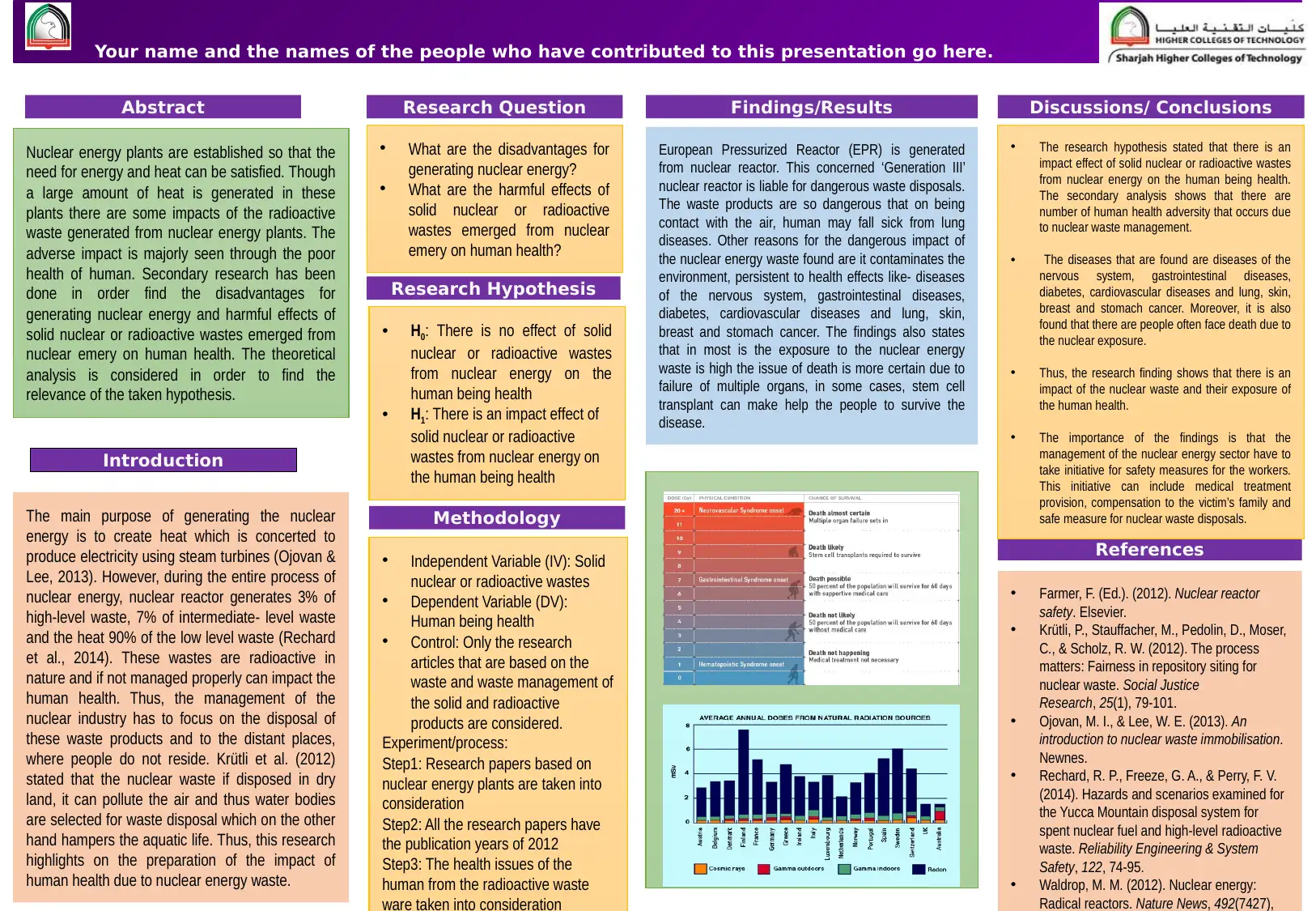
European Pressurized Reactor (EPR) is generated
from nuclear reactor. This concerned ‘Generation III’
nuclear reactor is liable for dangerous waste disposals.
The waste products are so dangerous that on being
contact with the air, human may fall sick from lung
diseases. Other reasons for the dangerous impact of
the nuclear energy waste found are it contaminates the
environment, persistent to health effects like- diseases
of the nervous system, gastrointestinal diseases,
diabetes, cardiovascular diseases and lung, skin,
breast and stomach cancer. The findings also states
that in most is the exposure to the nuclear energy
waste is high the issue of death is more certain due to
failure of multiple organs, in some cases, stem cell
transplant can make help the people to survive the
disease.
References
Farmer, F. (Ed.). (2012). Nuclear reactor
safety. Elsevier.
Krütli, P., Stauffacher, M., Pedolin, D., Moser,
C., & Scholz, R. W. (2012). The process
matters: Fairness in repository siting for
nuclear waste. Social Justice
Research, 25(1), 79-101.
Ojovan, M. I., & Lee, W. E. (2013). An
introduction to nuclear waste immobilisation.
Newnes.
Rechard, R. P., Freeze, G. A., & Perry, F. V.
(2014). Hazards and scenarios examined for
the Yucca Mountain disposal system for
spent nuclear fuel and high-level radioactive
waste. Reliability Engineering & System
Safety, 122, 74-95.
Waldrop, M. M. (2012). Nuclear energy:
Radical reactors. Nature News, 492(7427),
The research hypothesis stated that there is an
impact effect of solid nuclear or radioactive wastes
from nuclear energy on the human being health.
The secondary analysis shows that there are
number of human health adversity that occurs due
to nuclear waste management.
The diseases that are found are diseases of the
nervous system, gastrointestinal diseases,
diabetes, cardiovascular diseases and lung, skin,
breast and stomach cancer. Moreover, it is also
found that there are people often face death due to
the nuclear exposure.
Thus, the research finding shows that there is an
impact of the nuclear waste and their exposure of
the human health.
The importance of the findings is that the
management of the nuclear energy sector have to
take initiative for safety measures for the workers.
This initiative can include medical treatment
provision, compensation to the victim’s family and
safe measure for nuclear waste disposals.
Discussions/ Conclusions
Your name and the names of the people who have contributed to this presentation go here.
Independent Variable (IV): Solid
nuclear or radioactive wastes
Dependent Variable (DV):
Human being health
Control: Only the research
articles that are based on the
waste and waste management of
the solid and radioactive
products are considered.
Experiment/process:
Step1: Research papers based on
nuclear energy plants are taken into
consideration
Step2: All the research papers have
the publication years of 2012
Step3: The health issues of the
human from the radioactive waste
ware taken into consideration
Research Question
What are the disadvantages for
generating nuclear energy?
What are the harmful effects of
solid nuclear or radioactive
wastes emerged from nuclear
emery on human health?
Research Hypothesis
H0: There is no effect of solid
nuclear or radioactive wastes
from nuclear energy on the
human being health
H1: There is an impact effect of
solid nuclear or radioactive
wastes from nuclear energy on
the human being health
tabler-icon-diamond-filled.svg

Paraphrase This Document

Need a fresh take? Get an instant paraphrase of this document with our AI Paraphraser
[object Object]